Japan Aerospace Actuation Market Size & Growth Rate
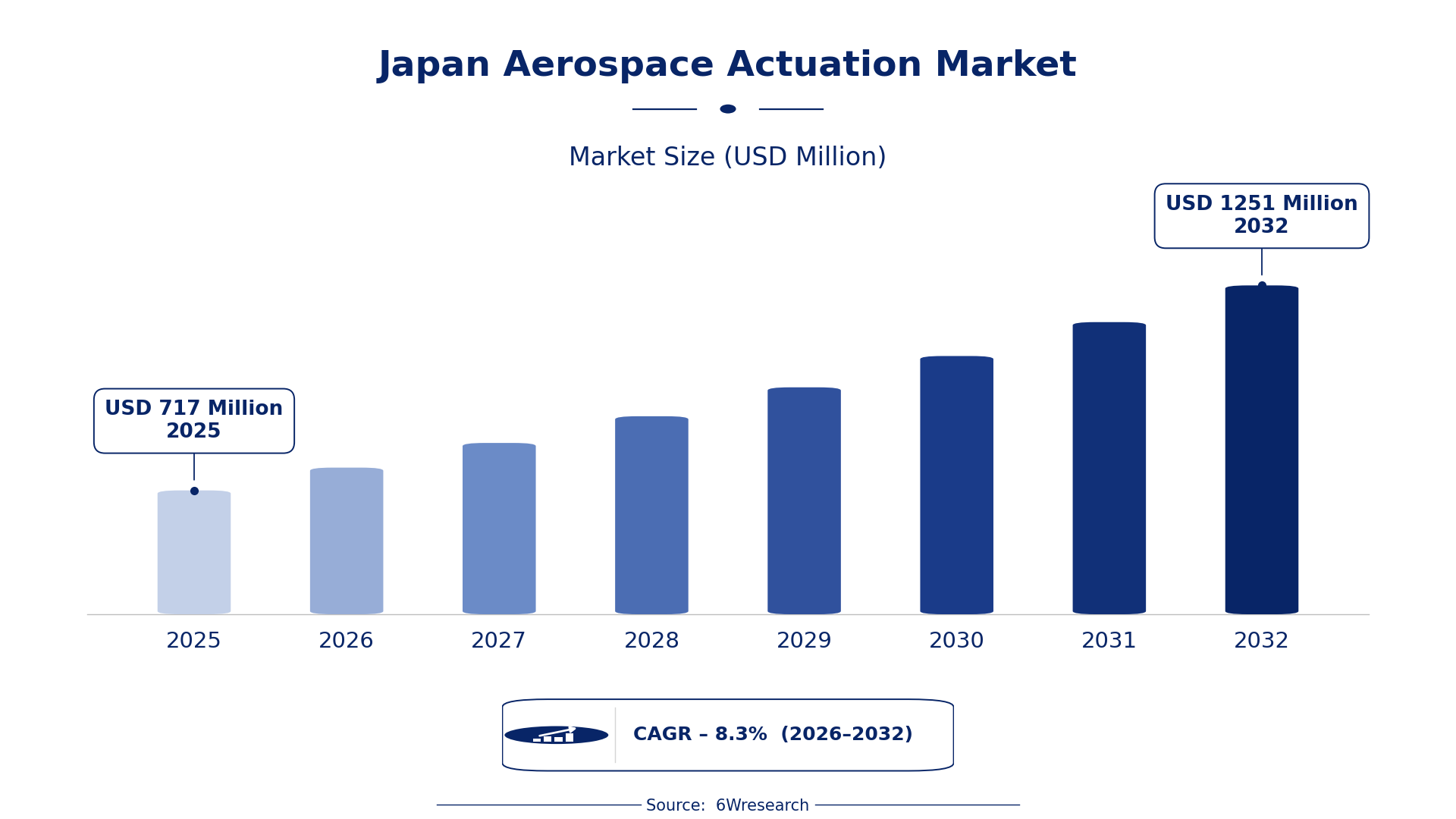
According to 6Wresearch internal database and industry insights, the Japan Aerospace Actuation Market was valued at USD 717 Million in 2025 and is projected to reach USD 1,251 Million by 2032, growing at a CAGR of approximately 8.3% during 2026–2032.
Japan Aerospace Actuation Market Highlights
| Report Metric | Details |
| Report Name | Japan Aerospace Actuation Market (2026-2032) |
| Market Size 2025 | USD 717 Million |
| Market Size 2032 | USD 1,251 Million |
| Absolute Growth 2025–2032 | USD 534 Million |
| CAGR 2026–2032 | 8.3% |
| Peak Annual Growth | 9.0% in 2027 |
| Forecast Period | 2026–2032 |
| Historical Data | 2022–2025 |
| Base Year | 2025 |
| Leading Product Type, 2025 | Linear Actuators (46% share) |
| Leading Actuation Mechanism, 2025 | Electric (48% share) |
| Leading Application Area, 2025 | Landing Gear Systems (36% share) |
| Leading Distribution Channel, 2025 | OEMs (39% share) |
| Leading End User, 2025 | Aircraft Manufacturers (46% share) |
| Fastest-Growing Product Type | Rotary Actuators (11.3% CAGR) |
| Fastest-Growing Actuation Mechanism | Hydraulic (10.6% CAGR) |
| Fastest-Growing Application Area | Wing Control Surfaces (9.8% CAGR) |
| Fastest-Growing Distribution Channel | Government Contracts (10.1% CAGR) |
| Fastest-Growing End User | Military Aerospace (10.4% CAGR) |
| Growing Sector | Wing Control Surfaces |
| Key End Users | Landing Gear Systems, Wing Control Surfaces, Braking Systems, Seat & Cargo Systems |
Japan Aerospace Actuation Market Year-wise Growth Rate and Key Drivers (2022–2032)
This graph illustrates the annual growth rates of the market from 2022 to 2032, highlighting a steady upward trajectory and projected market expansion over the forecast period.
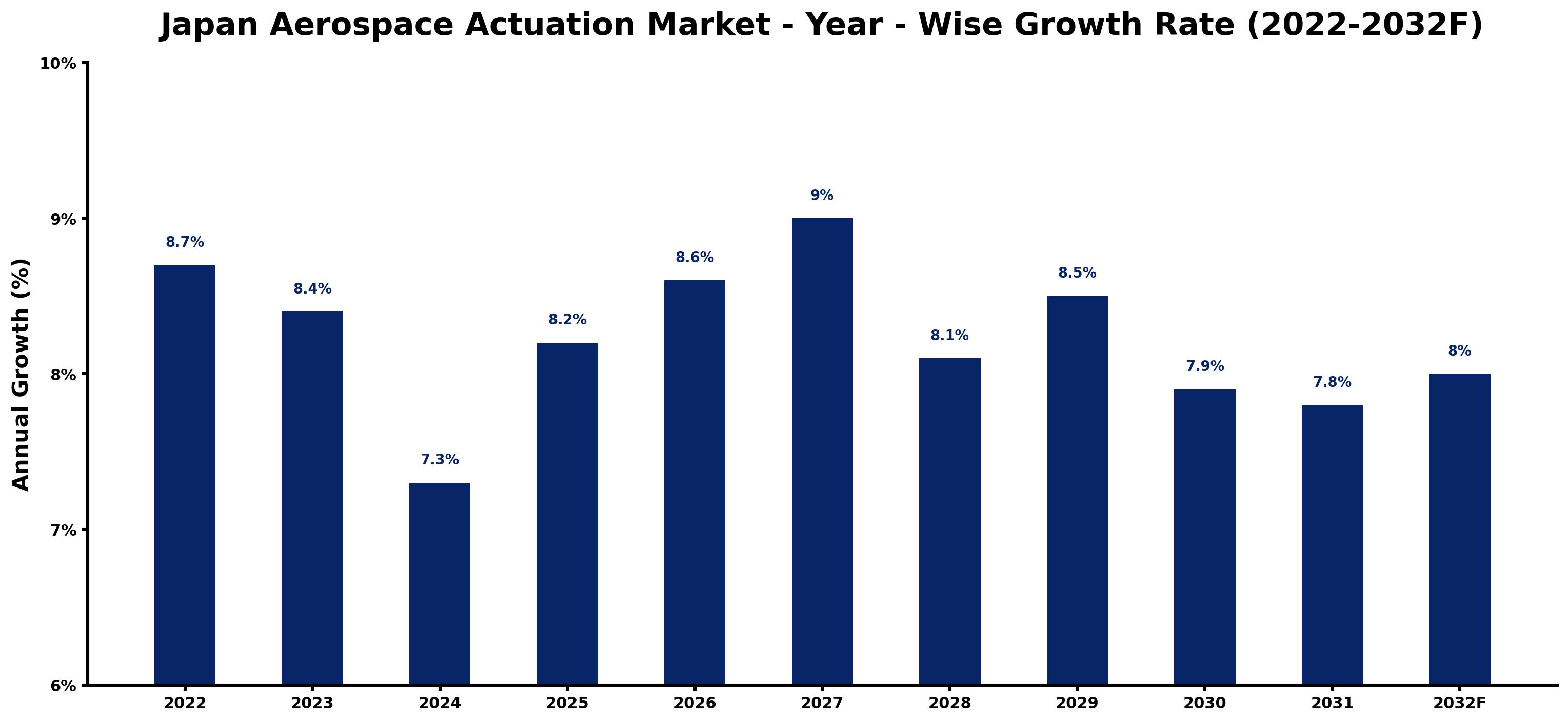
Below, each year's estimated growth is shown next to the factor that most influenced it.
| Year | Estimated Annual Growth (%) | Market Rationale |
| 2022 | 8.7 | The market experienced strong demand from military aerospace applications and commercial aircraft production. |
| 2023 | 8.4 | Growth slowed due to a temporary dip in domestic aircraft manufacturing activity. |
| 2024 | 7.3 | The market continued to grow, although at a slower pace as manufacturers adjusted to market conditions. |
| 2025 | 8.2 | Demand increased as Japan aimed for a 15% rise in domestic aircraft production by 2025. |
| 2026 | 8.6 | Investment in aerospace technology is expected to drive further growth in actuation systems. |
| 2027 | 9.0 | The market is projected to peak as military contracts and commercial aviation expand. |
| 2028 | 8.1 | Growth is anticipated to slow as the market stabilises after reaching peak demand. |
| 2029 | 8.5 | A rebound in commercial aviation is expected to accelerate growth once again. |
| 2030 | 7.9 | The market is projected to slow as manufacturers face capacity constraints and rising costs. |
| 2031 | 7.8 | Growth is expected to decelerate as the market adjusts to new production levels. |
| 2032 | 8.0 | An increase in military aerospace spending is expected to support growth in the actuation market. |
Note: Market size estimations and growth projections presented in this report are based on 6Wresearch's proprietary forecasting methodology, utilizing the latest available industry data, government publications, and primary research inputs.
Japan Aerospace Actuation Market Synopsis
Aerospace actuation systems control the movement of aircraft components using electric, hydraulic, and pneumatic technologies. In 2022, Japan produced 20 commercial aircraft, reflecting strong demand. Growth in the Japan Aerospace Actuation Market stems from rising domestic aircraft production, military aerospace applications, and investments in aerospace technology, which are expected to stimulate purchasing activity across the sector.
Market Dynamics Impact Analysis (2026–2032)
| Factor | Type | Impact | Primary Segment Affected |
| Rising military aerospace spending | Driver | High | Military Aerospace |
| Increasing domestic aircraft production | Driver | High | Commercial Aviation |
| Growing demand for efficient actuation systems | Opportunity | High | Commercial Aviation |
| Expansion of aerospace manufacturing capabilities | Opportunity | Medium | Aircraft Manufacturers |
| Capacity constraints in manufacturing | Restraint | High | Linear Actuators |
| Fluctuations in raw material costs | Restraint | Medium | Linear Actuators |
| Competition from international suppliers | Challenge | High | Linear Actuators |
| Technological advancements requiring upgrades | Challenge | Medium | Linear Actuators |
Evaluation of Drivers in Japan Aerospace Actuation Market (2026–2032)
The main growth drivers and the segments they affect most are set out below.
| Drivers | Primary Segment Affected | Why It Matters (Evidence) |
| Increased military contracts | Military Aerospace | The ¥5 trillion budget from the Ministry of Defense boosts demand for advanced actuation technologies. |
| Growing commercial aircraft production | Commercial Aviation | Japan's aim to increase domestic aircraft production by 15% by 2025 drives demand for efficient systems. |
| Investment in aerospace technology | Aircraft Manufacturers | The Tokyo region's focus on aerospace innovation supports the development of advanced actuation systems. |
| Expansion of landing gear systems | Landing Gear Systems | The critical role of landing gear in safety leads to ongoing investments in this area. |
| Adoption of ISO 9001 standards | Linear Actuators | The widespread adoption of quality standards improves product reliability and boosts buyer confidence. |
Several shifts outside the market lift sales. The Tokyo region's focus on aerospace innovation has led to a 15% increase in domestic aircraft production by 2025, driving demand for actuation systems. The aerospace sector's strong performance is reflected in Japan's aerospace exports, which reached ¥1.2 trillion in 2023. The adoption of ISO 9001 standards ensures quality across production, increasing buyer confidence and driving purchases. Investment in advanced technologies is crucial as manufacturers adapt to evolving market demands, further enhancing the growth of actuation systems.
Evaluation of Restraints in Japan Aerospace Actuation Market
These restraints slow adoption and weigh on supplier margins.
| Market Restraint | Primary Segment Affected | Why It Matters (Evidence) |
| Shortage of skilled engineers | Linear Actuators | This shortage limits production capabilities, leading to delays in project timelines for manufacturers. |
| Supply chain disruptions | Linear Actuators | Disruptions for high-quality materials can delay production schedules, forcing buyers to wait longer for components. |
| Increased competition from international markets | Linear Actuators | Local producers face pressure to lower prices, which can reduce profit margins. |
| Rapid technological advancements | Linear Actuators | Producers must invest constantly to keep up with evolving standards, straining budgets. |
| Rising production costs | Linear Actuators | Manufacturers are facing higher costs, which can limit their ability to invest in new technologies. |
Japan Aerospace Actuation Market Challenges
Japan's aerospace actuation systems struggle with a shortage of skilled engineers, limiting production capabilities for manufacturers. This shortage arises from an ageing workforce, causing delays in project timelines that impact buyers relying on timely deliveries. Increased competition from international markets forces local producers to lower prices, resulting in profit margins shrinking by up to 20%. Supply chain disruptions for high-quality materials lead to production delays, forcing buyers to wait an average of three months longer for critical components. Rapid technological advancements necessitate constant investment, straining budgets for producers who must adapt to evolving standards.
Trends in the Japan Aerospace Actuation Market
The trends below show where the Japan Aerospace Actuation Market is heading.
- Shift from Hydraulic to Electric Actuation: The Tokyo region is experiencing a shift towards electric actuation systems, recognised for their efficiency and reliability. In 2023, electric actuation systems accounted for 48% of the market, indicating a growing preference among manufacturers.
- Transition to Advanced Landing Gear Systems: Since 2022, there has been a transition towards advanced landing gear systems, improving safety and performance. The focus on these systems has resulted in a 36% market share by 2025, showcasing strong demand.
- Emergence of Military Aerospace Investments: Military aerospace is developing as a key growth area, with a projected 10.4% CAGR from 2026 to 2032. The budget allocation supports this trend, encouraging innovation in actuation technologies.
- Prioritisation of Quality Standards: The adoption of ISO 9001 standards is emphasised in aerospace manufacturing, ensuring product reliability. This trend is apparent as manufacturers increasingly prioritise quality, boosting buyer confidence.
Investment Opportunities in the Japan Aerospace Actuation Market
Below are the investment opportunities with the strongest case in the Japan Aerospace Actuation Market.
- Investment in Electric Actuation Systems: With a projected 15% increase in domestic aircraft production by 2025, there is a notable opportunity to invest in electric actuation systems. Aircraft manufacturers in the Tokyo region are particularly in need of these technologies.
- Expansion of Military Aerospace Contracts: The military aerospace sector is set for growth, with the ¥5 trillion budget providing a strong investment opportunity. Collaborating with local manufacturers can facilitate entry into this market.
- Development of Advanced Landing Gear Systems: The need for advanced landing gear systems presents a lucrative opportunity, especially with a 36% market share projected for 2025. Suppliers can target aircraft manufacturers to meet this demand.
- Enhancement of Quality Standards: The growing emphasis on ISO 9001 standards offers an opportunity for suppliers to enhance product reliability. Engaging with manufacturers to ensure compliance can open new market avenues.
Government Initiatives in the Japan Aerospace Actuation Market
The New Robot Strategy (2015) promotes the integration of robotics in manufacturing, which improves the production capabilities of aerospace actuation systems. This strategy complements existing laws like the Electrical Appliance and Material Safety Act (1961), which regulates safety standards in electrical components used in aerospace applications.
The Japan Aerospace Exploration Agency oversees space-related aerospace projects, providing funding and support for innovative technologies. This agency collaborates with aircraft manufacturers to ensure compliance with safety standards and promote advancements in actuation systems.
Future Insight of the Japan Aerospace Actuation Market
By 2032, Japan's aerospace actuation market will experience a surge in investment driven by the Ministry of Defense's ¥5 trillion budget for military projects and the Tokyo Metropolitan Government's commitment to technology innovation. This investment will generate demand for advanced actuation systems in military and commercial applications. The Japan Aerospace Association will improve collaboration among industry players, enhancing production efficiency. With Japan's aerospace exports reaching ¥1.2 trillion in 2023, the market is likely to attract further international partnerships, expanding opportunities for both buyers and suppliers.
Market Segmentation Analysis
Japan Aerospace Actuation Market report covers a detailed analysis of the following market segments:
By Product Type – Linear Actuators Lead, Rotary Actuators Expected to Grow Fastest
According to Saurav Kr Singh, Senior Research Analyst at 6Wresearch, the largest product type category in 2025 was Linear Actuators, at 46% of revenue. Linear actuators dominate the market as they are vital for the precise control of aircraft components, ensuring safety and operational efficiency. Their widespread use in aircraft manufactured in regions like Tokyo solidifies their leading position. Rotary Actuators are projected to grow fastest, at a CAGR of 11.3% during 2026–2032. Rotary actuators are experiencing rapid growth due to their importance in moving essential parts such as flaps and rudders, which are crucial for aircraft manoeuvrability. The push for improved aircraft performance continues to drive this demand. Suppliers should prioritise advancements in rotary actuator technology to leverage emerging market opportunities.
By Actuation Mechanism – Electric Leads, Hydraulic Expected to Grow Fastest
With 48% of actuation mechanism revenue in 2025, Electric was the largest category. Electric actuation mechanisms lead the market as they are the dominant choice in modern aircraft, offering reliability and efficiency. Their adoption aligns with the industry's shift towards more electric aircraft designs, particularly in the Tokyo region. Hydraulic is set to record the highest CAGR in this split, 10.6% over 2026–2032. Hydraulic mechanisms are growing quickly due to their traditional use in high-force applications, which remain essential for many military aerospace projects. The continued investment in military capabilities supports this segment's expansion. Buyers may benefit from exploring partnerships with suppliers who specialise in hydraulic technologies to meet demanding performance requirements.
By Application Area – Landing Gear Systems Lead, Wing Control Surfaces Expected to Grow Fastest
Landing Gear Systems accounted for 36% of the market by application area in 2025. Landing gear systems command the largest share as they are vital for ensuring aircraft safety and functionality, with a direct impact on operational readiness. Their critical role is highlighted by the stringent safety regulations imposed by aviation authorities in Japan. Over 2026–2032, Wing Control Surfaces are expected to post the fastest growth, at a CAGR of 9.8%. Wing control surfaces are experiencing the fastest growth as they are essential for improving aerodynamic performance, particularly with recent advancements in aircraft design. The drive for more efficient flight profiles is accelerating this segment's expansion. Suppliers should prioritise the development of advanced solutions for wing control surfaces to meet the increasing demands of aircraft manufacturers.
By Distribution Channel – OEMs Lead, Government Contracts Expected to Grow Fastest
OEMs took 39% of distribution channel revenue in 2025, more than any other category. OEMs serve as the main distribution channel, playing a critical role in manufacturing and supplying essential components directly to aircraft manufacturers. Their strong relationships with major manufacturers ensure a steady demand for actuation systems. The quickest growth will come from Government Contracts, forecast to expand at a CAGR of 10.1% between 2026 and 2032. Government contracts are rapidly gaining traction as a key source of demand for military applications, supported by substantial defence budgets. This trend highlights the increasing focus on military aerospace initiatives in Japan. Suppliers need to develop strategies to engage with government agencies to secure contracts in the military aerospace domain.
By End User – Aircraft Manufacturers Lead, Military Aerospace Expected to Grow Fastest
In 2025, Aircraft Manufacturers led the end user split with a 46% share. Aircraft manufacturers are the largest user group of actuation systems, significantly influencing the market's leading share due to their role in producing military and commercial aircraft. Their continuous production efforts are essential for sustaining market stability. Military Aerospace is projected to grow fastest, at a CAGR of 10.4% during 2026–2032. Military aerospace is the fastest-growing segment as it represents a major consumer of advanced actuation technologies, especially with rising defence budgets. The focus on enhancing military capabilities propels this growth. Suppliers should align their product development with the specific needs of military aerospace to capitalise on this expanding market.
Key Attractiveness of the Report
- 10 Years of Market Numbers
- Historical Data Starting from 2022 to 2025
- Base Year 2025
- Forecast Data until 2032
- Key Performance Indicators Impacting the Market
- Major Upcoming Developments and Projects
Key Highlights of the Report:
- Japan Aerospace Actuation Market Outlook
- Market Size of Japan Aerospace Actuation Market, 2025
- Forecast of Japan Aerospace Actuation Market, 2032
- Historical Data and Forecast of Japan Aerospace Actuation Revenues & Volume for the Period 2022-2032F
- Japan Aerospace Actuation Market Trend Evolution
- Japan Aerospace Actuation Market Drivers and Challenges
- Japan Aerospace Actuation Price Trends
- Japan Aerospace Actuation Porter's Five Forces
- Japan Aerospace Actuation Industry Life Cycle
- Historical Data and Forecast of Japan Aerospace Actuation Market Revenues & Volume By Product Type for the Period 2022-2032F
- Historical Data and Forecast of Japan Aerospace Actuation Market Revenues & Volume By Linear Actuators for the Period 2022-2032F
- Historical Data and Forecast of Japan Aerospace Actuation Market Revenues & Volume By Rotary Actuators for the Period 2022-2032F
- Historical Data and Forecast of Japan Aerospace Actuation Market Revenues & Volume By Electro-Mechanical Actuators for the Period 2022-2032F
- Historical Data and Forecast of Japan Aerospace Actuation Market Revenues & Volume By Pneumatic Actuators for the Period 2022-2032F
- Historical Data and Forecast of Japan Aerospace Actuation Market Revenues & Volume By Actuation Mechanism for the Period 2022-2032F
- Historical Data and Forecast of Japan Aerospace Actuation Market Revenues & Volume By Electric for the Period 2022-2032F
- Historical Data and Forecast of Japan Aerospace Actuation Market Revenues & Volume By Hydraulic for the Period 2022-2032F
- Historical Data and Forecast of Japan Aerospace Actuation Market Revenues & Volume By Servo-Driven for the Period 2022-2032F
- Historical Data and Forecast of Japan Aerospace Actuation Market Revenues & Volume By Air-Driven for the Period 2022-2032F
- Historical Data and Forecast of Japan Aerospace Actuation Market Revenues & Volume By Application Area for the Period 2022-2032F
- Historical Data and Forecast of Japan Aerospace Actuation Market Revenues & Volume By Landing Gear Systems for the Period 2022-2032F
- Historical Data and Forecast of Japan Aerospace Actuation Market Revenues & Volume By Wing Control Surfaces for the Period 2022-2032F
- Historical Data and Forecast of Japan Aerospace Actuation Market Revenues & Volume By Braking Systems for the Period 2022-2032F
- Historical Data and Forecast of Japan Aerospace Actuation Market Revenues & Volume By Seat & Cargo Systems for the Period 2022-2032F
- Historical Data and Forecast of Japan Aerospace Actuation Market Revenues & Volume By Distribution Channel for the Period 2022-2032F
- Historical Data and Forecast of Japan Aerospace Actuation Market Revenues & Volume By OEMs for the Period 2022-2032F
- Historical Data and Forecast of Japan Aerospace Actuation Market Revenues & Volume By Government Contracts for the Period 2022-2032F
- Historical Data and Forecast of Japan Aerospace Actuation Market Revenues & Volume By Direct Sales for the Period 2022-2032F
- Historical Data and Forecast of Japan Aerospace Actuation Market Revenues & Volume By Industrial Suppliers for the Period 2022-2032F
- Historical Data and Forecast of Japan Aerospace Actuation Market Revenues & Volume By End User for the Period 2022-2032F
- Historical Data and Forecast of Japan Aerospace Actuation Market Revenues & Volume By Aircraft Manufacturers for the Period 2022-2032F
- Historical Data and Forecast of Japan Aerospace Actuation Market Revenues & Volume By Military Aerospace for the Period 2022-2032F
- Historical Data and Forecast of Japan Aerospace Actuation Market Revenues & Volume By Commercial Aviation for the Period 2022-2032F
- Historical Data and Forecast of Japan Aerospace Actuation Market Revenues & Volume By Business Jet Operators for the Period 2022-2032F
- Japan Aerospace Actuation Import Export Trade Statistics
- Market Opportunity Assessment By Product Type
- Market Opportunity Assessment By Actuation Mechanism
- Market Opportunity Assessment By Application Area
- Market Opportunity Assessment By Distribution Channel
- Market Opportunity Assessment By End User
- Japan Aerospace Actuation Top Companies Market Share
- Japan Aerospace Actuation Competitive Benchmarking By Technical and Operational Parameters
- Japan Aerospace Actuation Company Profiles
- Japan Aerospace Actuation Key Strategic Recommendations
Market Covered
The report covers the following segments.
By Product Type
- Linear Actuators
- Rotary Actuators
- Electro-Mechanical Actuators
- Pneumatic Actuators
By Actuation Mechanism
- Electric
- Hydraulic
- Servo-Driven
- Air-Driven
By Application Area
- Landing Gear Systems
- Wing Control Surfaces
- Braking Systems
- Seat & Cargo Systems
By Distribution Channel
- OEMs
- Government Contracts
- Direct Sales
- Industrial Suppliers
By End User
- Aircraft Manufacturers
- Military Aerospace
- Commercial Aviation
- Business Jet Operators































