Japan Aerospace Assembly Hardware Market Size & Growth Rate
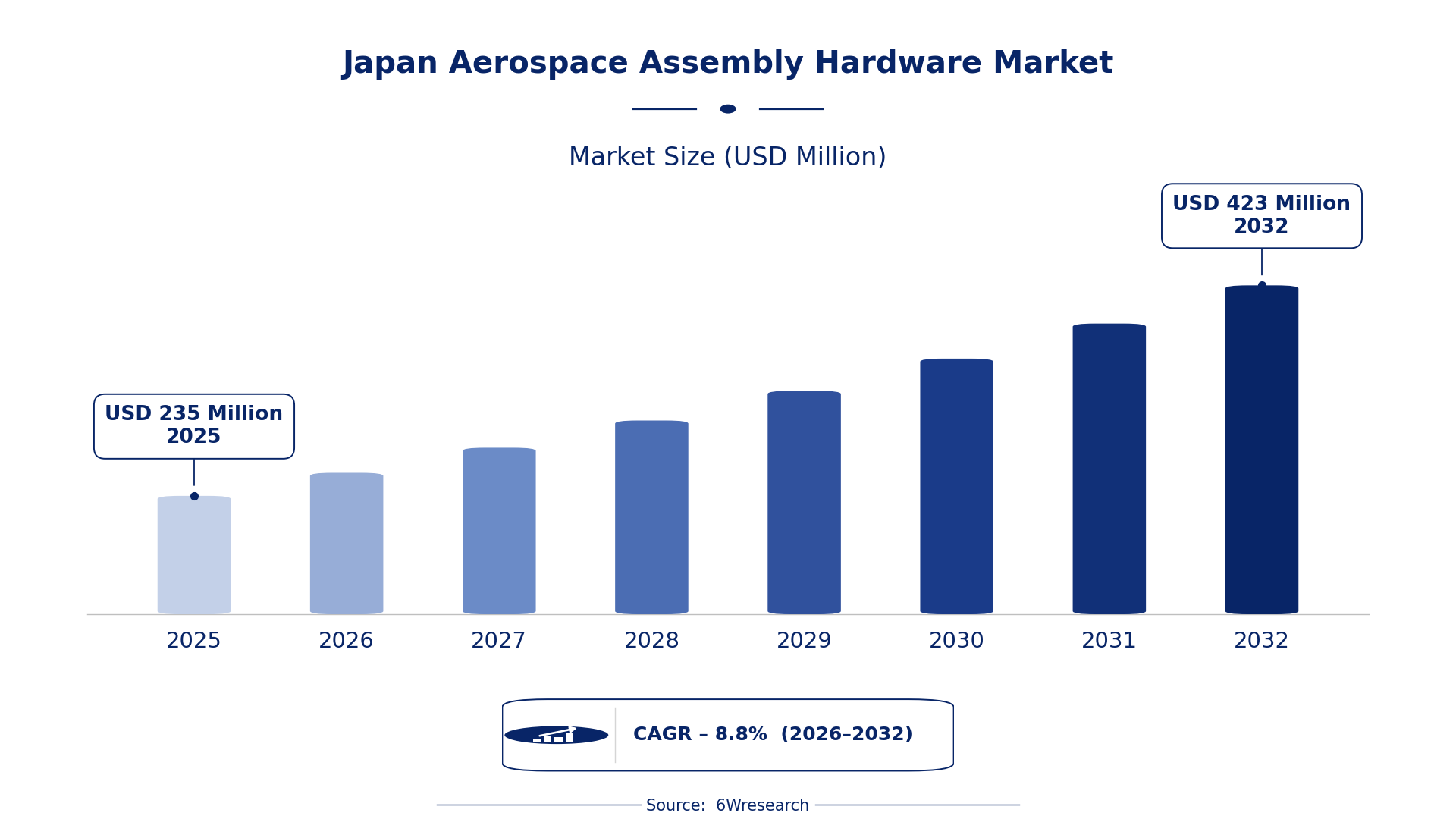
According to 6Wresearch internal database and industry insights, the Japan Aerospace Assembly Hardware Market was valued at USD 235 Million in 2025 and is projected to reach USD 423 Million by 2032, growing at a CAGR of approximately 8.8% during 2026–2032.
Japan Aerospace Assembly Hardware Market Highlights
| Report Metric | Details |
| Report Name | Japan Aerospace Assembly Hardware Market (2026-2032) |
| Market Size 2025 | USD 235 Million |
| Market Size 2032 | USD 423 Million |
| Absolute Growth 2025–2032 | USD 188 Million |
| CAGR 2026–2032 | 8.8% |
| Peak Annual Growth | 9.8% in 2032 |
| Forecast Period | 2026–2032 |
| Historical Data | 2022–2025 |
| Base Year | 2025 |
| Leading Hardware Type, 2025 | Fasteners (50% share) |
| Leading Material Type, 2025 | Stainless Steel (45% share) |
| Leading Distribution Channel, 2025 | Industrial Suppliers (42% share) |
| Leading End User, 2025 | MRO Facilities (49% share) |
| Fastest-Growing Hardware Type | Rivets (12.5% CAGR) |
| Fastest-Growing Material Type | Aluminum (12.4% CAGR) |
| Fastest-Growing Distribution Channel | Direct Sales (11.7% CAGR) |
| Fastest-Growing End User | Aircraft Assemblers (11.4% CAGR) |
| Growing Sector | Aerospace Manufacturing |
| Key End Users | MRO Facilities, Aerospace Manufacturing Units, Aircraft Assemblers |
Japan Aerospace Assembly Hardware Market Year-wise Growth Rate and Key Drivers (2022–2032)
This graph illustrates the annual growth rates of the market from 2022 to 2032, highlighting a steady upward trajectory and projected market expansion over the forecast period.
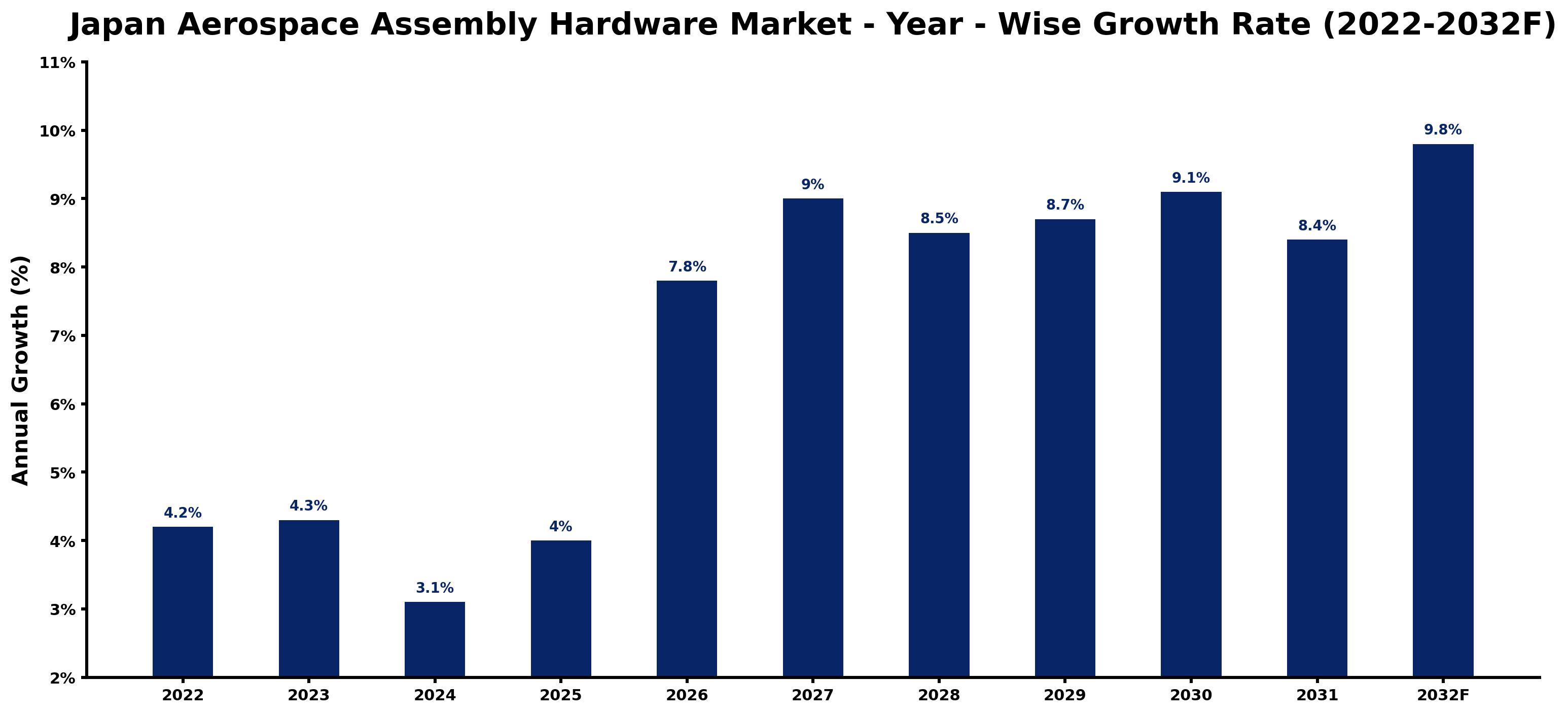
For each year, the table pairs the estimated growth rate with the leading influence on demand, showing how the drivers changed across the period.
| Year | Estimated Annual Growth (%) | Market Rationale |
| 2022 | 4.2 | The market exhibited steady growth due to ongoing aerospace projects and production activities. |
| 2023 | 4.3 | Demand increased as Japan produced 200 commercial aircraft, reflecting a strong manufacturing base. |
| 2024 | 3.1 | Growth slowed as some projects faced delays, yet the market maintained positive momentum. |
| 2025 | 4.0 | The market rebounded with renewed investments in aerospace manufacturing and MRO facilities. |
| 2026 | 7.8 | Growth is expected to accelerate as new aerospace innovation programmes are launched to boost production. |
| 2027 | 9.0 | Demand is projected to rise, driven by increased aircraft assembly and maintenance activities. |
| 2028 | 8.5 | Growth will decelerate slightly as the market adjusts to higher production rates and capacities. |
| 2029 | 8.7 | Demand is expected to increase again, supported by expanding aerospace manufacturing in the Tokyo region. |
| 2030 | 9.1 | The market will continue to grow as technological advancements in materials gain traction. |
| 2031 | 8.4 | Growth is projected to slow as the market stabilises after rapid expansion in previous years. |
| 2032 | 9.8 | The peak growth year is driven by strong demand from MRO facilities and aircraft assemblers. |
Note: Market size estimations and growth projections presented in this report are based on 6Wresearch's proprietary forecasting methodology, utilizing the latest available industry data, government publications, and primary research inputs.
Japan Aerospace Assembly Hardware Market Synopsis
Aerospace assembly hardware consists of components such as fasteners, rivets, clamps, and pins made from materials like stainless steel and titanium, which are vital for aircraft construction and maintenance. The Japan Aerospace Assembly Hardware Market is expanding due to increased production of commercial aircraft, supported by a workforce of over 80,000 in the aerospace sector. New aerospace innovation programmes and a focus on advanced materials are driving demand, positioning the market for substantial growth in the coming years.
Market Dynamics Impact Analysis (2026–2032)
| Factor | Type | Impact | Primary Segment Affected |
| Rising production of commercial aircraft | Driver | High | Fasteners |
| Increased demand for maintenance services | Driver | High | MRO Facilities |
| Technological advancements in materials | Opportunity | Medium | Titanium |
| Expansion of aerospace manufacturing hubs | Opportunity | High | Aerospace Manufacturing Units |
| Supply chain disruptions affecting material availability | Restraint | High | Aluminum |
| Regulatory compliance costs impacting production | Restraint | Medium | Alloy Steel |
| Competition from international suppliers | Challenge | High | Industrial Suppliers |
| Fluctuations in raw material prices | Challenge | Medium | Fasteners |
Evaluation of Drivers in Japan Aerospace Assembly Hardware Market (2026–2032)
The following drivers explain most of the expected growth.
| Drivers | Primary Segment Affected | Why It Matters (Evidence) |
| Increased aircraft production | Fasteners | Japan produced 200 commercial aircraft in 2022, driving demand for essential fastening components. |
| Growing MRO activities | MRO Facilities | MRO facilities service over 300 aircraft annually, increasing the need for assembly hardware. |
| Rising adoption of advanced materials | Titanium | The strong focus on titanium improves hardware performance, prompting manufacturers to source more. |
| Implementation of new aerospace programmes | Aerospace Manufacturing Units | New initiatives stimulate hardware demand and improve production capabilities. |
| Expansion of industrial suppliers | Industrial Suppliers | The Tokyo region serves as a hub for aerospace manufacturing, boosting local supplier networks. |
Volumes grow on the back of increased aircraft production, with Japan producing 200 commercial aircraft in 2022, leading to heightened demand for fasteners. MRO facilities servicing over 300 aircraft annually also drive the need for assembly hardware. The focus on advanced materials like titanium improves performance, prompting manufacturers to seek these components.
Evaluation of Restraints in Japan Aerospace Assembly Hardware Market
Below are the constraints most often cited by buyers and suppliers, with the segment each affects.
| Market Restraint | Primary Segment Affected | Why It Matters (Evidence) |
| Supply chain disruptions affecting material availability | Aluminum | Disruptions in the supply chain have limited the availability of aluminum, essential for aircraft structures. |
| Regulatory compliance costs impacting production | Alloy Steel | Compliance with safety regulations increases production costs for alloy steel components. |
| Competition from international suppliers | Industrial Suppliers | Domestic suppliers face challenges from international competitors offering lower prices. |
| Fluctuations in raw material prices | Fasteners | Volatility in raw material prices affects the cost structure of fasteners. |
| Market dependency on aerospace production cycles | MRO Facilities | MRO facilities' operations are closely tied to the aerospace production cycle, affecting demand. |
Japan Aerospace Assembly Hardware Market Challenges
Buyers in the aerospace sector encounter a shortage of skilled workers, as the current workforce lacks training in advanced manufacturing techniques, resulting in project delays that can extend up to six months. Suppliers face rising raw material costs, particularly for titanium, which can inflate prices by as much as 15%, disrupting budgets for manufacturers. Increased competition from international firms has compelled local suppliers to adopt aggressive pricing strategies, eroding profit margins and threatening their sustainability. Regulatory changes, such as stricter compliance with ISO 9001 standards, require additional investments from suppliers, delaying product launches and increasing expenses for buyers.
Trends in the Japan Aerospace Assembly Hardware Market
Below are the shifts with the largest effect on the Japan Aerospace Assembly Hardware Market.
- Shift towards Advanced Materials: Japan is increasingly adopting advanced materials like titanium in aerospace assembly hardware, improving performance. In 2023, the government launched a new aerospace innovation programme to support this shift, aiming for a 20% increase in aerospace exports by 2025.
- Growing Importance of MRO Facilities: MRO facilities are becoming more critical as they service over 300 aircraft annually, driving demand for assembly hardware. This trend is clear in the Tokyo region, where aerospace manufacturing is concentrated.
- Transition from Traditional to Digital Procurement: Aerospace manufacturers are moving towards digital procurement platforms, improving efficiency in sourcing hardware. This shift is reflected in the rise of online platforms, which are becoming increasingly significant in the market.
- Emphasis on Sustainability in Aerospace: Sustainability is gaining traction in aerospace manufacturing, with a focus on energy-efficient practices. The Act on the Rational Use of Energy obliges large energy users to report energy use, promoting greener operations.
Investment Opportunities in the Japan Aerospace Assembly Hardware Market
Investors looking at the Japan Aerospace Assembly Hardware Market should consider the following areas.
- Investment in Advanced Materials: There is a growing opportunity to supply advanced materials like titanium, with a focus on high-performance applications. MRO facilities are increasingly demanding these materials to improve aircraft safety.
- Expansion of Aerospace Manufacturing Units: The Tokyo region is expanding its aerospace manufacturing units, creating a need for assembly hardware. Suppliers can enter this market by partnering with local manufacturers.
- Growing Demand from Aircraft Assemblers: Aircraft assemblers are seeking reliable sources of assembly hardware, especially fasteners. With the market projected to grow, suppliers can target this segment by establishing local partnerships.
- Increased Focus on MRO Services: The MRO sector is set for growth, with over 300 aircraft serviced annually. Suppliers can invest in this area by providing tailored hardware solutions to meet specific maintenance needs.
Government Initiatives in the Japan Aerospace Assembly Hardware Market
The Economic Security Promotion Act of 2022 strengthens supply-chain resilience for critical aerospace materials, building on previous regulations. This act requires manufacturers to ensure a steady supply of essential components, thus supporting the aerospace assembly hardware market.
The Ministry of Economy, Trade and Industry (METI) oversees the approval of energy efficiency measures under the Act on the Rational Use of Energy. This act mandates large energy users to improve energy efficiency, impacting production practices in aerospace manufacturing.
Future Insight of the Japan Aerospace Assembly Hardware Market
Investment in aerospace assembly hardware will grow due to a new aerospace innovation program, creating demand for advanced materials like titanium. By 2032, the government's aim to increase aerospace exports by 20% by 2025 will necessitate high-performance components, benefiting both buyers and suppliers. Collaboration between the Japan Aerospace Exploration Agency and local manufacturers will improve process efficiency and innovation. MRO facilities will enhance their capabilities, servicing a growing number of aircraft, which will create further opportunities for suppliers.
Market Segmentation Analysis
Japan Aerospace Assembly Hardware Market report covers a detailed analysis of the following market segments:
By Hardware Type – Fasteners Lead, Rivets Expected to Grow Fastest
According to Saurav Kr Singh, Senior Research Analyst at 6Wresearch, Fasteners took 50% of hardware type revenue in 2025, more than any other category. Fasteners hold the largest share in the market due to their essential role in securing components within aircraft structures. Their widespread use in aerospace manufacturing, particularly in the Tokyo region, highlights their importance for safety and performance. The quickest growth will come from Rivets, forecast to expand at a CAGR of 12.5% between 2026 and 2032. Rivets are experiencing rapid growth because of their critical function in joining materials during aircraft construction. The production of 200 commercial aircraft in Japan in 2022 significantly increases the demand for rivets. Suppliers should focus on expanding their fastener offerings to meet the growing needs of the aerospace sector.
By Material Type – Stainless Steel Leads, Aluminum Expected to Grow Fastest
The largest material type category in 2025 was Stainless Steel, at 45% of revenue. Stainless steel dominates the market because of its corrosion resistance, making it ideal for aerospace applications. This material is extensively used in various components across Japan's aerospace industry, ensuring safety and durability. Over 2026–2032, Aluminum is expected to post the fastest growth, at a CAGR of 12.4%. Aluminum is growing quickly due to its lightweight properties, making it a preferred choice for modern aircraft designs. The focus on advanced materials in Japan's aerospace innovation program further fuels this trend. Buyers may benefit from exploring more aluminium options to reduce overall aircraft weight and improve fuel efficiency.
By Distribution Channel – Industrial Suppliers Lead, Direct Sales Expected to Grow Fastest
Industrial Suppliers accounted for 42% of the market by distribution channel in 2025. Industrial suppliers dominate the market as they serve as the primary source for aerospace hardware, providing a wide range of products. Their established networks and expertise are crucial for supporting manufacturers and maintenance facilities effectively. Direct Sales is projected to grow fastest, at a CAGR of 11.7% during 2026–2032. Direct sales are gaining traction as manufacturers look to build closer relationships with suppliers for more efficient procurement. This trend aligns with the ongoing growth of Japan's aerospace industry. Suppliers need to enhance their direct sales strategies to better connect with customers and fulfil their specific needs.
By End User – MRO Facilities Lead, Aircraft Assemblers Expected to Grow Fastest
With 49% of end user revenue in 2025, MRO Facilities was the largest category. MRO facilities are the largest consumers of aerospace assembly hardware, essential for maintaining over 300 aircraft annually in Japan. Their continuous demand creates a stable market for various hardware components. Aircraft Assemblers are set to record the highest CAGR in this split, 11.4% over 2026–2032. Aircraft assemblers are rapidly increasing their hardware consumption in response to the growth in aircraft production. The drive for more efficient assembly processes in Japan's aerospace industry fuels this trend. Suppliers should focus on building strong relationships with aircraft assemblers to take advantage of the rising demand for assembly hardware.
Key Attractiveness of the Report
- 10 Years of Market Numbers
- Historical Data Starting from 2022 to 2025
- Base Year 2025
- Forecast Data until 2032
- Key Performance Indicators Impacting the Market
- Major Upcoming Developments and Projects
Key Highlights of the Report:
- Japan Aerospace Assembly Hardware Market Outlook
- Market Size of Japan Aerospace Assembly Hardware Market, 2025
- Forecast of Japan Aerospace Assembly Hardware Market, 2032
- Historical Data and Forecast of Japan Aerospace Assembly Hardware Revenues & Volume for the Period 2022-2032F
- Japan Aerospace Assembly Hardware Market Trend Evolution
- Japan Aerospace Assembly Hardware Market Drivers and Challenges
- Japan Aerospace Assembly Hardware Price Trends
- Japan Aerospace Assembly Hardware Porter's Five Forces
- Japan Aerospace Assembly Hardware Industry Life Cycle
- Historical Data and Forecast of Japan Aerospace Assembly Hardware Market Revenues & Volume By Hardware Type for the Period 2022-2032F
- Historical Data and Forecast of Japan Aerospace Assembly Hardware Market Revenues & Volume By Fasteners for the Period 2022-2032F
- Historical Data and Forecast of Japan Aerospace Assembly Hardware Market Revenues & Volume By Rivets for the Period 2022-2032F
- Historical Data and Forecast of Japan Aerospace Assembly Hardware Market Revenues & Volume By Clamps for the Period 2022-2032F
- Historical Data and Forecast of Japan Aerospace Assembly Hardware Market Revenues & Volume By Pins & Bushings for the Period 2022-2032F
- Historical Data and Forecast of Japan Aerospace Assembly Hardware Market Revenues & Volume By Material Type for the Period 2022-2032F
- Historical Data and Forecast of Japan Aerospace Assembly Hardware Market Revenues & Volume By Stainless Steel for the Period 2022-2032F
- Historical Data and Forecast of Japan Aerospace Assembly Hardware Market Revenues & Volume By Aluminum for the Period 2022-2032F
- Historical Data and Forecast of Japan Aerospace Assembly Hardware Market Revenues & Volume By Titanium for the Period 2022-2032F
- Historical Data and Forecast of Japan Aerospace Assembly Hardware Market Revenues & Volume By Alloy Steel for the Period 2022-2032F
- Historical Data and Forecast of Japan Aerospace Assembly Hardware Market Revenues & Volume By Distribution Channel for the Period 2022-2032F
- Historical Data and Forecast of Japan Aerospace Assembly Hardware Market Revenues & Volume By Industrial Suppliers for the Period 2022-2032F
- Historical Data and Forecast of Japan Aerospace Assembly Hardware Market Revenues & Volume By Direct Sales for the Period 2022-2032F
- Historical Data and Forecast of Japan Aerospace Assembly Hardware Market Revenues & Volume By OEMs for the Period 2022-2032F
- Historical Data and Forecast of Japan Aerospace Assembly Hardware Market Revenues & Volume By Online Platforms for the Period 2022-2032F
- Historical Data and Forecast of Japan Aerospace Assembly Hardware Market Revenues & Volume By End User for the Period 2022-2032F
- Historical Data and Forecast of Japan Aerospace Assembly Hardware Market Revenues & Volume By MRO Facilities for the Period 2022-2032F
- Historical Data and Forecast of Japan Aerospace Assembly Hardware Market Revenues & Volume By Aircraft Assemblers for the Period 2022-2032F
- Historical Data and Forecast of Japan Aerospace Assembly Hardware Market Revenues & Volume By Aerospace Manufacturing Units for the Period 2022-2032F
- Historical Data and Forecast of Japan Aerospace Assembly Hardware Market Revenues & Volume By Engine Manufacturers for the Period 2022-2032F
- Japan Aerospace Assembly Hardware Import Export Trade Statistics
- Market Opportunity Assessment By Hardware Type
- Market Opportunity Assessment By Material Type
- Market Opportunity Assessment By Distribution Channel
- Market Opportunity Assessment By End User
- Japan Aerospace Assembly Hardware Top Companies Market Share
- Japan Aerospace Assembly Hardware Competitive Benchmarking By Technical and Operational Parameters
- Japan Aerospace Assembly Hardware Company Profiles
- Japan Aerospace Assembly Hardware Key Strategic Recommendations
Market Covered
Coverage by segment is as follows.
By Hardware Type
- Fasteners
- Rivets
- Clamps
- Pins & Bushings
By Material Type
- Stainless Steel
- Aluminum
- Titanium
- Alloy Steel
By Distribution Channel
- Industrial Suppliers
- Direct Sales
- OEMs
- Online Platforms
By End User
- MRO Facilities
- Aircraft Assemblers
- Aerospace Manufacturing Units
- Engine Manufacturers































