Japan Aerospace Ceramics Market Size & Growth Rate
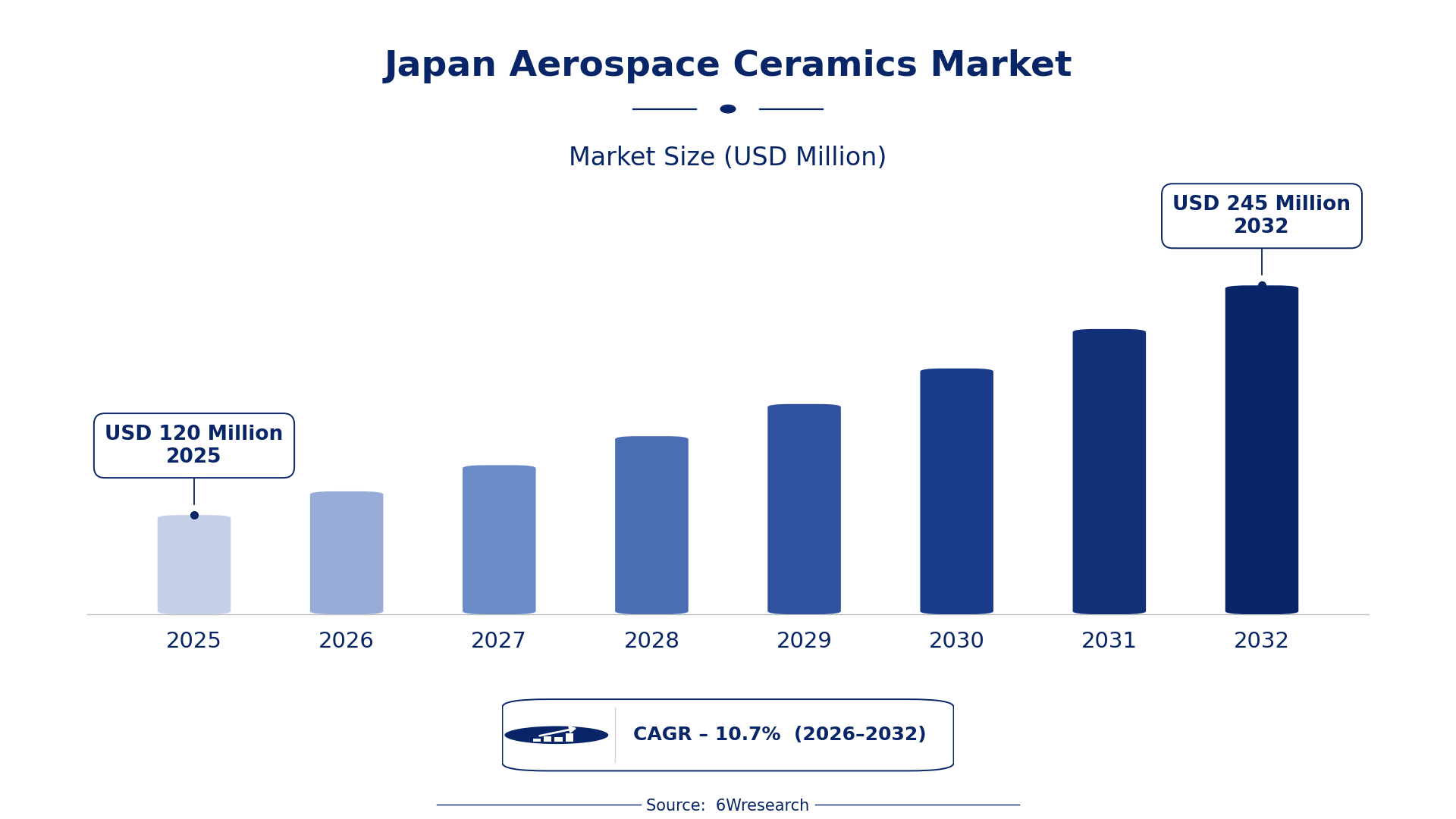
According to 6Wresearch internal database and industry insights, the Japan Aerospace Ceramics Market was valued at USD 120 Million in 2025 and is projected to reach USD 245 Million by 2032, growing at a CAGR of approximately 10.7% during 2026–2032.
Japan Aerospace Ceramics Market Highlights
| Report Metric | Details |
| Report Name | Japan Aerospace Ceramics Market (2026-2032) |
| Market Size 2025 | USD 120 Million |
| Market Size 2032 | USD 245 Million |
| Absolute Growth 2025–2032 | USD 125 Million |
| CAGR 2026–2032 | 10.7% |
| Peak Annual Growth | 12.3% in 2032 |
| Forecast Period | 2026–2032 |
| Historical Data | 2022–2025 |
| Base Year | 2025 |
| Leading Product Type, 2025 | Ceramic Coatings (45% share) |
| Leading Ceramic Type, 2025 | Oxide Ceramics (48% share) |
| Leading Application Area, 2025 | Thermal Barrier Coatings (46% share) |
| Leading Distribution Channel, 2025 | OEMs (40% share) |
| Leading End User, 2025 | Jet Engine Producers (44% share) |
| Fastest-Growing Product Type | Ceramic Matrix Composites (15.1% CAGR) |
| Fastest-Growing Ceramic Type | Non-Oxide Ceramics (15.3% CAGR) |
| Fastest-Growing Application Area | Electronics (13.0% CAGR) |
| Fastest-Growing Distribution Channel | Government Contracts (13.6% CAGR) |
| Fastest-Growing End User | Defense Organizations (13.9% CAGR) |
| Growing Sector | Aerospace Manufacturing |
| Key End Users | Jet Engine Producers, Defense Organizations, Avionics OEMs, Aerospace Factories |
Japan Aerospace Ceramics Market Year-wise Growth Rate and Key Drivers (2022–2032)
This graph illustrates the annual growth rates of the market from 2022 to 2032, highlighting a steady upward trajectory and projected market expansion over the forecast period.
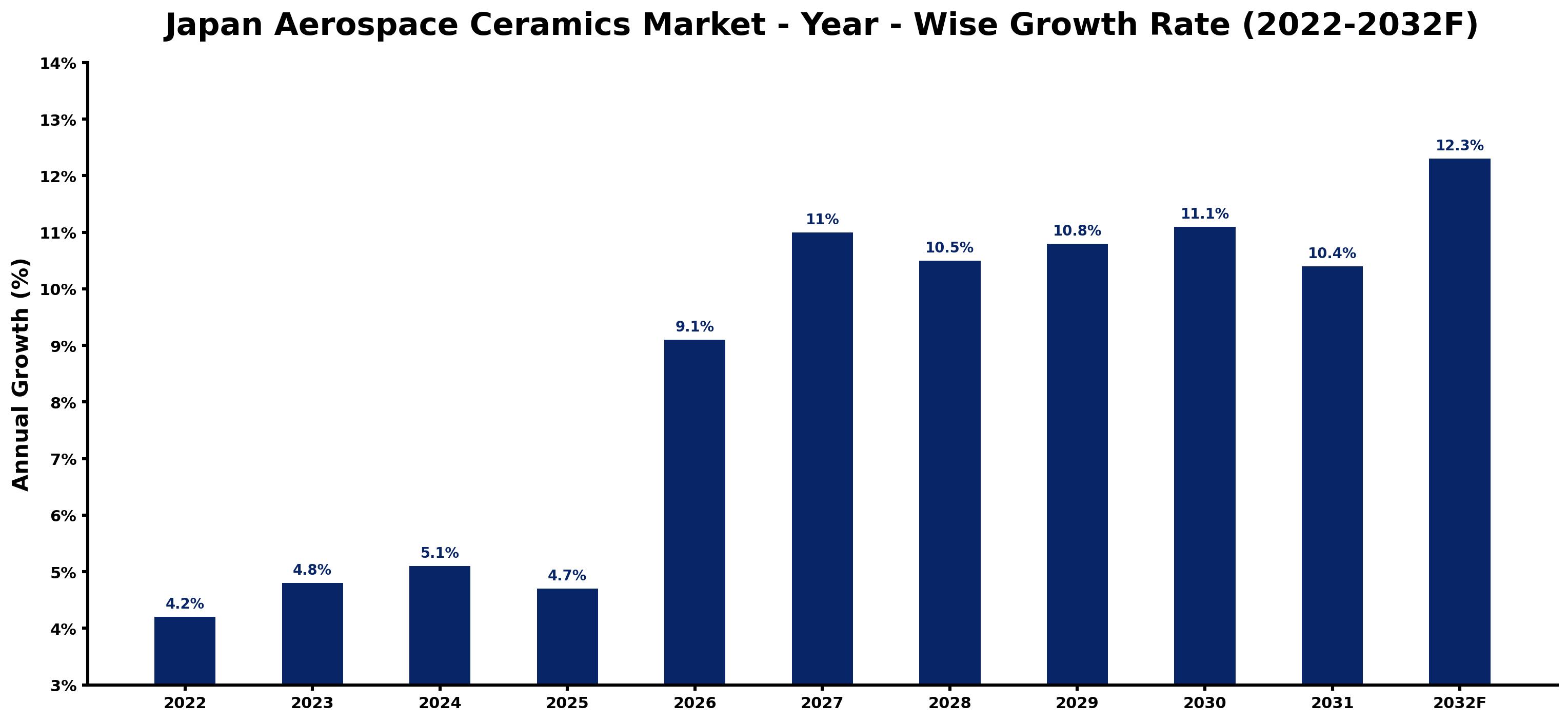
Annual growth estimates for each year appear below with the principal reason behind them, explaining the shifts that set the pace of the market.
| Year | Estimated Annual Growth (%) | Market Rationale |
| 2022 | 4.2 | The market experienced steady growth due to existing demand from domestic manufacturers. |
| 2023 | 4.8 | Increased production of jet engines contributed to a faster growth rate compared to the previous year. |
| 2024 | 5.1 | The market continued to grow as aerospace manufacturers ramped up output to meet rising demand. |
| 2025 | 4.7 | Growth slowed slightly as manufacturers adjusted to market conditions and production capacity. |
| 2026 | 9.1 | The introduction of new aerospace projects is expected to drive growth in the coming years. |
| 2027 | 11.0 | Demand for lightweight materials in aircraft construction is anticipated to boost growth further. |
| 2028 | 10.5 | Growth is projected to slow as the market stabilises after rapid expansion in previous years. |
| 2029 | 10.8 | Continued investment in aerospace technology is likely to enhance demand for advanced ceramics. |
| 2030 | 11.1 | The ongoing development of aerospace applications will sustain market growth. |
| 2031 | 10.4 | Growth is expected to moderate as the market reaches a more stable phase. |
| 2032 | 12.3 | The peak growth year will be driven by increased production and government contracts. |
Note: Market size estimations and growth projections presented in this report are based on 6Wresearch's proprietary forecasting methodology, utilizing the latest available industry data, government publications, and primary research inputs.
Japan Aerospace Ceramics Market Synopsis
Aerospace ceramics are high-performance materials essential for thermal protection, structural components, and electronic applications in aircraft and spacecraft. The Japan Aerospace Ceramics Market is expanding due to rising demand from domestic manufacturers and government contracts supporting both defense and commercial aviation.
Market Dynamics Impact Analysis (2026–2032)
| Factor | Type | Impact | Primary Segment Affected |
| Rising demand for lightweight materials in aircraft manufacturing | Driver | High | Ceramic Matrix Composites |
| Increased government contracts for defense applications | Driver | High | Government Contracts |
| Growing demand for thermal barrier coatings in jet engines | Opportunity | High | Thermal Barrier Coatings |
| Expansion of aerospace manufacturing hubs in the Tokyo region | Opportunity | Medium | Aerospace Factories |
| High production costs associated with advanced materials | Restraint | High | Technical Ceramics |
| Limited availability of skilled workforce in advanced manufacturing | Restraint | Medium | Ceramic Insulators |
| Compliance with stringent aerospace standards and regulations | Challenge | High | Ceramic Coatings |
| Capacity constraints in manufacturing facilities affecting output | Challenge | Medium | Jet Engine Producers |
Evaluation of Drivers in Japan Aerospace Ceramics Market (2026–2032)
Key forces behind demand, with the segment each one moves most, are listed below.
| Drivers | Primary Segment Affected | Why It Matters (Evidence) |
| Increased production of jet engines | Jet Engine Producers | Japan produced approximately 200 jet engines for commercial use in 2022, driving demand for aerospace ceramics. |
| Government contracts for defense procurement | Government Contracts | The Ministry of Defense allocated ¥1 trillion for procurement in 2023, increasing demand for aerospace components. |
| Technological advancements in aerospace applications | Technical Ceramics | Developments in advanced ceramic materials are driving innovation in aerospace applications. |
| Rising exports of aerospace products | Aerospace Factories | In 2023, Japan's aerospace exports reached ¥500 billion, indicating strong global competitiveness. |
| Adoption of ISO 9001 standards | Ceramic Coatings | Widespread adoption of ISO 9001 in the aerospace sector improves quality assurance and boosts demand. |
A broader customer base accounts for much of the growth, as jet engine production hit approximately 200 units in 2022, prompting higher purchases of aerospace ceramics. Large defence procurement contracts, with ¥1 trillion allocated in 2023, boost demand for aerospace components. Advances in ceramic materials are spurring innovation in applications like thermal protection systems. Aerospace product exports reached ¥500 billion in 2023, showcasing Japan's competitive advantage in the global market. The implementation of ISO 9001 standards improves quality assurance, further attracting manufacturers to high-performance ceramics.
Evaluation of Restraints in Japan Aerospace Ceramics Market
The table below lists the restraints and the evidence behind each.
| Market Restraint | Primary Segment Affected | Why It Matters (Evidence) |
| High production costs for advanced aerospace materials | Technical Ceramics | Producers face increased costs due to the complex manufacturing processes involved in creating high-performance ceramics. |
| Limited skilled workforce for advanced manufacturing | Ceramic Insulators | The shortage of skilled workers in the aerospace sector restricts production capacity and innovation. |
| Stringent compliance requirements for aerospace standards | Ceramic Coatings | Manufacturers must meet rigorous standards, increasing operational costs and complexity. |
| Capacity constraints in existing manufacturing facilities | Jet Engine Producers | Manufacturers struggle to meet demand due to limited production capacity in current facilities. |
| Supply chain disruptions affecting raw materials | Ceramic Matrix Composites | Global supply chain issues have led to delays and increased costs for essential raw materials. |
Japan Aerospace Ceramics Market Challenges
Producers are grappling with rising costs due to supply chain disruptions, which have increased production expenses by up to 15% for aerospace components. Foreign manufacturers are intensifying competition, potentially squeezing profit margins by 10% for domestic suppliers. Buyers face procurement delays, as regulatory compliance can extend lead times by an average of three months, significantly impacting project timelines. Suppliers must invest in quality assurance measures, which can elevate operational expenses by 5%, ultimately influencing pricing strategies for buyers seeking competitive rates.
Trends in the Japan Aerospace Ceramics Market
The shifts below are changing how Japan Aerospace Ceramics Market products are bought and supplied.
- Shift towards Advanced Manufacturing Techniques: In Japan, advanced manufacturing techniques like chemical vapor deposition are increasingly used in aerospace ceramics. This shift improves production efficiency and quality, with the Tokyo region hosting several major factories.
- Growing Focus on Lightweight Materials: The aerospace sector is prioritising lightweight materials, particularly in jet engine production. This trend is evident in the rising use of silicon nitride ceramics, which are important for high-performance bearings.
- Increased Collaboration in Aerospace Innovation: The Japan Aerospace Exploration Agency promotes collaboration among industry stakeholders to drive innovation. This initiative has led to advancements in ceramic materials, supporting the growing need for aerospace applications.
- Expansion of Aerospace Manufacturing Hubs: The Tokyo region is emerging as a key aerospace manufacturing hub, hosting several factories and research facilities. This expansion is expected to boost local production capacity and competitiveness.
Investment Opportunities in the Japan Aerospace Ceramics Market
The opportunities below stand out in the Japan Aerospace Ceramics Market for new entrants and existing suppliers.
- Supply of Advanced Ceramic Materials: There is a growing need for advanced ceramic materials in aerospace applications, with the Tokyo region's aerospace factories requiring solutions to meet demand for high-performance components.
- Investment in Aerospace Manufacturing Facilities: Aerospace manufacturers are looking to invest in new facilities, particularly in the Tokyo region, to increase production capacity and meet the demand for aerospace ceramics.
- Partnerships with Government Contracts: Collaborating with government entities can provide opportunities for aerospace manufacturers to secure contracts, particularly in defense applications, as the Ministry of Defense allocates substantial budgets.
- Expansion into Emerging Aerospace Markets: With aerospace exports reaching ¥500 billion, there is an opportunity for manufacturers to expand into emerging markets, using partnerships and local knowledge to penetrate new regions.
Government Initiatives in the Japan Aerospace Ceramics Market
The New Robot Strategy, introduced in 2015 and amended in 2022, aims to improve productivity in manufacturing, including aerospace ceramics. This measure encourages the adoption of robotics and automation, improving efficiency and reducing costs for producers.
Aerospace manufacturers benefit from the Building Energy Efficiency Act, which requires compliance with energy standards, ensuring sustainable practices in production. This act supports innovation and development in the sector, helping buyers access advanced materials and technologies.
Future Insight of the Japan Aerospace Ceramics Market
New aerospace manufacturing facilities are set to launch by 2032, supported by government initiatives aimed at boosting innovation. The Japan Aerospace Exploration Agency's work on advanced ceramic materials will improve performance in critical applications. Investment in thermal protection systems will enhance jet engine efficiency, contributing to a projected ¥1 trillion in defence procurement. Collaboration among industry stakeholders, facilitated by the Aerospace Industries Association of Japan, will further strengthen the sector's competitiveness.
Market Segmentation Analysis
Japan Aerospace Ceramics Market report covers a detailed analysis of the following market segments:
By Product Type – Ceramic Coatings Lead, Ceramic Matrix Composites Expected to Grow Fastest
According to Saurav Kr Singh, Senior Research Analyst at 6Wresearch, Ceramic Coatings accounted for 45% of the market by product type in 2025. Ceramic coatings hold the largest market share due to their critical role in thermal protection for jet engines, which are essential for aircraft performance. With Japan producing approximately 200 jet engines for commercial use in 2022, the demand for these coatings remains robust. The quickest growth will come from Ceramic Matrix Composites, forecast to expand at a CAGR of 15.1% between 2026 and 2032. The growth of ceramic matrix composites is propelled by their lightweight properties, making them ideal for structural components in aerospace applications. As manufacturers increasingly prioritise fuel efficiency, the adoption of these composites is expected to surge. Suppliers should focus on advancing ceramic matrix composites to align with the rising demand in the aerospace sector.
By Ceramic Type – Oxide Ceramics Lead, Non-Oxide Ceramics Expected to Grow Fastest
With 48% of ceramic type revenue in 2025, Oxide Ceramics was the largest category. Oxide ceramics dominate the market as they are commonly used in thermal barrier applications, which are vital for protecting engine components from extreme temperatures. Their established presence in the industry ensures a steady demand from aerospace manufacturers. Non-Oxide Ceramics are set to record the highest CAGR in this split, 15.3% over 2026–2032. Non-oxide ceramics are experiencing rapid growth due to their suitability for high-temperature applications, which are increasingly required in advanced aerospace systems. This trend is likely to accelerate as technology pushes the limits of operational temperatures. Buyers should consider sourcing non-oxide ceramics to meet the evolving performance requirements in aerospace applications.
By Application Area – Thermal Barrier Coatings Lead, Electronics Expected to Grow Fastest
In 2025, Thermal Barrier Coatings led the application area split with a 46% share. Thermal barrier coatings are the leading application area because they are essential for protecting engine components from thermal damage, ensuring reliability and efficiency in aerospace operations. Their critical function in jet engines underpins their dominant market position. Over 2026–2032, Electronics is expected to post the fastest growth, at a CAGR of 13.0%. The electronics application area is growing swiftly as the demand for advanced avionics systems increases, necessitating materials that provide electrical insulation and protection. This growth is driven by the ongoing advancements in aerospace technology and systems. Suppliers must invest in developing materials for the electronics sector to align with the increasing integration of advanced technologies in aerospace.
By Distribution Channel – OEMs Lead, Government Contracts Expected to Grow Fastest
The largest distribution channel category in 2025 was OEMs, at 40% of revenue. OEMs are the leading distribution channel for aerospace parts, directly involved in aircraft and spacecraft manufacturing, which ensures a steady demand for aerospace ceramics. Their established relationships with manufacturers facilitate a dependable supply chain. Government Contracts are projected to grow fastest, at a CAGR of 13.6% during 2026–2032. Government contracts are rapidly becoming a key source of demand for aerospace ceramics, particularly in defence applications, as substantial budgets are allocated for procurement. This trend is anticipated to continue as national security priorities grow. Suppliers should strengthen partnerships with government entities to leverage the increasing demand from defence contracts.
By End User – Jet Engine Producers Lead, Defense Organizations Expected to Grow Fastest
Jet Engine Producers held 44% of the Japan Aerospace Ceramics Market by end user in 2025. Jet engine producers are the largest consumers of aerospace ceramics, as these materials are vital for various components in engine production. Their significant consumption levels greatly impact the ceramics market within the aerospace industry. The quickest growth will come from Defense Organizations, forecast to expand at a CAGR of 13.9% between 2026 and 2032. Defense organizations are witnessing the fastest growth as end users due to heightened military applications and increased investments in advanced aerospace technologies. This trend suggests a focus on bolstering national defence capabilities and operational preparedness. Suppliers should tailor their offerings to meet the specific needs of defence organizations to capitalise on this growing market segment.
Key Attractiveness of the Report
- 10 Years of Market Numbers
- Historical Data Starting from 2022 to 2025
- Base Year 2025
- Forecast Data until 2032
- Key Performance Indicators Impacting the Market
- Major Upcoming Developments and Projects
Key Highlights of the Report:
- Japan Aerospace Ceramics Market Outlook
- Market Size of Japan Aerospace Ceramics Market, 2025
- Forecast of Japan Aerospace Ceramics Market, 2032
- Historical Data and Forecast of Japan Aerospace Ceramics Revenues & Volume for the Period 2022-2032F
- Japan Aerospace Ceramics Market Trend Evolution
- Japan Aerospace Ceramics Market Drivers and Challenges
- Japan Aerospace Ceramics Price Trends
- Japan Aerospace Ceramics Porter's Five Forces
- Japan Aerospace Ceramics Industry Life Cycle
- Historical Data and Forecast of Japan Aerospace Ceramics Market Revenues & Volume By Product Type for the Period 2022-2032F
- Historical Data and Forecast of Japan Aerospace Ceramics Market Revenues & Volume By Ceramic Coatings for the Period 2022-2032F
- Historical Data and Forecast of Japan Aerospace Ceramics Market Revenues & Volume By Ceramic Matrix Composites for the Period 2022-2032F
- Historical Data and Forecast of Japan Aerospace Ceramics Market Revenues & Volume By Ceramic Insulators for the Period 2022-2032F
- Historical Data and Forecast of Japan Aerospace Ceramics Market Revenues & Volume By Ceramic Bearings for the Period 2022-2032F
- Historical Data and Forecast of Japan Aerospace Ceramics Market Revenues & Volume By Ceramic Type for the Period 2022-2032F
- Historical Data and Forecast of Japan Aerospace Ceramics Market Revenues & Volume By Oxide Ceramics for the Period 2022-2032F
- Historical Data and Forecast of Japan Aerospace Ceramics Market Revenues & Volume By Non-Oxide Ceramics for the Period 2022-2032F
- Historical Data and Forecast of Japan Aerospace Ceramics Market Revenues & Volume By Technical Ceramics for the Period 2022-2032F
- Historical Data and Forecast of Japan Aerospace Ceramics Market Revenues & Volume By Silicon Nitride for the Period 2022-2032F
- Historical Data and Forecast of Japan Aerospace Ceramics Market Revenues & Volume By Application Area for the Period 2022-2032F
- Historical Data and Forecast of Japan Aerospace Ceramics Market Revenues & Volume By Thermal Barrier Coatings for the Period 2022-2032F
- Historical Data and Forecast of Japan Aerospace Ceramics Market Revenues & Volume By Exhaust Nozzles for the Period 2022-2032F
- Historical Data and Forecast of Japan Aerospace Ceramics Market Revenues & Volume By Electronics for the Period 2022-2032F
- Historical Data and Forecast of Japan Aerospace Ceramics Market Revenues & Volume By Turbomachinery for the Period 2022-2032F
- Historical Data and Forecast of Japan Aerospace Ceramics Market Revenues & Volume By Distribution Channel for the Period 2022-2032F
- Historical Data and Forecast of Japan Aerospace Ceramics Market Revenues & Volume By OEMs for the Period 2022-2032F
- Historical Data and Forecast of Japan Aerospace Ceramics Market Revenues & Volume By Government Contracts for the Period 2022-2032F
- Historical Data and Forecast of Japan Aerospace Ceramics Market Revenues & Volume By Direct Sales for the Period 2022-2032F
- Historical Data and Forecast of Japan Aerospace Ceramics Market Revenues & Volume By Industrial Suppliers for the Period 2022-2032F
- Historical Data and Forecast of Japan Aerospace Ceramics Market Revenues & Volume By End User for the Period 2022-2032F
- Historical Data and Forecast of Japan Aerospace Ceramics Market Revenues & Volume By Jet Engine Producers for the Period 2022-2032F
- Historical Data and Forecast of Japan Aerospace Ceramics Market Revenues & Volume By Defense Organizations for the Period 2022-2032F
- Historical Data and Forecast of Japan Aerospace Ceramics Market Revenues & Volume By Avionics OEMs for the Period 2022-2032F
- Historical Data and Forecast of Japan Aerospace Ceramics Market Revenues & Volume By Aerospace Factories for the Period 2022-2032F
- Japan Aerospace Ceramics Import Export Trade Statistics
- Market Opportunity Assessment By Product Type
- Market Opportunity Assessment By Ceramic Type
- Market Opportunity Assessment By Application Area
- Market Opportunity Assessment By Distribution Channel
- Market Opportunity Assessment By End User
- Japan Aerospace Ceramics Top Companies Market Share
- Japan Aerospace Ceramics Competitive Benchmarking By Technical and Operational Parameters
- Japan Aerospace Ceramics Company Profiles
- Japan Aerospace Ceramics Key Strategic Recommendations
Market Covered
This report examines the market across the segments below.
By Product Type
- Ceramic Coatings
- Ceramic Matrix Composites
- Ceramic Insulators
- Ceramic Bearings
By Ceramic Type
- Oxide Ceramics
- Non-Oxide Ceramics
- Technical Ceramics
- Silicon Nitride
By Application Area
- Thermal Barrier Coatings
- Exhaust Nozzles
- Electronics
- Turbomachinery
By Distribution Channel
- OEMs
- Government Contracts
- Direct Sales
- Industrial Suppliers
By End User
- Jet Engine Producers
- Defense Organizations
- Avionics OEMs
- Aerospace Factories































