Japan Aerospace Composites Bonding Market Size & Growth Rate
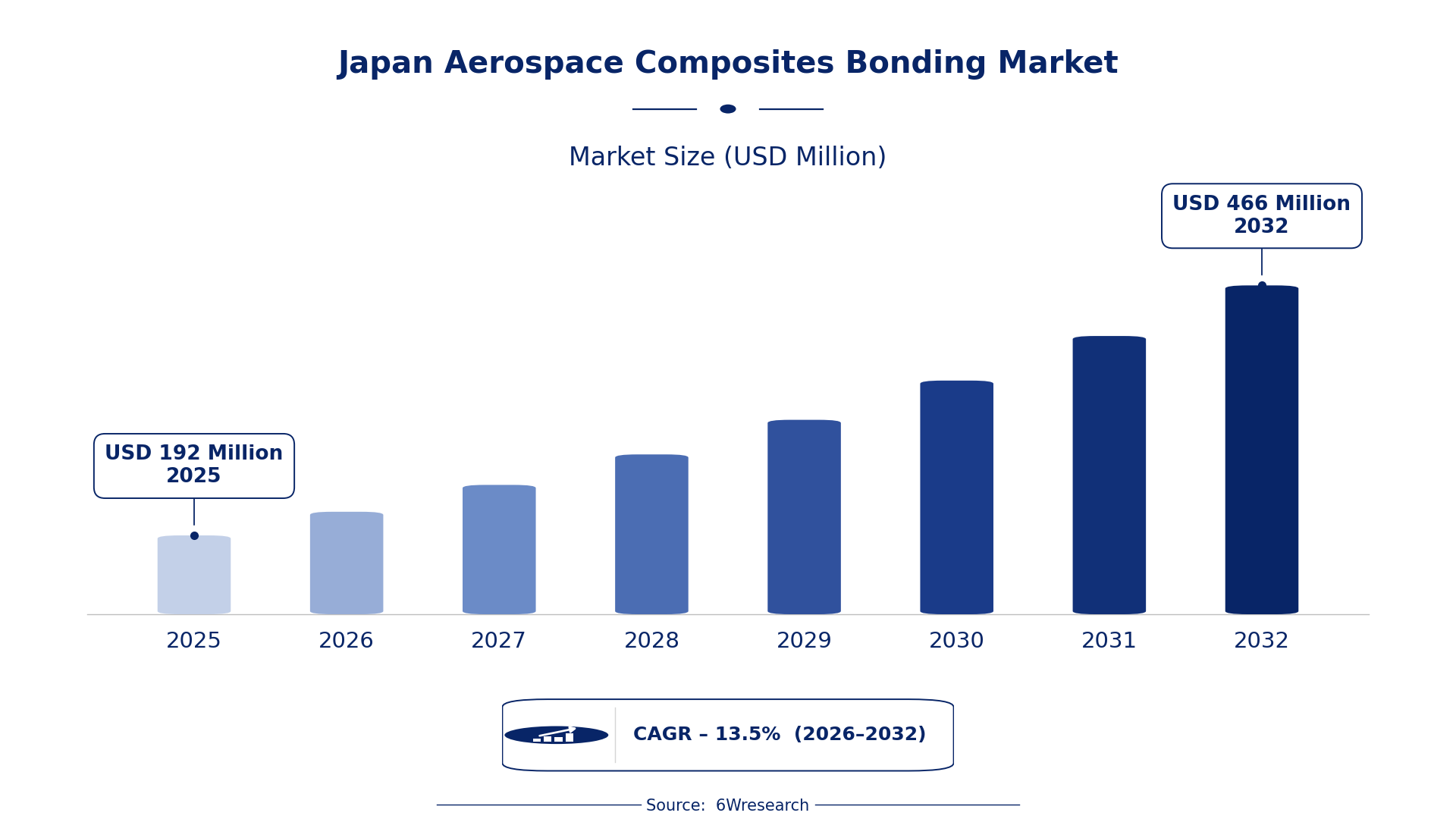
According to 6Wresearch internal database and industry insights, the Japan Aerospace Composites Bonding Market was valued at USD 192 Million in 2025 and is projected to reach USD 466 Million by 2032, growing at a CAGR of approximately 13.5% during 2026–2032.
Japan Aerospace Composites Bonding Market Highlights
| Report Metric | Details |
| Report Name | Japan Aerospace Composites Bonding Market (2026-2032) |
| Market Size 2025 | USD 192 Million |
| Market Size 2032 | USD 466 Million |
| Absolute Growth 2025–2032 | USD 274 Million |
| CAGR 2026–2032 | 13.5% |
| Peak Annual Growth | 16.7% in 2032 |
| Forecast Period | 2026–2032 |
| Historical Data | 2022–2025 |
| Base Year | 2025 |
| Leading Bonding Type, 2025 | Structural Adhesives (42% share) |
| Leading Resin Type, 2025 | Epoxy Resin (43% share) |
| Leading Application Area, 2025 | Wing Structures (41% share) |
| Leading Distribution Channel, 2025 | OEMs (44% share) |
| Leading End User, 2025 | Aircraft Manufacturers (47% share) |
| Fastest-Growing Bonding Type | Film Adhesives (19.1% CAGR) |
| Fastest-Growing Application Area | Fuselage Assembly (16.7% CAGR) |
| Fastest-Growing Distribution Channel | Direct Sales (18.1% CAGR) |
| Fastest-Growing End User | Composite Material Providers (17.6% CAGR) |
| Growing Sector | Fuselage Assembly |
| Key End Users | Wing Structures, Fuselage Assembly, Engine Nacelles, Interiors & Seats |
Japan Aerospace Composites Bonding Market Year-wise Growth Rate and Key Drivers (2022–2032)
This graph illustrates the annual growth rates of the market from 2022 to 2032, highlighting a steady upward trajectory and projected market expansion over the forecast period.
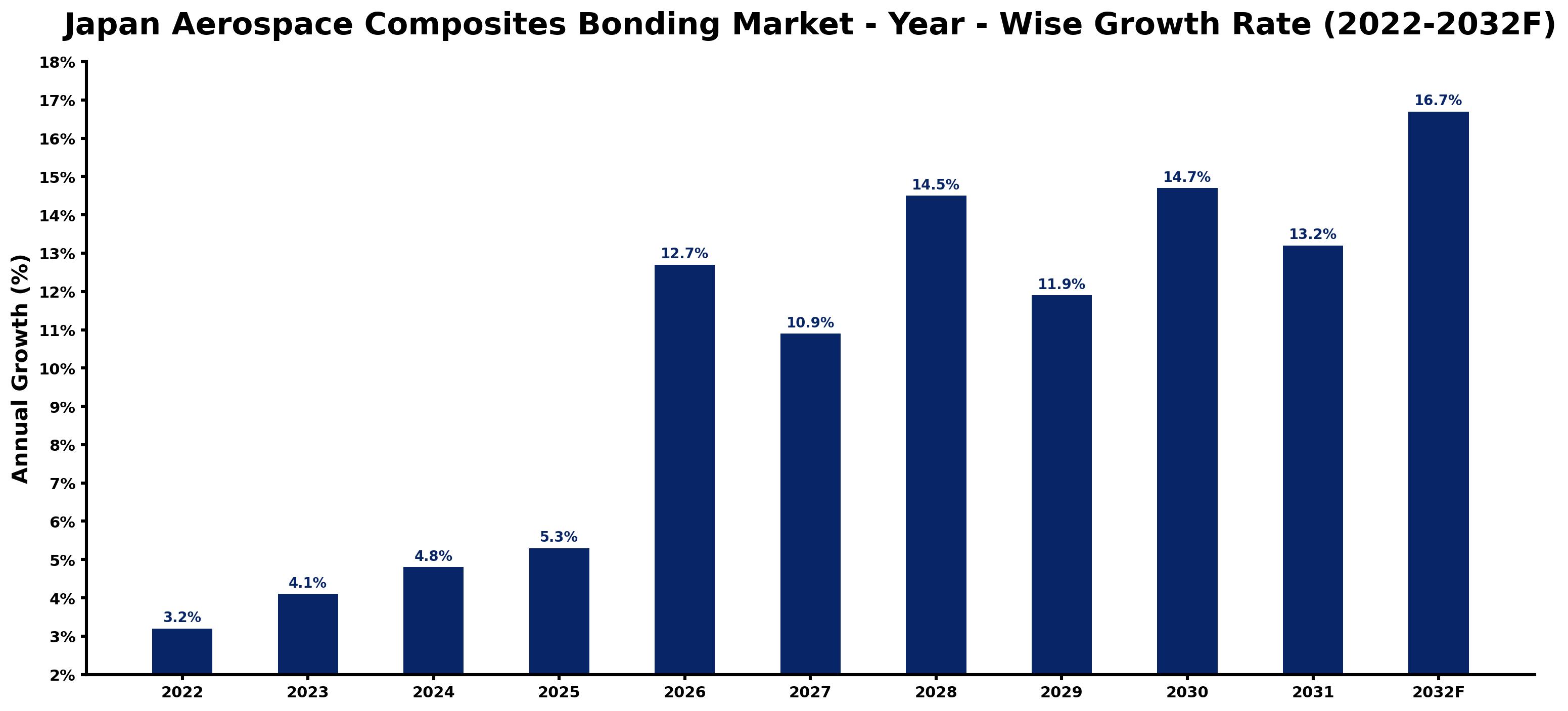
The yearly estimates that follow link every growth rate to its principal driver, so readers can see why the pace changed in each period.
| Year | Estimated Annual Growth (%) | Market Rationale |
| 2022 | 3.2 | The market exhibited steady growth, driven by increasing demand from domestic aircraft manufacturers. |
| 2023 | 4.1 | Growth accelerated due to rising air travel demand and investments in aerospace technology. |
| 2024 | 4.8 | Continued investments in aerospace infrastructure supported higher growth rates this year. |
| 2025 | 5.3 | The aerospace sector expanded further, driven by the increasing aircraft fleet size in Japan. |
| 2026 | 12.7 | Growth surged as new aerospace projects initiated, boosting demand for bonding materials. |
| 2027 | 10.9 | Growth slowed slightly as the market adjusted to previous high levels of investment. |
| 2028 | 14.5 | A resurgence in demand was noted as new aircraft models entered production phases. |
| 2029 | 11.9 | The market experienced a slowdown as competition intensified among bonding material suppliers. |
| 2030 | 14.7 | Demand increased again with new aerospace initiatives and a growing aircraft fleet. |
| 2031 | 13.2 | Growth moderated as the market stabilised after a period of rapid expansion. |
| 2032 | 16.7 | The market peaked with investments in advanced aerospace technologies. |
Note: Market size estimations and growth projections presented in this report are based on 6Wresearch's proprietary forecasting methodology, utilizing the latest available industry data, government publications, and primary research inputs.
Japan Aerospace Composites Bonding Market Synopsis
Aerospace composites bonding utilises adhesives to join composite materials in aircraft manufacturing, ensuring structural integrity in components like wings and fuselages. The Japan Aerospace Composites Bonding Market is growing due to rising air travel demand and investments in aerospace technology. The country’s aerospace industry, valued at approximately 1 trillion yen, benefits from initiatives by the Tokyo Metropolitan Government and the Ministry of Economy, Trade and Industry, which encourage innovation and development in this sector.
Market Dynamics Impact Analysis (2026–2032)
| Factor | Type | Impact | Primary Segment Affected |
| Increasing investments in aerospace technology development | Driver | High | Structural Adhesives |
| Growing aircraft fleet size driving demand for bonding materials | Driver | High | Epoxy Resin |
| Emerging demand for lightweight materials in aircraft manufacturing | Opportunity | High | Film Adhesives |
| Expansion of aerospace manufacturing hubs in the Tokyo region | Opportunity | High | Wing Structures |
| High competition among bonding material suppliers | Restraint | Medium | Paste Adhesives |
| Stringent quality standards affecting production timelines | Restraint | Medium | Thermoset Resin |
| Limited availability of skilled workforce in aerospace engineering | Challenge | High | Aircraft Manufacturers |
| Rising costs of raw materials impacting pricing | Challenge | Medium | Composite Material Providers |
Evaluation of Drivers in Japan Aerospace Composites Bonding Market (2026–2032)
The factors lifting demand, and the evidence behind each, are summarised below.
| Drivers | Primary Segment Affected | Why It Matters (Evidence) |
| Investment in aerospace technology development | Structural Adhesives | This investment increases production capabilities, leading to higher demand for strong bonding materials, particularly in critical aircraft components. |
| Rising air travel demand | Epoxy Resin | As passenger numbers grow, aircraft manufacturers require more high-strength adhesives, driving purchases of epoxy resin for structural applications. |
| Development of new aircraft models | Film Adhesives | New aircraft designs necessitate advanced bonding solutions, particularly film adhesives, to ensure structural integrity in wings and fuselages. |
| Expansion of aerospace manufacturing capacity | Wing Structures | The growth of manufacturing facilities in the Tokyo region boosts demand for bonding materials, especially for wing structures in new aircraft. |
| Increased focus on quality standards | Fuselage Assembly | The adoption of ISO 9001 standards enhances quality assurance in bonding processes, encouraging manufacturers to invest in high-quality adhesive solutions. |
A wider customer base accounts for much of the growth, as investment in aerospace technology increases production capabilities, raising demand for high-strength adhesives. The growing air travel demand is clear, with passenger numbers expected to rise, prompting aircraft manufacturers to seek more bonding materials for new aircraft. Development of new aircraft models requires advanced bonding solutions, particularly for film adhesives, ensuring structural integrity. The expansion of aerospace manufacturing capacity in the Tokyo region drives demand for bonding materials, especially in wing structures.
Evaluation of Restraints in Japan Aerospace Composites Bonding Market
Below are the constraints most often cited by buyers and suppliers, with the segment each affects.
| Market Restraint | Primary Segment Affected | Why It Matters (Evidence) |
| Rising adhesive costs due to limited domestic production | Structural Adhesives | This situation forces buyers to pay up to 15% more for bonding materials, impacting project budgets. |
| Shortage of skilled workers in aerospace composites bonding | Film Adhesives | Fewer graduates entering engineering programmes delays project timelines for suppliers by an average of six months. |
| Supply chain disruptions from fluctuating raw material availability | Epoxy Resin | These disruptions can lead to potential shortages that halt production, affecting manufacturers' output. |
| Increased competition from international markets | Paste Adhesives | This pressure forces local suppliers to lower prices, which can compromise the quality of bonding materials. |
| Regulatory compliance costs for aerospace materials | Wing Structures | Meeting stringent standards increases operational costs for manufacturers, affecting pricing strategies. |
Japan Aerospace Composites Bonding Market Challenges
Japan's aerospace industry, valued at approximately 1 trillion yen, faces rising adhesive costs due to limited domestic production, forcing buyers to pay up to 15% more for bonding materials. A shortage of skilled workers in aerospace composites bonding exists because fewer graduates enter engineering programmes, delaying project timelines for manufacturers by an average of six months. Supply chain disruptions occur as raw material availability fluctuates, leading to potential shortages that can halt production for producers. Increased competition from international markets pressures local manufacturers to lower prices, which can compromise the quality of materials for buyers.
Trends in the Japan Aerospace Composites Bonding Market
The following changes are redrawing the Japan Aerospace Composites Bonding Market.
- Shift towards Lightweight Materials: The aerospace sector is increasingly adopting lightweight materials to improve fuel efficiency. For instance, the demand for epoxy resin is rising, with projections indicating a 43% market share by 2025.
- Increased Focus on Sustainability: Aircraft manufacturers are prioritising sustainable materials in production, aligning with the GX Promotion Act. This shift is expected to drive demand for recyclable bonding solutions, supporting market growth.
- Emergence of Advanced Bonding Technologies: New bonding technologies are being developed to improve performance and reduce weight in aircraft. The National Institute of Advanced Industrial Science and Technology is conducting research in this area, resulting in innovative solutions.
- Growth of Direct Sales Channels: Direct sales are becoming the preferred distribution method, with a projected CAGR of 18.1% for this channel, reflecting changing buyer preferences towards more accessible purchasing options.
Investment Opportunities in the Japan Aerospace Composites Bonding Market
The opportunities below stand out in the Japan Aerospace Composites Bonding Market for new entrants and existing suppliers.
- Gap in High-Performance Adhesives: With the aerospace industry valued at approximately 1 trillion yen, there is a need for high-performance adhesives. Collaborating with aircraft manufacturers can help suppliers meet this demand effectively.
- Investment in Sustainable Solutions: As the market shifts towards sustainability, suppliers can focus on developing recyclable bonding materials. Partnering with the Japan Aerospace Association can facilitate access to key buyers.
- Expansion of Aerospace Manufacturing: With the Tokyo region accounting for over 40% of Japan's aerospace manufacturing capacity, investing in local production facilities can help meet rising demand for bonding materials.
- Development of Innovative Bonding Technologies: Investing in research for advanced bonding technologies can address the market's evolving needs. Collaborating with universities offering aerospace engineering programs can lead to effective solutions.
Government Initiatives in the Japan Aerospace Composites Bonding Market
The GX Promotion Act (2023) establishes a framework for promoting sustainable practices in the aerospace sector, complementing the Plastic Resource Circulation Act (2021) that encourages recycling. These measures aim to improve the environmental performance of aerospace composites bonding, ensuring compliance with modern standards.
The Ministry of Economy, Trade and Industry oversees initiatives that support aerospace technology development. Through funding programs, the ministry aids startups in the Tokyo region, promoting innovation in aerospace bonding materials and ensuring that manufacturers meet quality standards.
Future Insight of the Japan Aerospace Composites Bonding Market
The investment pipeline in aerospace technology development will drive demand for advanced bonding materials, linked to Japan's aircraft fleet projected to reach 1,500 by 2025. By 2032, the implementation of ISO 9001 standards will standardise quality across the industry, benefiting both buyers and suppliers. Initiatives from the Tokyo Metropolitan Government to support aerospace startups will encourage innovation and expand the variety of bonding solutions available. Research from the National Institute of Advanced Industrial Science and Technology will improve material performance and application.
Market Segmentation Analysis
Japan Aerospace Composites Bonding Market report covers a detailed analysis of the following market segments:
By Bonding Type – Structural Adhesives Lead, Film Adhesives Expected to Grow Fastest
According to Saurav Kr Singh, Senior Research Analyst at 6Wresearch, Structural Adhesives held 42% of the Japan Aerospace Composites Bonding Market by bonding type in 2025. Structural adhesives are essential for ensuring the structural integrity of aircraft components, making them the preferred choice among manufacturers. Their critical role in applications such as wings and fuselages solidifies their dominance in the market. The quickest growth will come from Film Adhesives, forecast to expand at a CAGR of 19.1% between 2026 and 2032. Film adhesives are gaining traction due to their specific use in bonding composite layers, which is increasingly required as aircraft designs evolve. This targeted application is driving their rapid adoption in the industry. Suppliers should focus on developing advanced film adhesive solutions to cater to the growing demand in aerospace applications.
By Resin Type – Epoxy Resin Leads and Records the Fastest Growth
Epoxy Resin accounted for 43% of the market by resin type in 2025. Epoxy resin holds the largest share due to its strong bonding capabilities, making it the go-to choice for aerospace applications. Its widespread use across various components ensures its leading position in the market. Epoxy Resin is also forecast to expand faster than any other category, at a CAGR of 15.4% over 2026–2032. Epoxy resin is also the fastest-growing segment, as its versatility and performance continue to meet the increasing demands of the aerospace sector. This dual role as leader and fastest will likely widen its market dominance further. Buyers will benefit from a stable supply of epoxy resin, while suppliers must innovate to maintain competitive advantages.
By Application Area – Wing Structures Lead, Fuselage Assembly Expected to Grow Fastest
With 41% of application area revenue in 2025, Wing Structures was the largest category. Wing structures are critical components in aircraft that require high-strength adhesives for secure bonding. Their importance in maintaining aircraft safety and performance secures their leading position in the market. Fuselage Assembly is set to record the highest CAGR in this split, 16.7% over 2026–2032. Fuselage assembly is experiencing rapid growth due to its vital role in ensuring the structural integrity of aircraft. The increasing complexity of fuselage designs drives the demand for advanced bonding solutions in this area. Suppliers should prioritise the development of specialised bonding solutions for fuselage assembly to take advantage of the expanding market.
By Distribution Channel – OEMs Lead, Direct Sales Expected to Grow Fastest
OEMs took 44% of distribution channel revenue in 2025, more than any other category. OEMs are the primary customers for aerospace bonding products, relying on these materials for aircraft manufacturing. Their established supply chains and consistent demand create a strong market presence for bonding solutions. Direct Sales is projected to grow fastest, at a CAGR of 18.1% during 2026–2032. Direct sales are becoming the fastest-growing channel as manufacturers seek more efficient purchasing processes. This trend indicates a need for suppliers to adjust to evolving buyer preferences for streamlined transactions. Suppliers must enhance their direct sales strategies to align with market demands and improve customer relationships.
By End User – Aircraft Manufacturers Lead, Composite Material Providers Expected to Grow Fastest
In 2025, Aircraft Manufacturers led the end user split with a 47% share. Aircraft manufacturers are the largest end users of bonding products, applying these materials directly in aircraft production. Their significant purchasing volume and ongoing demand reinforce their dominant position in the market. The quickest growth will come from Composite Material Providers, forecast to expand at a CAGR of 17.6% between 2026 and 2032. Composite material providers are rapidly gaining importance as they supply essential materials that require bonding, reflecting the industry's shift towards advanced composite technologies. Their growing role in the supply chain is significant. Suppliers should consider partnerships with composite material providers to expand their market reach and strengthen their product offerings.
Key Attractiveness of the Report
- 10 Years of Market Numbers
- Historical Data Starting from 2022 to 2025
- Base Year 2025
- Forecast Data until 2032
- Key Performance Indicators Impacting the Market
- Major Upcoming Developments and Projects
Key Highlights of the Report:
- Japan Aerospace Composites Bonding Market Outlook
- Market Size of Japan Aerospace Composites Bonding Market, 2025
- Forecast of Japan Aerospace Composites Bonding Market, 2032
- Historical Data and Forecast of Japan Aerospace Composites Bonding Revenues & Volume for the Period 2022-2032F
- Japan Aerospace Composites Bonding Market Trend Evolution
- Japan Aerospace Composites Bonding Market Drivers and Challenges
- Japan Aerospace Composites Bonding Price Trends
- Japan Aerospace Composites Bonding Porter's Five Forces
- Japan Aerospace Composites Bonding Industry Life Cycle
- Historical Data and Forecast of Japan Aerospace Composites Bonding Market Revenues & Volume By Bonding Type for the Period 2022-2032F
- Historical Data and Forecast of Japan Aerospace Composites Bonding Market Revenues & Volume By Film Adhesives for the Period 2022-2032F
- Historical Data and Forecast of Japan Aerospace Composites Bonding Market Revenues & Volume By Paste Adhesives for the Period 2022-2032F
- Historical Data and Forecast of Japan Aerospace Composites Bonding Market Revenues & Volume By Liquid Shims for the Period 2022-2032F
- Historical Data and Forecast of Japan Aerospace Composites Bonding Market Revenues & Volume By Structural Adhesives for the Period 2022-2032F
- Historical Data and Forecast of Japan Aerospace Composites Bonding Market Revenues & Volume By Resin Type for the Period 2022-2032F
- Historical Data and Forecast of Japan Aerospace Composites Bonding Market Revenues & Volume By Epoxy Resin for the Period 2022-2032F
- Historical Data and Forecast of Japan Aerospace Composites Bonding Market Revenues & Volume By Phenolic Resin for the Period 2022-2032F
- Historical Data and Forecast of Japan Aerospace Composites Bonding Market Revenues & Volume By Polyurethane Resin for the Period 2022-2032F
- Historical Data and Forecast of Japan Aerospace Composites Bonding Market Revenues & Volume By Thermoset Resin for the Period 2022-2032F
- Historical Data and Forecast of Japan Aerospace Composites Bonding Market Revenues & Volume By Application Area for the Period 2022-2032F
- Historical Data and Forecast of Japan Aerospace Composites Bonding Market Revenues & Volume By Wing Structures for the Period 2022-2032F
- Historical Data and Forecast of Japan Aerospace Composites Bonding Market Revenues & Volume By Engine Nacelles for the Period 2022-2032F
- Historical Data and Forecast of Japan Aerospace Composites Bonding Market Revenues & Volume By Fuselage Assembly for the Period 2022-2032F
- Historical Data and Forecast of Japan Aerospace Composites Bonding Market Revenues & Volume By Interiors & Seats for the Period 2022-2032F
- Historical Data and Forecast of Japan Aerospace Composites Bonding Market Revenues & Volume By Distribution Channel for the Period 2022-2032F
- Historical Data and Forecast of Japan Aerospace Composites Bonding Market Revenues & Volume By OEMs for the Period 2022-2032F
- Historical Data and Forecast of Japan Aerospace Composites Bonding Market Revenues & Volume By Industrial Suppliers for the Period 2022-2032F
- Historical Data and Forecast of Japan Aerospace Composites Bonding Market Revenues & Volume By Direct Sales for the Period 2022-2032F
- Historical Data and Forecast of Japan Aerospace Composites Bonding Market Revenues & Volume By Online Platforms for the Period 2022-2032F
- Historical Data and Forecast of Japan Aerospace Composites Bonding Market Revenues & Volume By End User for the Period 2022-2032F
- Historical Data and Forecast of Japan Aerospace Composites Bonding Market Revenues & Volume By Aircraft Manufacturers for the Period 2022-2032F
- Historical Data and Forecast of Japan Aerospace Composites Bonding Market Revenues & Volume By Aerospace Engineers for the Period 2022-2032F
- Historical Data and Forecast of Japan Aerospace Composites Bonding Market Revenues & Volume By Composite Material Providers for the Period 2022-2032F
- Historical Data and Forecast of Japan Aerospace Composites Bonding Market Revenues & Volume By Cabin Component Suppliers for the Period 2022-2032F
- Japan Aerospace Composites Bonding Import Export Trade Statistics
- Market Opportunity Assessment By Bonding Type
- Market Opportunity Assessment By Resin Type
- Market Opportunity Assessment By Application Area
- Market Opportunity Assessment By Distribution Channel
- Market Opportunity Assessment By End User
- Japan Aerospace Composites Bonding Top Companies Market Share
- Japan Aerospace Composites Bonding Competitive Benchmarking By Technical and Operational Parameters
- Japan Aerospace Composites Bonding Company Profiles
- Japan Aerospace Composites Bonding Key Strategic Recommendations
Market Covered
This report examines the market across the segments below.
By Bonding Type
- Film Adhesives
- Paste Adhesives
- Liquid Shims
- Structural Adhesives
By Resin Type
- Epoxy Resin
- Phenolic Resin
- Polyurethane Resin
- Thermoset Resin
By Application Area
- Wing Structures
- Engine Nacelles
- Fuselage Assembly
- Interiors & Seats
By Distribution Channel
- OEMs
- Industrial Suppliers
- Direct Sales
- Online Platforms
By End User
- Aircraft Manufacturers
- Aerospace Engineers
- Composite Material Providers
- Cabin Component Suppliers































