Japan Aerospace Cybersecurity Market Size & Growth Rate
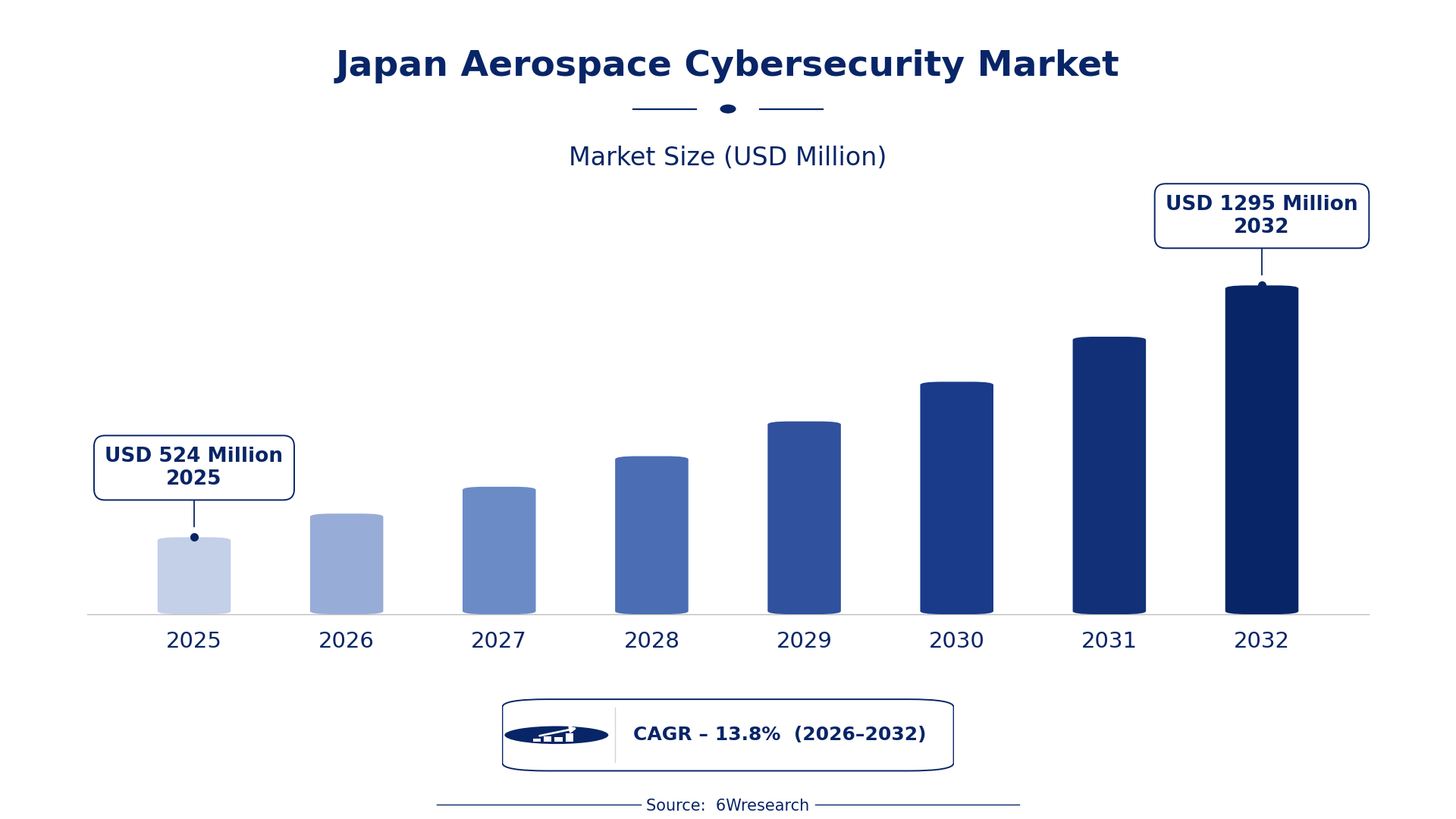
According to 6Wresearch internal database and industry insights, the Japan Aerospace Cybersecurity Market was valued at USD 524 Million in 2025 and is projected to reach USD 1,295 Million by 2032, growing at a CAGR of approximately 13.8% during 2026–2032.
Japan Aerospace Cybersecurity Market Highlights
| Report Metric | Details |
| Report Name | Japan Aerospace Cybersecurity Market (2026-2032) |
| Market Size 2025 | USD 524 Million |
| Market Size 2032 | USD 1,295 Million |
| Absolute Growth 2025–2032 | USD 771 Million |
| CAGR 2026–2032 | 13.8% |
| Peak Annual Growth | 14.3% in 2027 |
| Forecast Period | 2026–2032 |
| Historical Data | 2022–2025 |
| Base Year | 2025 |
| Leading Security Type, 2025 | Embedded System Security (36% share) |
| Leading Threat Type, 2025 | Malware/Ransomware (47% share) |
| Leading Solution Deployment, 2025 | On-Device (45% share) |
| Leading Distribution Channel, 2025 | Direct Sales (38% share) |
| Leading End User, 2025 | Aircraft OEMs (50% share) |
| Fastest-Growing Security Type | Satellite Cybersecurity (20.0% CAGR) |
| Fastest-Growing Threat Type | Hacking/Interference (19.6% CAGR) |
| Fastest-Growing Solution Deployment | Cloud-Based (19.7% CAGR) |
| Fastest-Growing Distribution Channel | Government Contracts (18.0% CAGR) |
| Fastest-Growing End User | Space Operations Agencies (17.5% CAGR) |
| Growing Sector | Aerospace |
| Key End Users | Aircraft OEMs, Military Aerospace Units, Space Operations Agencies, Satellite Control Centers |
Japan Aerospace Cybersecurity Market Year-wise Growth Rate and Key Drivers (2022–2032)
This graph illustrates the annual growth rates of the market from 2022 to 2032, highlighting a steady upward trajectory and projected market expansion over the forecast period.
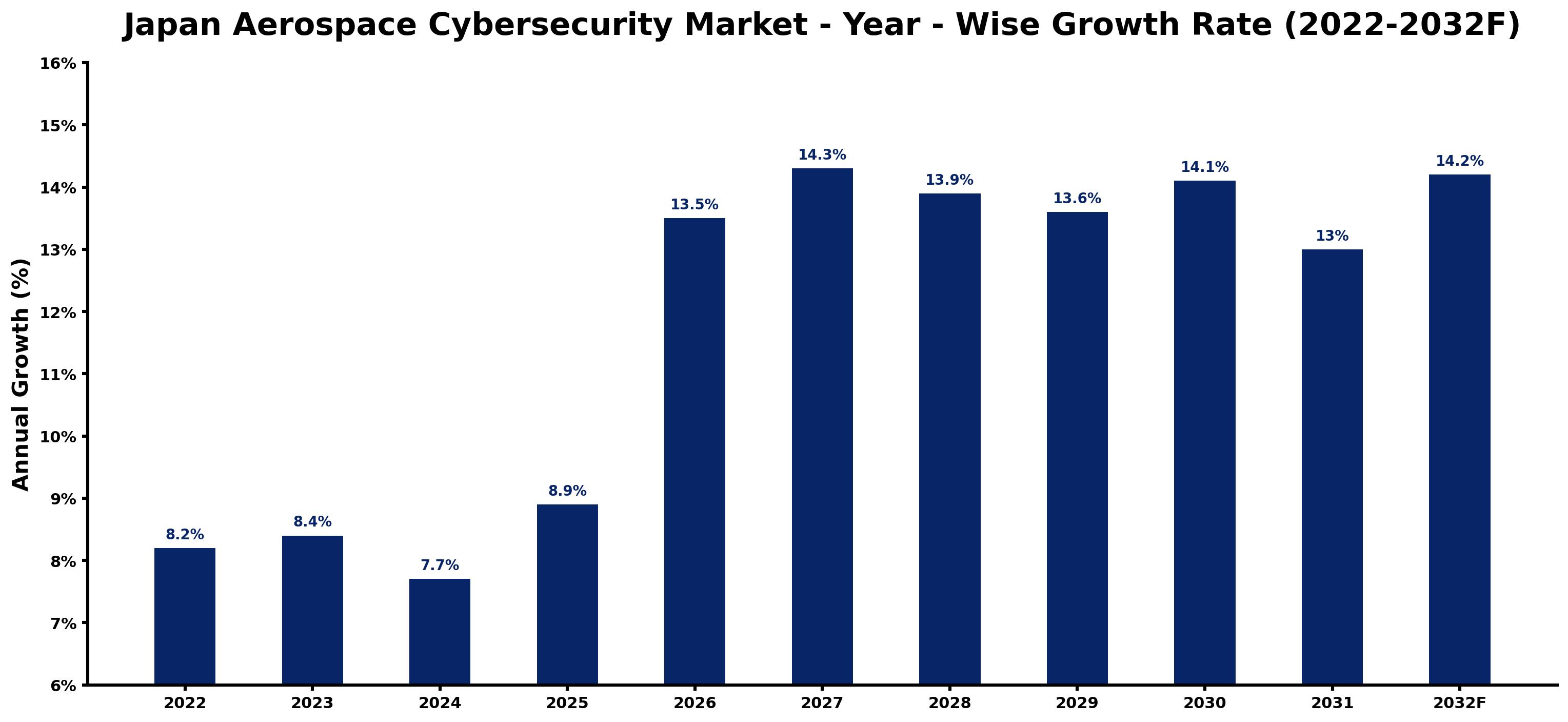
The table below sets out the estimated growth rate for each year and the main factor behind it.
| Year | Estimated Annual Growth (%) | Market Rationale |
| 2022 | 8.2 | The market exhibited steady growth due to increasing cybersecurity awareness among aerospace stakeholders. |
| 2023 | 8.4 | Growth accelerated as the Ministry of Defense launched a new cybersecurity strategy for military aerospace. |
| 2024 | 7.7 | A slight slowdown occurred as companies adjusted to new cybersecurity standards and protocols. |
| 2025 | 8.9 | The market rebounded with heightened investments in cybersecurity solutions across the aerospace sector. |
| 2026 | 13.5 | Demand surged as the number of satellites operated by Japan increased, necessitating advanced cybersecurity. |
| 2027 | 14.3 | The peak growth rate was driven by rising threats targeting aerospace systems and operations. |
| 2028 | 13.9 | Growth moderated slightly as existing systems were upgraded to meet evolving cybersecurity challenges. |
| 2029 | 13.6 | A continued slowdown occurred as market players focused on compliance with new regulations. |
| 2030 | 14.1 | Demand increased again as AI-powered security tools gained traction in satellite operations. |
| 2031 | 13.0 | Growth slowed as the market matured and companies consolidated their cybersecurity measures. |
| 2032 | 14.2 | The market saw renewed growth driven by expanding space operations and international collaborations. |
Note: Market size estimations and growth projections presented in this report are based on 6Wresearch's proprietary forecasting methodology, utilizing the latest available industry data, government publications, and primary research inputs.
Japan Aerospace Cybersecurity Market Synopsis
Aerospace cybersecurity protects aircraft and space systems from cyber threats through various technologies and practices. The Japan Aerospace Cybersecurity Market is growing, driven by domestic users and international collaborations. The Ministry of Defense's cybersecurity strategy initiated in 2023, along with increasing satellite operations, is creating demand for cybersecurity solutions, particularly in embedded systems and satellite cybersecurity.
Market Dynamics Impact Analysis (2026–2032)
| Factor | Type | Impact | Primary Segment Affected |
| Increasing investment in satellite cybersecurity initiatives | Driver | High | Satellite Cybersecurity |
| Rising threats from malware and ransomware targeting aerospace systems | Driver | High | Malware/Ransomware |
| Growing need for secure ground control operations | Opportunity | Medium | Ground Station Security |
| High demand for cybersecurity solutions from military aerospace units | Opportunity | Medium | Military Aerospace Units |
| Challenges in meeting new cybersecurity standards | Restraint | High | Embedded System Security |
| Limited awareness of cybersecurity protocols among smaller aerospace firms | Restraint | Medium | Ground Station Security |
| High costs associated with implementing comprehensive cybersecurity measures | Challenge | High | Satellite Cybersecurity |
| Shortage of skilled cybersecurity professionals in the aerospace sector | Challenge | Medium | Embedded System Security |
Evaluation of Drivers in Japan Aerospace Cybersecurity Market (2026–2032)
The main growth drivers and the segments they affect most are set out below.
| Drivers | Primary Segment Affected | Why It Matters (Evidence) |
| Increased satellite operations requiring advanced cybersecurity measures | Satellite Cybersecurity | Japan operates around 60 satellites, necessitating protection against cyber threats. |
| Growing incidents of cyberattacks on aerospace systems | Malware/Ransomware | Recent reports indicate a rise in malware attacks targeting critical aerospace infrastructure. |
| Government contracts driving demand for cybersecurity solutions | Government Contracts | Defense contracts accounted for a large portion of the 200 billion yen allocated for cybersecurity enhancements. |
| Rising awareness of cybersecurity importance among aircraft OEMs | Embedded System Security | Aircraft manufacturers are increasingly integrating cybersecurity into their systems to protect critical avionics. |
| Adoption of AI-powered security tools for improved threat detection | AI-Powered Security Tools | AI tools are increasingly used in satellite operations, improving response capabilities. |
The strongest pull on demand comes from Japan's increasing satellite operations, with around 60 satellites requiring advanced cybersecurity measures. The rise in malware attacks targeting critical aerospace infrastructure is prompting investments in cybersecurity solutions. Defense contracts have allocated 200 billion yen for cybersecurity enhancements, driving demand from military aerospace units. Aircraft manufacturers are integrating cybersecurity into their systems to protect critical avionics, while AI-powered security tools are increasingly adopted in satellite operations, improving threat detection capabilities.
Evaluation of Restraints in Japan Aerospace Cybersecurity Market
The key brakes on demand, and where they bite hardest, are shown below.
| Market Restraint | Primary Segment Affected | Why It Matters (Evidence) |
| Challenges in meeting new cybersecurity standards | Embedded System Security | Compliance with JIS Q 15001 requires substantial investment and resources from manufacturers. |
| Limited awareness of cybersecurity protocols among smaller aerospace firms | Ground Station Security | Many smaller firms lack the resources to implement effective cybersecurity measures. |
| High costs associated with implementing cybersecurity measures | Satellite Cybersecurity | Implementing cybersecurity solutions can exceed budgets for many aerospace companies. |
| Shortage of skilled cybersecurity professionals in the aerospace sector | Embedded System Security | The demand for cybersecurity talent outstrips supply, delaying project timelines. |
| Complexity of integrating cybersecurity into existing aerospace systems | Ground Station Security | Legacy systems pose challenges for effective cybersecurity upgrades and integration. |
Japan Aerospace Cybersecurity Market Challenges
Japan's aerospace cybersecurity market encounters supply chain disruptions due to reliance on foreign technology, delaying system upgrades for producers by up to six months. High costs associated with compliance to JIS Q 15001 can consume approximately 15% of buyers' budgets, limiting their financial flexibility. A shortage of skilled cybersecurity professionals restricts producers' capacity to develop robust systems, increasing operational vulnerabilities. Buyers face heightened risks as the need for effective cybersecurity measures intensifies with around 60 satellites requiring immediate protection against cyber threats.
Trends in the Japan Aerospace Cybersecurity Market
The shifts below are changing how Japan Aerospace Cybersecurity Market products are bought and supplied.
- Shift from Traditional to AI-Powered Security Tools: In 2023, AI-powered security tools gained traction in satellite operations, improving threat detection and response capabilities. More aerospace firms are adopting these technologies to strengthen their cybersecurity measures.
- Transition from On-Premise to Cloud-Based Solutions: The adoption of cloud-based cybersecurity solutions is increasing, with a projected CAGR of 19.7% from 2026 to 2032. This trend is particularly noticeable in military aerospace units seeking scalable security options.
- Emergence of Comprehensive Cybersecurity Training Programs: Cybersecurity training programs for aerospace personnel were mandated by the government in 2023. This initiative aims to improve workforce skills, addressing the shortage of skilled professionals.
- Focus on Ground Station Security Enhancements: The Tokyo region is prioritising ground station security enhancements to protect critical operations. This focus is driven by the increasing number of satellites and the need for effective cybersecurity measures.
Investment Opportunities in the Japan Aerospace Cybersecurity Market
The following opportunities in the Japan Aerospace Cybersecurity Market pair current demand with a clear way in.
- Aerospace OEMs seeking advanced cybersecurity solutions: With 50% of the market share, aircraft manufacturers are investing in advanced cybersecurity solutions to protect critical systems. Demand for these solutions is projected to increase substantially.
- Growing need for cybersecurity in military aerospace units: Military aerospace units are prioritising cybersecurity improvements, particularly in ground station security. The 200 billion yen allocated for defense cybersecurity presents a substantial investment opportunity.
- Increased demand for satellite cybersecurity solutions: As Japan operates around 60 satellites, the need for cybersecurity solutions is growing. Companies can enter this market by partnering with local aerospace firms.
- Emerging opportunities in government contracts: The government is increasing its cybersecurity budget, creating opportunities for suppliers. Companies can engage in joint ventures with local firms to secure contracts.
Government Initiatives in the Japan Aerospace Cybersecurity Market
The Electrical Appliance and Material Safety Act regulates the safety of electrical appliances and materials sold in Japan, impacting aerospace cybersecurity producers. Compliance with this act ensures that manufacturers meet safety standards, which is essential for maintaining operational integrity in aerospace systems.
The Digital Agency oversees government digital transformation and approves standards for cybersecurity. It funds initiatives aimed at improving cybersecurity measures across various sectors, including aerospace, thereby supporting producers and buyers in implementing effective solutions.
Future Insight of the Japan Aerospace Cybersecurity Market
New satellite cybersecurity initiatives will emerge by 2032, strengthening protection for the 60 satellites currently in operation. The Ministry of Defense's cybersecurity strategy will enhance military aerospace capabilities, ensuring greater resilience against cyber threats. Investment in defence cybersecurity enhancements, amounting to 200 billion yen, will stimulate advancements in security technologies. Collaborative projects between domestic aerospace entities and international partners will lead to the establishment of advanced security protocols, benefiting both buyers and suppliers.
Market Segmentation Analysis
Japan Aerospace Cybersecurity Market report covers a detailed analysis of the following market segments:
By Security Type – Embedded System Security Leads, Satellite Cybersecurity Expected to Grow Fastest
According to Saurav Kr Singh, Senior Research Analyst at 6Wresearch, with 36% of security type revenue in 2025, Embedded System Security was the largest category. Embedded system security is crucial for safeguarding avionics systems, which are vital for the safe operation of aircraft. The high demand for these solutions is largely due to the stringent requirements set by the Ministry of Defense for military aerospace cybersecurity. Satellite Cybersecurity is set to record the highest CAGR in this split, 20.0% over 2026–2032. Satellite cybersecurity is witnessing rapid growth as Japan operates approximately 60 satellites, creating a pressing need for robust protection against cyber threats. This segment's expansion will likely continue as satellite operations become increasingly integral to national security and communications. Suppliers should focus on developing tailored solutions that address the specific cybersecurity needs of embedded systems and satellite operations.
By Threat Type – Malware/Ransomware Leads, Hacking/Interference Expected to Grow Fastest
In 2025, Malware/Ransomware led the threat type split with a 47% share. Malware and ransomware pose significant threats to aerospace systems, targeting them to disrupt operations and compromise sensitive information. Their prevalence in the sector highlights the urgent need for effective cybersecurity measures to counteract these risks. Hacking/Interference is projected to grow fastest, at a CAGR of 19.6% during 2026–2032. Hacking and interference are emerging as the fastest-growing threats, with cybercriminals employing more sophisticated techniques. This trend underscores the necessity for enhanced protective strategies, which will further solidify the critical importance of addressing malware and ransomware. Buyers must prioritise acquiring solutions that specifically mitigate the risks associated with malware and ransomware to ensure comprehensive cybersecurity.
By Solution Deployment – On-Device Leads, Cloud-Based Expected to Grow Fastest
On-Device held 45% of the Japan Aerospace Cybersecurity Market by solution deployment in 2025. On-device solutions are widely adopted for immediate threat detection and response, making them essential for critical aerospace systems. Their effectiveness in real-time protection contributes to their dominant position in the market. The quickest growth will come from Cloud-Based, forecast to expand at a CAGR of 19.7% between 2026 and 2032. Cloud-based solutions are gaining traction as they offer scalable security options, although they are less common in critical systems. The shift towards cloud technologies is being propelled by the need for flexible and efficient cybersecurity measures. Suppliers should consider expanding their offerings to include cloud-based solutions to cater to evolving market needs.
By Distribution Channel – Direct Sales Leads, Government Contracts Expected to Grow Fastest
Direct Sales accounted for 38% of the market by distribution channel in 2025. Direct sales are the primary method for distributing cybersecurity solutions in the aerospace sector, enabling suppliers to tailor their offerings to meet specific client needs. This channel's effectiveness is essential for addressing the unique challenges posed by aerospace cybersecurity. Over 2026–2032, Government Contracts are expected to post the fastest growth, at a CAGR of 18.0%. Government contracts represent the fastest-growing distribution channel, spurred by increased defence spending and a heightened focus on cybersecurity initiatives. The recent allocation of 200 billion yen for defence cybersecurity enhancements illustrates the growing importance of this channel for suppliers. Suppliers should enhance their engagement with government entities to capitalise on the increasing demand for cybersecurity solutions.
By End User – Aircraft OEMs Lead, Space Operations Agencies Expected to Grow Fastest
The largest end user category in 2025 was Aircraft OEMs, at 50% of revenue. Aircraft OEMs dominate the end-user market as they require robust cybersecurity measures to protect their products and operations. Their central role in the aerospace industry drives substantial demand for comprehensive cybersecurity solutions. Space Operations Agencies are set to record the highest CAGR in this split, 17.5% over 2026–2032. Space operations agencies are rapidly expanding their satellite operations, necessitating enhanced cybersecurity measures to protect these critical assets. This growth presents a significant opportunity for suppliers to tailor their offerings to meet the specific needs of these agencies. Suppliers should customise their solutions to align with the unique requirements of space operations agencies to effectively capture this expanding market.
Key Attractiveness of the Report
- 10 Years of Market Numbers
- Historical Data Starting from 2022 to 2025
- Base Year 2025
- Forecast Data until 2032
- Key Performance Indicators Impacting the Market
- Major Upcoming Developments and Projects
Key Highlights of the Report:
- Japan Aerospace Cybersecurity Market Outlook
- Market Size of Japan Aerospace Cybersecurity Market, 2025
- Forecast of Japan Aerospace Cybersecurity Market, 2032
- Historical Data and Forecast of Japan Aerospace Cybersecurity Revenues & Volume for the Period 2022-2032F
- Japan Aerospace Cybersecurity Market Trend Evolution
- Japan Aerospace Cybersecurity Market Drivers and Challenges
- Japan Aerospace Cybersecurity Price Trends
- Japan Aerospace Cybersecurity Porter's Five Forces
- Japan Aerospace Cybersecurity Industry Life Cycle
- Historical Data and Forecast of Japan Aerospace Cybersecurity Market Revenues & Volume By Security Type for the Period 2022-2032F
- Historical Data and Forecast of Japan Aerospace Cybersecurity Market Revenues & Volume By Embedded System Security for the Period 2022-2032F
- Historical Data and Forecast of Japan Aerospace Cybersecurity Market Revenues & Volume By Satellite Cybersecurity for the Period 2022-2032F
- Historical Data and Forecast of Japan Aerospace Cybersecurity Market Revenues & Volume By Ground Station Security for the Period 2022-2032F
- Historical Data and Forecast of Japan Aerospace Cybersecurity Market Revenues & Volume By AI-Powered Security Tools for the Period 2022-2032F
- Historical Data and Forecast of Japan Aerospace Cybersecurity Market Revenues & Volume By Threat Type for the Period 2022-2032F
- Historical Data and Forecast of Japan Aerospace Cybersecurity Market Revenues & Volume By Malware/Ransomware for the Period 2022-2032F
- Historical Data and Forecast of Japan Aerospace Cybersecurity Market Revenues & Volume By Hacking/Interference for the Period 2022-2032F
- Historical Data and Forecast of Japan Aerospace Cybersecurity Market Revenues & Volume By Unauthorized Access for the Period 2022-2032F
- Historical Data and Forecast of Japan Aerospace Cybersecurity Market Revenues & Volume By Anomaly Detection for the Period 2022-2032F
- Historical Data and Forecast of Japan Aerospace Cybersecurity Market Revenues & Volume By Solution Deployment for the Period 2022-2032F
- Historical Data and Forecast of Japan Aerospace Cybersecurity Market Revenues & Volume By On-Device for the Period 2022-2032F
- Historical Data and Forecast of Japan Aerospace Cybersecurity Market Revenues & Volume By Cloud-Based for the Period 2022-2032F
- Historical Data and Forecast of Japan Aerospace Cybersecurity Market Revenues & Volume By Hybrid Model for the Period 2022-2032F
- Historical Data and Forecast of Japan Aerospace Cybersecurity Market Revenues & Volume By Network-Level for the Period 2022-2032F
- Historical Data and Forecast of Japan Aerospace Cybersecurity Market Revenues & Volume By Distribution Channel for the Period 2022-2032F
- Historical Data and Forecast of Japan Aerospace Cybersecurity Market Revenues & Volume By Direct Sales for the Period 2022-2032F
- Historical Data and Forecast of Japan Aerospace Cybersecurity Market Revenues & Volume By Government Contracts for the Period 2022-2032F
- Historical Data and Forecast of Japan Aerospace Cybersecurity Market Revenues & Volume By OEMs for the Period 2022-2032F
- Historical Data and Forecast of Japan Aerospace Cybersecurity Market Revenues & Volume By Online Platforms for the Period 2022-2032F
- Historical Data and Forecast of Japan Aerospace Cybersecurity Market Revenues & Volume By End User for the Period 2022-2032F
- Historical Data and Forecast of Japan Aerospace Cybersecurity Market Revenues & Volume By Aircraft OEMs for the Period 2022-2032F
- Historical Data and Forecast of Japan Aerospace Cybersecurity Market Revenues & Volume By Space Operations Agencies for the Period 2022-2032F
- Historical Data and Forecast of Japan Aerospace Cybersecurity Market Revenues & Volume By Satellite Control Centers for the Period 2022-2032F
- Historical Data and Forecast of Japan Aerospace Cybersecurity Market Revenues & Volume By Military Aerospace Units for the Period 2022-2032F
- Japan Aerospace Cybersecurity Import Export Trade Statistics
- Market Opportunity Assessment By Security Type
- Market Opportunity Assessment By Threat Type
- Market Opportunity Assessment By Solution Deployment
- Market Opportunity Assessment By Distribution Channel
- Market Opportunity Assessment By End User
- Japan Aerospace Cybersecurity Top Companies Market Share
- Japan Aerospace Cybersecurity Competitive Benchmarking By Technical and Operational Parameters
- Japan Aerospace Cybersecurity Company Profiles
- Japan Aerospace Cybersecurity Key Strategic Recommendations
Market Covered
The following segment groups are covered in the report.
By Security Type
- Embedded System Security
- Satellite Cybersecurity
- Ground Station Security
- AI-Powered Security Tools
By Threat Type
- Malware/Ransomware
- Hacking/Interference
- Unauthorized Access
- Anomaly Detection
By Solution Deployment
- On-Device
- Cloud-Based
- Hybrid Model
- Network-Level
By Distribution Channel
- Direct Sales
- Government Contracts
- OEMs
- Online Platforms
By End User
- Aircraft OEMs
- Space Operations Agencies
- Satellite Control Centers
- Military Aerospace Units































