Japan Aerospace Diagnostic Tools Market Size & Growth Rate
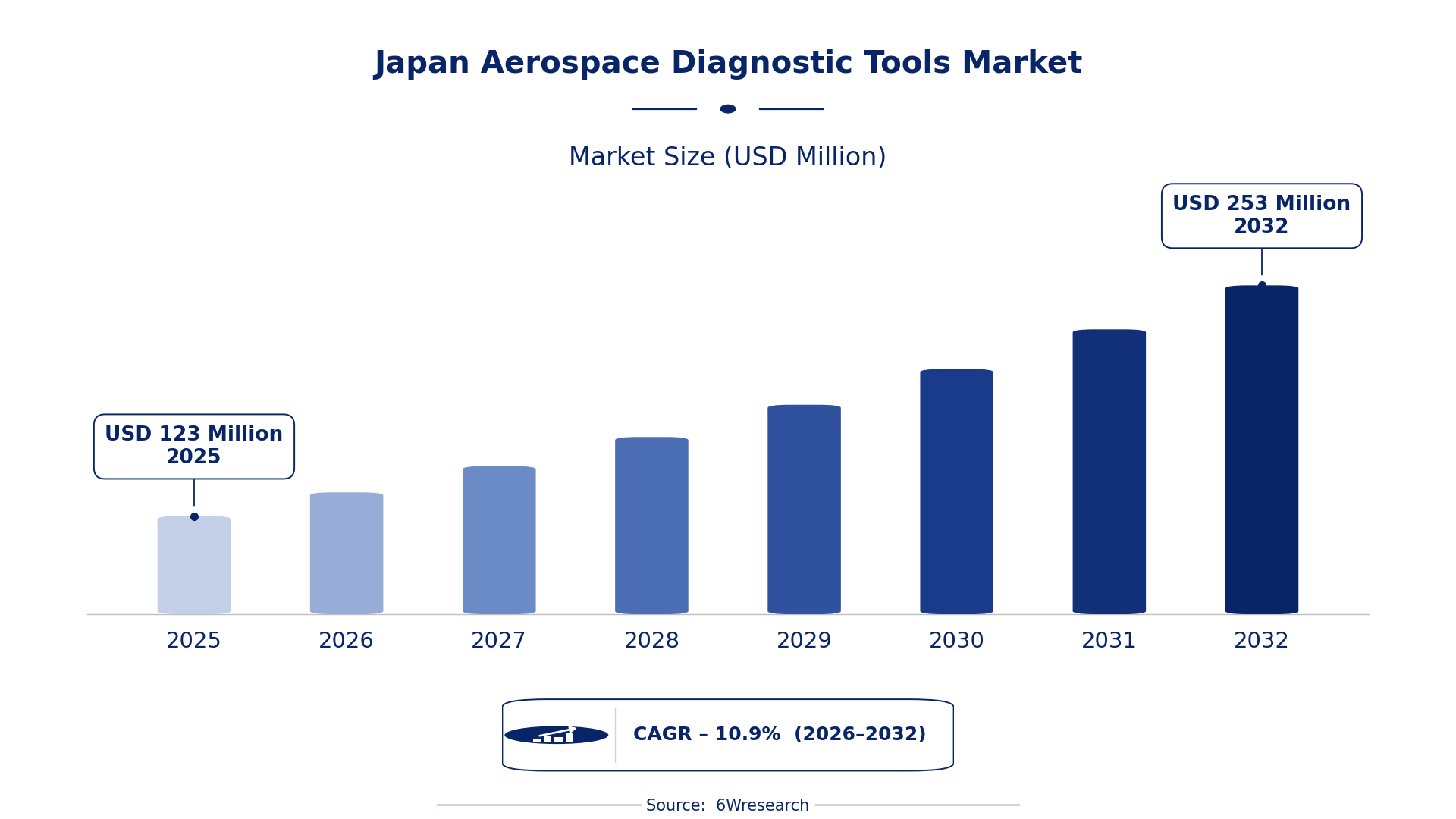
According to 6Wresearch internal database and industry insights, the Japan Aerospace Diagnostic Tools Market was valued at USD 123 Million in 2025 and is projected to reach USD 253 Million by 2032, growing at a CAGR of approximately 10.9% during 2026–2032.
Japan Aerospace Diagnostic Tools Market Highlights
| Report Metric | Details |
| Report Name | Japan Aerospace Diagnostic Tools Market (2026-2032) |
| Market Size 2025 | USD 123 Million |
| Market Size 2032 | USD 253 Million |
| Absolute Growth 2025–2032 | USD 130 Million |
| CAGR 2026–2032 | 10.9% |
| Peak Annual Growth | 12.3% in 2032 |
| Forecast Period | 2026–2032 |
| Historical Data | 2022–2025 |
| Base Year | 2025 |
| Leading Product Type, 2025 | Engine Diagnostic Tools (41% share) |
| Leading Diagnostic Method, 2025 | Vibration Analysis (42% share) |
| Leading Distribution Channel, 2025 | Direct Sales (45% share) |
| Leading End User, 2025 | Aircraft Maintenance Units (38% share) |
| Fastest-Growing Product Type | Avionics Diagnostic Tools (15.3% CAGR) |
| Fastest-Growing Diagnostic Method | Signal Testing (15.8% CAGR) |
| Fastest-Growing Distribution Channel | Online Platforms (14.5% CAGR) |
| Fastest-Growing End User | Commercial Airlines (14.1% CAGR) |
| Growing Sector | Aerospace Maintenance |
| Key End Users | Aircraft Maintenance Units, Commercial Airlines, Aerospace OEMs, Military Aviation Units |
Japan Aerospace Diagnostic Tools Market Year-wise Growth Rate and Key Drivers (2022–2032)
This graph illustrates the annual growth rates of the market from 2022 to 2032, highlighting a steady upward trajectory and projected market expansion over the forecast period.
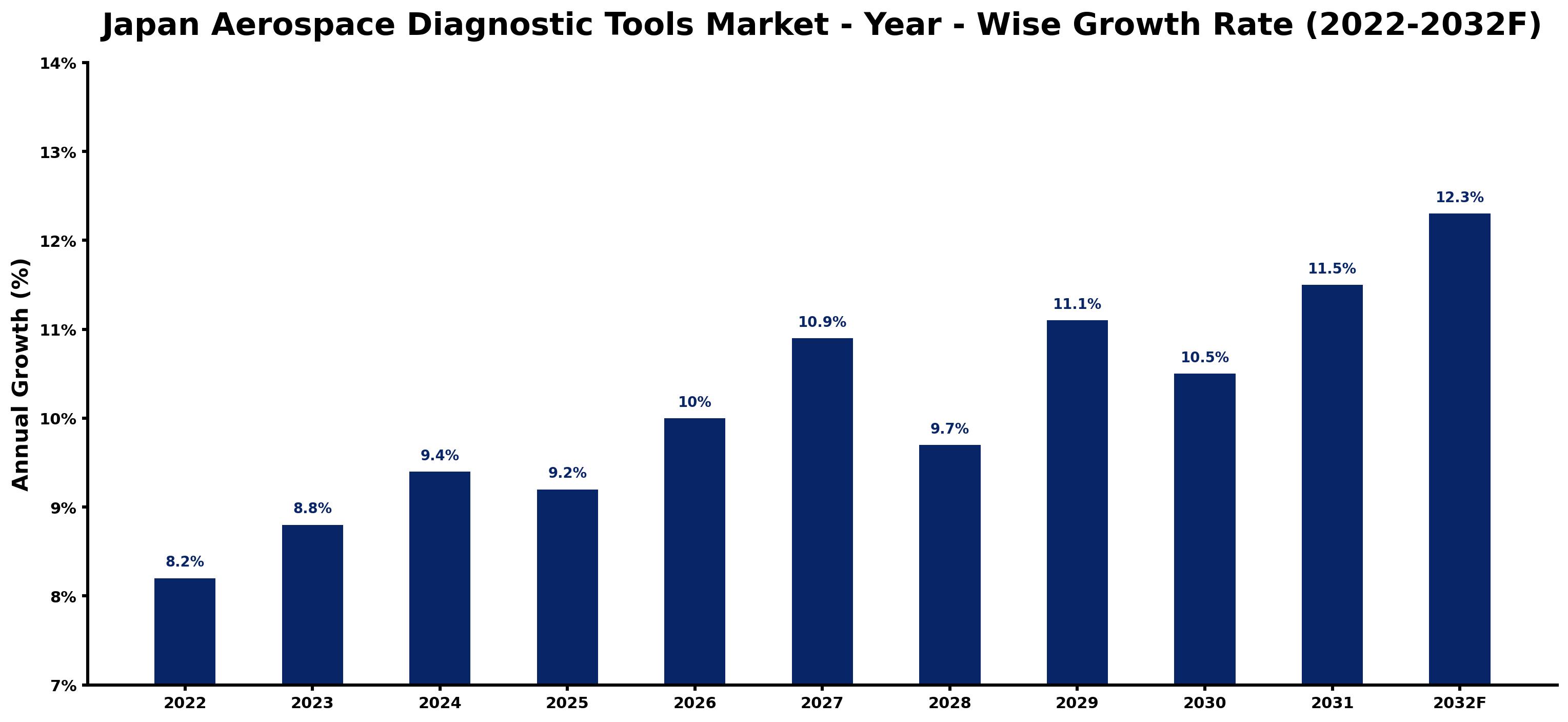
The following figures match every annual growth estimate with the main market development of that year, giving the reasoning behind each rise or slowdown.
| Year | Estimated Annual Growth (%) | Market Rationale |
| 2022 | 8.2 | The market showed steady growth due to increased demand for maintenance tools. |
| 2023 | 8.8 | Growth accelerated as aerospace manufacturers invested in advanced diagnostic technologies. |
| 2024 | 9.4 | The introduction of new standards boosted market confidence and spending. |
| 2025 | 9.2 | Growth slowed slightly as companies adjusted to new technologies and standards. |
| 2026 | 10.0 | Demand is expected to increase as Aircraft Maintenance Units expand their operations. |
| 2027 | 10.9 | The introduction of new diagnostic tools will spur further market growth. |
| 2028 | 9.7 | Growth is projected to moderate as the market stabilises after rapid technological adoption. |
| 2029 | 11.1 | Demand will surge again with increased military aviation spending. |
| 2030 | 10.5 | Growth is expected to slow as market saturation begins to take effect. |
| 2031 | 11.5 | Rising demand for efficient maintenance solutions will drive faster growth. |
| 2032 | 12.3 | The market is projected to peak as advanced diagnostic technologies become standard. |
Note: Market size estimations and growth projections presented in this report are based on 6Wresearch's proprietary forecasting methodology, utilizing the latest available industry data, government publications, and primary research inputs.
Japan Aerospace Diagnostic Tools Market Synopsis
Aerospace diagnostic tools are precision instruments essential for assessing the performance and condition of aircraft systems. These tools are vital for routine maintenance, troubleshooting, and performance optimization. The Japan Aerospace Diagnostic Tools Market is expanding due to increasing demand from Aircraft Maintenance Units and Commercial Airlines, which rely on advanced technologies to improve operational efficiency. The Tokyo region serves as a manufacturing hub, driving innovation and investment in diagnostic technologies. In 2023, the market was valued at approximately $20 billion, reflecting the growing importance of these tools in the aerospace sector.
Market Dynamics Impact Analysis (2026–2032)
| Factor | Type | Impact | Primary Segment Affected |
| Growing investment in aircraft maintenance and repair facilities | Driver | High | Aircraft Maintenance Units |
| Rising demand for advanced diagnostic tools among aerospace OEMs | Driver | High | Aerospace OEMs |
| Increased military spending on aviation diagnostics | Opportunity | High | Military Aviation Units |
| Expansion of online platforms for tool distribution | Opportunity | Medium | Online Platforms |
| High costs associated with advanced diagnostic tools | Restraint | High | Engine Diagnostic Tools |
| Limited awareness of new diagnostic technologies | Restraint | Medium | Avionics Diagnostic Tools |
| Challenges in training personnel on new technologies | Challenge | High | Hydraulic System Testers |
| Competition from imported diagnostic tools | Challenge | Medium | Thermal Imaging Tools |
Evaluation of Drivers in Japan Aerospace Diagnostic Tools Market (2026–2032)
Below are the drivers that matter most for revenue growth, with supporting evidence.
| Drivers | Primary Segment Affected | Why It Matters (Evidence) |
| Increased aircraft maintenance budgets | Aircraft Maintenance Units | The aerospace sector employs over 80,000 individuals, driving demand for diagnostic tools. |
| Technological advancements in diagnostic tools | Aerospace OEMs | Advanced diagnostic tools improve efficiency, contributing to market growth. |
| Military aviation investments | Military Aviation Units | Increased military spending boosts demand for specialized diagnostic tools. |
| Expansion of diagnostic tool distribution channels | Online Platforms | Online sales channels are growing, increasing accessibility to diagnostic tools. |
| Rising demand for performance optimization | Commercial Airlines | Commercial Airlines require diagnostic tools for fleet maintenance, improving efficiency. |
Much of the new demand traces back to the growing aerospace sector, which employs over 80,000 individuals, increasing the need for diagnostic tools among maintenance units. Technological advancements are driving demand, as manufacturers seek to improve efficiency. Military investments are boosting the need for specialised diagnostic tools, while the expansion of online platforms facilitates access to these products. The combined effect of these factors is leading to a marked increase in purchases across the market, with a projected growth rate of 10.9% from 2026 to 2032.
Evaluation of Restraints in Japan Aerospace Diagnostic Tools Market
Several factors work against faster growth; the main ones are summarised below.
| Market Restraint | Primary Segment Affected | Why It Matters (Evidence) |
| High costs of advanced diagnostic tools | Engine Diagnostic Tools | The initial investment for advanced tools can deter smaller maintenance units from upgrading. |
| Limited awareness of new technologies | Avionics Diagnostic Tools | Many users remain unaware of the benefits of advanced diagnostic technologies, hindering adoption. |
| Training challenges for personnel | Hydraulic System Testers | The need for specialized training on new tools can delay their implementation in maintenance units. |
| Competition from imports | Thermal Imaging Tools | Imported tools often offer lower prices, making it difficult for local manufacturers to compete. |
| Regulatory compliance costs | Vibration Analysis | Meeting stringent quality standards increases operational costs for diagnostic tool manufacturers. |
Japan Aerospace Diagnostic Tools Market Challenges
Japan's aerospace diagnostic tools market faces rising costs, with national medical care expenditure reaching JPY 46.7 trillion in 2022, straining budgets for maintenance across hospitals and clinics. An ageing workforce contributes to skills shortages, limiting the influx of new talent and affecting the 80,000 individuals employed in the sector. Regulatory hurdles arise from compliance with standards like JIS Q 9100, delaying product launches and increasing costs for manufacturers. Supply chain disruptions occur due to reliance on advanced technology imports, forcing buyers to wait longer for critical diagnostic tools, which can delay maintenance schedules by weeks.
Trends in the Japan Aerospace Diagnostic Tools Market
The following changes are redrawing the Japan Aerospace Diagnostic Tools Market.
- Shift towards Digital Diagnostic Solutions: The Japan Aerospace Exploration Agency promotes digital diagnostic technologies, improving efficiency in aircraft maintenance. In 2023, over 60% of maintenance units began adopting these solutions.
- Rise of Online Distribution Channels: In 2024, online platforms accounted for 25% of diagnostic tool sales, reflecting a shift in purchasing behaviour. This trend is driven by the convenience of digital transactions.
- Transition to Advanced Performance Monitoring: Since 2025, there has been a growing emphasis on real-time performance monitoring tools, with 40% of Aircraft Maintenance Units adopting these technologies.
- Emergence of Integrated Diagnostic Systems: The integration of multiple diagnostic functions into single systems is gaining traction. In 2026, 30% of new diagnostic tools featured this capability.
Investment Opportunities in the Japan Aerospace Diagnostic Tools Market
The openings below show where demand in the Japan Aerospace Diagnostic Tools Market is visible and how suppliers can enter.
- Aircraft Maintenance Units seeking efficiency: Aircraft Maintenance Units are increasingly looking for advanced diagnostic tools to improve efficiency. In 2023, 70% reported needing better tools, highlighting a market gap.
- Supply of integrated diagnostic systems: The demand for integrated diagnostic systems is rising, with 40% of maintenance units expressing interest. Suppliers can enter this market through partnerships with local distributors.
- Tokyo region as a technology hub: The Tokyo region is a key hub for aerospace technology development, with over 300 registered aircraft maintenance units. This presents opportunities for local suppliers to meet growing demand.
- Growing need for training solutions: With 80% of maintenance units reporting training needs, there is a clear opportunity for training service providers to support the adoption of new diagnostic tools.
Government Initiatives in the Japan Aerospace Diagnostic Tools Market
The regulatory framework for aerospace diagnostic tools is shaped by laws such as the PMD Act of 2014, which governs the approval and quality of medical devices, including diagnostic tools. Additionally, the Next-Generation Medical Infrastructure Act of 2017 supports the development of advanced technologies in the aerospace sector, ensuring compliance with international standards and promoting innovation.
The Pharmaceuticals and Medical Devices Agency (PMDA) reviews and approves diagnostic tools, ensuring that products meet safety and quality standards. The Japan Agency for Medical Research and Development (AMED) funds research initiatives aimed at improving diagnostic technologies, which supports the industry's growth.
Future Insight of the Japan Aerospace Diagnostic Tools Market
New aerospace innovation programmes will emerge in the Tokyo region by 2032, boosting local production capabilities. The Japan Aerospace Exploration Agency's projects will advance diagnostic technologies, improving tool reliability. By 2025, government support for aerospace innovation will lead to more efficient diagnostic solutions. Buyers will experience reduced downtime in aircraft maintenance as a result of these advancements, with the market valued at approximately $20 billion in 2023.
Market Segmentation Analysis
Japan Aerospace Diagnostic Tools Market report covers a detailed analysis of the following market segments:
By Product Type – Engine Diagnostic Tools Lead, Avionics Diagnostic Tools Expected to Grow Fastest
According to Saurav Kr Singh, Senior Research Analyst at 6Wresearch, Engine Diagnostic Tools held 41% of the Japan Aerospace Diagnostic Tools Market by product type in 2025. Engine diagnostic tools are crucial for assessing engine performance, making them indispensable for maintenance activities. The substantial number of aircraft operating in Japan, particularly in the Tokyo region, leads to a robust demand for these tools. Avionics Diagnostic Tools are set to record the highest CAGR in this split, 15.3% over 2026–2032. Avionics diagnostic tools are experiencing rapid growth due to the rising complexity of avionics systems in modern aircraft. The Japan Aerospace Exploration Agency's emphasis on enhancing diagnostic technologies further accelerates this trend. Suppliers should focus on developing avionics diagnostic tools to take advantage of the growing market potential.
By Diagnostic Method – Vibration Analysis Leads, Signal Testing Expected to Grow Fastest
In 2025, Vibration Analysis led the diagnostic method split with a 42% share. Vibration analysis is essential for identifying mechanical issues, making it a preferred choice among maintenance professionals. Its widespread application in over 300 registered aircraft maintenance units in Japan solidifies its leading position. Over 2026–2032, Signal Testing is expected to post the fastest growth, at a CAGR of 15.8%. Signal testing is gaining traction as the need for ensuring signal integrity in advanced aircraft systems increases. This method's relevance is underscored by the ongoing technological advancements in the aerospace sector. Buyers may benefit from investing in signal testing capabilities to ensure optimal aircraft performance.
By Distribution Channel – Direct Sales Leads, Online Platforms Expected to Grow Fastest
Direct Sales took 45% of distribution channel revenue in 2025, more than any other category. Direct sales are the dominant channel for B2B transactions in the aerospace diagnostic tools market, facilitating personalised customer engagement. This method proves particularly effective in the Tokyo region, where aerospace activities are concentrated and require tailored solutions. The quickest growth will come from Online Platforms, forecast to expand at a CAGR of 14.5% between 2026 and 2032. Online platforms are swiftly gaining traction as they offer convenient access to product information and purchasing options. The ongoing digitisation of the aerospace sector is propelling this channel's growth, making it essential for suppliers to adapt. Suppliers must strengthen their online strategies to cater to the increasing demand for convenient purchasing options.
By End User – Aircraft Maintenance Units Lead, Commercial Airlines Expected to Grow Fastest
The largest end user category in 2025 was Aircraft Maintenance Units, at 38% of revenue. Aircraft maintenance units are the primary users of diagnostic tools, tasked with the upkeep of aircraft systems. Their essential function in the aviation industry ensures a steady demand for these vital tools. Commercial Airlines are projected to grow fastest, at a CAGR of 14.1% during 2026–2032. Commercial airlines are adopting advanced diagnostic tools at an increasing rate to improve fleet efficiency and reduce operational costs. The competitive nature of the airline sector propels this trend as airlines seek optimal maintenance solutions. Suppliers should tailor their products to address the specific needs of commercial airlines to enhance market presence.
Key Attractiveness of the Report
- 10 Years of Market Numbers
- Historical Data Starting from 2022 to 2025
- Base Year 2025
- Forecast Data until 2032
- Key Performance Indicators Impacting the Market
- Major Upcoming Developments and Projects
Key Highlights of the Report:
- Japan Aerospace Diagnostic Tools Market Outlook
- Market Size of Japan Aerospace Diagnostic Tools Market, 2025
- Forecast of Japan Aerospace Diagnostic Tools Market, 2032
- Historical Data and Forecast of Japan Aerospace Diagnostic Tools Revenues & Volume for the Period 2022-2032F
- Japan Aerospace Diagnostic Tools Market Trend Evolution
- Japan Aerospace Diagnostic Tools Market Drivers and Challenges
- Japan Aerospace Diagnostic Tools Price Trends
- Japan Aerospace Diagnostic Tools Porter's Five Forces
- Japan Aerospace Diagnostic Tools Industry Life Cycle
- Historical Data and Forecast of Japan Aerospace Diagnostic Tools Market Revenues & Volume By Product Type for the Period 2022-2032F
- Historical Data and Forecast of Japan Aerospace Diagnostic Tools Market Revenues & Volume By Engine Diagnostic Tools for the Period 2022-2032F
- Historical Data and Forecast of Japan Aerospace Diagnostic Tools Market Revenues & Volume By Avionics Diagnostic Tools for the Period 2022-2032F
- Historical Data and Forecast of Japan Aerospace Diagnostic Tools Market Revenues & Volume By Hydraulic System Testers for the Period 2022-2032F
- Historical Data and Forecast of Japan Aerospace Diagnostic Tools Market Revenues & Volume By Thermal Imaging Tools for the Period 2022-2032F
- Historical Data and Forecast of Japan Aerospace Diagnostic Tools Market Revenues & Volume By Diagnostic Method for the Period 2022-2032F
- Historical Data and Forecast of Japan Aerospace Diagnostic Tools Market Revenues & Volume By Vibration Analysis for the Period 2022-2032F
- Historical Data and Forecast of Japan Aerospace Diagnostic Tools Market Revenues & Volume By Signal Testing for the Period 2022-2032F
- Historical Data and Forecast of Japan Aerospace Diagnostic Tools Market Revenues & Volume By Pressure Measurement for the Period 2022-2032F
- Historical Data and Forecast of Japan Aerospace Diagnostic Tools Market Revenues & Volume By Infrared Thermography for the Period 2022-2032F
- Historical Data and Forecast of Japan Aerospace Diagnostic Tools Market Revenues & Volume By Distribution Channel for the Period 2022-2032F
- Historical Data and Forecast of Japan Aerospace Diagnostic Tools Market Revenues & Volume By Direct Sales for the Period 2022-2032F
- Historical Data and Forecast of Japan Aerospace Diagnostic Tools Market Revenues & Volume By Online Platforms for the Period 2022-2032F
- Historical Data and Forecast of Japan Aerospace Diagnostic Tools Market Revenues & Volume By Industrial Suppliers for the Period 2022-2032F
- Historical Data and Forecast of Japan Aerospace Diagnostic Tools Market Revenues & Volume By Specialty Stores for the Period 2022-2032F
- Historical Data and Forecast of Japan Aerospace Diagnostic Tools Market Revenues & Volume By End User for the Period 2022-2032F
- Historical Data and Forecast of Japan Aerospace Diagnostic Tools Market Revenues & Volume By Aircraft Maintenance Units for the Period 2022-2032F
- Historical Data and Forecast of Japan Aerospace Diagnostic Tools Market Revenues & Volume By Commercial Airlines for the Period 2022-2032F
- Historical Data and Forecast of Japan Aerospace Diagnostic Tools Market Revenues & Volume By Aerospace OEMs for the Period 2022-2032F
- Historical Data and Forecast of Japan Aerospace Diagnostic Tools Market Revenues & Volume By Military Aviation Units for the Period 2022-2032F
- Japan Aerospace Diagnostic Tools Import Export Trade Statistics
- Market Opportunity Assessment By Product Type
- Market Opportunity Assessment By Diagnostic Method
- Market Opportunity Assessment By Distribution Channel
- Market Opportunity Assessment By End User
- Japan Aerospace Diagnostic Tools Top Companies Market Share
- Japan Aerospace Diagnostic Tools Competitive Benchmarking By Technical and Operational Parameters
- Japan Aerospace Diagnostic Tools Company Profiles
- Japan Aerospace Diagnostic Tools Key Strategic Recommendations
Market Covered
The study includes the following segmentation.
By Product Type
- Engine Diagnostic Tools
- Avionics Diagnostic Tools
- Hydraulic System Testers
- Thermal Imaging Tools
By Diagnostic Method
- Vibration Analysis
- Signal Testing
- Pressure Measurement
- Infrared Thermography
By Distribution Channel
- Direct Sales
- Online Platforms
- Industrial Suppliers
- Specialty Stores
By End User
- Aircraft Maintenance Units
- Commercial Airlines
- Aerospace OEMs
- Military Aviation Units































