Japan Aerospace Die Casting Market Size & Growth Rate
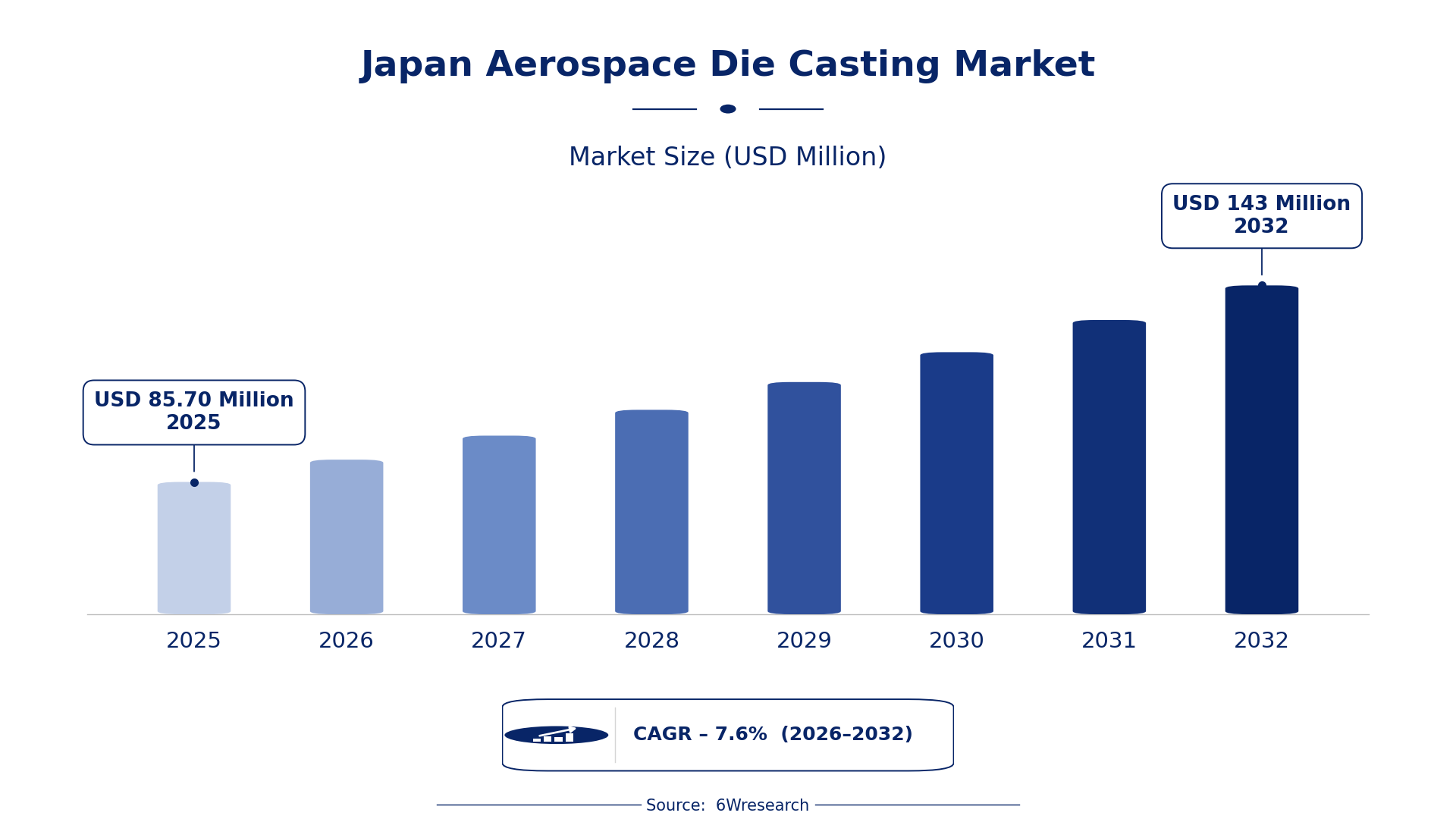
According to 6Wresearch internal database and industry insights, the Japan Aerospace Die Casting Market was valued at USD 85.70 Million in 2025 and is projected to reach USD 143 Million by 2032, growing at a CAGR of approximately 7.6% during 2026–2032.
Japan Aerospace Die Casting Market Highlights
| Report Metric | Details |
| Report Name | Japan Aerospace Die Casting Market (2026-2032) |
| Market Size 2025 | USD 85.70 Million |
| Market Size 2032 | USD 143 Million |
| Absolute Growth 2025–2032 | USD 57.30 Million |
| CAGR 2026–2032 | 7.6% |
| Peak Annual Growth | 8.3% in 2028 |
| Forecast Period | 2026–2032 |
| Historical Data | 2022–2025 |
| Base Year | 2025 |
| Leading Casting Type, 2025 | Gravity Die Casting (41% share) |
| Leading Material Type, 2025 | Aluminum (39% share) |
| Leading Distribution Channel, 2025 | Direct Sales (34% share) |
| Leading End User, 2025 | Aircraft Engine Suppliers (41% share) |
| Fastest-Growing Casting Type | Pressure Die Casting (10.5% CAGR) |
| Fastest-Growing Material Type | Magnesium (11.0% CAGR) |
| Fastest-Growing Distribution Channel | Industrial Suppliers (10.0% CAGR) |
| Fastest-Growing End User | Aerospace OEMs (9.7% CAGR) |
| Growing Sector | Aerospace Manufacturing |
| Key End Users | Aerospace OEMs, Aircraft Engine Suppliers, Defense Contractors, Helicopter Manufacturers |
Japan Aerospace Die Casting Market Year-wise Growth Rate and Key Drivers (2022–2032)
This graph illustrates the annual growth rates of the market from 2022 to 2032, highlighting a steady upward trajectory and projected market expansion over the forecast period.
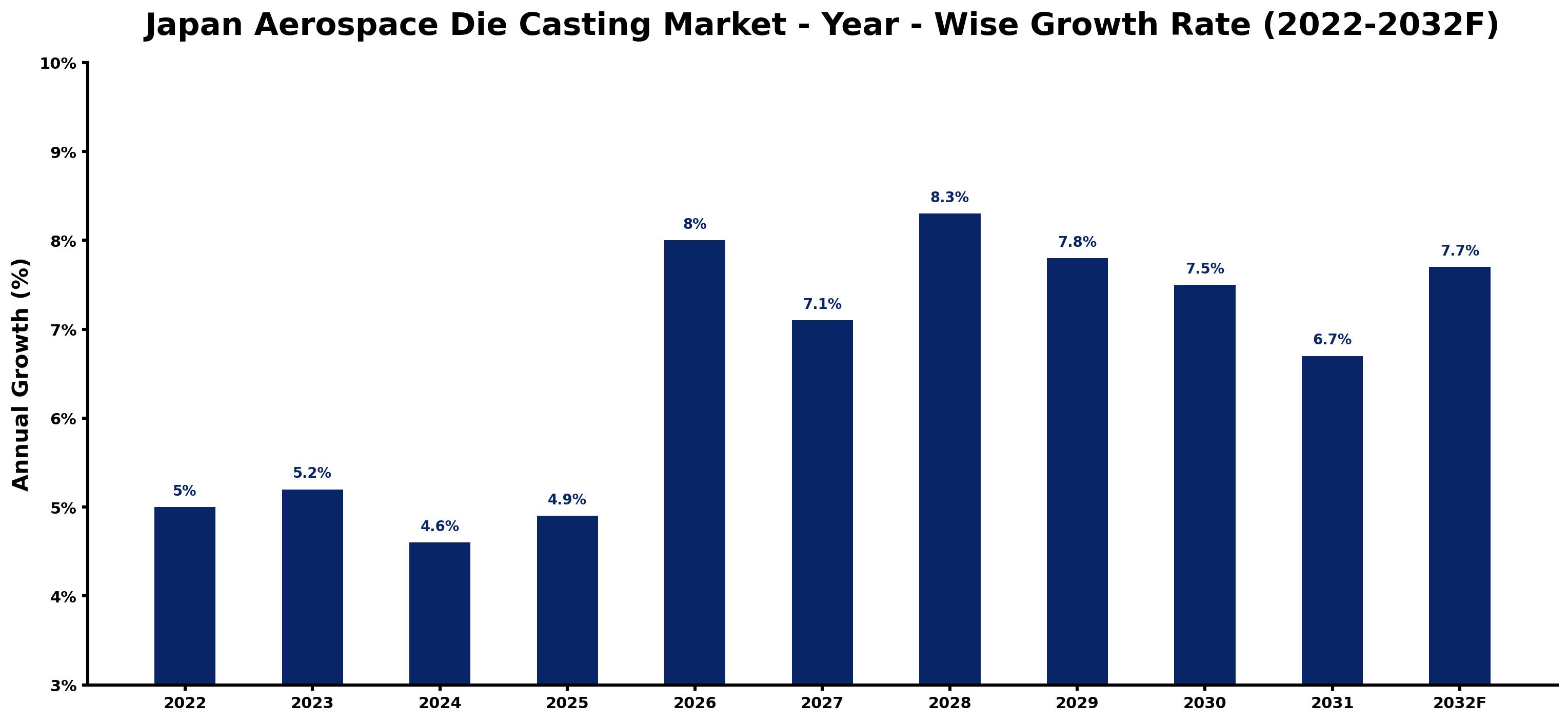
The yearly estimates that follow link every growth rate to its principal driver, so readers can see why the pace changed in each period.
| Year | Estimated Annual Growth (%) | Market Rationale |
| 2022 | 5.0 | The market experienced steady growth due to strong demand from domestic manufacturers. |
| 2023 | 5.2 | Growth accelerated as aerospace OEMs increased investment in new technologies. |
| 2024 | 4.6 | A slowdown occurred as the market adjusted to previous high growth rates. |
| 2025 | 4.9 | Demand improved again as the installed base of aircraft continued to rise. |
| 2026 | 8.0 | A surge in growth is anticipated as pressure die casting becomes more popular for engine components. |
| 2027 | 7.1 | The market will see a slowdown as the growth rate stabilises after rapid increases. |
| 2028 | 8.3 | A peak in growth is projected due to heightened production demands from OEMs. |
| 2029 | 7.8 | The market will experience a slowdown as growth rates begin to normalise. |
| 2030 | 7.5 | A further slowdown is expected as the market adjusts to previous peaks. |
| 2031 | 6.7 | Growth will continue to slow as the market stabilises after rapid expansions. |
| 2032 | 7.7 | Demand is projected to rise again as new technologies are adopted. |
Note: Market size estimations and growth projections presented in this report are based on 6Wresearch's proprietary forecasting methodology, utilizing the latest available industry data, government publications, and primary research inputs.
Japan Aerospace Die Casting Market Synopsis
Aerospace die casting involves pouring molten metal into molds to create components for aircraft engines and airframes. The Japan Aerospace Die Casting Market is expanding as domestic manufacturers invest heavily in technology, with aerospace OEMs expected to invest 2 billion yen by 2025. The Tokyo region remains a manufacturing hub, driving demand for lightweight materials like aluminum and titanium, which are essential for improving aircraft performance and efficiency.
Market Dynamics Impact Analysis (2026–2032)
| Factor | Type | Impact | Primary Segment Affected |
| Increased investment in advanced manufacturing technologies | Driver | High | Pressure Die Casting |
| Growing demand for lightweight components in aerospace applications | Driver | High | Aluminum |
| Rising exports of aerospace components to international markets | Opportunity | High | Aerospace OEMs |
| Expansion of the aircraft fleet in Japan driving component needs | Opportunity | Medium | Aircraft Engine Suppliers |
| High costs associated with advanced material procurement | Restraint | High | Titanium |
| Regulatory compliance costs for hazardous materials management | Restraint | Medium | Aluminum |
| Limited capacity for scaling production to meet demand | Challenge | High | Pressure Die Casting |
| Challenges in maintaining quality standards during production | Challenge | Medium | Gravity Die Casting |
Evaluation of Drivers in Japan Aerospace Die Casting Market (2026–2032)
The table below links each growth driver to the segment it affects and the evidence for it.
| Drivers | Primary Segment Affected | Why It Matters (Evidence) |
| Investment in new technologies by aerospace OEMs | Aerospace OEMs | This investment, expected to reach 2 billion yen by 2025, drives demand for advanced die cast components. |
| Adoption of pressure die casting for engine components | Pressure Die Casting | This method is gaining traction, resulting in increased orders from manufacturers seeking quality. |
| Focus on weight reduction in aircraft design | Aluminum | The average weight reduction target of 20% by 2025 prompts higher demand for lightweight materials. |
| Expansion of the aircraft fleet in Japan | Aircraft Engine Suppliers | With approximately 3,000 aircraft, the need for components continues to grow. |
| Technological advancements in die casting processes | Gravity Die Casting | These advancements improve efficiency and attract more buyers looking for cost-effective solutions. |
What keeps demand rising is the expected investment of 2 billion yen by aerospace OEMs in new technologies by 2025, which drives orders for advanced die cast components. The average weight reduction target of 20% by 2025 prompts increased demand for lightweight materials like aluminum. The expansion of Japan's aircraft fleet continues to fuel the need for aerospace components. The adoption of pressure die casting for engine components improves precision, attracting manufacturers focused on quality. Innovations in die casting processes boost efficiency, encouraging buyers to place more orders.
Evaluation of Restraints in Japan Aerospace Die Casting Market
Several factors work against faster growth; the main ones are summarised below.
| Market Restraint | Primary Segment Affected | Why It Matters (Evidence) |
| High costs associated with titanium procurement | Titanium | The premium price of titanium limits its use in cost-sensitive applications, affecting buyer choices. |
| Regulatory compliance costs for hazardous materials | Aluminum | Compliance with the PRTR Law increases operational costs for manufacturers, impacting pricing. |
| Limited production capacity for specialized components | Pressure Die Casting | Manufacturers face challenges in scaling production to meet rising demand, causing delays. |
| Quality assurance challenges during production | Gravity Die Casting | Maintaining high quality standards is difficult, leading to potential rejections. |
| Supply chain disruptions affecting material availability | Aluminum | Disruptions in the supply chain can delay production schedules, impacting delivery timelines. |
Japan Aerospace Die Casting Market Challenges
Producers encounter a shortage of skilled workers, as the aerospace industry competes with other sectors for talent, delaying production timelines and increasing costs by 20% for manufacturers. Technology adoption remains behind global standards, leading to inefficiencies in die casting processes that can inflate production costs by 15% for suppliers. Material prices have surged, with aluminum costs rising by 10% over the past year, squeezing profit margins for producers. Supply chain disruptions, exacerbated by global events, have resulted in delivery delays of up to four weeks, forcing buyers to adjust their production schedules.
Trends in the Japan Aerospace Die Casting Market
The trends below show where the Japan Aerospace Die Casting Market is heading.
- Shift from Gravity to Pressure Die Casting: Since 2023, manufacturers have increasingly adopted pressure die casting for engine components due to its precision, with usage rising by 15%. This shift improves the quality of aerospace parts produced.
- Transition to Lightweight Materials: The aerospace industry is moving towards lightweight materials like aluminum and titanium, driven by a 20% weight reduction target by 2025. This change is reflected in new aircraft designs across the sector.
- Emergence of Advanced Manufacturing Techniques: The introduction of advanced manufacturing techniques began in 2022, leading to a 10% increase in production efficiency. This trend is reshaping how components are produced in the aerospace sector.
- Focus on Sustainability in Aerospace Production: The Japan Aerospace Exploration Agency has promoted sustainable practices since 2023, resulting in a 30% increase in the use of recycled materials in die casting processes.
Investment Opportunities in the Japan Aerospace Die Casting Market
Where to invest in the Japan Aerospace Die Casting Market: the main openings are set out below.
- Aerospace OEMs seeking advanced components: With a projected investment of 2 billion yen by 2025, aerospace OEMs are looking for high-quality die cast components. Suppliers can enter this market through local partnerships.
- Aircraft Engine Suppliers expanding production: As the installed base of aircraft grows, Aircraft Engine Suppliers are increasing their component orders. This presents an opportunity for suppliers to offer specialized die casting services.
- Growing demand for lightweight materials: The push for a 20% weight reduction in aerospace components creates a demand for aluminum and titanium. Suppliers should focus on providing these materials to meet this need.
- Industrial Suppliers enhancing distribution channels: With a projected growth of 10.0% for Industrial Suppliers, there is a chance to collaborate with these distributors for wider market reach.
Government Initiatives in the Japan Aerospace Die Casting Market
The Economic Security Promotion Act of 2022 impacts aerospace die casting by supporting supply-chain resilience for critical materials. This legislation encourages manufacturers to invest in local production capabilities, ensuring a steady supply of essential components. The Ministry of Economy, Trade and Industry has allocated 5 billion yen for 2023 to support technology development in the aerospace sector, which will improve the capabilities of die casting producers.
Aerospace OEMs benefit from the Economic Security Promotion Act by accessing funding for new technologies. This support allows them to improve production processes and invest in advanced materials, ultimately increasing their competitiveness in the global market. The Aerospace Industry Association of Japan plays a key role in facilitating collaborations among member companies to effectively utilise these government initiatives.
Future Insight of the Japan Aerospace Die Casting Market
A policy-driven shift will transform Japan's aerospace die casting market, with a 5 billion yen budget for technology development driving advancements. The Japan Aerospace Exploration Agency's focus on advanced materials will enable the creation of lighter components, supporting the average weight reduction target of 20% by 2025. Precision die casting technologies will play a vital role in meeting these targets, prompting manufacturers to invest in innovative processes. Domestic production is projected to rise by 30% by 2025, enhancing supply chain reliability for both buyers and suppliers.
Market Segmentation Analysis
Japan Aerospace Die Casting Market report covers a detailed analysis of the following market segments:
By Casting Type – Gravity Die Casting Leads, Pressure Die Casting Expected to Grow Fastest
According to Saurav Kr Singh, Senior Research Analyst at 6Wresearch, in 2025, Gravity Die Casting led the casting type split with a 41% share. Gravity die casting holds the largest share as it is extensively used for producing large, complex parts crucial for aerospace applications. This method is particularly favoured by manufacturers in the Tokyo region, which serves as a significant hub for aerospace production. The quickest growth will come from Pressure Die Casting, forecast to expand at a CAGR of 10.5% between 2026 and 2032. Pressure die casting is witnessing rapid growth due to its capability to provide high precision and superior surface finish for critical components. The increasing demand for lightweight engine parts is prompting manufacturers to adopt this method more frequently, thereby widening its lead. Suppliers should focus on enhancing their pressure die casting capabilities to meet the rising demand for precision-engineered components.
By Material Type – Aluminum Leads, Magnesium Expected to Grow Fastest
With 39% of material type revenue in 2025, Aluminum was the largest category. Aluminum dominates the market as the primary material due to its lightweight and strong properties, making it ideal for various aerospace applications. Its widespread use in aircraft components reflects a robust supply chain and established manufacturing practices in Japan. Magnesium is set to record the highest CAGR in this split, 11.0% over 2026–2032. Magnesium is growing at the fastest rate as it is increasingly utilised in specialised applications aimed at weight reduction, essential for improving fuel efficiency. The aerospace industry's focus on minimising component weight is driving this trend forward. Manufacturers should consider expanding their magnesium die casting capabilities to capture opportunities in the growing niche market.
By Distribution Channel – Direct Sales Leads, Industrial Suppliers Expected to Grow Fastest
Direct Sales accounted for 34% of the market by distribution channel in 2025. Direct sales is the leading distribution channel, commonly employed by aerospace manufacturers to procure components directly from suppliers. This method enhances communication and ensures a clear understanding of specific requirements between buyers and sellers. Over 2026–2032, Industrial Suppliers are expected to post the fastest growth, at a CAGR of 10.0%. Industrial suppliers are the fastest-growing distribution channel, serving as key distributors for aerospace components and offering access to a broader range of products. Their role in streamlining supply chains is becoming increasingly important as demand escalates. Suppliers need to strengthen partnerships with industrial suppliers to enhance their market presence and distribution effectiveness.
By End User – Aircraft Engine Suppliers Lead, Aerospace OEMs Expected to Grow Fastest
Aircraft Engine Suppliers held 41% of the Japan Aerospace Die Casting Market by end user in 2025. Aircraft engine suppliers represent the largest end-user group, as they are major consumers of die cast components necessary for engine assembly. The installed base of aircraft in Japan ensures a steady demand for these critical parts. Aerospace OEMs are projected to grow fastest, at a CAGR of 9.7% during 2026–2032. Aerospace OEMs are the fastest-growing end-user segment, driven by their need for finished die cast parts to meet production targets. Their investments in new technologies are likely to further accelerate this growth. Suppliers should align their production capabilities with the needs of aerospace OEMs to capitalise on this growth opportunity.
Key Attractiveness of the Report
- 10 Years of Market Numbers
- Historical Data Starting from 2022 to 2025
- Base Year 2025
- Forecast Data until 2032
- Key Performance Indicators Impacting the Market
- Major Upcoming Developments and Projects
Key Highlights of the Report:
- Japan Aerospace Die Casting Market Outlook
- Market Size of Japan Aerospace Die Casting Market, 2025
- Forecast of Japan Aerospace Die Casting Market, 2032
- Historical Data and Forecast of Japan Aerospace Die Casting Revenues & Volume for the Period 2022-2032F
- Japan Aerospace Die Casting Market Trend Evolution
- Japan Aerospace Die Casting Market Drivers and Challenges
- Japan Aerospace Die Casting Price Trends
- Japan Aerospace Die Casting Porter's Five Forces
- Japan Aerospace Die Casting Industry Life Cycle
- Historical Data and Forecast of Japan Aerospace Die Casting Market Revenues & Volume By Casting Type for the Period 2022-2032F
- Historical Data and Forecast of Japan Aerospace Die Casting Market Revenues & Volume By Gravity Die Casting for the Period 2022-2032F
- Historical Data and Forecast of Japan Aerospace Die Casting Market Revenues & Volume By Pressure Die Casting for the Period 2022-2032F
- Historical Data and Forecast of Japan Aerospace Die Casting Market Revenues & Volume By Vacuum Die Casting for the Period 2022-2032F
- Historical Data and Forecast of Japan Aerospace Die Casting Market Revenues & Volume By Squeeze Die Casting for the Period 2022-2032F
- Historical Data and Forecast of Japan Aerospace Die Casting Market Revenues & Volume By Material Type for the Period 2022-2032F
- Historical Data and Forecast of Japan Aerospace Die Casting Market Revenues & Volume By Aluminum for the Period 2022-2032F
- Historical Data and Forecast of Japan Aerospace Die Casting Market Revenues & Volume By Magnesium for the Period 2022-2032F
- Historical Data and Forecast of Japan Aerospace Die Casting Market Revenues & Volume By Zinc Alloy for the Period 2022-2032F
- Historical Data and Forecast of Japan Aerospace Die Casting Market Revenues & Volume By Titanium for the Period 2022-2032F
- Historical Data and Forecast of Japan Aerospace Die Casting Market Revenues & Volume By Distribution Channel for the Period 2022-2032F
- Historical Data and Forecast of Japan Aerospace Die Casting Market Revenues & Volume By Direct Sales for the Period 2022-2032F
- Historical Data and Forecast of Japan Aerospace Die Casting Market Revenues & Volume By Industrial Suppliers for the Period 2022-2032F
- Historical Data and Forecast of Japan Aerospace Die Casting Market Revenues & Volume By Online Platforms for the Period 2022-2032F
- Historical Data and Forecast of Japan Aerospace Die Casting Market Revenues & Volume By Specialty Stores for the Period 2022-2032F
- Historical Data and Forecast of Japan Aerospace Die Casting Market Revenues & Volume By End User for the Period 2022-2032F
- Historical Data and Forecast of Japan Aerospace Die Casting Market Revenues & Volume By Aircraft Engine Suppliers for the Period 2022-2032F
- Historical Data and Forecast of Japan Aerospace Die Casting Market Revenues & Volume By Aerospace OEMs for the Period 2022-2032F
- Historical Data and Forecast of Japan Aerospace Die Casting Market Revenues & Volume By Helicopter Manufacturers for the Period 2022-2032F
- Historical Data and Forecast of Japan Aerospace Die Casting Market Revenues & Volume By Defense Contractors for the Period 2022-2032F
- Japan Aerospace Die Casting Import Export Trade Statistics
- Market Opportunity Assessment By Casting Type
- Market Opportunity Assessment By Material Type
- Market Opportunity Assessment By Distribution Channel
- Market Opportunity Assessment By End User
- Japan Aerospace Die Casting Top Companies Market Share
- Japan Aerospace Die Casting Competitive Benchmarking By Technical and Operational Parameters
- Japan Aerospace Die Casting Company Profiles
- Japan Aerospace Die Casting Key Strategic Recommendations
Market Covered
The following segment groups are covered in the report.
By Casting Type
- Gravity Die Casting
- Pressure Die Casting
- Vacuum Die Casting
- Squeeze Die Casting
By Material Type
- Aluminum
- Magnesium
- Zinc Alloy
- Titanium
By Distribution Channel
- Direct Sales
- Industrial Suppliers
- Online Platforms
- Specialty Stores
By End User
- Aircraft Engine Suppliers
- Aerospace OEMs
- Helicopter Manufacturers
- Defense Contractors































