Japan Aerospace Electrical Components Market Size & Growth Rate
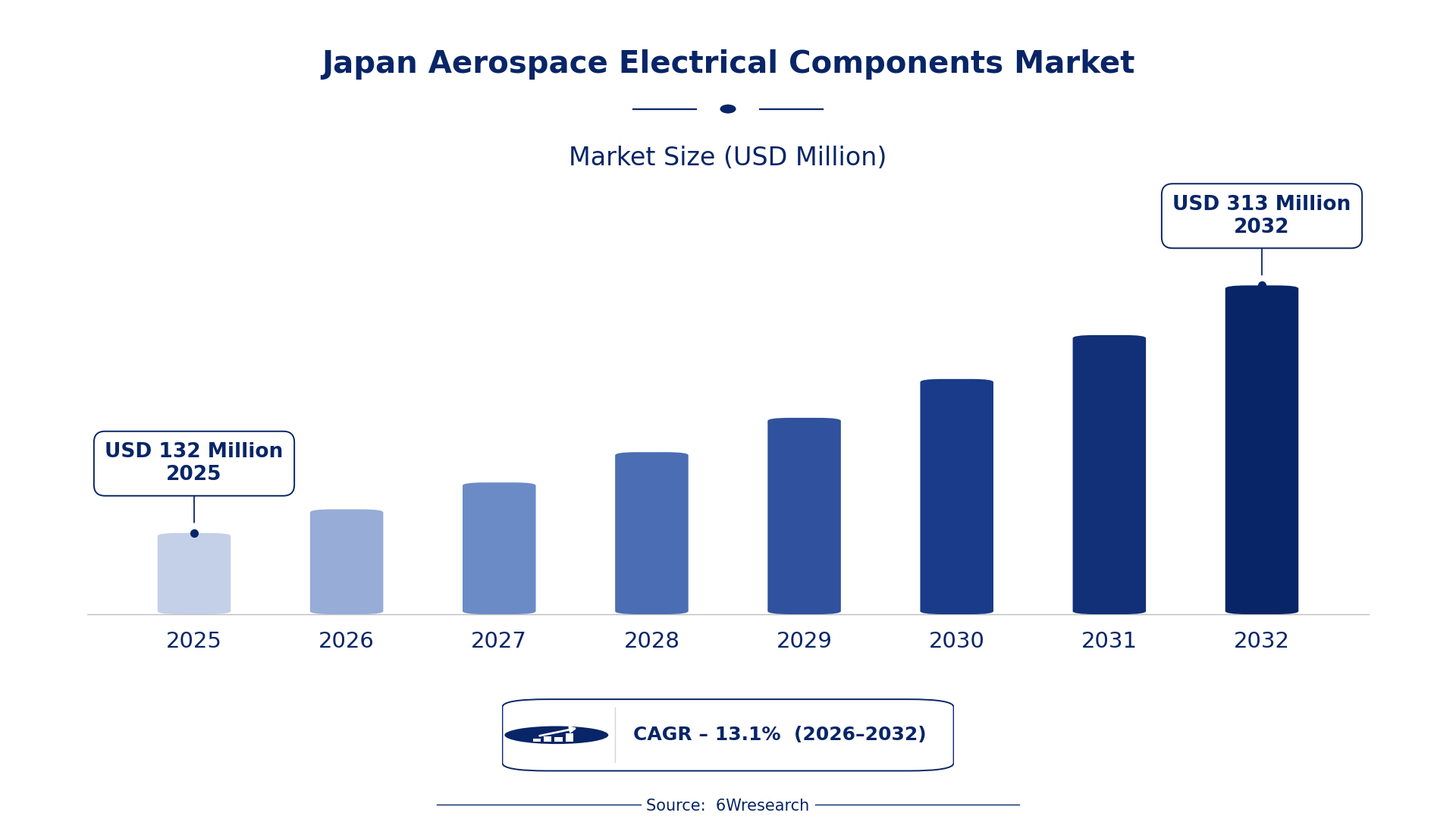
According to 6Wresearch internal database and industry insights, the Japan Aerospace Electrical Components Market was valued at USD 132 Million in 2025 and is projected to reach USD 313 Million by 2032, growing at a CAGR of approximately 13.1% during 2026–2032.
Japan Aerospace Electrical Components Market Highlights
| Report Metric | Details |
| Report Name | Japan Aerospace Electrical Components Market (2026-2032) |
| Market Size 2025 | USD 132 Million |
| Market Size 2032 | USD 313 Million |
| Absolute Growth 2025–2032 | USD 181 Million |
| CAGR 2026–2032 | 13.1% |
| Peak Annual Growth | 14.0% in 2028 |
| Forecast Period | 2026–2032 |
| Historical Data | 2022–2025 |
| Base Year | 2025 |
| Leading Component Type, 2025 | Connectors (43% share) |
| Leading Material Used, 2025 | Aluminum Alloy (55% share) |
| Leading Distribution Channel, 2025 | Direct Sales (40% share) |
| Leading End User, 2025 | Avionics Manufacturers (51% share) |
| Fastest-Growing Component Type | Wiring Harness (18.4% CAGR) |
| Fastest-Growing Material Used | Copper (18.1% CAGR) |
| Fastest-Growing Distribution Channel | Online Platforms (17.2% CAGR) |
| Fastest-Growing End User | Commercial Aircraft Makers (16.7% CAGR) |
| Growing Sector | Aerospace Manufacturing |
| Key End Users | Avionics Manufacturers, Commercial Aircraft Makers, Military Aerospace Units |
Japan Aerospace Electrical Components Market Year-wise Growth Rate and Key Drivers (2022–2032)
This graph illustrates the annual growth rates of the market from 2022 to 2032, highlighting a steady upward trajectory and projected market expansion over the forecast period.
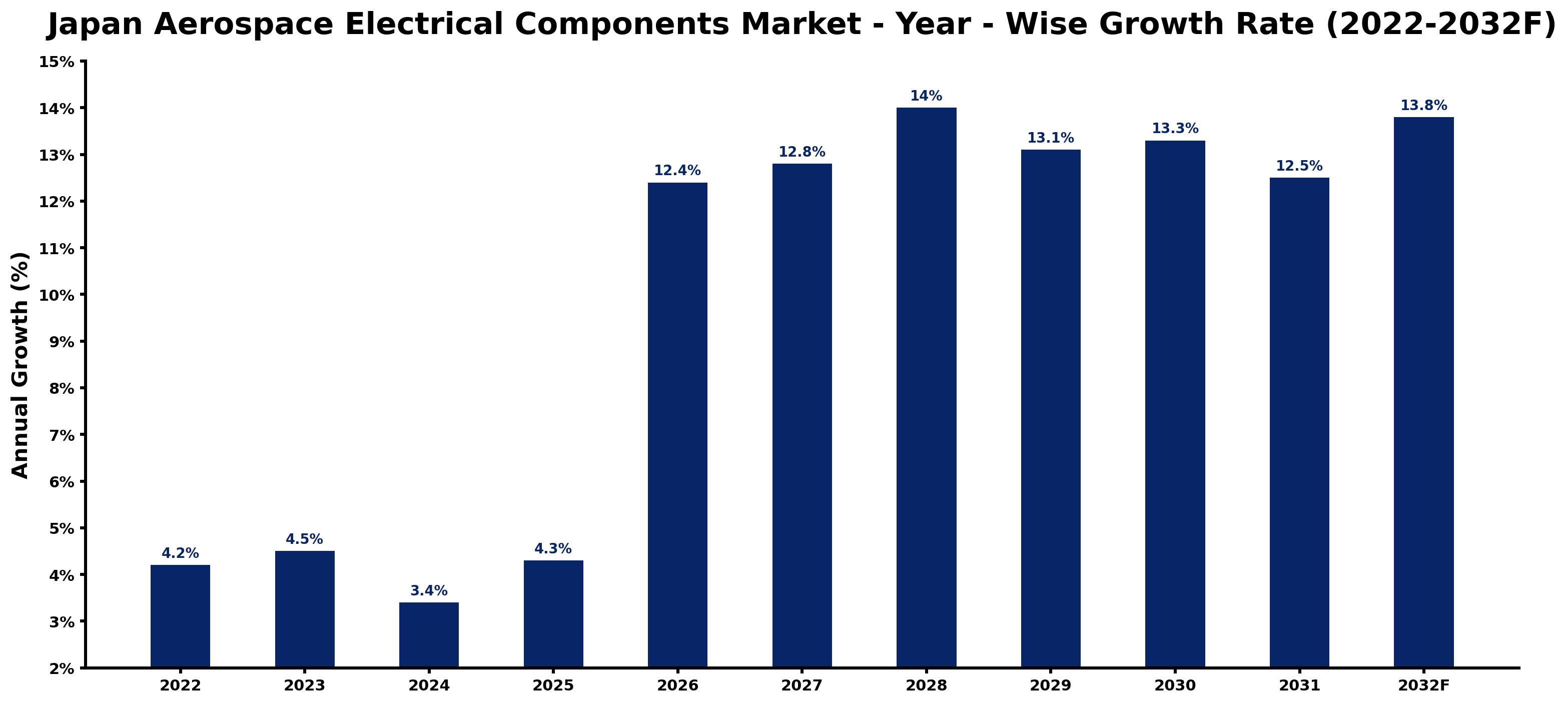
Annual growth estimates for each year appear below with the principal reason behind them, explaining the shifts that set the pace of the market.
| Year | Estimated Annual Growth (%) | Market Rationale |
| 2022 | 4.2 | The market experienced steady growth due to consistent demand from avionics manufacturers. |
| 2023 | 4.5 | Growth accelerated as Japan produced 200 commercial aircraft, increasing component requirements significantly. |
| 2024 | 3.4 | A slight slowdown occurred as production stabilised, but demand remained strong from key sectors. |
| 2025 | 4.3 | Demand picked up again, driven by new projects in the commercial aerospace sector and increased orders. |
| 2026 | 12.4 | Investment in advanced aerospace technologies is expected to drive demand growth significantly. |
| 2027 | 12.8 | Rising defence spending is projected to further boost demand for military aerospace units and components. |
| 2028 | 14.0 | Peak growth is anticipated as new initiatives enhance domestic supply chains and production capabilities. |
| 2029 | 13.1 | Growth will slow slightly as the market stabilises after rapid expansion in previous years. |
| 2030 | 13.3 | Demand is expected to rise again as new projects in commercial aviation gain momentum and require more components. |
| 2031 | 12.5 | A slight slowdown is projected as the market adjusts to previous growth rates and stabilises. |
| 2032 | 13.8 | Continued investment in aerospace technologies is expected to sustain high demand for electrical components. |
Note: Market size estimations and growth projections presented in this report are based on 6Wresearch's proprietary forecasting methodology, utilizing the latest available industry data, government publications, and primary research inputs.
Japan Aerospace Electrical Components Market Synopsis
Aerospace Electrical Components encompass critical systems such as connectors, wiring harnesses, relays, and circuit protection devices that are vital for aircraft operation. The Japan Aerospace Electrical Components Market is growing due to robust demand from avionics manufacturers and ongoing projects in both the commercial and military sectors. The Tokyo region is home to over 50 avionics companies, while the Japan Aerospace Exploration Agency is dedicated to advancing technologies.
Market Dynamics Impact Analysis (2026–2032)
| Factor | Type | Impact | Primary Segment Affected |
| Rising investment in advanced aerospace technologies | Driver | High | Wiring Harness |
| Increased production of commercial aircraft | Driver | High | Connectors |
| Growing demand for military aerospace applications | Opportunity | High | Relays & Switches |
| Expansion of online procurement channels | Opportunity | Medium | Online Platforms |
| Regulatory compliance costs for manufacturers | Restraint | High | Circuit Protection Devices |
| Supply chain disruptions impacting material availability | Restraint | Medium | Copper |
| High costs associated with advanced materials | Challenge | High | Aluminum Alloy |
| Competition from international aerospace suppliers | Challenge | Medium | Avionics Manufacturers |
Evaluation of Drivers in Japan Aerospace Electrical Components Market (2026–2032)
Key forces behind demand, with the segment each one moves most, are listed below.
| Drivers | Primary Segment Affected | Why It Matters (Evidence) |
| Investment in advanced aerospace technologies | Wiring Harness | This investment unlocks demand for complex wiring systems, with wiring harnesses accounting for approximately 30% of total component costs. |
| Increased production of commercial aircraft | Connectors | The production of 200 commercial aircraft in 2022 raised the need for reliable connectors, driving demand significantly. |
| Growing demand for military aerospace applications | Relays & Switches | Increased defense spending is driving demand for reliable relays and switches in military aircraft, boosting market growth. |
| Expansion of online procurement channels | Online Platforms | The shift towards online platforms is increasing accessibility for buyers, leading to higher procurement volumes and efficiency. |
| Focus on lightweight materials | Aluminum Alloy | Aluminum alloys, accounting for 40% of components, are preferred for their lightweight and durable properties, enhancing performance. |
Buyers are adding capacity as investment in advanced aerospace technologies rises, unlocking demand for wiring harnesses, which represent about 30% of total component costs. The production of commercial aircraft in 2022 raised the need for connectors, essential for aircraft systems. Increased defense spending is driving demand for relays and switches in military aerospace applications. The expansion of online procurement channels is improving accessibility for buyers, leading to higher volumes of orders. Aluminum alloys, preferred for their lightweight and durable properties, further support the demand for aerospace electrical components.
Evaluation of Restraints in Japan Aerospace Electrical Components Market
Below are the constraints most often cited by buyers and suppliers, with the segment each affects.
| Market Restraint | Primary Segment Affected | Why It Matters (Evidence) |
| Regulatory compliance costs for manufacturers | Circuit Protection Devices | Compliance with JIS standards for safety increases operational costs for manufacturers of circuit protection devices by approximately 15%. |
| Supply chain disruptions impacting material availability | Copper | Recent global supply chain issues have led to shortages of copper, affecting production timelines and increasing costs. |
| High costs associated with advanced materials | Aluminum Alloy | The rising prices of aluminum alloys, which account for 40% of components, are impacting overall production costs. |
| Limited distribution channels for specialty products | Relays & Switches | The reliance on traditional distribution channels restricts market access for relay and switch products, limiting sales opportunities. |
| Competition from international aerospace suppliers | Avionics Manufacturers | Local avionics manufacturers face pressure from international suppliers offering competitive pricing and advanced technologies, impacting market share. |
Japan Aerospace Electrical Components Market Challenges
Regulatory standards impose compliance costs on manufacturers, as ISO 9001 certification necessitates substantial investment in quality management systems, potentially delaying production timelines for suppliers. Technology adoption is sluggish, with many producers relying on outdated systems, causing inefficiencies that inflate operational costs by 15% for buyers. Competition from international markets intensifies, compelling local firms to reduce prices, which can shrink profit margins by around 10% for domestic manufacturers. Cost pressures rise due to escalating prices of materials like copper, with demand reaching 20,000 tons annually, affecting overall component pricing for buyers.
Trends in the Japan Aerospace Electrical Components Market
Buyers and suppliers in the Japan Aerospace Electrical Components Market are adjusting to the following trends.
- Shift from Traditional to Online Procurement: The aerospace industry is progressively transitioning to online procurement channels, enhancing accessibility for buyers. In 2023, online platforms represented 25% of transactions, facilitating easier access to components.
- Transition from Copper to Aluminium Alloys: The aerospace sector is moving from copper to aluminium alloys for electrical components, driven by the need for lightweight materials. In 2022, aluminium alloys accounted for 40% of all aerospace components, reflecting this shift.
- Emergence of New Safety Standards: New safety standards are being introduced for aerospace electrical components, especially for relays and switches. The updated JIS standards launched in 2023 aim to improve safety and reliability across the industry.
- Increased Focus on Domestic Supply Chains: Japan is prioritising the enhancement of domestic aerospace supply chains, with initiatives initiated in 2023 to strengthen local production capabilities. This is expected to improve supply chain resilience and reduce reliance on imports.
Investment Opportunities in the Japan Aerospace Electrical Components Market
The following areas offer the clearest openings for investors and suppliers in the Japan Aerospace Electrical Components Market.
- Aerospace Electrical Components: The demand for aerospace electrical components is rising, particularly in the Tokyo region, where over 50 avionics manufacturers are located. Investing in local production facilities can capture this growing market, projected to reach USD 132 million by 2025.
- Wiring Harness Production: The wiring harness segment is expanding rapidly, driven by increased aircraft production. Manufacturers in the Tokyo region should consider scaling operations to meet this demand, which is projected to grow considerably due to rising aircraft orders.
- Relays and Switches for Military Applications: Military aerospace units are seeking advanced relays and switches to improve operational efficiency. Suppliers can enter this market by partnering with defence contractors in Japan, capitalising on increased defense spending.
- Online Sales Channels: The shift towards online platforms for procurement presents a timely opportunity for suppliers. Establishing partnerships with major online distributors can facilitate market entry and boost sales volumes.
Government Initiatives in the Japan Aerospace Electrical Components Market
The Electrical Appliance and Material Safety Act of 1961 regulates the safety of electrical components used in aerospace applications. Compliance with this law is essential for manufacturers to ensure product safety and reliability, with over 500 manufacturers affected. The Chemical Substances Control Law mandates the evaluation of chemical substances used in production, further ensuring safety standards are met and impacting production methods.
In 2023, the Japanese government allocated USD 500 million to support aerospace innovation through various funding programmes. The Ministry of Economy, Trade and Industry oversees these initiatives, which aim to strengthen domestic supply chains and promote collaboration among aerospace firms, benefiting numerous local manufacturers.
Future Insight of the Japan Aerospace Electrical Components Market
New aerospace facilities will emerge by 2032, supported by government funding initiatives that strengthen domestic supply chains. The Japan Aerospace Exploration Agency will advance aerospace technologies, driving greater efficiency and innovation in component manufacturing. Wiring harnesses will continue to be a focus, with their costs projected to account for 30% of total component expenses. As defense spending rises, opportunities for suppliers will expand, enabling them to meet the growing demand in the military sector.
Market Segmentation Analysis
Japan Aerospace Electrical Components Market report covers a detailed analysis of the following market segments:
By Component Type – Connectors Lead, Wiring Harness Expected to Grow Fastest
According to Vasu Joshi, Associate Consultant at 6Wresearch, Connectors took 43% of component type revenue in 2025, more than any other category. Connectors are essential for reliable electrical connections in aircraft systems, making them indispensable for avionics manufacturers. The concentration of over 50 avionics companies in the Tokyo region highlights the strong demand for connectors in Japan's aerospace sector. Over 2026–2032, Wiring Harness is expected to post the fastest growth, at a CAGR of 18.4%. Wiring harnesses are experiencing rapid growth due to their critical role in organising and protecting electrical wiring, which constitutes about 30% of total component costs. The surge in commercial aircraft production will further increase the need for efficient wiring solutions. Suppliers must focus on enhancing wiring harness offerings to align with the growing market demand.
By Material Used – Aluminum Alloy Leads, Copper Expected to Grow Fastest
The largest material used category in 2025 was Aluminum Alloy, at 55% of revenue. Aluminum alloys are widely used in aerospace components due to their lightweight and durable properties, making them the preferred choice for manufacturers. This material accounts for 40% of aerospace components, underscoring its importance in aircraft production. Copper is projected to grow fastest, at a CAGR of 18.1% during 2026–2032. Copper is gaining traction as a key material for electrical conductivity, with an annual demand of approximately 20,000 tons. As the need for efficient electrical systems in aircraft rises, the demand for copper components will continue to grow. Buyers should consider sourcing more copper components to meet the increasing demands of electrical systems.
By Distribution Channel – Direct Sales Leads, Online Platforms Expected to Grow Fastest
In 2025, Direct Sales led the distribution channel split with a 40% share. Direct sales remain the primary channel for B2B transactions in the aerospace electrical components market, allowing manufacturers to establish strong relationships with clients. This approach is particularly effective in Japan's tightly-knit aerospace sector. The quickest growth will come from Online Platforms, forecast to expand at a CAGR of 17.2% between 2026 and 2032. Online platforms are emerging as a growing channel for procurement, enabling quicker access to a wider range of products. As more companies embrace digital transformation, this channel will likely expand rapidly. Suppliers must invest in online platforms to reach a broader audience and remain competitive.
By End User – Avionics Manufacturers Lead, Commercial Aircraft Makers Expected to Grow Fastest
Avionics Manufacturers accounted for 51% of the market by end user in 2025. Avionics manufacturers are the primary consumers of electrical components, relying on them for the safe and efficient operation of critical aircraft systems. Their substantial role in Japan's aerospace industry drives a consistent demand for these essential components. Commercial Aircraft Makers are set to record the highest CAGR in this split, 16.7% over 2026–2032. Commercial aircraft makers are experiencing notable growth, spurred by the production of 200 commercial aircraft in 2022. This increase in manufacturing activity will lead to a heightened demand for electrical components. Suppliers must tailor their offerings to address the specific requirements of commercial aircraft makers.
Key Attractiveness of the Report
- 10 Years of Market Numbers
- Historical Data Starting from 2022 to 2025
- Base Year 2025
- Forecast Data until 2032
- Key Performance Indicators Impacting the Market
- Major Upcoming Developments and Projects
Key Highlights of the Report:
- Japan Aerospace Electrical Components Market Outlook
- Market Size of Japan Aerospace Electrical Components Market, 2025
- Forecast of Japan Aerospace Electrical Components Market, 2032
- Historical Data and Forecast of Japan Aerospace Electrical Components Revenues & Volume for the Period 2022-2032F
- Japan Aerospace Electrical Components Market Trend Evolution
- Japan Aerospace Electrical Components Market Drivers and Challenges
- Japan Aerospace Electrical Components Price Trends
- Japan Aerospace Electrical Components Porter's Five Forces
- Japan Aerospace Electrical Components Industry Life Cycle
- Historical Data and Forecast of Japan Aerospace Electrical Components Market Revenues & Volume By Component Type for the Period 2022-2032F
- Historical Data and Forecast of Japan Aerospace Electrical Components Market Revenues & Volume By Connectors for the Period 2022-2032F
- Historical Data and Forecast of Japan Aerospace Electrical Components Market Revenues & Volume By Wiring Harness for the Period 2022-2032F
- Historical Data and Forecast of Japan Aerospace Electrical Components Market Revenues & Volume By Relays & Switches for the Period 2022-2032F
- Historical Data and Forecast of Japan Aerospace Electrical Components Market Revenues & Volume By Circuit Protection Devices for the Period 2022-2032F
- Historical Data and Forecast of Japan Aerospace Electrical Components Market Revenues & Volume By Material Used for the Period 2022-2032F
- Historical Data and Forecast of Japan Aerospace Electrical Components Market Revenues & Volume By Aluminum Alloy for the Period 2022-2032F
- Historical Data and Forecast of Japan Aerospace Electrical Components Market Revenues & Volume By Copper for the Period 2022-2032F
- Historical Data and Forecast of Japan Aerospace Electrical Components Market Revenues & Volume By Composite Plastics for the Period 2022-2032F
- Historical Data and Forecast of Japan Aerospace Electrical Components Market Revenues & Volume By Ceramic for the Period 2022-2032F
- Historical Data and Forecast of Japan Aerospace Electrical Components Market Revenues & Volume By Distribution Channel for the Period 2022-2032F
- Historical Data and Forecast of Japan Aerospace Electrical Components Market Revenues & Volume By Direct Sales for the Period 2022-2032F
- Historical Data and Forecast of Japan Aerospace Electrical Components Market Revenues & Volume By Online Platforms for the Period 2022-2032F
- Historical Data and Forecast of Japan Aerospace Electrical Components Market Revenues & Volume By Industrial Suppliers for the Period 2022-2032F
- Historical Data and Forecast of Japan Aerospace Electrical Components Market Revenues & Volume By Specialty Stores for the Period 2022-2032F
- Historical Data and Forecast of Japan Aerospace Electrical Components Market Revenues & Volume By End User for the Period 2022-2032F
- Historical Data and Forecast of Japan Aerospace Electrical Components Market Revenues & Volume By Avionics Manufacturers for the Period 2022-2032F
- Historical Data and Forecast of Japan Aerospace Electrical Components Market Revenues & Volume By Commercial Aircraft Makers for the Period 2022-2032F
- Historical Data and Forecast of Japan Aerospace Electrical Components Market Revenues & Volume By Helicopter Assemblers for the Period 2022-2032F
- Historical Data and Forecast of Japan Aerospace Electrical Components Market Revenues & Volume By Military Aerospace Units for the Period 2022-2032F
- Japan Aerospace Electrical Components Import Export Trade Statistics
- Market Opportunity Assessment By Component Type
- Market Opportunity Assessment By Material Used
- Market Opportunity Assessment By Distribution Channel
- Market Opportunity Assessment By End User
- Japan Aerospace Electrical Components Top Companies Market Share
- Japan Aerospace Electrical Components Competitive Benchmarking By Technical and Operational Parameters
- Japan Aerospace Electrical Components Company Profiles
- Japan Aerospace Electrical Components Key Strategic Recommendations
Market Covered
Coverage by segment is as follows.
By Component Type
- Connectors
- Wiring Harness
- Relays & Switches
- Circuit Protection Devices
By Material Used
- Aluminum Alloy
- Copper
- Composite Plastics
- Ceramic
By Distribution Channel
- Direct Sales
- Online Platforms
- Industrial Suppliers
- Specialty Stores
By End User
- Avionics Manufacturers
- Commercial Aircraft Makers
- Helicopter Assemblers
- Military Aerospace Units































