Japan Agentic Artificial Intelligence in Retail and E-commerce Market Size & Growth Rate
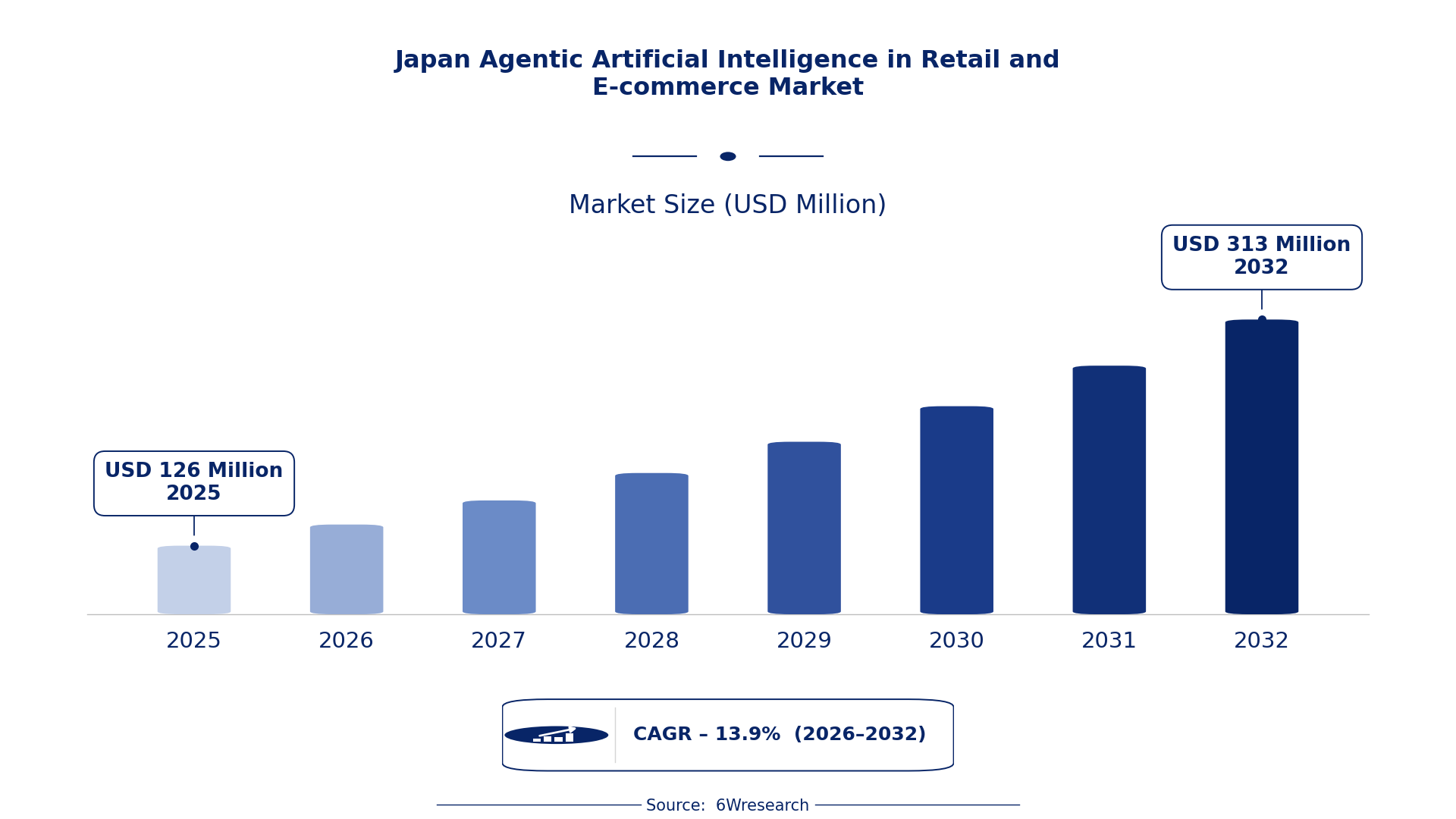
According to 6Wresearch internal database and industry insights, the Japan Agentic Artificial Intelligence in Retail and E-commerce Market was valued at USD 126 Million in 2025 and is projected to reach USD 313 Million by 2032, growing at a CAGR of approximately 13.9% during 2026–2032.
Japan Agentic Artificial Intelligence in Retail and E-commerce Market Highlights
| Report Metric | Details |
| Report Name | Japan Agentic Artificial Intelligence in Retail and E-commerce Market (2026-2032) |
| Market Size 2025 | USD 126 Million |
| Market Size 2032 | USD 313 Million |
| Absolute Growth 2025–2032 | USD 187 Million |
| CAGR 2026–2032 | 13.9% |
| Peak Annual Growth | 15.4% in 2026 |
| Forecast Period | 2026–2032 |
| Historical Data | 2022–2025 |
| Base Year | 2025 |
| Leading Technology Type, 2025 | AI Agents (47% share) |
| Leading Functionality, 2025 | Customer Engagement (35% share) |
| Leading Application Area, 2025 | Recommendations (35% share) |
| Leading Distribution Channel, 2025 | SaaS Platforms (35% share) |
| Leading End User, 2025 | E-commerce Chains (47% share) |
| Fastest-Growing Technology Type | Personalization AI (19.7% CAGR) |
| Fastest-Growing Application Area | Pricing & Offers (16.6% CAGR) |
| Fastest-Growing Distribution Channel | Cloud-based (17.5% CAGR) |
| Fastest-Growing End User | Online Stores (18.0% CAGR) |
| Growing Sector | E-commerce |
| Key End Users | Retailers, E-commerce Chains, Online Stores, Retail Operators |
Japan Agentic Artificial Intelligence in Retail and E-commerce Market Year-wise Growth Rate and Key Drivers (2022–2032)
This graph illustrates the annual growth rates of the market from 2022 to 2032, highlighting a steady upward trajectory and projected market expansion over the forecast period.
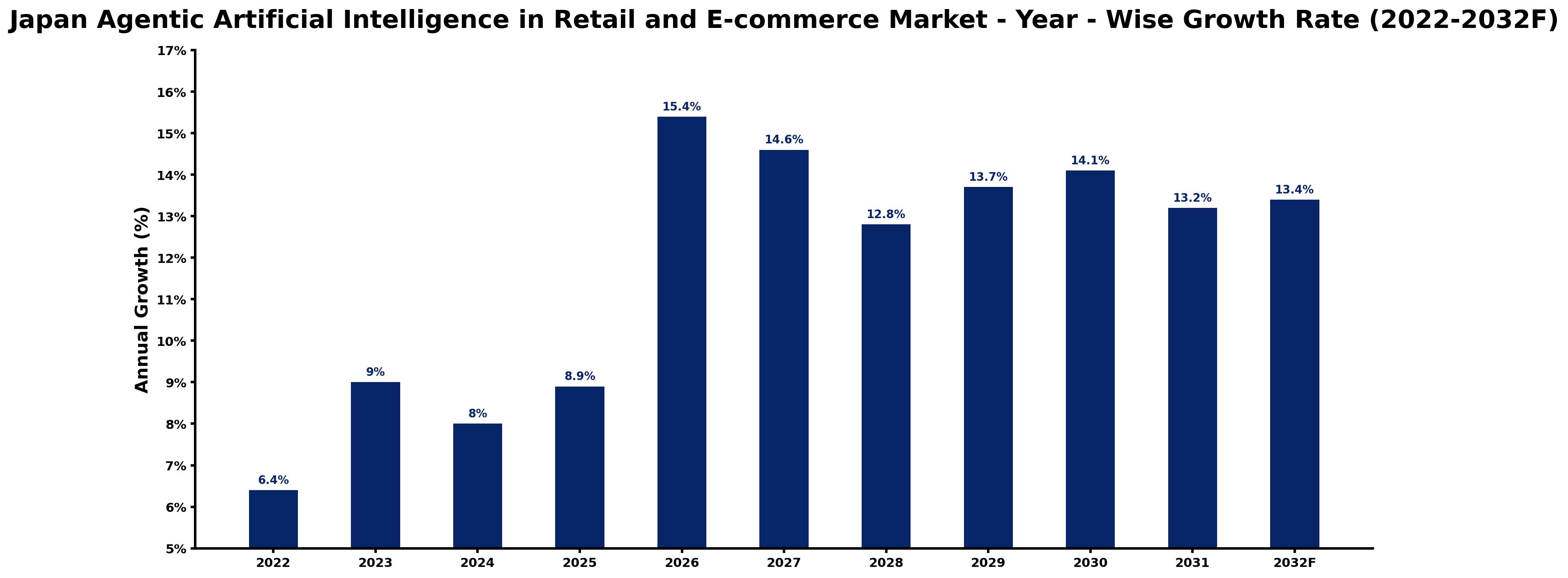
Year by year, the estimates below pair each growth rate with the development that shaped it.
| Year | Estimated Annual Growth (%) | Market Rationale |
| 2022 | 6.4 | The market experienced steady growth, reflecting increased interest in AI solutions. |
| 2023 | 9.0 | Demand surged as retailers adopted AI technologies to improve customer engagement. |
| 2024 | 8.0 | Growth slowed due to market saturation in certain AI applications. |
| 2025 | 8.9 | Investment in AI solutions rose, driven by competitive pressures in retail. |
| 2026 | 15.4 | A notable spike in growth is expected as new AI technologies are introduced. |
| 2027 | 14.6 | The market will see a slight slowdown as early adopters reach operational capacity. |
| 2028 | 12.8 | Growth is projected to continue decelerating as the market matures and competition intensifies. |
| 2029 | 13.7 | Demand is expected to rebound as innovative AI applications gain traction in retail. |
| 2030 | 14.1 | Growth will remain strong, supported by increased consumer spending in e-commerce. |
| 2031 | 13.2 | A minor slowdown is anticipated as the market adjusts to new technology standards. |
| 2032 | 13.4 | Growth is projected to accelerate again as AI integration becomes essential for retailers. |
Note: Market size estimations and growth projections presented in this report are based on 6Wresearch's proprietary forecasting methodology, utilizing the latest available industry data, government publications, and primary research inputs.
Japan Agentic Artificial Intelligence in Retail and E-commerce Market Synopsis
Agentic Artificial Intelligence in Retail and E-commerce refers to AI systems that autonomously make decisions and interact with customers. In Japan, the retail and e-commerce sectors are thriving, driven by technological advancements and consumer preferences for online shopping. The Japan Agentic Artificial Intelligence in Retail and E-commerce Market is expanding due to over 70% of retailers investing in AI solutions and the e-commerce market reaching ¥19 trillion in 2022, underscoring a strong shift towards digital transformation.
Market Dynamics Impact Analysis (2026–2032)
| Factor | Type | Impact | Primary Segment Affected |
| Increased investment in AI technologies among retailers | Driver | High | AI Agents |
| Rising consumer preference for personalized shopping experiences | Driver | High | Personalization AI |
| Growing demand for efficient inventory management solutions | Opportunity | High | Inventory Management |
| Expansion of e-commerce platforms necessitating advanced AI tools | Opportunity | High | Online Platforms |
| High initial costs of AI implementation for small retailers | Restraint | Medium | Retailers |
| Limited availability of skilled AI professionals in the market | Restraint | Medium | E-commerce Chains |
| Competition from international AI providers affecting local firms | Challenge | High | Online Stores |
| Rapid technological changes leading to obsolescence of existing systems | Challenge | High | Retail Operators |
Evaluation of Drivers in Japan Agentic Artificial Intelligence in Retail and E-commerce Market (2026–2032)
Key forces behind demand, with the segment each one moves most, are listed below.
| Drivers | Primary Segment Affected | Why It Matters (Evidence) |
| High adoption of AI technologies by retailers to improve customer engagement | AI Agents | Over 70% of retailers are investing in AI solutions, resulting in increased orders. |
| Consumer demand for personalized shopping experiences drives AI adoption | Personalization AI | The average online shopper in Japan spends about ¥80,000 annually, prompting tailored solutions. |
| The rise of e-commerce necessitates advanced AI tools for operational efficiency | Inventory Management | Japan's e-commerce market reached ¥19 trillion in 2022, boosting demand for AI tools. |
| Technological advancements in AI systems improve decision-making processes | Conversational AI | The Tokyo region is a hub for AI technology development, driving innovation in the sector. |
| Investment in AI solutions provides a competitive advantage among retailers | Predictive AI | The AI and Robotics Investment Program launched in 2023 supports industry growth. |
Behind the steady rise in orders sits a marked increase in the adoption of AI technologies among retailers, with over 70% investing in these solutions to improve customer engagement. Demand for personalised experiences drives further AI adoption, as the average online shopper spends about ¥80,000 annually. The e-commerce market, valued at ¥19 trillion in 2022, necessitates efficient management solutions powered by AI. These elements contribute to rising demand for agentic AI systems in retail and e-commerce.
Evaluation of Restraints in Japan Agentic Artificial Intelligence in Retail and E-commerce Market
Several factors work against faster growth; the main ones are summarised below.
| Market Restraint | Primary Segment Affected | Why It Matters (Evidence) |
| High initial costs of implementing AI solutions for smaller retailers | Retailers | Smaller retailers struggle with the financial burden of integrating advanced AI technologies. |
| Limited availability of skilled professionals in AI technology | E-commerce Chains | The Japan AI Strategy aims to double AI professionals by 2025, but shortages persist. |
| Intense competition from international AI providers affecting local market share | Online Stores | Local firms face challenges competing against established global AI solution providers. |
| Rapid technological changes leading to obsolescence of existing systems | Retail Operators | Frequent updates in AI technology require ongoing investment to stay competitive. |
| Concerns over data privacy and security in AI applications | AI Agents | ISO/IEC 27001 compliance is necessary, adding complexity to implementation. |
Japan Agentic Artificial Intelligence in Retail and E-commerce Market Challenges
High implementation costs for agentic AI systems limit adoption among retailers, delaying their digital transformation efforts and potentially costing them significant market share. Skills shortages in AI and data analytics hinder suppliers' ability to develop and maintain these systems, resulting in project timelines that can extend by six months for smaller retailers. Compliance with information security standards like ISO/IEC 27001 adds operational costs, increasing project budgets by approximately 15%. Intense competition for AI talent drives up salaries, making it difficult for smaller retailers to attract skilled professionals and stalling their technological advancements.
Trends in the Japan Agentic Artificial Intelligence in Retail and E-commerce Market
These developments are changing demand patterns in the Japan Agentic Artificial Intelligence in Retail and E-commerce Market.
- Shift from Traditional to AI-Driven Customer Engagement: Retailers are increasingly adopting AI-driven solutions for customer engagement, with over 70% investing in these technologies. This shift is reflected in the Tokyo region, where AI technology development is thriving, indicating a growing trend towards automation.
- Transition from Manual to Automated Inventory Management: The move towards automated inventory management is gaining traction among retailers, particularly in e-commerce. In 2023, the average online store in Japan is expected to implement AI solutions to optimise stock levels, improving operational efficiency.
- Emergence of Personalized Shopping Experiences: Personalisation AI is becoming a priority for retailers aiming to improve customer experience. As of 2023, the average online shopper spends around ¥80,000 annually, prompting retailers to invest in tailored recommendations.
- Prioritisation of Cloud-Based AI Solutions: Cloud-based AI solutions are increasingly preferred by retailers for their scalability and accessibility. The SaaS Platforms segment leads the market, holding a 35% share in 2025, reflecting a shift towards subscription-based models.
Investment Opportunities in the Japan Agentic Artificial Intelligence in Retail and E-commerce Market
Several openings in the Japan Agentic Artificial Intelligence in Retail and E-commerce Market merit attention from investors.
- Timing for Investment in AI Solutions: With the e-commerce market reaching ¥19 trillion in 2022, there is a gap in AI adoption among smaller retailers. Investing in AI solutions now can help these retailers improve operational efficiency and customer engagement.
- Need for Advanced AI Tools in E-commerce: The demand for AI tools is rising as e-commerce platforms expand. The Japan External Trade Organization supports AI startups, providing opportunities for investment in new solutions.
- Growing Demand for Personalization in Retail: As consumer preferences shift towards personalised experiences, retailers are seeking AI-driven solutions. Investing in Personalisation AI can cater to this demand, especially in urban areas like Tokyo.
- Expansion of AI Applications in Inventory Management: With the total number of online stores in Japan expected to exceed 1 million, there is a growing need for AI in inventory management. Suppliers can enter this market by partnering with local retailers.
Government Initiatives in the Japan Agentic Artificial Intelligence in Retail and E-commerce Market
The Digital Agency, established in September 2021, leads Japan's digital transformation efforts, setting common system standards for AI applications. This initiative complements existing laws like the Long-Term Care Insurance Act, which supports technological integration in various sectors, improving the operational capacity of AI in retail. By 2025, the Japan AI Strategy aims to double the number of AI professionals, expanding the talent pool for AI applications in retail.
The Japan External Trade Organization plays a crucial role in supporting AI startups in retail. By providing funding and resources, it enables these startups to innovate and implement AI solutions effectively, ensuring that buyers can access the latest technologies.
Future Insight of the Japan Agentic Artificial Intelligence in Retail and E-commerce Market
Buyers will increasingly rely on agentic AI to enhance user experiences and streamline operations by 2032. The digital transformation initiative from the Ministry of Economy, Trade and Industry will accelerate AI adoption across various sectors. The Japan AI Strategy aims to double the number of AI professionals by 2025, which will expand the talent pool for suppliers. With e-commerce transactions reaching 2 billion annually, buyers will benefit from improved pricing strategies and personalised shopping experiences.
Market Segmentation Analysis
Japan Agentic Artificial Intelligence in Retail and E-commerce Market report covers a detailed analysis of the following market segments:
By Technology Type – AI Agents Lead, Personalization AI Expected to Grow Fastest
According to Ayushi Shukla, Senior Research Analyst at 6Wresearch, the largest technology type category in 2025 was AI Agents, at 47% of revenue. AI Agents hold the largest share due to their direct role in facilitating automated customer interactions, which are essential for enhancing user experience in the retail sector. The Tokyo region serves as a significant hub for technology development, driving widespread adoption among businesses. The quickest growth will come from Personalization AI, forecast to expand at a CAGR of 19.7% between 2026 and 2032. Personalization AI is experiencing rapid growth as it significantly enhances customer experience through tailored recommendations, which are increasingly important for driving consumer engagement. With the e-commerce penetration rate in Japan around 30% as of 2023, demand for personalised solutions is expected to rise. Suppliers should focus on developing AI Agents and Personalization AI to meet the growing demand from the retail sector.
By Functionality – Customer Engagement Leads and Records the Fastest Growth
Customer Engagement accounted for 35% of the market by functionality in 2025. Customer Engagement leads the market as it greatly improves interactions through targeted marketing strategies, which are vital for customer retention in a competitive environment. The recent digital transformation initiative launched by the Ministry of Economy, Trade and Industry in 2023 highlights the emphasis on enhancing customer engagement. Customer Engagement is also forecast to expand faster than any other category, at a CAGR of 17.6% over 2026–2032. The emphasis on Customer Engagement as the fastest-growing functionality indicates that businesses are prioritising improved interactions to boost sales. This trend suggests that demand for engagement solutions will continue to increase as companies adapt to evolving market needs. Buyers should invest in Customer Engagement solutions to improve their marketing effectiveness and strengthen customer loyalty.
By Application Area – Recommendations Lead, Pricing & Offers Expected to Grow Fastest
Recommendations took 35% of application area revenue in 2025, more than any other category. Recommendations hold the largest share as they suggest products based on user behaviour, which is vital for driving sales in the e-commerce sector. The total number of e-commerce transactions in Japan reached 2 billion in 2022, underscoring the effectiveness of recommendation systems. Over 2026–2032, Pricing & Offers are expected to post the fastest growth, at a CAGR of 16.6%. Pricing & Offers are growing rapidly as they dynamically adjust prices based on market conditions, enabling retailers to optimise sales strategies. The e-commerce penetration rate in Japan is around 30% as of 2023, creating a need for agile pricing solutions. Suppliers should develop advanced pricing strategies to capitalise on the growing demand for dynamic pricing solutions.
By Distribution Channel – SaaS Platforms Lead, Cloud-based Expected to Grow Fastest
In 2025, SaaS Platforms led the distribution channel split with a 35% share. SaaS Platforms lead the market by delivering AI solutions via subscription models, allowing businesses to easily adopt advanced technologies. The Tokyo region is a hub for AI technology development, further supporting the growth of SaaS offerings. Cloud-based is set to record the highest CAGR in this split, 17.5% over 2026–2032. Cloud-based solutions are gaining traction as they provide scalable AI solutions accessible from anywhere, catering to the increasing need for flexibility in operations. The Ministry of Economy, Trade and Industry launched a digital transformation initiative in 2023, promoting cloud adoption. Buyers should consider cloud-based solutions to ensure scalability and accessibility in their operations.
By End User – E-commerce Chains Lead, Online Stores Expected to Grow Fastest
With 47% of end user revenue in 2025, E-commerce Chains was the largest category. E-commerce Chains dominate the market as they leverage advanced technologies to gain a competitive edge, improving operational efficiency and customer satisfaction. The total number of e-commerce transactions in Japan reached 2 billion in 2022, underscoring the scale and importance of this sector. The quickest growth will come from Online Stores, forecast to expand at a CAGR of 18.0% between 2026 and 2032. Online Stores are witnessing rapid growth as they employ advanced technologies to enhance customer experience, which is crucial for attracting and retaining consumers. The average online shopper in Japan spends approximately ¥80,000 annually, indicating substantial growth potential in this segment. Suppliers should tailor their offerings to address the specific needs of E-commerce Chains and Online Stores to seize market opportunities.
Key Attractiveness of the Report
- 10 Years of Market Numbers
- Historical Data Starting from 2022 to 2025
- Base Year 2025
- Forecast Data until 2032
- Key Performance Indicators Impacting the Market
- Major Upcoming Developments and Projects
Key Highlights of the Report:
- Japan Agentic Artificial Intelligence in Retail and E-commerce Market Outlook
- Market Size of Japan Agentic Artificial Intelligence in Retail and E-commerce Market, 2025
- Forecast of Japan Agentic Artificial Intelligence in Retail and E-commerce Market, 2032
- Historical Data and Forecast of Japan Agentic Artificial Intelligence in Retail and E-commerce Market Revenues & Volume for the Period 2022-2032F
- Japan Agentic Artificial Intelligence in Retail and E-commerce Market Trend Evolution
- Japan Agentic Artificial Intelligence in Retail and E-commerce Market Drivers and Challenges
- Japan Agentic Artificial Intelligence in Retail and E-commerce Market Price Trends
- Japan Agentic Artificial Intelligence in Retail and E-commerce Market Porter's Five Forces
- Japan Agentic Artificial Intelligence in Retail and E-commerce Market Industry Life Cycle
- Historical Data and Forecast of Japan Agentic Artificial Intelligence in Retail and E-commerce Market Revenues & Volume By Technology Type for the Period 2022-2032F
- Historical Data and Forecast of Japan Agentic Artificial Intelligence in Retail and E-commerce Market Revenues & Volume By AI Agents for the Period 2022-2032F
- Historical Data and Forecast of Japan Agentic Artificial Intelligence in Retail and E-commerce Market Revenues & Volume By Predictive AI for the Period 2022-2032F
- Historical Data and Forecast of Japan Agentic Artificial Intelligence in Retail and E-commerce Market Revenues & Volume By Personalization AI for the Period 2022-2032F
- Historical Data and Forecast of Japan Agentic Artificial Intelligence in Retail and E-commerce Market Revenues & Volume By Conversational AI for the Period 2022-2032F
- Historical Data and Forecast of Japan Agentic Artificial Intelligence in Retail and E-commerce Market Revenues & Volume By Functionality for the Period 2022-2032F
- Historical Data and Forecast of Japan Agentic Artificial Intelligence in Retail and E-commerce Market Revenues & Volume By Autonomous Decision-making for the Period 2022-2032F
- Historical Data and Forecast of Japan Agentic Artificial Intelligence in Retail and E-commerce Market Revenues & Volume By Forecasting for the Period 2022-2032F
- Historical Data and Forecast of Japan Agentic Artificial Intelligence in Retail and E-commerce Market Revenues & Volume By Customer Engagement for the Period 2022-2032F
- Historical Data and Forecast of Japan Agentic Artificial Intelligence in Retail and E-commerce Market Revenues & Volume By Customer Support for the Period 2022-2032F
- Historical Data and Forecast of Japan Agentic Artificial Intelligence in Retail and E-commerce Market Revenues & Volume By Application Area for the Period 2022-2032F
- Historical Data and Forecast of Japan Agentic Artificial Intelligence in Retail and E-commerce Market Revenues & Volume By Pricing & Offers for the Period 2022-2032F
- Historical Data and Forecast of Japan Agentic Artificial Intelligence in Retail and E-commerce Market Revenues & Volume By Inventory Management for the Period 2022-2032F
- Historical Data and Forecast of Japan Agentic Artificial Intelligence in Retail and E-commerce Market Revenues & Volume By Recommendations for the Period 2022-2032F
- Historical Data and Forecast of Japan Agentic Artificial Intelligence in Retail and E-commerce Market Revenues & Volume By Chat & Assistance for the Period 2022-2032F
- Historical Data and Forecast of Japan Agentic Artificial Intelligence in Retail and E-commerce Market Revenues & Volume By Distribution Channel for the Period 2022-2032F
- Historical Data and Forecast of Japan Agentic Artificial Intelligence in Retail and E-commerce Market Revenues & Volume By SaaS Platforms for the Period 2022-2032F
- Historical Data and Forecast of Japan Agentic Artificial Intelligence in Retail and E-commerce Market Revenues & Volume By Online Platforms for the Period 2022-2032F
- Historical Data and Forecast of Japan Agentic Artificial Intelligence in Retail and E-commerce Market Revenues & Volume By Cloud-based for the Period 2022-2032F
- Historical Data and Forecast of Japan Agentic Artificial Intelligence in Retail and E-commerce Market Revenues & Volume By Enterprise Resellers for the Period 2022-2032F
- Historical Data and Forecast of Japan Agentic Artificial Intelligence in Retail and E-commerce Market Revenues & Volume By End User for the Period 2022-2032F
- Historical Data and Forecast of Japan Agentic Artificial Intelligence in Retail and E-commerce Market Revenues & Volume By Retailers for the Period 2022-2032F
- Historical Data and Forecast of Japan Agentic Artificial Intelligence in Retail and E-commerce Market Revenues & Volume By E-commerce Chains for the Period 2022-2032F
- Historical Data and Forecast of Japan Agentic Artificial Intelligence in Retail and E-commerce Market Revenues & Volume By Online Stores for the Period 2022-2032F
- Historical Data and Forecast of Japan Agentic Artificial Intelligence in Retail and E-commerce Market Revenues & Volume By Retail Operators for the Period 2022-2032F
- Japan Agentic Artificial Intelligence in Retail and E-commerce Market Import Export Trade Statistics
- Market Opportunity Assessment By Technology Type
- Market Opportunity Assessment By Functionality
- Market Opportunity Assessment By Application Area
- Market Opportunity Assessment By Distribution Channel
- Market Opportunity Assessment By End User
- Japan Agentic Artificial Intelligence in Retail and E-commerce Market Top Companies Market Share
- Japan Agentic Artificial Intelligence in Retail and E-commerce Market Competitive Benchmarking By Technical and Operational Parameters
- Japan Agentic Artificial Intelligence in Retail and E-commerce Market Company Profiles
- Japan Agentic Artificial Intelligence in Retail and E-commerce Market Key Strategic Recommendations
Market Covered
The following segment groups are covered in the report.
By Technology Type
- AI Agents
- Predictive AI
- Personalization AI
- Conversational AI
By Functionality
- Autonomous Decision-making
- Forecasting
- Customer Engagement
- Customer Support
By Application Area
- Pricing & Offers
- Inventory Management
- Recommendations
- Chat & Assistance
By Distribution Channel
- SaaS Platforms
- Online Platforms
- Cloud-based
- Enterprise Resellers
By End User
- Retailers
- E-commerce Chains
- Online Stores
- Retail Operators































