Japan Agricultural Parametric Insurance Market Size & Growth Rate
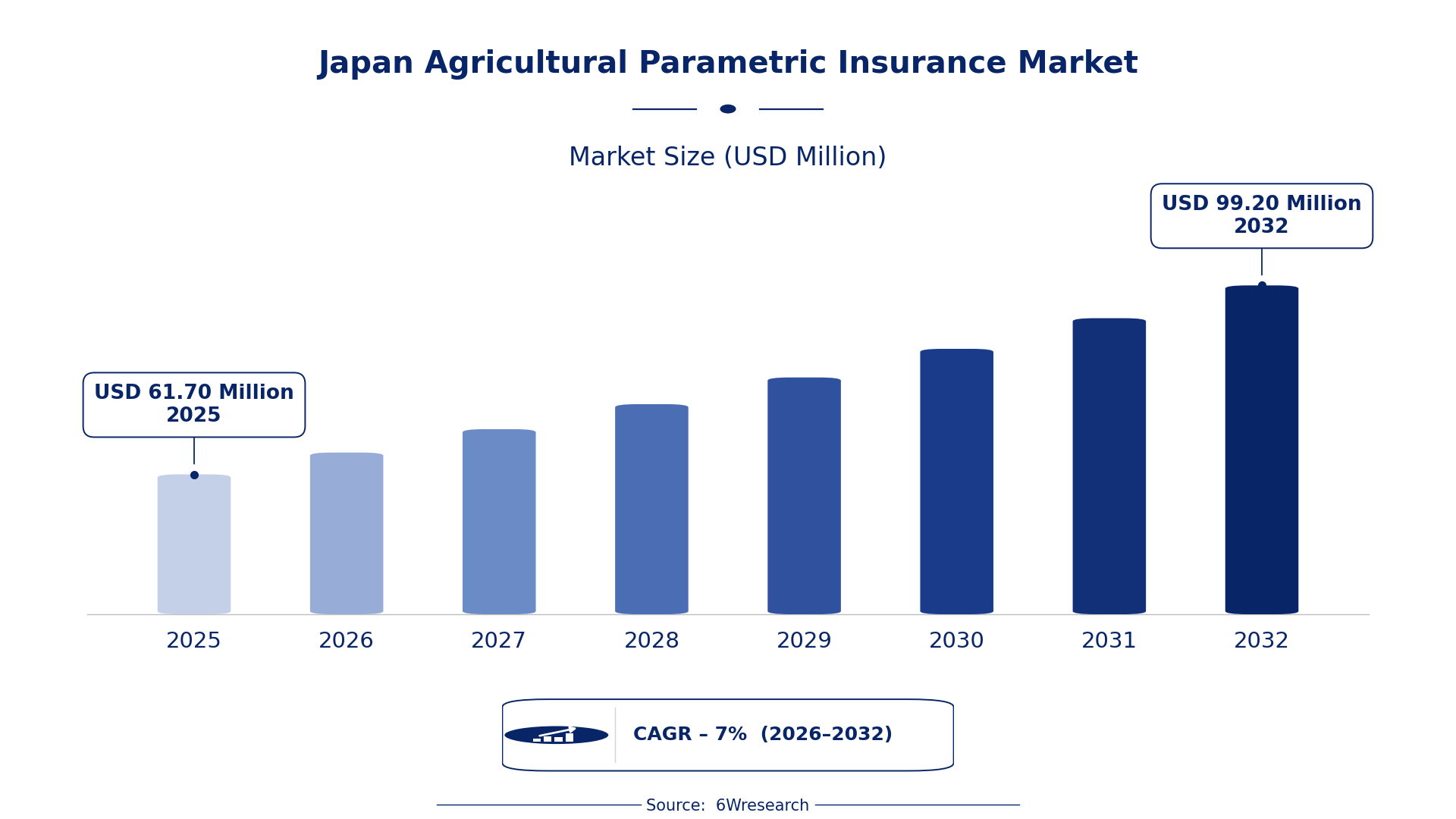
According to 6Wresearch internal database and industry insights, the Japan Agricultural Parametric Insurance Market was valued at USD 61.70 Million in 2025 and is projected to reach USD 99.20 Million by 2032, growing at a CAGR of approximately 7% during 2026–2032.
Japan Agricultural Parametric Insurance Market Highlights
| Report Metric | Details |
| Report Name | Japan Agricultural Parametric Insurance Market (2026-2032) |
| Market Size 2025 | USD 61.70 Million |
| Market Size 2032 | USD 99.20 Million |
| Absolute Growth 2025–2032 | USD 37.50 Million |
| CAGR 2026–2032 | 7% |
| Peak Annual Growth | 9.3% in 2026 |
| Forecast Period | 2026–2032 |
| Historical Data | 2022–2025 |
| Base Year | 2025 |
| Leading Insurance Type, 2025 | Crop Weather Index (48% share) |
| Leading Functionality, 2025 | Risk Mitigation (38% share) |
| Leading Application Area, 2025 | Farmland (40% share) |
| Leading Distribution Channel, 2025 | Direct Sales (48% share) |
| Leading End User, 2025 | Farmers (42% share) |
| Fastest-Growing Insurance Type | Livestock Parametric (9.4% CAGR) |
| Fastest-Growing Functionality | Loss Protection (8.7% CAGR) |
| Fastest-Growing Application Area | Dairy & Poultry (8.1% CAGR) |
| Fastest-Growing Distribution Channel | Online Platforms (8.9% CAGR) |
| Fastest-Growing End User | Livestock Owners (8.6% CAGR) |
| Growing Sector | Agriculture |
| Key End Users | Farmers, Livestock Owners, Agri-business Firms, Rural Communities |
Japan Agricultural Parametric Insurance Market Year-wise Growth Rate and Key Drivers (2022–2032)
This graph illustrates the annual growth rates of the market from 2022 to 2032, highlighting a steady upward trajectory and projected market expansion over the forecast period.
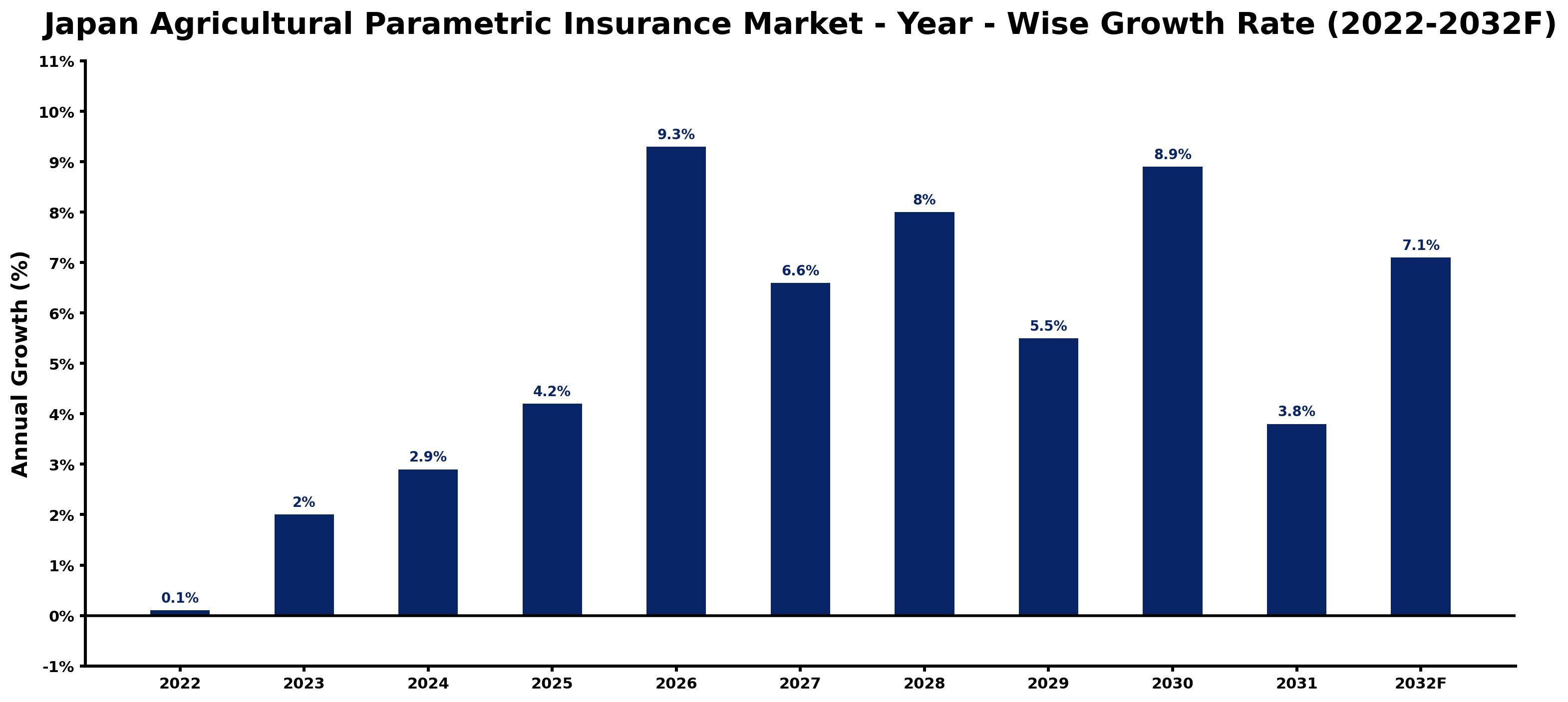
The yearly estimates that follow link every growth rate to its principal driver, so readers can see why the pace changed in each period.
| Year | Estimated Annual Growth (%) | Market Rationale |
| 2022 | 0.1 | The market showed minimal growth, reflecting the initial adoption of parametric insurance products. |
| 2023 | 2.0 | Growth accelerated due to increased awareness among farmers about financial protection options. |
| 2024 | 2.9 | Demand continued to rise as more farmers engaged with risk management solutions. |
| 2025 | 4.2 | The market experienced growth as more insurance products were introduced. |
| 2026 | 9.3 | A peak in growth is expected due to heightened awareness and adoption of parametric insurance. |
| 2027 | 6.6 | Growth is projected to slow as the market begins to stabilise after rapid expansion in 2026. |
| 2028 | 8.0 | Demand is expected to increase again as farmers seek effective risk mitigation strategies. |
| 2029 | 5.5 | Growth is projected to decelerate slightly as market saturation begins to take effect. |
| 2030 | 8.9 | A rebound in growth is expected as new insurance products are launched. |
| 2031 | 3.8 | Growth is projected to slow again as the market adjusts to established insurance offerings. |
| 2032 | 7.1 | Demand is expected to rise as more farmers recognise the benefits of parametric insurance. |
Note: Market size estimations and growth projections presented in this report are based on 6Wresearch's proprietary forecasting methodology, utilizing the latest available industry data, government publications, and primary research inputs.
Japan Agricultural Parametric Insurance Market Synopsis
Agricultural parametric insurance offers coverage against specific agricultural risks, using statistical models to trigger payments based on predefined parameters, such as weather conditions. The Japan Agricultural Parametric Insurance Market is growing due to increased awareness among farmers, government backing for agricultural disaster relief, and the introduction of tailored insurance solutions. In 2022, Japan's agricultural output was valued at approximately 8 trillion yen, reflecting strong demand for effective risk management products.
Market Dynamics Impact Analysis (2026–2032)
| Factor | Type | Impact | Primary Segment Affected |
| Increased awareness of financial protection options among farmers | Driver | High | Risk Mitigation |
| Introduction of innovative insurance products tailored for specific risks | Driver | High | Crop Weather Index |
| Growing need for sustainable insurance solutions due to aging farmer demographics | Opportunity | High | Livestock Parametric |
| Expansion of online platforms for insurance distribution | Opportunity | Medium | Online Platforms |
| Limited understanding of parametric insurance among some farmers | Restraint | Medium | Multi-peril Parametric |
| High average age of farmers leading to slower adoption of new products | Restraint | High | Agriculture |
| Resistance to change from traditional insurance models | Challenge | High | Disaster Coverage |
| Insufficient government funding for comprehensive insurance programmes | Challenge | Medium | Loss Protection |
Evaluation of Drivers in Japan Agricultural Parametric Insurance Market (2026–2032)
The table below links each growth driver to the segment it affects and the evidence for it.
| Drivers | Primary Segment Affected | Why It Matters (Evidence) |
| Increased government funding for agricultural disaster relief | Rainfall-based Insurance | In 2023, the government allocated 10 billion yen for agricultural disaster relief, encouraging farmers to adopt insurance. |
| Growing agricultural output value | Crop Weather Index | Japan's agricultural output was valued at approximately 8 trillion yen in 2022, driving demand for risk mitigation. |
| Launch of the Rainfall-based Insurance programme in 2020 | Livestock Parametric | This programme has led to increased adoption of livestock insurance among farmers. |
| Expansion of online platforms for insurance distribution | Online Platforms | With 25% of policies sold online, digital access improves insurance uptake among farmers. |
| Aging farmer population necessitating sustainable solutions | Risk Mitigation | The average age of farmers in Japan is 67 years, prompting demand for effective risk management. |
This funding encourages farmers to adopt insurance products, thus driving market growth. Japan's agricultural output was valued at approximately 8 trillion yen in 2022, which stimulates demand for risk management solutions. The average age of farmers, at 67 years, highlights the need for sustainable solutions to protect their livelihoods.
Evaluation of Restraints in Japan Agricultural Parametric Insurance Market
These restraints slow adoption and weigh on supplier margins.
| Market Restraint | Primary Segment Affected | Why It Matters (Evidence) |
| Limited understanding of parametric insurance among farmers | Multi-peril Parametric | Many farmers lack knowledge about how parametric insurance works, hindering uptake. |
| High average age of farmers leading to slower adoption of new products | Agriculture | With farmers averaging 67 years old, there is a reluctance to adopt new insurance solutions. |
| Resistance to change from traditional insurance models | Disaster Coverage | Farmers accustomed to conventional insurance may hesitate to switch to parametric options. |
| Insufficient government funding for new insurance programmes | Loss Protection | Limited funding restricts the development and promotion of new insurance products. |
| Complexity of insurance terms and conditions | Risk Mitigation | Farmers often find insurance policies difficult to understand, which can deter purchases. |
Japan Agricultural Parametric Insurance Market Challenges
Producers face delays in policy issuance due to outdated risk assessment technology, leaving them exposed during critical weather events. The average age of farmers in Japan is 67 years, which contributes to a lack of competitive innovation and fewer options for buyers, potentially resulting in higher premiums. Buyers struggle with complex regulatory frameworks, including the JIS Z 8401 standard, which can create confusion and lead to coverage gaps. Limited online policy sales, with only 25% sold digitally, restrict access for many farmers and delay their ability to secure necessary coverage.
Trends in the Japan Agricultural Parametric Insurance Market
The shifts below are changing how Japan Agricultural Parametric Insurance Market products are bought and supplied.
- Shift towards Digital Insurance Solutions: A shift towards digital platforms for insurance distribution is occurring, with 25% of policies sold online. Farmers increasingly prefer online access to insurance products, improving their purchasing experience.
- Growing Adoption of Rainfall-based Insurance: The Rainfall-based Insurance programme, launched in 2020, is gaining traction among rice farmers, reflecting a growing recognition of its benefits. This programme has led to increased insurance uptake in Japan's agricultural sector.
- Increased Focus on Livestock Protection: The livestock sector is prioritising parametric insurance solutions, particularly for dairy operations. With 1.4 million dairy cows in Japan, this focus is driving demand for tailored insurance products.
- Expansion of Risk Mitigation Strategies: Farmers are increasingly adopting risk mitigation strategies to safeguard their operations. This trend is supported by the introduction of new insurance products that cater to specific agricultural risks.
Investment Opportunities in the Japan Agricultural Parametric Insurance Market
Below are the investment opportunities with the strongest case in the Japan Agricultural Parametric Insurance Market.
- Need for Sustainable Insurance Solutions: With the average age of farmers at 67 years, there is an urgent need for sustainable insurance solutions. Investing in tailored products for older farmers can capture this growing market segment.
- Supply of Tailored Insurance Products: The demand for tailored insurance products is increasing, particularly in the livestock sector. Suppliers can focus on developing solutions for dairy and poultry operations to meet this need.
- Targeting Farmers in Rural Communities: Farmers in rural communities are increasingly seeking financial protection against agricultural risks. Engaging with local agricultural associations can facilitate the introduction of parametric insurance products.
- Development of Online Distribution Channels: The expansion of online platforms for insurance distribution presents an opportunity. Investing in digital marketing strategies can help reach a broader audience of potential buyers.
Government Initiatives in the Japan Agricultural Parametric Insurance Market
The Industrial Standardization Act, established in 1949 and amended in 2019, governs product and test standards for agricultural insurance in Japan. This framework ensures that insurance products meet specific quality and safety requirements, benefiting both producers and buyers. The Food Sanitation Act amendment in 2018, fully applied in June 2021, mandates HACCP-based hygiene management for food businesses, indirectly supporting agricultural insurance by improving food safety standards.
The Digital Agency oversees the implementation of digital transformation initiatives in agriculture. This agency approves digital tools that enhance risk management practices. In 2023, the government allocated 10 billion yen for agricultural disaster relief, which will support the implementation of effective insurance solutions.
Future Insight of the Japan Agricultural Parametric Insurance Market
The introduction of advanced weather monitoring systems will improve risk assessment accuracy by 2032, allowing for more tailored insurance policies. Increased government investment in agricultural disaster relief programmes will provide greater financial support for producers. As digital platforms expand, they will simplify the purchasing process, making insurance more accessible to a wider range of users. New insurance products will emerge to tackle specific agricultural challenges, ensuring buyers have adequate coverage options to manage unforeseen risks.
Market Segmentation Analysis
Japan Agricultural Parametric Insurance Market report covers a detailed analysis of the following market segments:
By Insurance Type – Crop Weather Index Leads, Livestock Parametric Expected to Grow Fastest
According to Ayushi Shukla, Senior Research Analyst at 6Wresearch, the largest insurance type category in 2025 was Crop Weather Index, at 48% of revenue. The Crop Weather Index segment holds the largest share as it directly addresses weather-related risks for crops, which is vital for over 1.5 million farmers in Japan. The backing from the Ministry of Agriculture, Forestry and Fisheries further solidifies its prominence in the market. Livestock Parametric is projected to grow fastest, at a CAGR of 9.4% during 2026–2032. The Livestock Parametric segment is experiencing rapid growth due to its essential role in providing coverage for livestock against specific risks, particularly in the dairy sector with 1.4 million dairy cows. Increased awareness among farmers regarding the necessity of livestock protection is driving this segment's expansion. Suppliers should enhance their livestock parametric insurance offerings to cater to the rising demand.
By Functionality – Risk Mitigation Leads, Loss Protection Expected to Grow Fastest
Risk Mitigation took 38% of functionality revenue in 2025, more than any other category. Risk Mitigation leads in functionality as it directly assists farmers in managing financial risks linked to agriculture, ensuring operational stability. This functionality resonates with the priorities of Japan's agricultural sector, which seeks financial security amidst unpredictable weather patterns. Over 2026–2032, Loss Protection is expected to post the fastest growth, at a CAGR of 8.7%. Loss Protection is the fastest-growing functionality as it compensates for losses incurred due to insured events, addressing the urgent financial needs of farmers after adverse occurrences. The increasing frequency of weather-related disasters affecting agricultural output is fuelling this functionality's growth. Buyers should prioritise insurance products that provide comprehensive loss protection features.
By Application Area – Farmland Leads, Dairy & Poultry Expected to Grow Fastest
With 40% of application area revenue in 2025, Farmland was the largest category. Farmland is the leading application area as it directly pertains to farmland operations, which are fundamental to Japan's agricultural sector. The vast area of farmland, approximately 4.5 million hectares, necessitates effective insurance solutions tailored for crop protection. Dairy & Poultry is set to record the highest CAGR in this split, 8.1% over 2026–2032. Dairy & Poultry is the fastest-growing application area, vital for safeguarding dairy and poultry operations that face rising risks. The growth in dairy farming and poultry production underscores the urgent need for specialised insurance solutions in these sectors. Suppliers should develop targeted insurance products for the dairy and poultry sectors to seize emerging opportunities.
By Distribution Channel – Direct Sales Leads, Online Platforms Expected to Grow Fastest
In 2025, Direct Sales led the distribution channel split with a 48% share. Direct Sales is the leading distribution channel as it facilitates direct engagement with end-users like farmers, ensuring that insurance products effectively meet their specific needs. This method cultivates trust and direct communication between providers and farmers, enhancing overall customer satisfaction. The quickest growth will come from Online Platforms, forecast to expand at a CAGR of 8.9% between 2026 and 2032. Online Platforms are the fastest-growing distribution channel, broadening access to insurance products for a wider audience. The trend of 25% of policies sold online indicates a shift towards digital solutions that appeal to tech-savvy farmers. Suppliers must invest in online platforms to expand their customer base and improve service delivery.
By End User – Farmers Lead, Livestock Owners Expected to Grow Fastest
Farmers accounted for 42% of the market by end user in 2025. Farmers are the leading end-user group as they are the primary beneficiaries of agricultural parametric insurance, relying on these products for financial protection. The presence of over 1.5 million farmers in Japan significantly drives the market's growth. Livestock Owners are projected to grow fastest, at a CAGR of 8.6% during 2026–2032. Livestock Owners represent the fastest-growing end-user group, benefiting directly from livestock-related insurance, particularly in Japan's substantial dairy industry. The increasing focus on livestock health and productivity is propelling this segment's expansion. Suppliers should tailor their marketing strategies to meet the specific needs of livestock owners.
Key Attractiveness of the Report
- 10 Years of Market Numbers
- Historical Data Starting from 2022 to 2025
- Base Year 2025
- Forecast Data until 2032
- Key Performance Indicators Impacting the Market
- Major Upcoming Developments and Projects
Key Highlights of the Report:
- Japan Agricultural Parametric Insurance Market Outlook
- Market Size of Japan Agricultural Parametric Insurance Market, 2025
- Forecast of Japan Agricultural Parametric Insurance Market, 2032
- Historical Data and Forecast of Japan Agricultural Parametric Insurance Market Revenues & Volume for the Period 2022-2032F
- Japan Agricultural Parametric Insurance Market Trend Evolution
- Japan Agricultural Parametric Insurance Market Drivers and Challenges
- Japan Agricultural Parametric Insurance Market Price Trends
- Japan Agricultural Parametric Insurance Market Porter's Five Forces
- Japan Agricultural Parametric Insurance Market Industry Life Cycle
- Historical Data and Forecast of Japan Agricultural Parametric Insurance Market Revenues & Volume By Insurance Type for the Period 2022-2032F
- Historical Data and Forecast of Japan Agricultural Parametric Insurance Market Revenues & Volume By Crop Weather Index for the Period 2022-2032F
- Historical Data and Forecast of Japan Agricultural Parametric Insurance Market Revenues & Volume By Livestock Parametric for the Period 2022-2032F
- Historical Data and Forecast of Japan Agricultural Parametric Insurance Market Revenues & Volume By Rainfall-based Insurance for the Period 2022-2032F
- Historical Data and Forecast of Japan Agricultural Parametric Insurance Market Revenues & Volume By Multi-peril Parametric for the Period 2022-2032F
- Historical Data and Forecast of Japan Agricultural Parametric Insurance Market Revenues & Volume By Functionality for the Period 2022-2032F
- Historical Data and Forecast of Japan Agricultural Parametric Insurance Market Revenues & Volume By Risk Mitigation for the Period 2022-2032F
- Historical Data and Forecast of Japan Agricultural Parametric Insurance Market Revenues & Volume By Loss Protection for the Period 2022-2032F
- Historical Data and Forecast of Japan Agricultural Parametric Insurance Market Revenues & Volume By Yield Protection for the Period 2022-2032F
- Historical Data and Forecast of Japan Agricultural Parametric Insurance Market Revenues & Volume By Disaster Coverage for the Period 2022-2032F
- Historical Data and Forecast of Japan Agricultural Parametric Insurance Market Revenues & Volume By Application Area for the Period 2022-2032F
- Historical Data and Forecast of Japan Agricultural Parametric Insurance Market Revenues & Volume By Farmland for the Period 2022-2032F
- Historical Data and Forecast of Japan Agricultural Parametric Insurance Market Revenues & Volume By Dairy & Poultry for the Period 2022-2032F
- Historical Data and Forecast of Japan Agricultural Parametric Insurance Market Revenues & Volume By Agriculture for the Period 2022-2032F
- Historical Data and Forecast of Japan Agricultural Parametric Insurance Market Revenues & Volume By Farming Regions for the Period 2022-2032F
- Historical Data and Forecast of Japan Agricultural Parametric Insurance Market Revenues & Volume By Distribution Channel for the Period 2022-2032F
- Historical Data and Forecast of Japan Agricultural Parametric Insurance Market Revenues & Volume By Direct Sales for the Period 2022-2032F
- Historical Data and Forecast of Japan Agricultural Parametric Insurance Market Revenues & Volume By Online Platforms for the Period 2022-2032F
- Historical Data and Forecast of Japan Agricultural Parametric Insurance Market Revenues & Volume By Insurance Brokers for the Period 2022-2032F
- Historical Data and Forecast of Japan Agricultural Parametric Insurance Market Revenues & Volume By Specialty Distributors for the Period 2022-2032F
- Historical Data and Forecast of Japan Agricultural Parametric Insurance Market Revenues & Volume By End User for the Period 2022-2032F
- Historical Data and Forecast of Japan Agricultural Parametric Insurance Market Revenues & Volume By Farmers for the Period 2022-2032F
- Historical Data and Forecast of Japan Agricultural Parametric Insurance Market Revenues & Volume By Livestock Owners for the Period 2022-2032F
- Historical Data and Forecast of Japan Agricultural Parametric Insurance Market Revenues & Volume By Rural Communities for the Period 2022-2032F
- Historical Data and Forecast of Japan Agricultural Parametric Insurance Market Revenues & Volume By Agri-business Firms for the Period 2022-2032F
- Japan Agricultural Parametric Insurance Market Import Export Trade Statistics
- Market Opportunity Assessment By Insurance Type
- Market Opportunity Assessment By Functionality
- Market Opportunity Assessment By Application Area
- Market Opportunity Assessment By Distribution Channel
- Market Opportunity Assessment By End User
- Japan Agricultural Parametric Insurance Market Top Companies Market Share
- Japan Agricultural Parametric Insurance Market Competitive Benchmarking By Technical and Operational Parameters
- Japan Agricultural Parametric Insurance Market Company Profiles
- Japan Agricultural Parametric Insurance Market Key Strategic Recommendations
Market Covered
The study includes the following segmentation.
By Insurance Type
- Crop Weather Index
- Livestock Parametric
- Rainfall-based Insurance
- Multi-peril Parametric
By Functionality
- Risk Mitigation
- Loss Protection
- Yield Protection
- Disaster Coverage
By Application Area
- Farmland
- Dairy & Poultry
- Agriculture
- Farming Regions
By Distribution Channel
- Direct Sales
- Online Platforms
- Insurance Brokers
- Specialty Distributors
By End User
- Farmers
- Livestock Owners
- Rural Communities
- Agri-business Firms































