Japan Agronomic Amino Acids Market Size & Growth Rate
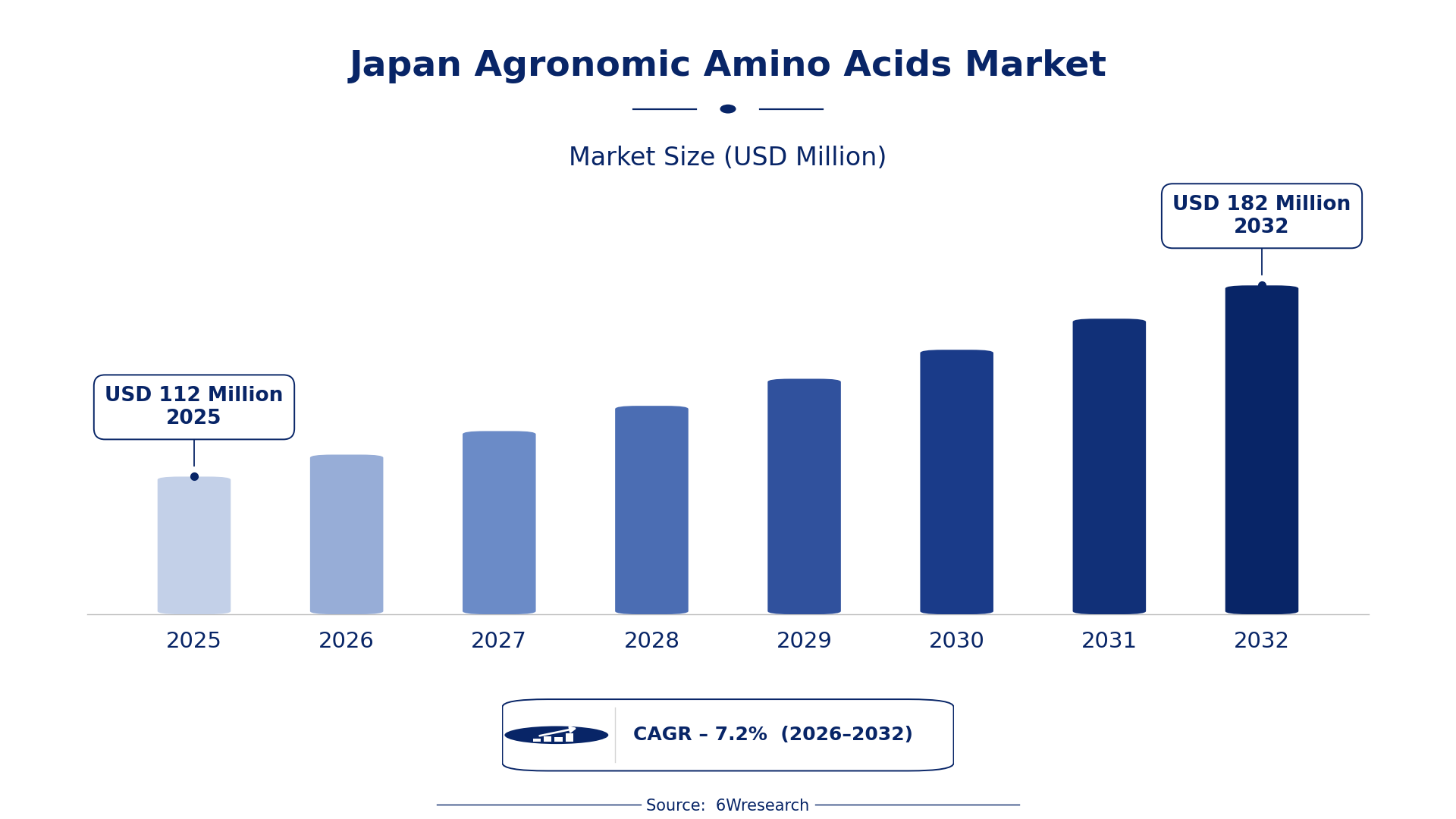
According to 6Wresearch internal database and industry insights, the Japan Agronomic Amino Acids Market was valued at USD 112 Million in 2025 and is projected to reach USD 182 Million by 2032, growing at a CAGR of approximately 7.2% during 2026–2032.
Japan Agronomic Amino Acids Market Highlights
| Report Metric | Details |
| Report Name | Japan Agronomic Amino Acids Market (2026-2032) |
| Market Size 2025 | USD 112 Million |
| Market Size 2032 | USD 182 Million |
| Absolute Growth 2025–2032 | USD 70 Million |
| CAGR 2026–2032 | 7.2% |
| Peak Annual Growth | 8.0% in 2028 |
| Forecast Period | 2026–2032 |
| Historical Data | 2022–2025 |
| Base Year | 2025 |
| Leading Type, 2025 | Lysine (28% share) |
| Leading Source, 2025 | Plant-based (42% share) |
| Leading Application, 2025 | Soil Amendment (29% share) |
| Fastest-Growing Type | Thymine (10.5% CAGR) |
| Fastest-Growing Source | Animal-based (10.6% CAGR) |
| Fastest-Growing Application | Chlorophyll Synthesis (10.1% CAGR) |
| Growing Sector | agriculture |
| Key End Users | farmers, agricultural cooperatives, organic farming practitioners |
Japan Agronomic Amino Acids Market Year-wise Growth Rate and Key Drivers (2022–2032)
This graph illustrates the annual growth rates of the market from 2022 to 2032, highlighting a steady upward trajectory and projected market expansion over the forecast period.
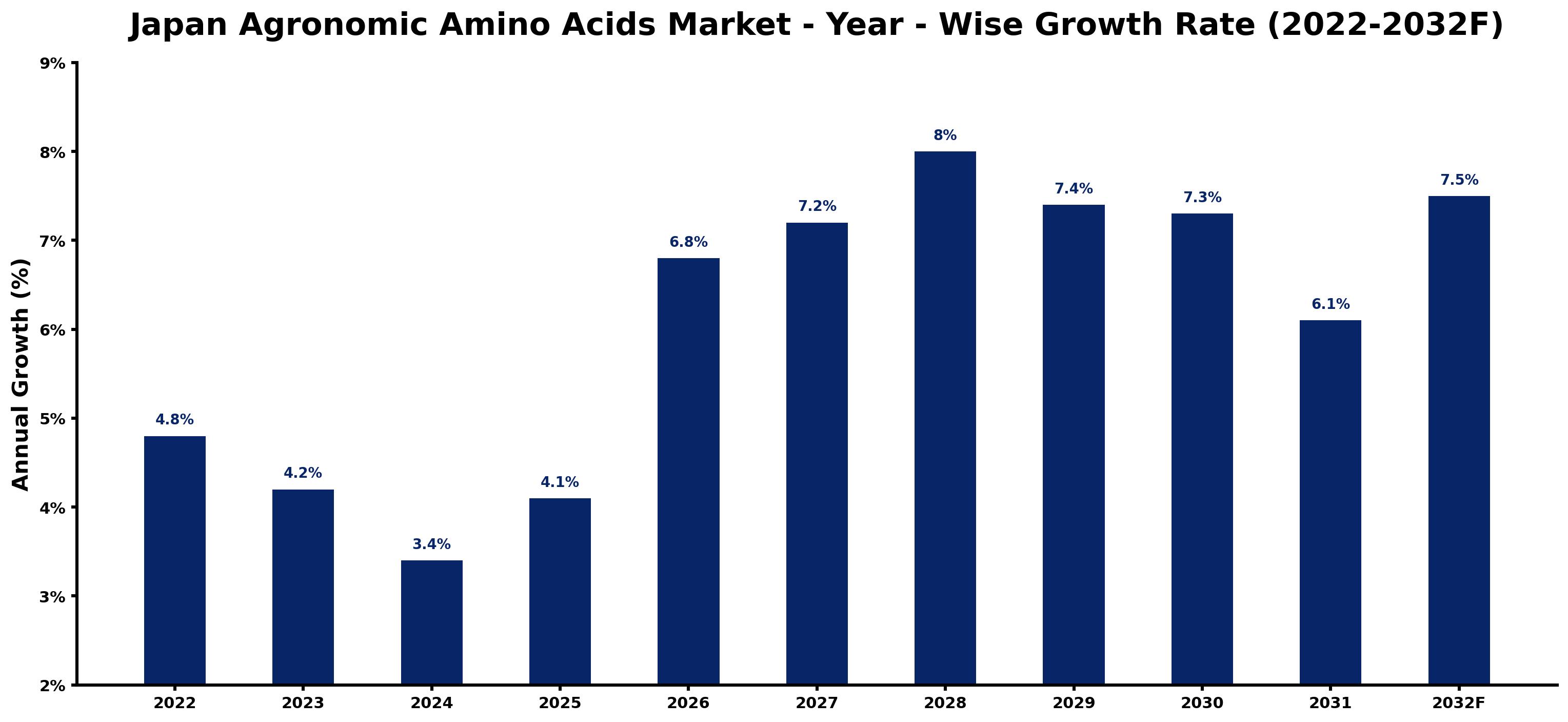
The yearly estimates that follow link every growth rate to its principal driver, so readers can see why the pace changed in each period.
| Year | Estimated Annual Growth (%) | Market Rationale |
| 2022 | 4.8 | The market experienced strong demand due to increased focus on sustainable agriculture practices. |
| 2023 | 4.2 | Growth slowed as farmers adjusted to higher input costs and changing market conditions. |
| 2024 | 3.4 | The market continued to slow as farmers explored alternative fertilisation methods. |
| 2025 | 4.1 | Demand picked up again as agricultural cooperatives promoted amino acid use for crop health. |
| 2026 | 6.8 | Growth is expected to accelerate with rising interest in organic farming and eco-friendly practices. |
| 2027 | 7.2 | The market is projected to expand further as farmers seek to improve yields amid climate challenges. |
| 2028 | 8.0 | The peak growth year will see increased investments in agricultural technology and practices. |
| 2029 | 7.4 | Growth is anticipated to moderate as the market stabilises after the peak growth period. |
| 2030 | 7.3 | Demand will continue to slow as market conditions normalise and competition increases. |
| 2031 | 6.1 | The market is expected to experience a further slowdown as saturation in certain segments becomes apparent. |
| 2032 | 7.5 | Growth will rebound as new technologies enhance amino acid applications in agriculture. |
Note: Market size estimations and growth projections presented in this report are based on 6Wresearch's proprietary forecasting methodology, utilizing the latest available industry data, government publications, and primary research inputs.
Japan Agronomic Amino Acids Market Synopsis
Agronomic amino acids are organic compounds essential for plant growth, derived from various sources and produced through fermentation or extraction. In Japan, these amino acids are particularly used in rice and vegetable cultivation, with growing demand from domestic farmers and agricultural cooperatives. The Japan Agronomic Amino Acids Market is expanding due to investments in sustainable farming practices, with the total fertilizer market valued at approximately 1.2 billion USD, driving further adoption of these compounds in agriculture.
Market Dynamics Impact Analysis (2026–2032)
| Factor | Type | Impact | Primary Segment Affected |
| Rising focus on organic farming practices | Driver | High | Plant-based |
| Increased demand for crop yield enhancement | Driver | High | Soil Amendment |
| Growing interest in sustainable agriculture | Opportunity | High | Chlorophyll Synthesis |
| Expansion of agricultural cooperatives promoting amino acids | Opportunity | High | Soil Amendment |
| High input costs affecting farmer adoption | Restraint | High | Synthetic |
| Limited awareness of benefits among farmers | Restraint | Medium | Animal-based |
| Regulatory compliance challenges for producers | Challenge | High | Plant-based |
| Capacity constraints in production facilities | Challenge | Medium | Synthetic |
Evaluation of Drivers in Japan Agronomic Amino Acids Market (2026–2032)
Demand rests on the following drivers, each shown with the segment it touches most.
| Drivers | Primary Segment Affected | Why It Matters (Evidence) |
| Increased adoption of organic farming techniques | Plant-based | Approximately 30% of organic farming practices in Japan utilise amino acids, driving demand for plant-based sources. |
| Rising crop yield requirements due to population growth | Soil Amendment | Japan's agricultural sector contributes 1% to GDP, necessitating improved soil quality for higher yields. |
| Government initiatives promoting sustainable practices | Chlorophyll Synthesis | The Ministry of Agriculture, Forestry and Fisheries supports eco-friendly farming, increasing demand for amino acids. |
| Technological advancements in amino acid applications | Foliar | New methods for foliar application improve nutrient absorption, encouraging farmers to adopt these practices. |
| Growing awareness of amino acids' benefits for crop health | Seed | Farmers are increasingly recognising the advantages of amino acids in seed treatments for better germination. |
Most of the extra volume comes from rising focus on organic farming techniques, with approximately 30% of organic practices in Japan utilising amino acids. The agricultural sector, contributing 1% to GDP, necessitates improved soil quality for higher yields, driving demand for soil amendments. New methods for foliar application improve nutrient absorption and boost farmer adoption. Increasing recognition of amino acids' benefits for crop health leads to greater use in seed treatments, enhancing germination rates.
Evaluation of Restraints in Japan Agronomic Amino Acids Market
The key brakes on demand, and where they bite hardest, are shown below.
| Market Restraint | Primary Segment Affected | Why It Matters (Evidence) |
| High input costs affecting farmer adoption | Synthetic | The total fertilizer market in Japan is valued at approximately 1.2 billion USD, impacting affordability for farmers. |
| Limited awareness of benefits among farmers | Animal-based | Many farmers lack information about the advantages of amino acids, leading to underutilisation. |
| Regulatory compliance challenges for producers | Plant-based | Producers must navigate complex regulations, such as the Chemical Substances Control Law, which can delay market entry. |
| Capacity constraints in production facilities | Synthetic | Existing production facilities may struggle to meet the growing demand for amino acids in agriculture. |
| Competition from alternative fertilisation methods | Soil Amendment | Farmers may opt for traditional fertilisers over amino acids due to familiarity and perceived cost-effectiveness. |
Japan Agronomic Amino Acids Market Challenges
In Japan, JIS standards for agricultural inputs create compliance challenges for suppliers, delaying product availability and reducing crop yields for farmers. Regulatory hurdles increase the time to market for new products, costing producers up to 15% in potential revenue. Technological limitations in fermentation processes lead to production inefficiencies, raising costs for producers and limiting their competitiveness. An aging workforce, with farmers averaging 67 years, results in a skills gap that hampers innovation, restricting growth for agricultural cooperatives. Supply chain disruptions complicate timely delivery of amino acids, forcing farmers to resort to less effective alternatives, negatively impacting crop quality and productivity.
Trends in the Japan Agronomic Amino Acids Market
These developments are changing demand patterns in the Japan Agronomic Amino Acids Market.
- Shift towards Organic Farming Practices: Since 2022, Japan has seen a shift towards organic farming, with a government programme aiming to increase organic farming by 25% by 2025. This trend is encouraging the use of agronomic amino acids, which are essential for sustainable agriculture.
- Transition to Eco-Friendly Fertilisation Methods: The Tokyo region is leading the transition to eco-friendly fertilisation methods, with ongoing government initiatives to reduce chemical fertiliser use by 20% by 2030. This change is driving demand for amino acids as sustainable alternatives.
- Emerging Focus on Crop Resistance: The emphasis on improving crop resistance has grown, particularly in rice cultivation, where amino acids play a significant role. In 2022, Japan produced around 7.5 million tons of rice, highlighting the need for enhanced crop health.
- Prioritisation of Soil Health Improvement: A programme by the Ministry of Agriculture, Forestry and Fisheries promotes soil health improvement through amino acid applications. This initiative is vital as Japan's arable land totals about 4.5 million hectares.
Investment Opportunities in the Japan Agronomic Amino Acids Market
The opportunities below stand out in the Japan Agronomic Amino Acids Market for new entrants and existing suppliers.
- Partnering with Agricultural Cooperatives: Investing in partnerships with agricultural cooperatives can promote amino acid usage. With Japan's agricultural population around 2.1 million, this collaboration can improve market penetration.
- Investing in Research Facilities: The Tokyo region is a hub for agricultural innovation, presenting opportunities to invest in research facilities focused on amino acid applications. This investment can tap into the growing interest in sustainable practices.
- Addressing the Gap in Awareness: With approximately 1.2 billion USD in the fertilizer market, there is a gap in farmer awareness about amino acids. Targeted educational campaigns can effectively bridge this gap and drive adoption.
- Timing for Sustainable Solutions: The Japanese government's 25% increase target for organic farming by 2025 creates an urgent opportunity for suppliers of agronomic amino acids. Engaging with local partners can facilitate market entry.
Government Initiatives in the Japan Agronomic Amino Acids Market
Producers of agronomic amino acids must evaluate and control chemical substances in their products as per the Chemical Substances Control Law. This requirement ensures that buyers can trust the safety and efficacy of the amino acids they use in agriculture, promoting sustainable practices. The law supports compliance with JIS standards, which regulate agricultural inputs, including amino acids, ensuring quality and safety for consumers.
Funding through the Ministry of Agriculture, Forestry and Fisheries supports sustainable farming initiatives, including projects that improve the use of amino acids in agriculture. The government aims to increase organic farming by 25% by 2025, which will expand the market for agronomic amino acids.
Future Insight of the Japan Agronomic Amino Acids Market
Technological advancements in precision agriculture will transform demand for agronomic amino acids, allowing for targeted application that improves soil health. The government's commitment to boost organic farming by 25% by 2025 will drive increased use of these amino acids in sustainable practices. Initiatives aimed at reducing chemical fertiliser use by 20% by 2030 will create a supportive environment for organic inputs. With Japan's agricultural population around 2.1 million, a shift towards eco-friendly farming is expected to elevate the role of amino acids in enhancing crop resilience and supporting food security.
Market Segmentation Analysis
Japan Agronomic Amino Acids Market report covers a detailed analysis of the following market segments:
By Type – Lysine Leads, Thymine Expected to Grow Fastest
According to Summon Dutta, Assistant Manager at 6Wresearch, with 28% of type revenue in 2025, Lysine was the largest category. Lysine holds the largest share due to its essential role in enhancing protein content in animal feed, which is critical for livestock health and productivity. The strong demand from farmers for high-quality feed in Japan's agricultural sector reinforces its leading position. The quickest growth will come from Thymine, forecast to expand at a CAGR of 10.5% between 2026 and 2032. Thymine is experiencing rapid growth as it aids in chlorophyll production, increasingly important in sustainable farming practices. Government initiatives promoting organic farming are contributing to the rising interest in this amino acid. Suppliers should emphasise Thymine's benefits to meet the growing demand for sustainable agricultural solutions.
By Source – Plant-based Leads, Animal-based Expected to Grow Fastest
In 2025, Plant-based led the source split with a 42% share. The plant-based segment leads the market as it is widely utilised in organic farming practices, aligning with Japan's agricultural standards and sustainability goals. This strong alignment with the country's organic farming initiatives solidifies its position. Animal-based is set to record the highest CAGR in this split, 10.6% over 2026–2032. Animal-based sources are growing quickly as they are increasingly recognised for their nutritional benefits in livestock feed, which supports the overall agricultural output. The rising demand for high-quality animal products is a key factor in this growth. Buyers should consider diversifying their sources to include animal-based amino acids to meet the increasing demand for livestock nutrition.
By Application – Soil Amendment Leads, Chlorophyll Synthesis Expected to Grow Fastest
Soil Amendment accounted for 29% of the market by application in 2025. Soil amendment applications dominate the market as they are specifically designed to improve soil properties, which are vital for boosting crop yields. The focus on soil health within Japan's agricultural practices ensures this segment's leading status. Over 2026–2032, Chlorophyll Synthesis is expected to post the fastest growth, at a CAGR of 10.1%. Chlorophyll synthesis is on the rise due to its direct impact on plant vitality and yield, particularly in organic farming contexts. The growing emphasis on sustainable agricultural practices is propelling this application forward. Suppliers should invest in developing products for chlorophyll synthesis to address the increasing demand for sustainable farming methods.
Key Attractiveness of the Report
- 10 Years of Market Numbers
- Historical Data Starting from 2022 to 2025
- Base Year 2025
- Forecast Data until 2032
- Key Performance Indicators Impacting the Market
- Major Upcoming Developments and Projects
Key Highlights of the Report:
- Japan Agronomic Amino Acids Market Outlook
- Market Size of Japan Agronomic Amino Acids Market, 2025
- Forecast of Japan Agronomic Amino Acids Market, 2032
- Historical Data and Forecast of Japan Agronomic Amino Acids Revenues & Volume for the Period 2022-2032
- Japan Agronomic Amino Acids Market Trend Evolution
- Japan Agronomic Amino Acids Market Drivers and Challenges
- Japan Agronomic Amino Acids Price Trends
- Japan Agronomic Amino Acids Porter's Five Forces
- Japan Agronomic Amino Acids Industry Life Cycle
- Historical Data and Forecast of Japan Agronomic Amino Acids Market Revenues & Volume By Type for the Period 2022-2032
- Historical Data and Forecast of Japan Agronomic Amino Acids Market Revenues & Volume By Lysine for the Period 2022-2032
- Historical Data and Forecast of Japan Agronomic Amino Acids Market Revenues & Volume By Thymine for the Period 2022-2032
- Historical Data and Forecast of Japan Agronomic Amino Acids Market Revenues & Volume By Methionine for the Period 2022-2032
- Historical Data and Forecast of Japan Agronomic Amino Acids Market Revenues & Volume By Glutamic Acid for the Period 2022-2032
- Historical Data and Forecast of Japan Agronomic Amino Acids Market Revenues & Volume By Alanine for the Period 2022-2032
- Historical Data and Forecast of Japan Agronomic Amino Acids Market Revenues & Volume By Leucine for the Period 2022-2032
- Historical Data and Forecast of Japan Agronomic Amino Acids Market Revenues & Volume By Arginine for the Period 2022-2032
- Historical Data and Forecast of Japan Lysine Agronomic Amino Acids Market Revenues & Volume By Others for the Period 2022-2032
- Historical Data and Forecast of Japan Agronomic Amino Acids Market Revenues & Volume By Source for the Period 2022-2032
- Historical Data and Forecast of Japan Agronomic Amino Acids Market Revenues & Volume By Plant-based for the Period 2022-2032
- Historical Data and Forecast of Japan Agronomic Amino Acids Market Revenues & Volume By Animal-based for the Period 2022-2032
- Historical Data and Forecast of Japan Agronomic Amino Acids Market Revenues & Volume By Synthetic for the Period 2022-2032
- Historical Data and Forecast of Japan Agronomic Amino Acids Market Revenues & Volume By Treatment Method for the Period 2022-2032
- Historical Data and Forecast of Japan Agronomic Amino Acids Market Revenues & Volume By Foliar for the Period 2022-2032
- Historical Data and Forecast of Japan Agronomic Amino Acids Market Revenues & Volume By Seed for the Period 2022-2032
- Historical Data and Forecast of Japan Agronomic Amino Acids Market Revenues & Volume By Soil for the Period 2022-2032
- Historical Data and Forecast of Japan Agronomic Amino Acids Market Revenues & Volume By Others for the Period 2022-2032
- Historical Data and Forecast of Japan Agronomic Amino Acids Market Revenues & Volume By Application for the Period 2022-2032
- Historical Data and Forecast of Japan Agronomic Amino Acids Market Revenues & Volume By Soil Amendment for the Period 2022-2032
- Historical Data and Forecast of Japan Agronomic Amino Acids Market Revenues & Volume By Chlorophyll Synthesis for the Period 2022-2032
- Historical Data and Forecast of Japan Agronomic Amino Acids Market Revenues & Volume By Roots Development for the Period 2022-2032
- Historical Data and Forecast of Japan Agronomic Amino Acids Market Revenues & Volume By Bud Growth and Leaves Development for the Period 2022-2032
- Historical Data and Forecast of Japan Agronomic Amino Acids Market Revenues & Volume By Crop Resistance for the Period 2022-2032
- Historical Data and Forecast of Japan Agronomic Amino Acids Market Revenues & Volume By Ripening for the Period 2022-2032
- Historical Data and Forecast of Japan Agronomic Amino Acids Market Revenues & Volume By Others for the Period 2022-2032
- Japan Agronomic Amino Acids Import Export Trade Statistics
- Market Opportunity Assessment By Type
- Market Opportunity Assessment By Source
- Market Opportunity Assessment By Application
- Japan Agronomic Amino Acids Top Companies Market Share
- Japan Agronomic Amino Acids Competitive Benchmarking By Technical and Operational Parameters
- Japan Agronomic Amino Acids Company Profiles
- Japan Agronomic Amino Acids Key Strategic Recommendations
Market Covered
Segments analysed in this report are listed below.
By Type
- Lysine
- Thymine
- Methionine
- Glutamic Acid
- Alanine
- Leucine
- Arginine
- Others
By Source
- Plant-based
- Animal-based
- Synthetic
- Treatment Method
- Foliar
- Seed
- Soil
- Others
By Application
- Soil Amendment
- Chlorophyll Synthesis
- Roots Development
- Bud Growth and Leaves Development
- Crop Resistance
- Ripening
- Others































