Japan AI-Aided GI Diagnostics Market Size & Growth Rate
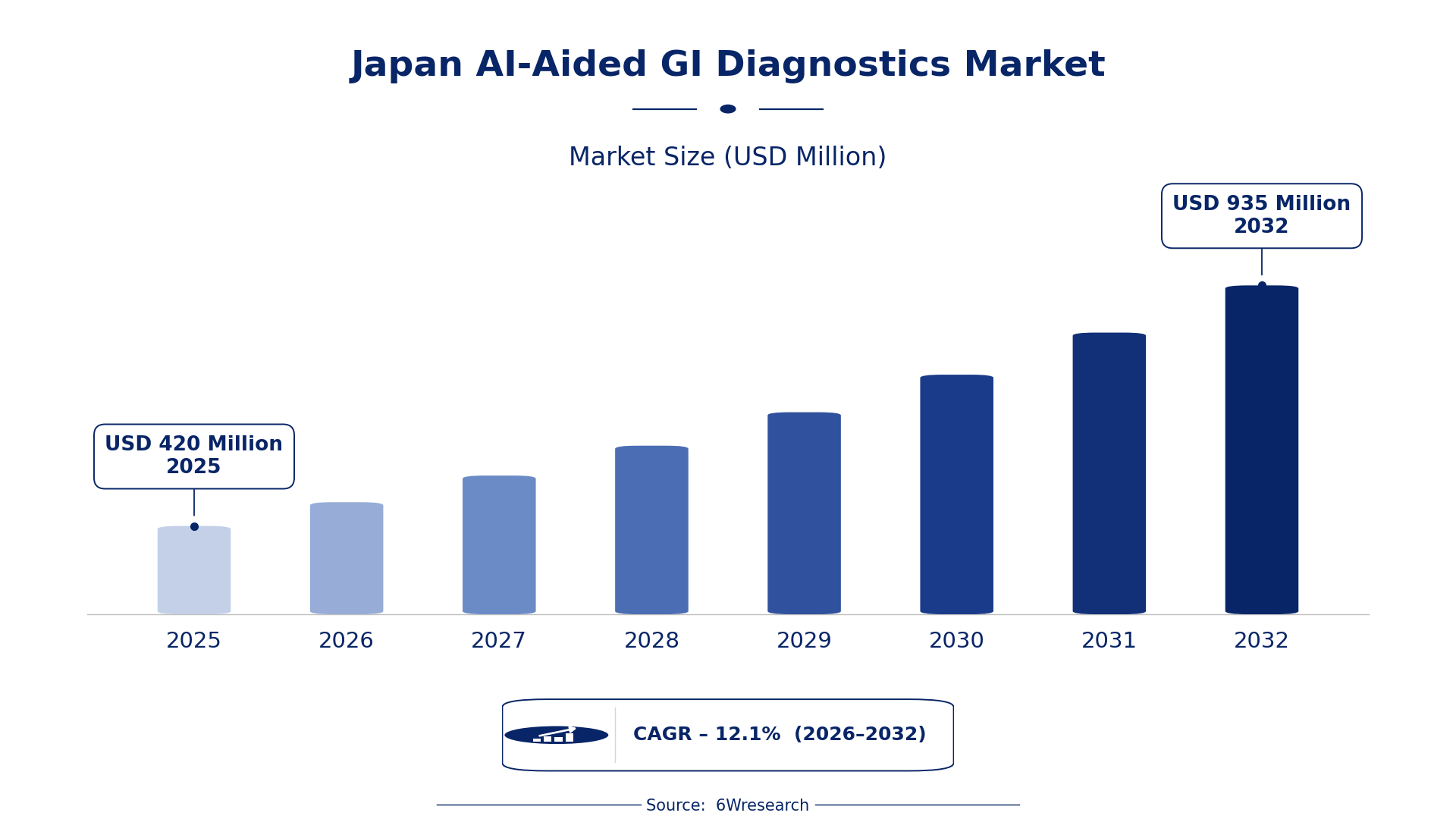
According to 6Wresearch internal database and industry insights, the Japan AI-Aided GI Diagnostics Market was valued at USD 420 Million in 2025 and is projected to reach USD 935 Million by 2032, growing at a CAGR of approximately 12.1% during 2026–2032.
Japan AI-Aided GI Diagnostics Market Highlights
| Report Metric | Details |
| Report Name | Japan AI-Aided GI Diagnostics Market (2026-2032) |
| Market Size 2025 | USD 420 Million |
| Market Size 2032 | USD 935 Million |
| Absolute Growth 2025–2032 | USD 515 Million |
| CAGR 2026–2032 | 12.1% |
| Peak Annual Growth | 13.2% in 2028 |
| Forecast Period | 2026–2032 |
| Historical Data | 2022–2025 |
| Base Year | 2025 |
| Leading GI Condition, 2025 | Colon Polyp Detection (33% share) |
| Leading AI Model Type, 2025 | Vision AI (42% share) |
| Leading Distribution Channel, 2025 | Endoscopy Equipment Vendors (44% share) |
| Leading End User, 2025 | Gastroenterology Clinics (42% share) |
| Fastest-Growing GI Condition | Liver Disease Analysis (15.5% CAGR) |
| Fastest-Growing AI Model Type | Predictive Modeling (17.0% CAGR) |
| Fastest-Growing Distribution Channel | Imaging Software Suites (15.7% CAGR) |
| Fastest-Growing End User | Liver Health Specialists (15.4% CAGR) |
| Growing Sector | Liver Health Specialists |
| Key End Users | Gastroenterology Clinics, Liver Health Specialists, GI Physicians, Oncology Departments |
Japan AI-Aided GI Diagnostics Market Year-wise Growth Rate and Key Drivers (2022–2032)
This graph illustrates the annual growth rates of the market from 2022 to 2032, highlighting a steady upward trajectory and projected market expansion over the forecast period.
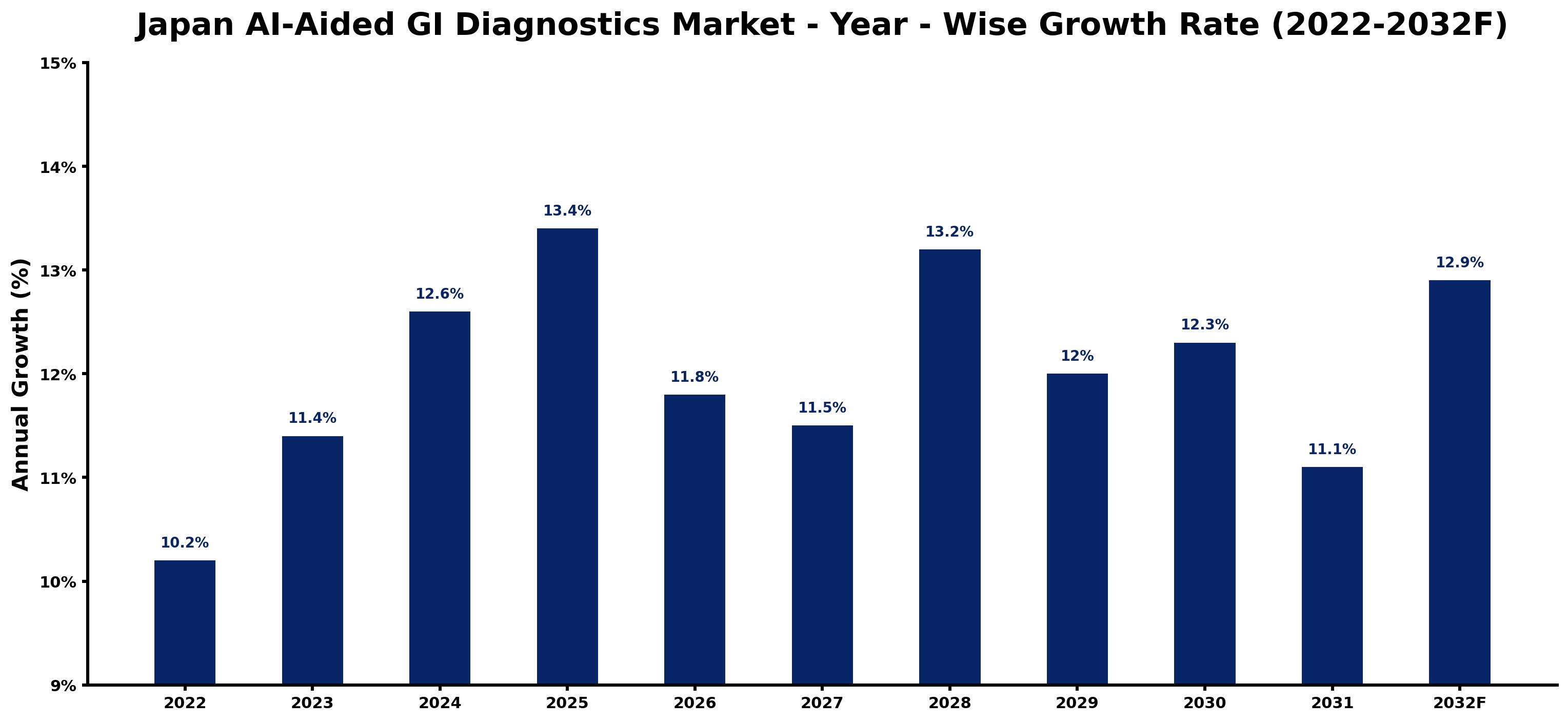
The table below sets out the estimated growth rate for each year and the main factor behind it.
| Year | Estimated Annual Growth (%) | Market Rationale |
| 2022 | 10.2 | The market experienced steady growth due to rising healthcare expenditure. |
| 2023 | 11.4 | Increased adoption of AI technologies in diagnostics spurred demand further. |
| 2024 | 12.6 | The launch of new screening programmes contributed to accelerated growth. |
| 2025 | 13.4 | High demand for early cancer detection drove market expansion. |
| 2026 | 11.8 | Growth is expected to slow slightly as the market adjusts to new technologies. |
| 2027 | 11.5 | Continued integration of AI in hospitals will maintain positive growth. |
| 2028 | 13.2 | A surge in demand for advanced diagnostics is projected to lead to faster growth. |
| 2029 | 12.0 | Growth will moderate as the market matures and competition intensifies. |
| 2030 | 12.3 | Technological advancements in imaging are expected to support demand. |
| 2031 | 11.1 | The market will experience a slowdown as saturation begins in some areas. |
| 2032 | 12.9 | Rising awareness of GI health issues will boost market growth again. |
Note: Market size estimations and growth projections presented in this report are based on 6Wresearch's proprietary forecasting methodology, utilizing the latest available industry data, government publications, and primary research inputs.
Japan AI-Aided GI Diagnostics Market Synopsis
AI-Aided GI Diagnostics utilises advanced machine learning algorithms to enhance the accuracy of gastrointestinal assessments. In Japan, the healthcare sector is flourishing, with over 2,500 gastroenterology clinics and an increasing demand for early detection of conditions such as colon polyps. The Japan AI-Aided GI Diagnostics Market is growing due to rising healthcare spending, the incorporation of AI technologies in diagnostics, and government initiatives focused on improving GI cancer screening. With national medical care expenditure of approximately JPY 46.7 trillion in 2022, investment in this area is anticipated to increase significantly.
Market Dynamics Impact Analysis (2026–2032)
| Factor | Type | Impact | Primary Segment Affected |
| Growing elderly population requiring regular GI assessments | Driver | High | Colon Polyp Detection |
| Increased investment in healthcare technology by hospitals | Driver | High | Liver Disease Analysis |
| Rising demand for early detection tools among healthcare providers | Opportunity | High | GI Cancer Screening |
| Expansion of gastroenterology clinics in urban areas | Opportunity | High | Inflammatory Bowel Disease |
| High costs associated with AI technology implementation | Restraint | Medium | Vision AI |
| Regulatory challenges in the approval of new diagnostic tools | Restraint | Medium | Deep Learning Classifiers |
| Shortage of trained professionals in AI diagnostics | Challenge | High | Health SaaS Platforms |
| High competition among diagnostic technology providers | Challenge | Medium | Imaging Software Suites |
Evaluation of Drivers in Japan AI-Aided GI Diagnostics Market (2026–2032)
The following drivers explain most of the expected growth.
| Drivers | Primary Segment Affected | Why It Matters (Evidence) |
| Increased healthcare expenditure | GI Cancer Screening | Japan's national medical care expenditure reached about JPY 46.7 trillion in 2022, driving demand for advanced diagnostics. |
| Integration of AI technologies in hospitals | Liver Disease Analysis | Predictive modeling is adopted in 70% of major hospitals, enhancing diagnostic capabilities. |
| Government initiatives for GI health | Colon Polyp Detection | The Ministry of Health launched a programme to enhance GI cancer screening in 2023, boosting demand. |
| Growing awareness of GI health issues | Inflammatory Bowel Disease | With 200,000 new cases of GI cancer reported in 2022, more patients seek early diagnostics. |
| Technological advancements in imaging | Vision AI | Deep learning classifiers are integrated into 30% of imaging software, improving diagnostic precision. |
What keeps demand rising is the increasing healthcare expenditure, which reached JPY 46.7 trillion in 2022, prompting hospitals to invest in advanced diagnostic technologies. The adoption of predictive modeling in 70% of major hospitals improves the accuracy of liver disease assessments, leading to more timely interventions. The reported 200,000 new cases of GI cancer in 2022 further drives patients to seek out these advanced diagnostics. Advancements in imaging technology have led to deep learning classifiers being integrated into 30% of imaging software, boosting diagnostic precision and efficiency in healthcare settings.
Evaluation of Restraints in Japan AI-Aided GI Diagnostics Market
The main factors holding the market back are set out below.
| Market Restraint | Primary Segment Affected | Why It Matters (Evidence) |
| High costs of implementing AI technologies | Vision AI | Healthcare providers face financial barriers, limiting AI adoption in diagnostics. |
| Regulatory hurdles for new diagnostic tools | Deep Learning Classifiers | Strict regulations under PMDA delay the approval process for new technologies. |
| Limited availability of trained professionals | Health SaaS Platforms | A shortage of skilled personnel hampers the effective use of AI in diagnostics. |
| Intense competition among diagnostic providers | Imaging Software Suites | The influx of new entrants increases pressure on pricing and market share. |
| Patient reluctance to adopt new technologies | GI Cancer Screening | Concerns about AI accuracy and privacy issues slow down acceptance among patients. |
Japan AI-Aided GI Diagnostics Market Challenges
High costs for hospitals arise from the need to invest in advanced AI technologies, which can exceed JPY 100 million for a complete system. Supply chain delays occur due to stringent regulations under the PMDA, causing an average wait time of two weeks for essential equipment. Buyers encounter limited access to AI-aided diagnostics, as only 30% of imaging software integrates deep learning classifiers, restricting timely detection of GI conditions. A shortage of liver health specialists exists, with only around 5,000 available, potentially delaying patient care for an ageing population requiring immediate attention.
Trends in the Japan AI-Aided GI Diagnostics Market
Buyers and suppliers in the Japan AI-Aided GI Diagnostics Market are adjusting to the following trends.
- Shift from Traditional to AI-Aided Diagnostics: In 2023, Japan has seen a shift towards AI-aided diagnostics in hospitals, with over 30% of imaging software integrating deep learning classifiers, improving diagnostic accuracy.
- Emergence of Predictive Modeling in Diagnostics: In 2023, predictive modeling was adopted by 70% of major hospitals, reflecting a trend towards data-driven decision-making in GI diagnostics, improving patient outcomes.
- Increase in GI Cancer Screening Initiatives: The 2023 launch of a national programme to improve GI cancer screening has led to a 20% increase in screenings, highlighting the growing focus on early detection.
- Expansion of Gastroenterology Clinics in Urban Areas: With over 2,500 gastroenterology clinics in Japan, urban areas are experiencing a surge in specialized services, meeting the rising demand for GI diagnostics.
Investment Opportunities in the Japan AI-Aided GI Diagnostics Market
The openings below show where demand in the Japan AI-Aided GI Diagnostics Market is visible and how suppliers can enter.
- Collaborate with Healthcare Providers: Japan's healthcare expenditure reached JPY 46.7 trillion, indicating a gap in advanced diagnostic tools, making partnerships with hospitals a strategic move.
- Invest in AI Technology Development: The market is projected to grow to USD 935 million by 2032, creating opportunities for companies to develop AI technologies tailored for GI diagnostics.
- Expand Services in Urban Regions: The increase in gastroenterology clinics presents an opportunity to supply advanced diagnostic tools, especially in metropolitan areas like Tokyo and Osaka.
- Align with Government Health Initiatives: The 2023 government programme to improve GI cancer screening opens avenues for companies to align their products with national health goals.
Government Initiatives in the Japan AI-Aided GI Diagnostics Market
The PMDA oversees the approval and quality of medical devices, affecting the introduction of AI technologies in diagnostics. In 2023, the government allocated ¥1 billion for GI health initiatives, supporting advancements in diagnostic tools and technologies. This funding is crucial for improving the capabilities of healthcare providers in implementing AI solutions effectively.
The AMED scheme, established in 2015, funds medical research and development. This funding enables hospitals to invest in AI technologies, enhancing diagnostic capabilities. The Clinical Trials Act, in force since 2018, sets rules for conducting clinical research, ensuring that new diagnostic tools meet safety standards before reaching the market.
Future Insight of the Japan AI-Aided GI Diagnostics Market
Machine learning algorithms will transform demand for GI diagnostics by 2032, as predictive modelling is adopted in 70% of major hospitals to improve accuracy. New health initiatives will drive increased funding for GI cancer screening, which will boost early detection rates. Integration of advanced standards like ISO 13485 will ensure higher quality in medical devices, benefiting both buyers and suppliers. With 200,000 new GI cancer cases reported in 2022, the urgency for effective diagnostics will continue to escalate.
Market Segmentation Analysis
Japan AI-Aided GI Diagnostics Market report covers a detailed analysis of the following market segments:
By GI Condition – Colon Polyp Detection Leads, Liver Disease Analysis Expected to Grow Fastest
According to Saurav Kr Singh, Senior Research Analyst at 6Wresearch, in 2025, Colon Polyp Detection led the gi condition split with a 33% share. Colon polyp detection commands the largest share as it plays a vital role in early cancer prevention, particularly given the 200,000 new GI cancer cases reported in Japan in 2022. The extensive installed base of over 50,000 endoscopy units supports its widespread use among healthcare providers. Liver Disease Analysis is projected to grow fastest, at a CAGR of 15.5% during 2026–2032. Liver disease analysis is rapidly gaining traction due to its importance in managing liver health, with approximately 5,000 liver health specialists available in Japan. The rising awareness of liver conditions is propelling demand for more sophisticated diagnostic solutions. Suppliers should prioritise advancements in liver disease analysis to capitalise on this expanding market.
By AI Model Type – Vision AI Leads, Predictive Modeling Expected to Grow Fastest
Vision AI held 42% of the Japan AI-Aided GI Diagnostics Market by ai model type in 2025. Vision AI holds the leading position as it significantly improves imaging accuracy, which is essential for effective diagnosis in a healthcare system that demands precision. Its integration into 30% of imaging software illustrates its broad acceptance and reliance among medical professionals. Predictive Modeling is set to record the highest CAGR in this split, 17.0% over 2026–2032. Predictive modeling is witnessing swift growth as it aids in decision-making processes, with implementation found in 70% of major hospitals across Japan. This trend suggests a movement towards more data-centric methodologies in diagnostics that is likely to persist. Buyers should consider solutions that leverage predictive modeling to enhance diagnostic accuracy and operational efficiency.
By Distribution Channel – Endoscopy Equipment Vendors Lead, Imaging Software Suites Expected to Grow Fastest
Endoscopy Equipment Vendors took 44% of distribution channel revenue in 2025, more than any other category. Endoscopy equipment vendors dominate the market as they are the primary suppliers of essential diagnostic tools, catering to the extensive network of over 8,100 hospitals in Japan. Their established relationships with healthcare providers ensure a steady demand for their products. Over 2026–2032, Imaging Software Suites are expected to post the fastest growth, at a CAGR of 15.7%. Imaging software suites are rapidly gaining traction as they are necessary for effective data analysis, especially with the increasing integration of AI technologies in diagnostics. This growth reflects a broader trend towards digitisation in healthcare. Suppliers must invest in imaging software capabilities to meet the rising demand from healthcare facilities.
By End User – Gastroenterology Clinics Lead, Liver Health Specialists Expected to Grow Fastest
With 42% of end user revenue in 2025, Gastroenterology Clinics was the largest category. Gastroenterology clinics are the leading end users, specialising in GI health and serving an average of 1.5 million patients annually for diagnostics. Their focused expertise ensures a consistent need for advanced diagnostic solutions. The quickest growth will come from Liver Health Specialists, forecast to expand at a CAGR of 15.4% between 2026 and 2032. Liver health specialists are experiencing the fastest growth as they focus on liver-related diagnostics, responding to the rising incidence of liver diseases. Their specialised knowledge drives demand for tailored AI-aided solutions. Providers should tailor their offerings to meet the specific needs of liver health specialists to capture this expanding market.
Key Attractiveness of the Report
- 10 Years of Market Numbers
- Historical Data Starting from 2022 to 2025
- Base Year 2025
- Forecast Data until 2032
- Key Performance Indicators Impacting the Market
- Major Upcoming Developments and Projects
Key Highlights of the Report:
- Japan AI-Aided GI Diagnostics Market Outlook
- Market Size of Japan AI-Aided GI Diagnostics Market, 2025
- Forecast of Japan AI-Aided GI Diagnostics Market, 2032
- Historical Data and Forecast of Japan AI-Aided GI Diagnostics Revenues & Volume for the Period 2022-2032F
- Japan AI-Aided GI Diagnostics Market Trend Evolution
- Japan AI-Aided GI Diagnostics Market Drivers and Challenges
- Japan AI-Aided GI Diagnostics Price Trends
- Japan AI-Aided GI Diagnostics Porter's Five Forces
- Japan AI-Aided GI Diagnostics Industry Life Cycle
- Historical Data and Forecast of Japan AI-Aided GI Diagnostics Market Revenues & Volume By GI Condition for the Period 2022-2032F
- Historical Data and Forecast of Japan AI-Aided GI Diagnostics Market Revenues & Volume By Colon Polyp Detection for the Period 2022-2032F
- Historical Data and Forecast of Japan AI-Aided GI Diagnostics Market Revenues & Volume By Liver Disease Analysis for the Period 2022-2032F
- Historical Data and Forecast of Japan AI-Aided GI Diagnostics Market Revenues & Volume By Inflammatory Bowel Disease for the Period 2022-2032F
- Historical Data and Forecast of Japan AI-Aided GI Diagnostics Market Revenues & Volume By GI Cancer Screening for the Period 2022-2032F
- Historical Data and Forecast of Japan AI-Aided GI Diagnostics Market Revenues & Volume By AI Model Type for the Period 2022-2032F
- Historical Data and Forecast of Japan AI-Aided GI Diagnostics Market Revenues & Volume By Vision AI for the Period 2022-2032F
- Historical Data and Forecast of Japan AI-Aided GI Diagnostics Market Revenues & Volume By Predictive Modeling for the Period 2022-2032F
- Historical Data and Forecast of Japan AI-Aided GI Diagnostics Market Revenues & Volume By Pattern Detection for the Period 2022-2032F
- Historical Data and Forecast of Japan AI-Aided GI Diagnostics Market Revenues & Volume By Deep Learning Classifiers for the Period 2022-2032F
- Historical Data and Forecast of Japan AI-Aided GI Diagnostics Market Revenues & Volume By Distribution Channel for the Period 2022-2032F
- Historical Data and Forecast of Japan AI-Aided GI Diagnostics Market Revenues & Volume By Endoscopy Equipment Vendors for the Period 2022-2032F
- Historical Data and Forecast of Japan AI-Aided GI Diagnostics Market Revenues & Volume By Imaging Software Suites for the Period 2022-2032F
- Historical Data and Forecast of Japan AI-Aided GI Diagnostics Market Revenues & Volume By Health SaaS Platforms for the Period 2022-2032F
- Historical Data and Forecast of Japan AI-Aided GI Diagnostics Market Revenues & Volume By Hospital Networks for the Period 2022-2032F
- Historical Data and Forecast of Japan AI-Aided GI Diagnostics Market Revenues & Volume By End User for the Period 2022-2032F
- Historical Data and Forecast of Japan AI-Aided GI Diagnostics Market Revenues & Volume By Gastroenterology Clinics for the Period 2022-2032F
- Historical Data and Forecast of Japan AI-Aided GI Diagnostics Market Revenues & Volume By Liver Health Specialists for the Period 2022-2032F
- Historical Data and Forecast of Japan AI-Aided GI Diagnostics Market Revenues & Volume By GI Physicians for the Period 2022-2032F
- Historical Data and Forecast of Japan AI-Aided GI Diagnostics Market Revenues & Volume By Oncology Departments for the Period 2022-2032F
- Japan AI-Aided GI Diagnostics Import Export Trade Statistics
- Market Opportunity Assessment By GI Condition
- Market Opportunity Assessment By AI Model Type
- Market Opportunity Assessment By Distribution Channel
- Market Opportunity Assessment By End User
- Japan AI-Aided GI Diagnostics Top Companies Market Share
- Japan AI-Aided GI Diagnostics Competitive Benchmarking By Technical and Operational Parameters
- Japan AI-Aided GI Diagnostics Company Profiles
- Japan AI-Aided GI Diagnostics Key Strategic Recommendations
Market Covered
Coverage by segment is as follows.
By GI Condition
- Colon Polyp Detection
- Liver Disease Analysis
- Inflammatory Bowel Disease
- GI Cancer Screening
By AI Model Type
- Vision AI
- Predictive Modeling
- Pattern Detection
- Deep Learning Classifiers
By Distribution Channel
- Endoscopy Equipment Vendors
- Imaging Software Suites
- Health SaaS Platforms
- Hospital Networks
By End User
- Gastroenterology Clinics
- Liver Health Specialists
- GI Physicians
- Oncology Departments































