Japan AI-assisted Diagnostics Market Size & Growth Rate
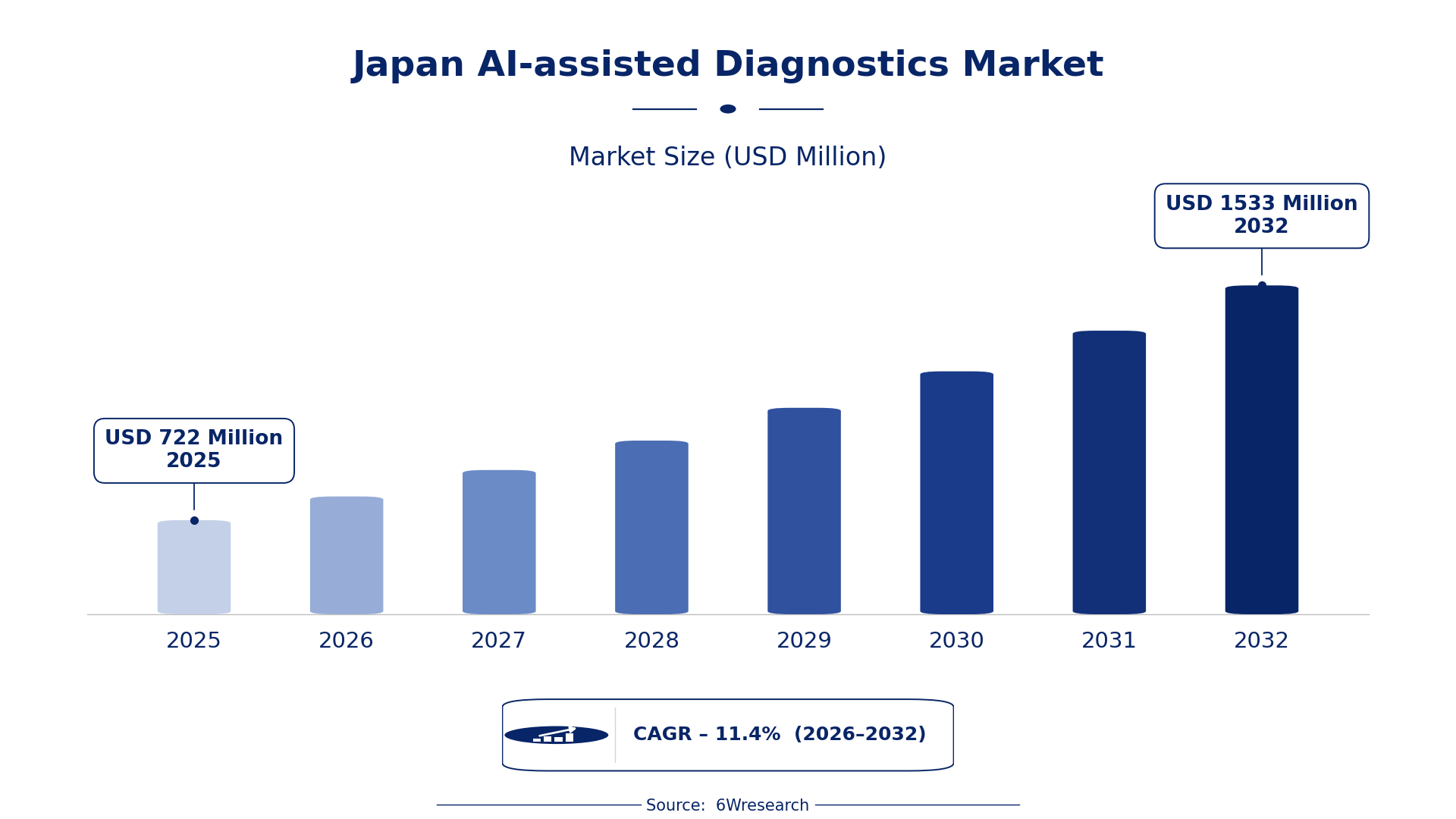
According to 6Wresearch internal database and industry insights, the Japan AI-assisted Diagnostics Market was valued at USD 722 Million in 2025 and is projected to reach USD 1,533 Million by 2032, growing at a CAGR of approximately 11.4% during 2026–2032.
Japan AI-assisted Diagnostics Market Highlights
| Report Metric | Details |
| Report Name | Japan AI-assisted Diagnostics Market (2026-2032) |
| Market Size 2025 | USD 722 Million |
| Market Size 2032 | USD 1,533 Million |
| Absolute Growth 2025–2032 | USD 811 Million |
| CAGR 2026–2032 | 11.4% |
| Peak Annual Growth | 12.3% in 2028 |
| Forecast Period | 2026–2032 |
| Historical Data | 2022–2025 |
| Base Year | 2025 |
| Leading Diagnostic Area, 2025 | Radiology (55% share) |
| Leading AI Feature, 2025 | Pattern Recognition (43% share) |
| Leading Distribution Channel, 2025 | Imaging Software Vendors (43% share) |
| Leading End User, 2025 | Hospitals (51% share) |
| Fastest-Growing Diagnostic Area | Dermatology (13.6% CAGR) |
| Fastest-Growing AI Feature | Cell-Level Classification (14.7% CAGR) |
| Fastest-Growing Distribution Channel | Health AI SaaS Tools (15.5% CAGR) |
| Fastest-Growing End User | Skin Clinics (14.6% CAGR) |
| Growing Sector | Healthcare diagnostics |
| Key End Users | Hospitals, Diagnostic Labs, Cardiology Centers, Skin Clinics |
Japan AI-assisted Diagnostics Market Year-wise Growth Rate and Key Drivers (2022–2032)
This graph illustrates the annual growth rates of the market from 2022 to 2032, highlighting a steady upward trajectory and projected market expansion over the forecast period.
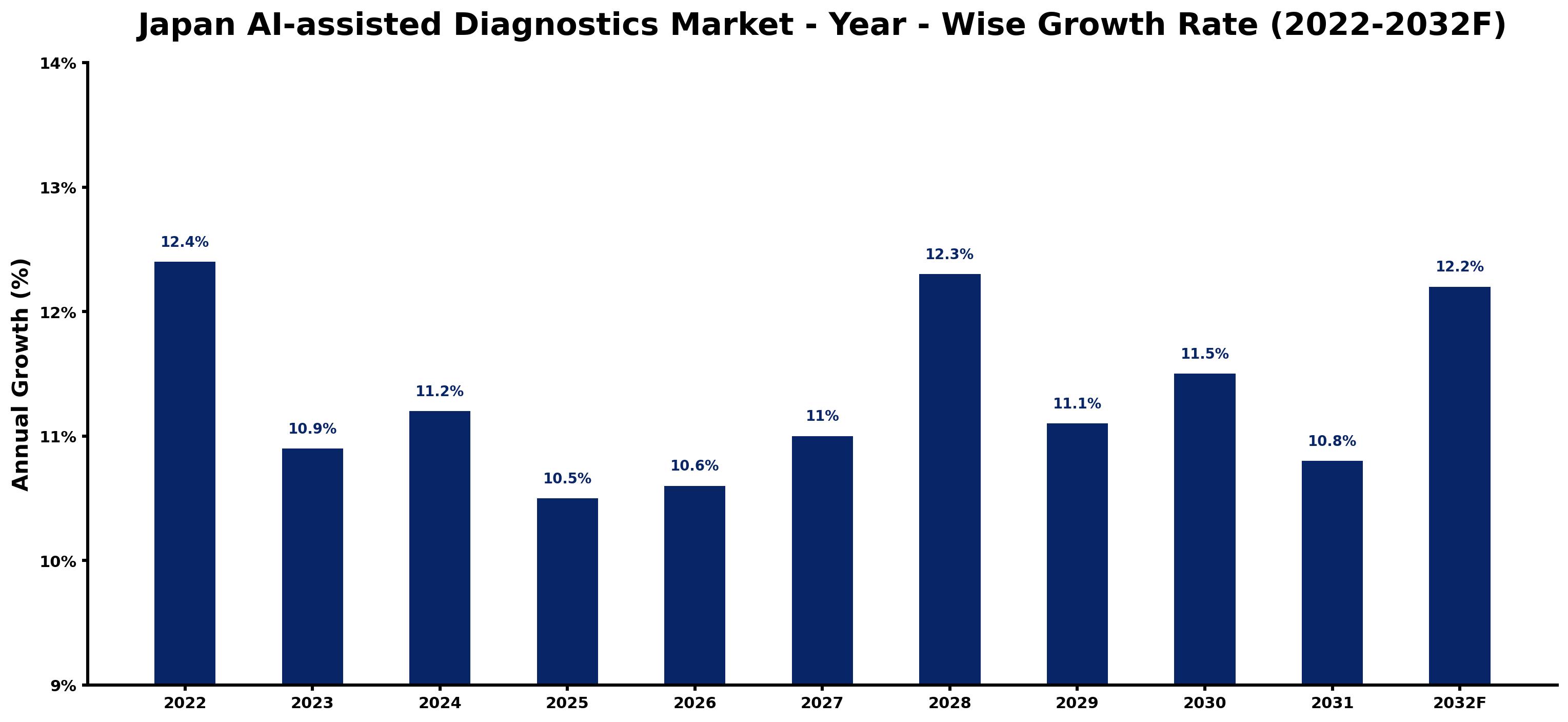
Each row of the following table gives one year's estimated growth and the event or demand shift that explains it.
| Year | Estimated Annual Growth (%) | Market Rationale |
| 2022 | 12.4 | The market experienced strong demand due to advancements in AI technologies. |
| 2023 | 10.9 | Growth slowed as hospitals adjusted to new diagnostic technologies and integration. |
| 2024 | 11.2 | Increased adoption of AI-assisted tools in hospitals boosted growth rates. |
| 2025 | 10.5 | Market growth slowed as hospitals faced budget constraints and resource allocation. |
| 2026 | 10.6 | Demand is expected to rise with the introduction of new AI diagnostic tools. |
| 2027 | 11.0 | Growing investments in healthcare technology will drive market expansion. |
| 2028 | 12.3 | The peak growth period is projected as hospitals improve diagnostic capabilities. |
| 2029 | 11.1 | Market growth slows as saturation in urban areas begins to occur. |
| 2030 | 11.5 | Increased healthcare spending is anticipated to support further growth. |
| 2031 | 10.8 | Market growth slows due to potential regulatory adjustments and compliance costs. |
| 2032 | 12.2 | Demand is expected to rise as the aging population increases healthcare needs. |
Note: Market size estimations and growth projections presented in this report are based on 6Wresearch's proprietary forecasting methodology, utilizing the latest available industry data, government publications, and primary research inputs.
Japan AI-assisted Diagnostics Market Synopsis
AI-assisted diagnostics utilises advanced technologies to analyse medical data, supporting clinical decision-making and improving diagnostic accuracy. Key applications include disease detection across various medical fields, primarily in hospitals and diagnostic labs. The Japan AI-assisted Diagnostics Market is expanding due to the country's aging population, which accounted for 29.3% of the population in September 2024, and substantial healthcare expenditure, reaching approximately JPY 46.7 trillion in fiscal 2022. These elements drive demand for advanced diagnostic solutions, particularly in urban healthcare settings.
Market Dynamics Impact Analysis (2026–2032)
| Factor | Type | Impact | Primary Segment Affected |
| Aging population driving demand for efficient diagnostics | Driver | High | Hospitals |
| Increased healthcare expenditure supporting advanced technologies | Driver | High | Diagnostic Labs |
| Rising integration of AI tools in clinical workflows | Opportunity | High | Health AI SaaS Tools |
| Expansion of AI-assisted diagnostics in urban healthcare facilities | Opportunity | High | Cardiology Centers |
| Budget constraints limiting hospital investments in new technologies | Restraint | High | Hospitals |
| Regulatory challenges affecting the speed of AI tool approvals | Restraint | Medium | Diagnostic Labs |
| High initial costs of implementing AI systems in healthcare | Challenge | High | Health AI SaaS Tools |
| Competition from traditional diagnostic methods delaying adoption | Challenge | Medium | Cardiology Centers |
Evaluation of Drivers in Japan AI-assisted Diagnostics Market (2026–2032)
These are the developments adding the most demand over the forecast period.
| Drivers | Primary Segment Affected | Why It Matters (Evidence) |
| Aging population increases demand for diagnostics | Hospitals | 29.3% of Japan's population was aged 65 or older in September 2024, leading to higher healthcare needs. |
| Healthcare expenditure supports advanced diagnostic technologies | Diagnostic Labs | Japan's national medical care expenditure was about JPY 46.7 trillion in fiscal 2022, facilitating investments in AI. |
| Integration of AI tools improves clinical workflows | Health AI SaaS Tools | Health AI SaaS tools are increasingly adopted in urban hospitals, improving diagnostic efficiency and patient care. |
| Technological advancements in AI improve accuracy | Cardiology | AI-assisted ECG interpretation tools are being rapidly adopted in cardiology centers, enhancing diagnostic precision. |
| Growing research funding for AI diagnostics | Pattern Recognition | The National Institute of Health Sciences supports AI research, driving development in pattern recognition technologies. |
Volumes grow on the back of Japan's aging population, with 29.3% aged 65 or older in September 2024, increasing demand for healthcare services. The national medical care expenditure reached approximately JPY 46.7 trillion in fiscal 2022, facilitating investments in advanced diagnostic technologies. Urban hospitals are increasingly integrating AI tools into clinical workflows, which enhances diagnostic efficiency. The National Institute of Health Sciences is actively funding research, driving advancements in pattern recognition technologies. Rapid adoption of AI-assisted ECG interpretation tools in cardiology centers is improving diagnostic accuracy and patient outcomes.
Evaluation of Restraints in Japan AI-assisted Diagnostics Market
The following restraints limit how fast demand can grow.
| Market Restraint | Primary Segment Affected | Why It Matters (Evidence) |
| Budget constraints limiting hospital investments in new technologies | Hospitals | Budget limitations hinder hospitals' ability to invest in advanced AI diagnostics, impacting their operational capabilities. |
| Regulatory challenges affecting the speed of AI tool approvals | Diagnostic Labs | Complex regulatory processes delay the introduction of new AI-assisted diagnostic tools, affecting market entry. |
| High initial costs of implementing AI systems in healthcare | Health AI SaaS Tools | The upfront investment required for AI systems deters some healthcare facilities from adopting these technologies. |
| Competition from traditional diagnostic methods delaying adoption | Cardiology Centers | Established diagnostic methods remain preferred, slowing the transition to AI-assisted solutions in cardiology. |
| Limited awareness of AI benefits among healthcare providers | Skin Clinics | Some skin clinics lack understanding of AI's advantages, hindering adoption rates and limiting market growth. |
Japan AI-assisted Diagnostics Market Challenges
Japan encounters supply shortages of AI-assisted diagnostic tools stemming from limited local production capacity. This reliance on imports results in longer lead times for hospitals and diagnostic labs, potentially delaying critical patient diagnoses by weeks. Technological advancements are hindered as local developers struggle to keep pace with global innovations, compelling producers to depend on outdated systems that diminish diagnostic accuracy. Regulatory challenges, including strict compliance with ISO 13485, extend approval timelines, delaying access to new solutions for buyers and affecting patient care across the healthcare system.
Trends in the Japan AI-assisted Diagnostics Market
The shifts below are changing how Japan AI-assisted Diagnostics Market products are bought and supplied.
- Shift from Traditional to AI-assisted Diagnostics: Since 2022, hospitals in Japan have increasingly adopted AI-assisted diagnostic tools, enhancing accuracy and efficiency. Approximately 8,100 hospitals are now employing advanced technologies, reflecting a growing trend towards AI integration.
- Emergence of Health AI SaaS Tools: In 2023, Health AI SaaS tools gained traction in urban healthcare facilities, with a projected CAGR of 15.5% through 2032. This shift enables more efficient diagnostic processes and improved patient outcomes.
- Transition to AI-driven Imaging Analysis: The introduction of AI-driven imaging software in 2024 has transformed diagnostic practices, with hospitals reporting enhanced accuracy in disease detection. This change is supported by a growing number of diagnostic labs adopting AI solutions.
- Growth of AI in Cardiology: In 2023, cardiology centres rapidly adopted AI for ECG interpretation, with adoption rates increasing significantly. This trend reflects the need for improved diagnostic accuracy in heart-related conditions.
Investment Opportunities in the Japan AI-assisted Diagnostics Market
The following opportunities in the Japan AI-assisted Diagnostics Market pair current demand with a clear way in.
- Partnerships for AI Tool Development: Hospitals in Japan are seeking partnerships to develop advanced AI diagnostic tools. Collaborating with local tech firms can facilitate entry into this expanding market.
- Investment in Health AI SaaS Tools: Skin clinics are increasingly looking for AI solutions to improve diagnostic capabilities. Investing in Health AI SaaS tools can help meet this demand, particularly in urban areas where technology adoption is higher.
- Expansion of AI in Diagnostic Labs: Diagnostic labs are broadening their use of AI technologies, with around 1,500 labs in Japan. Supplying advanced AI tools can effectively capture this growing market segment.
- Development of AI for Dermatology: The dermatology sector is projected to grow at a CAGR of 13.6% through 2032. Focusing on developing AI solutions for skin condition diagnosis presents opportunities.
Government Initiatives in the Japan AI-assisted Diagnostics Market
The Clinical Trials Act, enacted in 2017, establishes rules for conducting and disclosing clinical research, strengthening the regulatory framework for AI-assisted diagnostics. This law complements the PMD Act, which regulates the approval and quality of medical devices, ensuring that AI tools meet safety standards and are effective for clinical use.
The Pharmaceuticals and Medical Devices Agency (PMDA) reviews and approves AI-assisted diagnostic tools, ensuring compliance with regulations. The agency also monitors post-market safety, providing assurance to healthcare providers about the reliability of these technologies.
Future Insight of the Japan AI-assisted Diagnostics Market
Hospitals will evolve their operations by 2032, driven by government initiatives that promote technology integration in healthcare. The number of facilities adopting AI solutions is set to rise significantly, improving operational efficiency across the sector. As urban areas implement advanced diagnostic technologies, clinical workflows will become more streamlined, benefiting both buyers and suppliers. Japan's healthcare expenditure reached approximately 42 trillion yen in 2023, indicating a strong push for investment in advanced diagnostic solutions to meet the demands of the aging population.
Market Segmentation Analysis
Japan AI-assisted Diagnostics Market report covers a detailed analysis of the following market segments:
By Diagnostic Area – Radiology Leads, Dermatology Expected to Grow Fastest
According to Saurav Kr Singh, Senior Research Analyst at 6Wresearch, the largest diagnostic area category in 2025 was Radiology, at 55% of revenue. Radiology holds the largest share due to its extensive application in imaging analysis across Japan's 8,100 hospitals. The high volume of imaging procedures performed in these facilities drives demand for advanced diagnostic technologies. Over 2026–2032, Dermatology is expected to post the fastest growth, at a CAGR of 13.6%. Dermatology is experiencing rapid growth as AI tools become essential for accurate skin condition diagnosis, particularly in urban areas where skin clinics are increasingly adopting these solutions. This trend is supported by the rising prevalence of skin disorders among the aging population. Suppliers should focus on developing tailored solutions for dermatology to capitalise on this growing demand.
By AI Feature – Pattern Recognition Leads, Cell-Level Classification Expected to Grow Fastest
With 43% of ai feature revenue in 2025, Pattern Recognition was the largest category. Pattern Recognition holds the largest share due to its critical role in identifying anomalies in medical images, particularly in radiology departments across Japan. Its established use in over 8,000 hospitals ensures sustained demand and reliance on this technology. Cell-Level Classification is projected to grow fastest, at a CAGR of 14.7% during 2026–2032. Cell-Level Classification is experiencing rapid growth as it plays a vital role in accurate cancer diagnosis, a priority in Japan's healthcare system given the rising cancer rates among the elderly. The increasing focus on early detection will likely further elevate its market position. Suppliers should prioritise advancements in pattern recognition and cell-level classification technologies to satisfy the growing need for precise diagnostics.
By Distribution Channel – Imaging Software Vendors Lead, Health AI SaaS Tools Expected to Grow Fastest
Imaging Software Vendors took 43% of distribution channel revenue in 2025, more than any other category. Imaging Software Vendors lead the market by providing essential diagnostic tools that are integral to the operations of healthcare facilities throughout Japan. Their strong relationships with hospitals and diagnostic labs guarantee a steady demand for their products. The quickest growth will come from Health AI SaaS Tools, forecast to expand at a CAGR of 15.5% between 2026 and 2032. Health AI SaaS Tools are witnessing rapid growth as they deliver cloud-based diagnostic solutions that streamline clinical workflows, particularly in urban healthcare settings. The push for efficiency and seamless integration in diagnostics drives this segment's expansion. Suppliers must focus on developing cloud-based solutions to align with the ongoing digital transformation in healthcare.
By End User – Hospitals Lead, Skin Clinics Expected to Grow Fastest
In 2025, Hospitals led the end user split with a 51% share. Hospitals are the primary consumers of AI-assisted technologies, using these systems to improve patient care and operational efficiency. Their substantial healthcare expenditure, which reached approximately 42 trillion yen in 2023, reinforces their leading position in the market. Skin Clinics are set to record the highest CAGR in this split, 14.6% over 2026–2032. Skin Clinics are quickly adopting advanced diagnostic technologies for dermatological assessments, reflecting a growing trend towards specialised care. This shift is driven by an increasing focus on skin health and early detection among the population. Suppliers should customise their products to cater to the specific requirements of skin clinics to capitalise on this expanding market segment.
Key Attractiveness of the Report
- 10 Years of Market Numbers
- Historical Data Starting from 2022 to 2025
- Base Year 2025
- Forecast Data until 2032
- Key Performance Indicators Impacting the Market
- Major Upcoming Developments and Projects
Key Highlights of the Report:
- Japan AI-assisted Diagnostics Market Outlook
- Market Size of Japan AI-assisted Diagnostics Market, 2025
- Forecast of Japan AI-assisted Diagnostics Market, 2032
- Historical Data and Forecast of Japan AI-assisted Diagnostics Revenues & Volume for the Period 2022-2032F
- Japan AI-assisted Diagnostics Market Trend Evolution
- Japan AI-assisted Diagnostics Market Drivers and Challenges
- Japan AI-assisted Diagnostics Price Trends
- Japan AI-assisted Diagnostics Porter's Five Forces
- Japan AI-assisted Diagnostics Industry Life Cycle
- Historical Data and Forecast of Japan AI-assisted Diagnostics Market Revenues & Volume By Diagnostic Area for the Period 2022-2032F
- Historical Data and Forecast of Japan AI-assisted Diagnostics Market Revenues & Volume By Radiology for the Period 2022-2032F
- Historical Data and Forecast of Japan AI-assisted Diagnostics Market Revenues & Volume By Pathology for the Period 2022-2032F
- Historical Data and Forecast of Japan AI-assisted Diagnostics Market Revenues & Volume By Dermatology for the Period 2022-2032F
- Historical Data and Forecast of Japan AI-assisted Diagnostics Market Revenues & Volume By Cardiology for the Period 2022-2032F
- Historical Data and Forecast of Japan AI-assisted Diagnostics Market Revenues & Volume By AI Feature for the Period 2022-2032F
- Historical Data and Forecast of Japan AI-assisted Diagnostics Market Revenues & Volume By Pattern Recognition for the Period 2022-2032F
- Historical Data and Forecast of Japan AI-assisted Diagnostics Market Revenues & Volume By Cell-Level Classification for the Period 2022-2032F
- Historical Data and Forecast of Japan AI-assisted Diagnostics Market Revenues & Volume By Visual Analysis for the Period 2022-2032F
- Historical Data and Forecast of Japan AI-assisted Diagnostics Market Revenues & Volume By ECG Interpretation for the Period 2022-2032F
- Historical Data and Forecast of Japan AI-assisted Diagnostics Market Revenues & Volume By Distribution Channel for the Period 2022-2032F
- Historical Data and Forecast of Japan AI-assisted Diagnostics Market Revenues & Volume By Imaging Software Vendors for the Period 2022-2032F
- Historical Data and Forecast of Japan AI-assisted Diagnostics Market Revenues & Volume By Health AI SaaS Tools for the Period 2022-2032F
- Historical Data and Forecast of Japan AI-assisted Diagnostics Market Revenues & Volume By Mobile Health Apps for the Period 2022-2032F
- Historical Data and Forecast of Japan AI-assisted Diagnostics Market Revenues & Volume By Clinical IT Systems for the Period 2022-2032F
- Historical Data and Forecast of Japan AI-assisted Diagnostics Market Revenues & Volume By End User for the Period 2022-2032F
- Historical Data and Forecast of Japan AI-assisted Diagnostics Market Revenues & Volume By Diagnostic Labs for the Period 2022-2032F
- Historical Data and Forecast of Japan AI-assisted Diagnostics Market Revenues & Volume By Hospitals for the Period 2022-2032F
- Historical Data and Forecast of Japan AI-assisted Diagnostics Market Revenues & Volume By Skin Clinics for the Period 2022-2032F
- Historical Data and Forecast of Japan AI-assisted Diagnostics Market Revenues & Volume By Cardiology Centers for the Period 2022-2032F
- Japan AI-assisted Diagnostics Import Export Trade Statistics
- Market Opportunity Assessment By Diagnostic Area
- Market Opportunity Assessment By AI Feature
- Market Opportunity Assessment By Distribution Channel
- Market Opportunity Assessment By End User
- Japan AI-assisted Diagnostics Top Companies Market Share
- Japan AI-assisted Diagnostics Competitive Benchmarking By Technical and Operational Parameters
- Japan AI-assisted Diagnostics Company Profiles
- Japan AI-assisted Diagnostics Key Strategic Recommendations
Market Covered
The report covers the following segments.
By Diagnostic Area
- Radiology
- Pathology
- Dermatology
- Cardiology
By AI Feature
- Pattern Recognition
- Cell-Level Classification
- Visual Analysis
- ECG Interpretation
By Distribution Channel
- Imaging Software Vendors
- Health AI SaaS Tools
- Mobile Health Apps
- Clinical IT Systems
By End User
- Diagnostic Labs
- Hospitals
- Skin Clinics
- Cardiology Centers































