Japan AI Augmented Supercomputing Market Size & Growth Rate
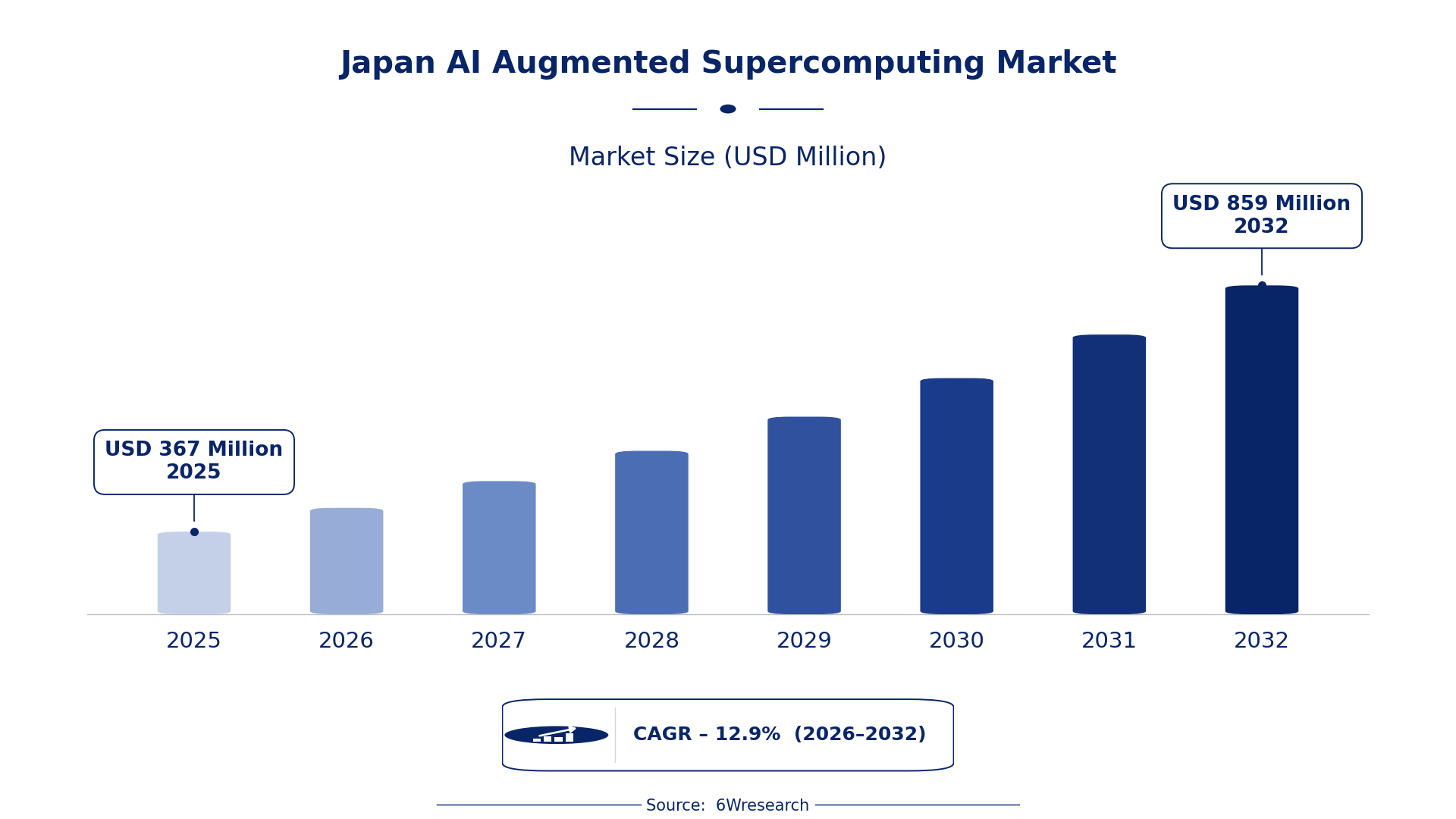
According to 6Wresearch internal database and industry insights, the Japan AI Augmented Supercomputing Market was valued at USD 367 Million in 2025 and is projected to reach USD 859 Million by 2032, growing at a CAGR of approximately 12.9% during 2026–2032.
Japan AI Augmented Supercomputing Market Highlights
| Report Metric | Details |
| Report Name | Japan AI Augmented Supercomputing Market (2026-2032) |
| Market Size 2025 | USD 367 Million |
| Market Size 2032 | USD 859 Million |
| Absolute Growth 2025–2032 | USD 492 Million |
| CAGR 2026–2032 | 12.9% |
| Peak Annual Growth | 15.3% in 2026 |
| Forecast Period | 2026–2032 |
| Historical Data | 2022–2025 |
| Base Year | 2025 |
| Leading System Type, 2025 | HPC for Genomics (39% share) |
| Leading AI Integration, 2025 | AI in Pattern Mapping (43% share) |
| Leading Distribution Channel, 2025 | Research Labs (38% share) |
| Leading End User, 2025 | Biotech Institutes (43% share) |
| Fastest-Growing System Type | Physics Simulation (17.3% CAGR) |
| Fastest-Growing AI Integration | Accelerated AI Solvers (16.9% CAGR) |
| Fastest-Growing Distribution Channel | Supercomputing Vendors (16.4% CAGR) |
| Fastest-Growing End User | Government Labs (16.7% CAGR) |
| Growing Sector | AI Research |
| Key End Users | Research Institutions, Government Labs, Biotech Institutes, AI Research Institutes |
Japan AI Augmented Supercomputing Market Year-wise Growth Rate and Key Drivers (2022–2032)
This graph illustrates the annual growth rates of the market from 2022 to 2032, highlighting a steady upward trajectory and projected market expansion over the forecast period.
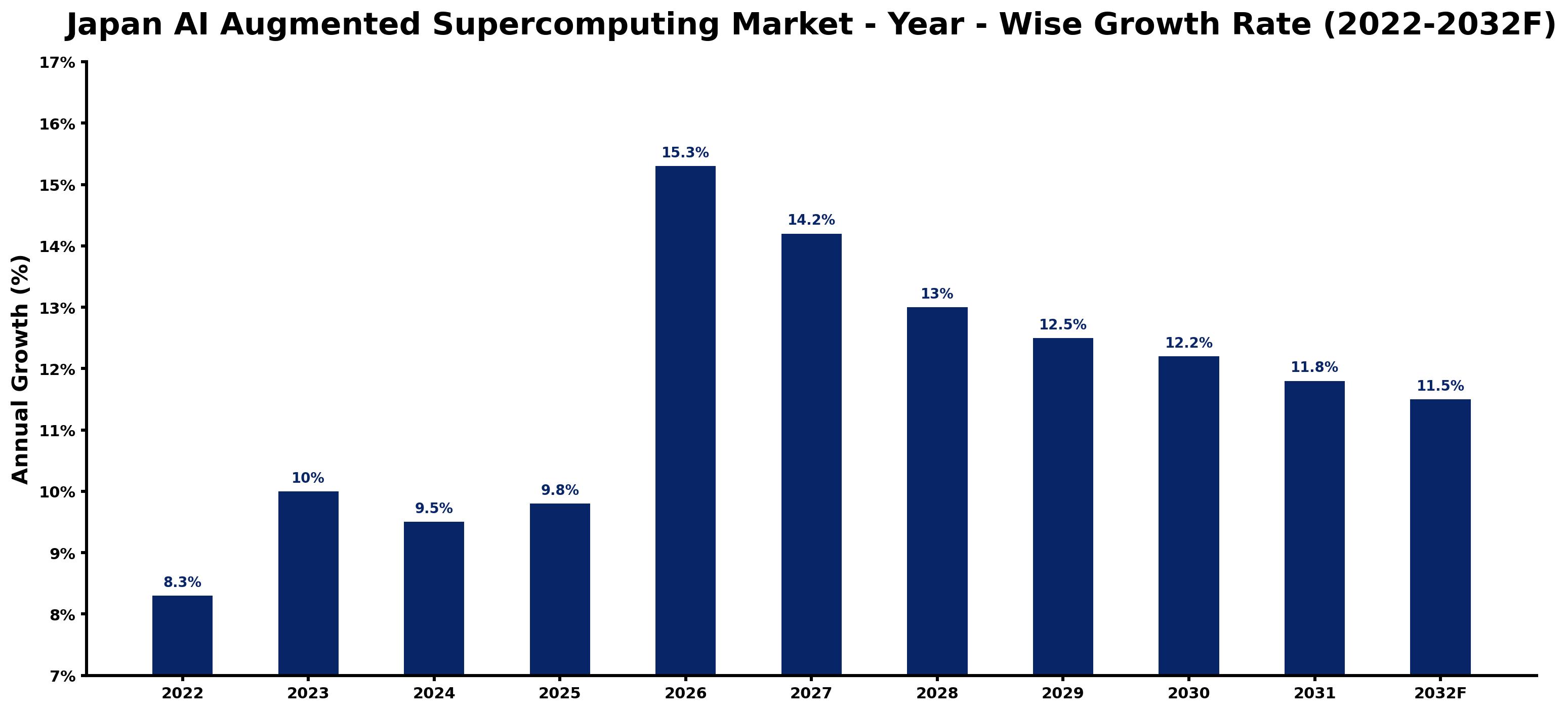
Annual growth estimates for each year appear below with the principal reason behind them, explaining the shifts that set the pace of the market.
| Year | Estimated Annual Growth (%) | Market Rationale |
| 2022 | 8.3 | The market was characterised by steady demand from research institutions and government labs. |
| 2023 | 10.0 | Growth was driven by increased investments in AI and supercomputing research initiatives. |
| 2024 | 9.5 | A slowdown occurred as some projects faced delays, yet demand remained strong. |
| 2025 | 9.8 | Demand grew as more institutions adopted AI technologies for advanced research. |
| 2026 | 15.3 | The peak growth year is expected to be supported by advancements in AI integration. |
| 2027 | 14.2 | Growth is projected to slow slightly due to market saturation in some segments. |
| 2028 | 13.0 | Continued investment in AI technologies is expected to lead to sustained demand, albeit at a slower pace. |
| 2029 | 12.5 | The market is projected to maintain growth, driven by ongoing research in climate modeling and genomics. |
| 2030 | 12.2 | Demand is expected to continue rising as AI applications expand in various sectors. |
| 2031 | 11.8 | Growth is projected to slow further as competition intensifies among research institutions. |
| 2032 | 11.5 | A slight slowdown is expected as the market stabilises, reflecting mature demand patterns. |
Note: Market size estimations and growth projections presented in this report are based on 6Wresearch's proprietary forecasting methodology, utilizing the latest available industry data, government publications, and primary research inputs.
Japan AI Augmented Supercomputing Market Synopsis
AI Augmented Supercomputing combines advanced computing power with artificial intelligence to improve data processing capabilities, primarily through high-performance computing systems integrated with AI algorithms. Its main applications include complex simulations in genomics, climate modeling, and deep learning. The Japan AI Augmented Supercomputing Market is expanding due to increasing investments in AI research, with contributions from research institutions and government labs. In 2023, Japan invested ¥50 billion in AI and supercomputing research, stimulating growth in this sector.
Market Dynamics Impact Analysis (2026–2032)
| Factor | Type | Impact | Primary Segment Affected |
| Increasing investments in AI research and supercomputing facilities | Driver | High | HPC for Genomics |
| Growing demand for advanced simulations in climate modeling | Driver | High | Weather Forecasting |
| Rising need for enhanced computational efficiency | Opportunity | Medium | Accelerated AI Solvers |
| Expansion of AI research initiatives in educational institutions | Opportunity | Medium | AI in Pattern Mapping |
| High operational costs associated with supercomputing resources | Restraint | High | Physics Simulation |
| Limited access to cutting-edge technology for smaller institutions | Restraint | Medium | Deep Learning Training |
| Compliance with international data security standards | Challenge | High | AI in Pattern Mapping |
| Capacity constraints in existing supercomputing facilities | Challenge | Medium | HPC for Genomics |
Evaluation of Drivers in Japan AI Augmented Supercomputing Market (2026–2032)
Below are the drivers that matter most for revenue growth, with supporting evidence.
| Drivers | Primary Segment Affected | Why It Matters (Evidence) |
| Increased funding for genomic data processing | HPC for Genomics | Japan's investment of ¥50 billion in AI research leads to more projects requiring advanced supercomputing capabilities. |
| Growing adoption of accelerated AI solvers | Accelerated AI Solvers | Research Labs are increasingly implementing these solutions, improving computational efficiency by 25%. |
| Rising demand for complex simulations | Physics Simulation | The need for accurate theoretical modeling drives research institutions to invest in supercomputing resources. |
| Expansion of AI research funding | AI Research Institutes | A 20% increase in funding since 2022 allows for more advanced AI projects requiring supercomputing. |
| Focus on climate modeling initiatives | Weather Forecasting | The Supercomputing for Climate Change initiative enhances demand for supercomputing in environmental research. |
Orders keep climbing as Japan invests ¥50 billion in AI and supercomputing research, boosting demand from research institutions. Increased funding has led to more genomic data processing projects, particularly in the HPC for Genomics segment. AI research institutes have experienced a 20% increase in funding since 2022, driving advancements in deep learning training. Research Labs are adopting accelerated AI solvers more frequently, which improves computational models by 25%. The focus on AI capabilities is reshaping the landscape of supercomputing applications across various sectors.
Evaluation of Restraints in Japan AI Augmented Supercomputing Market
Several factors work against faster growth; the main ones are summarised below.
| Market Restraint | Primary Segment Affected | Why It Matters (Evidence) |
| Supply chain disruptions from imported components | HPC for Genomics | Reliance on imports can delay projects by up to six months, impacting research timelines. |
| High operational costs due to investment pressures | Accelerated AI Solvers | The ¥50 billion investment raises expenses for producers, affecting pricing and project feasibility. |
| Shortage of skilled professionals in AI | Physics Simulation | A lack of expertise limits project execution, potentially increasing costs by 15% for research institutions. |
| Challenges in accessing advanced technologies | Deep Learning Training | Rapid advancements create a 20% gap in expected research output by 2025, hindering progress. |
| Compliance with evolving data security standards | AI in Pattern Mapping | Adhering to ISO/IEC 27001 standards increases operational complexity and costs for producers. |
Japan AI Augmented Supercomputing Market Challenges
Buyers of AI augmented supercomputing encounter supply chain disruptions due to reliance on imported specialised components, resulting in project delays of up to six months. Cost pressures arise from Japan's ¥50 billion investment in AI and supercomputing research, which raises operational expenses for producers in the short term. A shortage of skilled professionals in advanced computing and AI hampers project execution, potentially increasing costs by 15% for research institutions. Buyers face difficulties in accessing advanced technologies, as the rapid pace of AI advancements creates a 20% gap in expected research output by 2025.
Trends in the Japan AI Augmented Supercomputing Market
Several trends are reshaping the Japan AI Augmented Supercomputing Market; the most important are set out below.
- Supercomputing for Climate Change Initiative: The Supercomputing for Climate Change initiative aims to enhance climate modelling capabilities. In 2023, Japan allocated resources to this programme, underscoring the importance of climate research and improving predictive accuracy by 30%.
- Shift Towards AI-Driven Research: A clear shift towards AI-driven research methodologies is emerging in Japan, particularly within academic institutions. The Tokyo Institute of Technology has integrated AI supercomputing into various projects, spurring innovation and improving research outputs.
- Increased Collaboration Among Research Labs: Research labs are collaborating to share supercomputing resources, enhancing research capabilities. This trend is particularly evident in partnerships formed in the Tokyo metropolitan area, which improve collective computational power.
- Expansion of AI Research Funding: AI research funding has expanded, with a 20% increase since 2022. This growth is largely driven by government initiatives and private investments in AI technologies, creating new opportunities for researchers.
Investment Opportunities in the Japan AI Augmented Supercomputing Market
The opportunities below stand out in the Japan AI Augmented Supercomputing Market for new entrants and existing suppliers.
- Tokyo Metropolitan Area: The Tokyo metropolitan area is a hub for AI research, with investment opportunities. In 2023, the region saw a ¥50 billion investment in AI and supercomputing research, attracting various research institutions.
- AI Augmented Supercomputing Solutions: There is a demand for advanced AI augmented supercomputing solutions. Research Labs require these solutions to improve their computational capabilities, creating a market for suppliers to fulfil this need.
- Biotech Institutes: Biotech Institutes are increasingly reliant on supercomputing for research and development. With a growing demand for genomic data processing, suppliers can enter this market through partnerships with these institutions.
- Funding Gap in AI Research: A funding gap exists in AI research, with a 20% increase in funding since 2022. This presents an opportunity for investors to support emerging AI research initiatives.
Government Initiatives in the Japan AI Augmented Supercomputing Market
The AI Promotion Act (2025) establishes a framework for AI research and development, encouraging integration across sectors. The act aims for a 30% increase in AI research output by 2025, influencing supercomputing facilities and their operations. Additionally, the PMDA, founded in 2004, reviews pharmaceuticals and medical devices, ensuring compliance with safety standards, which indirectly impacts AI applications in healthcare.
Buyers in the healthcare sector benefit from the AMED scheme, which funds medical research and development. This funding supports projects that utilise AI augmented supercomputing for advanced medical research. The Clinical Trials Act (2017) sets regulations for conducting and disclosing clinical research, ensuring that AI applications in this field adhere to regulatory standards.
Future Insight of the Japan AI Augmented Supercomputing Market
Advancements in high-performance computing systems will reshape demand for supercomputing by 2032, as AI integration becomes more prevalent. Japan's government aims for a 30% increase in AI research output by 2025, reflecting a shift in focus. Research institutions will adopt ISO/IEC 27001 standards for data security, enhancing trust in AI applications. The Tokyo Institute of Technology will lead initiatives that utilise AI for complex simulations, broadening the applications of supercomputing across various sectors.
Market Segmentation Analysis
Japan AI Augmented Supercomputing Market report covers a detailed analysis of the following market segments:
By System Type – HPC for Genomics Lead, Physics Simulation Expected to Grow Fastest
According to Vasu Joshi, Associate Consultant at 6Wresearch, the largest system type category in 2025 was HPC for Genomics, at 39% of revenue. HPC for Genomics holds the largest share as it is essential for processing large genomic datasets, which are critical for advancements in medical research. The K computer in Kobe exemplifies its application, enabling significant breakthroughs in genomic studies. Over 2026–2032, Physics Simulation is expected to post the fastest growth, at a CAGR of 17.3%. Physics Simulation is experiencing rapid growth due to its extensive application in theoretical and experimental physics research, with increased funding reported in this area. The Japan Supercomputing Association has noted a surge in demand for simulations, which will likely drive further expansion. Suppliers should focus on enhancing HPC capabilities tailored for genomics to capture the largest segment.
By AI Integration – AI in Pattern Mapping Leads, Accelerated AI Solvers Expected to Grow Fastest
With 43% of ai integration revenue in 2025, AI in Pattern Mapping was the largest category. AI in Pattern Mapping leads the market as it supports various research applications, making it vital for researchers across multiple fields. The integration into projects at the Tokyo Institute of Technology highlights its critical role in advancing research outcomes. Accelerated AI Solvers are set to record the highest CAGR in this split, 16.9% over 2026–2032. Accelerated AI Solvers are witnessing quick growth due to their direct impact on computational efficiency, which is crucial for solving complex problems. Increased funding for related research initiatives has stimulated demand for these solvers, ensuring continued expansion. Buyers will benefit from investing in advanced solvers to improve their research efficiency.
By Distribution Channel – Research Labs Lead, Supercomputing Vendors Expected to Grow Fastest
Research Labs held 38% of the Japan AI Augmented Supercomputing Market by distribution channel in 2025. Research Labs dominate this segment as they are the primary users of supercomputing resources for diverse studies, ensuring a consistent demand. The active engagement of labs in AI research solidifies their leading position in the market. The quickest growth will come from Supercomputing Vendors, forecast to expand at a CAGR of 16.4% between 2026 and 2032. Supercomputing Vendors are rapidly growing as they provide essential infrastructure and support, responding to the increasing needs of research facilities. The rise in AI funding has led to more partnerships between vendors and research labs, boosting this segment. Suppliers must strengthen partnerships with research labs to maintain a competitive edge.
By End User – Biotech Institutes Lead, Government Labs Expected to Grow Fastest
Biotech Institutes took 43% of end user revenue in 2025, more than any other category. Biotech Institutes command the largest share as they heavily rely on supercomputing for their research and development, driving ongoing investments in this domain. Their focus on genomic research necessitates advanced computing capabilities to achieve their objectives. Government Labs are projected to grow fastest, at a CAGR of 16.7% during 2026–2032. Government Labs are the fastest growing segment due to their significant involvement in national research initiatives, which increasingly prioritise supercomputing. The government's target for a 30% increase in AI research output by 2025 is propelling this growth further. Suppliers should tailor their offerings to meet the specific needs of government labs to capitalise on this growth.
Key Attractiveness of the Report
- 10 Years of Market Numbers
- Historical Data Starting from 2022 to 2025
- Base Year 2025
- Forecast Data until 2032
- Key Performance Indicators Impacting the Market
- Major Upcoming Developments and Projects
Key Highlights of the Report:
- Japan AI Augmented Supercomputing Market Outlook
- Market Size of Japan AI Augmented Supercomputing Market, 2025
- Forecast of Japan AI Augmented Supercomputing Market, 2032
- Historical Data and Forecast of Japan AI Augmented Supercomputing Revenues & Volume for the Period 2022-2032F
- Japan AI Augmented Supercomputing Market Trend Evolution
- Japan AI Augmented Supercomputing Market Drivers and Challenges
- Japan AI Augmented Supercomputing Price Trends
- Japan AI Augmented Supercomputing Porter's Five Forces
- Japan AI Augmented Supercomputing Industry Life Cycle
- Historical Data and Forecast of Japan AI Augmented Supercomputing Market Revenues & Volume By System Type for the Period 2022-2032F
- Historical Data and Forecast of Japan AI Augmented Supercomputing Market Revenues & Volume By HPC for Genomics for the Period 2022-2032F
- Historical Data and Forecast of Japan AI Augmented Supercomputing Market Revenues & Volume By Physics Simulation for the Period 2022-2032F
- Historical Data and Forecast of Japan AI Augmented Supercomputing Market Revenues & Volume By Weather Forecasting for the Period 2022-2032F
- Historical Data and Forecast of Japan AI Augmented Supercomputing Market Revenues & Volume By Deep Learning Training for the Period 2022-2032F
- Historical Data and Forecast of Japan AI Augmented Supercomputing Market Revenues & Volume By AI Integration for the Period 2022-2032F
- Historical Data and Forecast of Japan AI Augmented Supercomputing Market Revenues & Volume By AI in Pattern Mapping for the Period 2022-2032F
- Historical Data and Forecast of Japan AI Augmented Supercomputing Market Revenues & Volume By Accelerated AI Solvers for the Period 2022-2032F
- Historical Data and Forecast of Japan AI Augmented Supercomputing Market Revenues & Volume By Predictive AI Models for the Period 2022-2032F
- Historical Data and Forecast of Japan AI Augmented Supercomputing Market Revenues & Volume By Scalable AI Clusters for the Period 2022-2032F
- Historical Data and Forecast of Japan AI Augmented Supercomputing Market Revenues & Volume By Distribution Channel for the Period 2022-2032F
- Historical Data and Forecast of Japan AI Augmented Supercomputing Market Revenues & Volume By Research Labs for the Period 2022-2032F
- Historical Data and Forecast of Japan AI Augmented Supercomputing Market Revenues & Volume By Supercomputing Vendors for the Period 2022-2032F
- Historical Data and Forecast of Japan AI Augmented Supercomputing Market Revenues & Volume By Climate Tech Companies for the Period 2022-2032F
- Historical Data and Forecast of Japan AI Augmented Supercomputing Market Revenues & Volume By Data Center Providers for the Period 2022-2032F
- Historical Data and Forecast of Japan AI Augmented Supercomputing Market Revenues & Volume By End User for the Period 2022-2032F
- Historical Data and Forecast of Japan AI Augmented Supercomputing Market Revenues & Volume By Biotech Institutes for the Period 2022-2032F
- Historical Data and Forecast of Japan AI Augmented Supercomputing Market Revenues & Volume By Government Labs for the Period 2022-2032F
- Historical Data and Forecast of Japan AI Augmented Supercomputing Market Revenues & Volume By Meteorological Departments for the Period 2022-2032F
- Historical Data and Forecast of Japan AI Augmented Supercomputing Market Revenues & Volume By AI Research Institutes for the Period 2022-2032F
- Japan AI Augmented Supercomputing Import Export Trade Statistics
- Market Opportunity Assessment By System Type
- Market Opportunity Assessment By AI Integration
- Market Opportunity Assessment By Distribution Channel
- Market Opportunity Assessment By End User
- Japan AI Augmented Supercomputing Top Companies Market Share
- Japan AI Augmented Supercomputing Competitive Benchmarking By Technical and Operational Parameters
- Japan AI Augmented Supercomputing Company Profiles
- Japan AI Augmented Supercomputing Key Strategic Recommendations
Market Covered
The study includes the following segmentation.
By System Type
- HPC for Genomics
- Physics Simulation
- Weather Forecasting
- Deep Learning Training
By AI Integration
- AI in Pattern Mapping
- Accelerated AI Solvers
- Predictive AI Models
- Scalable AI Clusters
By Distribution Channel
- Research Labs
- Supercomputing Vendors
- Climate Tech Companies
- Data Center Providers
By End User
- Biotech Institutes
- Government Labs
- Meteorological Departments
- AI Research Institutes































