Japan AI-Based Defense Systems Market Size & Growth Rate
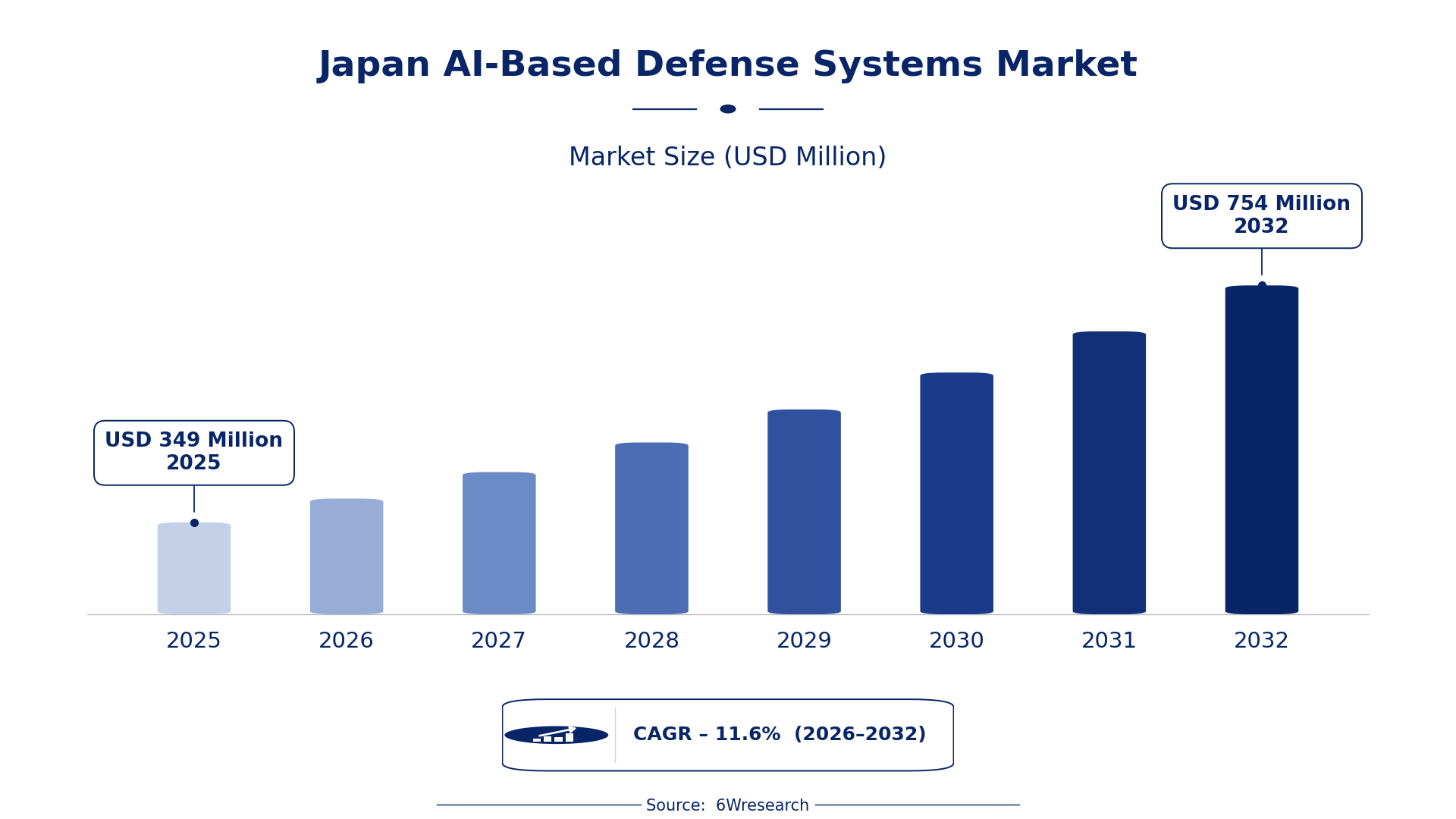
According to 6Wresearch internal database and industry insights, the Japan AI-Based Defense Systems Market was valued at USD 349 Million in 2025 and is projected to reach USD 754 Million by 2032, growing at a CAGR of approximately 11.6% during 2026–2032.
Japan AI-Based Defense Systems Market Highlights
| Report Metric | Details |
| Report Name | Japan AI-Based Defense Systems Market (2026-2032) |
| Market Size 2025 | USD 349 Million |
| Market Size 2032 | USD 754 Million |
| Absolute Growth 2025–2032 | USD 405 Million |
| CAGR 2026–2032 | 11.6% |
| Peak Annual Growth | 13.2% in 2026 |
| Forecast Period | 2026–2032 |
| Historical Data | 2022–2025 |
| Base Year | 2025 |
| Leading System Type, 2025 | Autonomous Drones (41% share) |
| Leading AI Use Case, 2025 | Object Identification (41% share) |
| Leading Distribution Channel, 2025 | Defense Contractors (47% share) |
| Leading End User, 2025 | Military Surveillance Units (43% share) |
| Fastest-Growing System Type | Battlefield Robots (16.6% CAGR) |
| Fastest-Growing AI Use Case | Target Tracking AI (15.7% CAGR) |
| Fastest-Growing Distribution Channel | Military Tech Vendors (15.0% CAGR) |
| Fastest-Growing End User | Defense IT Departments (14.5% CAGR) |
| Growing Sector | Military Technology |
| Key End Users | Self-Defense Forces, Military Surveillance Units, Defense Contractors, Cybersecurity Agencies |
Japan AI-Based Defense Systems Market Year-wise Growth Rate and Key Drivers (2022–2032)
This graph illustrates the annual growth rates of the market from 2022 to 2032, highlighting a steady upward trajectory and projected market expansion over the forecast period.
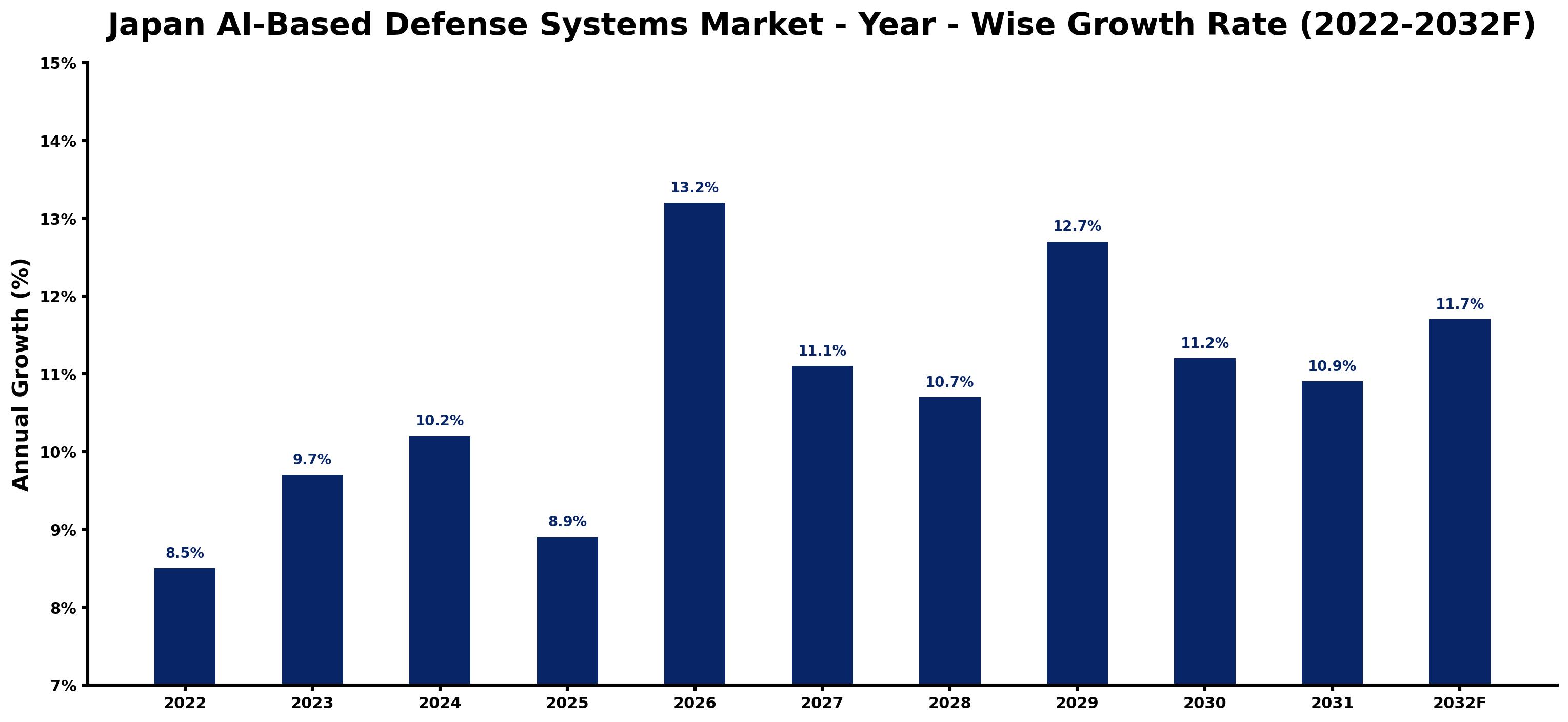
Year by year, the estimates below pair each growth rate with the development that shaped it.
| Year | Estimated Annual Growth (%) | Market Rationale |
| 2022 | 8.5 | The market saw steady growth as Japan focused on modernising its military capabilities. |
| 2023 | 9.7 | Increased investment in defense technologies contributed to a faster growth rate than the previous year. |
| 2024 | 10.2 | The introduction of advanced missile guidance systems spurred further growth in the market. |
| 2025 | 8.9 | Growth slowed slightly as the market adjusted to previous rapid expansions and ongoing projects. |
| 2026 | 13.2 | The market is expected to experience a boost due to heightened defense spending and new AI initiatives. |
| 2027 | 11.1 | Growth is projected to slow as the market stabilises after the peak in defense investments. |
| 2028 | 10.7 | A further slowdown is anticipated as the market matures and demand becomes more consistent. |
| 2029 | 12.7 | The market will rebound with renewed interest in AI applications for military operations. |
| 2030 | 11.2 | Growth is expected to slow again as the market begins to normalise after several years of rapid expansion. |
| 2031 | 10.9 | The market will continue to grow, albeit at a slower pace as demand stabilises. |
| 2032 | 11.7 | Growth is projected to accelerate again as new technologies and applications emerge in defense. |
Note: Market size estimations and growth projections presented in this report are based on 6Wresearch's proprietary forecasting methodology, utilizing the latest available industry data, government publications, and primary research inputs.
Japan AI-Based Defense Systems Market Synopsis
AI-Based Defense Systems in Japan encompass advanced technologies such as autonomous drones and cyber warfare tools, developed through sophisticated algorithms and machine learning techniques. The Japan AI-Based Defense Systems Market is expanding due to military modernisation efforts and strategic partnerships, particularly with the Self-Defense Forces driving demand. In 2023, defence spending reached ¥5 trillion, while the establishment of the Cyber Defense Unit indicates a strong commitment to integrating AI in military applications.
Market Dynamics Impact Analysis (2026–2032)
| Factor | Type | Impact | Primary Segment Affected |
| Military modernization efforts are increasing demand for advanced technologies. | Driver | High | Autonomous Drones |
| Strategic partnerships with universities are fostering innovation in AI applications. | Driver | High | Cyber Warfare Tools |
| The Tokyo region is emerging as a hub for military technology development. | Opportunity | High | Battlefield Robots |
| Growing interest in AI threat detection systems presents new market potential. | Opportunity | High | AI Threat Detection |
| Limited domestic production capabilities may hinder supply chain efficiency. | Restraint | Medium | Missile Guidance |
| High costs associated with advanced technology integration can restrict budgets. | Restraint | Medium | Cyber Warfare Tools |
| The complexity of implementing AI systems poses challenges for military units. | Challenge | High | Defense Contractors |
| Rapid technological advancements can outpace existing training programs. | Challenge | High | Military Surveillance Units |
Evaluation of Drivers in Japan AI-Based Defense Systems Market (2026–2032)
The factors lifting demand, and the evidence behind each, are summarised below.
| Drivers | Primary Segment Affected | Why It Matters (Evidence) |
| Increased defense spending | Autonomous Drones | Japan's Ministry of Defense allocated ¥5 trillion for defense in 2023, driving demand for advanced surveillance technologies. |
| Collaboration with academic institutions | Cyber Warfare Tools | Military tech vendors are partnering with universities for AI research, improving capabilities in cybersecurity. |
| Focus on AI threat detection | AI Threat Detection | The Self-Defense Forces aim to improve AI threat detection capabilities by 2025, increasing demand for related technologies. |
| Expansion of battlefield robotics | Battlefield Robots | The government launched a program to develop battlefield robots by 2024, stimulating investment in this area. |
| Development of missile guidance systems | Missile Guidance | Japan's air defense systems include advanced missile guidance technologies, essential for precision targeting. |
Much of the new demand traces back to Japan's defense budget, which reached ¥5 trillion in 2023, prompting military units to invest in advanced technologies like autonomous drones for surveillance. Collaborations between military tech vendors and universities are improving cybersecurity capabilities, particularly in AI threat detection, which the Self-Defense Forces aim to enhance by 2025. Increased emphasis on missile guidance systems also drives demand, as they are essential for precision targeting in defense operations.
Evaluation of Restraints in Japan AI-Based Defense Systems Market
The key brakes on demand, and where they bite hardest, are shown below.
| Market Restraint | Primary Segment Affected | Why It Matters (Evidence) |
| Limited domestic production capabilities | Missile Guidance | Japan's reliance on foreign technology for missile systems can create vulnerabilities in supply chains. |
| High integration costs of advanced technologies | Cyber Warfare Tools | The costs associated with integrating AI systems can strain budgets for military units. |
| Complexity of AI implementation | Defense Contractors | The intricate nature of AI systems can lead to delays in deployment and training. |
| Rapid technological advancements outpacing training | Military Surveillance Units | As technology evolves quickly, military personnel may struggle to keep up with necessary skills. |
| Regulatory hurdles in defense procurement | Battlefield Robots | Strict regulations can slow down the approval process for new technologies in defense. |
Japan AI-Based Defense Systems Market Challenges
Japan's Ministry of Defence allocated ¥5 trillion for defence spending in 2023, creating pressure on buyers to justify expenditures amidst stringent regulations. Compliance with established standards for AI in defence under JIS Q 9001 complicates procurement processes, leading to delays that can extend project timelines for suppliers by up to six months. Increased competition among domestic military technology developers has driven up costs, forcing buyers to navigate higher prices for advanced systems. Rapid technological advancements in AI require continuous investment, straining budgets for the Self-Defense Forces and delaying upgrades to existing systems.
Trends in the Japan AI-Based Defense Systems Market
Below are the shifts with the largest effect on the Japan AI-Based Defense Systems Market.
- New AI Standards Established: Japan has established standards for AI in defence under JIS Q 9001, improving the quality and reliability of AI systems. This standardisation is projected to streamline procurement processes for military units, ensuring compliance with national security requirements.
- Shift Towards Autonomous Systems: The focus on autonomous drones has intensified, with the Self-Defense Forces utilising over 100 units for surveillance. This shift indicates a broader trend towards automation in military operations, improving operational efficiency.
- Increased Investment in Cybersecurity: The formation of the Cyber Defense Unit in 2022 marked a key step towards strengthening Japan's cybersecurity. This unit is expected to drive investments in AI technologies aimed at protecting national infrastructure from cyber threats.
- Growth of Military Technology Hubs: The Tokyo region is emerging as a key hub for military technology development, with increased collaboration between defence contractors and research institutions. This trend is projected to drive innovation and attract investment in AI-based defence systems.
Investment Opportunities in the Japan AI-Based Defense Systems Market
The openings below show where demand in the Japan AI-Based Defense Systems Market is visible and how suppliers can enter.
- Military Technology Development in Tokyo: The Tokyo region is experiencing a surge in military technology development, with the government investing heavily in AI applications. This creates an opportunity for suppliers to engage with defence contractors and establish partnerships.
- Supply of Advanced Cyber Warfare Tools: With the Cyber Defense Unit's formation, there is a growing demand for advanced cyber warfare tools. Suppliers can target military units looking to strengthen their cybersecurity measures, tapping into a market worth billions.
- Investment in Battlefield Robotics: The government's programme to develop battlefield robots by 2024 creates an opportunity for investment in robotic technologies. Collaborating with defence contractors in Japan can facilitate entry into this expanding market.
- AI Threat Detection Systems Supply: The Self-Defense Forces' focus on improving AI threat detection capabilities by 2025 opens avenues for suppliers. Establishing partnerships with military tech vendors can help access this growing segment.
Government Initiatives in the Japan AI-Based Defense Systems Market
The AI Promotion Act (2025) encourages producers to invest in compliant systems and technologies, supporting the integration of AI in military applications. This law assists military units in accessing advanced solutions that improve operational capabilities. The Defence Agency oversees the integration of AI in defence systems, ensuring compliance with established standards. The agency funds projects that enhance military capabilities, including AI threat detection and autonomous systems.
The Defence Agency ensures that military units can effectively implement AI technologies by funding projects that improve operational capabilities. This support facilitates the integration of AI in defence systems, enabling military units to access advanced tools for improved security.
Future Insight of the Japan AI-Based Defense Systems Market
Self-Defense Forces will enhance AI threat detection capabilities by 2025, improving operational readiness for buyers. By 2032, advancements in military technology will transform operations, allowing suppliers to provide more sophisticated solutions. The Cyber Defense Unit's formation in 2022 will lead to stronger cybersecurity measures, ensuring that buyers benefit from secure systems. Increased collaboration between military technology developers and universities will drive innovation, resulting in practical applications that improve the effectiveness of defence strategies.
Market Segmentation Analysis
Japan AI-Based Defense Systems Market report covers a detailed analysis of the following market segments:
By System Type – Autonomous Drones Lead, Battlefield Robots Expected to Grow Fastest
According to Saurav Kr Singh, Senior Research Analyst at 6Wresearch, in 2025, Autonomous Drones led the system type split with a 41% share. Autonomous drones hold the largest share due to their extensive use for surveillance and reconnaissance missions by Japan's Self-Defense Forces, which operate over 100 units. This widespread deployment underscores their critical role in modern military operations. Battlefield Robots are set to record the highest CAGR in this split, 16.6% over 2026–2032. The battlefield robots segment is experiencing rapid growth as the government has launched a programme to develop these systems by 2024, addressing logistics needs in ground operations. This initiative is likely to accelerate adoption as capabilities expand. Suppliers should enhance collaborations with military technology developers to meet increasing demands.
By AI Use Case – Object Identification Leads, Target Tracking AI Expected to Grow Fastest
The largest ai use case category in 2025 was Object Identification, at 41% of revenue. Object identification leads the market as it is essential for recognising and classifying targets in real-time, a critical requirement for military operations. This capability is increasingly sought after by Japan's military to enhance situational awareness. Target Tracking AI is projected to grow fastest, at a CAGR of 15.7% during 2026–2032. Target tracking technology is growing quickly due to the need for improved engagement accuracy during military operations, especially as the Self-Defense Forces aim to enhance operational effectiveness. This focus on precision will likely drive further advancements in this area. Buyers will benefit from investing in advanced technologies that improve operational efficiency and accuracy.
By Distribution Channel – Defense Contractors Lead, Military Tech Vendors Expected to Grow Fastest
Defense Contractors accounted for 47% of the market by distribution channel in 2025. Defense contractors dominate the market as they are the primary providers of advanced defense technologies and systems, ensuring a consistent supply to the military. Their established relationships with government agencies facilitate ongoing procurement and integration of new technologies. The quickest growth will come from Military Tech Vendors, forecast to expand at a CAGR of 15.0% between 2026 and 2032. Military tech vendors are rapidly expanding their presence, driven by the demand for advanced technologies that enhance defense capabilities. As military needs change, these vendors are well-positioned to meet emerging requirements. Suppliers must adapt their offerings to align with the changing needs of military tech vendors to capture market opportunities.
By End User – Military Surveillance Units Lead, Defense IT Departments Expected to Grow Fastest
With 43% of end user revenue in 2025, Military Surveillance Units was the largest category. Military surveillance units represent the largest segment as they utilise advanced systems for intelligence gathering and monitoring, which are vital for national security. Their continuous operational requirements ensure sustained demand for these technologies. Over 2026–2032, Defense IT Departments are expected to post the fastest growth, at a CAGR of 14.5%. Defense IT departments are experiencing the fastest growth as they integrate advanced systems for improved cybersecurity and data management, reflecting the rising importance of digital security in military operations. This trend indicates a shift towards more technology-centric defence strategies. Buyers should prioritise investments in solutions that enhance data management and cybersecurity capabilities.
Key Attractiveness of the Report
- 10 Years of Market Numbers
- Historical Data Starting from 2022 to 2025
- Base Year 2025
- Forecast Data until 2032
- Key Performance Indicators Impacting the Market
- Major Upcoming Developments and Projects
Key Highlights of the Report:
- Japan AI-Based Defense Systems Market Outlook
- Market Size of Japan AI-Based Defense Systems Market, 2025
- Forecast of Japan AI-Based Defense Systems Market, 2032
- Historical Data and Forecast of Japan AI-Based Defense Systems Revenues & Volume for the Period 2022-2032F
- Japan AI-Based Defense Systems Market Trend Evolution
- Japan AI-Based Defense Systems Market Drivers and Challenges
- Japan AI-Based Defense Systems Price Trends
- Japan AI-Based Defense Systems Porter's Five Forces
- Japan AI-Based Defense Systems Industry Life Cycle
- Historical Data and Forecast of Japan AI-Based Defense Systems Market Revenues & Volume By System Type for the Period 2022-2032F
- Historical Data and Forecast of Japan AI-Based Defense Systems Market Revenues & Volume By Autonomous Drones for the Period 2022-2032F
- Historical Data and Forecast of Japan AI-Based Defense Systems Market Revenues & Volume By Missile Guidance for the Period 2022-2032F
- Historical Data and Forecast of Japan AI-Based Defense Systems Market Revenues & Volume By Cyber Warfare Tools for the Period 2022-2032F
- Historical Data and Forecast of Japan AI-Based Defense Systems Market Revenues & Volume By Battlefield Robots for the Period 2022-2032F
- Historical Data and Forecast of Japan AI-Based Defense Systems Market Revenues & Volume By AI Use Case for the Period 2022-2032F
- Historical Data and Forecast of Japan AI-Based Defense Systems Market Revenues & Volume By Object Identification for the Period 2022-2032F
- Historical Data and Forecast of Japan AI-Based Defense Systems Market Revenues & Volume By Target Tracking AI for the Period 2022-2032F
- Historical Data and Forecast of Japan AI-Based Defense Systems Market Revenues & Volume By AI Threat Detection for the Period 2022-2032F
- Historical Data and Forecast of Japan AI-Based Defense Systems Market Revenues & Volume By Terrain Navigation for the Period 2022-2032F
- Historical Data and Forecast of Japan AI-Based Defense Systems Market Revenues & Volume By Distribution Channel for the Period 2022-2032F
- Historical Data and Forecast of Japan AI-Based Defense Systems Market Revenues & Volume By Defense Contractors for the Period 2022-2032F
- Historical Data and Forecast of Japan AI-Based Defense Systems Market Revenues & Volume By Government Suppliers for the Period 2022-2032F
- Historical Data and Forecast of Japan AI-Based Defense Systems Market Revenues & Volume By Military Tech Vendors for the Period 2022-2032F
- Historical Data and Forecast of Japan AI-Based Defense Systems Market Revenues & Volume By Robotics OEMs for the Period 2022-2032F
- Historical Data and Forecast of Japan AI-Based Defense Systems Market Revenues & Volume By End User for the Period 2022-2032F
- Historical Data and Forecast of Japan AI-Based Defense Systems Market Revenues & Volume By Military Surveillance Units for the Period 2022-2032F
- Historical Data and Forecast of Japan AI-Based Defense Systems Market Revenues & Volume By Air Force Divisions for the Period 2022-2032F
- Historical Data and Forecast of Japan AI-Based Defense Systems Market Revenues & Volume By Defense IT Departments for the Period 2022-2032F
- Historical Data and Forecast of Japan AI-Based Defense Systems Market Revenues & Volume By Tactical Units for the Period 2022-2032F
- Japan AI-Based Defense Systems Import Export Trade Statistics
- Market Opportunity Assessment By System Type
- Market Opportunity Assessment By AI Use Case
- Market Opportunity Assessment By Distribution Channel
- Market Opportunity Assessment By End User
- Japan AI-Based Defense Systems Top Companies Market Share
- Japan AI-Based Defense Systems Competitive Benchmarking By Technical and Operational Parameters
- Japan AI-Based Defense Systems Company Profiles
- Japan AI-Based Defense Systems Key Strategic Recommendations
Market Covered
Coverage by segment is as follows.
By System Type
- Autonomous Drones
- Missile Guidance
- Cyber Warfare Tools
- Battlefield Robots
By AI Use Case
- Object Identification
- Target Tracking AI
- AI Threat Detection
- Terrain Navigation
By Distribution Channel
- Defense Contractors
- Government Suppliers
- Military Tech Vendors
- Robotics OEMs
By End User
- Military Surveillance Units
- Air Force Divisions
- Defense IT Departments
- Tactical Units































