Japan AI-Based Farm Automation Market Size & Growth Rate
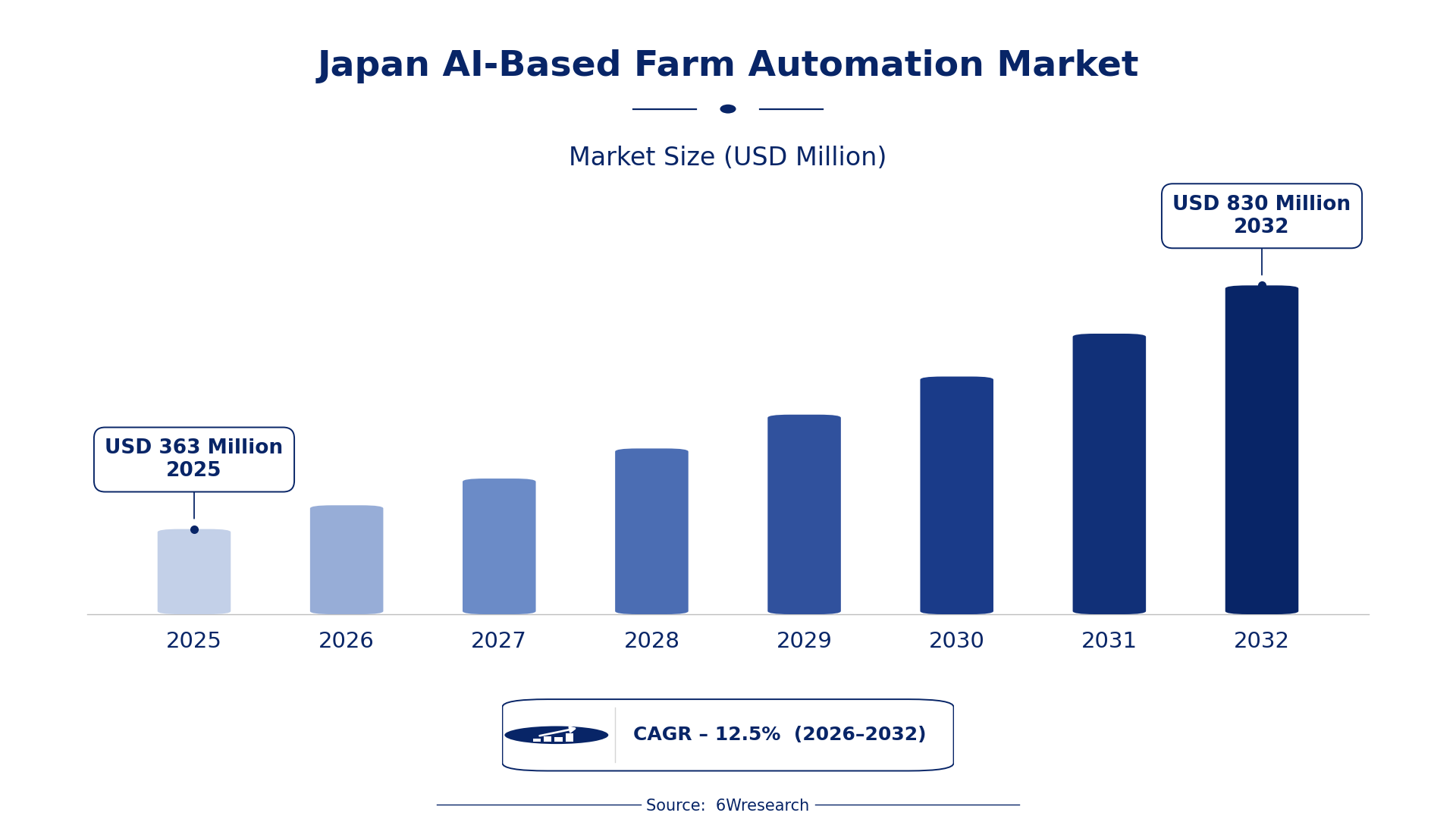
According to 6Wresearch internal database and industry insights, the Japan AI-Based Farm Automation Market was valued at USD 363 Million in 2025 and is projected to reach USD 830 Million by 2032, growing at a CAGR of approximately 12.5% during 2026–2032.
Japan AI-Based Farm Automation Market Highlights
| Report Metric | Details |
| Report Name | Japan AI-Based Farm Automation Market (2026-2032) |
| Market Size 2025 | USD 363 Million |
| Market Size 2032 | USD 830 Million |
| Absolute Growth 2025–2032 | USD 467 Million |
| CAGR 2026–2032 | 12.5% |
| Peak Annual Growth | 14.6% in 2026 |
| Forecast Period | 2026–2032 |
| Historical Data | 2022–2025 |
| Base Year | 2025 |
| Leading Application Area, 2025 | Harvest Automation (42% share) |
| Leading AI Feature, 2025 | AI Sensors & Alerts (48% share) |
| Leading Distribution Channel, 2025 | Agri-Tech Platforms (43% share) |
| Leading End User, 2025 | Commercial Farms (38% share) |
| Fastest-Growing Application Area | Crop Monitoring (14.9% CAGR) |
| Fastest-Growing Distribution Channel | Precision Farming Portals (15.8% CAGR) |
| Fastest-Growing End User | Agri-Scientists (15.3% CAGR) |
| Growing Sector | Crop Monitoring |
| Key End Users | Harvest Automation, Crop Monitoring, Smart Irrigation, Soil Monitoring |
Japan AI-Based Farm Automation Market Year-wise Growth Rate and Key Drivers (2022–2032)
This graph illustrates the annual growth rates of the market from 2022 to 2032, highlighting a steady upward trajectory and projected market expansion over the forecast period.
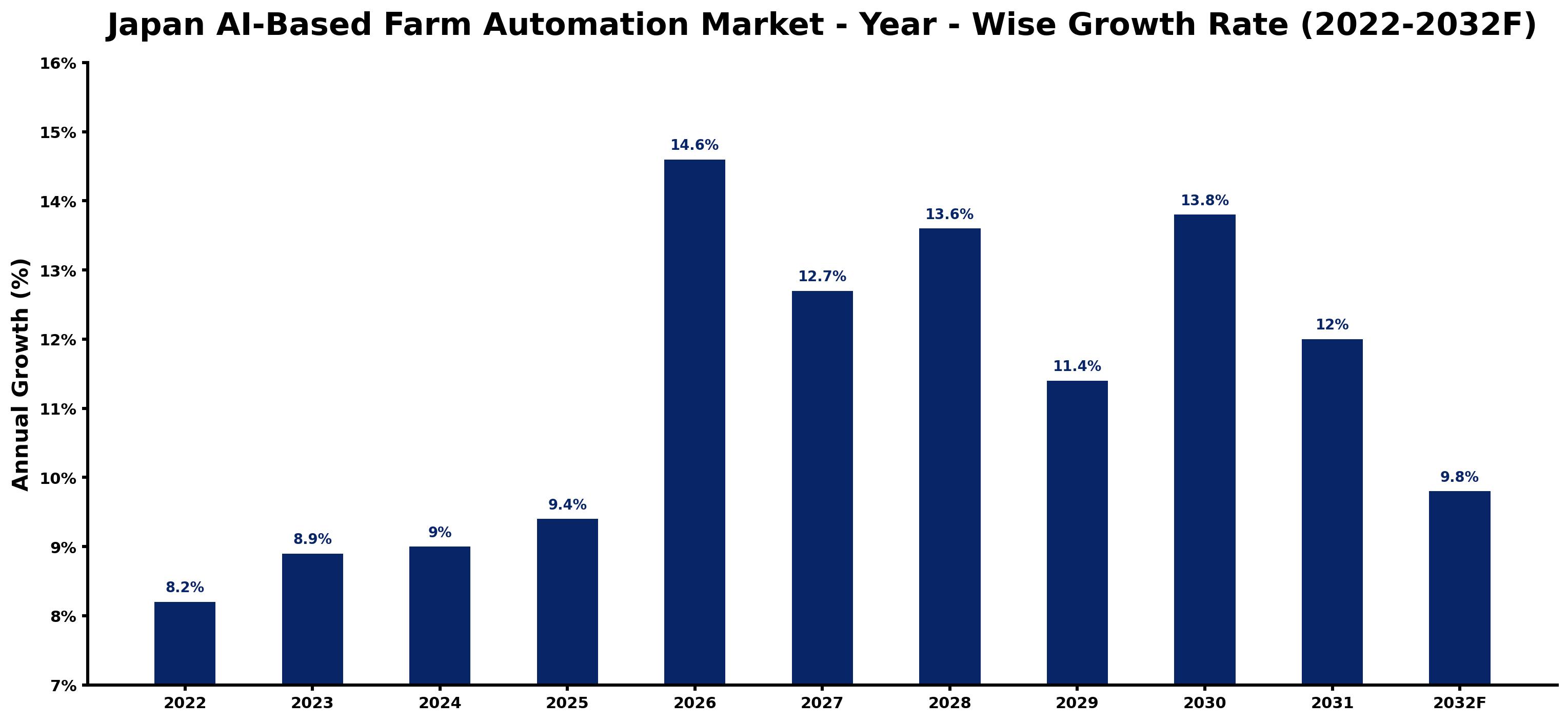
The following figures match every annual growth estimate with the main market development of that year, giving the reasoning behind each rise or slowdown.
| Year | Estimated Annual Growth (%) | Market Rationale |
| 2022 | 8.2 | The market showed steady growth as commercial farms began adopting AI technologies. |
| 2023 | 8.9 | Increased interest in smart agriculture led to faster growth compared to the previous year. |
| 2024 | 9.0 | The expansion of AI applications in agriculture continued to drive growth at a higher rate. |
| 2025 | 9.4 | Demand surged as more farms implemented AI solutions for efficiency and productivity. |
| 2026 | 14.6 | A peak in growth is expected as technological advancements and investments accelerate adoption. |
| 2027 | 12.7 | Growth is projected to slow slightly as the market begins to stabilise after rapid expansion. |
| 2028 | 13.6 | Demand is expected to increase again as more large farms integrate AI for crop monitoring. |
| 2029 | 11.4 | A slight slowdown is anticipated as adoption rates begin to normalise across the sector. |
| 2030 | 13.8 | Growth is projected to accelerate as new AI applications emerge, improving farming practices. |
| 2031 | 12.0 | The market is expected to experience a slowdown as it reaches a more mature phase of development. |
| 2032 | 9.8 | Growth will continue but at a slower rate as the market stabilises. |
Note: Market size estimations and growth projections presented in this report are based on 6Wresearch's proprietary forecasting methodology, utilizing the latest available industry data, government publications, and primary research inputs.
Japan AI-Based Farm Automation Market Synopsis
AI-Based Farm Automation in Japan utilises advanced technologies such as machine learning and robotics to improve agricultural productivity. The market is expanding due to rising investments in agricultural technology, with the Japanese government allocating ¥10 billion for development in 2022 and aiming for substantial decarbonisation investments over the next decade. Key buyer groups include commercial farms and agronomists seeking efficiency. The focus on sustainability and productivity drives demand for AI solutions in Japan's agriculture sector.
Market Dynamics Impact Analysis (2026–2032)
| Factor | Type | Impact | Primary Segment Affected |
| Growing demand for efficient farming practices | Driver | High | Harvest Automation |
| Increasing investments in agricultural technology | Driver | High | Crop Monitoring |
| Adoption of AI technologies in large farms | Opportunity | High | Commercial Farms |
| Emerging interest in sustainable farming solutions | Opportunity | Medium | Soil Monitoring |
| High initial investment costs for AI technologies | Restraint | High | AI Sensors & Alerts |
| Limited awareness among small-scale farmers | Restraint | Medium | Smart Irrigation |
| Competition from traditional farming methods | Challenge | High | Vision-based Analysis |
| Slow regulatory approvals for new technologies | Challenge | Medium | Agri-Tech Platforms |
Evaluation of Drivers in Japan AI-Based Farm Automation Market (2026–2032)
The following drivers explain most of the expected growth.
| Drivers | Primary Segment Affected | Why It Matters (Evidence) |
| Increased crop yields through automation | Harvest Automation | This technology allows farms to harvest crops more efficiently, resulting in higher productivity and profitability. |
| Real-time monitoring of crop health | Crop Monitoring | Farmers can make informed decisions based on data, improving crop management and reducing losses. |
| Optimisation of water usage in agriculture | Smart Irrigation | This technology helps farmers conserve water while ensuring crops receive adequate hydration. |
| Improved soil condition assessments | Soil Monitoring | Farmers can enhance yields by understanding soil health, leading to better crop management. |
| Integration of AI in farming practices | AI Sensors & Alerts | These sensors provide timely alerts, enabling farmers to respond quickly to changing conditions. |
Spending rises because commercial farms increasingly adopt AI technologies to improve productivity. In 2022, 1,200 commercial farms used AI solutions, resulting in higher crop yields and operational efficiency. Consequently, over 30% of large farms reported using AI for crop monitoring in 2023, showcasing the growing reliance on data-driven practices. Japan's target of a 46% reduction in greenhouse-gas emissions by 2030 is prompting further demand for efficient farming technologies.
Evaluation of Restraints in Japan AI-Based Farm Automation Market
Below are the constraints most often cited by buyers and suppliers, with the segment each affects.
| Market Restraint | Primary Segment Affected | Why It Matters (Evidence) |
| High initial costs of AI technology implementation | AI Sensors & Alerts | Many farms struggle to afford the upfront investment required for AI systems, limiting adoption. |
| Limited understanding of AI benefits among farmers | Smart Irrigation | A lack of awareness about AI's advantages hinders its adoption in smaller farming operations. |
| Dependence on traditional farming practices | Vision-based Analysis | Farmers accustomed to conventional methods may resist transitioning to AI-based solutions. |
| Slow regulatory processes for new technology approvals | Agri-Tech Platforms | Delays in regulatory approvals can postpone the introduction of new farming solutions. |
| Insufficient infrastructure for technology integration | Crop Monitoring | Many regions lack the necessary infrastructure to support advanced AI technologies. |
Japan AI-Based Farm Automation Market Challenges
Strict adherence to the JIS Z 8401 standard complicates the integration of new technologies, as many producers struggle to meet compliance requirements, delaying project timelines and increasing costs by up to 20% for buyers. High initial investment costs for AI-based systems deter many commercial farms, leading to a potential 30% reduction in technology adoption among smaller operations. Limited awareness of available funding programs, such as the ¥10 billion allocated for agricultural technology development, prevents buyers from accessing financial support, resulting in slower innovation. Intense competition from traditional farming methods hampers the growth of AI adoption, causing stagnation in productivity improvements for farmers.
Trends in the Japan AI-Based Farm Automation Market
The trends below show where the Japan AI-Based Farm Automation Market is heading.
- Shift from Traditional to AI-Driven Farming: In 2023, the Tohoku region saw a rise in AI adoption among farms, with over 30% of large farms using AI for crop monitoring. This shift indicates a growing acceptance of technology in agriculture, improving productivity.
- Transition to Smart Irrigation Solutions: Since 2020, the Ministry of Agriculture, Forestry and Fisheries has promoted smart agriculture initiatives, leading to a rise in smart irrigation technologies. This trend helps farmers optimise water usage, essential in Japan's changing climate.
- Commercial Farms Embracing Automation: Commercial farms are increasingly adopting automation technologies, with 42% using harvest automation solutions by 2025. This trend reflects the need for efficiency and cost reduction in agricultural practices.
- Emergence of AI Sensors in Agriculture: AI sensors are becoming integral to farming, with 48% of farms using them for real-time alerts. This trend highlights the growing reliance on technology to monitor crop conditions and improve yields.
Investment Opportunities in the Japan AI-Based Farm Automation Market
The following opportunities in the Japan AI-Based Farm Automation Market pair current demand with a clear way in.
- Investment in AI-Driven Technologies: With a projected gap in AI adoption, suppliers can invest in AI-driven technologies for commercial farms, which are increasingly seeking efficient solutions. The ongoing trend towards automation indicates strong demand.
- Expansion of Smart Irrigation Systems: As water scarcity becomes a pressing issue, there is a growing need for smart irrigation solutions. Large farms in regions like Hokkaido are looking to invest in these technologies to optimise water usage.
- Development of Crop Monitoring Solutions: The rise in demand for real-time crop monitoring presents an opportunity for technology providers. Agronomists are actively seeking advanced solutions to improve crop management and yield.
- AI Sensors for Precision Agriculture: The increasing adoption of AI sensors in agriculture creates opportunities for suppliers to provide innovative solutions. Commercial farms are looking for technologies that offer real-time data to improve farming practices.
Government Initiatives in the Japan AI-Based Farm Automation Market
The New Robot Strategy, established in 2015, aims to expand robot use in various sectors, including agriculture. This law encourages the integration of robotics in farming, promoting efficiency and productivity improvements for producers. The AI Promotion Act, set to be implemented in 2025, establishes a national framework for AI research and development, further supporting the agricultural sector's transition to advanced technologies.
In 2022, the Japanese government allocated ¥10 billion for agricultural technology development, administered by the Ministry of Agriculture, Forestry and Fisheries. This funding supports projects aimed at improving productivity and sustainability in agriculture, benefiting both producers and buyers.
Future Insight of the Japan AI-Based Farm Automation Market
The upcoming decarbonisation investment of approximately JPY 150 trillion will drive the adoption of AI-based farm automation technologies, prompting suppliers to innovate rapidly. By 2032, the integration of advanced machine learning algorithms will optimise irrigation processes, improving water efficiency for buyers. Increased collaboration between government initiatives and farms will further drive the deployment of AI technologies, enabling more sustainable farming practices across the nation. The Smart Agriculture Strategy will enhance productivity, positioning Japan as a leader in agricultural innovation.
Market Segmentation Analysis
Japan AI-Based Farm Automation Market report covers a detailed analysis of the following market segments:
By Application Area – Harvest Automation Leads, Crop Monitoring Expected to Grow Fastest
According to Saurav Kr Singh, Senior Research Analyst at 6Wresearch, Harvest Automation held 42% of the Japan AI-Based Farm Automation Market by application area in 2025. Harvest automation holds the largest share due to its critical role in enhancing efficiency for large-scale agricultural operations. This technology is particularly vital for commercial farms that depend on timely harvesting to maximise yield and reduce labour costs. The quickest growth will come from Crop Monitoring, forecast to expand at a CAGR of 14.9% between 2026 and 2032. Crop monitoring is experiencing rapid growth, with over 30% of large farms adopting these technologies in 2023. This surge is propelled by the increasing need for real-time data to assess crop health and optimise agricultural practices. Suppliers should prioritise the development of crop monitoring solutions to meet the rising demand from commercial farms.
By AI Feature – AI Sensors & Alerts Lead and Record the Fastest Growth
In 2025, AI Sensors & Alerts led the ai feature split with a 48% share. AI sensors and alerts dominate the market by providing essential real-time information that enables farmers to manage various agricultural parameters effectively. Their widespread use across different farming practices highlights their importance in enhancing operational efficiency. Its lead should widen, with a projected CAGR of 14.7% during 2026–2032, the highest in this split. The growth of AI sensors and alerts will continue as they are crucial for monitoring and notifying farmers about vital agricultural conditions. This dual functionality ensures their market lead will keep expanding. Buyers should invest in advanced sensor technologies to boost their operational efficiency and responsiveness in farming.
By Distribution Channel – Agri-Tech Platforms Lead, Precision Farming Portals Expected to Grow Fastest
The largest distribution channel category in 2025 was Agri-Tech Platforms, at 43% of revenue. Agri-tech platforms lead the market by providing essential access to advanced agricultural solutions for farmers. Their role in connecting technology providers with end-users is crucial for the adoption of farm automation technologies. Precision Farming Portals are set to record the highest CAGR in this split, 15.8% over 2026–2032. Precision farming portals are witnessing rapid growth as they offer farmers aggregated data that significantly enhances their decision-making processes. This trend reflects a shift towards more data-centric agricultural practices, indicating a strong future for these platforms. Suppliers should explore partnerships with precision farming portals to broaden their market reach and enhance service offerings.
By End User – Commercial Farms Lead, Agri-Scientists Expected to Grow Fastest
With 38% of end user revenue in 2025, Commercial Farms was the largest category. Commercial farms account for the largest share as they are the primary users of advanced farm automation technologies. Their substantial investments are driven by the need for increased productivity and operational efficiency in agriculture. Over 2026–2032, Agri-Scientists are expected to post the fastest growth, at a CAGR of 15.3%. Agri-scientists are increasingly adopting these technologies as they are essential in researching and developing agricultural applications. This trend signifies a growing recognition of the importance of scientific research in advancing farm automation. Suppliers should focus on engaging with agri-scientists to drive innovation and expand the application of automation technologies in agriculture.
Key Attractiveness of the Report
- 10 Years of Market Numbers
- Historical Data Starting from 2022 to 2025
- Base Year 2025
- Forecast Data until 2032
- Key Performance Indicators Impacting the Market
- Major Upcoming Developments and Projects
Key Highlights of the Report:
- Japan AI-Based Farm Automation Market Outlook
- Market Size of Japan AI-Based Farm Automation Market, 2025
- Forecast of Japan AI-Based Farm Automation Market, 2032
- Historical Data and Forecast of Japan AI-Based Farm Automation Revenues & Volume for the Period 2022-2032F
- Japan AI-Based Farm Automation Market Trend Evolution
- Japan AI-Based Farm Automation Market Drivers and Challenges
- Japan AI-Based Farm Automation Price Trends
- Japan AI-Based Farm Automation Porter's Five Forces
- Japan AI-Based Farm Automation Industry Life Cycle
- Historical Data and Forecast of Japan AI-Based Farm Automation Market Revenues & Volume By Application Area for the Period 2022-2032F
- Historical Data and Forecast of Japan AI-Based Farm Automation Market Revenues & Volume By Smart Irrigation for the Period 2022-2032F
- Historical Data and Forecast of Japan AI-Based Farm Automation Market Revenues & Volume By Crop Monitoring for the Period 2022-2032F
- Historical Data and Forecast of Japan AI-Based Farm Automation Market Revenues & Volume By Harvest Automation for the Period 2022-2032F
- Historical Data and Forecast of Japan AI-Based Farm Automation Market Revenues & Volume By Soil Monitoring for the Period 2022-2032F
- Historical Data and Forecast of Japan AI-Based Farm Automation Market Revenues & Volume By AI Feature for the Period 2022-2032F
- Historical Data and Forecast of Japan AI-Based Farm Automation Market Revenues & Volume By Predictive Watering for the Period 2022-2032F
- Historical Data and Forecast of Japan AI-Based Farm Automation Market Revenues & Volume By Vision-based Analysis for the Period 2022-2032F
- Historical Data and Forecast of Japan AI-Based Farm Automation Market Revenues & Volume By AI-Driven Robotics for the Period 2022-2032F
- Historical Data and Forecast of Japan AI-Based Farm Automation Market Revenues & Volume By AI Sensors & Alerts for the Period 2022-2032F
- Historical Data and Forecast of Japan AI-Based Farm Automation Market Revenues & Volume By Distribution Channel for the Period 2022-2032F
- Historical Data and Forecast of Japan AI-Based Farm Automation Market Revenues & Volume By Agri-Tech Platforms for the Period 2022-2032F
- Historical Data and Forecast of Japan AI-Based Farm Automation Market Revenues & Volume By Drone Agri Vendors for the Period 2022-2032F
- Historical Data and Forecast of Japan AI-Based Farm Automation Market Revenues & Volume By Equipment Manufacturers for the Period 2022-2032F
- Historical Data and Forecast of Japan AI-Based Farm Automation Market Revenues & Volume By Precision Farming Portals for the Period 2022-2032F
- Historical Data and Forecast of Japan AI-Based Farm Automation Market Revenues & Volume By End User for the Period 2022-2032F
- Historical Data and Forecast of Japan AI-Based Farm Automation Market Revenues & Volume By Commercial Farms for the Period 2022-2032F
- Historical Data and Forecast of Japan AI-Based Farm Automation Market Revenues & Volume By Agronomists for the Period 2022-2032F
- Historical Data and Forecast of Japan AI-Based Farm Automation Market Revenues & Volume By Large Farms for the Period 2022-2032F
- Historical Data and Forecast of Japan AI-Based Farm Automation Market Revenues & Volume By Agri-Scientists for the Period 2022-2032F
- Japan AI-Based Farm Automation Import Export Trade Statistics
- Market Opportunity Assessment By Application Area
- Market Opportunity Assessment By AI Feature
- Market Opportunity Assessment By Distribution Channel
- Market Opportunity Assessment By End User
- Japan AI-Based Farm Automation Top Companies Market Share
- Japan AI-Based Farm Automation Competitive Benchmarking By Technical and Operational Parameters
- Japan AI-Based Farm Automation Company Profiles
- Japan AI-Based Farm Automation Key Strategic Recommendations
Market Covered
The study includes the following segmentation.
By Application Area
- Smart Irrigation
- Crop Monitoring
- Harvest Automation
- Soil Monitoring
By AI Feature
- Predictive Watering
- Vision-based Analysis
- AI-Driven Robotics
- AI Sensors & Alerts
By Distribution Channel
- Agri-Tech Platforms
- Drone Agri Vendors
- Equipment Manufacturers
- Precision Farming Portals
By End User
- Commercial Farms
- Agronomists
- Large Farms
- Agri-Scientists































