Japan AI-Based Freight Trucks Market Size & Growth Rate
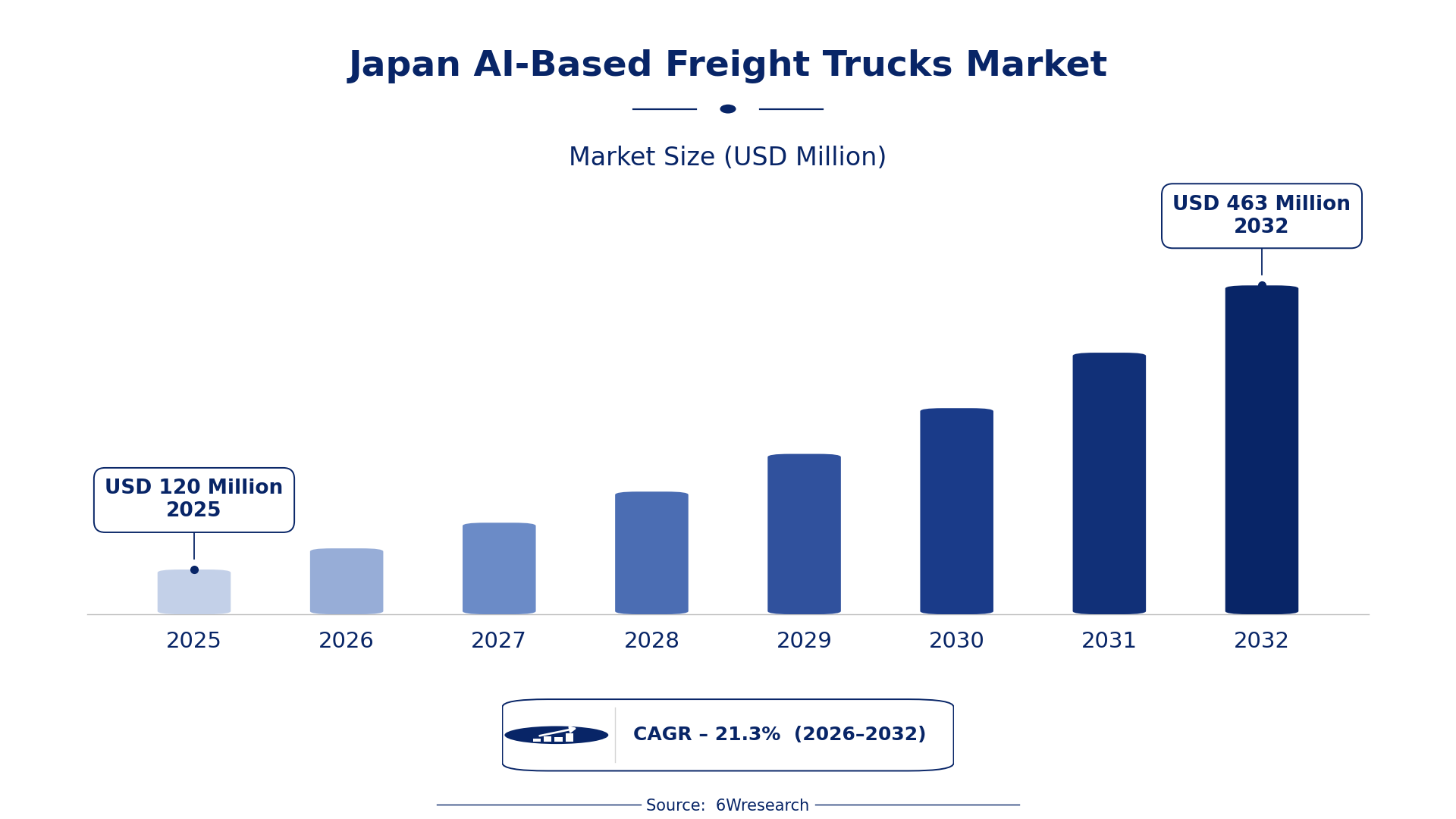
According to 6Wresearch internal database and industry insights, the Japan AI-Based Freight Trucks Market was valued at USD 120 Million in 2025 and is projected to reach USD 463 Million by 2032, growing at a CAGR of approximately 21.3% during 2026–2032.
Japan AI-Based Freight Trucks Market Highlights
| Report Metric | Details |
| Report Name | Japan AI-Based Freight Trucks Market (2026-2032) |
| Market Size 2025 | USD 120 Million |
| Market Size 2032 | USD 463 Million |
| Absolute Growth 2025–2032 | USD 343 Million |
| CAGR 2026–2032 | 21.3% |
| Peak Annual Growth | 25.0% in 2030 |
| Forecast Period | 2026–2032 |
| Historical Data | 2022–2025 |
| Base Year | 2025 |
| Leading Truck Type, 2025 | Autonomous Trucks (38% share) |
| Leading AI Feature, 2025 | Route Optimization (36% share) |
| Leading Distribution Channel, 2025 | Truck OEMs (39% share) |
| Leading End User, 2025 | Logistics Companies (54% share) |
| Fastest-Growing Truck Type | Semi-Autonomous Fleets (22.6% CAGR) |
| Fastest-Growing AI Feature | Load Analysis AI (24.0% CAGR) |
| Fastest-Growing Distribution Channel | Smart Sensors Providers (29.5% CAGR) |
| Fastest-Growing End User | Cold Chain Transporters (27.5% CAGR) |
| Growing Sector | logistics |
| Key End Users | logistics companies, fleet operators, cold chain transporters, freight haulers |
Japan AI-Based Freight Trucks Market Year-wise Growth Rate and Key Drivers (2022–2032)
This graph illustrates the annual growth rates of the market from 2022 to 2032, highlighting a steady upward trajectory and projected market expansion over the forecast period.
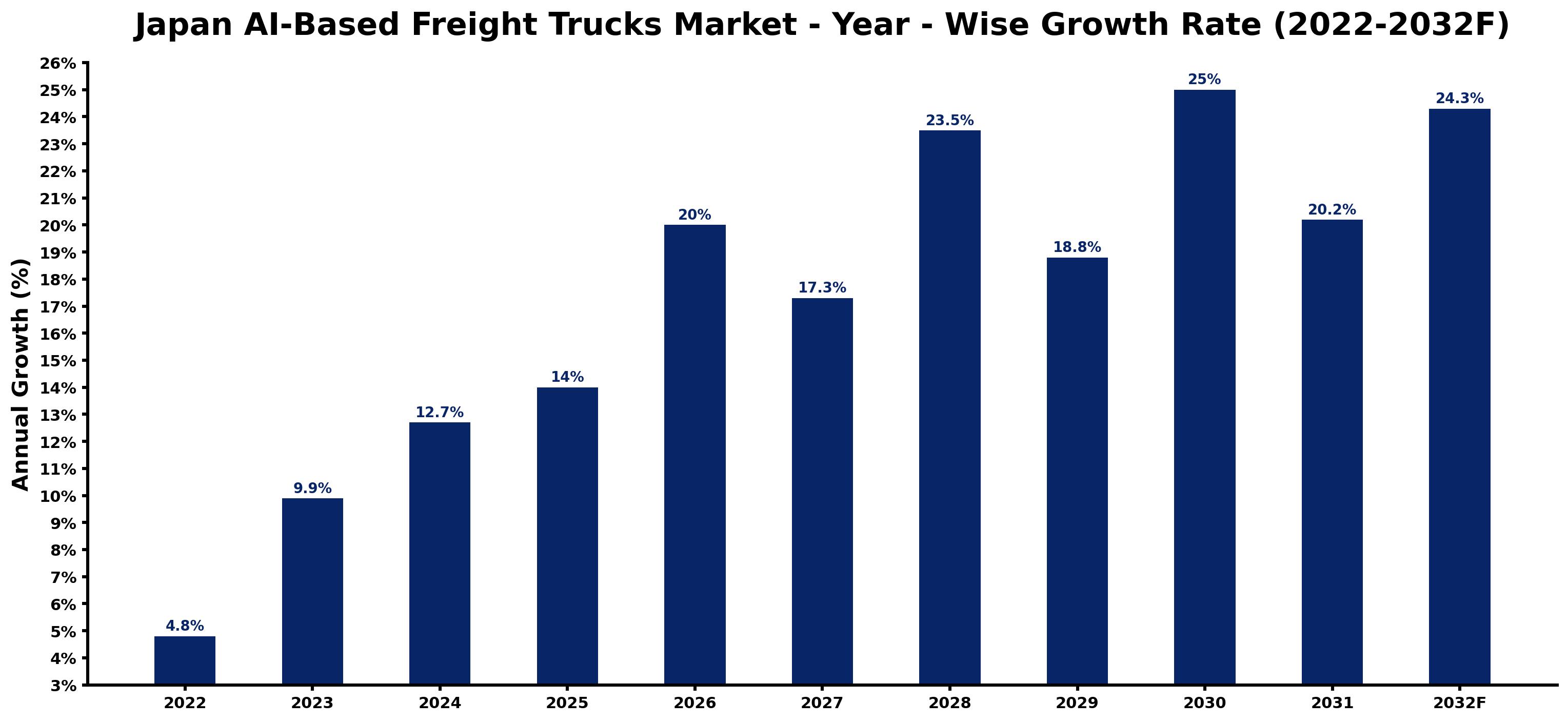
The table below sets out the estimated growth rate for each year and the main factor behind it.
| Year | Estimated Annual Growth (%) | Market Rationale |
| 2022 | 4.8 | The market experienced solid growth due to increasing logistics demands. |
| 2023 | 9.9 | Growth accelerated as more logistics companies adopted AI technologies. |
| 2024 | 12.7 | The introduction of new AI features contributed to faster growth rates. |
| 2025 | 14.0 | The market peaked historically as investments in autonomous technologies surged. |
| 2026 | 20.0 | Growth continued robustly as logistics firms sought efficiency improvements. |
| 2027 | 17.3 | Growth slowed slightly as the market began to stabilise after rapid expansion. |
| 2028 | 23.5 | Increased demand for cold chain logistics drove faster growth again. |
| 2029 | 18.8 | Growth slowed as the market adjusted to previous high levels of investment. |
| 2030 | 25.0 | The peak annual growth was reached with advancements in technology. |
| 2031 | 20.2 | Growth slowed as the market matured and competition intensified. |
| 2032 | 24.3 | Strong demand for AI-based solutions will sustain growth into the future. |
Note: Market size estimations and growth projections presented in this report are based on 6Wresearch's proprietary forecasting methodology, utilizing the latest available industry data, government publications, and primary research inputs.
Japan AI-Based Freight Trucks Market Synopsis
AI-based freight trucks integrate advanced algorithms and machine learning to optimise logistics efficiency, primarily used for route optimisation and safety improvements. The Japan AI-Based Freight Trucks Market is expanding due to a robust logistics sector, substantial investments in technology, and the increasing need for operational efficiency. Valued at approximately 15 trillion JPY, major hubs like Tokyo are driving demand for effective solutions. Government initiatives aim to reduce logistics costs by 10% by 2025, further stimulating growth in this sector.
Market Dynamics Impact Analysis (2026–2032)
| Factor | Type | Impact | Primary Segment Affected |
| Increasing investment in AI technologies | Driver | High | Route Optimization |
| Growth in e-commerce requiring efficient logistics | Driver | High | Cold Chain Transporters |
| Expansion of autonomous vehicle technology | Opportunity | High | Autonomous Trucks |
| Rising demand for predictive maintenance solutions | Opportunity | Medium | Predictive Maintenance |
| High average age of freight trucks necessitating upgrades | Restraint | High | Freight Haulers |
| Limited availability of skilled technicians for AI systems | Restraint | Medium | Fleet Operators |
| High initial investment costs for AI integration | Challenge | High | Logistics Companies |
| Regulatory hurdles in adopting autonomous technologies | Challenge | Medium | Autonomous Trucks |
Evaluation of Drivers in Japan AI-Based Freight Trucks Market (2026–2032)
The following drivers explain most of the expected growth.
| Drivers | Primary Segment Affected | Why It Matters (Evidence) |
| Increased logistics efficiency through AI integration | Route Optimization | This technology improves delivery times, resulting in higher demand from logistics companies needing to meet customer expectations. |
| Growth in e-commerce driving logistics needs | Cold Chain Transporters | The cold chain logistics sector is projected to grow significantly, necessitating efficient transportation solutions. |
| Government initiatives promoting autonomous vehicle technology | Autonomous Trucks | The 2023 program from the Ministry of Land, Infrastructure, Transport and Tourism boosts investment in autonomous solutions. |
| Rising operational costs prompting investment in AI solutions | Fleet Operators | With logistics costs set to reduce by 10% by 2025, fleet operators are investing in AI for efficiency. |
| Technological advancements in AI diagnostics | AI Diagnostic Tools | These tools improve vehicle performance monitoring, increasing purchases from logistics companies. |
Buyers are adding capacity as logistics companies increasingly invest in AI technologies, with the average age of freight trucks exceeding 10 years, highlighting a need for modernisation. The cold chain logistics sector is expanding, spurred by rising e-commerce, necessitating efficient delivery solutions. Fleet operators are investing heavily in predictive maintenance systems, anticipating a reduction in operational costs by 10% by 2025. Advancements in AI diagnostics are improving vehicle performance monitoring, resulting in greater purchases from logistics companies.
Evaluation of Restraints in Japan AI-Based Freight Trucks Market
The following restraints limit how fast demand can grow.
| Market Restraint | Primary Segment Affected | Why It Matters (Evidence) |
| High average age of freight trucks | Freight Haulers | With over 1 million units in operation, many trucks need upgrades to meet modern standards. |
| Limited skilled workforce for AI technologies | Fleet Operators | The shortage of technicians capable of managing AI systems hampers operational efficiency. |
| High initial costs for AI integration | Logistics Companies | The investment required for AI solutions can deter smaller firms from upgrading. |
| Regulatory challenges in autonomous vehicle adoption | Autonomous Trucks | Compliance with JIS B 8401 standards can delay the deployment of new technologies. |
| Market competition leading to price pressures | Cold Chain Transporters | As more players enter the market, profit margins may decrease, affecting investments. |
Japan AI-Based Freight Trucks Market Challenges
Buyers in Japan's logistics sector face rising costs due to an ageing freight truck fleet, which averages over 10 years old. This situation results in increased maintenance expenses, pushing operational costs up by approximately 10% by 2025 for buyers. Competition intensifies as firms strive to modernise their fleets while keeping prices competitive, causing delays in technology adoption. Technology integration remains slow, as many companies are reluctant to invest in AI solutions, leading to inefficiencies that hinder buyers from realising potential improvements in logistics efficiency.
Trends in the Japan AI-Based Freight Trucks Market
The following changes are redrawing the Japan AI-Based Freight Trucks Market.
- Shift from Traditional to AI-Driven Logistics: Since 2023, logistics companies in Tokyo have increasingly adopted AI technologies, with a 10% rise in AI-based freight trucks. This trend indicates a move towards more efficient operations, prompting suppliers to innovate.
- Emergence of Predictive Maintenance Solutions: In 2024, predictive maintenance solutions gained traction among fleet operators, with a 15% increase in adoption. This shift allows companies to reduce downtime and improve operational efficiency.
- Transition to Autonomous Freight Operations: Beginning in 2023, the push for autonomous trucks has intensified, with the government allocating 2 billion JPY for research. This investment is expected to accelerate the development of fully automated logistics.
- Growth of Cold Chain Logistics: In 2023, the cold chain logistics sector is projected to grow, driven by e-commerce, with an anticipated 20% increase in AI-based solutions. This trend highlights the demand for efficient temperature-controlled transport.
Investment Opportunities in the Japan AI-Based Freight Trucks Market
Where to invest in the Japan AI-Based Freight Trucks Market: the main openings are set out below.
- Tokyo as a Logistics Innovation Hub: Tokyo is emerging as a leading region for AI integration in logistics, with a 15 trillion JPY market. Investing in AI-based freight trucks here offers growth potential for suppliers.
- Logistics Companies Seeking Efficiency Improvements: Logistics companies are increasingly looking for AI solutions to improve operational efficiency, with a projected 10% reduction in costs by 2025. Suppliers can enter this market through partnerships with local firms.
- Investment in Predictive Maintenance Systems: There is a growing need for predictive maintenance solutions among fleet operators, especially with the average truck age over 10 years. Suppliers can capitalise by offering tailored AI solutions.
- Cold Chain Transporters Expanding Operations: The cold chain transport sector is set to grow, driven by e-commerce demands. Suppliers should focus on providing AI technologies that improve temperature monitoring.
Government Initiatives in the Japan AI-Based Freight Trucks Market
The Semiconductor and Digital Industry Strategy established in June 2021 aims to secure domestic semiconductor manufacturing, which is essential for AI technologies in freight trucks. This initiative supports the development of advanced logistics solutions, aligning with the government's goal to reduce logistics costs by 10% by 2025.
The Economic Security Promotion Act, enacted in 2022, promotes supply-chain resilience for critical products, including those used in AI-based freight trucks. This act facilitates smoother operations for logistics companies, ensuring they can maintain efficiency amidst global supply challenges.
Future Insight of the Japan AI-Based Freight Trucks Market
The emergence of AI technologies will transform freight truck operations in Japan, prioritising route optimisation and safety enhancements. By 2032, the cold chain logistics sector will see substantial growth, driven by rising e-commerce demand, with logistics costs projected to decrease by 10% through technology adoption. Government support, including 2 billion JPY for research in autonomous vehicle technology, will accelerate the development of new solutions. Suppliers will increasingly implement AI to improve operational efficiency, directly benefiting buyers through streamlined logistics processes.
Market Segmentation Analysis
Japan AI-Based Freight Trucks Market report covers a detailed analysis of the following market segments:
By Truck Type – Autonomous Trucks Lead, Semi-Autonomous Fleets Expected to Grow Fastest
According to Saurav Kr Singh, Senior Research Analyst at 6Wresearch, the largest truck type category in 2025 was Autonomous Trucks, at 38% of revenue. Autonomous Trucks dominate the market as they are designed for fully automated logistics operations, appealing to logistics firms seeking efficiency. The Tokyo metropolitan area exemplifies this trend, with logistics operations increasingly integrating fully automated solutions. Semi-Autonomous Fleets are set to record the highest CAGR in this split, 22.6% over 2026–2032. Semi-Autonomous Fleets are growing rapidly as they assist human drivers while enhancing safety, supported by the government's 2 billion JPY investment in autonomous vehicle technology for 2024. This commitment will likely widen the lead of autonomous trucks in the market. Suppliers should focus on developing features that enhance the capabilities of semi-autonomous systems to meet rising demand.
By AI Feature – Route Optimization Leads, Load Analysis AI Expected to Grow Fastest
Route Optimization accounted for 36% of the market by ai feature in 2025. Route Optimization is the leading feature as it directly improves delivery efficiency and reduces fuel consumption, crucial for logistics firms in Japan's competitive market. This capability is vital, especially given the logistics market's valuation of approximately 15 trillion JPY. Over 2026–2032, Load Analysis AI is expected to post the fastest growth, at a CAGR of 24.0%. Load Analysis AI is experiencing rapid growth as it optimises load distribution, which is essential for improving fuel efficiency in freight operations. The increasing focus on reducing operational costs aligns well with the capabilities of this feature, driving its adoption. Buyers should prioritise AI features that enhance operational efficiency to remain competitive.
By Distribution Channel – Truck OEMs Lead, Smart Sensors Providers Expected to Grow Fastest
Truck OEMs held 39% of the Japan AI-Based Freight Trucks Market by distribution channel in 2025. Truck OEMs lead the market as they manufacture vehicles that integrate advanced technologies, catering to Japan's robust logistics sector. Their established relationships with logistics companies facilitate the incorporation of AI-based freight trucks into operations. Smart Sensors Providers are projected to grow fastest, at a CAGR of 29.5% during 2026–2032. Smart Sensors Providers are the fastest-growing channel, supplying essential components that enhance functionalities in trucks. As demand for advanced monitoring and automation rises, these providers are positioned for significant growth. Suppliers must consider partnerships with smart sensor providers to enhance their offerings and meet evolving market demands.
By End User – Logistics Companies Lead, Cold Chain Transporters Expected to Grow Fastest
Logistics Companies took 54% of end user revenue in 2025, more than any other category. Logistics Companies are the primary users of AI-based freight trucks, utilising these technologies to optimise their operations and reduce costs effectively. The installed base of around 1 million freight trucks in Japan indicates substantial potential for AI integration in this sector. The quickest growth will come from Cold Chain Transporters, forecast to expand at a CAGR of 27.5% between 2026 and 2032. Cold Chain Transporters are rapidly adopting AI technologies to ensure the integrity of temperature-sensitive goods, particularly driven by the growth of the e-commerce sector. This trend is expected to accelerate as logistics costs are targeted for a 10% reduction by 2025. Suppliers should tailor solutions to meet the specific needs of cold chain transporters to capitalise on this growth opportunity.
Key Attractiveness of the Report
- 10 Years of Market Numbers
- Historical Data Starting from 2022 to 2025
- Base Year 2025
- Forecast Data until 2032
- Key Performance Indicators Impacting the Market
- Major Upcoming Developments and Projects
Key Highlights of the Report:
- Japan AI-Based Freight Trucks Market Outlook
- Market Size of Japan AI-Based Freight Trucks Market, 2025
- Forecast of Japan AI-Based Freight Trucks Market, 2032
- Historical Data and Forecast of Japan AI-Based Freight Trucks Revenues & Volume for the Period 2022-2032F
- Japan AI-Based Freight Trucks Market Trend Evolution
- Japan AI-Based Freight Trucks Market Drivers and Challenges
- Japan AI-Based Freight Trucks Price Trends
- Japan AI-Based Freight Trucks Porter's Five Forces
- Japan AI-Based Freight Trucks Industry Life Cycle
- Historical Data and Forecast of Japan AI-Based Freight Trucks Market Revenues & Volume By Truck Type for the Period 2022-2032F
- Historical Data and Forecast of Japan AI-Based Freight Trucks Market Revenues & Volume By Autonomous Trucks for the Period 2022-2032F
- Historical Data and Forecast of Japan AI-Based Freight Trucks Market Revenues & Volume By Semi-Autonomous Fleets for the Period 2022-2032F
- Historical Data and Forecast of Japan AI-Based Freight Trucks Market Revenues & Volume By Cargo Monitoring for the Period 2022-2032F
- Historical Data and Forecast of Japan AI-Based Freight Trucks Market Revenues & Volume By Predictive Maintenance for the Period 2022-2032F
- Historical Data and Forecast of Japan AI-Based Freight Trucks Market Revenues & Volume By AI Feature for the Period 2022-2032F
- Historical Data and Forecast of Japan AI-Based Freight Trucks Market Revenues & Volume By Route Optimization for the Period 2022-2032F
- Historical Data and Forecast of Japan AI-Based Freight Trucks Market Revenues & Volume By Driver Assistance AI for the Period 2022-2032F
- Historical Data and Forecast of Japan AI-Based Freight Trucks Market Revenues & Volume By Load Analysis AI for the Period 2022-2032F
- Historical Data and Forecast of Japan AI-Based Freight Trucks Market Revenues & Volume By AI Diagnostic Tools for the Period 2022-2032F
- Historical Data and Forecast of Japan AI-Based Freight Trucks Market Revenues & Volume By Distribution Channel for the Period 2022-2032F
- Historical Data and Forecast of Japan AI-Based Freight Trucks Market Revenues & Volume By Truck OEMs for the Period 2022-2032F
- Historical Data and Forecast of Japan AI-Based Freight Trucks Market Revenues & Volume By Freight Platforms for the Period 2022-2032F
- Historical Data and Forecast of Japan AI-Based Freight Trucks Market Revenues & Volume By Smart Sensors Providers for the Period 2022-2032F
- Historical Data and Forecast of Japan AI-Based Freight Trucks Market Revenues & Volume By Fleet Management SaaS for the Period 2022-2032F
- Historical Data and Forecast of Japan AI-Based Freight Trucks Market Revenues & Volume By End User for the Period 2022-2032F
- Historical Data and Forecast of Japan AI-Based Freight Trucks Market Revenues & Volume By Logistics Companies for the Period 2022-2032F
- Historical Data and Forecast of Japan AI-Based Freight Trucks Market Revenues & Volume By Fleet Operators for the Period 2022-2032F
- Historical Data and Forecast of Japan AI-Based Freight Trucks Market Revenues & Volume By Cold Chain Transporters for the Period 2022-2032F
- Historical Data and Forecast of Japan AI-Based Freight Trucks Market Revenues & Volume By Freight Haulers for the Period 2022-2032F
- Japan AI-Based Freight Trucks Import Export Trade Statistics
- Market Opportunity Assessment By Truck Type
- Market Opportunity Assessment By AI Feature
- Market Opportunity Assessment By Distribution Channel
- Market Opportunity Assessment By End User
- Japan AI-Based Freight Trucks Top Companies Market Share
- Japan AI-Based Freight Trucks Competitive Benchmarking By Technical and Operational Parameters
- Japan AI-Based Freight Trucks Company Profiles
- Japan AI-Based Freight Trucks Key Strategic Recommendations
Market Covered
Segments analysed in this report are listed below.
By Truck Type
- Autonomous Trucks
- Semi-Autonomous Fleets
- Cargo Monitoring
- Predictive Maintenance
By AI Feature
- Route Optimization
- Driver Assistance AI
- Load Analysis AI
- AI Diagnostic Tools
By Distribution Channel
- Truck OEMs
- Freight Platforms
- Smart Sensors Providers
- Fleet Management SaaS
By End User
- Logistics Companies
- Fleet Operators
- Cold Chain Transporters
- Freight Haulers































