Japan AI-Based Imaging Market Size & Growth Rate
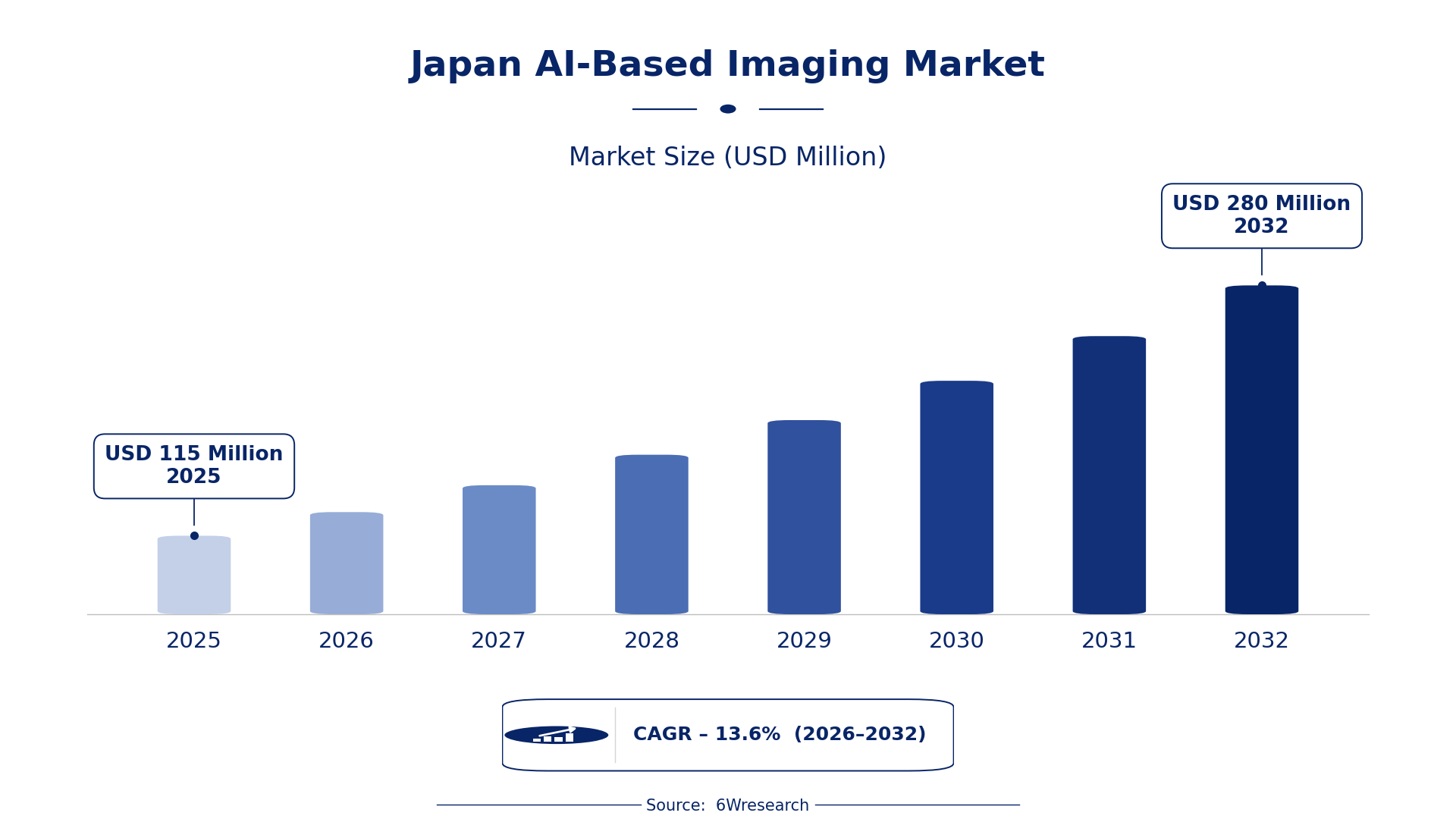
According to 6Wresearch internal database and industry insights, the Japan AI-Based Imaging Market was valued at USD 115 Million in 2025 and is projected to reach USD 280 Million by 2032, growing at a CAGR of approximately 13.6% during 2026–2032.
Japan AI-Based Imaging Market Highlights
| Report Metric | Details |
| Report Name | Japan AI-Based Imaging Market (2026-2032) |
| Market Size 2025 | USD 115 Million |
| Market Size 2032 | USD 280 Million |
| Absolute Growth 2025–2032 | USD 165 Million |
| CAGR 2026–2032 | 13.6% |
| Peak Annual Growth | 14.9% in 2032 |
| Forecast Period | 2026–2032 |
| Historical Data | 2022–2025 |
| Base Year | 2025 |
| Leading Imaging Type, 2025 | Medical Imaging (46% share) |
| Leading AI Feature, 2025 | Pattern Recognition (35% share) |
| Leading Distribution Channel, 2025 | Imaging Software Vendors (50% share) |
| Leading End User, 2025 | Radiology Centers (36% share) |
| Fastest-Growing Imaging Type | Satellite Imaging (19.2% CAGR) |
| Fastest-Growing AI Feature | Resolution Enhancement (17.8% CAGR) |
| Fastest-Growing Distribution Channel | Geospatial Tech Providers (19.6% CAGR) |
| Fastest-Growing End User | Defense & Aerospace Agencies (18.9% CAGR) |
| Growing Sector | Medical Imaging |
| Key End Users | Radiology Centers, Defense & Aerospace Agencies, Manufacturing Plants, Smart Stores |
Japan AI-Based Imaging Market Year-wise Growth Rate and Key Drivers (2022–2032)
This graph illustrates the annual growth rates of the market from 2022 to 2032, highlighting a steady upward trajectory and projected market expansion over the forecast period.
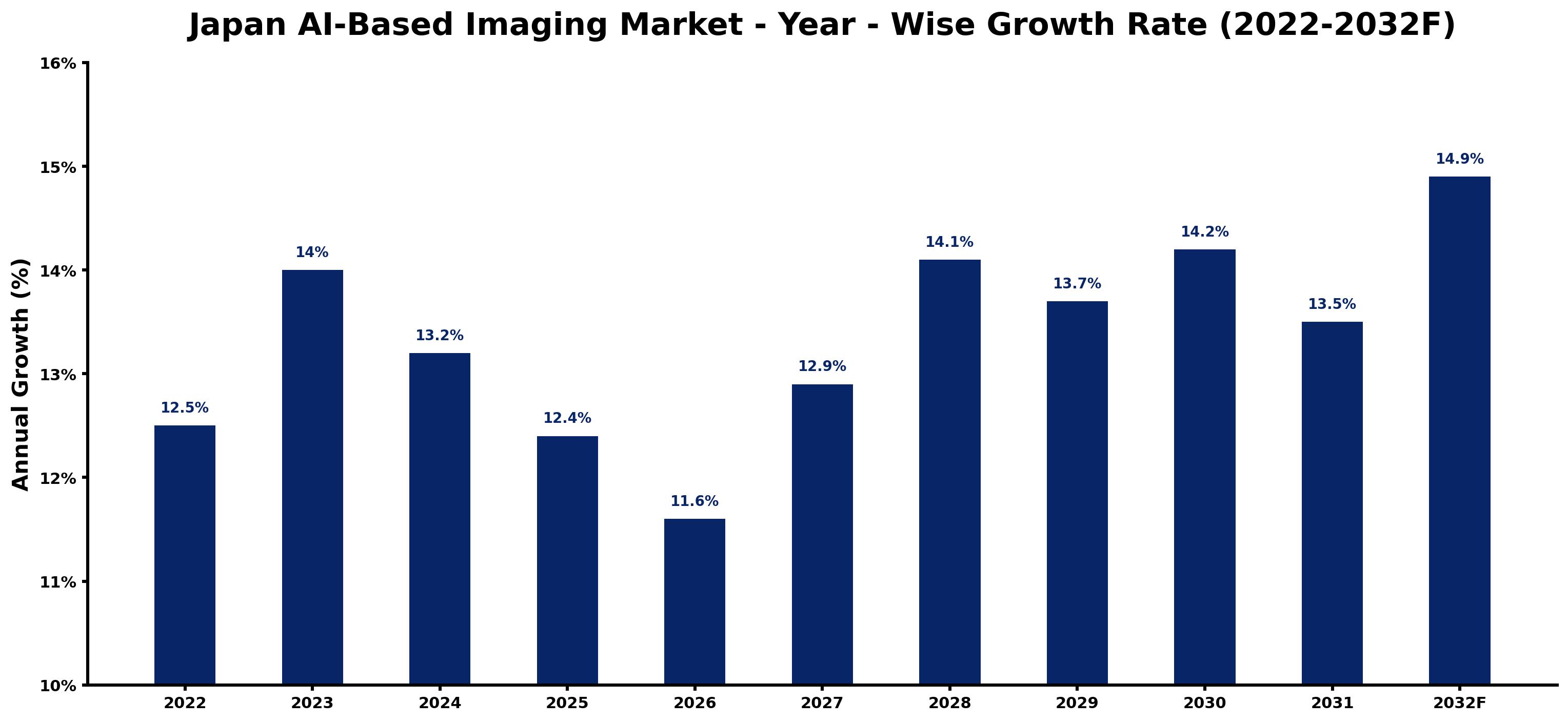
Each row of the following table gives one year's estimated growth and the event or demand shift that explains it.
| Year | Estimated Annual Growth (%) | Market Rationale |
| 2022 | 12.5 | The market exhibited strong growth due to increasing adoption of AI technologies in healthcare. |
| 2023 | 14.0 | Demand accelerated as healthcare facilities expanded their AI imaging capabilities. |
| 2024 | 13.2 | Growth slowed slightly as the market matured and competition intensified. |
| 2025 | 12.4 | A further slowdown occurred as market saturation began to take effect. |
| 2026 | 11.6 | The market is expected to continue growing, albeit at a reduced rate, reflecting ongoing technological advancements. |
| 2027 | 12.9 | Growth will pick up again as new applications in industrial imaging emerge. |
| 2028 | 14.1 | Demand is projected to rise sharply with advancements in resolution technologies. |
| 2029 | 13.7 | A slight slowdown is expected as market conditions stabilise. |
| 2030 | 14.2 | Growth will accelerate again due to increased investment in AI-driven medical imaging. |
| 2031 | 13.5 | The market will experience a slowdown as the pace of new technology adoption moderates. |
| 2032 | 14.9 | Demand is projected to surge as the integration of AI in imaging reaches new heights. |
Note: Market size estimations and growth projections presented in this report are based on 6Wresearch's proprietary forecasting methodology, utilizing the latest available industry data, government publications, and primary research inputs.
Japan AI-Based Imaging Market Synopsis
AI-Based Imaging employs advanced technologies that harness artificial intelligence to enhance accuracy and efficiency in various sectors, especially in medical diagnostics. The Japan AI-Based Imaging Market is set for growth, driven by an aging population and ongoing technological advancements in healthcare. With over 8,000 radiology centres embracing these technologies, the demand for sophisticated medical diagnostics continues to increase, supported by the 'Healthcare New Frontier' programme aiming for integration by 2025.
Market Dynamics Impact Analysis (2026–2032)
| Factor | Type | Impact | Primary Segment Affected |
| Increasing adoption of AI technologies in healthcare is driving demand for medical imaging solutions. | Driver | High | Medical Imaging |
| The aging population necessitates advanced imaging solutions for diagnostics and treatment. | Driver | High | Medical Imaging |
| The growing need for quality assurance in manufacturing presents opportunities for industrial imaging. | Opportunity | High | Industrial Imaging |
| The expansion of AI SaaS platforms in retail creates new avenues for imaging solutions. | Opportunity | Medium | Retail Imaging |
| Compliance with stringent regulations can hinder the speed of AI technology integration. | Restraint | High | Medical Imaging |
| Limited awareness among smaller healthcare facilities restricts market growth potential. | Restraint | Medium | Medical Imaging |
| High costs associated with AI technology implementation can deter smaller players. | Challenge | High | Medical Imaging |
| Capacity constraints in skilled workforce for AI technology can limit growth. | Challenge | Medium | Medical Imaging |
Evaluation of Drivers in Japan AI-Based Imaging Market (2026–2032)
The table below links each growth driver to the segment it affects and the evidence for it.
| Drivers | Primary Segment Affected | Why It Matters (Evidence) |
| Rising healthcare expenditures are increasing demand for advanced imaging technologies. | Medical Imaging | In 2022, Japan's healthcare spending was approximately USD 400 billion, driving investments in AI solutions. |
| Technological advancements in AI are improving imaging accuracy and efficiency. | Medical Imaging | The introduction of ISO 13485 standards has improved quality management in medical devices, prompting adoption. |
| The increasing number of radiology centers is boosting the demand for AI-based imaging. | Medical Imaging | With over 8,000 radiology centers in Japan, there is a substantial market for AI imaging solutions. |
| The push for smart manufacturing is driving AI integration in industrial imaging. | Industrial Imaging | The 'Smart Manufacturing Strategy' aims to enhance efficiency, leading to increased AI adoption. |
| Growing interest in satellite imaging for environmental monitoring is expanding market opportunities. | Satellite Imaging | The Geospatial Information Strategy supports advancements in satellite imaging technologies. |
What keeps demand rising is the growing healthcare expenditures, which reached approximately USD 400 billion in 2022, prompting investments in AI imaging solutions. Technological advancements in AI have improved imaging accuracy, underpinned by ISO 13485 standards that ensure quality management. The large number of radiology centres creates a substantial market for AI-based imaging. The push for smart manufacturing drives AI integration in industrial imaging, while interest in satellite imaging for environmental monitoring broadens opportunities.
Evaluation of Restraints in Japan AI-Based Imaging Market
The main factors holding the market back are set out below.
| Market Restraint | Primary Segment Affected | Why It Matters (Evidence) |
| Compliance with stringent regulations can slow down the adoption of AI imaging technologies. | Medical Imaging | Regulatory requirements under the Industrial Safety and Health Act can complicate implementation processes. |
| Limited awareness among smaller healthcare facilities restricts the market's growth potential. | Medical Imaging | Many smaller facilities lack knowledge of AI imaging benefits, limiting their adoption. |
| High costs associated with AI technology implementation can deter smaller players from entering the market. | Medical Imaging | The initial investment for AI imaging systems can be prohibitive for smaller healthcare providers. |
| Capacity constraints in skilled workforce for AI technology can limit growth in the sector. | Medical Imaging | A shortage of qualified professionals can hinder the effective implementation of AI imaging solutions. |
| The complexity of AI systems can lead to integration challenges within existing workflows. | Medical Imaging | Healthcare facilities may struggle to incorporate AI imaging into their current processes effectively. |
Japan AI-Based Imaging Market Challenges
Over 1 million imaging devices in Japan are becoming outdated due to rapid technological changes, forcing buyers to incur upgrade costs averaging 20% of their annual budgets. Many healthcare facilities struggle to adopt AI technologies, which can delay patient diagnostics by as much as 30%. Suppliers face challenges in meeting regulatory standards set by the Ministry of Health, Labour and Welfare, prolonging product development timelines and hindering market entry. Compliance with JIS standards raises operational costs for hospitals, compelling them to allocate additional budgets for necessary compliance measures.
Trends in the Japan AI-Based Imaging Market
These developments are changing demand patterns in the Japan AI-Based Imaging Market.
- Shift from Traditional Imaging to AI-Driven Solutions: Since 2022, healthcare facilities have increasingly adopted AI-driven imaging solutions, improving diagnostic accuracy. Over 8,000 radiology centres are now utilising these technologies, reflecting a growing trend in the sector.
- Emergence of AI SaaS Platforms in Retail Imaging: The rise of AI SaaS platforms has transformed retail imaging, with over 500 smart stores implementing AI solutions. This shift improves customer engagement and inventory management, marking a change in the retail sector.
- Transition from Manual to Automated Imaging Processes: The adoption of automated imaging processes has increased, particularly in industrial settings. Manufacturers are integrating AI for quality control, boosting efficiency and accuracy.
- Growth of Satellite Imaging for Environmental Monitoring: The Geospatial Information Strategy's initiatives have propelled the use of satellite imaging for environmental monitoring since 2021. This trend supports urban planning and resource management, highlighting the importance of AI in geospatial applications.
Investment Opportunities in the Japan AI-Based Imaging Market
Investors looking at the Japan AI-Based Imaging Market should consider the following areas.
- The Timing is Right for Investment in AI Imaging: With the Japanese population aging, there is a pressing need for advanced medical imaging solutions. The healthcare sector is expected to grow, creating opportunities for investment in AI technologies.
- Supply of AI Imaging Software: The demand for imaging software is surging, particularly among radiology centres. Investing in AI imaging software can meet the needs of healthcare facilities across Japan.
- Gap in AI Adoption Among Smaller Facilities: Approximately 30% of smaller healthcare facilities have yet to adopt AI imaging technologies. This presents a significant opportunity for suppliers to bridge this gap and expand their market presence.
- Expansion in Urban Planning Initiatives: The Tokyo Metropolitan Government's support for AI initiatives in urban planning creates opportunities for imaging solutions. Suppliers can engage with local governments to provide AI-driven imaging technologies.
Government Initiatives in the Japan AI-Based Imaging Market
The Long-Term Care Insurance Act, enacted in 1997 and effective from 2000, encourages healthcare facilities to adopt advanced technologies to improve patient care for the aging population. This law provides funding for essential services, promoting the integration of AI-based imaging to improve diagnostic processes. Additionally, the Industrial Safety and Health Act of 1972 mandates safety standards for medical devices, ensuring compliance and quality in AI imaging applications.
The Pharmaceuticals and Medical Devices Agency (PMDA) reviews medical devices and monitors safety, supporting the integration of AI technologies in healthcare settings. The Japan Agency for Medical Research and Development (AMED) funds research in medical imaging technologies, facilitating the development and implementation of AI solutions in various healthcare facilities.
Future Insight of the Japan AI-Based Imaging Market
Technological advancements will reshape demand for imaging solutions by 2032, driven by the 'Healthcare New Frontier' programme aiming for full AI integration by 2025. The 'AI Strategy 2023' will open new avenues for suppliers across healthcare and urban development sectors. By 2030, the total number of AI-enabled imaging devices is expected to surpass 1.5 million, reflecting a shift towards advanced imaging solutions. Enhanced digital transformation initiatives will streamline processes, benefiting both buyers and suppliers.
Market Segmentation Analysis
Japan AI-Based Imaging Market report covers a detailed analysis of the following market segments:
By Imaging Type – Medical Imaging Leads, Satellite Imaging Expected to Grow Fastest
According to Saurav Kr Singh, Senior Research Analyst at 6Wresearch, with 46% of imaging type revenue in 2025, Medical Imaging was the largest category. Medical imaging holds the largest share due to its critical role in diagnostics and treatment planning, utilised by over 8,000 radiology centres in Japan. The robust demand from healthcare facilities, particularly driven by an ageing population, reinforces its dominant position in the market. Satellite Imaging is set to record the highest CAGR in this split, 19.2% over 2026–2032. Satellite imaging is experiencing rapid growth as the need for environmental monitoring and urban planning intensifies, supported by initiatives like the 'Geospatial Information Strategy'. This focus on satellite technologies will likely accelerate adoption rates in the coming years. Suppliers must prioritise advancements in satellite imaging to capitalise on this growing demand.
By AI Feature – Pattern Recognition Leads, Resolution Enhancement Expected to Grow Fastest
Pattern Recognition held 35% of the Japan AI-Based Imaging Market by ai feature in 2025. Pattern recognition leads the feature segment as it automates image analysis tasks, making it essential for various applications in healthcare and industry. Its widespread adoption across multiple sectors solidifies its market dominance. The quickest growth will come from Resolution Enhancement, forecast to expand at a CAGR of 17.8% between 2026 and 2032. Resolution enhancement is gaining momentum as it significantly improves clarity in critical imaging applications, particularly in medical diagnostics. This increasing emphasis on image quality will likely drive further investments in this area. Buyers should seek solutions that incorporate advanced resolution enhancement capabilities to improve imaging outcomes.
By Distribution Channel – Imaging Software Vendors Lead, Geospatial Tech Providers Expected to Grow Fastest
In 2025, Imaging Software Vendors led the distribution channel split with a 50% share. Imaging software vendors dominate the distribution channel as they provide essential tools for image processing across various sectors. Their established presence in healthcare and industrial markets ensures they capture a substantial share. Over 2026–2032, Geospatial Tech Providers are expected to post the fastest growth, at a CAGR of 19.6%. Geospatial tech providers are the fastest-growing channel, driven by the rising demand for satellite imaging applications in urban planning and environmental monitoring. Their role in supporting these initiatives will continue to expand as government strategies evolve. Suppliers should consider partnerships with geospatial tech providers to enhance their market reach.
By End User – Radiology Centers Lead, Defense & Aerospace Agencies Expected to Grow Fastest
Radiology Centers accounted for 36% of the market by end user in 2025. Radiology centres lead the end user segment as they are the primary users of AI-enhanced imaging for patient care, utilising advanced technologies to improve diagnostic accuracy. The high number of hospitals adopting these solutions further strengthens their position. Defense & Aerospace Agencies are projected to grow fastest, at a CAGR of 18.9% during 2026–2032. Defense and aerospace agencies are the fastest-growing end users, leveraging imaging technologies for reconnaissance and surveillance amid increasing defence budgets. This trend indicates a growing reliance on advanced imaging capabilities in national security. Buyers in the defence sector should invest in cutting-edge imaging technologies to remain competitive.
Key Attractiveness of the Report
- 10 Years of Market Numbers
- Historical Data Starting from 2022 to 2025
- Base Year 2025
- Forecast Data until 2032
- Key Performance Indicators Impacting the Market
- Major Upcoming Developments and Projects
Key Highlights of the Report:
- Japan AI-Based Imaging Market Outlook
- Market Size of Japan AI-Based Imaging Market, 2025
- Forecast of Japan AI-Based Imaging Market, 2032
- Historical Data and Forecast of Japan AI-Based Imaging Revenues & Volume for the Period 2022-2032F
- Japan AI-Based Imaging Market Trend Evolution
- Japan AI-Based Imaging Market Drivers and Challenges
- Japan AI-Based Imaging Price Trends
- Japan AI-Based Imaging Porter's Five Forces
- Japan AI-Based Imaging Industry Life Cycle
- Historical Data and Forecast of Japan AI-Based Imaging Market Revenues & Volume By Imaging Type for the Period 2022-2032F
- Historical Data and Forecast of Japan AI-Based Imaging Market Revenues & Volume By Medical Imaging for the Period 2022-2032F
- Historical Data and Forecast of Japan AI-Based Imaging Market Revenues & Volume By Satellite Imaging for the Period 2022-2032F
- Historical Data and Forecast of Japan AI-Based Imaging Market Revenues & Volume By Industrial Imaging for the Period 2022-2032F
- Historical Data and Forecast of Japan AI-Based Imaging Market Revenues & Volume By Retail Imaging for the Period 2022-2032F
- Historical Data and Forecast of Japan AI-Based Imaging Market Revenues & Volume By AI Feature for the Period 2022-2032F
- Historical Data and Forecast of Japan AI-Based Imaging Market Revenues & Volume By Pattern Recognition for the Period 2022-2032F
- Historical Data and Forecast of Japan AI-Based Imaging Market Revenues & Volume By Resolution Enhancement for the Period 2022-2032F
- Historical Data and Forecast of Japan AI-Based Imaging Market Revenues & Volume By Defect Detection for the Period 2022-2032F
- Historical Data and Forecast of Japan AI-Based Imaging Market Revenues & Volume By Facial Recognition for the Period 2022-2032F
- Historical Data and Forecast of Japan AI-Based Imaging Market Revenues & Volume By Distribution Channel for the Period 2022-2032F
- Historical Data and Forecast of Japan AI-Based Imaging Market Revenues & Volume By Imaging Software Vendors for the Period 2022-2032F
- Historical Data and Forecast of Japan AI-Based Imaging Market Revenues & Volume By Geospatial Tech Providers for the Period 2022-2032F
- Historical Data and Forecast of Japan AI-Based Imaging Market Revenues & Volume By Vision System Suppliers for the Period 2022-2032F
- Historical Data and Forecast of Japan AI-Based Imaging Market Revenues & Volume By AI SaaS Platforms for the Period 2022-2032F
- Historical Data and Forecast of Japan AI-Based Imaging Market Revenues & Volume By End User for the Period 2022-2032F
- Historical Data and Forecast of Japan AI-Based Imaging Market Revenues & Volume By Radiology Centers for the Period 2022-2032F
- Historical Data and Forecast of Japan AI-Based Imaging Market Revenues & Volume By Defense & Aerospace Agencies for the Period 2022-2032F
- Historical Data and Forecast of Japan AI-Based Imaging Market Revenues & Volume By Manufacturing Plants for the Period 2022-2032F
- Historical Data and Forecast of Japan AI-Based Imaging Market Revenues & Volume By Smart Stores for the Period 2022-2032F
- Japan AI-Based Imaging Import Export Trade Statistics
- Market Opportunity Assessment By Imaging Type
- Market Opportunity Assessment By AI Feature
- Market Opportunity Assessment By Distribution Channel
- Market Opportunity Assessment By End User
- Japan AI-Based Imaging Top Companies Market Share
- Japan AI-Based Imaging Competitive Benchmarking By Technical and Operational Parameters
- Japan AI-Based Imaging Company Profiles
- Japan AI-Based Imaging Key Strategic Recommendations
Market Covered
This report examines the market across the segments below.
By Imaging Type
- Medical Imaging
- Satellite Imaging
- Industrial Imaging
- Retail Imaging
By AI Feature
- Pattern Recognition
- Resolution Enhancement
- Defect Detection
- Facial Recognition
By Distribution Channel
- Imaging Software Vendors
- Geospatial Tech Providers
- Vision System Suppliers
- AI SaaS Platforms
By End User
- Radiology Centers
- Defense & Aerospace Agencies
- Manufacturing Plants
- Smart Stores































