Japan AI-based Intrusion Detection Market Size & Growth Rate
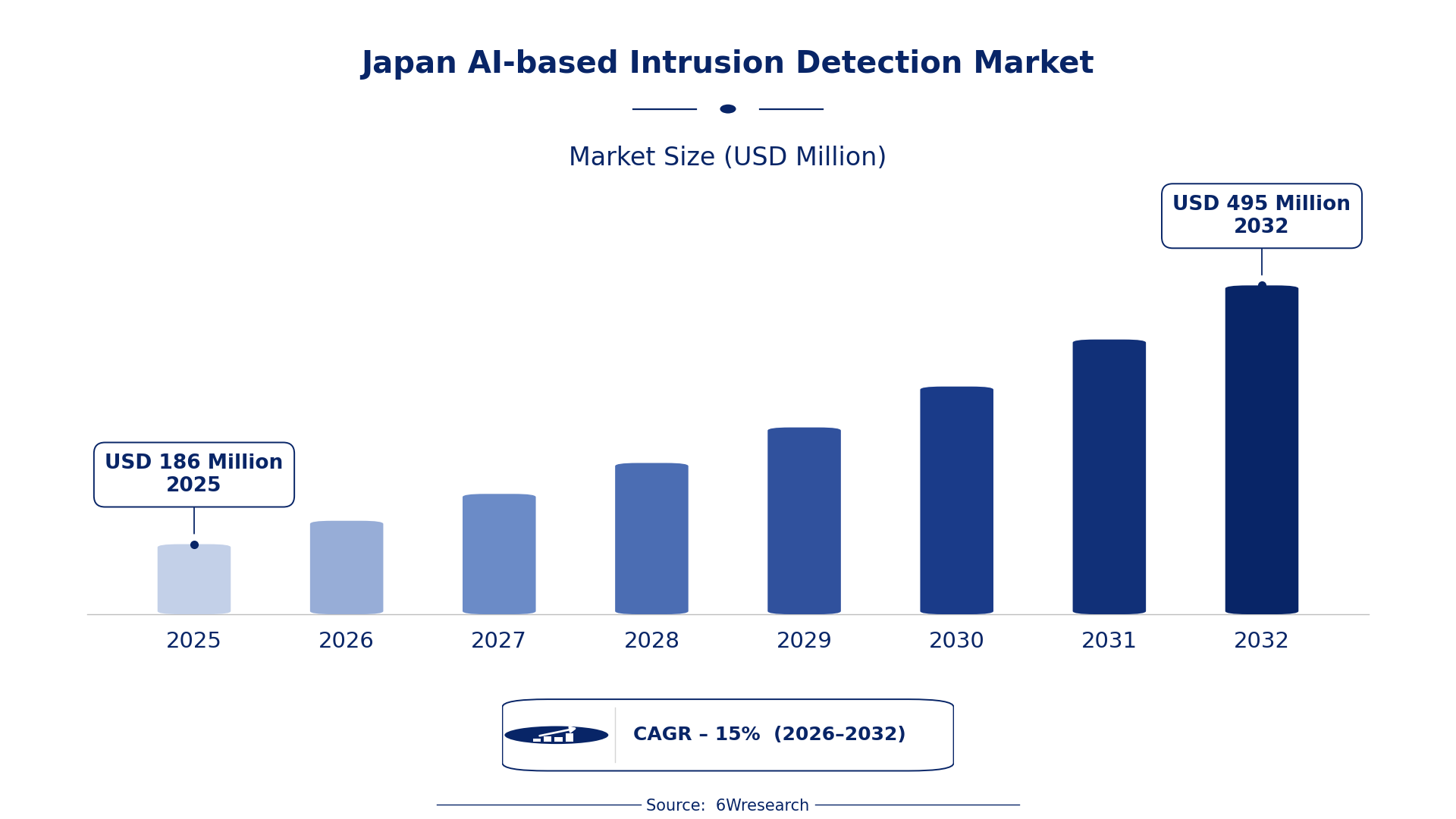
According to 6Wresearch internal database and industry insights, the Japan AI-based Intrusion Detection Market was valued at USD 186 Million in 2025 and is projected to reach USD 495 Million by 2032, growing at a CAGR of approximately 15% during 2026–2032.
Japan AI-based Intrusion Detection Market Highlights
| Report Metric | Details |
| Report Name | Japan AI-based Intrusion Detection Market (2026-2032) |
| Market Size 2025 | USD 186 Million |
| Market Size 2032 | USD 495 Million |
| Absolute Growth 2025–2032 | USD 309 Million |
| CAGR 2026–2032 | 15% |
| Peak Annual Growth | 15.4% in 2032 |
| Forecast Period | 2026–2032 |
| Historical Data | 2022–2025 |
| Base Year | 2025 |
| Leading Threat Type, 2025 | Network Intrusion (52% share) |
| Leading Detection Technique, 2025 | Behavior Analysis (36% share) |
| Leading Distribution Channel, 2025 | Cybersecurity Platforms (46% share) |
| Leading End User, 2025 | IT Security Teams (52% share) |
| Fastest-Growing Threat Type | Physical Intrusion (21.6% CAGR) |
| Fastest-Growing Detection Technique | Facial/Activity Recognition (19.4% CAGR) |
| Fastest-Growing Distribution Channel | Security Solution Providers (19.5% CAGR) |
| Fastest-Growing End User | Airports & Government Facilities (20.1% CAGR) |
| Growing Sector | Airports & Government Facilities |
| Key End Users | IT Security Teams, Airports & Government Facilities, Smart Building Managers, Enterprise Tech Teams |
Japan AI-based Intrusion Detection Market Year-wise Growth Rate and Key Drivers (2022–2032)
This graph illustrates the annual growth rates of the market from 2022 to 2032, highlighting a steady upward trajectory and projected market expansion over the forecast period.
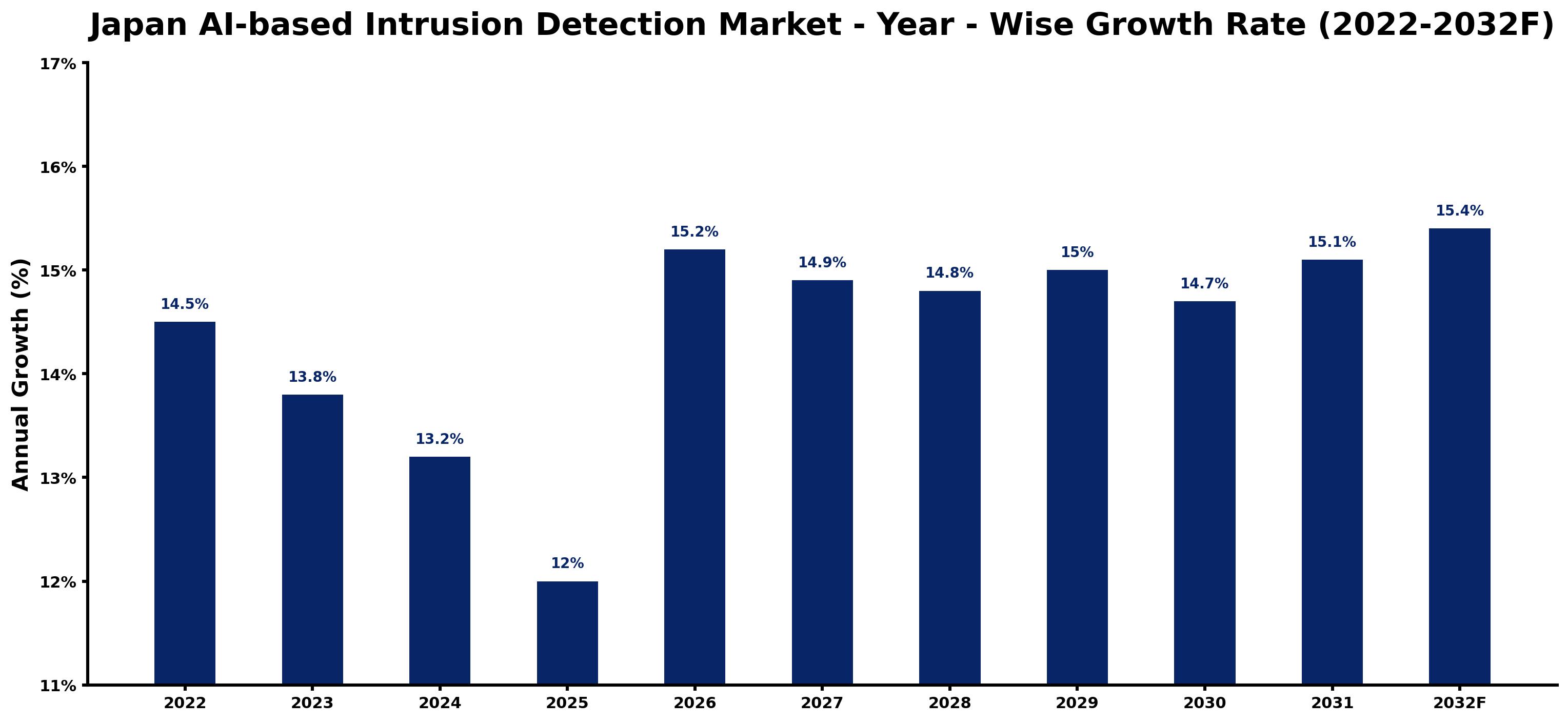
Each row of the following table gives one year's estimated growth and the event or demand shift that explains it.
| Year | Estimated Annual Growth (%) | Market Rationale |
| 2022 | 14.5 | The market experienced notable activity with a 14.5% growth rate. |
| 2023 | 13.8 | Growth slowed as demand stabilised, reflecting market maturity in cybersecurity. |
| 2024 | 13.2 | The trend of slowing growth continued, driven by market saturation. |
| 2025 | 12.0 | Growth further slowed, indicating a transition phase before renewed investment. |
| 2026 | 15.2 | Demand is expected to accelerate as businesses increase investments in cybersecurity technologies. |
| 2027 | 14.9 | Growth is projected to slow slightly, reflecting a normalisation after rapid expansion. |
| 2028 | 14.8 | The market is expected to maintain steady growth, supported by ongoing technological advancements. |
| 2029 | 15.0 | Demand is projected to surge again as businesses prioritise security in digital transformation. |
| 2030 | 14.7 | Growth is expected to slow, indicating a stabilisation in the market after previous peaks. |
| 2031 | 15.1 | Demand is projected to pick up again as new technologies emerge and are adopted. |
| 2032 | 15.4 | The market is expected to peak with a 15.4% growth rate, driven by heightened security needs. |
Note: Market size estimations and growth projections presented in this report are based on 6Wresearch's proprietary forecasting methodology, utilizing the latest available industry data, government publications, and primary research inputs.
Japan AI-based Intrusion Detection Market Synopsis
AI-based Intrusion Detection systems employ advanced algorithms and machine learning to detect potential security threats in real-time, safeguarding networks and cloud infrastructures. In Japan, the cybersecurity industry is thriving, with investments in technology upgrades reaching ¥10 billion in 2023. Demand stems from a 15% increase in reported cyber incidents in 2022, prompting businesses to strengthen their security measures. This growth underscores a commitment to national security against evolving threats, supported by ongoing advancements in technology and infrastructure.
Market Dynamics Impact Analysis (2026–2032)
| Factor | Type | Impact | Primary Segment Affected |
| Increased cyber incidents drive demand for advanced security solutions. | Driver | High | Network Intrusion |
| Growing adoption of IoT devices necessitates enhanced security measures. | Driver | High | IoT Intrusion |
| Rising demand for integrated security solutions presents opportunities for new entrants. | Opportunity | High | Cybersecurity Platforms |
| Investment in smart building technologies opens new markets for intrusion detection. | Opportunity | High | Smart Building Managers |
| High costs of advanced systems may limit access for smaller businesses. | Restraint | Medium | Security Solution Providers |
| Lack of awareness about cybersecurity risks can hinder market growth. | Restraint | Medium | IT Security Teams |
| Talent shortages in cybersecurity limit the ability to implement solutions effectively. | Challenge | High | IT Security Teams |
| Rapidly evolving threats require constant updates, straining resources. | Challenge | High | Cybersecurity Platforms |
Evaluation of Drivers in Japan AI-based Intrusion Detection Market (2026–2032)
These are the developments adding the most demand over the forecast period.
| Drivers | Primary Segment Affected | Why It Matters (Evidence) |
| Increased investment in cybersecurity technology. | Network Intrusion | The number of reported cyber incidents in Japan rose by 15% in 2022, prompting businesses to invest more in security solutions. |
| Growing integration of AI in security systems. | IoT Intrusion | The installed base of AI-based security solutions in enterprises is expanding rapidly, improving detection capabilities. |
| Rising awareness of data protection regulations. | Cloud Infrastructure | The adoption of ISO/IEC 27001 drives demand for effective cloud security measures, particularly in cloud infrastructures. |
| Expansion of smart cities and connected devices. | IoT Intrusion | The increasing number of connected devices in urban areas raises the need for effective IoT security. |
| Government support for cybersecurity initiatives. | Cybersecurity Platforms | The government allocated ¥10 billion for cybersecurity initiatives in 2023, boosting market growth. |
A wider customer base explains much of the growth, as increased investment in cybersecurity technology follows a 15% rise in reported cyber incidents in 2022. The installed base of AI-based security solutions in enterprises is expanding rapidly, improving detection capabilities. The adoption of ISO/IEC 27001 drives demand for effective security measures, particularly in cloud infrastructures. The increasing number of connected devices in urban areas raises the need for effective IoT security.
Evaluation of Restraints in Japan AI-based Intrusion Detection Market
The main factors holding the market back are set out below.
| Market Restraint | Primary Segment Affected | Why It Matters (Evidence) |
| High costs of advanced AI-based systems limit accessibility. | Network Intrusion | The financial burden of implementing advanced security solutions can restrict smaller businesses from adopting necessary technologies. |
| Limited awareness of cybersecurity risks among businesses hinders growth. | IT Security Teams | Many organisations underestimate the importance of cybersecurity, leading to insufficient investment in intrusion detection systems. |
| Talent shortages in cybersecurity create implementation challenges. | Cybersecurity Platforms | The lack of skilled professionals affects the ability to deploy and manage advanced security systems effectively. |
| Rapidly evolving cyber threats require constant updates. | IoT Intrusion | Keeping up with new threats strains resources and complicates security management for businesses. |
| Regulatory compliance can be complex and costly. | Cloud Infrastructure | Navigating various data protection regulations can be a barrier for companies seeking to implement effective security measures. |
Japan AI-based Intrusion Detection Market Challenges
In Japan, the lack of skilled cybersecurity professionals hampers the effective deployment of AI-based Intrusion Detection systems, leading to project delays of up to six months for companies. Implementation costs average ¥5 million per enterprise, discouraging smaller businesses from investing in crucial upgrades. Rapid technological advancements result in frequent obsolescence, forcing firms to update systems every two years, which disrupts operations for end users. Supply chain disruptions for essential components, such as sensors and processors, can delay system availability, impacting security readiness for businesses nationwide.
Trends in the Japan AI-based Intrusion Detection Market
These developments are changing demand patterns in the Japan AI-based Intrusion Detection Market.
- Shift from Traditional to AI-Driven Security Solutions: Since 2022, businesses have increasingly adopted AI-driven security solutions to improve threat detection capabilities. The growing installed base of AI-based security solutions in enterprises reflects this shift, with a notable increase in demand.
- Emergence of Integrated Cybersecurity Platforms: In 2023, the launch of new integrated cybersecurity platforms transformed how businesses approach security. These platforms streamline security management, responding to the increasing complexity of cyber threats.
- Focus on IoT Security in Smart Environments: Tokyo has become a focal point for IoT security advancements, with a growing number of connected devices. This trend is driven by the need for improved security measures in smart buildings and urban infrastructure.
- Increased Government Investment in Cybersecurity: In 2023, the government allocated ¥10 billion for cybersecurity initiatives, reflecting a commitment to strengthen national security. This investment supports the development of advanced security technologies and training programs.
Investment Opportunities in the Japan AI-based Intrusion Detection Market
Several openings in the Japan AI-based Intrusion Detection Market merit attention from investors.
- Growing Demand for AI-based Solutions: With a projected increase of ¥309 million in market size by 2032, there is an opportunity to supply AI-based intrusion detection systems. IT Security Teams in various sectors are actively seeking advanced solutions to enhance their security measures.
- Investment in Cybersecurity Training: The government’s allocation of ¥10 billion for cybersecurity initiatives opens avenues for training programs. Collaborating with educational institutions can help meet the demand for skilled professionals in the field.
- Expansion of IoT Security Solutions: As the number of connected devices increases, there is a pressing need for IoT security solutions. IoT Security Vendors can capitalise on this trend by offering tailored security measures for smart environments.
- Development of Integrated Security Platforms: The emergence of integrated cybersecurity platforms presents a timely opportunity for suppliers. Collaborating with Cybersecurity Platforms can facilitate the delivery of comprehensive security solutions to businesses.
Government Initiatives in the Japan AI-based Intrusion Detection Market
The National Institute of Information and Communications Technology (NICT) promotes cybersecurity initiatives, strengthening the framework for AI-based Intrusion Detection systems. The Cybersecurity Strategy Council was established to improve national cybersecurity, focusing on standards and best practices to guide the industry. In 2023, the government allocated ¥10 billion for cybersecurity initiatives, administered by the Ministry of Internal Affairs and Communications. This funding supports various programs aimed at enhancing cybersecurity awareness and technology adoption across sectors.
In 2023, the government allocated ¥10 billion for cybersecurity initiatives, administered by the Ministry of Internal Affairs and Communications. This funding supports various programs aimed at enhancing cybersecurity awareness and technology adoption across sectors.
Future Insight of the Japan AI-based Intrusion Detection Market
By 2032, advancements in machine learning algorithms will enhance threat detection capabilities, enabling faster response times. The introduction of targeted cybersecurity training programmes will increase the number of skilled professionals, streamlining system deployment. Enhanced collaboration between government and private sectors will facilitate the establishment of effective cybersecurity frameworks. With the government allocating ¥10 billion for cybersecurity initiatives in 2023, both buyers and suppliers will be compelled to invest in more resilient solutions.
Market Segmentation Analysis
Japan AI-based Intrusion Detection Market report covers a detailed analysis of the following market segments:
By Threat Type – Network Intrusion Leads, Physical Intrusion Expected to Grow Fastest
According to Saurav Kr Singh, Senior Research Analyst at 6Wresearch, Network Intrusion held 52% of the Japan AI-based Intrusion Detection Market by threat type in 2025. Network Intrusion captures the largest share as it is essential for protecting organisations from cyber threats, particularly in light of a 15% rise in cyber incidents reported in 2022. This segment is crucial for safeguarding sensitive information across various industries, including finance and healthcare. Physical Intrusion is projected to grow fastest, at a CAGR of 21.6% during 2026–2032. Physical Intrusion is experiencing rapid growth as organisations increasingly acknowledge the importance of securing physical locations alongside their digital assets. The introduction of new cybersecurity training initiatives in 2023 highlights the growing emphasis on comprehensive security strategies. Suppliers must consider the increasing demand for integrated security solutions that address both digital and physical security needs.
By Detection Technique – Behavior Analysis Leads, Facial/Activity Recognition Expected to Grow Fastest
Behavior Analysis took 36% of detection technique revenue in 2025, more than any other category. Behavior Analysis leads the market due to its capability to identify anomalies in user actions, making it vital for timely threat detection. This technique is widely adopted across various sectors, ensuring robust protection against sophisticated cyber threats. The quickest growth will come from Facial/Activity Recognition, forecast to expand at a CAGR of 19.4% between 2026 and 2032. Facial/Activity Recognition is witnessing the fastest growth, particularly in high-security environments like airports and government facilities. The rising implementation of advanced surveillance technologies is boosting demand for this detection method. Buyers should focus on investing in advanced detection techniques to strengthen their security measures against evolving threats.
By Distribution Channel – Cybersecurity Platforms Lead, Security Solution Providers Expected to Grow Fastest
Cybersecurity Platforms accounted for 46% of the market by distribution channel in 2025. Cybersecurity Platforms dominate the market as they serve as the primary means for delivering intrusion detection solutions to end users. Their comprehensive functionalities and user-friendly interfaces make them the preferred option for organisations seeking effective security measures. Over 2026–2032, Security Solution Providers are expected to post the fastest growth, at a CAGR of 19.5%. Security Solution Providers are gaining importance as they facilitate access to various intrusion detection technologies. The increasing complexity of cybersecurity challenges drives organisations to seek specialised providers for tailored solutions. Suppliers should enhance collaborations with solution providers to expand their market reach.
By End User – IT Security Teams Lead, Airports & Government Facilities Expected to Grow Fastest
With 52% of end user revenue in 2025, IT Security Teams was the largest category. IT Security Teams represent the largest segment as they are the primary users of intrusion detection systems, tasked with ensuring organisational security. Their continuous need for effective threat detection guarantees a steady demand for these solutions. Airports & Government Facilities are set to record the highest CAGR in this split, 20.1% over 2026–2032. Airports & Government Facilities are experiencing the fastest growth due to their stringent security requirements and the need for robust intrusion detection systems. Ongoing investments in security infrastructure in these sectors further fuel this growth. Buyers in high-security sectors must prioritise advanced intrusion detection systems to protect critical assets.
Key Attractiveness of the Report
- 10 Years of Market Numbers
- Historical Data Starting from 2022 to 2025
- Base Year 2025
- Forecast Data until 2032
- Key Performance Indicators Impacting the Market
- Major Upcoming Developments and Projects
Key Highlights of the Report:
- Japan AI-based Intrusion Detection Market Outlook
- Market Size of Japan AI-based Intrusion Detection Market, 2025
- Forecast of Japan AI-based Intrusion Detection Market, 2032
- Historical Data and Forecast of Japan AI-based Intrusion Detection Revenues & Volume for the Period 2022-2032F
- Japan AI-based Intrusion Detection Market Trend Evolution
- Japan AI-based Intrusion Detection Market Drivers and Challenges
- Japan AI-based Intrusion Detection Price Trends
- Japan AI-based Intrusion Detection Porter's Five Forces
- Japan AI-based Intrusion Detection Industry Life Cycle
- Historical Data and Forecast of Japan AI-based Intrusion Detection Market Revenues & Volume By Threat Type for the Period 2022-2032F
- Historical Data and Forecast of Japan AI-based Intrusion Detection Market Revenues & Volume By Network Intrusion for the Period 2022-2032F
- Historical Data and Forecast of Japan AI-based Intrusion Detection Market Revenues & Volume By Physical Intrusion for the Period 2022-2032F
- Historical Data and Forecast of Japan AI-based Intrusion Detection Market Revenues & Volume By IoT Intrusion for the Period 2022-2032F
- Historical Data and Forecast of Japan AI-based Intrusion Detection Market Revenues & Volume By Cloud Infrastructure for the Period 2022-2032F
- Historical Data and Forecast of Japan AI-based Intrusion Detection Market Revenues & Volume By Detection Technique for the Period 2022-2032F
- Historical Data and Forecast of Japan AI-based Intrusion Detection Market Revenues & Volume By Behavior Analysis for the Period 2022-2032F
- Historical Data and Forecast of Japan AI-based Intrusion Detection Market Revenues & Volume By Facial/Activity Recognition for the Period 2022-2032F
- Historical Data and Forecast of Japan AI-based Intrusion Detection Market Revenues & Volume By Device Behavior Mapping for the Period 2022-2032F
- Historical Data and Forecast of Japan AI-based Intrusion Detection Market Revenues & Volume By Real-Time Monitoring for the Period 2022-2032F
- Historical Data and Forecast of Japan AI-based Intrusion Detection Market Revenues & Volume By Distribution Channel for the Period 2022-2032F
- Historical Data and Forecast of Japan AI-based Intrusion Detection Market Revenues & Volume By Cybersecurity Platforms for the Period 2022-2032F
- Historical Data and Forecast of Japan AI-based Intrusion Detection Market Revenues & Volume By Security Solution Providers for the Period 2022-2032F
- Historical Data and Forecast of Japan AI-based Intrusion Detection Market Revenues & Volume By IoT Security Vendors for the Period 2022-2032F
- Historical Data and Forecast of Japan AI-based Intrusion Detection Market Revenues & Volume By Cloud Security Suites for the Period 2022-2032F
- Historical Data and Forecast of Japan AI-based Intrusion Detection Market Revenues & Volume By End User for the Period 2022-2032F
- Historical Data and Forecast of Japan AI-based Intrusion Detection Market Revenues & Volume By IT Security Teams for the Period 2022-2032F
- Historical Data and Forecast of Japan AI-based Intrusion Detection Market Revenues & Volume By Airports & Government Facilities for the Period 2022-2032F
- Historical Data and Forecast of Japan AI-based Intrusion Detection Market Revenues & Volume By Smart Building Managers for the Period 2022-2032F
- Historical Data and Forecast of Japan AI-based Intrusion Detection Market Revenues & Volume By Enterprise Tech Teams for the Period 2022-2032F
- Japan AI-based Intrusion Detection Import Export Trade Statistics
- Market Opportunity Assessment By Threat Type
- Market Opportunity Assessment By Detection Technique
- Market Opportunity Assessment By Distribution Channel
- Market Opportunity Assessment By End User
- Japan AI-based Intrusion Detection Top Companies Market Share
- Japan AI-based Intrusion Detection Competitive Benchmarking By Technical and Operational Parameters
- Japan AI-based Intrusion Detection Company Profiles
- Japan AI-based Intrusion Detection Key Strategic Recommendations
Market Covered
The study includes the following segmentation.
By Threat Type
- Network Intrusion
- Physical Intrusion
- IoT Intrusion
- Cloud Infrastructure
By Detection Technique
- Behavior Analysis
- Facial/Activity Recognition
- Device Behavior Mapping
- Real-Time Monitoring
By Distribution Channel
- Cybersecurity Platforms
- Security Solution Providers
- IoT Security Vendors
- Cloud Security Suites
By End User
- IT Security Teams
- Airports & Government Facilities
- Smart Building Managers
- Enterprise Tech Teams































