Japan AI-Based Navigation Market Size & Growth Rate
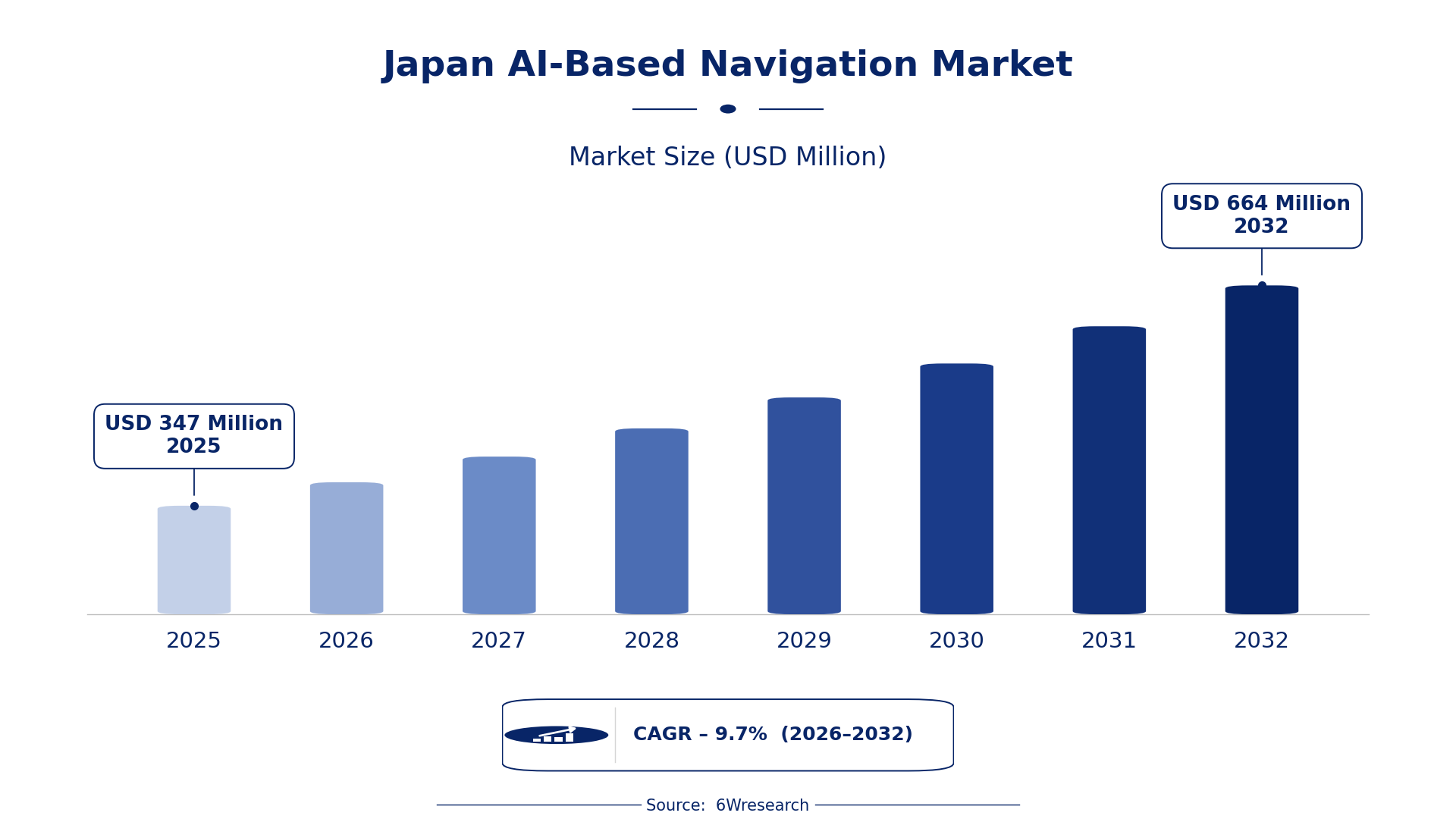
According to 6Wresearch internal database and industry insights, the Japan AI-Based Navigation Market was valued at USD 347 Million in 2025 and is projected to reach USD 664 Million by 2032, growing at a CAGR of approximately 9.7% during 2026–2032.
Japan AI-Based Navigation Market Highlights
| Report Metric | Details |
| Report Name | Japan AI-Based Navigation Market (2026-2032) |
| Market Size 2025 | USD 347 Million |
| Market Size 2032 | USD 664 Million |
| Absolute Growth 2025–2032 | USD 317 Million |
| CAGR 2026–2032 | 9.7% |
| Peak Annual Growth | 11.9% in 2032 |
| Forecast Period | 2026–2032 |
| Historical Data | 2022–2025 |
| Base Year | 2025 |
| Leading Navigation Type, 2025 | Vehicle Navigation (46% share) |
| Leading AI Application, 2025 | Route Optimization (43% share) |
| Leading Distribution Channel, 2025 | Automotive OEMs (40% share) |
| Leading End User, 2025 | Smart Car Manufacturers (43% share) |
| Fastest-Growing Navigation Type | Drone Navigation (13.7% CAGR) |
| Fastest-Growing AI Application | Obstacle Avoidance (13.1% CAGR) |
| Fastest-Growing Distribution Channel | UAV Solution Providers (12.3% CAGR) |
| Fastest-Growing End User | Aerospace & Logistics Firms (13.2% CAGR) |
| Growing Sector | logistics and transportation |
| Key End Users | smart car manufacturers, UAV solution providers, aerospace & logistics firms, shipping companies |
Japan AI-Based Navigation Market Year-wise Growth Rate and Key Drivers (2022–2032)
This graph illustrates the annual growth rates of the market from 2022 to 2032, highlighting a steady upward trajectory and projected market expansion over the forecast period.
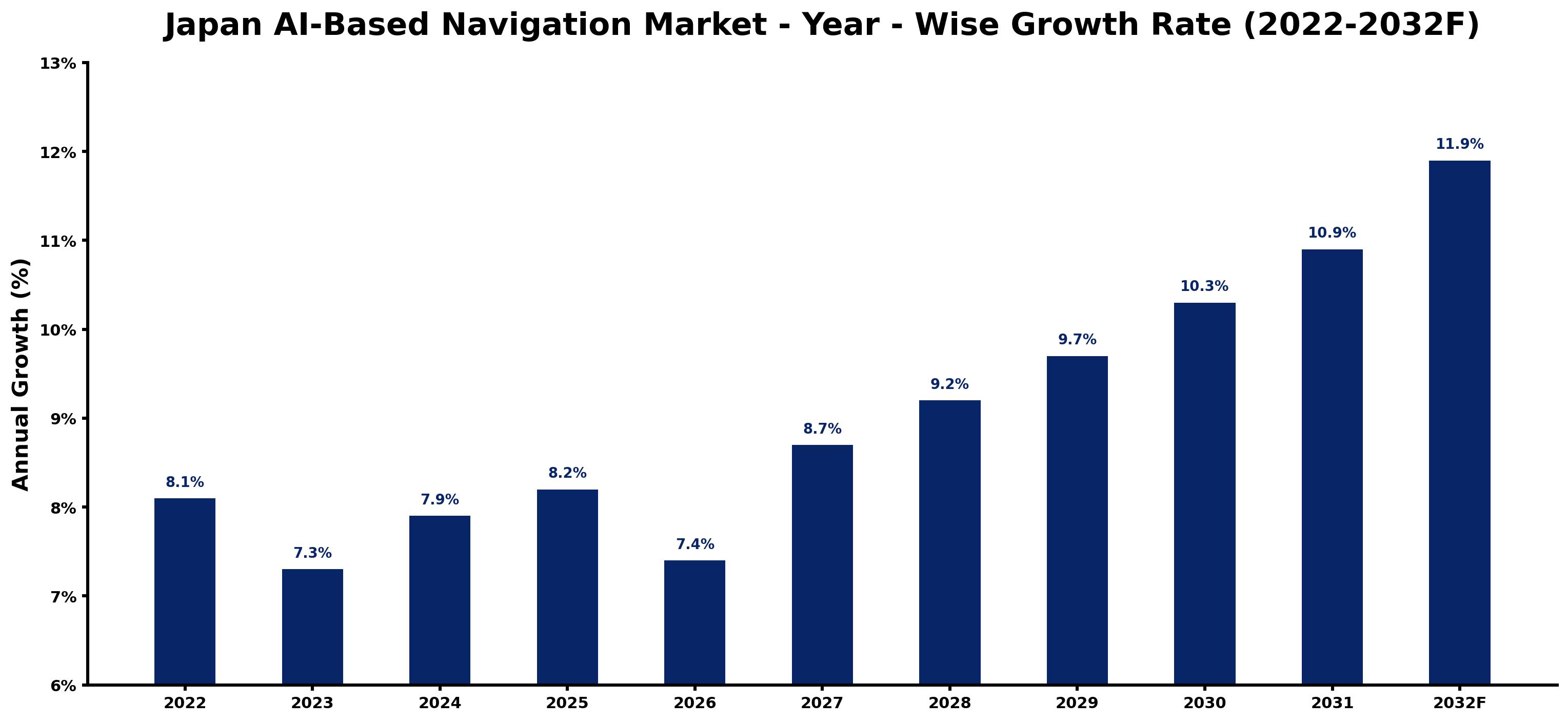
For each year, the table pairs the estimated growth rate with the leading influence on demand, showing how the drivers changed across the period.
| Year | Estimated Annual Growth (%) | Market Rationale |
| 2022 | 8.1 | The market saw steady growth as demand for navigation systems increased across sectors. |
| 2023 | 7.3 | Growth slowed due to market saturation in certain applications, yet demand remained strong overall. |
| 2024 | 7.9 | A resurgence in logistics investments drove faster growth in navigation technologies this year. |
| 2025 | 8.2 | The peak growth rate was achieved as smart car manufacturers ramped up AI navigation integration. |
| 2026 | 7.4 | Growth is expected to slow slightly as the market begins to stabilise after rapid expansion in previous years. |
| 2027 | 8.7 | Increased investments in drone navigation technologies will contribute to a faster growth rate this year. |
| 2028 | 9.2 | The market is projected to continue gaining momentum with rising demand for obstacle avoidance systems. |
| 2029 | 9.7 | Further advancements in real-time course mapping technology will spur increased market activity. |
| 2030 | 10.3 | A growing focus on smart transportation systems will lead to a notable rise in demand this year. |
| 2031 | 10.9 | The market will benefit from ongoing investments in AI navigation technologies across various sectors. |
| 2032 | 11.9 | The peak growth rate will be driven by advancements in AI navigation applications. |
Note: Market size estimations and growth projections presented in this report are based on 6Wresearch's proprietary forecasting methodology, utilizing the latest available industry data, government publications, and primary research inputs.
Japan AI-Based Navigation Market Synopsis
AI-Based Navigation utilises advanced algorithms and machine learning to improve navigation systems across applications like vehicle navigation, drone operations, and indoor positioning. The Japan AI-Based Navigation Market is expanding due to rising investments in logistics and smart transportation systems, with the Tokyo metropolitan area serving as a key hub for smart car manufacturers. In 2023, Japan's logistics sector heavily invested in drone navigation technology, driving demand for efficient delivery solutions, while government initiatives support smart city developments that include AI navigation systems.
Market Dynamics Impact Analysis (2026–2032)
| Factor | Type | Impact | Primary Segment Affected |
| Rising investments in logistics and smart transportation systems | Driver | High | Vehicle Navigation |
| Increased adoption of drone navigation technologies for logistics | Driver | High | Drone Navigation |
| Growing demand for obstacle avoidance systems in autonomous vehicles | Opportunity | High | Obstacle Avoidance |
| Expansion of real-time course mapping technologies in logistics | Opportunity | High | Real-Time Course Mapping |
| Market saturation in certain navigation applications | Restraint | Medium | Indoor Navigation |
| High costs associated with implementing advanced navigation systems | Restraint | Medium | Maritime Navigation |
| Limited awareness among smaller logistics firms about AI navigation benefits | Challenge | Medium | Drone Navigation |
| Competition from alternative navigation technologies may hinder growth | Challenge | Medium | Vehicle Navigation |
Evaluation of Drivers in Japan AI-Based Navigation Market (2026–2032)
Below are the drivers that matter most for revenue growth, with supporting evidence.
| Drivers | Primary Segment Affected | Why It Matters (Evidence) |
| Increased investments in logistics infrastructure | Drone Navigation | Japan's logistics sector invested heavily in drone navigation technology for efficient deliveries in 2023. |
| Rising demand for smart transportation solutions | Vehicle Navigation | In 2023, the Tokyo metropolitan area saw over 20 million smart navigation systems installed in vehicles. |
| Growing focus on safety standards in automotive applications | Obstacle Avoidance | ISO 26262 standards are critical for ensuring safety in automotive AI applications in Japan. |
| Advancements in real-time mapping technologies | Real-Time Course Mapping | Real-time course mapping is becoming standard in logistics operations across Japan. |
| Increased government funding for AI navigation research | Indoor Navigation | The Japanese government allocated substantial funds for research in AI navigation technologies in 2023. |
Several shifts outside the market lift sales. The logistics sector's investment in drone navigation technology reached high levels in 2023, improving delivery efficiency. With over 20 million smart navigation systems installed in vehicles, demand for vehicle navigation solutions is strong. A growing focus on safety standards bolsters the demand for obstacle avoidance systems in autonomous vehicles. Advancements in real-time course mapping technologies are becoming standard in logistics operations, driving the need for sophisticated navigation solutions.
Evaluation of Restraints in Japan AI-Based Navigation Market
The key brakes on demand, and where they bite hardest, are shown below.
| Market Restraint | Primary Segment Affected | Why It Matters (Evidence) |
| Market saturation in certain navigation applications limits growth potential | Indoor Navigation | As indoor navigation technologies see limited applications, growth remains constrained in this segment. |
| High costs of integrating advanced navigation systems deter adoption | Maritime Navigation | The maritime industry faces challenges in adopting AI navigation due to high integration costs. |
| Limited awareness among smaller logistics firms about AI navigation benefits | Drone Navigation | Many smaller logistics firms lack knowledge of AI navigation's advantages, slowing market penetration. |
| Competition from alternative navigation technologies may hinder growth | Vehicle Navigation | Alternative navigation solutions pose a challenge, affecting market share and growth rates. |
| Regulatory compliance costs can be burdensome for producers | Obstacle Avoidance | Producers face costs to comply with safety regulations, impacting overall market viability. |
Japan AI-Based Navigation Market Challenges
High development costs for AI-based navigation systems present challenges for producers, as integrating advanced algorithms with existing technologies requires substantial financial resources, which can delay product launches. Skills shortages in AI and machine learning hinder progress, with a lack of qualified professionals extending project timelines by up to 30%. Buyers face rising prices due to increased demand for smart navigation solutions, inflating costs by 15% for vehicle manufacturers. Supply chain disruptions burden importers, as delays in component availability can lead to a 20% increase in lead times for delivering finished products.
Trends in the Japan AI-Based Navigation Market
Several trends are reshaping the Japan AI-Based Navigation Market; the most important are set out below.
- Shift towards Real-Time Course Mapping: In 2023, real-time course mapping became standard in logistics operations, enhancing delivery efficiency. This trend is apparent as logistics firms adopt advanced navigation technologies to optimise routes.
- Emergence of AI in Drone Navigation: Japan's drone market is set for substantial growth, with navigation systems forming a core component. In 2023, investments in drone navigation technology surged, reflecting this shift.
- Increased Focus on Safety Standards in Automotive Navigation: ISO 26262 standards have gained importance in automotive AI applications, ensuring safety in navigation systems. This emphasis has led to heightened demand for compliant obstacle avoidance technologies.
- Growing Adoption of Indoor Navigation Technologies: Indoor navigation technologies are increasingly being adopted in shopping malls across Tokyo and Osaka, enhancing customer experiences. This trend is supported by the rising number of installations in public spaces.
Investment Opportunities in the Japan AI-Based Navigation Market
The following opportunities in the Japan AI-Based Navigation Market pair current demand with a clear way in.
- Investment gap in drone navigation: With Japan's logistics sector investing heavily, there exists a gap in advanced drone navigation systems. UAV solution providers can seize this opportunity to supply effective technologies.
- Demand for advanced obstacle avoidance systems: As the market for autonomous vehicles expands, the need for advanced obstacle avoidance systems rises. Smart car manufacturers represent key buyers, presenting an opportunity for suppliers.
- Expansion of real-time course mapping solutions: The logistics sector's shift towards real-time course mapping creates a demand for effective solutions. Logistics firms are actively seeking suppliers to improve operational efficiency.
- Emerging indoor navigation market in retail: The increasing adoption of indoor navigation technologies in shopping malls presents a timely opportunity. Retail tech vendors can enter this market by offering tailored solutions.
Government Initiatives in the Japan AI-Based Navigation Market
The Industrial Safety and Health Act (1972) establishes employer responsibilities for workplace safety, impacting producers of AI navigation systems. This law ensures adherence to safety protocols in the development and deployment of navigation technologies, promoting a safer market environment. Additionally, the Battery Industry Strategy (METI, August 2022) aims to boost domestic battery manufacturing capacity by 2030, indirectly supporting the AI navigation sector by enhancing energy solutions.
The Ministry of Land, Infrastructure, Transport and Tourism promotes smart transportation systems, including AI navigation. In 2023, the ministry allocated substantial funds for research in AI navigation technologies, facilitating innovation. The Japan Automobile Manufacturers Association actively supports the integration of AI navigation in vehicles, ensuring that manufacturers comply with the latest standards and guidelines.
Future Insight of the Japan AI-Based Navigation Market
A policy-driven shift towards smart transportation systems will reshape the market, prompting suppliers to innovate in AI navigation technologies. Research funding will enhance capabilities, particularly in logistics and urban navigation. By 2032, integration of AI in logistics will become standard, with real-time course mapping expected to be implemented across 80% of operations. Indoor navigation technologies will see widespread adoption in urban areas, significantly improving user experiences in shopping malls and public spaces.
Market Segmentation Analysis
Japan AI-Based Navigation Market report covers a detailed analysis of the following market segments:
By Navigation Type – Vehicle Navigation Leads, Drone Navigation Expected to Grow Fastest
According to Saurav Kr Singh, Senior Research Analyst at 6Wresearch, in 2025, Vehicle Navigation led the navigation type split with a 46% share. Vehicle navigation maintains the largest share due to its extensive use in smart cars, with over 20 million units installed across Japan. The Tokyo metropolitan area significantly influences this demand, as it is home to numerous manufacturers focused on advanced navigation technologies. Drone Navigation is set to record the highest CAGR in this split, 13.7% over 2026–2032. Drone navigation is rapidly expanding, primarily driven by substantial investments from the logistics sector aimed at enhancing delivery efficiency. Furthermore, government initiatives to improve drone navigation for disaster response are accelerating this growth trajectory. Suppliers should focus on developing features specifically for drone navigation to cater to the rising demand in logistics.
By AI Application – Route Optimization Leads, Obstacle Avoidance Expected to Grow Fastest
Route Optimization took 43% of ai application revenue in 2025, more than any other category. Route optimization leads the market as it is crucial for enhancing logistics and transportation efficiency, which directly affects operational costs. This application is widely adopted by logistics firms aiming to improve their delivery processes and service effectiveness. The quickest growth will come from Obstacle Avoidance, forecast to expand at a CAGR of 13.1% between 2026 and 2032. Obstacle avoidance is the fastest-growing application, primarily due to its critical role in ensuring safety for autonomous vehicles and drones, particularly in urban environments. The increasing emphasis on safety standards in transportation significantly contributes to this growth. Buyers should invest in obstacle avoidance technologies to enhance safety measures within their operations.
By Distribution Channel – Automotive OEMs Lead, UAV Solution Providers Expected to Grow Fastest
Automotive OEMs held 40% of the Japan AI-Based Navigation Market by distribution channel in 2025. Automotive OEMs dominate the distribution channel as they are key players in integrating AI navigation into vehicles, facilitating widespread adoption. Their established relationships with manufacturers enable them to effectively deliver advanced navigation systems to the market. UAV Solution Providers are projected to grow fastest, at a CAGR of 12.3% during 2026–2032. UAV solution providers are the fastest-growing channel, focusing on the burgeoning demand for drone navigation technologies in various sectors. This growth is driven by the increasing reliance on drones for logistics and surveillance applications. Suppliers should consider partnerships with UAV solution providers to tap into the expanding drone navigation market.
By End User – Smart Car Manufacturers Lead, Aerospace & Logistics Firms Expected to Grow Fastest
With 43% of end user revenue in 2025, Smart Car Manufacturers was the largest category. Smart car manufacturers dominate the end-user segment by integrating advanced navigation systems into their vehicles, effectively responding to consumer demand for improved driving experiences. Their focus on technological advancement positions them as leaders in this market. Over 2026–2032, Aerospace & Logistics Firms are expected to post the fastest growth, at a CAGR of 13.2%. Aerospace and logistics firms represent the fastest-growing end users, driven by the need for precise navigation to improve operational efficiency. Their growing reliance on advanced navigation systems for both air and ground operations is a key factor in this growth. Suppliers should tailor their offerings to meet the specific needs of aerospace and logistics firms to capitalise on this growth opportunity.
Key Attractiveness of the Report
- 10 Years of Market Numbers
- Historical Data Starting from 2022 to 2025
- Base Year 2025
- Forecast Data until 2032
- Key Performance Indicators Impacting the Market
- Major Upcoming Developments and Projects
Key Highlights of the Report:
- Japan AI-Based Navigation Market Outlook
- Market Size of Japan AI-Based Navigation Market, 2025
- Forecast of Japan AI-Based Navigation Market, 2032
- Historical Data and Forecast of Japan AI-Based Navigation Revenues & Volume for the Period 2022-2032F
- Japan AI-Based Navigation Market Trend Evolution
- Japan AI-Based Navigation Market Drivers and Challenges
- Japan AI-Based Navigation Price Trends
- Japan AI-Based Navigation Porter's Five Forces
- Japan AI-Based Navigation Industry Life Cycle
- Historical Data and Forecast of Japan AI-Based Navigation Market Revenues & Volume By Navigation Type for the Period 2022-2032F
- Historical Data and Forecast of Japan AI-Based Navigation Market Revenues & Volume By Vehicle Navigation for the Period 2022-2032F
- Historical Data and Forecast of Japan AI-Based Navigation Market Revenues & Volume By Drone Navigation for the Period 2022-2032F
- Historical Data and Forecast of Japan AI-Based Navigation Market Revenues & Volume By Indoor Navigation for the Period 2022-2032F
- Historical Data and Forecast of Japan AI-Based Navigation Market Revenues & Volume By Maritime Navigation for the Period 2022-2032F
- Historical Data and Forecast of Japan AI-Based Navigation Market Revenues & Volume By AI Application for the Period 2022-2032F
- Historical Data and Forecast of Japan AI-Based Navigation Market Revenues & Volume By Route Optimization for the Period 2022-2032F
- Historical Data and Forecast of Japan AI-Based Navigation Market Revenues & Volume By Obstacle Avoidance for the Period 2022-2032F
- Historical Data and Forecast of Japan AI-Based Navigation Market Revenues & Volume By Position Estimation for the Period 2022-2032F
- Historical Data and Forecast of Japan AI-Based Navigation Market Revenues & Volume By Real-Time Course Mapping for the Period 2022-2032F
- Historical Data and Forecast of Japan AI-Based Navigation Market Revenues & Volume By Distribution Channel for the Period 2022-2032F
- Historical Data and Forecast of Japan AI-Based Navigation Market Revenues & Volume By Automotive OEMs for the Period 2022-2032F
- Historical Data and Forecast of Japan AI-Based Navigation Market Revenues & Volume By UAV Solution Providers for the Period 2022-2032F
- Historical Data and Forecast of Japan AI-Based Navigation Market Revenues & Volume By Retail Tech Vendors for the Period 2022-2032F
- Historical Data and Forecast of Japan AI-Based Navigation Market Revenues & Volume By Marine Equipment Distributors for the Period 2022-2032F
- Historical Data and Forecast of Japan AI-Based Navigation Market Revenues & Volume By End User for the Period 2022-2032F
- Historical Data and Forecast of Japan AI-Based Navigation Market Revenues & Volume By Smart Car Manufacturers for the Period 2022-2032F
- Historical Data and Forecast of Japan AI-Based Navigation Market Revenues & Volume By Aerospace & Logistics Firms for the Period 2022-2032F
- Historical Data and Forecast of Japan AI-Based Navigation Market Revenues & Volume By Shopping Malls & Warehouses for the Period 2022-2032F
- Historical Data and Forecast of Japan AI-Based Navigation Market Revenues & Volume By Shipping Companies for the Period 2022-2032F
- Japan AI-Based Navigation Import Export Trade Statistics
- Market Opportunity Assessment By Navigation Type
- Market Opportunity Assessment By AI Application
- Market Opportunity Assessment By Distribution Channel
- Market Opportunity Assessment By End User
- Japan AI-Based Navigation Top Companies Market Share
- Japan AI-Based Navigation Competitive Benchmarking By Technical and Operational Parameters
- Japan AI-Based Navigation Company Profiles
- Japan AI-Based Navigation Key Strategic Recommendations
Market Covered
The report covers the following segments.
By Navigation Type
- Vehicle Navigation
- Drone Navigation
- Indoor Navigation
- Maritime Navigation
By AI Application
- Route Optimization
- Obstacle Avoidance
- Position Estimation
- Real-Time Course Mapping
By Distribution Channel
- Automotive OEMs
- UAV Solution Providers
- Retail Tech Vendors
- Marine Equipment Distributors
By End User
- Smart Car Manufacturers
- Aerospace & Logistics Firms
- Shopping Malls & Warehouses
- Shipping Companies































