Japan AI-Based Predictive Maintenance Market Size & Growth Rate
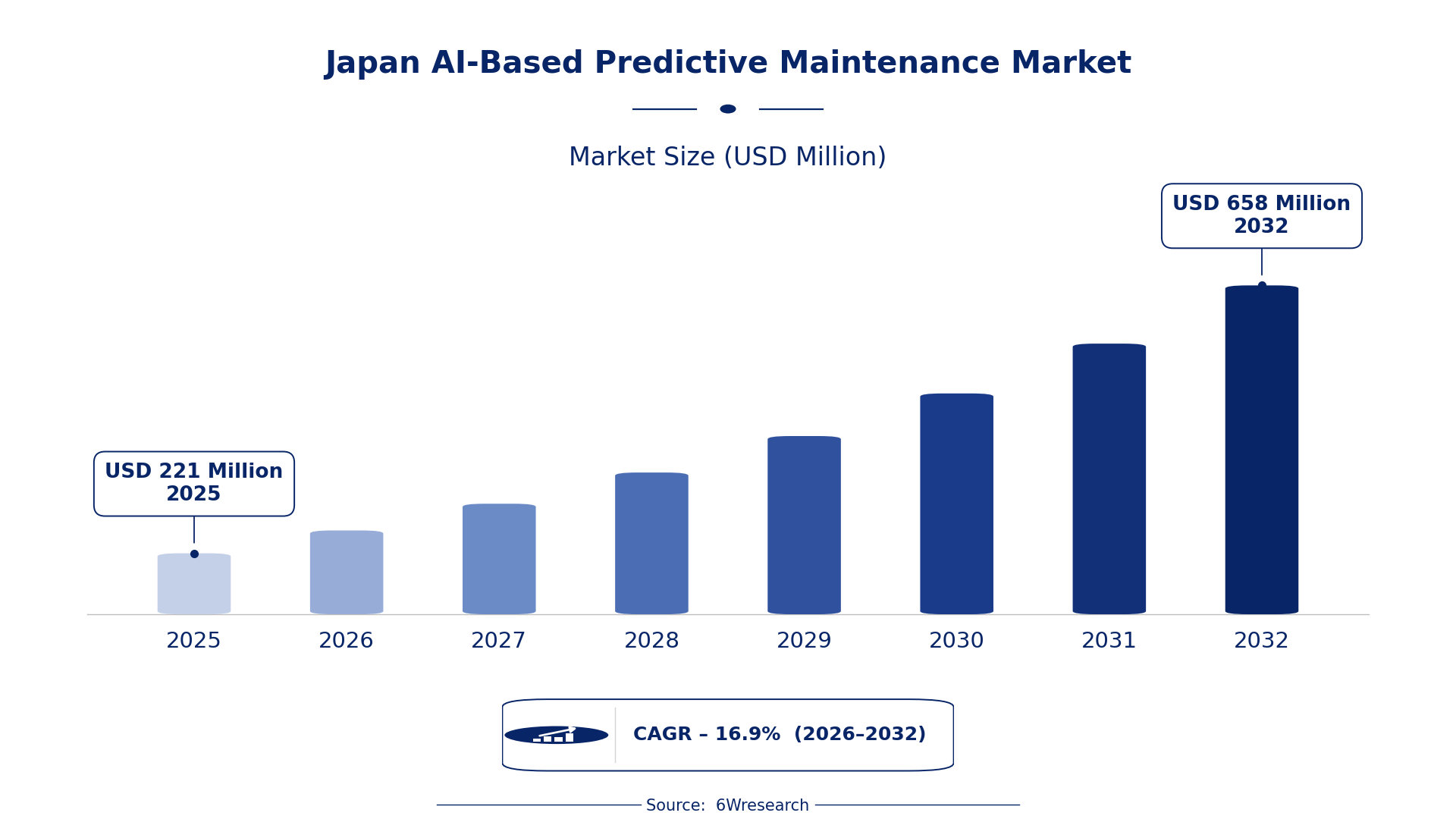
According to 6Wresearch internal database and industry insights, the Japan AI-Based Predictive Maintenance Market was valued at USD 221 Million in 2025 and is projected to reach USD 658 Million by 2032, growing at a CAGR of approximately 16.9% during 2026–2032.
Japan AI-Based Predictive Maintenance Market Highlights
| Report Metric | Details |
| Report Name | Japan AI-Based Predictive Maintenance Market (2026-2032) |
| Market Size 2025 | USD 221 Million |
| Market Size 2032 | USD 658 Million |
| Absolute Growth 2025–2032 | USD 437 Million |
| CAGR 2026–2032 | 16.9% |
| Peak Annual Growth | 17.4% in 2026 |
| Forecast Period | 2026–2032 |
| Historical Data | 2022–2025 |
| Base Year | 2025 |
| Leading Equipment Type, 2025 | Manufacturing Machines (40% share) |
| Leading AI Use Case, 2025 | Failure Prediction (47% share) |
| Leading Distribution Channel, 2025 | Industrial AI Vendors (38% share) |
| Leading End User, 2025 | Production Plants (41% share) |
| Fastest-Growing Equipment Type | HVAC Systems (23.9% CAGR) |
| Fastest-Growing AI Use Case | Sensor-Based Analysis (23.4% CAGR) |
| Fastest-Growing Distribution Channel | Energy Maintenance SaaS (21.5% CAGR) |
| Fastest-Growing End User | Facility Management Firms (21.4% CAGR) |
| Growing Sector | Manufacturing |
| Key End Users | Production Plants, Utility Companies, Logistics Companies |
Japan AI-Based Predictive Maintenance Market Year-wise Growth Rate and Key Drivers (2022–2032)
This graph illustrates the annual growth rates of the market from 2022 to 2032, highlighting a steady upward trajectory and projected market expansion over the forecast period.
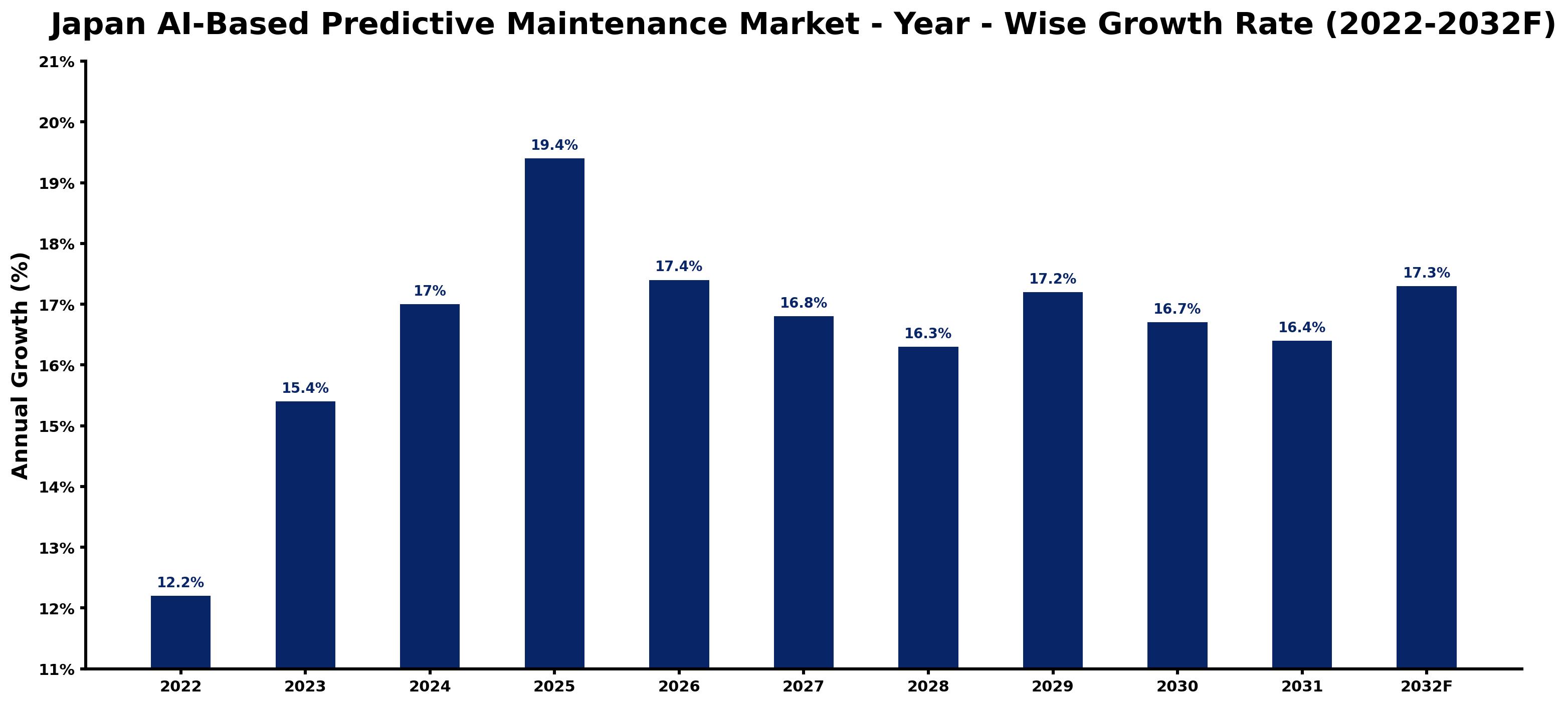
The yearly estimates that follow link every growth rate to its principal driver, so readers can see why the pace changed in each period.
| Year | Estimated Annual Growth (%) | Market Rationale |
| 2022 | 12.2 | The market experienced steady growth as industries began integrating predictive maintenance solutions. |
| 2023 | 15.4 | Increased adoption of AI technologies propelled faster growth across key sectors. |
| 2024 | 17.0 | The implementation of advanced analytics tools further accelerated market expansion. |
| 2025 | 19.4 | A surge in demand for operational efficiency drove peak growth in predictive maintenance. |
| 2026 | 17.4 | Growth is projected to slow as the market begins to stabilise after rapid expansion in previous years. |
| 2027 | 16.8 | Continued investments in AI technologies will maintain positive growth, albeit at a slower pace. |
| 2028 | 16.3 | Market growth is expected to moderate as industries focus on optimising existing solutions. |
| 2029 | 17.2 | Renewed interest in predictive maintenance technologies is anticipated to spur a faster growth rate. |
| 2030 | 16.7 | Growth will decelerate as market maturity sets in and competition intensifies. |
| 2031 | 16.4 | The market will continue to expand, driven by ongoing technological advancements. |
| 2032 | 17.3 | A resurgence in demand for predictive maintenance solutions is expected to lead to renewed growth. |
Note: Market size estimations and growth projections presented in this report are based on 6Wresearch's proprietary forecasting methodology, utilizing the latest available industry data, government publications, and primary research inputs.
Japan AI-Based Predictive Maintenance Market Synopsis
AI-Based Predictive Maintenance utilises machine learning algorithms to foresee equipment failures and optimise maintenance schedules, essential for reducing downtime in various industries. The Japan AI-Based Predictive Maintenance Market is expanding due to the manufacturing sector's contribution to GDP and the ongoing integration of AI technologies, supported by initiatives like 'Society 5.0'. Over 50% of production plants have adopted these solutions, driving demand for predictive maintenance across sectors.
Market Dynamics Impact Analysis (2026–2032)
| Factor | Type | Impact | Primary Segment Affected |
| Growing investment in AI technologies is driving demand for predictive maintenance solutions. | Driver | High | Manufacturing Machines |
| The need for operational efficiency in production plants creates opportunities for predictive maintenance. | Driver | High | Production Plants |
| The increasing number of aging power generators necessitates predictive maintenance solutions. | Opportunity | High | Power Generators |
| The rising adoption of real-time monitoring systems in utility companies presents a significant opportunity. | Opportunity | High | Utility Companies |
| High initial investment costs can deter smaller companies from adopting predictive maintenance. | Restraint | Medium | Manufacturing Machines |
| Limited awareness of predictive maintenance benefits restricts market growth in certain sectors. | Restraint | Medium | Production Plants |
| Compliance with evolving standards can strain resources for companies implementing predictive maintenance. | Challenge | High | Power Generators |
| Capacity constraints in AI technology development can limit the availability of solutions. | Challenge | Medium | Utility Companies |
Evaluation of Drivers in Japan AI-Based Predictive Maintenance Market (2026–2032)
The main growth drivers and the segments they affect most are set out below.
| Drivers | Primary Segment Affected | Why It Matters (Evidence) |
| Increased investment in AI technologies is driving demand for predictive maintenance solutions. | Manufacturing Machines | The annual investment in AI technologies in Japan is estimated at ¥1 trillion, encouraging manufacturers to adopt predictive maintenance. |
| The need for operational efficiency in production plants creates opportunities for predictive maintenance. | Production Plants | Japan's manufacturing sector contributes 20% to the national GDP, prompting plants to optimise maintenance schedules. |
| The aging infrastructure of power generators necessitates predictive maintenance solutions. | Power Generators | The average age of power generators in Japan is over 15 years, leading to increased demand for predictive maintenance. |
| Real-time monitoring systems are increasingly adopted in utility companies. | Utility Companies | Over 40% of utility companies in Japan have implemented real-time monitoring systems to enhance operational efficiency. |
| The adoption of ISO 55000 standards is promoting asset management practices. | Manufacturing Machines | Compliance with ISO 55000 standards is becoming essential for effective asset management in predictive maintenance. |
The strongest pull on demand comes from increased investment in AI technologies, with annual spending estimated at ¥1 trillion. This financial commitment drives manufacturers to adopt predictive maintenance solutions, particularly in the manufacturing sector, which contributes 20% to Japan's GDP. The aging infrastructure of power generators, averaging over 15 years, necessitates predictive maintenance, improving reliability. More than 40% of utility companies have implemented real-time monitoring systems, which further drives demand for predictive maintenance solutions. Compliance with ISO 55000 standards is encouraging manufacturers to improve asset management practices, resulting in increased purchases of predictive maintenance technologies.
Evaluation of Restraints in Japan AI-Based Predictive Maintenance Market
The following restraints limit how fast demand can grow.
| Market Restraint | Primary Segment Affected | Why It Matters (Evidence) |
| High initial investment costs can deter smaller companies from adopting predictive maintenance. | Manufacturing Machines | The average downtime cost for manufacturing machines in Japan is estimated at ¥1 million per hour, making initial investments challenging for smaller firms. |
| Limited awareness of predictive maintenance benefits restricts market growth in certain sectors. | Production Plants | Despite over 50% adoption, many production plants remain unaware of the full advantages of predictive maintenance. |
| Integration challenges with existing systems can hinder predictive maintenance adoption. | Manufacturing Machines | Many manufacturers face difficulties in integrating predictive maintenance solutions with legacy systems. |
| Capacity constraints in AI technology development can limit the availability of solutions. | Utility Companies | As demand for AI solutions grows, limited development capacity can delay implementation timelines. |
| Compliance with evolving standards can strain resources for companies implementing predictive maintenance. | Power Generators | The need to meet new regulations can divert funds from other critical areas for power generation companies. |
Japan AI-Based Predictive Maintenance Market Challenges
A lack of diverse supply sources hampers producers, as over 50% of production plants rely on a limited number of predictive maintenance solution providers. This concentration leads to delays in implementation, costing manufacturers potential savings of ¥1 million per hour in downtime. Technological integration remains a hurdle for many facilities; the average age of HVAC systems is around 12 years, complicating upgrades for operators. Competition is fierce, with many firms struggling to differentiate their services, which can lead to price wars that erode margins for suppliers. Skills shortages in AI and data analytics are prevalent, impacting the ability of manufacturers to fully utilise predictive maintenance technologies.
Trends in the Japan AI-Based Predictive Maintenance Market
Buyers and suppliers in the Japan AI-Based Predictive Maintenance Market are adjusting to the following trends.
- Shift from Traditional Maintenance to Predictive Maintenance: In 2023, over 50% of production plants in Japan adopted predictive maintenance solutions, reflecting a shift from traditional maintenance practices. This transition reduces downtime and improves operational efficiency, driving further investments in AI technologies.
- Transition to Real-Time Monitoring: The Tokyo region is experiencing a transition to real-time monitoring systems, with over 40% of utility companies implementing these technologies. This shift improves operational responsiveness and efficiency, increasing demand for predictive maintenance solutions.
- Emergence of Energy Maintenance SaaS: The Energy Maintenance SaaS segment is rapidly growing, with a projected CAGR of 21.5% from 2026 to 2032. This trend is driven by the need for cloud-based management tools in utility companies, facilitating better maintenance practices.
- Rise of Sensor-Based Analysis: Sensor-Based Analysis has emerged as a key application in predictive maintenance, with a CAGR of 23.4% expected from 2026 to 2032. This trend is driven by the need for data-driven insights in manufacturing facilities.
Investment Opportunities in the Japan AI-Based Predictive Maintenance Market
Below are the investment opportunities with the strongest case in the Japan AI-Based Predictive Maintenance Market.
- Gap in Predictive Maintenance for Aging Equipment: With over 50% of production plants adopting predictive maintenance, a gap remains for aging equipment. The manufacturing sector requires advanced solutions to optimise maintenance schedules, presenting an opportunity for AI vendors.
- Growing Demand from Utility Companies: Utility companies are increasingly seeking predictive maintenance solutions to improve operational stability. With approximately 10 utility companies in Japan, this sector presents a promising opportunity for AI-based technologies.
- Investment in Smart Building Technologies: The Tokyo Metropolitan Government's program to enhance smart building technologies is creating demand for predictive maintenance solutions. This initiative aligns with energy efficiency regulations, driving investment in HVAC systems.
- Focus on Energy Efficiency Regulations: The HVAC market is projected to grow due to energy efficiency regulations. This presents an opportunity for suppliers to provide predictive maintenance solutions tailored to the HVAC sector.
Government Initiatives in the Japan AI-Based Predictive Maintenance Market
The Economic Security Promotion Act, enacted in 2022, enhances supply-chain resilience for critical products, including AI-based predictive maintenance technologies. This law mandates that producers implement measures to ensure the reliability of their systems, which encourages investment in advanced predictive maintenance solutions. Coupled with the Semiconductor and Digital Industry Strategy from June 2021, which aims to secure domestic semiconductor manufacturing, these policies provide a solid foundation for the growth of AI technologies in various sectors.
The Ministry of Economy, Trade and Industry (METI) plays a crucial role in funding AI technology development, approving projects that align with national strategies. In 2023, METI allocated ¥10 billion to support AI integration in industries, facilitating the adoption of predictive maintenance solutions. This funding enables manufacturers to enhance their operational efficiency and reliability, ultimately benefiting the overall productivity of the manufacturing and utility sectors.
Future Insight of the Japan AI-Based Predictive Maintenance Market
By 2032, the logistics sector will increasingly implement AI-based predictive maintenance, improving efficiency for over 1.5 million workers. The 'Society 5.0' initiative will drive technological advancements, encouraging suppliers to adopt new AI solutions. Updated ISO 55000 standards will guide asset management practices, benefiting buyers through improved operational reliability. As energy efficiency regulations reshape the HVAC market, suppliers must adjust their strategies to meet the rising need for predictive maintenance solutions.
Market Segmentation Analysis
Japan AI-Based Predictive Maintenance Market report covers a detailed analysis of the following market segments:
By Equipment Type – Manufacturing Machines Lead, HVAC Systems Expected to Grow Fastest
According to Saurav Kr Singh, Senior Research Analyst at 6Wresearch, in 2025, Manufacturing Machines led the equipment type split with a 40% share. Manufacturing machines play a critical role in Japan's industrial landscape, significantly influencing productivity and operational efficiency. With more than 2 million industrial machines installed, this segment benefits from a robust user base that solidifies its leading share. HVAC Systems are set to record the highest CAGR in this split, 23.9% over 2026–2032. The HVAC systems segment is witnessing rapid growth due to increasing energy efficiency regulations that compel operators to enhance their maintenance practices. The average age of HVAC systems, approximately 12 years, creates a pressing need for effective predictive maintenance solutions. Suppliers should focus on developing tailored solutions for HVAC systems to address the rising demand prompted by regulatory requirements.
By AI Use Case – Failure Prediction Leads, Sensor-Based Analysis Expected to Grow Fastest
With 47% of ai use case revenue in 2025, Failure Prediction was the largest category. Failure prediction is essential for proactive maintenance, allowing industries to effectively reduce downtime and associated costs. This approach is particularly relevant in Japan, where the average downtime cost for manufacturing machines is estimated at ¥1 million per hour, underscoring its importance. Sensor-Based Analysis is projected to grow fastest, at a CAGR of 23.4% during 2026–2032. Sensor-based analysis is rapidly gaining traction as it provides critical data insights that improve maintenance strategies. The adoption of sensors in over 30% of manufacturing facilities indicates a growing reliance on this analytical method. Buyers should invest in sensor-based solutions to leverage real-time data for optimising their maintenance operations.
By Distribution Channel – Industrial AI Vendors Lead, Energy Maintenance SaaS Expected to Grow Fastest
Industrial AI Vendors held 38% of the Japan AI-Based Predictive Maintenance Market by distribution channel in 2025. Industrial AI vendors are crucial in supplying specialised solutions that cater to the diverse needs of various sectors in Japan. Their established presence in the market and expertise enable them to maintain a dominant share of the distribution channel. The quickest growth will come from Energy Maintenance SaaS, forecast to expand at a CAGR of 21.5% between 2026 and 2032. Energy maintenance SaaS is quickly becoming popular due to its cloud-based management tools that improve operational efficiency. The shift towards digital solutions is evident as more companies seek effective ways to manage their maintenance schedules. Suppliers must enhance their SaaS offerings to meet the growing demand for energy maintenance solutions.
By End User – Production Plants Lead, Facility Management Firms Expected to Grow Fastest
The largest end user category in 2025 was Production Plants, at 41% of revenue. Production plants are the core users of predictive maintenance, directly benefiting from reduced downtime and maintenance costs. Their substantial contribution to Japan's GDP highlights their critical role in the adoption of these technologies. Over 2026–2032, Facility Management Firms are expected to post the fastest growth, at a CAGR of 21.4%. Facility management firms are increasingly adopting predictive maintenance to improve building operations and energy efficiency. This trend is driven by the need for better management of ageing infrastructure, particularly in urban areas. Buyers in facility management should prioritise predictive maintenance tools to optimise operational efficiency.
Key Attractiveness of the Report
- 10 Years of Market Numbers
- Historical Data Starting from 2022 to 2025
- Base Year 2025
- Forecast Data until 2032
- Key Performance Indicators Impacting the Market
- Major Upcoming Developments and Projects
Key Highlights of the Report:
- Japan AI-Based Predictive Maintenance Market Outlook
- Market Size of Japan AI-Based Predictive Maintenance Market, 2025
- Forecast of Japan AI-Based Predictive Maintenance Market, 2032
- Historical Data and Forecast of Japan AI-Based Predictive Maintenance Revenues & Volume for the Period 2022-2032F
- Japan AI-Based Predictive Maintenance Market Trend Evolution
- Japan AI-Based Predictive Maintenance Market Drivers and Challenges
- Japan AI-Based Predictive Maintenance Price Trends
- Japan AI-Based Predictive Maintenance Porter's Five Forces
- Japan AI-Based Predictive Maintenance Industry Life Cycle
- Historical Data and Forecast of Japan AI-Based Predictive Maintenance Market Revenues & Volume By Equipment Type for the Period 2022-2032F
- Historical Data and Forecast of Japan AI-Based Predictive Maintenance Market Revenues & Volume By Manufacturing Machines for the Period 2022-2032F
- Historical Data and Forecast of Japan AI-Based Predictive Maintenance Market Revenues & Volume By Power Generators for the Period 2022-2032F
- Historical Data and Forecast of Japan AI-Based Predictive Maintenance Market Revenues & Volume By Vehicles for the Period 2022-2032F
- Historical Data and Forecast of Japan AI-Based Predictive Maintenance Market Revenues & Volume By HVAC Systems for the Period 2022-2032F
- Historical Data and Forecast of Japan AI-Based Predictive Maintenance Market Revenues & Volume By AI Use Case for the Period 2022-2032F
- Historical Data and Forecast of Japan AI-Based Predictive Maintenance Market Revenues & Volume By Failure Prediction for the Period 2022-2032F
- Historical Data and Forecast of Japan AI-Based Predictive Maintenance Market Revenues & Volume By Vibration Analysis for the Period 2022-2032F
- Historical Data and Forecast of Japan AI-Based Predictive Maintenance Market Revenues & Volume By Real-Time Monitoring for the Period 2022-2032F
- Historical Data and Forecast of Japan AI-Based Predictive Maintenance Market Revenues & Volume By Sensor-Based Analysis for the Period 2022-2032F
- Historical Data and Forecast of Japan AI-Based Predictive Maintenance Market Revenues & Volume By Distribution Channel for the Period 2022-2032F
- Historical Data and Forecast of Japan AI-Based Predictive Maintenance Market Revenues & Volume By Industrial AI Vendors for the Period 2022-2032F
- Historical Data and Forecast of Japan AI-Based Predictive Maintenance Market Revenues & Volume By Energy Maintenance SaaS for the Period 2022-2032F
- Historical Data and Forecast of Japan AI-Based Predictive Maintenance Market Revenues & Volume By Fleet Tech Providers for the Period 2022-2032F
- Historical Data and Forecast of Japan AI-Based Predictive Maintenance Market Revenues & Volume By Building Tech Distributors for the Period 2022-2032F
- Historical Data and Forecast of Japan AI-Based Predictive Maintenance Market Revenues & Volume By End User for the Period 2022-2032F
- Historical Data and Forecast of Japan AI-Based Predictive Maintenance Market Revenues & Volume By Production Plants for the Period 2022-2032F
- Historical Data and Forecast of Japan AI-Based Predictive Maintenance Market Revenues & Volume By Utility Companies for the Period 2022-2032F
- Historical Data and Forecast of Japan AI-Based Predictive Maintenance Market Revenues & Volume By Logistics Companies for the Period 2022-2032F
- Historical Data and Forecast of Japan AI-Based Predictive Maintenance Market Revenues & Volume By Facility Management Firms for the Period 2022-2032F
- Japan AI-Based Predictive Maintenance Import Export Trade Statistics
- Market Opportunity Assessment By Equipment Type
- Market Opportunity Assessment By AI Use Case
- Market Opportunity Assessment By Distribution Channel
- Market Opportunity Assessment By End User
- Japan AI-Based Predictive Maintenance Top Companies Market Share
- Japan AI-Based Predictive Maintenance Competitive Benchmarking By Technical and Operational Parameters
- Japan AI-Based Predictive Maintenance Company Profiles
- Japan AI-Based Predictive Maintenance Key Strategic Recommendations
Market Covered
Segments analysed in this report are listed below.
By Equipment Type
- Manufacturing Machines
- Power Generators
- Vehicles
- HVAC Systems
By AI Use Case
- Failure Prediction
- Vibration Analysis
- Real-Time Monitoring
- Sensor-Based Analysis
By Distribution Channel
- Industrial AI Vendors
- Energy Maintenance SaaS
- Fleet Tech Providers
- Building Tech Distributors
By End User
- Production Plants
- Utility Companies
- Logistics Companies
- Facility Management Firms































