Japan AI-based Quality Inspection Market Size & Growth Rate
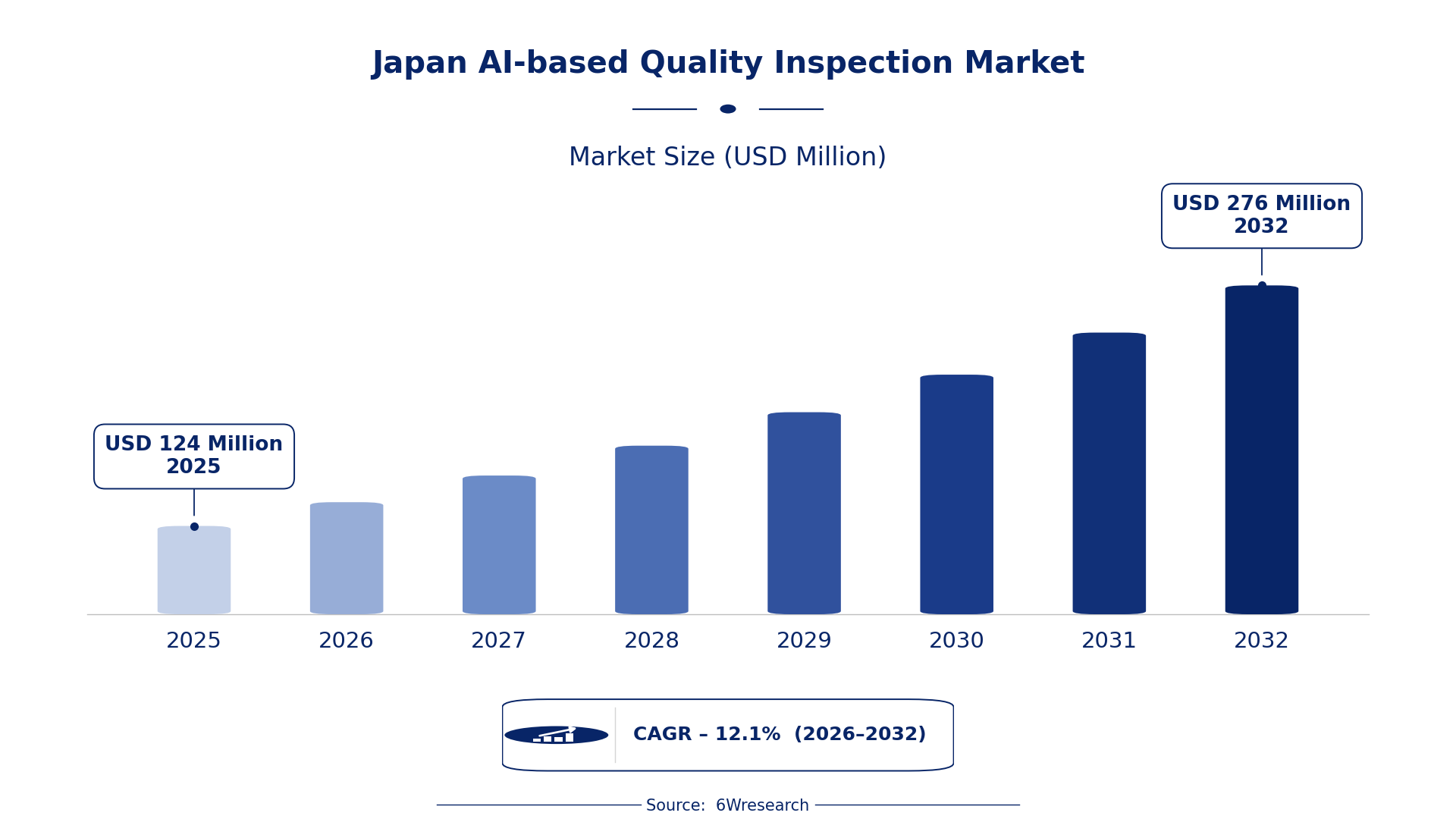
According to 6Wresearch internal database and industry insights, the Japan AI-based Quality Inspection Market was valued at USD 124 Million in 2025 and is projected to reach USD 276 Million by 2032, growing at a CAGR of approximately 12.1% during 2026–2032.
Japan AI-based Quality Inspection Market Highlights
| Report Metric | Details |
| Report Name | Japan AI-based Quality Inspection Market (2026-2032) |
| Market Size 2025 | USD 124 Million |
| Market Size 2032 | USD 276 Million |
| Absolute Growth 2025–2032 | USD 152 Million |
| CAGR 2026–2032 | 12.1% |
| Peak Annual Growth | 13.4% in 2026 |
| Forecast Period | 2026–2032 |
| Historical Data | 2022–2025 |
| Base Year | 2025 |
| Leading Inspection Area, 2025 | Automotive Components (37% share) |
| Leading AI Functionality, 2025 | Surface Defect Detection (39% share) |
| Leading Distribution Channel, 2025 | Vision System Providers (47% share) |
| Leading End User, 2025 | Car Manufacturers (46% share) |
| Fastest-Growing Inspection Area | Electronics Assembly (14.1% CAGR) |
| Fastest-Growing AI Functionality | Fault Prediction (15.6% CAGR) |
| Fastest-Growing Distribution Channel | SMT Equipment Providers (15.7% CAGR) |
| Fastest-Growing End User | PCB Manufacturing Units (15.5% CAGR) |
| Growing Sector | automotive |
| Key End Users | car manufacturers, electronics assembly plants, food processing companies |
Japan AI-based Quality Inspection Market Year-wise Growth Rate and Key Drivers (2022–2032)
This graph illustrates the annual growth rates of the market from 2022 to 2032, highlighting a steady upward trajectory and projected market expansion over the forecast period.
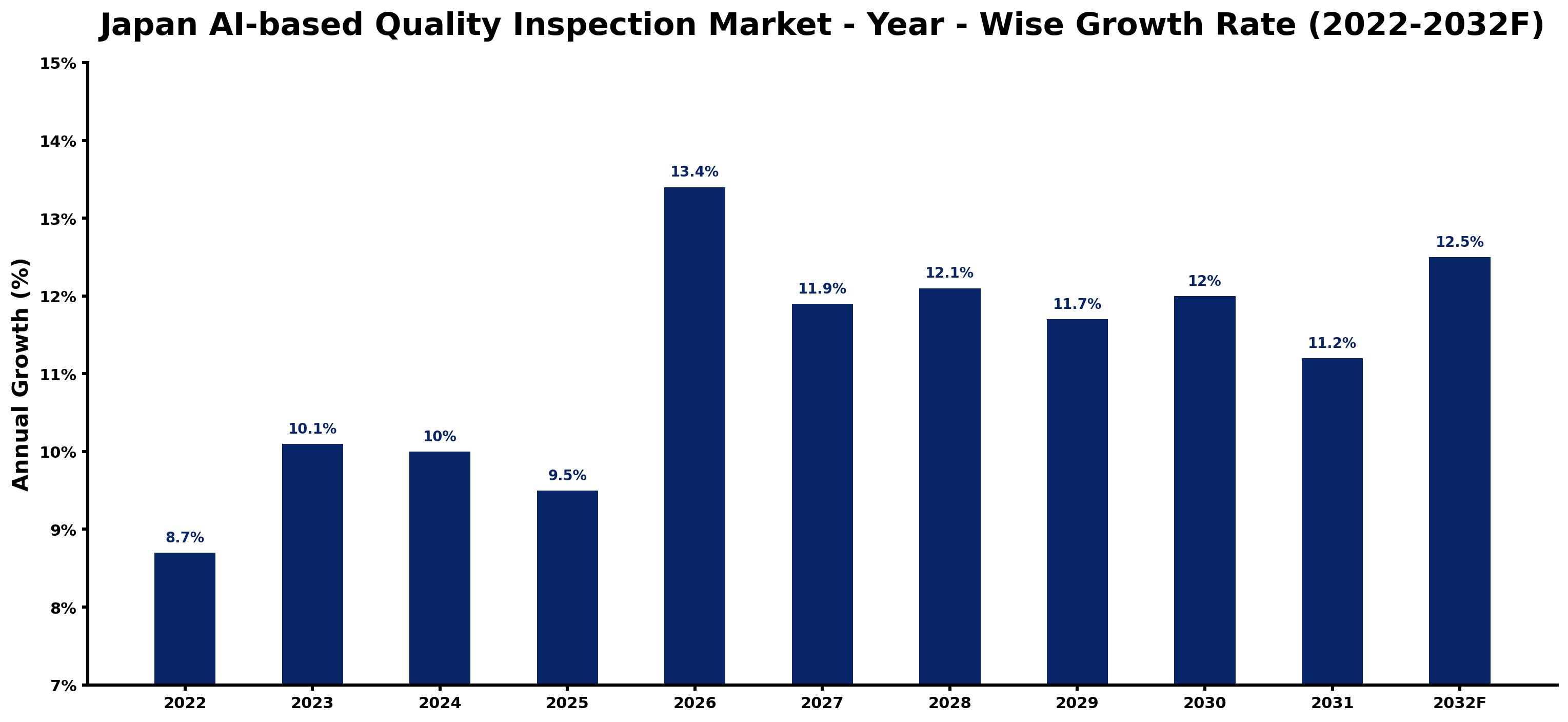
Year by year, the estimates below pair each growth rate with the development that shaped it.
| Year | Estimated Annual Growth (%) | Market Rationale |
| 2022 | 8.7 | The market experienced steady activity with increasing adoption of AI technologies. |
| 2023 | 10.1 | Demand surged as manufacturers sought to improve quality control processes. |
| 2024 | 10.0 | Growth slowed slightly as companies consolidated their investments in AI systems. |
| 2025 | 9.5 | Market expansion continued, albeit at a reduced pace due to market saturation concerns. |
| 2026 | 13.4 | An uptick in adoption occurred as new technologies emerged. |
| 2027 | 11.9 | Growth moderated as companies focused on optimising existing AI systems. |
| 2028 | 12.1 | Demand accelerated again with the introduction of advanced AI functionalities. |
| 2029 | 11.7 | The market growth rate decreased as competition intensified among suppliers. |
| 2030 | 12.0 | A renewed interest in AI technologies boosted growth as new applications emerged. |
| 2031 | 11.2 | The market saw a slowdown as companies reassessed their AI investments. |
| 2032 | 12.5 | Growth accelerated once more as technological advancements drive demand. |
Note: Market size estimations and growth projections presented in this report are based on 6Wresearch's proprietary forecasting methodology, utilizing the latest available industry data, government publications, and primary research inputs.
Japan AI-based Quality Inspection Market Synopsis
AI-based Quality Inspection utilises artificial intelligence to improve quality control across various industries, particularly in automotive and electronics. The Japan AI-based Quality Inspection Market is expanding due to rising demand from domestic manufacturers and advancements in AI technologies. The automotive sector, producing over 5 million vehicles annually, drives this trend. The electronics assembly industry, employing around 1.2 million workers, increasingly relies on AI for precision and efficiency, contributing to overall market growth.
Market Dynamics Impact Analysis (2026–2032)
| Factor | Type | Impact | Primary Segment Affected |
| Increasing vehicle production and quality assurance needs drive demand for AI-based inspection in automotive components. | Driver | High | Automotive Components |
| Growing employment in electronics assembly necessitates enhanced quality control measures through AI technologies. | Driver | High | Electronics Assembly |
| Rising food safety standards create opportunities for AI in food processing. | Opportunity | High | Food Processing |
| The rapid adoption of AI in packaging lines presents significant investment opportunities. | Opportunity | High | Packaging Lines |
| High initial investment costs for AI systems can deter smaller manufacturers from adoption. | Restraint | Medium | Automotive Components |
| Limited awareness of AI benefits in quality inspection restricts market growth potential. | Restraint | Medium | Electronics Assembly |
| Competition among technology providers can lead to price wars, affecting profitability. | Challenge | High | Food Processing |
| Integration challenges with existing manufacturing processes can delay AI adoption. | Challenge | Medium | Packaging Lines |
Evaluation of Drivers in Japan AI-based Quality Inspection Market (2026–2032)
Key forces behind demand, with the segment each one moves most, are listed below.
| Drivers | Primary Segment Affected | Why It Matters (Evidence) |
| Rising vehicle production requires stringent quality checks, leading to increased AI adoption in automotive components. | Automotive Components | With over 5 million vehicles produced annually, manufacturers need advanced inspection to maintain quality. |
| The electronics assembly industry faces high precision demands, driving AI integration for quality assurance. | Electronics Assembly | Approximately 1.2 million workers rely on AI to ensure defect-free production. |
| Food safety regulations are pushing food processing companies to adopt AI technologies for compliance. | Food Processing | Adoption rates are increasing by 30% annually as companies seek to improve safety measures. |
| Packaging lines are increasingly integrating AI technologies to improve efficiency and accuracy. | Packaging Lines | AI-based inspection technologies are projected to be implemented in 70% of packaging lines by 2025. |
| The need for contaminant detection in food production drives demand for AI solutions. | Food Processing | The Food Safety and Inspection Agency mandates AI systems to ensure hygiene standards. |
Buyers are adding capacity as the automotive sector demands stringent quality checks, with over 5 million vehicles produced annually. The electronics assembly industry relies on AI for precision, driving growth. Food processing companies are adopting AI at a rate of 30% annually to improve safety measures. Packaging lines are projected to implement AI technologies in 70% of their operations by 2025, improving efficiency. The need for contaminant detection in food production is also boosting demand for AI solutions.
Evaluation of Restraints in Japan AI-based Quality Inspection Market
Several factors work against faster growth; the main ones are summarised below.
| Market Restraint | Primary Segment Affected | Why It Matters (Evidence) |
| High initial investment costs deter smaller manufacturers from adopting AI inspection systems. | Automotive Components | With average investments projected at ¥5 million per facility, smaller players may struggle to afford AI solutions. |
| Limited awareness of AI benefits restricts growth in the electronics assembly sector. | Electronics Assembly | Many manufacturers hesitate to invest in new technologies without understanding their advantages. |
| Integration challenges with existing processes can delay AI adoption in food processing. | Food Processing | Companies face difficulties in adapting AI systems to traditional manufacturing workflows. |
| Competition among technology providers can lead to price wars, affecting profitability in packaging lines. | Packaging Lines | As more suppliers enter the market, prices may drop, impacting margins for existing players. |
| Regulatory compliance issues can slow down the implementation of AI technologies in food production. | Food Processing | Companies must navigate complex regulations that can delay the adoption of new systems. |
Japan AI-based Quality Inspection Market Challenges
Regulatory standards, such as JIS Z 9101, impose strict requirements on manufacturers implementing AI-based quality inspection, causing delays that can extend production timelines by up to three months for automotive producers. The high costs associated with AI technology development, averaging ¥5 million per facility, burden smaller manufacturers, restricting their competitive edge in the market. Competition in the automotive sector, producing over 5 million vehicles annually, compels companies to adopt AI rapidly, often resulting in rushed implementations that can lower defect detection rates. Supply chain issues, especially with tech components, disrupt timely AI system deployment, delaying production schedules for electronics manufacturers reliant on these technologies.
Trends in the Japan AI-based Quality Inspection Market
Four trends stand out in the Japan AI-based Quality Inspection Market.
- Shift towards AI Integration in Automotive Manufacturing: The automotive sector is increasingly integrating AI technologies for quality control, with over 60% of new production lines adopting such systems. This trend improves defect detection rates, reported at 98%.
- Growing Adoption of AI in Electronics Assembly: Electronics assembly is experiencing a shift as AI technologies are integrated into production lines. Approximately 40% penetration is expected by 2025, improving quality assurance processes.
- Rise of AI in Food Safety Compliance: Food processing companies are prioritising AI technologies to meet safety standards, with a 30% annual adoption rate. This shift is driven by regulatory requirements for contaminant detection.
- Increased AI Utilisation in Packaging Lines: Packaging lines are rapidly adopting AI inspection technologies, projected to reach 70% implementation by 2025. This change improves efficiency and accuracy in product packaging.
Investment Opportunities in the Japan AI-based Quality Inspection Market
The following areas offer the clearest openings for investors and suppliers in the Japan AI-based Quality Inspection Market.
- Supply of AI Inspection Systems for Automotive Components: With the automotive sector producing over 5 million vehicles annually, there is a pressing need for AI inspection systems. Suppliers can target car manufacturers in Japan to meet this demand.
- Investment in AI Technologies for Electronics Assembly: Electronics assembly is experiencing growth, with a projected increase in AI adoption. Suppliers should focus on providing AI solutions to PCB manufacturing units to capitalise on this trend.
- AI Solutions for Food Processing Safety: Food processing companies are adopting AI at a rate of 30% annually, creating opportunities for suppliers of AI technologies. Targeting food and beverage companies can yield substantial returns.
- AI Integration in Packaging Facilities: The packaging sector is rapidly adopting AI technologies, with 70% implementation expected by 2025. Suppliers should consider partnerships with packaging line manufacturers to enter this market.
Government Initiatives in the Japan AI-based Quality Inspection Market
The Ministry of Economy, Trade and Industry has launched initiatives since 2022 to promote AI adoption in manufacturing, including funding for technology development. In 2023, the government allocated ¥10 billion to support advancements in AI systems, benefiting various sectors.
The Food Safety and Inspection Agency mandates the use of AI systems for contaminant detection in food production. This requirement ensures compliance with hygiene standards, pushing manufacturers to invest in AI technologies.
Future Insight of the Japan AI-based Quality Inspection Market
By 2032, advancements in AI will reshape quality inspection, with a projected 70% implementation in packaging lines by 2025 improving operational efficiency for producers. Enhanced machine learning algorithms will provide superior defect detection accuracy, meeting the increasing demands of buyers for quality assurance. Continued government support for AI adoption will spur innovation across various manufacturing sectors. As standards like ISO 9001 evolve to incorporate AI, suppliers will need to adapt their processes to comply with these new requirements, ensuring their competitiveness in the global market.
Market Segmentation Analysis
Japan AI-based Quality Inspection Market report covers a detailed analysis of the following market segments:
By Inspection Area – Automotive Components Lead, Electronics Assembly Expected to Grow Fastest
According to Saurav Kr Singh, Senior Research Analyst at 6Wresearch, Automotive Components held 37% of the Japan AI-based Quality Inspection Market by inspection area in 2025. The automotive components sector commands the largest share due to its significant production volume, with over 5 million vehicles manufactured annually in Japan. This high output necessitates rigorous quality inspection to meet safety and performance standards, ensuring reliability in the automotive market. The quickest growth will come from Electronics Assembly, forecast to expand at a CAGR of 14.1% between 2026 and 2032. Electronics assembly is experiencing rapid growth, primarily due to the increasing demand for precision in PCB assembly processes. With around 1.2 million workers engaged in this industry, the adoption of advanced inspection technologies is accelerating to meet quality requirements. Suppliers should prioritise solutions tailored for the electronics assembly sector to capitalise on growth opportunities.
By AI Functionality – Surface Defect Detection Leads, Fault Prediction Expected to Grow Fastest
With 39% of ai functionality revenue in 2025, Surface Defect Detection was the largest category. Surface defect detection is the leading functionality as it is vital for identifying flaws in products, particularly in critical sectors like automotive manufacturing. This capability is essential for upholding product quality and ensuring compliance with safety regulations. Fault Prediction is set to record the highest CAGR in this split, 15.6% over 2026–2032. Fault prediction is the fastest-growing functionality, allowing manufacturers to foresee equipment failures and mitigate downtime. This proactive approach is becoming increasingly crucial for maintaining high operational efficiency in production environments. Buyers should consider investing in fault prediction technologies to enhance reliability and reduce production interruptions.
By Distribution Channel – Vision System Providers Lead, SMT Equipment Providers Expected to Grow Fastest
In 2025, Vision System Providers led the distribution channel split with a 47% share. Vision system providers lead the market as they furnish the essential hardware needed for effective inspection processes. Their pivotal role in the overall inspection framework makes them indispensable to manufacturers across various industries. Over 2026–2032, SMT Equipment Providers are expected to post the fastest growth, at a CAGR of 15.7%. SMT equipment providers are the fastest-growing channel, spurred by the rising integration of inspection technologies into production machinery. This trend indicates a shift towards more automated and efficient manufacturing processes. Suppliers must build strong alliances with SMT equipment providers to facilitate seamless technology integration.
By End User – Car Manufacturers Lead, PCB Manufacturing Units Expected to Grow Fastest
The largest end user category in 2025 was Car Manufacturers, at 46% of revenue. Car manufacturers are the primary end users of inspection technologies, driven by their critical need for quality assurance in production processes. Their substantial investments in these technologies highlight the importance of maintaining high standards in automotive manufacturing. PCB Manufacturing Units are projected to grow fastest, at a CAGR of 15.5% during 2026–2032. PCB manufacturing units are witnessing the fastest growth as they play a crucial role in ensuring quality in electronic components. The increasing demand for electronics is accelerating the adoption of inspection technologies in this sector. Manufacturers in the electronics sector should prioritise advanced inspection solutions to improve product quality and maintain competitiveness.
Key Attractiveness of the Report
- 10 Years of Market Numbers
- Historical Data Starting from 2022 to 2025
- Base Year 2025
- Forecast Data until 2032
- Key Performance Indicators Impacting the Market
- Major Upcoming Developments and Projects
Key Highlights of the Report:
- Japan AI-based Quality Inspection Market Outlook
- Market Size of Japan AI-based Quality Inspection Market, 2025
- Forecast of Japan AI-based Quality Inspection Market, 2032
- Historical Data and Forecast of Japan AI-based Quality Inspection Revenues & Volume for the Period 2022-2032F
- Japan AI-based Quality Inspection Market Trend Evolution
- Japan AI-based Quality Inspection Market Drivers and Challenges
- Japan AI-based Quality Inspection Price Trends
- Japan AI-based Quality Inspection Porter's Five Forces
- Japan AI-based Quality Inspection Industry Life Cycle
- Historical Data and Forecast of Japan AI-based Quality Inspection Market Revenues & Volume By Inspection Area for the Period 2022-2032F
- Historical Data and Forecast of Japan AI-based Quality Inspection Market Revenues & Volume By Automotive Components for the Period 2022-2032F
- Historical Data and Forecast of Japan AI-based Quality Inspection Market Revenues & Volume By Electronics Assembly for the Period 2022-2032F
- Historical Data and Forecast of Japan AI-based Quality Inspection Market Revenues & Volume By Food Processing for the Period 2022-2032F
- Historical Data and Forecast of Japan AI-based Quality Inspection Market Revenues & Volume By Packaging Lines for the Period 2022-2032F
- Historical Data and Forecast of Japan AI-based Quality Inspection Market Revenues & Volume By AI Functionality for the Period 2022-2032F
- Historical Data and Forecast of Japan AI-based Quality Inspection Market Revenues & Volume By Surface Defect Detection for the Period 2022-2032F
- Historical Data and Forecast of Japan AI-based Quality Inspection Market Revenues & Volume By Fault Prediction for the Period 2022-2032F
- Historical Data and Forecast of Japan AI-based Quality Inspection Market Revenues & Volume By Contaminant Detection for the Period 2022-2032F
- Historical Data and Forecast of Japan AI-based Quality Inspection Market Revenues & Volume By Shape & Label Validation for the Period 2022-2032F
- Historical Data and Forecast of Japan AI-based Quality Inspection Market Revenues & Volume By Distribution Channel for the Period 2022-2032F
- Historical Data and Forecast of Japan AI-based Quality Inspection Market Revenues & Volume By Vision System Providers for the Period 2022-2032F
- Historical Data and Forecast of Japan AI-based Quality Inspection Market Revenues & Volume By SMT Equipment Providers for the Period 2022-2032F
- Historical Data and Forecast of Japan AI-based Quality Inspection Market Revenues & Volume By Smart Food Tech Vendors for the Period 2022-2032F
- Historical Data and Forecast of Japan AI-based Quality Inspection Market Revenues & Volume By Robotics Integrators for the Period 2022-2032F
- Historical Data and Forecast of Japan AI-based Quality Inspection Market Revenues & Volume By End User for the Period 2022-2032F
- Historical Data and Forecast of Japan AI-based Quality Inspection Market Revenues & Volume By Car Manufacturers for the Period 2022-2032F
- Historical Data and Forecast of Japan AI-based Quality Inspection Market Revenues & Volume By PCB Manufacturing Units for the Period 2022-2032F
- Historical Data and Forecast of Japan AI-based Quality Inspection Market Revenues & Volume By Food & Beverage Companies for the Period 2022-2032F
- Historical Data and Forecast of Japan AI-based Quality Inspection Market Revenues & Volume By Consumer Goods Plants for the Period 2022-2032F
- Japan AI-based Quality Inspection Import Export Trade Statistics
- Market Opportunity Assessment By Inspection Area
- Market Opportunity Assessment By AI Functionality
- Market Opportunity Assessment By Distribution Channel
- Market Opportunity Assessment By End User
- Japan AI-based Quality Inspection Top Companies Market Share
- Japan AI-based Quality Inspection Competitive Benchmarking By Technical and Operational Parameters
- Japan AI-based Quality Inspection Company Profiles
- Japan AI-based Quality Inspection Key Strategic Recommendations
Market Covered
The following segment groups are covered in the report.
By Inspection Area
- Automotive Components
- Electronics Assembly
- Food Processing
- Packaging Lines
By AI Functionality
- Surface Defect Detection
- Fault Prediction
- Contaminant Detection
- Shape & Label Validation
By Distribution Channel
- Vision System Providers
- SMT Equipment Providers
- Smart Food Tech Vendors
- Robotics Integrators
By End User
- Car Manufacturers
- PCB Manufacturing Units
- Food & Beverage Companies
- Consumer Goods Plants































