Japan AI-based Surgical Navigation Market Size & Growth Rate
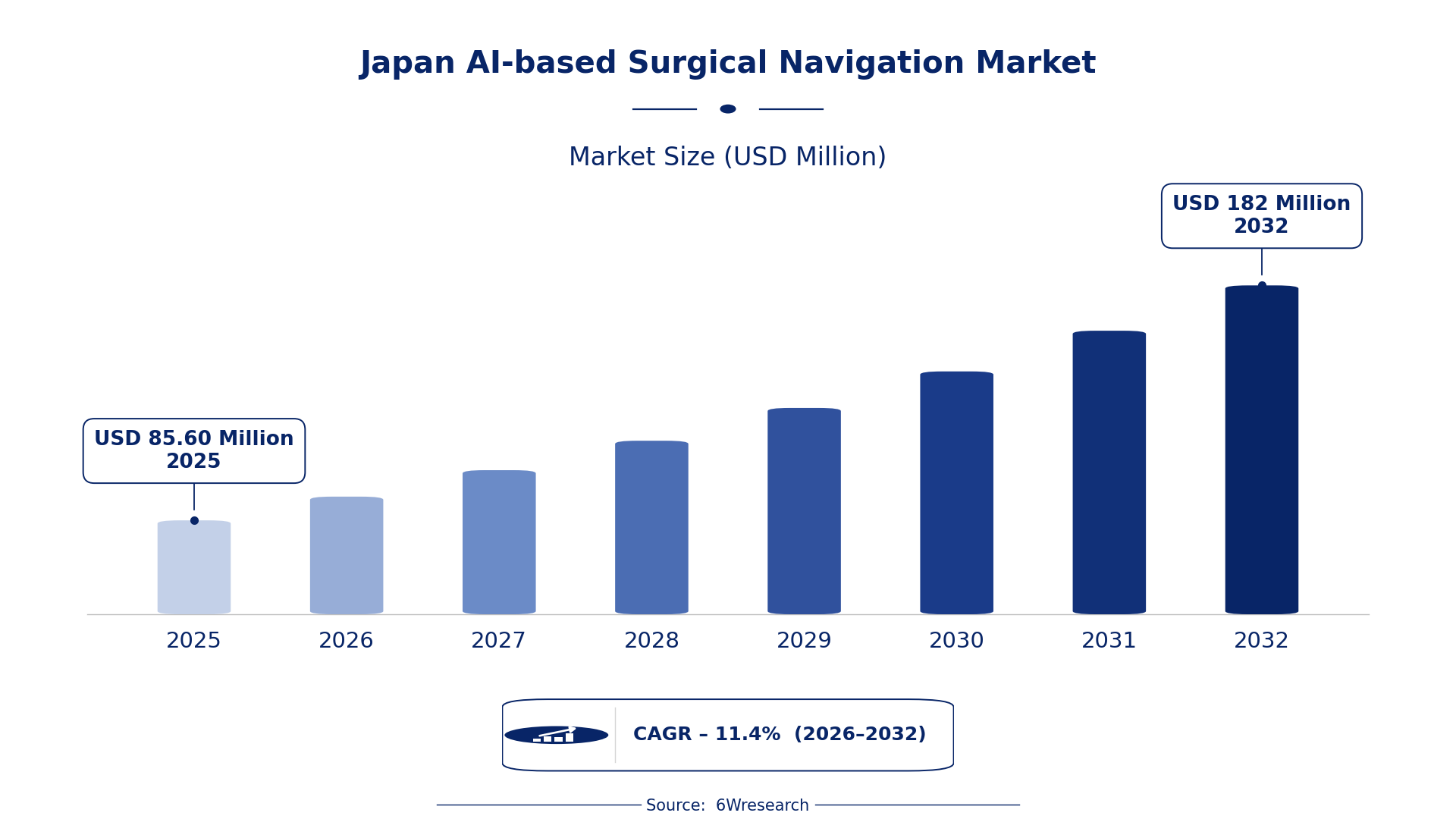
According to 6Wresearch internal database and industry insights, the Japan AI-based Surgical Navigation Market was valued at USD 85.60 Million in 2025 and is projected to reach USD 182 Million by 2032, growing at a CAGR of approximately 11.4% during 2026–2032.
Japan AI-based Surgical Navigation Market Highlights
| Report Metric | Details |
| Report Name | Japan AI-based Surgical Navigation Market (2026-2032) |
| Market Size 2025 | USD 85.60 Million |
| Market Size 2032 | USD 182 Million |
| Absolute Growth 2025–2032 | USD 96.40 Million |
| CAGR 2026–2032 | 11.4% |
| Peak Annual Growth | 12.3% in 2026 |
| Forecast Period | 2026–2032 |
| Historical Data | 2022–2025 |
| Base Year | 2025 |
| Leading Surgery Type, 2025 | Orthopedic Surgery (52% share) |
| Leading AI Use Case, 2025 | Real-Time Navigation (46% share) |
| Leading Distribution Channel, 2025 | Medical Robotics Vendors (41% share) |
| Leading End User, 2025 | Specialty Surgery Hospitals (43% share) |
| Fastest-Growing Surgery Type | Spine Surgery (15.4% CAGR) |
| Fastest-Growing AI Use Case | Anatomical Tracking (14.7% CAGR) |
| Fastest-Growing Distribution Channel | MedTech Startups (14.0% CAGR) |
| Fastest-Growing End User | Neurological Clinics (14.4% CAGR) |
| Growing Sector | surgical navigation technology |
| Key End Users | specialty surgery hospitals, neurological clinics, spine specialists, ENT surgeons |
Japan AI-based Surgical Navigation Market Year-wise Growth Rate and Key Drivers (2022–2032)
This graph illustrates the annual growth rates of the market from 2022 to 2032, highlighting a steady upward trajectory and projected market expansion over the forecast period.
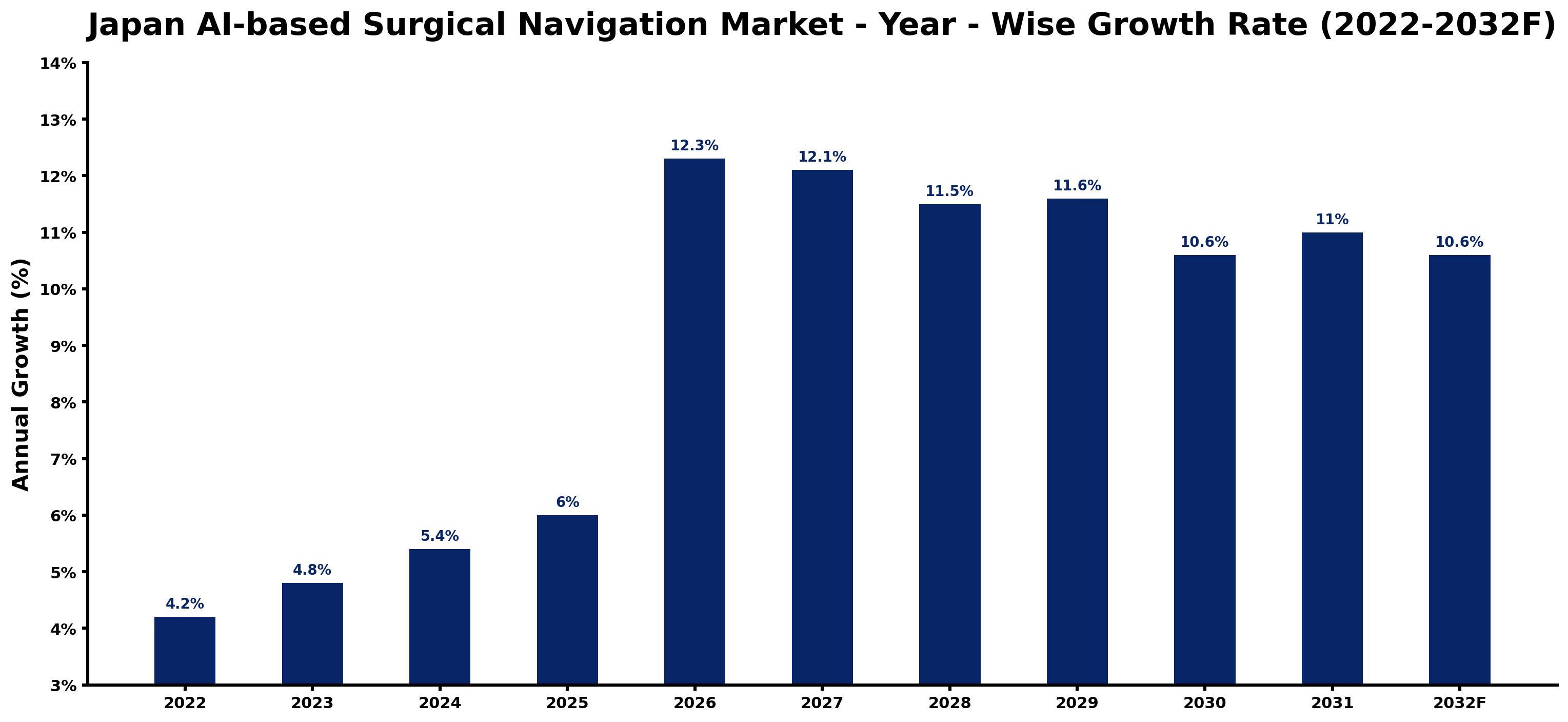
Below, each year's estimated growth is shown next to the factor that most influenced it.
| Year | Estimated Annual Growth (%) | Market Rationale |
| 2022 | 4.2 | The market exhibited steady growth, reflecting ongoing advancements in surgical technologies. |
| 2023 | 4.8 | Growth accelerated as healthcare providers increasingly adopted AI technologies for surgical precision. |
| 2024 | 5.4 | Demand continued to rise, driven by the expansion of specialty surgery hospitals across the country. |
| 2025 | 6.0 | The market reached a peak growth rate, supported by substantial investments in medical technology. |
| 2026 | 12.3 | The peak annual growth is expected to be achieved as AI integration in surgical procedures gains traction. |
| 2027 | 12.1 | Growth is projected to slow slightly, influenced by market maturation and increased competition among providers. |
| 2028 | 11.5 | A further slowdown is anticipated as the market stabilises, reflecting a more saturated environment. |
| 2029 | 11.6 | Demand is expected to pick up again, driven by innovations in surgical navigation technologies. |
| 2030 | 10.6 | Growth is projected to decelerate, indicating a transition to a more consistent growth phase. |
| 2031 | 11.0 | The market is expected to experience a slight rebound, supported by ongoing investments in healthcare technology. |
| 2032 | 10.6 | Growth is projected to stabilise, reflecting a mature market with established AI applications in surgery. |
Note: Market size estimations and growth projections presented in this report are based on 6Wresearch's proprietary forecasting methodology, utilizing the latest available industry data, government publications, and primary research inputs.
Japan AI-based Surgical Navigation Market Synopsis
AI-based Surgical Navigation Market utilises artificial intelligence to improve the accuracy and effectiveness of surgical procedures through advanced algorithms that analyse medical imaging data. In Japan, the market is expanding due to a growing elderly population, increasing surgical needs, and substantial investments in healthcare technology. The Tokyo region serves as a hub for these advancements, with over 1,000 specialty surgery hospitals adopting AI solutions. Government initiatives, such as the AI Promotion Act, stimulate demand, making this market a focal point for innovation and investment.
Market Dynamics Impact Analysis (2026–2032)
| Factor | Type | Impact | Primary Segment Affected |
| Growing elderly population increases demand for surgical procedures. | Driver | High | Orthopedic Surgery |
| Investments in AI technologies enhance surgical outcomes and accuracy. | Driver | High | Real-Time Navigation |
| Increasing number of specialty surgery hospitals adopting AI solutions. | Opportunity | High | Specialty Surgery Hospitals |
| Research initiatives in AI navigation technologies create new applications. | Opportunity | Medium | MedTech Startups |
| High costs of implementing AI technologies may limit adoption. | Restraint | High | Spine Surgery |
| Compliance with stringent regulations can delay product approvals. | Restraint | Medium | Brain Surgery |
| Limited availability of skilled professionals in AI technologies. | Challenge | High | Neuro Navigation Providers |
| Capacity constraints in manufacturing AI-based surgical tools. | Challenge | Medium | Medical Robotics Vendors |
Evaluation of Drivers in Japan AI-based Surgical Navigation Market (2026–2032)
The following drivers explain most of the expected growth.
| Drivers | Primary Segment Affected | Why It Matters (Evidence) |
| Increasing surgical procedures among the elderly population drives demand for AI-based navigation. | Orthopedic Surgery | Japan's aging demographic, with approximately 30% over 65 years, necessitates advanced surgical solutions. |
| Investment in AI technologies improves surgical precision and outcomes. | Real-Time Navigation | Healthcare providers are allocating resources to integrate AI, enhancing patient care and operational efficiency. |
| The rise of specialty surgery hospitals adopting advanced technologies boosts market growth. | Specialty Surgery Hospitals | With over 1,000 specialty hospitals, the demand for AI navigation solutions is surging. |
| Research initiatives on AI navigation technologies create new market opportunities. | MedTech Startups | Institutions like Tokyo Medical University are developing innovative AI applications for surgeries. |
| Government funding for AI healthcare initiatives supports market expansion. | Neuro Navigation Providers | The government allocated ¥500 million in 2023 to enhance AI integration in healthcare. |
What keeps demand rising is the increasing number of surgical procedures performed on the elderly, with approximately 125 million people in Japan, many over 65 years old. This demographic shift necessitates advanced surgical solutions, particularly in orthopedic surgeries. Investment in AI technologies is also vital, as healthcare providers are integrating these systems to improve surgical precision. Over 1,000 specialty surgery hospitals are adopting these technologies, reflecting a growing trend towards AI-enhanced surgical practices.
Evaluation of Restraints in Japan AI-based Surgical Navigation Market
These restraints slow adoption and weigh on supplier margins.
| Market Restraint | Primary Segment Affected | Why It Matters (Evidence) |
| High implementation costs of AI technologies can hinder adoption. | Spine Surgery | Many hospitals face budget constraints, limiting their ability to invest in advanced surgical navigation systems. |
| Compliance with regulations can delay the introduction of new technologies. | Brain Surgery | Stringent standards and lengthy approval processes can slow down the deployment of AI solutions. |
| Limited availability of skilled professionals may restrict market growth. | Neuro Navigation Providers | A shortage of trained personnel in AI technologies affects the ability to implement these systems effectively. |
| Capacity constraints in manufacturing advanced surgical tools can impact supply. | Medical Robotics Vendors | Increased demand for AI-based navigation tools may exceed current production capabilities. |
| Technological integration challenges can complicate adoption. | Real-Time Navigation | Healthcare facilities may struggle with integrating new AI systems into existing workflows. |
Japan AI-based Surgical Navigation Market Challenges
A critical obstacle in the AI-based surgical navigation market stems from a shortage of skilled professionals, as training programs remain limited and slow to develop. Buyers face high integration costs associated with complex AI technologies, which can inflate surgical expenses by as much as 15% and delay procedures. Many hospitals struggle with outdated infrastructure, leading to a 20% increase in surgery duration for patients needing advanced navigation. Competition among specialty hospitals in urban areas drives up prices, compelling buyers to allocate larger budgets for surgical procedures, which restricts timely access to care for patients.
Trends in the Japan AI-based Surgical Navigation Market
The following changes are redrawing the Japan AI-based Surgical Navigation Market.
- Surgeons Prioritising AI for Enhanced Precision: Specialty surgery hospitals are increasingly prioritising AI-based navigation tools to improve surgical outcomes. In 2023, over 1,000 hospitals adopted these technologies, reflecting a shift towards precision in surgical practices.
- AI Integration in Orthopedic Surgery: The Tokyo Medical University has been at the forefront of AI research in orthopedic surgeries since 2023, leading to improved patient outcomes and a more efficient surgical process.
- Shift Towards Real-Time Navigation Systems: The introduction of real-time navigation systems has transformed surgical procedures, with a notable increase in their adoption among specialty hospitals, improving accuracy and efficiency.
- Focus on Compliance with ISO Standards: The adoption of ISO 13485 standards is becoming essential for surgical navigation providers, ensuring quality management in medical devices, which is important for market growth.
Investment Opportunities in the Japan AI-based Surgical Navigation Market
Where to invest in the Japan AI-based Surgical Navigation Market: the main openings are set out below.
- Specialty Surgery Hospitals Seeking Advanced Solutions: Specialty surgery hospitals are actively seeking advanced AI navigation solutions. This presents an opportunity for suppliers to develop tailored products that meet their needs, particularly as the demand for precision in surgical procedures increases.
- Partnerships with MedTech Startups: Collaborating with MedTech startups can facilitate the introduction of new AI solutions. The growing number of startups in Japan indicates a vibrant market for new technologies, allowing for innovative partnerships and developments.
- Investment in AI Navigation Technologies: With ¥500 million allocated for AI healthcare initiatives, there is a strong opportunity for investment in AI navigation technologies that enhance surgical precision and improve patient outcomes.
- Focus on Neurological Clinics: Neurological clinics are increasingly adopting AI solutions, with a projected growth rate of 14.4%. Suppliers can enter this market through partnerships or by obtaining necessary certifications.
Government Initiatives in the Japan AI-based Surgical Navigation Market
The Medical Care Act of 1948 established essential standards for hospitals and clinics, including staffing and facilities, ensuring a foundation for quality healthcare. This law has shaped the operational framework for surgical navigation technologies, promoting compliance with safety and quality standards.
The Pharmaceuticals and Medical Devices Agency (PMDA) reviews and approves medical devices, including surgical navigation systems. With a focus on post-market safety, the PMDA ensures that AI technologies meet regulatory requirements, facilitating their integration into healthcare practices.
Future Insight of the Japan AI-based Surgical Navigation Market
The launch of AI healthcare initiatives will enhance surgical precision in hospitals by 2032, enabling buyers to expect improved outcomes. Ongoing research at medical universities will lead to advancements in AI algorithms, creating more efficient navigation systems. The adoption of ISO 13485 standards will ensure higher quality in medical devices, benefiting both suppliers and buyers. With Japan's population of approximately 125 million and an increasing elderly demographic, the integration of these technologies will significantly improve surgical practices and patient care across the nation.
Market Segmentation Analysis
Japan AI-based Surgical Navigation Market report covers a detailed analysis of the following market segments:
By Surgery Type – Orthopedic Surgery Leads, Spine Surgery Expected to Grow Fastest
According to Saurav Kr Singh, Senior Research Analyst at 6Wresearch, in 2025, Orthopedic Surgery led the surgery type split with a 52% share. Orthopedic surgery holds the largest share as it is extensively used for joint procedures, which are increasingly required due to Japan's ageing demographic. The widespread implementation of surgical navigation systems in specialty hospitals solidifies its leading position in the market. The quickest growth will come from Spine Surgery, forecast to expand at a CAGR of 15.4% between 2026 and 2032. Spine surgery is experiencing rapid growth owing to significant advancements in spinal correction techniques, particularly for patients averaging 65 years old. This trend is expected to further accelerate the adoption of navigation technologies in spine operations. Suppliers should focus on developing solutions specifically for orthopedic and spine surgery to meet the growing demand.
By AI Use Case – Real-Time Navigation Leads, Anatomical Tracking Expected to Grow Fastest
The largest ai use case category in 2025 was Real-Time Navigation, at 46% of revenue. Real-time navigation is the dominant use case as it is vital for assisting surgeons during operations, ensuring precision and improved outcomes. Its critical role across various surgical specialties underscores its importance in contemporary surgical practices. Anatomical Tracking is set to record the highest CAGR in this split, 14.7% over 2026–2032. Anatomical tracking is growing swiftly as it plays a key role in identifying essential structures during surgery, crucial for maintaining patient safety. As surgical methods advance, the need for precise anatomical tracking will likely increase significantly. Buyers should prioritise solutions that offer real-time navigation and anatomical tracking to enhance surgical efficacy.
By Distribution Channel – Medical Robotics Vendors Lead, MedTech Startups Expected to Grow Fastest
Medical Robotics Vendors took 41% of distribution channel revenue in 2025, more than any other category. Medical robotics vendors dominate the distribution channel as they supply robotic systems that are integral to surgical navigation, catering to the needs of specialty surgery hospitals. Their established presence and expertise in the market provide them with a competitive edge. Over 2026–2032, MedTech Startups are expected to post the fastest growth, at a CAGR of 14.0%. MedTech startups are rapidly gaining traction by developing new navigation technologies that address emerging surgical needs, appealing to a tech-savvy healthcare market. Their agility allows them to innovate faster than traditional vendors, driving their growth. Suppliers must consider partnerships with MedTech startups to stay competitive and meet evolving market demands.
By End User – Specialty Surgery Hospitals Lead, Neurological Clinics Expected to Grow Fastest
Specialty Surgery Hospitals held 43% of the Japan AI-based Surgical Navigation Market by end user in 2025. Specialty surgery hospitals represent the largest end user group, primarily employing advanced surgical navigation systems in high-demand fields such as orthopedic and spine surgeries. Their ongoing investment in modern technologies is a major factor driving market expansion. Neurological Clinics are projected to grow fastest, at a CAGR of 14.4% during 2026–2032. Neurological clinics are witnessing the fastest growth due to their rising need for advanced navigation in intricate brain surgeries. The increasing prevalence of neurological disorders is anticipated to further elevate this demand. Buyers should concentrate on procuring advanced navigation systems tailored for specialty surgery hospitals and neurological clinics.
Key Attractiveness of the Report
- 10 Years of Market Numbers
- Historical Data Starting from 2022 to 2025
- Base Year 2025
- Forecast Data until 2032
- Key Performance Indicators Impacting the Market
- Major Upcoming Developments and Projects
Key Highlights of the Report:
- Japan AI-based Surgical Navigation Market Outlook
- Market Size of Japan AI-based Surgical Navigation Market, 2025
- Forecast of Japan AI-based Surgical Navigation Market, 2032
- Historical Data and Forecast of Japan AI-based Surgical Navigation Revenues & Volume for the Period 2022-2032F
- Japan AI-based Surgical Navigation Market Trend Evolution
- Japan AI-based Surgical Navigation Market Drivers and Challenges
- Japan AI-based Surgical Navigation Price Trends
- Japan AI-based Surgical Navigation Porter's Five Forces
- Japan AI-based Surgical Navigation Industry Life Cycle
- Historical Data and Forecast of Japan AI-based Surgical Navigation Market Revenues & Volume By Surgery Type for the Period 2022-2032F
- Historical Data and Forecast of Japan AI-based Surgical Navigation Market Revenues & Volume By Orthopedic Surgery for the Period 2022-2032F
- Historical Data and Forecast of Japan AI-based Surgical Navigation Market Revenues & Volume By Brain Surgery for the Period 2022-2032F
- Historical Data and Forecast of Japan AI-based Surgical Navigation Market Revenues & Volume By ENT Surgery for the Period 2022-2032F
- Historical Data and Forecast of Japan AI-based Surgical Navigation Market Revenues & Volume By Spine Surgery for the Period 2022-2032F
- Historical Data and Forecast of Japan AI-based Surgical Navigation Market Revenues & Volume By AI Use Case for the Period 2022-2032F
- Historical Data and Forecast of Japan AI-based Surgical Navigation Market Revenues & Volume By Bone Mapping for the Period 2022-2032F
- Historical Data and Forecast of Japan AI-based Surgical Navigation Market Revenues & Volume By Real-Time Navigation for the Period 2022-2032F
- Historical Data and Forecast of Japan AI-based Surgical Navigation Market Revenues & Volume By Anatomical Tracking for the Period 2022-2032F
- Historical Data and Forecast of Japan AI-based Surgical Navigation Market Revenues & Volume By Path Planning for the Period 2022-2032F
- Historical Data and Forecast of Japan AI-based Surgical Navigation Market Revenues & Volume By Distribution Channel for the Period 2022-2032F
- Historical Data and Forecast of Japan AI-based Surgical Navigation Market Revenues & Volume By Medical Robotics Vendors for the Period 2022-2032F
- Historical Data and Forecast of Japan AI-based Surgical Navigation Market Revenues & Volume By Neuro Navigation Providers for the Period 2022-2032F
- Historical Data and Forecast of Japan AI-based Surgical Navigation Market Revenues & Volume By ENT Tech Distributors for the Period 2022-2032F
- Historical Data and Forecast of Japan AI-based Surgical Navigation Market Revenues & Volume By MedTech Startups for the Period 2022-2032F
- Historical Data and Forecast of Japan AI-based Surgical Navigation Market Revenues & Volume By End User for the Period 2022-2032F
- Historical Data and Forecast of Japan AI-based Surgical Navigation Market Revenues & Volume By Specialty Surgery Hospitals for the Period 2022-2032F
- Historical Data and Forecast of Japan AI-based Surgical Navigation Market Revenues & Volume By Neurological Clinics for the Period 2022-2032F
- Historical Data and Forecast of Japan AI-based Surgical Navigation Market Revenues & Volume By ENT Surgeons for the Period 2022-2032F
- Historical Data and Forecast of Japan AI-based Surgical Navigation Market Revenues & Volume By Spine Specialists for the Period 2022-2032F
- Japan AI-based Surgical Navigation Import Export Trade Statistics
- Market Opportunity Assessment By Surgery Type
- Market Opportunity Assessment By AI Use Case
- Market Opportunity Assessment By Distribution Channel
- Market Opportunity Assessment By End User
- Japan AI-based Surgical Navigation Top Companies Market Share
- Japan AI-based Surgical Navigation Competitive Benchmarking By Technical and Operational Parameters
- Japan AI-based Surgical Navigation Company Profiles
- Japan AI-based Surgical Navigation Key Strategic Recommendations
Market Covered
The study includes the following segmentation.
By Surgery Type
- Orthopedic Surgery
- Brain Surgery
- ENT Surgery
- Spine Surgery
By AI Use Case
- Bone Mapping
- Real-Time Navigation
- Anatomical Tracking
- Path Planning
By Distribution Channel
- Medical Robotics Vendors
- Neuro Navigation Providers
- ENT Tech Distributors
- MedTech Startups
By End User
- Specialty Surgery Hospitals
- Neurological Clinics
- ENT Surgeons
- Spine Specialists































