Japan AI-based Unmanned Systems Market Size & Growth Rate
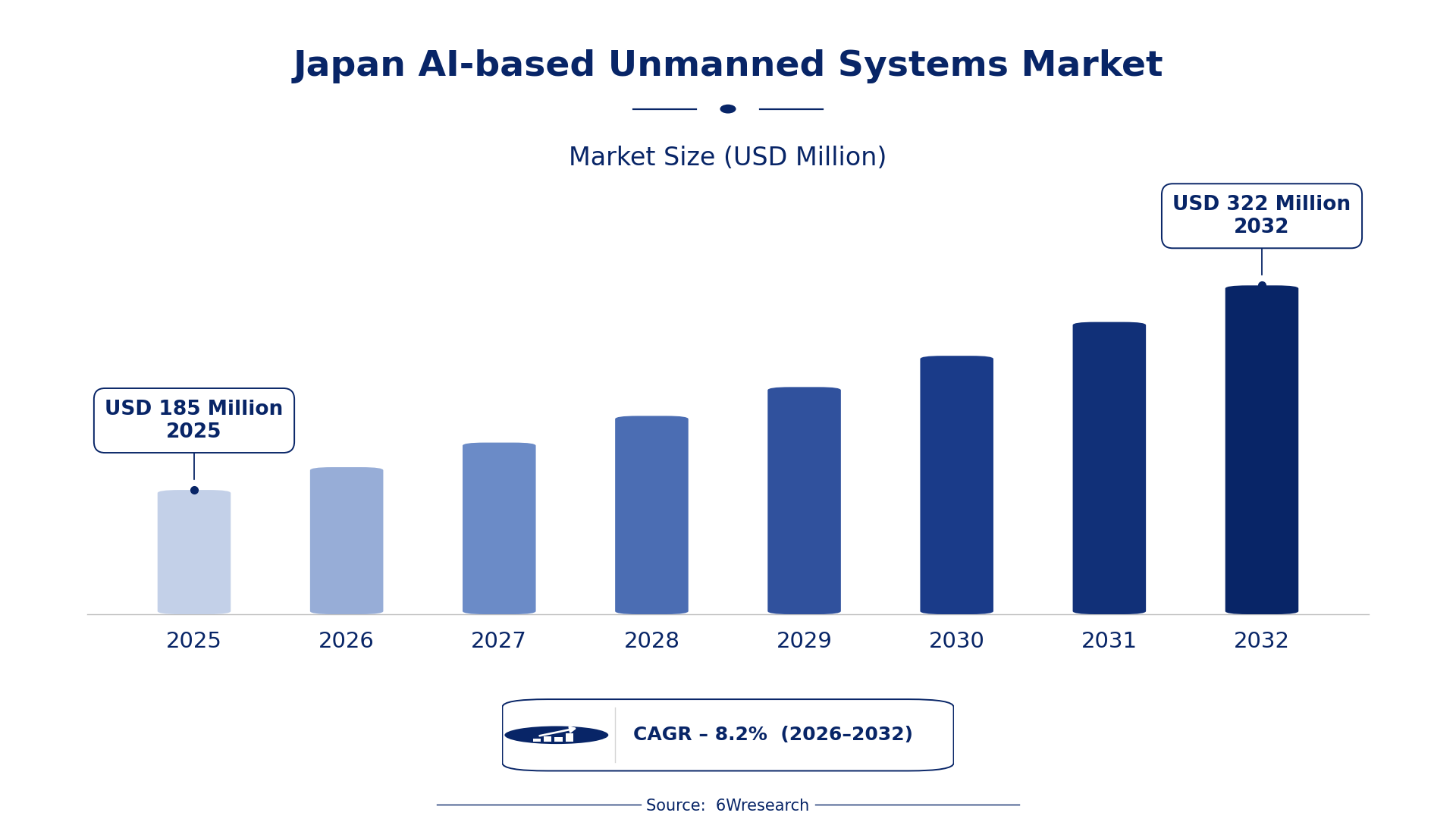
According to 6Wresearch internal database and industry insights, the Japan AI-based Unmanned Systems Market was valued at USD 185 Million in 2025 and is projected to reach USD 322 Million by 2032, growing at a CAGR of approximately 8.2% during 2026–2032.
Japan AI-based Unmanned Systems Market Highlights
| Report Metric | Details |
| Report Name | Japan AI-based Unmanned Systems Market (2026-2032) |
| Market Size 2025 | USD 185 Million |
| Market Size 2032 | USD 322 Million |
| Absolute Growth 2025–2032 | USD 137 Million |
| CAGR 2026–2032 | 8.2% |
| Peak Annual Growth | 9.0% in 2031 |
| Forecast Period | 2026–2032 |
| Historical Data | 2022–2025 |
| Base Year | 2025 |
| Leading System Type, 2025 | UAVs (Drones) (40% share) |
| Leading AI Functionality, 2025 | Path Optimization (37% share) |
| Leading Distribution Channel, 2025 | Drone OEMs (45% share) |
| Leading End User, 2025 | Military & Agricultural Firms (48% share) |
| Fastest-Growing System Type | UGVs (Ground Vehicles) (11.2% CAGR) |
| Fastest-Growing AI Functionality | Terrain Mapping (10.4% CAGR) |
| Fastest-Growing Distribution Channel | Robotics Distributors (10.8% CAGR) |
| Fastest-Growing End User | Defense & Industrial Warehouses (11.3% CAGR) |
| Growing Sector | Agriculture |
| Key End Users | Military, Agricultural Firms, E-commerce Firms, Defense Warehouses |
Japan AI-based Unmanned Systems Market Year-wise Growth Rate and Key Drivers (2022–2032)
This graph illustrates the annual growth rates of the market from 2022 to 2032, highlighting a steady upward trajectory and projected market expansion over the forecast period.
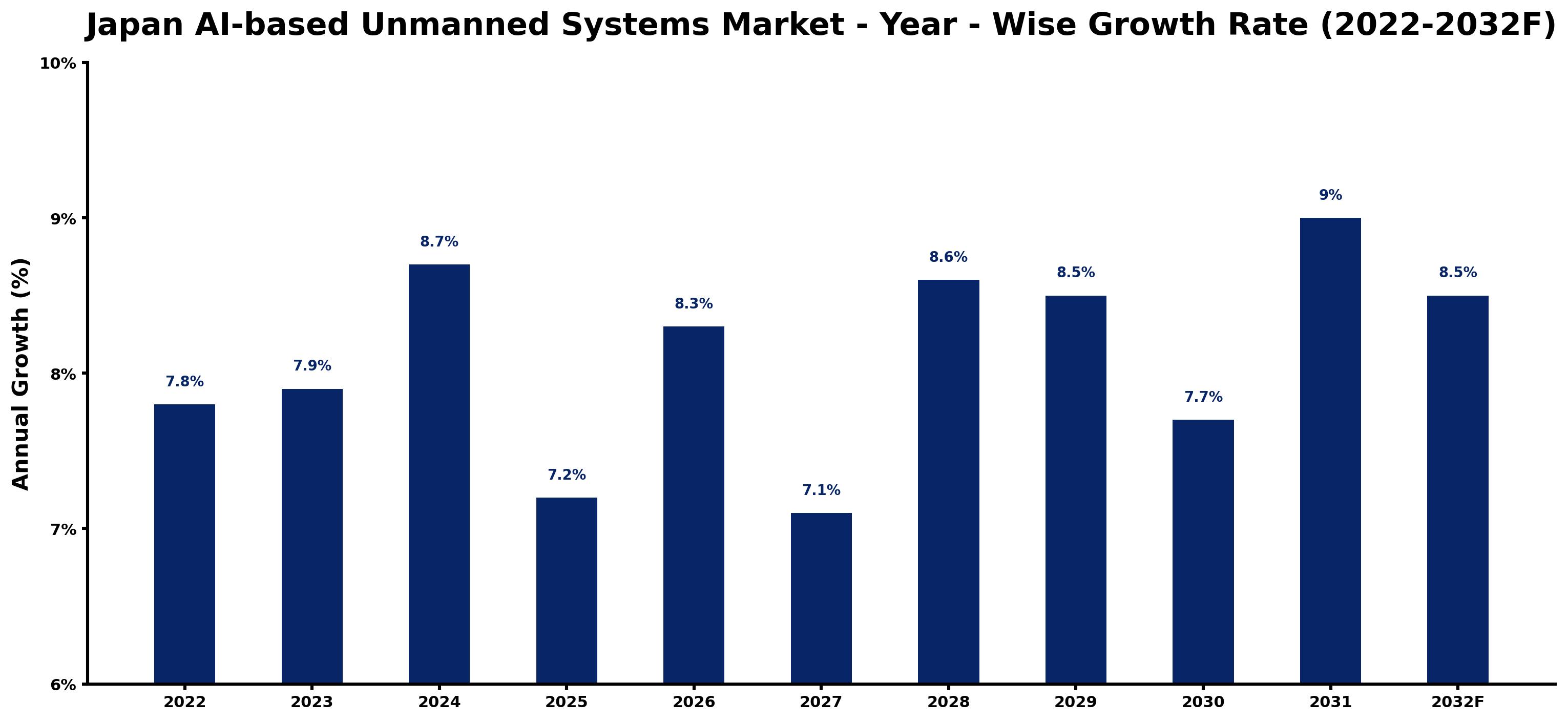
Annual growth estimates for each year appear below with the principal reason behind them, explaining the shifts that set the pace of the market.
| Year | Estimated Annual Growth (%) | Market Rationale |
| 2022 | 7.8 | The market experienced steady growth, driven by increased military investments in unmanned systems. |
| 2023 | 7.9 | Demand rose as agricultural firms adopted UAVs for crop monitoring and logistics. |
| 2024 | 8.7 | The growth accelerated due to heightened interest in AI technologies for unmanned applications. |
| 2025 | 7.2 | Growth slowed slightly as market maturity set in, yet demand remained strong. |
| 2026 | 8.3 | An uptick in military spending on unmanned systems is expected to spur faster growth this year. |
| 2027 | 7.1 | Growth will decelerate as supply chain challenges impact delivery timelines for systems. |
| 2028 | 8.6 | Demand is projected to surge again as agricultural UAV usage expands beyond initial projections. |
| 2029 | 8.5 | The market will see a slight slowdown, but military and agricultural sectors continue to invest. |
| 2030 | 7.7 | Growth is anticipated to moderate as the market stabilises, with steady demand from key sectors. |
| 2031 | 9.0 | A peak in growth will occur due to advancements in AI technology applications. |
| 2032 | 8.5 | The market growth rate is expected to slow as it approaches maturity, yet demand remains strong. |
Note: Market size estimations and growth projections presented in this report are based on 6Wresearch's proprietary forecasting methodology, utilizing the latest available industry data, government publications, and primary research inputs.
Japan AI-based Unmanned Systems Market Synopsis
AI-based unmanned systems utilise artificial intelligence to improve the functionality of drones, ground vehicles, and underwater systems through advanced robotics and AI algorithms. Military and agricultural firms are the primary buyers in Japan, driving demand for surveillance, monitoring, and logistics applications. The Tokyo region is a hub for innovation, with government initiatives such as the 2023 subsidy program for agricultural drones further stimulating market growth.
Market Dynamics Impact Analysis (2026–2032)
| Factor | Type | Impact | Primary Segment Affected |
| Rising military investments in unmanned systems | Driver | High | UAVs (Drones) |
| Growing agricultural adoption of UAVs for crop monitoring | Driver | High | UAVs (Drones) |
| Increased demand for logistics solutions in e-commerce | Opportunity | High | Unmanned Delivery Bots |
| Expansion of smart city initiatives in urban areas | Opportunity | Medium | UAVs (Drones) |
| Supply chain disruptions affecting component availability | Restraint | High | UGVs (Ground Vehicles) |
| High initial investment costs for advanced systems | Restraint | Medium | UAVs (Drones) |
| Technological integration challenges in military operations | Challenge | High | UAVs (Drones) |
| Limited awareness of unmanned systems benefits in agriculture | Challenge | Medium | UGVs (Ground Vehicles) |
Evaluation of Drivers in Japan AI-based Unmanned Systems Market (2026–2032)
Key forces behind demand, with the segment each one moves most, are listed below.
| Drivers | Primary Segment Affected | Why It Matters (Evidence) |
| Increased military budgets for unmanned systems | UAVs (Drones) | The Ministry of Defense allocated funds for unmanned systems development in 2023, leading to higher procurement. |
| Growing agricultural UAV adoption | UAVs (Drones) | Over 20% of Japan's agricultural sector now uses UAVs for crop monitoring, boosting demand. |
| Expansion of e-commerce logistics | Unmanned Delivery Bots | E-commerce firms are increasingly adopting unmanned delivery solutions to improve operational efficiency. |
| Investment in AI research for unmanned systems | UGVs (Ground Vehicles) | The National Institute of Advanced Industrial Science and Technology promotes AI integration, driving demand. |
| Development of smart city initiatives | UAVs (Drones) | The Tokyo Metropolitan Government is investing in smart city projects, increasing UAV deployment. |
Behind the steady rise in orders sits the increased military budget for unmanned systems, with substantial funding allocated for development in 2023. Agricultural firms are also driving demand, as over 20% of the sector now utilises UAVs for crop monitoring. E-commerce logistics is evolving, with firms adopting unmanned delivery bots to improve efficiency.
Evaluation of Restraints in Japan AI-based Unmanned Systems Market
The main factors holding the market back are set out below.
| Market Restraint | Primary Segment Affected | Why It Matters (Evidence) |
| Supply chain disruptions affecting component availability | UGVs (Ground Vehicles) | Component shortages have delayed production timelines, impacting the availability of UGVs for buyers. |
| High initial investment costs for advanced systems | UAVs (Drones) | The upfront costs deter some agricultural firms from adopting UAV technology. |
| Technological integration challenges in military operations | UAVs (Drones) | Complex integration of new systems into existing military frameworks creates delays and complications. |
| Limited awareness of unmanned systems benefits in agriculture | UGVs (Ground Vehicles) | Many agricultural firms are unaware of the efficiency gains possible with UGVs, limiting adoption. |
| Regulatory hurdles for UAV operations in urban areas | UAVs (Drones) | Strict guidelines from the Ministry of Land, Infrastructure, Transport and Tourism slow down deployment. |
Japan AI-based Unmanned Systems Market Challenges
In 2023, agricultural producers incur higher costs due to limited technology options for unmanned systems, delaying crop monitoring and impacting yields. A lack of skilled workers in AI and robotics restricts sector growth, with over 30% of producers unable to find qualified personnel, leading to inefficiencies. Supply chain disruptions in component delivery extend lead times, forcing buyers to postpone project timelines. Buyers also face escalating compliance costs with evolving regulations, which can add up to 15% to operational budgets for those integrating new technologies.
Trends in the Japan AI-based Unmanned Systems Market
Four trends stand out in the Japan AI-based Unmanned Systems Market.
- Shift in Agricultural Practices: Agricultural firms are increasingly adopting UAVs for crop monitoring, with over 20% usage reported in 2023. This shift highlights the growing reliance on technology for efficiency in farming.
- Rise of Unmanned Delivery Solutions: E-commerce firms are rapidly integrating unmanned delivery bots, reflecting a trend towards automation in logistics. In 2023, this sector saw a notable increase in adoption rates.
- Expansion of Smart City Initiatives: The Tokyo Metropolitan Government is investing in smart city projects that incorporate unmanned systems, aiming for improved urban management. This initiative is expected to increase UAV deployment.
- Growing Military Integration of AI: Military operations are increasingly integrating AI into unmanned systems, improving capabilities for surveillance and logistics. The Defense Technology Agency is leading this integration effort.
Investment Opportunities in the Japan AI-based Unmanned Systems Market
The following areas offer the clearest openings for investors and suppliers in the Japan AI-based Unmanned Systems Market.
- Supply of Advanced UAVs: With agricultural UAV usage exceeding 20%, there is an opportunity to supply advanced UAVs for crop monitoring. This demand is particularly strong in rural regions of Japan.
- Investment in Unmanned Delivery Bots: The e-commerce sector is rapidly adopting unmanned delivery solutions, creating a gap for suppliers to enter this market. Now is the time to invest in this technology to meet rising demands.
- Expansion of UGVs in Industrial Automation: The growing need for automation in industries presents an opportunity to supply UGVs. The manufacturing sector is increasingly looking for efficient solutions to improve productivity.
- Development of AI Functionality in Unmanned Systems: As AI functionality becomes essential, there is a gap for suppliers to develop advanced AI algorithms. The military sector is particularly interested in improving operational capabilities.
Government Initiatives in the Japan AI-based Unmanned Systems Market
The New Robot Strategy launched in 2015 aims to expand the use of robots across various sectors, including agriculture and manufacturing. This strategy encourages producers to innovate and adopt advanced technologies, improving the capabilities of unmanned systems in Japan. The Ministry of Defense allocated funds for unmanned systems development in 2023, supporting the integration of these technologies into various applications.
The Defense Technology Agency oversees the integration of unmanned systems into military operations, approving projects that improve operational efficiency. In 2023, the agency funded multiple initiatives to advance unmanned technologies, ensuring that military operations can effectively utilise these systems.
Future Insight of the Japan AI-based Unmanned Systems Market
By 2032, a shift in government policy will drive the adoption of unmanned delivery services, prompting suppliers to develop advanced solutions. The Japanese government's subsidy program for agricultural drones will lead to a projected 40% increase in UAV usage among farmers. New regulations from the Japan Industrial Standards Committee will standardise safety protocols, fostering a more competitive environment for buyers. Investment in smart city initiatives will further stimulate demand for unmanned systems, creating opportunities for suppliers to tailor their offerings.
Market Segmentation Analysis
Japan AI-based Unmanned Systems Market report covers a detailed analysis of the following market segments:
By System Type – UAVs (Drones) Leads, UGVs (Ground Vehicles) Expected to Grow Fastest
According to Saurav Kr Singh, Senior Research Analyst at 6Wresearch, UAVs (Drones) took 40% of system type revenue in 2025, more than any other category. UAVs hold the largest share due to their widespread application in military surveillance and logistics delivery, with over 100,000 registered drones in Japan as of 2023. Their established presence in agriculture further reinforces their leading position in the market. The quickest growth will come from UGVs (Ground Vehicles), forecast to expand at a CAGR of 11.2% between 2026 and 2032. UGVs are witnessing rapid growth as agricultural firms increasingly adopt them for crop monitoring, with over 20% usage reported in this sector. This trend indicates a shift towards automation in agricultural practices, which is expected to continue expanding. Suppliers should focus on enhancing UGV offerings to capitalise on the growing trend of agricultural automation.
By AI Functionality – Path Optimization Leads, Terrain Mapping Expected to Grow Fastest
In 2025, Path Optimization led the ai functionality split with a 37% share. Path Optimization leads the market as it is vital for efficient navigation in unmanned systems, significantly impacting operational effectiveness. This functionality is essential for military and agricultural applications, where precision is crucial for success. Terrain Mapping is projected to grow fastest, at a CAGR of 10.4% during 2026–2032. Terrain Mapping is gaining traction due to its importance in agricultural assessments, allowing farmers to make informed decisions based on data. The increasing emphasis on precision agriculture is anticipated to drive further adoption of this capability. Buyers will gain from advanced functionalities that improve operational efficiency and decision-making capabilities.
By Distribution Channel – Drone OEMs Lead, Robotics Distributors Expected to Grow Fastest
The largest distribution channel category in 2025 was Drone OEMs, at 45% of revenue. Drone OEMs dominate the distribution channel as they are the primary manufacturers of UAVs, ensuring a consistent supply to the market. Their established relationships with end users in military and agricultural sectors solidify their leading role. Over 2026–2032, Robotics Distributors are expected to post the fastest growth, at a CAGR of 10.8%. Robotics Distributors are experiencing the fastest growth as they act as key intermediaries in the supply chain, facilitating access to unmanned systems across various industries. Their expanding role is becoming increasingly important as market demand rises. Suppliers should explore partnerships with robotics distributors to enhance market penetration and reach diverse customer segments.
By End User – Military & Agricultural Firms Lead, Defense & Industrial Warehouses Expected to Grow Fastest
With 48% of end user revenue in 2025, Military & Agricultural Firms was the largest category. Military and Agricultural Firms represent the largest user group for unmanned systems, employing these technologies for surveillance and crop monitoring. Their substantial investment in unmanned systems highlights the critical role these technologies play in their operations. Defense & Industrial Warehouses are set to record the highest CAGR in this split, 11.3% over 2026–2032. Defense and Industrial Warehouses are rapidly adopting unmanned systems for logistics and security, motivated by the need for efficiency and safety in operations. This trend reflects a growing recognition of the value of unmanned systems in enhancing operational capabilities. Suppliers must tailor their offerings to meet the specific needs of defense and industrial clients to capture this emerging market.
Key Attractiveness of the Report
- 10 Years of Market Numbers
- Historical Data Starting from 2022 to 2025
- Base Year 2025
- Forecast Data until 2032
- Key Performance Indicators Impacting the Market
- Major Upcoming Developments and Projects
Key Highlights of the Report:
- Japan AI-based Unmanned Systems Market Outlook
- Market Size of Japan AI-based Unmanned Systems Market, 2025
- Forecast of Japan AI-based Unmanned Systems Market, 2032
- Historical Data and Forecast of Japan AI-based Unmanned Systems Revenues & Volume for the Period 2022-2032F
- Japan AI-based Unmanned Systems Market Trend Evolution
- Japan AI-based Unmanned Systems Market Drivers and Challenges
- Japan AI-based Unmanned Systems Price Trends
- Japan AI-based Unmanned Systems Porter's Five Forces
- Japan AI-based Unmanned Systems Industry Life Cycle
- Historical Data and Forecast of Japan AI-based Unmanned Systems Market Revenues & Volume By System Type for the Period 2022-2032F
- Historical Data and Forecast of Japan AI-based Unmanned Systems Market Revenues & Volume By UAVs (Drones) for the Period 2022-2032F
- Historical Data and Forecast of Japan AI-based Unmanned Systems Market Revenues & Volume By UGVs (Ground Vehicles) for the Period 2022-2032F
- Historical Data and Forecast of Japan AI-based Unmanned Systems Market Revenues & Volume By UUVs (Underwater) for the Period 2022-2032F
- Historical Data and Forecast of Japan AI-based Unmanned Systems Market Revenues & Volume By Unmanned Delivery Bots for the Period 2022-2032F
- Historical Data and Forecast of Japan AI-based Unmanned Systems Market Revenues & Volume By AI Functionality for the Period 2022-2032F
- Historical Data and Forecast of Japan AI-based Unmanned Systems Market Revenues & Volume By Path Optimization for the Period 2022-2032F
- Historical Data and Forecast of Japan AI-based Unmanned Systems Market Revenues & Volume By Terrain Mapping for the Period 2022-2032F
- Historical Data and Forecast of Japan AI-based Unmanned Systems Market Revenues & Volume By Obstacle Avoidance for the Period 2022-2032F
- Historical Data and Forecast of Japan AI-based Unmanned Systems Market Revenues & Volume By Route Prediction for the Period 2022-2032F
- Historical Data and Forecast of Japan AI-based Unmanned Systems Market Revenues & Volume By Distribution Channel for the Period 2022-2032F
- Historical Data and Forecast of Japan AI-based Unmanned Systems Market Revenues & Volume By Drone OEMs for the Period 2022-2032F
- Historical Data and Forecast of Japan AI-based Unmanned Systems Market Revenues & Volume By Robotics Distributors for the Period 2022-2032F
- Historical Data and Forecast of Japan AI-based Unmanned Systems Market Revenues & Volume By Marine Tech Vendors for the Period 2022-2032F
- Historical Data and Forecast of Japan AI-based Unmanned Systems Market Revenues & Volume By Retail Tech Providers for the Period 2022-2032F
- Historical Data and Forecast of Japan AI-based Unmanned Systems Market Revenues & Volume By End User for the Period 2022-2032F
- Historical Data and Forecast of Japan AI-based Unmanned Systems Market Revenues & Volume By Military & Agricultural Firms for the Period 2022-2032F
- Historical Data and Forecast of Japan AI-based Unmanned Systems Market Revenues & Volume By Defense & Industrial Warehouses for the Period 2022-2032F
- Historical Data and Forecast of Japan AI-based Unmanned Systems Market Revenues & Volume By Naval Research Units for the Period 2022-2032F
- Historical Data and Forecast of Japan AI-based Unmanned Systems Market Revenues & Volume By E-commerce Firms for the Period 2022-2032F
- Japan AI-based Unmanned Systems Import Export Trade Statistics
- Market Opportunity Assessment By System Type
- Market Opportunity Assessment By AI Functionality
- Market Opportunity Assessment By Distribution Channel
- Market Opportunity Assessment By End User
- Japan AI-based Unmanned Systems Top Companies Market Share
- Japan AI-based Unmanned Systems Competitive Benchmarking By Technical and Operational Parameters
- Japan AI-based Unmanned Systems Company Profiles
- Japan AI-based Unmanned Systems Key Strategic Recommendations
Market Covered
Coverage by segment is as follows.
By System Type
- UAVs (Drones)
- UGVs (Ground Vehicles)
- UUVs (Underwater)
- Unmanned Delivery Bots
By AI Functionality
- Path Optimization
- Terrain Mapping
- Obstacle Avoidance
- Route Prediction
By Distribution Channel
- Drone OEMs
- Robotics Distributors
- Marine Tech Vendors
- Retail Tech Providers
By End User
- Military & Agricultural Firms
- Defense & Industrial Warehouses
- Naval Research Units
- E-commerce Firms































