Japan AI-Based Voice Assistants Market Size & Growth Rate
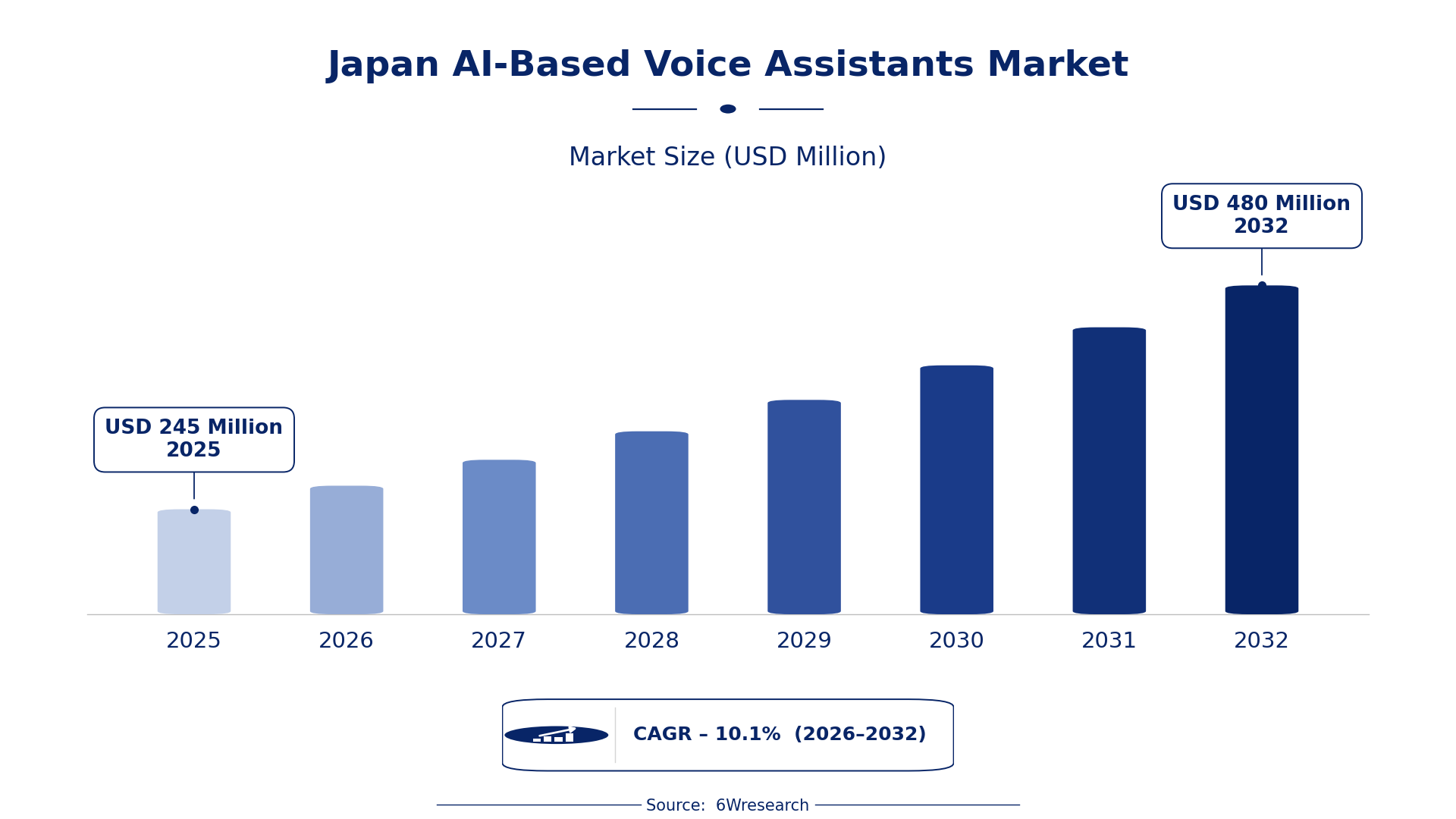
According to 6Wresearch internal database and industry insights, the Japan AI-Based Voice Assistants Market was valued at USD 245 Million in 2025 and is projected to reach USD 480 Million by 2032, growing at a CAGR of approximately 10.1% during 2026–2032.
Japan AI-Based Voice Assistants Market Highlights
| Report Metric | Details |
| Report Name | Japan AI-Based Voice Assistants Market (2026-2032) |
| Market Size 2025 | USD 245 Million |
| Market Size 2032 | USD 480 Million |
| Absolute Growth 2025–2032 | USD 235 Million |
| CAGR 2026–2032 | 10.1% |
| Peak Annual Growth | 12.7% in 2026 |
| Forecast Period | 2026–2032 |
| Historical Data | 2022–2025 |
| Base Year | 2025 |
| Leading Assistant Type, 2025 | Smart Home Assistants (49% share) |
| Leading AI Feature, 2025 | Natural Language Processing (46% share) |
| Leading Distribution Channel, 2025 | Consumer Electronics Stores (47% share) |
| Leading End User, 2025 | Homeowners (38% share) |
| Fastest-Growing Assistant Type | Healthcare Voice Aides (13.7% CAGR) |
| Fastest-Growing Distribution Channel | MedTech Retailers (12.6% CAGR) |
| Fastest-Growing End User | Elderly Care Homes (12.4% CAGR) |
| Growing Sector | Healthcare |
| Key End Users | Homeowners, Car Manufacturers, Corporates, Elderly Care Homes |
Japan AI-Based Voice Assistants Market Year-wise Growth Rate and Key Drivers (2022–2032)
This graph illustrates the annual growth rates of the market from 2022 to 2032, highlighting a steady upward trajectory and projected market expansion over the forecast period.
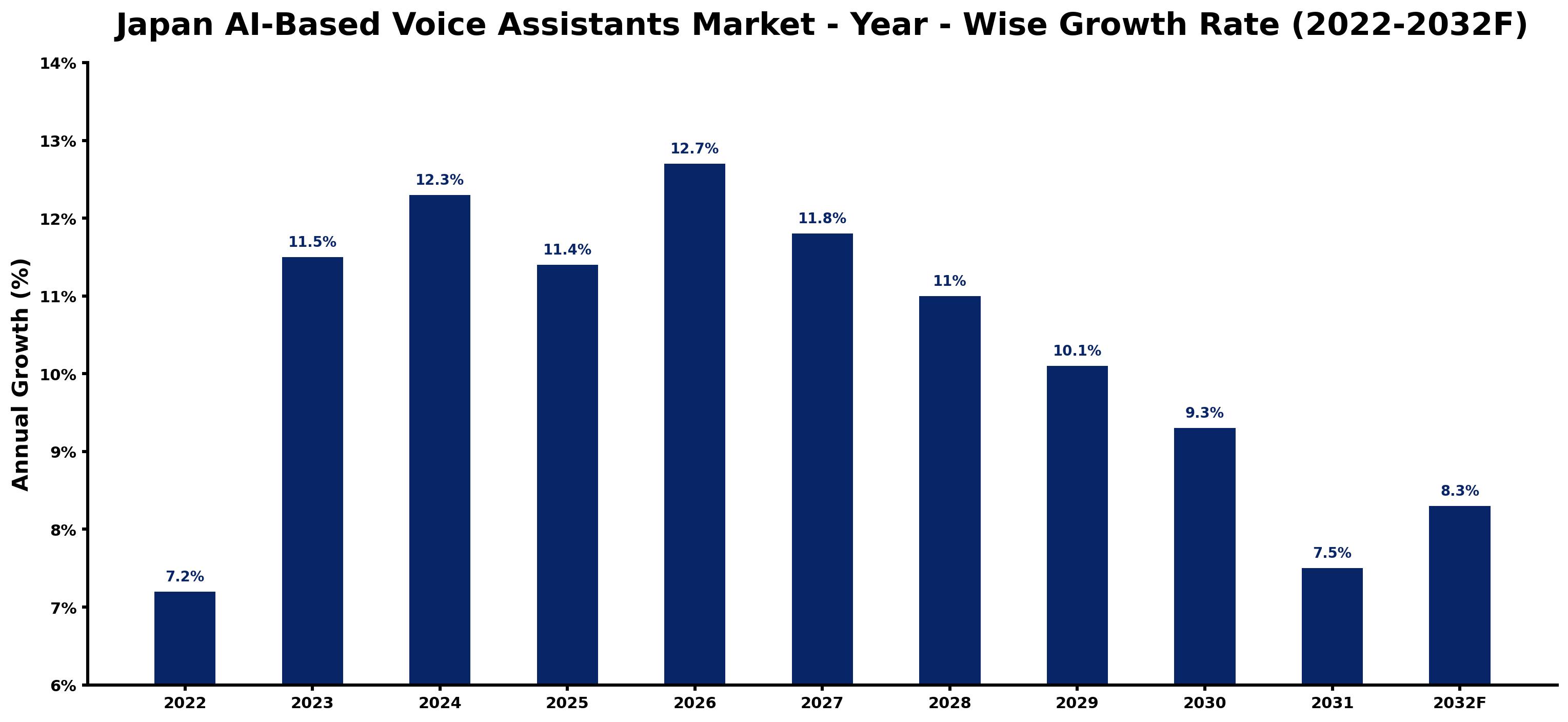
The yearly estimates that follow link every growth rate to its principal driver, so readers can see why the pace changed in each period.
| Year | Estimated Annual Growth (%) | Market Rationale |
| 2022 | 7.2 | The market showed steady growth as consumers began adopting smart home technologies. |
| 2023 | 11.5 | Growth accelerated due to increased investment in AI technologies and consumer interest. |
| 2024 | 12.3 | The demand surged as more households integrated smart devices into their homes. |
| 2025 | 11.4 | Growth slowed slightly as the market matured and competition intensified. |
| 2026 | 12.7 | The market is expected to rebound with new product launches driving demand. |
| 2027 | 11.8 | A slight slowdown is projected as market saturation begins to impact growth rates. |
| 2028 | 11.0 | Demand is expected to continue growing, albeit at a slower pace as technology evolves. |
| 2029 | 10.1 | The market is projected to maintain growth as new applications in healthcare emerge. |
| 2030 | 9.3 | Growth is expected to moderate as the market reaches a more stable phase of development. |
| 2031 | 7.5 | The market is projected to continue growing, supported by ongoing technological advancements. |
| 2032 | 8.3 | Demand is expected to increase again as innovations in AI features attract new users. |
Note: Market size estimations and growth projections presented in this report are based on 6Wresearch's proprietary forecasting methodology, utilizing the latest available industry data, government publications, and primary research inputs.
Japan AI-Based Voice Assistants Market Synopsis
AI-Based Voice Assistants are software applications that utilise artificial intelligence to interpret and respond to voice commands, primarily used in home automation, in-car navigation, enterprise communication, and healthcare support. The Japan AI-Based Voice Assistants Market is growing due to rising consumer interest in smart home technology and the integration of AI across various sectors. With over 30 million smart home devices in Japan, demand is further bolstered by government initiatives aimed at increasing AI adoption, particularly in healthcare, by 50% by 2025. This multifaceted growth presents ample opportunities for suppliers and technology developers.
Market Dynamics Impact Analysis (2026–2032)
| Factor | Type | Impact | Primary Segment Affected |
| Increasing adoption of smart home technology | Driver | High | Smart Home Assistants |
| Integration of AI in automotive applications | Driver | High | In-Car Assistants |
| Growing demand for healthcare solutions | Opportunity | High | Healthcare Voice Aides |
| Expansion of AI in enterprise communication | Opportunity | Medium | Enterprise Voice Bots |
| Limited awareness among potential users | Restraint | Medium | Healthcare Voice Aides |
| High competition among technology providers | Restraint | Medium | Smart Home Assistants |
| High costs of AI development and implementation | Challenge | High | In-Car Assistants |
| Slow adoption rates in corporate environments | Challenge | Medium | Enterprise Voice Bots |
Evaluation of Drivers in Japan AI-Based Voice Assistants Market (2026–2032)
These are the developments adding the most demand over the forecast period.
| Drivers | Primary Segment Affected | Why It Matters (Evidence) |
| Investment in smart home technologies | Smart Home Assistants | With over 30 million smart home devices in Japan, households are increasingly purchasing voice assistants for automation. |
| Increased demand for elderly care solutions | Healthcare Voice Aides | Healthcare voice aides are currently used in over 1,000 elderly care homes, streamlining patient management. |
| Growth in enterprise communication solutions | Enterprise Voice Bots | Corporates are adopting voice bots to improve customer service and operational efficiency. |
| Focus on natural language processing advancements | Natural Language Processing | Natural language processing is a key feature in 70% of AI-based voice assistants, improving user interaction. |
| Rising consumer interest in smart home devices | Smart Home Assistants | The average household in Japan owns 2.5 smart devices, increasing the need for voice assistants. |
Purchasing is picking up as investment in smart home technologies rises, with over 30 million devices in Japan driving demand for voice assistants. The automotive sector is projected to integrate in-car assistants into 80% of new vehicles by 2025, prompting manufacturers to expand their offerings. The healthcare sector is experiencing a surge in the use of voice aides, implemented in over 1,000 elderly care homes, streamlining patient management. Enterprises are increasingly adopting voice bots to enhance customer service, while advancements in natural language processing are featured in 70% of AI-based voice assistants, improving user interaction and satisfaction. The growing interest in smart home devices further fuels the market, as households seek automation solutions.
Evaluation of Restraints in Japan AI-Based Voice Assistants Market
The key brakes on demand, and where they bite hardest, are shown below.
| Market Restraint | Primary Segment Affected | Why It Matters (Evidence) |
| Limited awareness among potential users | Healthcare Voice Aides | Many potential users lack knowledge of the benefits of healthcare voice aides, limiting market growth. |
| High competition among technology providers | Smart Home Assistants | Intense competition among providers leads to price wars, affecting profitability and innovation. |
| Costs associated with AI development | In-Car Assistants | High costs of developing and integrating AI technologies can deter manufacturers from investing. |
| Slow adoption rates in corporate environments | Enterprise Voice Bots | Many corporates are hesitant to adopt new technologies, slowing the growth of enterprise voice bots. |
| Regulatory challenges in healthcare | Healthcare Voice Aides | Healthcare regulations can complicate the implementation of voice aides, limiting their adoption. |
Japan AI-Based Voice Assistants Market Challenges
Healthcare providers face delays in adopting voice assistants, costing hospitals time and resources due to a shortage of skilled personnel trained in AI technologies. This skills gap exists because educational programmes in Japan have not adapted to the rapid advancements in AI, leading to inefficiencies in patient care. Technology integration issues arise as many existing healthcare systems are incompatible with new AI solutions, resulting in increased operational costs for clinics. Buyers experience rising prices for advanced voice assistants, with some paying up to 20% more than expected due to high demand outstripping supply.
Trends in the Japan AI-Based Voice Assistants Market
Below are the shifts with the largest effect on the Japan AI-Based Voice Assistants Market.
- Shift towards Smart Home Integration: The trend towards smart home integration has gained momentum, with over 30 million smart devices in Japan as of 2023. This shift supports the increasing need for AI-based voice assistants, improving home automation.
- Rising Adoption of AI in Automotive: Since 2023, the integration of AI in vehicles has accelerated, with expectations that 80% of new cars will feature in-car assistants by 2025. This trend is reshaping the automotive sector, driving demand for advanced voice technologies.
- Healthcare Voice Aides Gaining Popularity: In 2023, healthcare voice aides are being implemented in over 1,000 elderly care homes across Japan. This trend reflects the increasing need for technology in patient management and support.
- Natural Language Processing as a Key Feature: Natural language processing has become essential, featured in 70% of AI-based voice assistants in Japan. This development improves user interaction, driving further adoption of voice technologies.
Investment Opportunities in the Japan AI-Based Voice Assistants Market
Where to invest in the Japan AI-Based Voice Assistants Market: the main openings are set out below.
- Growing Demand for Healthcare Solutions: With a target to increase AI adoption in healthcare by 50% by 2025, there is a strong opportunity for investment in healthcare voice aides in elderly care homes.
- Expansion of Smart Home Technologies: As the average household owns 2.5 smart devices, there is a growing need for smart home assistants, particularly in urban areas like Tokyo.
- Increasing Integration in Automotive Sector: With 80% of new vehicles expected to feature in-car assistants by 2025, automotive OEMs represent a key opportunity for suppliers to expand their offerings.
- Rising Interest in Enterprise Communication: Corporates are increasingly looking for solutions to improve customer service, creating opportunities for investment in enterprise voice bots.
Government Initiatives in the Japan AI-Based Voice Assistants Market
The regulatory framework for AI-based voice assistants in Japan is shaped by various laws, including the Long-Term Care Insurance Act of 1997, which funds services for the elderly, and the Semiconductor and Digital Industry Strategy introduced in June 2021 to secure domestic semiconductor manufacturing. These measures support the development and integration of AI technologies in various sectors, including healthcare and smart home applications.
In 2023, the Ministry of Internal Affairs and Communications launched a programme to promote AI in public services, with a funding allocation of 1 billion yen. This initiative aims to improve accessibility and efficiency in public services, encouraging the adoption of AI technologies, including voice assistants, across different sectors.
Future Insight of the Japan AI-Based Voice Assistants Market
Investment in AI technology will create strong demand for voice assistants across various sectors by 2032. The healthcare sector will see a notable rise in AI adoption, with the Japanese government targeting a 50% increase in AI use by 2025. Smart home technology will expand, with over 30 million devices already in use, prompting suppliers to develop new solutions. Standards like ISO/IEC 30170 will ensure quality and reliability in AI applications, benefiting both buyers and suppliers.
Market Segmentation Analysis
Japan AI-Based Voice Assistants Market report covers a detailed analysis of the following market segments:
By Assistant Type – Smart Home Assistants Lead, Healthcare Voice Aides Expected to Grow Fastest
According to Saurav Kr Singh, Senior Research Analyst at 6Wresearch, with 49% of assistant type revenue in 2025, Smart Home Assistants was the largest category. Smart Home Assistants hold the largest share as they are extensively utilised for home automation, with over 30 million smart home devices currently active in Japan. This segment primarily caters to homeowners who seek convenience and efficiency in their daily lives. Over 2026–2032, Healthcare Voice Aides are expected to post the fastest growth, at a CAGR of 13.7%. Healthcare Voice Aides are experiencing rapid growth, evidenced by a 15% sales increase in 2023, as they play a crucial role in managing care for patients in over 1,000 elderly care homes. The rising demand for healthcare support is driving this expansion. Suppliers should focus on enhancing features that cater to healthcare applications to capitalise on this growing market.
By AI Feature – Natural Language Processing Leads and Records the Fastest Growth
Natural Language Processing accounted for 46% of the market by ai feature in 2025. Natural Language Processing is the leading feature as it is essential for accurately understanding user commands, being integrated into 70% of voice assistants in Japan. This capability is vital for ensuring a smooth user experience and delivering precise responses. Its lead should widen, with a projected CAGR of 13.0% during 2026–2032, the highest in this split. The growth of Natural Language Processing will continue to accelerate due to its increasing integration across various applications, further solidifying its dominant position. Its importance in both smart home and healthcare solutions reinforces this trend. Investing in advancements in Natural Language Processing will be crucial for suppliers to maintain competitive advantages.
By Distribution Channel – Consumer Electronics Stores Lead, MedTech Retailers Expected to Grow Fastest
Consumer Electronics Stores took 47% of distribution channel revenue in 2025, more than any other category. Consumer Electronics Stores serve as the primary distribution channel, providing easy access to a wide range of voice assistants and ensuring high visibility for these products. Their established presence in the technology retail market enhances consumer awareness and availability. MedTech Retailers are projected to grow fastest, at a CAGR of 12.6% during 2026–2032. MedTech Retailers are witnessing faster growth, albeit as a secondary channel, due to the rising incorporation of voice assistants in healthcare settings, which is becoming increasingly relevant for these retailers. This trend aligns with the growing demand for healthcare solutions. Suppliers should consider partnerships with MedTech retailers to tap into the expanding healthcare market.
By End User – Homeowners Lead, Elderly Care Homes Expected to Grow Fastest
In 2025, Homeowners led the end user split with a 38% share. Homeowners represent the largest user group as voice assistants are primarily designed for residential users seeking convenience and smart home integration. This demographic's enthusiasm for smart home technology significantly fuels demand. The quickest growth will come from Elderly Care Homes, forecast to expand at a CAGR of 12.4% between 2026 and 2032. Elderly Care Homes are rapidly adopting voice assistants to assist in providing care and reminders for the elderly, reflecting a notable trend in healthcare support. The increasing number of such facilities is accelerating growth in this segment. Suppliers should tailor their offerings to meet the specific needs of elderly care facilities to leverage this growth opportunity.
Key Attractiveness of the Report
- 10 Years of Market Numbers
- Historical Data Starting from 2022 to 2025
- Base Year 2025
- Forecast Data until 2032
- Key Performance Indicators Impacting the Market
- Major Upcoming Developments and Projects
Key Highlights of the Report:
- Japan AI-Based Voice Assistants Market Outlook
- Market Size of Japan AI-Based Voice Assistants Market, 2025
- Forecast of Japan AI-Based Voice Assistants Market, 2032
- Historical Data and Forecast of Japan AI-Based Voice Assistants Revenues & Volume for the Period 2022-2032F
- Japan AI-Based Voice Assistants Market Trend Evolution
- Japan AI-Based Voice Assistants Market Drivers and Challenges
- Japan AI-Based Voice Assistants Price Trends
- Japan AI-Based Voice Assistants Porter's Five Forces
- Japan AI-Based Voice Assistants Industry Life Cycle
- Historical Data and Forecast of Japan AI-Based Voice Assistants Market Revenues & Volume By Assistant Type for the Period 2022-2032F
- Historical Data and Forecast of Japan AI-Based Voice Assistants Market Revenues & Volume By Smart Home Assistants for the Period 2022-2032F
- Historical Data and Forecast of Japan AI-Based Voice Assistants Market Revenues & Volume By In-Car Assistants for the Period 2022-2032F
- Historical Data and Forecast of Japan AI-Based Voice Assistants Market Revenues & Volume By Enterprise Voice Bots for the Period 2022-2032F
- Historical Data and Forecast of Japan AI-Based Voice Assistants Market Revenues & Volume By Healthcare Voice Aides for the Period 2022-2032F
- Historical Data and Forecast of Japan AI-Based Voice Assistants Market Revenues & Volume By AI Feature for the Period 2022-2032F
- Historical Data and Forecast of Japan AI-Based Voice Assistants Market Revenues & Volume By Natural Language Processing for the Period 2022-2032F
- Historical Data and Forecast of Japan AI-Based Voice Assistants Market Revenues & Volume By Voice-Activated Commands for the Period 2022-2032F
- Historical Data and Forecast of Japan AI-Based Voice Assistants Market Revenues & Volume By AI Customer Support for the Period 2022-2032F
- Historical Data and Forecast of Japan AI-Based Voice Assistants Market Revenues & Volume By Medication Reminders for the Period 2022-2032F
- Historical Data and Forecast of Japan AI-Based Voice Assistants Market Revenues & Volume By Distribution Channel for the Period 2022-2032F
- Historical Data and Forecast of Japan AI-Based Voice Assistants Market Revenues & Volume By Consumer Electronics Stores for the Period 2022-2032F
- Historical Data and Forecast of Japan AI-Based Voice Assistants Market Revenues & Volume By Automotive OEMs for the Period 2022-2032F
- Historical Data and Forecast of Japan AI-Based Voice Assistants Market Revenues & Volume By CRM Software Vendors for the Period 2022-2032F
- Historical Data and Forecast of Japan AI-Based Voice Assistants Market Revenues & Volume By MedTech Retailers for the Period 2022-2032F
- Historical Data and Forecast of Japan AI-Based Voice Assistants Market Revenues & Volume By End User for the Period 2022-2032F
- Historical Data and Forecast of Japan AI-Based Voice Assistants Market Revenues & Volume By Homeowners for the Period 2022-2032F
- Historical Data and Forecast of Japan AI-Based Voice Assistants Market Revenues & Volume By Car Manufacturers for the Period 2022-2032F
- Historical Data and Forecast of Japan AI-Based Voice Assistants Market Revenues & Volume By Corporates for the Period 2022-2032F
- Historical Data and Forecast of Japan AI-Based Voice Assistants Market Revenues & Volume By Elderly Care Homes for the Period 2022-2032F
- Japan AI-Based Voice Assistants Import Export Trade Statistics
- Market Opportunity Assessment By Assistant Type
- Market Opportunity Assessment By AI Feature
- Market Opportunity Assessment By Distribution Channel
- Market Opportunity Assessment By End User
- Japan AI-Based Voice Assistants Top Companies Market Share
- Japan AI-Based Voice Assistants Competitive Benchmarking By Technical and Operational Parameters
- Japan AI-Based Voice Assistants Company Profiles
- Japan AI-Based Voice Assistants Key Strategic Recommendations
Market Covered
The following segment groups are covered in the report.
By Assistant Type
- Smart Home Assistants
- In-Car Assistants
- Enterprise Voice Bots
- Healthcare Voice Aides
By AI Feature
- Natural Language Processing
- Voice-Activated Commands
- AI Customer Support
- Medication Reminders
By Distribution Channel
- Consumer Electronics Stores
- Automotive OEMs
- CRM Software Vendors
- MedTech Retailers
By End User
- Homeowners
- Car Manufacturers
- Corporates
- Elderly Care Homes































