Japan AI-driven Quality Control Market Size & Growth Rate
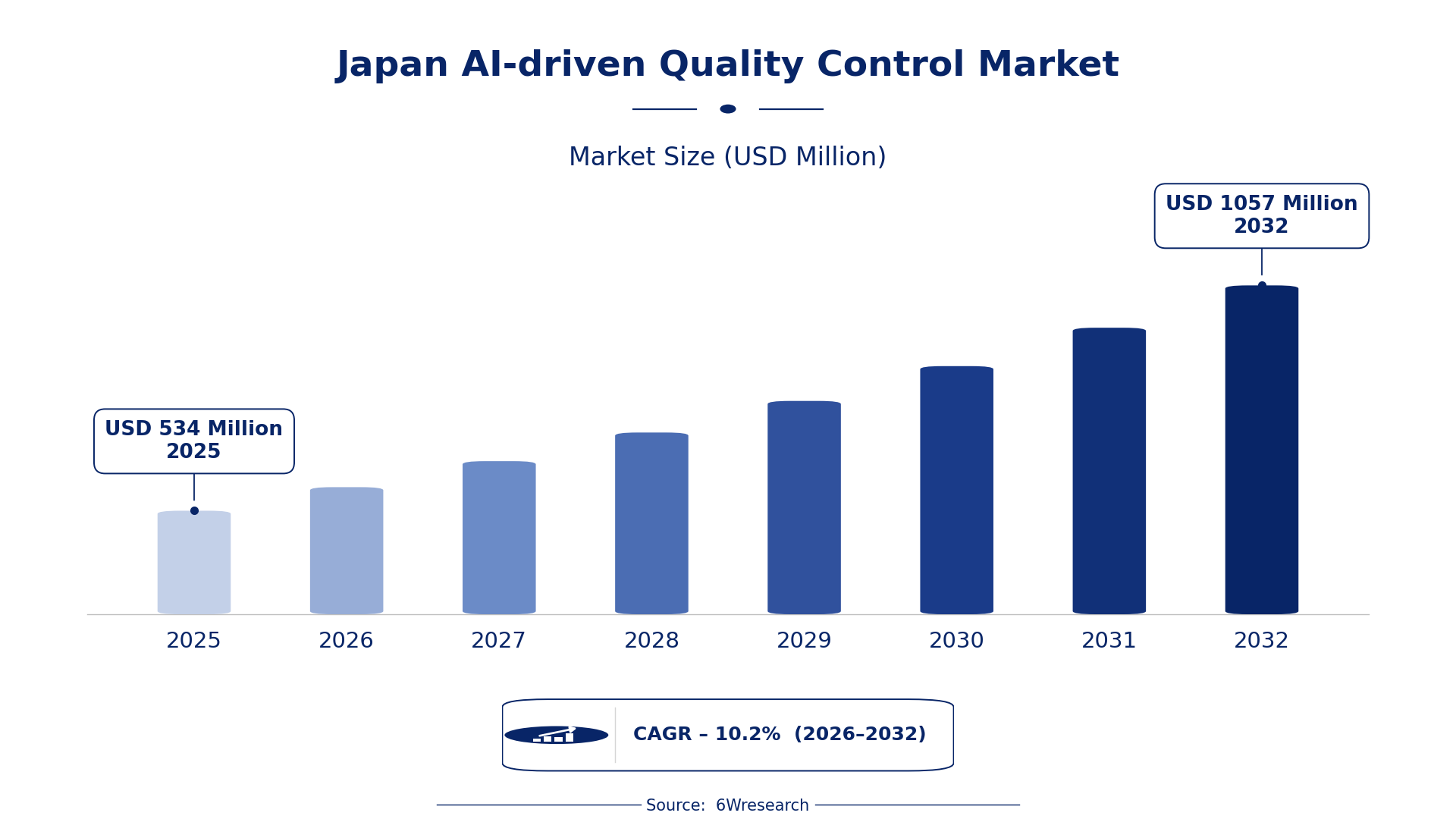
According to 6Wresearch internal database and industry insights, the Japan AI-driven Quality Control Market was valued at USD 534 Million in 2025 and is projected to reach USD 1,057 Million by 2032, growing at a CAGR of approximately 10.2% during 2026–2032.
Japan AI-driven Quality Control Market Highlights
| Report Metric | Details |
| Report Name | Japan AI-driven Quality Control Market (2026-2032) |
| Market Size 2025 | USD 534 Million |
| Market Size 2032 | USD 1,057 Million |
| Absolute Growth 2025–2032 | USD 523 Million |
| CAGR 2026–2032 | 10.2% |
| Peak Annual Growth | 11.7% in 2027 |
| Forecast Period | 2026–2032 |
| Historical Data | 2022–2025 |
| Base Year | 2025 |
| Leading Product Segment, 2025 | Electronics Assembly (45% share) |
| Leading AI Technology, 2025 | Defect Detection (39% share) |
| Leading Distribution Channel, 2025 | Inspection System Providers (44% share) |
| Leading End User, 2025 | PCB Manufacturers (34% share) |
| Fastest-Growing Product Segment | Automotive Components (14.2% CAGR) |
| Fastest-Growing AI Technology | Vision-Based Inspection (14.0% CAGR) |
| Fastest-Growing Distribution Channel | Quality Automation Vendors (13.9% CAGR) |
| Fastest-Growing End User | Car Manufacturers (12.9% CAGR) |
| Growing Sector | Car Manufacturers |
| Key End Users | PCB Manufacturers, Car Manufacturers, FMCG Processing Units, Pharmaceutical Plants |
Japan AI-driven Quality Control Market Year-wise Growth Rate and Key Drivers (2022–2032)
This graph illustrates the annual growth rates of the market from 2022 to 2032, highlighting a steady upward trajectory and projected market expansion over the forecast period.
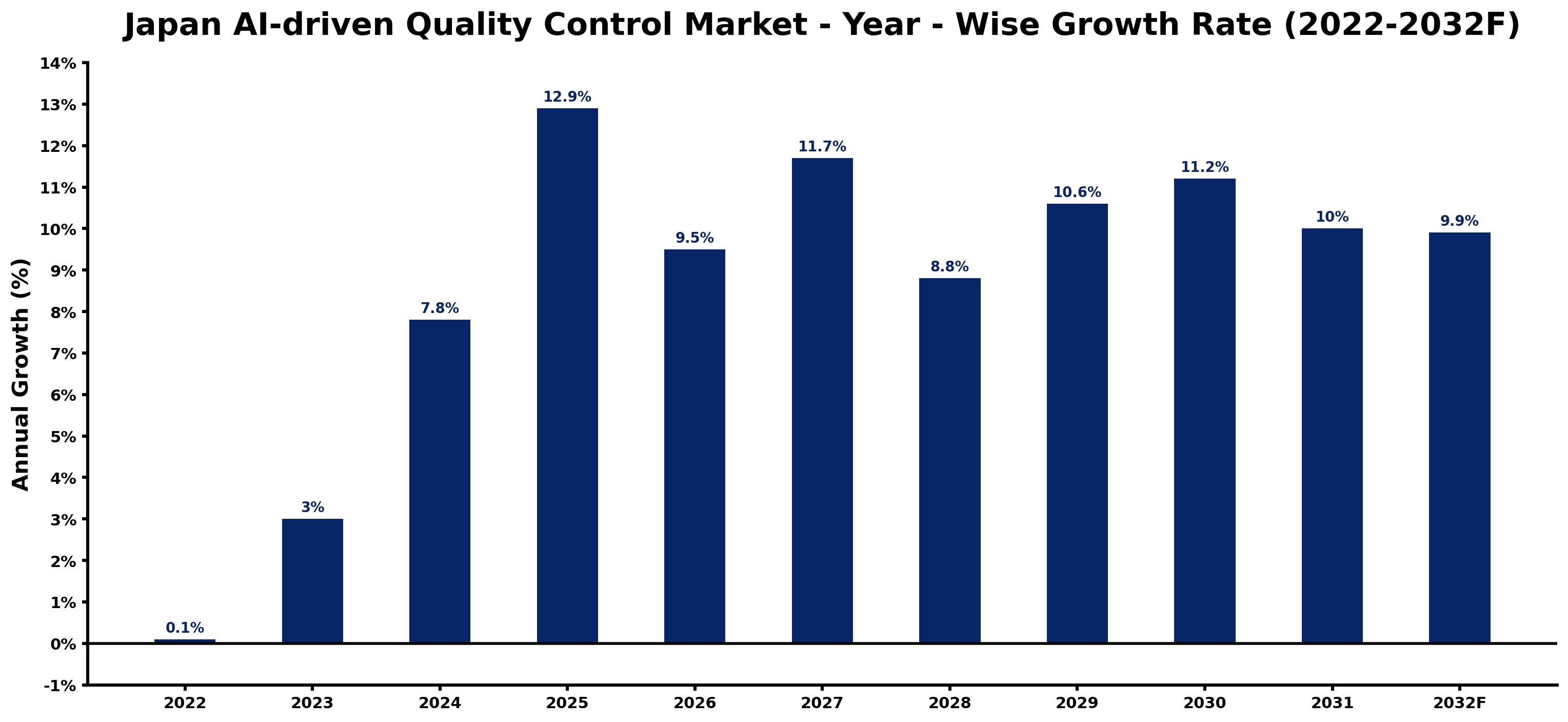
For each year, the table pairs the estimated growth rate with the leading influence on demand, showing how the drivers changed across the period.
| Year | Estimated Annual Growth (%) | Market Rationale |
| 2022 | 0.1 | The market exhibited minimal growth as manufacturers began integrating AI technologies. |
| 2023 | 3.0 | Demand accelerated as manufacturers invested in automation and quality assurance systems. |
| 2024 | 7.8 | The introduction of advanced AI solutions spurred further growth in quality control processes. |
| 2025 | 12.9 | A surge in production activities led to the highest growth rate in this period. |
| 2026 | 9.5 | Growth is expected to slow as the market adjusts to previous rapid expansions in technology adoption. |
| 2027 | 11.7 | Increased investments in AI-driven systems will revitalise growth momentum once more. |
| 2028 | 8.8 | A slight deceleration is projected as the market stabilises after peak growth. |
| 2029 | 10.6 | Demand is expected to accelerate again as manufacturers seek efficiency improvements in production. |
| 2030 | 11.2 | Continued investment in AI technologies will drive strong growth in quality control. |
| 2031 | 10.0 | A slowdown is anticipated as the market matures and growth rates normalise. |
| 2032 | 9.9 | Growth is expected to continue, albeit at a moderated pace as competition intensifies. |
Note: Market size estimations and growth projections presented in this report are based on 6Wresearch's proprietary forecasting methodology, utilizing the latest available industry data, government publications, and primary research inputs.
Japan AI-driven Quality Control Market Synopsis
AI-driven Quality Control in Japan integrates machine learning algorithms with imaging systems to improve quality assurance in manufacturing. The Japan AI-driven Quality Control Market is primarily driven by sectors such as electronics, automotive, food and beverage, and pharmaceuticals, where high standards are crucial. Rising automation and ongoing investments in AI technologies are key factors propelling market growth, with the electronics sector projected to increase its AI investments by 15% by 2025.
Market Dynamics Impact Analysis (2026–2032)
| Factor | Type | Impact | Primary Segment Affected |
| Rising automation in manufacturing processes | Driver | High | Electronics Assembly |
| Increased focus on compliance with health regulations | Driver | High | Pharma Packaging |
| Growing demand for quality assurance in manufacturing | Opportunity | High | Food & Beverage |
| Investment in advanced AI technologies for quality control | Opportunity | Medium | Automotive Components |
| High initial investment costs for AI systems | Restraint | High | Defect Detection |
| Limited awareness of AI benefits among smaller manufacturers | Restraint | Medium | Vision-Based Inspection |
| Competition from traditional quality control methods | Challenge | High | Inspection System Providers |
| Challenges in integrating AI with existing systems | Challenge | Medium | Quality Automation Vendors |
Evaluation of Drivers in Japan AI-driven Quality Control Market (2026–2032)
The table below links each growth driver to the segment it affects and the evidence for it.
| Drivers | Primary Segment Affected | Why It Matters (Evidence) |
| Increased production in the electronics sector | Electronics Assembly | Japan's electronics assembly sector employs over 1 million workers, creating a strong need for effective quality control systems. |
| Stringent health regulations in pharmaceuticals | Pharma Packaging | Pharmaceutical plants must comply with strict regulations, necessitating advanced quality control measures. |
| Growing investments in food safety protocols | Food & Beverage | Food and beverage processing units valued at over $200 billion are increasing demand for quality assurance systems. |
| Rising vehicle production in the automotive sector | Automotive Components | The automotive industry produced approximately 8.3 million vehicles in 2022, driving the need for quality control systems. |
| Adoption of ISO 9001 standards | Defect Detection | ISO 9001 is widely adopted in Japan, pushing manufacturers to enhance their quality control systems. |
Orders keep climbing as the electronics sector employs over 1 million workers, increasing the demand for effective quality control systems. The automotive industry’s production of approximately 8.3 million vehicles in 2022 necessitates stringent quality checks. Food and beverage processing units, valued at over $200 billion, are investing in advanced quality assurance technologies. The adoption of ISO 9001 standards drives manufacturers to improve their quality assurance processes.
Evaluation of Restraints in Japan AI-driven Quality Control Market
The main factors holding the market back are set out below.
| Market Restraint | Primary Segment Affected | Why It Matters (Evidence) |
| High initial investment costs for AI systems | Defect Detection | The integration of AI technologies requires considerable capital, limiting adoption among smaller manufacturers. |
| Limited awareness of AI benefits among smaller manufacturers | Vision-Based Inspection | Many smaller firms lack knowledge about AI's advantages, hindering their investment in quality control. |
| Resistance to change from traditional quality control methods | Inspection System Providers | Established methods often resist new technologies, making it difficult for innovations to gain traction. |
| Challenges in integrating AI with existing systems | Quality Automation Vendors | Existing infrastructure may not support new AI technologies, complicating implementation for suppliers. |
| Regulatory compliance complexities | Pharma Packaging | Pharmaceutical plants face strict regulations, making compliance a barrier to adopting new technologies. |
Japan AI-driven Quality Control Market Challenges
Japan's automotive industry produced approximately 8.3 million vehicles in 2022, yet fierce competition compels manufacturers to cut prices, squeezing profit margins for producers. Rising labour costs, with the national minimum wage reaching JPY 1,055 per hour in October 2024, pressure suppliers' financial flexibility, potentially leading to higher costs for clinics. A shortage of skilled workers in the electronics sector, employing over 1 million individuals, results in production delays, forcing buyers to seek alternative sourcing solutions. Many manufacturers still depend on outdated quality control methods, causing inefficiencies that waste time and resources for both buyers and suppliers.
Trends in the Japan AI-driven Quality Control Market
The shifts below are changing how Japan AI-driven Quality Control Market products are bought and supplied.
- Automation in Electronics Manufacturing: Tokyo is experiencing a shift towards automation in electronics manufacturing, with a projected 15% increase in AI investments by 2025. This trend prompts manufacturers to adopt AI-driven quality control systems to improve efficiency.
- AI Integration in Automotive Manufacturing: Car manufacturers are increasingly adopting AI-driven solutions, focusing on safety and performance checks. In 2023, the automotive sector's investment in quality control technologies is expected to rise significantly.
- Smart Sensors in Food Safety: Smart sensors are becoming standard in food safety protocols, with food and beverage processing units valued at over $200 billion. Their adoption is essential for maintaining hygiene and quality standards.
- Vision-Based Inspection Technologies in Automotive Production: Since 2023, vision-based inspection technologies have gained traction in automotive production lines, enhancing quality checks. This trend supports manufacturers in meeting stringent compliance standards.
Investment Opportunities in the Japan AI-driven Quality Control Market
The opportunities below stand out in the Japan AI-driven Quality Control Market for new entrants and existing suppliers.
- PCB Manufacturers Seeking Quality Solutions: PCB manufacturers are increasingly looking for advanced quality control systems to ensure product reliability. The growing demand for precision in electronics is driving investments in AI technologies.
- Automotive Manufacturing Facilities Upgrading Systems: Automotive manufacturing facilities in Aichi are investing in AI-driven quality control systems to improve safety and compliance. This presents opportunities for suppliers of advanced inspection technologies.
- Quality Automation Vendors Expanding Offerings: Quality automation vendors are focusing on integrated solutions for quality assurance, especially in the automotive sector. Collaborating with local firms can facilitate market entry and expansion.
- Pharmaceutical Plants Adopting New Technologies: Pharmaceutical plants are under pressure to comply with stringent regulations, creating a demand for innovative quality control solutions. Suppliers can enter this market through partnerships or certifications.
Government Initiatives in the Japan AI-driven Quality Control Market
The Electrical Appliance and Material Safety Act (1961) ensures that manufacturers adhere to quality standards for electrical appliances and materials, impacting quality control practices in manufacturing. The Industrial Safety and Health Act (1972) sets employer duties regarding hazardous substances and machinery, which influences quality assurance processes.
In 2023, the government allocated ¥10 billion for AI research in manufacturing, administered by the Ministry of Economy, Trade and Industry. This funding supports the development of advanced quality control technologies, enhancing competitiveness in the sector.
Future Insight of the Japan AI-driven Quality Control Market
The government has initiated a programme to enhance AI integration in manufacturing, prompting suppliers to modernise their operations. By 2025, electronics manufacturers are expected to increase AI investments by 15%, improving quality assurance processes. The allocation of ¥10 billion in 2023 for AI research will support the development of innovative automation technologies. As smart sensors become standard in production, buyers will benefit from greater accuracy and efficiency in quality monitoring.
Market Segmentation Analysis
Japan AI-driven Quality Control Market report covers a detailed analysis of the following market segments:
By Product Segment – Electronics Assembly Leads, Automotive Components Expected to Grow Fastest
According to Saurav Kr Singh, Senior Research Analyst at 6Wresearch, the largest product segment category in 2025 was Electronics Assembly, at 45% of revenue. Electronics assembly holds the largest share due to its essential role in quality checks for PCB manufacturing, crucial for the electronics sector employing over 1 million workers. The segment is bolstered by ongoing investments in automation technologies, particularly as the electronics sector aims to increase AI integration by 15% by 2025. Over 2026–2032, Automotive Components are expected to post the fastest growth, at a CAGR of 14.2%. Automotive components are experiencing the fastest growth as the automotive industry produced approximately 8.3 million vehicles in 2022, necessitating stringent quality measures. The lead in this segment will widen as vision-based inspection technologies become standard in production lines, ensuring compliance and safety standards. Suppliers should focus on enhancing their offerings for automotive components to capitalise on this growth opportunity.
By AI Technology – Defect Detection Leads, Vision-Based Inspection Expected to Grow Fastest
Defect Detection accounted for 39% of the market by ai technology in 2025. Defect detection leads the market as it is crucial for identifying product flaws across various manufacturing sectors, ensuring high-quality outputs. This technology is vital for maintaining compliance with standards such as ISO 9001, which is widely adopted in Japan. Vision-Based Inspection is set to record the highest CAGR in this split, 14.0% over 2026–2032. Vision-based inspection is the fastest-growing technology, widely used for automated visual checks that improve efficiency in quality processes. As manufacturers increasingly adopt these systems, the gap between defect detection and vision-based inspection will continue to expand. Buyers should seek advanced vision-based inspection solutions to stay competitive in quality assurance.
By Distribution Channel – Inspection System Providers Lead, Quality Automation Vendors Expected to Grow Fastest
With 44% of distribution channel revenue in 2025, Inspection System Providers was the largest category. Inspection system providers dominate the market as they supply critical quality control systems necessary for various manufacturing processes. Their established relationships with manufacturers ensure a steady demand for high-quality inspection solutions. The quickest growth will come from Quality Automation Vendors, forecast to expand at a CAGR of 13.9% between 2026 and 2032. Quality automation vendors are the fastest-growing channel, providing integrated solutions that address the increasing need for automation in manufacturing. With rising labour costs, the demand for these vendors will likely accelerate as companies seek efficiency gains. Suppliers must enhance their integration capabilities to meet the growing demand from quality automation vendors.
By End User – PCB Manufacturers Lead, Car Manufacturers Expected to Grow Fastest
PCB Manufacturers held 34% of the Japan AI-driven Quality Control Market by end user in 2025. PCB manufacturers occupy the largest share as they depend heavily on quality control for product reliability, making it a vital aspect of their operations. The size and complexity of the electronics assembly sector further solidify this segment's dominance. Car Manufacturers are projected to grow fastest, at a CAGR of 12.9% during 2026–2032. Car manufacturers are experiencing the fastest growth in demand for quality control systems, driven by the need for safety and performance checks in the production of millions of vehicles annually. As this segment expands, it will likely attract more investment in quality assurance technologies. Suppliers should tailor their solutions to meet the specific needs of car manufacturers to leverage this growth.
Key Attractiveness of the Report
- 10 Years of Market Numbers
- Historical Data Starting from 2022 to 2025
- Base Year 2025
- Forecast Data until 2032
- Key Performance Indicators Impacting the Market
- Major Upcoming Developments and Projects
Key Highlights of the Report:
- Japan AI-driven Quality Control Market Outlook
- Market Size of Japan AI-driven Quality Control Market, 2025
- Forecast of Japan AI-driven Quality Control Market, 2032
- Historical Data and Forecast of Japan AI-driven Quality Control Revenues & Volume for the Period 2022-2032F
- Japan AI-driven Quality Control Market Trend Evolution
- Japan AI-driven Quality Control Market Drivers and Challenges
- Japan AI-driven Quality Control Price Trends
- Japan AI-driven Quality Control Porter's Five Forces
- Japan AI-driven Quality Control Industry Life Cycle
- Historical Data and Forecast of Japan AI-driven Quality Control Market Revenues & Volume By Product Segment for the Period 2022-2032F
- Historical Data and Forecast of Japan AI-driven Quality Control Market Revenues & Volume By Electronics Assembly for the Period 2022-2032F
- Historical Data and Forecast of Japan AI-driven Quality Control Market Revenues & Volume By Automotive Components for the Period 2022-2032F
- Historical Data and Forecast of Japan AI-driven Quality Control Market Revenues & Volume By Food & Beverage for the Period 2022-2032F
- Historical Data and Forecast of Japan AI-driven Quality Control Market Revenues & Volume By Pharma Packaging for the Period 2022-2032F
- Historical Data and Forecast of Japan AI-driven Quality Control Market Revenues & Volume By AI Technology for the Period 2022-2032F
- Historical Data and Forecast of Japan AI-driven Quality Control Market Revenues & Volume By Defect Detection for the Period 2022-2032F
- Historical Data and Forecast of Japan AI-driven Quality Control Market Revenues & Volume By Vision-Based Inspection for the Period 2022-2032F
- Historical Data and Forecast of Japan AI-driven Quality Control Market Revenues & Volume By Contaminant Detection for the Period 2022-2032F
- Historical Data and Forecast of Japan AI-driven Quality Control Market Revenues & Volume By Anomaly Detection for the Period 2022-2032F
- Historical Data and Forecast of Japan AI-driven Quality Control Market Revenues & Volume By Distribution Channel for the Period 2022-2032F
- Historical Data and Forecast of Japan AI-driven Quality Control Market Revenues & Volume By Inspection System Providers for the Period 2022-2032F
- Historical Data and Forecast of Japan AI-driven Quality Control Market Revenues & Volume By Quality Automation Vendors for the Period 2022-2032F
- Historical Data and Forecast of Japan AI-driven Quality Control Market Revenues & Volume By Smart Sensors Suppliers for the Period 2022-2032F
- Historical Data and Forecast of Japan AI-driven Quality Control Market Revenues & Volume By Pharma Equipment Vendors for the Period 2022-2032F
- Historical Data and Forecast of Japan AI-driven Quality Control Market Revenues & Volume By End User for the Period 2022-2032F
- Historical Data and Forecast of Japan AI-driven Quality Control Market Revenues & Volume By PCB Manufacturers for the Period 2022-2032F
- Historical Data and Forecast of Japan AI-driven Quality Control Market Revenues & Volume By Car Manufacturers for the Period 2022-2032F
- Historical Data and Forecast of Japan AI-driven Quality Control Market Revenues & Volume By FMCG Processing Units for the Period 2022-2032F
- Historical Data and Forecast of Japan AI-driven Quality Control Market Revenues & Volume By Pharmaceutical Plants for the Period 2022-2032F
- Japan AI-driven Quality Control Import Export Trade Statistics
- Market Opportunity Assessment By Product Segment
- Market Opportunity Assessment By AI Technology
- Market Opportunity Assessment By Distribution Channel
- Market Opportunity Assessment By End User
- Japan AI-driven Quality Control Top Companies Market Share
- Japan AI-driven Quality Control Competitive Benchmarking By Technical and Operational Parameters
- Japan AI-driven Quality Control Company Profiles
- Japan AI-driven Quality Control Key Strategic Recommendations
Market Covered
The following segment groups are covered in the report.
By Product Segment
- Electronics Assembly
- Automotive Components
- Food & Beverage
- Pharma Packaging
By AI Technology
- Defect Detection
- Vision-Based Inspection
- Contaminant Detection
- Anomaly Detection
By Distribution Channel
- Inspection System Providers
- Quality Automation Vendors
- Smart Sensors Suppliers
- Pharma Equipment Vendors
By End User
- PCB Manufacturers
- Car Manufacturers
- FMCG Processing Units
- Pharmaceutical Plants































