Japan AI-driven Risk Management Market Size & Growth Rate
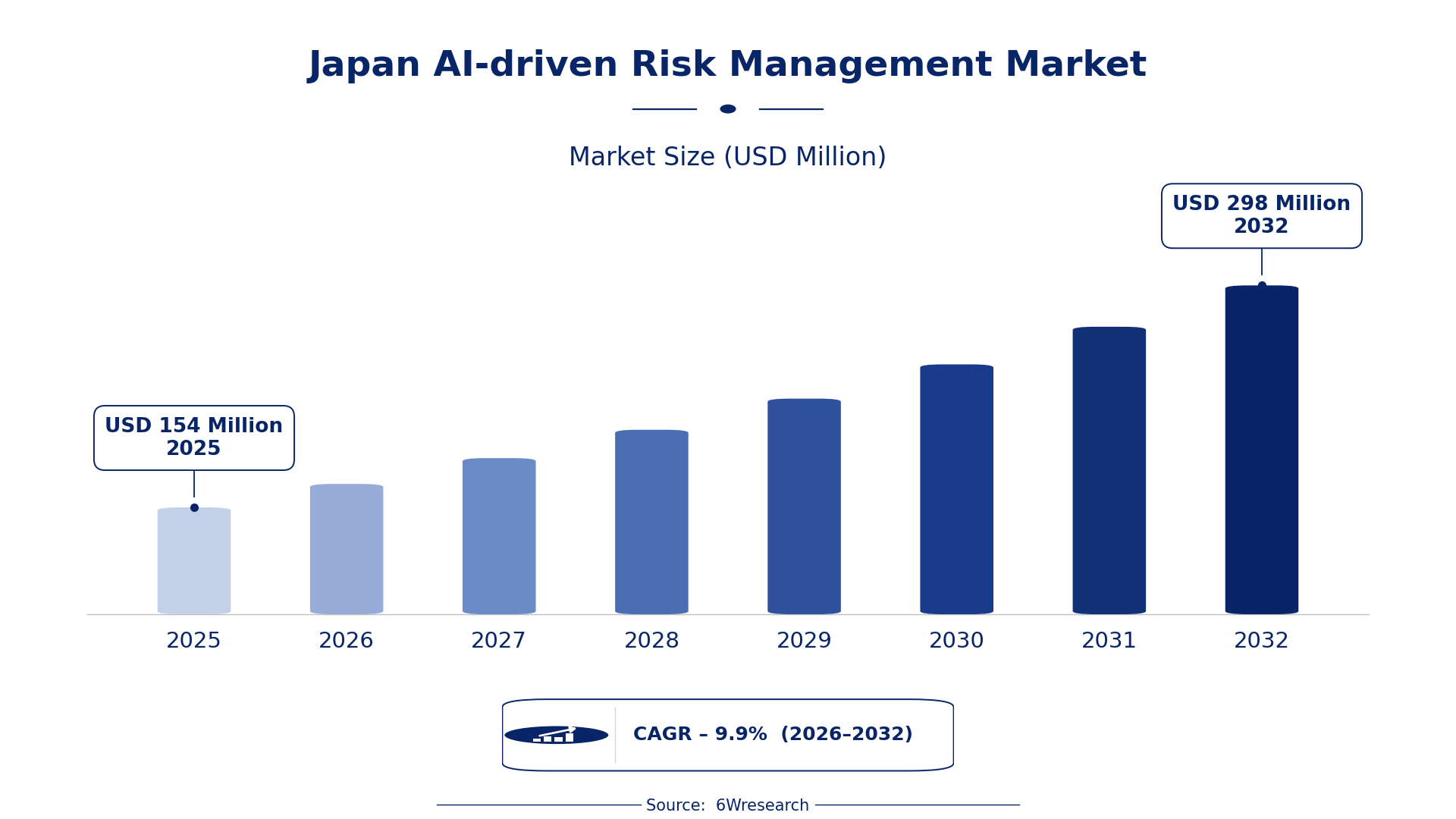
According to 6Wresearch internal database and industry insights, the Japan AI-driven Risk Management Market was valued at USD 154 Million in 2025 and is projected to reach USD 298 Million by 2032, growing at a CAGR of approximately 9.9% during 2026–2032.
Japan AI-driven Risk Management Market Highlights
| Report Metric | Details |
| Report Name | Japan AI-driven Risk Management Market (2026-2032) |
| Market Size 2025 | USD 154 Million |
| Market Size 2032 | USD 298 Million |
| Absolute Growth 2025–2032 | USD 144 Million |
| CAGR 2026–2032 | 9.9% |
| Peak Annual Growth | 11.1% in 2026 |
| Forecast Period | 2026–2032 |
| Historical Data | 2022–2025 |
| Base Year | 2025 |
| Leading Risk Type, 2025 | Financial Risk (43% share) |
| Leading AI Feature, 2025 | Predictive Modeling (36% share) |
| Leading Distribution Channel, 2025 | FinTech SaaS Vendors (44% share) |
| Leading End User, 2025 | Banks & Insurance Firms (47% share) |
| Fastest-Growing Risk Type | Operational Risk (13.2% CAGR) |
| Fastest-Growing AI Feature | NLP for Document Analysis (12.3% CAGR) |
| Fastest-Growing End User | Enterprises (12.6% CAGR) |
| Growing Sector | Financial Services |
| Key End Users | Banks, Insurance Firms, IT Departments, Regulatory Teams |
Japan AI-driven Risk Management Market Year-wise Growth Rate and Key Drivers (2022–2032)
This graph illustrates the annual growth rates of the market from 2022 to 2032, highlighting a steady upward trajectory and projected market expansion over the forecast period.
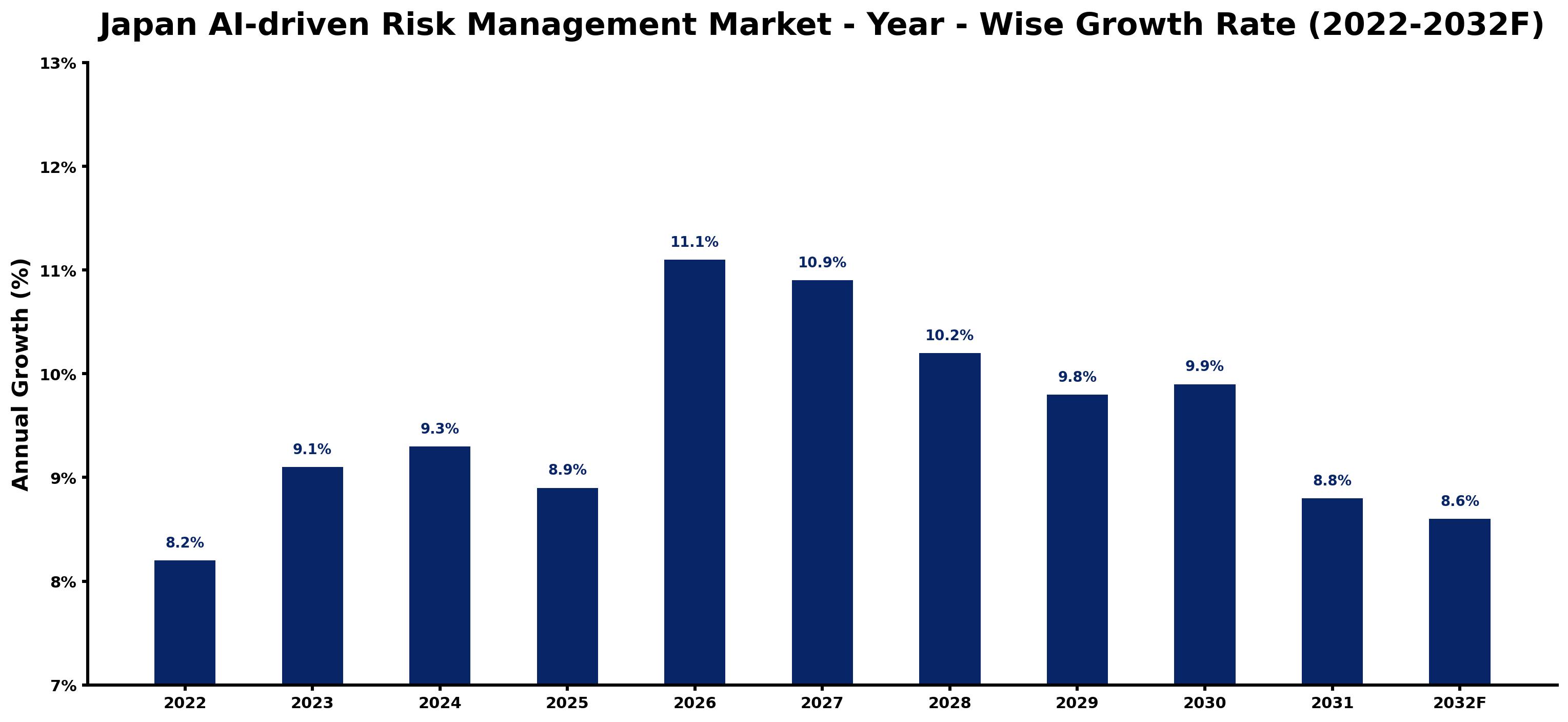
The table below sets out the estimated growth rate for each year and the main factor behind it.
| Year | Estimated Annual Growth (%) | Market Rationale |
| 2022 | 8.2 | The market showed steady growth, reflecting ongoing digital transformation in various sectors. |
| 2023 | 9.1 | Demand accelerated as financial institutions increased AI investments for risk management. |
| 2024 | 9.3 | Growth continued as more companies adopted AI technologies to improve operational efficiencies. |
| 2025 | 8.9 | The growth rate slowed slightly as market saturation began to affect new investments. |
| 2026 | 11.1 | A surge in demand is expected as organizations prioritize AI for predictive analytics and compliance. |
| 2027 | 10.9 | Growth is projected to decelerate marginally as firms focus on optimizing existing AI solutions. |
| 2028 | 10.2 | The market is expected to experience another slowdown as competition intensifies among service providers. |
| 2029 | 9.8 | A slight recovery in growth is anticipated as companies seek to strengthen cybersecurity measures. |
| 2030 | 9.9 | Demand is expected to increase again as financial institutions expand AI applications in risk assessment. |
| 2031 | 8.8 | The market will see slower growth as firms reassess their AI investment strategies. |
| 2032 | 8.6 | Growth is projected to continue slowing as market maturity sets in, stabilizing demand. |
Note: Market size estimations and growth projections presented in this report are based on 6Wresearch's proprietary forecasting methodology, utilizing the latest available industry data, government publications, and primary research inputs.
Japan AI-driven Risk Management Market Synopsis
In Japan, financial institutions are major users, with over 1,000 banks and insurance firms adopting these solutions. The market is expanding due to digital transformation efforts, rising cybersecurity threats, and substantial investments in AI technologies, with banks allocating around 20% of their IT budgets to these innovations.
Market Dynamics Impact Analysis (2026–2032)
| Factor | Type | Impact | Primary Segment Affected |
| Increased investment in AI technologies | Driver | High | Financial Risk |
| Growing demand for compliance solutions | Driver | High | Compliance Risk |
| Rising cybersecurity incidents driving AI adoption | Opportunity | High | Cybersecurity Risk |
| Expansion of digital transformation initiatives | Opportunity | Medium | Operational Risk |
| High costs associated with AI implementation | Restraint | High | Operational Risk |
| Limited availability of skilled AI professionals | Restraint | Medium | Financial Risk |
| Complexity in integrating AI with existing systems | Challenge | High | Compliance Risk |
| Rapid technological changes requiring constant updates | Challenge | Medium | Cybersecurity Risk |
Evaluation of Drivers in Japan AI-driven Risk Management Market (2026–2032)
The main growth drivers and the segments they affect most are set out below.
| Drivers | Primary Segment Affected | Why It Matters (Evidence) |
| Increased digital transformation in financial services | Financial Risk | Over 1,000 banks and insurance firms are investing heavily in AI technologies, driving demand. |
| Rising need for compliance with regulations | Compliance Risk | The Financial Services Agency oversees regulations, prompting firms to adopt AI for compliance. |
| Escalating cybersecurity threats | Cybersecurity Risk | Cybersecurity incidents increased by 20% in 2022, pushing firms to invest in AI solutions. |
| Demand for predictive analytics | Predictive Modeling | The Tokyo Stock Exchange is integrating AI for risk assessment, boosting predictive modeling applications. |
| Need for operational efficiency | Operational Risk | AI streamlines operations, leading to an average investment in AI by Japanese banks of around 20%. |
Most of the extra volume comes from the financial sector's ongoing digital transformation, with over 1,000 banks and insurance firms investing heavily in AI technologies. These institutions typically invest around 20% of their IT budgets in AI, demonstrating a strong commitment to improving operational efficiencies. Cybersecurity incidents surged by 20% in 2022, prompting firms to adopt AI-driven solutions for real-time threat detection. The Tokyo Stock Exchange is integrating AI for risk assessment, further increasing demand for predictive analytics.
Evaluation of Restraints in Japan AI-driven Risk Management Market
Several factors work against faster growth; the main ones are summarised below.
| Market Restraint | Primary Segment Affected | Why It Matters (Evidence) |
| High costs of AI implementation | Operational Risk | The average investment in AI technologies can reach 20% of IT budgets, limiting adoption. |
| Shortage of skilled AI professionals | Financial Risk | Limited availability of talent hampers the ability of firms to effectively implement AI solutions. |
| Integration challenges with existing systems | Compliance Risk | Complexity in merging AI with legacy systems can delay compliance efforts for financial institutions. |
| Rapid technological changes | Cybersecurity Risk | The fast pace of AI advancements requires constant updates, straining resources for many organizations. |
| Regulatory compliance costs | Compliance Risk | Ensuring adherence to regulations often incurs substantial expenses, impacting overall profitability. |
Japan AI-driven Risk Management Market Challenges
Buyers in Japan's financial sector face rising costs as banks allocate around 20% of their IT budgets to AI technologies, straining financial resources. Supply challenges arise due to reliance on a limited number of research institutions for advanced algorithms, leading to implementation delays that can exceed six months for financial firms. Regulatory hurdles from the Financial Services Agency complicate AI adoption, with compliance requirements potentially extending project timelines by up to four months for affected institutions. Skills shortages in AI expertise hinder operational efficiency, forcing companies to invest in training programmes that may take over a year to yield qualified personnel.
Trends in the Japan AI-driven Risk Management Market
The following changes are redrawing the Japan AI-driven Risk Management Market.
- Shift from Traditional to AI-Driven Risk Assessment: Financial institutions in Tokyo are increasingly adopting AI-driven risk assessment tools, moving away from traditional methods. In 2023, this shift is evident as over 60% of banks are integrating AI technologies.
- Transition from Reactive to Proactive Risk Management: The focus is shifting towards proactive risk management strategies, especially in cybersecurity. In 2022, incidents rose by 20%, prompting firms to adopt AI for real-time threat detection.
- NLP Tools Gaining Importance in Compliance: NLP for Document Analysis is becoming essential for compliance teams in Japan, streamlining regulatory checks. By 2025, its adoption is expected to grow significantly as firms seek efficiency.
- Increased Investment in AI for Operational Efficiency: The trend towards investing in AI for operational efficiency is strong, particularly among banks. In 2023, average AI investments reached around 20% of IT budgets, indicating a commitment to modernization.
Investment Opportunities in the Japan AI-driven Risk Management Market
The following opportunities in the Japan AI-driven Risk Management Market pair current demand with a clear way in.
- Timing for AI Adoption in Financial Services: The current demand for AI solutions is heightened due to increased cybersecurity threats, with a 20% rise in incidents in 2022. Financial institutions are looking to invest in AI-driven risk management solutions.
- Partnerships with FinTech SaaS Vendors: Now is an ideal time to partner with FinTech SaaS Vendors, who hold a 44% market share in distribution. Collaborating can facilitate entry into the AI-driven risk management space.
- Gap in Cybersecurity Solutions: With cybersecurity incidents increasing by 20%, there is a pressing gap in effective solutions. Investing in AI for real-time threat detection can meet this urgent demand.
- Expansion in Tokyo's Financial Sector: Tokyo's financial technology hub presents opportunities for AI-driven risk management solutions. Engaging with local firms can enhance market entry and growth.
Government Initiatives in the Japan AI-driven Risk Management Market
The Industrial Standardization Act, established in 1949 and amended in 2019, governs product and test standards in Japan. This law ensures that AI-driven risk management solutions meet necessary compliance and quality standards, benefiting producers and buyers alike. The Digital Agency, established in September 2021, promotes digital transformation across sectors, including the adoption of AI technologies in risk management, further supporting compliance and innovation.
The Financial Services Agency oversees initiatives impacting AI adoption in the financial sector. It funds programs aimed at supporting digital transformation, ensuring that AI solutions align with regulatory requirements. The National Institute of Advanced Industrial Science and Technology is also researching AI applications in risk management, providing resources for innovation and compliance.
Future Insight of the Japan AI-driven Risk Management Market
The Digital Agency's initiatives will drive the integration of AI in risk management by 2032, streamlining operations for financial institutions. The Ministry of Economy, Trade and Industry's support programme for AI development will boost innovation in risk assessment technologies. By 2032, the Tokyo Stock Exchange plans to fully implement AI for real-time trading assessments, improving decision-making processes. Cybersecurity advancements will address the increased demand for AI solutions, highlighting the urgent need for effective risk management capabilities.
Market Segmentation Analysis
Japan AI-driven Risk Management Market report covers a detailed analysis of the following market segments:
By Risk Type – Financial Risk Leads, Operational Risk Expected to Grow Fastest
According to Saurav Kr Singh, Senior Research Analyst at 6Wresearch, with 43% of risk type revenue in 2025, Financial Risk was the largest category. Financial Risk holds the largest share as it is crucial for over 1,000 banks and insurance firms in Japan to manage investments and predict downturns. This segment is essential for maintaining financial stability and adhering to compliance regulations overseen by the Financial Services Agency. Operational Risk is projected to grow fastest, at a CAGR of 13.2% during 2026–2032. Operational Risk is experiencing rapid growth as businesses increasingly adopt new technologies to streamline operations, particularly in response to a 20% rise in cybersecurity incidents in 2022. This trend underscores the urgent need for effective risk management solutions across various sectors. Suppliers should focus on developing solutions that address operational risk to meet the rising demand in the market.
By AI Feature – Predictive Modeling Leads, NLP for Document Analysis Expected to Grow Fastest
In 2025, Predictive Modeling led the ai feature split with a 36% share. Predictive Modeling leads the market due to its importance in forecasting potential risks based on historical data, particularly for financial institutions in Japan. Its widespread application across multiple sectors reinforces its dominant position in risk management. The quickest growth will come from NLP for Document Analysis, forecast to expand at a CAGR of 12.3% between 2026 and 2032. NLP for Document Analysis is growing quickly as the demand for efficient processing of regulatory documents increases, especially with tightening compliance requirements. This capability is vital for financial institutions striving to meet their obligations effectively. Investors should prioritise advancements in NLP technologies to align with the increasing demand for compliance solutions.
By Distribution Channel – FinTech SaaS Vendors Lead and Record the Fastest Growth
FinTech SaaS Vendors accounted for 44% of the market by distribution channel in 2025. FinTech SaaS Vendors dominate the distribution channel by offering tailored solutions specifically designed for the financial services sector. Their ability to integrate advanced technologies into existing frameworks makes them essential partners for clients. The same category are also set to grow fastest, at a CAGR of 12.1% during 2026–2032. FinTech SaaS Vendors are also the fastest-growing channel, as their solutions are increasingly adopted by financial institutions looking to enhance their risk management capabilities. Their ongoing innovation ensures they effectively address the evolving needs of the market. Suppliers must maintain competitive offerings to capitalise on the growth of FinTech SaaS solutions.
By End User – Banks & Insurance Firms Lead, Enterprises Expected to Grow Fastest
The largest end user category in 2025 was Banks & Insurance Firms, at 47% of revenue. Banks & Insurance Firms represent the largest user group for risk management solutions, utilising these technologies to improve decision-making and ensure compliance. Their substantial investment in AI highlights the importance of effectively managing financial risks. Over 2026–2032, Enterprises are expected to post the fastest growth, at a CAGR of 12.6%. Enterprises are the fastest-growing end user segment as they adopt AI for broader operational risk management beyond finance, driven by the need for efficiency across diverse sectors. This shift indicates a growing trend towards comprehensive risk management solutions. Providers should expand their offerings to cater to the increasing demand from enterprises for advanced risk management solutions.
Key Attractiveness of the Report
- 10 Years of Market Numbers
- Historical Data Starting from 2022 to 2025
- Base Year 2025
- Forecast Data until 2032
- Key Performance Indicators Impacting the Market
- Major Upcoming Developments and Projects
Key Highlights of the Report:
- Japan AI-driven Risk Management Market Outlook
- Market Size of Japan AI-driven Risk Management Market, 2025
- Forecast of Japan AI-driven Risk Management Market, 2032
- Historical Data and Forecast of Japan AI-driven Risk Management Revenues & Volume for the Period 2022-2032F
- Japan AI-driven Risk Management Market Trend Evolution
- Japan AI-driven Risk Management Market Drivers and Challenges
- Japan AI-driven Risk Management Price Trends
- Japan AI-driven Risk Management Porter's Five Forces
- Japan AI-driven Risk Management Industry Life Cycle
- Historical Data and Forecast of Japan AI-driven Risk Management Market Revenues & Volume By Risk Type for the Period 2022-2032F
- Historical Data and Forecast of Japan AI-driven Risk Management Market Revenues & Volume By Financial Risk for the Period 2022-2032F
- Historical Data and Forecast of Japan AI-driven Risk Management Market Revenues & Volume By Operational Risk for the Period 2022-2032F
- Historical Data and Forecast of Japan AI-driven Risk Management Market Revenues & Volume By Cybersecurity Risk for the Period 2022-2032F
- Historical Data and Forecast of Japan AI-driven Risk Management Market Revenues & Volume By Compliance Risk for the Period 2022-2032F
- Historical Data and Forecast of Japan AI-driven Risk Management Market Revenues & Volume By AI Feature for the Period 2022-2032F
- Historical Data and Forecast of Japan AI-driven Risk Management Market Revenues & Volume By Predictive Modeling for the Period 2022-2032F
- Historical Data and Forecast of Japan AI-driven Risk Management Market Revenues & Volume By Scenario Simulation for the Period 2022-2032F
- Historical Data and Forecast of Japan AI-driven Risk Management Market Revenues & Volume By Real-time Threat Detection for the Period 2022-2032F
- Historical Data and Forecast of Japan AI-driven Risk Management Market Revenues & Volume By NLP for Document Analysis for the Period 2022-2032F
- Historical Data and Forecast of Japan AI-driven Risk Management Market Revenues & Volume By Distribution Channel for the Period 2022-2032F
- Historical Data and Forecast of Japan AI-driven Risk Management Market Revenues & Volume By FinTech SaaS Vendors for the Period 2022-2032F
- Historical Data and Forecast of Japan AI-driven Risk Management Market Revenues & Volume By Business Intelligence Tools for the Period 2022-2032F
- Historical Data and Forecast of Japan AI-driven Risk Management Market Revenues & Volume By Security Platform Vendors for the Period 2022-2032F
- Historical Data and Forecast of Japan AI-driven Risk Management Market Revenues & Volume By RegTech Providers for the Period 2022-2032F
- Historical Data and Forecast of Japan AI-driven Risk Management Market Revenues & Volume By End User for the Period 2022-2032F
- Historical Data and Forecast of Japan AI-driven Risk Management Market Revenues & Volume By Banks & Insurance Firms for the Period 2022-2032F
- Historical Data and Forecast of Japan AI-driven Risk Management Market Revenues & Volume By Enterprises for the Period 2022-2032F
- Historical Data and Forecast of Japan AI-driven Risk Management Market Revenues & Volume By IT Departments for the Period 2022-2032F
- Historical Data and Forecast of Japan AI-driven Risk Management Market Revenues & Volume By Legal & Regulatory Teams for the Period 2022-2032F
- Japan AI-driven Risk Management Import Export Trade Statistics
- Market Opportunity Assessment By Risk Type
- Market Opportunity Assessment By AI Feature
- Market Opportunity Assessment By Distribution Channel
- Market Opportunity Assessment By End User
- Japan AI-driven Risk Management Top Companies Market Share
- Japan AI-driven Risk Management Competitive Benchmarking By Technical and Operational Parameters
- Japan AI-driven Risk Management Company Profiles
- Japan AI-driven Risk Management Key Strategic Recommendations
Market Covered
This report examines the market across the segments below.
By Risk Type
- Financial Risk
- Operational Risk
- Cybersecurity Risk
- Compliance Risk
By AI Feature
- Predictive Modeling
- Scenario Simulation
- Real-time Threat Detection
- NLP for Document Analysis
By Distribution Channel
- FinTech SaaS Vendors
- Business Intelligence Tools
- Security Platform Vendors
- RegTech Providers
By End User
- Banks & Insurance Firms
- Enterprises
- IT Departments
- Legal & Regulatory Teams































