Japan AI-enabled Automotive Systems Market Size & Growth Rate
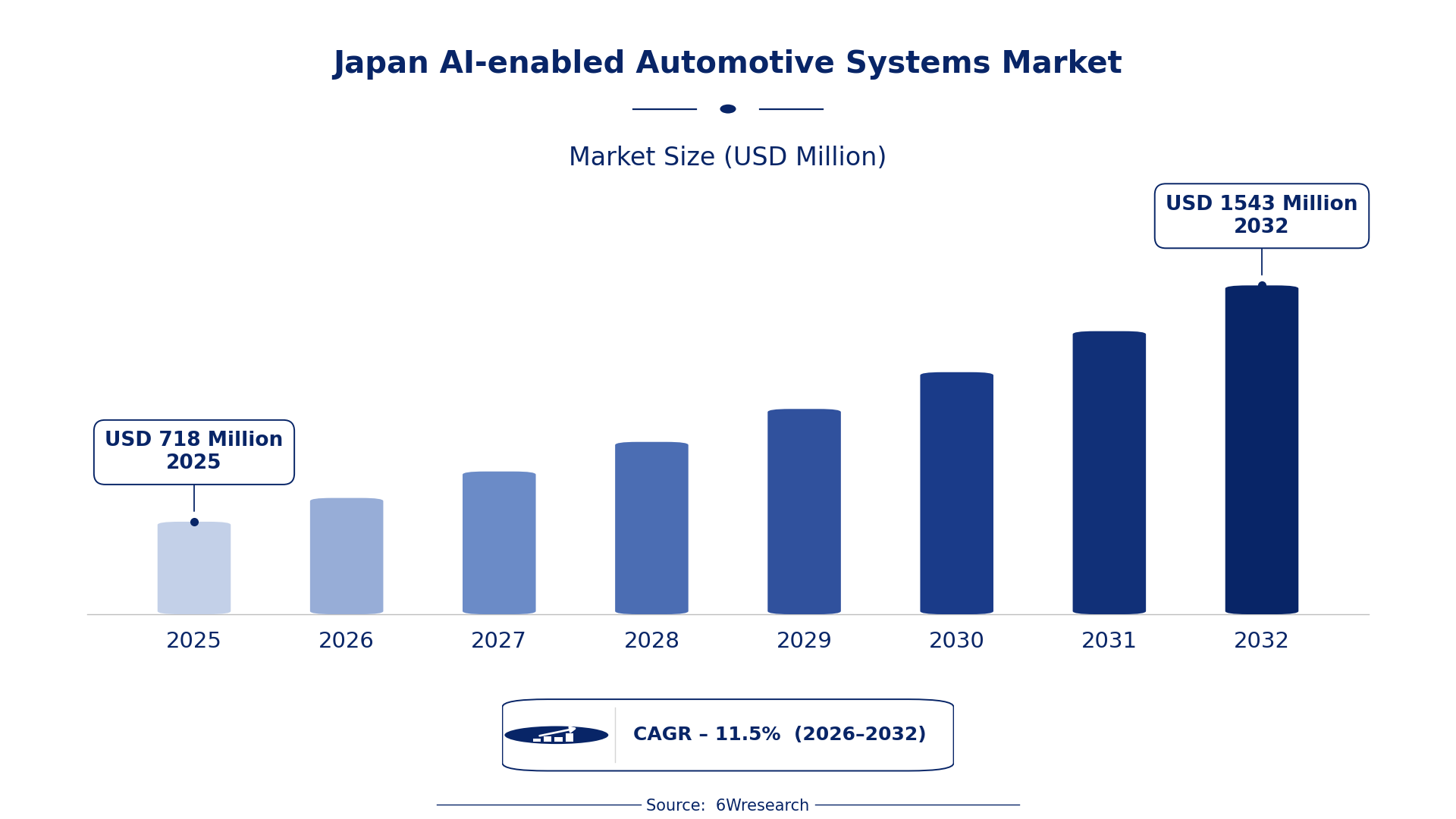
According to 6Wresearch internal database and industry insights, the Japan AI-enabled Automotive Systems Market was valued at USD 718 Million in 2025 and is projected to reach USD 1,543 Million by 2032, growing at a CAGR of approximately 11.5% during 2026–2032.
Japan AI-enabled Automotive Systems Market Highlights
| Report Metric | Details |
| Report Name | Japan AI-enabled Automotive Systems Market (2026-2032) |
| Market Size 2025 | USD 718 Million |
| Market Size 2032 | USD 1,543 Million |
| Absolute Growth 2025–2032 | USD 825 Million |
| CAGR 2026–2032 | 11.5% |
| Peak Annual Growth | 14.1% in 2032 |
| Forecast Period | 2026–2032 |
| Historical Data | 2022–2025 |
| Base Year | 2025 |
| Leading System Type, 2025 | ADAS (Driver Assist) (42% share) |
| Leading AI Functionality, 2025 | Object Detection (41% share) |
| Leading Distribution Channel, 2025 | Automotive OEMs (39% share) |
| Leading End User, 2025 | Car Manufacturers (46% share) |
| Fastest-Growing System Type | Predictive Maintenance (17.1% CAGR) |
| Fastest-Growing AI Functionality | Condition Monitoring (15.8% CAGR) |
| Fastest-Growing Distribution Channel | Vehicle Software Vendors (15.1% CAGR) |
| Fastest-Growing End User | Connected Vehicle Developers (15.4% CAGR) |
| Growing Sector | automotive technology |
| Key End Users | Car Manufacturers, Automotive OEMs, Vehicle Software Vendors, Connected Vehicle Developers |
Japan AI-enabled Automotive Systems Market Year-wise Growth Rate and Key Drivers (2022–2032)
This graph illustrates the annual growth rates of the market from 2022 to 2032, highlighting a steady upward trajectory and projected market expansion over the forecast period.
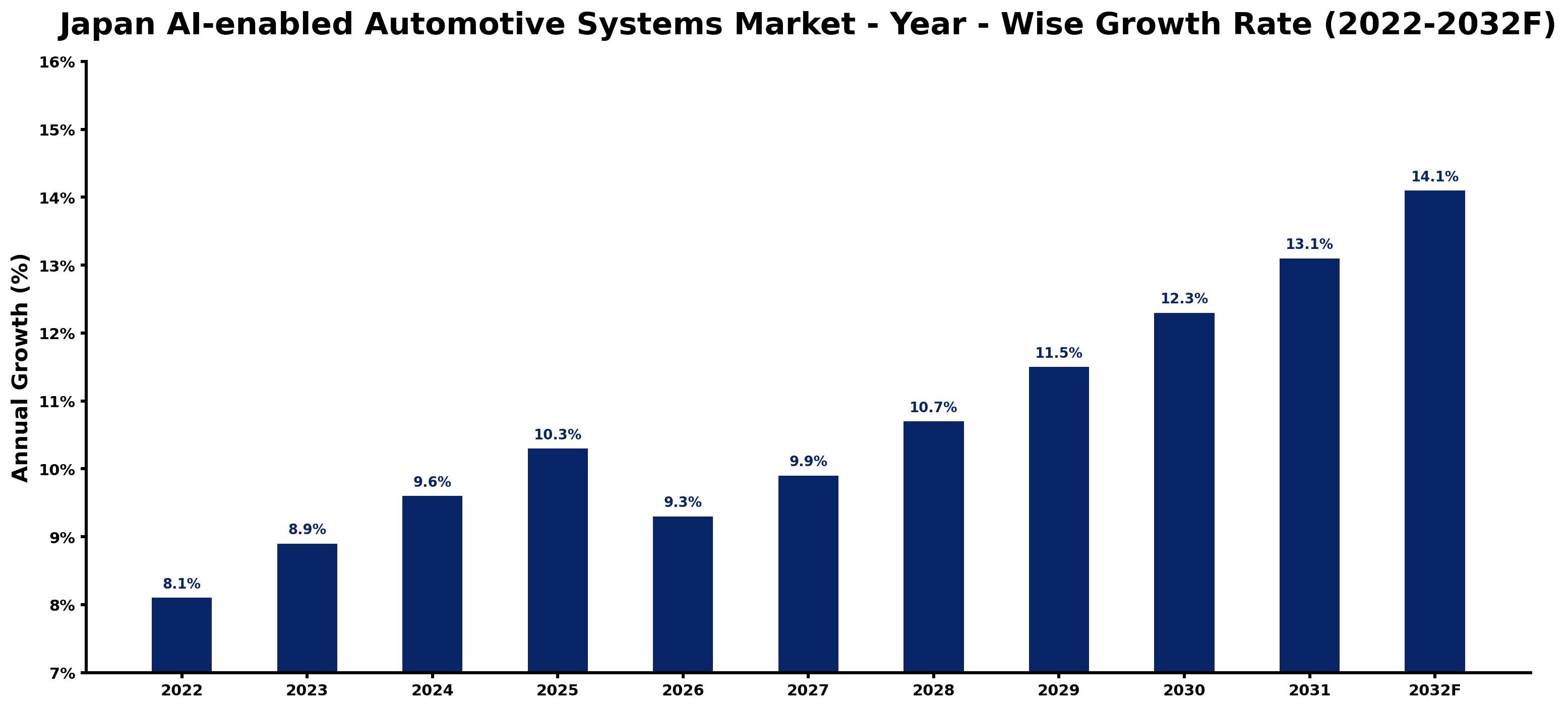
Year by year, the estimates below pair each growth rate with the development that shaped it.
| Year | Estimated Annual Growth (%) | Market Rationale |
| 2022 | 8.1 | The automotive industry showed stable demand, driven by domestic production and exports. |
| 2023 | 8.9 | Growth accelerated as manufacturers adopted more advanced technologies in vehicles. |
| 2024 | 9.6 | Increased investments in AI systems boosted market activity and innovation. |
| 2025 | 10.3 | The peak growth year saw strong adoption of ADAS under new safety standards. |
| 2026 | 9.3 | Growth is expected to slow slightly as the market adjusts to technological advancements. |
| 2027 | 9.9 | Demand is projected to pick up again with rising interest in predictive maintenance solutions. |
| 2028 | 10.7 | The market is expected to expand as more vehicles integrate in-vehicle infotainment systems. |
| 2029 | 11.5 | Growth is projected to continue with more connected vehicles entering the market. |
| 2030 | 12.3 | The push for 100% connected vehicles by 2030 will drive further demand. |
| 2031 | 13.1 | Demand is expected to surge as AI technologies become standard in new models. |
| 2032 | 14.1 | The market is projected to peak with extensive adoption of AI-enabled systems across all segments. |
Note: Market size estimations and growth projections presented in this report are based on 6Wresearch's proprietary forecasting methodology, utilizing the latest available industry data, government publications, and primary research inputs.
Japan AI-enabled Automotive Systems Market Synopsis
AI-enabled Automotive Systems in Japan encompass advanced technologies such as ADAS, in-vehicle infotainment, and predictive maintenance, developed through machine learning and data analytics. The Japan AI-enabled Automotive Systems Market is growing due to strong domestic demand from manufacturers and a rising focus on vehicle safety and connectivity. Investment in AI technologies reached 1 trillion yen in 2023, while the number of connected vehicles is projected to hit 20 million by 2025, underscoring the increasing integration of advanced systems in the automotive sector.
Market Dynamics Impact Analysis (2026–2032)
| Factor | Type | Impact | Primary Segment Affected |
| Rising adoption of ADAS technologies for enhanced vehicle safety | Driver | High | ADAS (Driver Assist) |
| Increasing demand for predictive maintenance to reduce downtime | Driver | High | Predictive Maintenance |
| Expansion of connected vehicle technology in urban areas | Opportunity | High | In-Vehicle Infotainment |
| Growing interest in AI-driven solutions among car manufacturers | Opportunity | Medium | AI ECU Systems |
| High competition among automotive electronics firms | Restraint | High | Automotive Electronics Firms |
| Challenges in integrating AI systems into existing vehicle platforms | Restraint | Medium | Car Manufacturers |
| Supply chain disruptions affecting component availability | Challenge | High | Tier-1 Auto Suppliers |
| Rapid technological advancements outpacing current market readiness | Challenge | Medium | Vehicle Software Vendors |
Evaluation of Drivers in Japan AI-enabled Automotive Systems Market (2026–2032)
The following drivers explain most of the expected growth.
| Drivers | Primary Segment Affected | Why It Matters (Evidence) |
| Investment in AI technologies | ADAS (Driver Assist) | This investment enhances safety features, with ADAS systems mandated under JIS D 0203 standards. |
| Growing number of connected vehicles | In-Vehicle Infotainment | The expected rise to 20 million connected vehicles by 2025 increases demand for infotainment systems. |
| Focus on reducing greenhouse gas emissions | Predictive Maintenance | This focus encourages manufacturers to adopt predictive maintenance to optimize vehicle performance. |
| Integration of smartphone applications | AI ECU Systems | The increasing integration with smartphones enhances user experience and drives demand for AI ECU systems. |
| Rising consumer demand for connectivity | Object Detection | This demand propels the development of object detection systems for autonomous driving features. |
Spending rises because Japan's automotive sector is increasingly investing in AI technologies, with 1 trillion yen allocated in 2023 for automotive applications. The push for 100% connected vehicles by 2030 is driving manufacturers to adopt advanced systems. The number of connected vehicles is expected to reach 20 million by 2025, further stimulating market growth.
Evaluation of Restraints in Japan AI-enabled Automotive Systems Market
These restraints slow adoption and weigh on supplier margins.
| Market Restraint | Primary Segment Affected | Why It Matters (Evidence) |
| High competition leading to price pressures | Automotive Electronics Firms | Over 200 automotive electronics firms in Japan intensify competition, impacting profit margins. |
| Integration challenges with legacy systems | Car Manufacturers | Existing vehicle platforms complicate the adoption of new AI technologies, affecting upgrades. |
| Supply chain disruptions affecting component availability | Tier-1 Auto Suppliers | Global supply chain issues have delayed the delivery of essential components, hindering production. |
| Limited consumer awareness of AI benefits | Vehicle Software Vendors | Many consumers remain unaware of the advantages of AI-enabled systems, slowing adoption rates. |
| Regulatory hurdles for new technologies | AI ECU Systems | Compliance with evolving safety regulations can delay product launches, affecting market entry. |
Japan AI-enabled Automotive Systems Market Challenges
A major obstacle for AI-enabled automotive systems in Japan is the rapid pace of technological advancement, which leaves many producers unable to keep up. This technology gap results in delays in product launches, costing manufacturers potential revenue losses of up to 200 billion yen annually. Buyers face challenges with integrating new technologies, as many existing vehicles lack the necessary infrastructure, leading to an estimated 15% increase in retrofitting costs. Complexities in the supply chain arise from reliance on over 1,000 Tier-1 suppliers, which can cause production delays and inflate costs for manufacturers. Regulatory compliance with standards like JIS D 0203 adds further pressure, as non-compliance can result in hefty fines impacting both manufacturers and buyers.
Trends in the Japan AI-enabled Automotive Systems Market
The trends below show where the Japan AI-enabled Automotive Systems Market is heading.
- Shift towards Advanced Driver Assistance Systems: In 2023, the adoption of ADAS technologies surged as manufacturers responded to safety mandates. This shift is reflected in the approximately 8.3 million vehicles produced in Japan, with a significant portion equipped with these systems.
- Increase in Connected Vehicles: The Tokyo region is experiencing a rapid increase in connected vehicles, expected to reach 20 million by 2025. This trend enhances data usage and connectivity, benefiting automotive electronics firms.
- Growing Integration of In-Vehicle Infotainment Systems: Since 2022, in-vehicle infotainment systems have increasingly integrated smartphone applications, improving user experience. This trend is evident as car manufacturers focus on connectivity features in new models.
- Emphasis on Predictive Maintenance Technologies: Starting in 2023, major car manufacturers are adopting predictive maintenance technologies to reduce downtime. This shift addresses maintenance costs and improves vehicle reliability.
Investment Opportunities in the Japan AI-enabled Automotive Systems Market
Below are the investment opportunities with the strongest case in the Japan AI-enabled Automotive Systems Market.
- Investment gap in AI technologies: With investment in AI technologies reaching 1 trillion yen in 2023, there is an opportunity for suppliers to develop advanced automotive systems. Car manufacturers are eager to adopt these innovations to improve their offerings.
- Demand for enhanced vehicle safety features: As safety regulations tighten, there is a growing need for advanced AI-enabled safety features. Automotive OEMs are actively seeking solutions to meet these requirements, presenting a prime opportunity for technology providers.
- Expansion of connected vehicle infrastructure: The target for 100% connected vehicles by 2030 creates a demand for infrastructure development. Urban areas are looking for partners to support this transition, making it an opportune time for investment.
- Rising consumer interest in infotainment systems: With the increasing integration of smartphone applications, there is a demand for innovative infotainment solutions. Vehicle software vendors can capitalise on this trend by offering advanced technologies.
Government Initiatives in the Japan AI-enabled Automotive Systems Market
The GX Promotion Act (2023) establishes a framework for promoting decarbonisation in the automotive sector, building on the Green Growth Strategy from 2020. This new law encourages investment in AI technologies and mandates compliance with environmental standards, ensuring that automotive systems align with national targets and improving their marketability.
The Ministry of Economy, Trade and Industry oversees funding for research and development in automotive AI. This agency supports projects aimed at improving vehicle safety and connectivity, approving initiatives that align with Japan's decarbonisation goals and facilitating the integration of new technologies.
Future Insight of the Japan AI-enabled Automotive Systems Market
Japan's commitment to a 46% reduction in greenhouse-gas emissions by 2030 will drive the adoption of AI-enabled automotive systems. By 2032, investment in AI technologies for automotive applications is expected to reach 3 trillion yen, spurring advancements in vehicle safety and maintenance. The government’s target for 100% connected vehicles by 2030 will create new opportunities for suppliers and buyers. As the Tokyo region solidifies its role as a technology hub, collaboration between research institutions and manufacturers will support the evolution of in-vehicle systems.
Market Segmentation Analysis
Japan AI-enabled Automotive Systems Market report covers a detailed analysis of the following market segments:
By System Type – ADAS (Driver Assist) Leads, Predictive Maintenance Expected to Grow Fastest
According to Saurav Kr Singh, Senior Research Analyst at 6Wresearch, with 42% of system type revenue in 2025, ADAS (Driver Assist) was the largest category. ADAS systems hold the largest share due to their critical role in enhancing vehicle safety and driver assistance, as mandated under JIS D 0203 standards. The substantial installed base is supported by Japan's production of approximately 8.3 million vehicles in 2022. Predictive Maintenance is projected to grow fastest, at a CAGR of 17.1% during 2026–2032. Predictive maintenance is experiencing rapid growth as major car manufacturers adopt these technologies to reduce downtime and maintenance costs. Investment in AI technologies for automotive applications reached 1 trillion yen in 2023, indicating strong market interest. Suppliers should focus on developing advanced predictive maintenance solutions to meet the growing demand from manufacturers.
By AI Functionality – Object Detection Leads, Condition Monitoring Expected to Grow Fastest
Object Detection held 41% of the Japan AI-enabled Automotive Systems Market by ai functionality in 2025. Object detection leads the market as it is crucial for enabling autonomous driving features, which are increasingly sought after in modern vehicles. This functionality is essential for the safety and efficiency of the growing number of connected vehicles in Japan. Condition Monitoring is set to record the highest CAGR in this split, 15.8% over 2026–2032. Condition monitoring is growing quickly as it is vital for ensuring vehicle health and performance, particularly with the target of 100% connected vehicles by 2030. The increasing integration of AI in automotive systems is further propelling this segment's growth. Buyers will benefit from enhanced vehicle performance and safety through improved condition monitoring technologies.
By Distribution Channel – Automotive OEMs Lead, Vehicle Software Vendors Expected to Grow Fastest
Automotive OEMs accounted for 39% of the market by distribution channel in 2025. Automotive OEMs dominate the market as they are the primary developers and integrators of AI-enabled systems, directly influencing the adoption of these technologies in new vehicles. Their established relationships with manufacturers facilitate widespread implementation. The quickest growth will come from Vehicle Software Vendors, forecast to expand at a CAGR of 15.1% between 2026 and 2032. Vehicle software vendors are rapidly expanding as key providers of software solutions for automotive applications, driven by the increasing complexity of AI technologies. The push for connected vehicles is further accelerating their growth in the market. Suppliers should consider partnerships with software vendors to enhance their offerings and reach a broader customer base.
By End User – Car Manufacturers Lead, Connected Vehicle Developers Expected to Grow Fastest
The largest end user category in 2025 was Car Manufacturers, at 46% of revenue. Car manufacturers are the leading end users as they are the main developers of AI-enabled systems, directly influencing the implementation of advanced technologies in their vehicles. Their significant production volume ensures a strong demand for these systems. Over 2026–2032, Connected Vehicle Developers are expected to post the fastest growth, at a CAGR of 15.4%. Connected vehicle developers are growing swiftly as they focus on enhancing vehicle connectivity and data usage, which are critical for the future of automotive technology. The government's push for 100% connected vehicles by 2030 is a key driver of this growth. Suppliers must align their products with the needs of connected vehicle developers to capitalise on emerging opportunities.
Key Attractiveness of the Report
- 10 Years of Market Numbers
- Historical Data Starting from 2022 to 2025
- Base Year 2025
- Forecast Data until 2032
- Key Performance Indicators Impacting the Market
- Major Upcoming Developments and Projects
Key Highlights of the Report:
- Japan AI-enabled Automotive Systems Market Outlook
- Market Size of Japan AI-enabled Automotive Systems Market, 2025
- Forecast of Japan AI-enabled Automotive Systems Market, 2032
- Historical Data and Forecast of Japan AI-enabled Automotive Systems Revenues & Volume for the Period 2022-2032F
- Japan AI-enabled Automotive Systems Market Trend Evolution
- Japan AI-enabled Automotive Systems Market Drivers and Challenges
- Japan AI-enabled Automotive Systems Price Trends
- Japan AI-enabled Automotive Systems Porter's Five Forces
- Japan AI-enabled Automotive Systems Industry Life Cycle
- Historical Data and Forecast of Japan AI-enabled Automotive Systems Market Revenues & Volume By System Type for the Period 2022-2032F
- Historical Data and Forecast of Japan AI-enabled Automotive Systems Market Revenues & Volume By ADAS (Driver Assist) for the Period 2022-2032F
- Historical Data and Forecast of Japan AI-enabled Automotive Systems Market Revenues & Volume By In-Vehicle Infotainment for the Period 2022-2032F
- Historical Data and Forecast of Japan AI-enabled Automotive Systems Market Revenues & Volume By Predictive Maintenance for the Period 2022-2032F
- Historical Data and Forecast of Japan AI-enabled Automotive Systems Market Revenues & Volume By AI ECU Systems for the Period 2022-2032F
- Historical Data and Forecast of Japan AI-enabled Automotive Systems Market Revenues & Volume By AI Functionality for the Period 2022-2032F
- Historical Data and Forecast of Japan AI-enabled Automotive Systems Market Revenues & Volume By Object Detection for the Period 2022-2032F
- Historical Data and Forecast of Japan AI-enabled Automotive Systems Market Revenues & Volume By Voice/Touch AI Interface for the Period 2022-2032F
- Historical Data and Forecast of Japan AI-enabled Automotive Systems Market Revenues & Volume By Condition Monitoring for the Period 2022-2032F
- Historical Data and Forecast of Japan AI-enabled Automotive Systems Market Revenues & Volume By Behavior Optimization for the Period 2022-2032F
- Historical Data and Forecast of Japan AI-enabled Automotive Systems Market Revenues & Volume By Distribution Channel for the Period 2022-2032F
- Historical Data and Forecast of Japan AI-enabled Automotive Systems Market Revenues & Volume By Automotive OEMs for the Period 2022-2032F
- Historical Data and Forecast of Japan AI-enabled Automotive Systems Market Revenues & Volume By Vehicle Software Vendors for the Period 2022-2032F
- Historical Data and Forecast of Japan AI-enabled Automotive Systems Market Revenues & Volume By Fleet Tech Providers for the Period 2022-2032F
- Historical Data and Forecast of Japan AI-enabled Automotive Systems Market Revenues & Volume By Tier-1 Auto Suppliers for the Period 2022-2032F
- Historical Data and Forecast of Japan AI-enabled Automotive Systems Market Revenues & Volume By End User for the Period 2022-2032F
- Historical Data and Forecast of Japan AI-enabled Automotive Systems Market Revenues & Volume By Car Manufacturers for the Period 2022-2032F
- Historical Data and Forecast of Japan AI-enabled Automotive Systems Market Revenues & Volume By Connected Vehicle Developers for the Period 2022-2032F
- Historical Data and Forecast of Japan AI-enabled Automotive Systems Market Revenues & Volume By Vehicle Maintenance Teams for the Period 2022-2032F
- Historical Data and Forecast of Japan AI-enabled Automotive Systems Market Revenues & Volume By Automotive Electronics Firms for the Period 2022-2032F
- Japan AI-enabled Automotive Systems Import Export Trade Statistics
- Market Opportunity Assessment By System Type
- Market Opportunity Assessment By AI Functionality
- Market Opportunity Assessment By Distribution Channel
- Market Opportunity Assessment By End User
- Japan AI-enabled Automotive Systems Top Companies Market Share
- Japan AI-enabled Automotive Systems Competitive Benchmarking By Technical and Operational Parameters
- Japan AI-enabled Automotive Systems Company Profiles
- Japan AI-enabled Automotive Systems Key Strategic Recommendations
Market Covered
Coverage by segment is as follows.
By System Type
- ADAS (Driver Assist)
- In-Vehicle Infotainment
- Predictive Maintenance
- AI ECU Systems
By AI Functionality
- Object Detection
- Voice/Touch AI Interface
- Condition Monitoring
- Behavior Optimization
By Distribution Channel
- Automotive OEMs
- Vehicle Software Vendors
- Fleet Tech Providers
- Tier-1 Auto Suppliers
By End User
- Car Manufacturers
- Connected Vehicle Developers
- Vehicle Maintenance Teams
- Automotive Electronics Firms































