Japan AI-Enabled Luxury Vehicles Market Size & Growth Rate
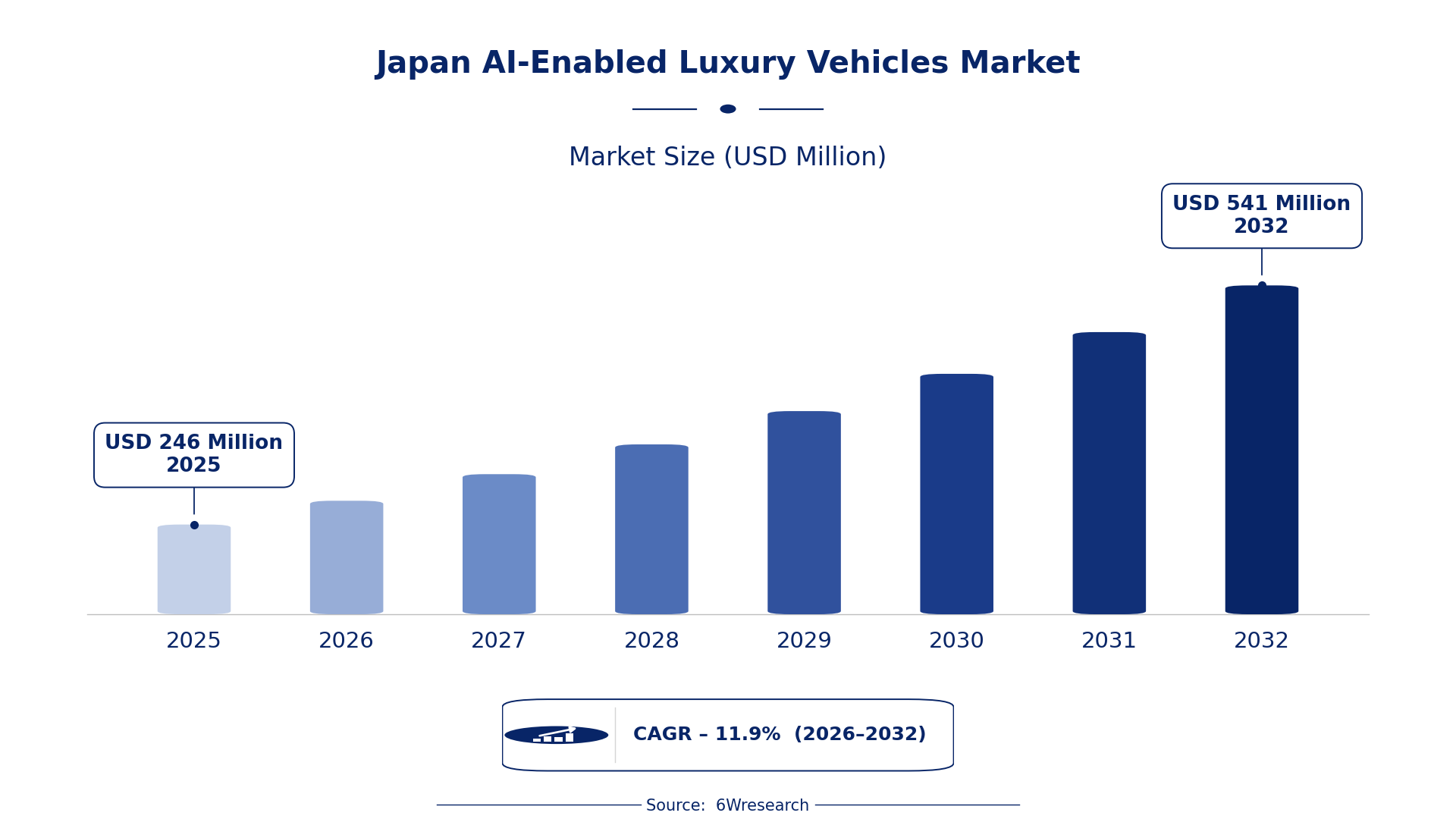
According to 6Wresearch internal database and industry insights, the Japan AI-Enabled Luxury Vehicles Market was valued at USD 246 Million in 2025 and is projected to reach USD 541 Million by 2032, growing at a CAGR of approximately 11.9% during 2026–2032.
Japan AI-Enabled Luxury Vehicles Market Highlights
| Report Metric | Details |
| Report Name | Japan AI-Enabled Luxury Vehicles Market (2026-2032) |
| Market Size 2025 | USD 246 Million |
| Market Size 2032 | USD 541 Million |
| Absolute Growth 2025–2032 | USD 295 Million |
| CAGR 2026–2032 | 11.9% |
| Peak Annual Growth | 13.3% in 2032 |
| Forecast Period | 2026–2032 |
| Historical Data | 2022–2025 |
| Base Year | 2025 |
| Leading Feature Type, 2025 | Autonomous Driving (53% share) |
| Leading AI Enhancement, 2025 | NLP and Emotion AI (38% share) |
| Leading Distribution Channel, 2025 | Premium Auto Brands (45% share) |
| Leading End User, 2025 | High-End Car Buyers (45% share) |
| Fastest-Growing Feature Type | Cabin Personalization (17.6% CAGR) |
| Fastest-Growing Distribution Channel | Luxury Showrooms (16.0% CAGR) |
| Fastest-Growing End User | Luxury Vehicle Manufacturers (15.5% CAGR) |
| Growing Sector | Luxury Vehicle Manufacturing |
| Key End Users | High-End Car Buyers, Luxury Vehicle Manufacturers, Executive Segment Drivers, Elite Chauffeur Services |
Japan AI-Enabled Luxury Vehicles Market Year-wise Growth Rate and Key Drivers (2022–2032)
This graph illustrates the annual growth rates of the market from 2022 to 2032, highlighting a steady upward trajectory and projected market expansion over the forecast period.
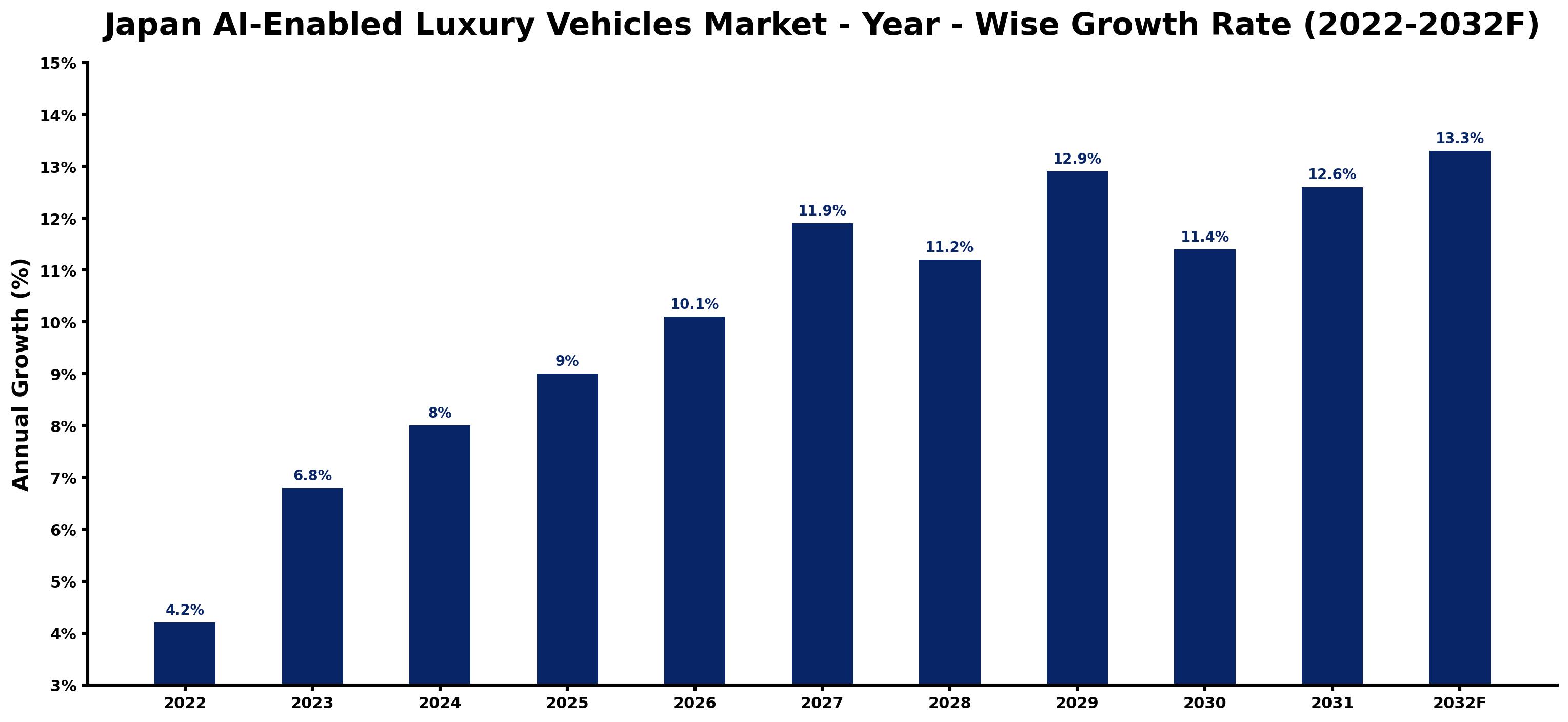
Annual growth estimates for each year appear below with the principal reason behind them, explaining the shifts that set the pace of the market.
| Year | Estimated Annual Growth (%) | Market Rationale |
| 2022 | 4.2 | The market showed steady growth, reflecting increasing interest in luxury vehicles. |
| 2023 | 6.8 | Demand accelerated due to rising consumer interest in AI technologies for improved driving experiences. |
| 2024 | 8.0 | Growth continued as more buyers sought advanced features in luxury vehicles. |
| 2025 | 9.0 | The market peaked historically as sales reached new heights driven by technology adoption. |
| 2026 | 10.1 | Growth is expected to remain strong as AI technologies become more integrated into vehicles. |
| 2027 | 11.9 | The market is projected to expand further with rising investments in AI capabilities. |
| 2028 | 11.2 | Growth is expected to slow slightly as the market matures and competition intensifies. |
| 2029 | 12.9 | Demand is expected to rise again as new models with advanced features are introduced. |
| 2030 | 11.4 | Growth is projected to moderate as buyers become more selective in their luxury vehicle purchases. |
| 2031 | 12.6 | The market is expected to accelerate again as consumer preferences shift towards AI-enabled features. |
| 2032 | 13.3 | Growth is projected to peak as the market embraces fully autonomous driving capabilities. |
Note: Market size estimations and growth projections presented in this report are based on 6Wresearch's proprietary forecasting methodology, utilizing the latest available industry data, government publications, and primary research inputs.
Japan AI-Enabled Luxury Vehicles Market Synopsis
AI-Enabled Luxury Vehicles are high-end automobiles equipped with advanced artificial intelligence technologies that improve driving experiences and safety. The Japanese AI-Enabled Luxury Vehicles Market is projected to reach 1.5 million units by 2025, driven by high-income consumers and technology enthusiasts. Ongoing investments in AI technologies and increasing demand for personalised user experiences are propelling market growth.
Market Dynamics Impact Analysis (2026–2032)
| Factor | Type | Impact | Primary Segment Affected |
| Rising consumer interest in advanced AI features | Driver | High | Autonomous Driving |
| Increasing demand for personalized experiences in vehicles | Driver | High | Cabin Personalization |
| Growth in high-income consumers seeking luxury vehicles | Opportunity | High | High-End Car Buyers |
| Expansion of luxury showrooms in urban areas | Opportunity | Medium | Luxury Showrooms |
| High costs associated with AI technology integration | Restraint | High | Autonomous Driving |
| Limited availability of skilled workforce for AI development | Restraint | Medium | NLP and Emotion AI |
| Intense competition among luxury vehicle manufacturers | Challenge | High | Premium Auto Brands |
| Regulatory hurdles for autonomous vehicle deployment | Challenge | Medium | Autonomous Driving |
Evaluation of Drivers in Japan AI-Enabled Luxury Vehicles Market (2026–2032)
Demand rests on the following drivers, each shown with the segment it touches most.
| Drivers | Primary Segment Affected | Why It Matters (Evidence) |
| Growing investments in AI technologies | NLP and Emotion AI | Japan's automotive industry invested ¥200 billion in AI technologies in 2023, leading to increased development of advanced features. |
| Demand for enhanced safety features | Autonomous Driving | The implementation of ISO 26262 standards for functional safety has driven manufacturers to integrate AI technologies into vehicles. |
| Consumer preference for luxury experiences | Cabin Personalization | Cabin personalization features are increasingly demanded by 70% of high-end car buyers, prompting manufacturers to innovate. |
| Expansion of luxury vehicle sales channels | Luxury Showrooms | Tokyo, with over 300 luxury showrooms, serves as a major hub for luxury vehicle sales, boosting market access. |
| Government initiatives promoting smart mobility | Smart Suspension | The 'Smart Mobility Strategy' launched in 2023 encourages the adoption of AI in transportation, increasing demand for smart features. |
The strongest pull on demand comes from growing investments in AI technologies, with Japan's automotive industry investing ¥200 billion in 2023. Demand for improved safety features rises as manufacturers implement ISO 26262 standards for functional safety, encouraging more AI integration. Consumer preference for luxury experiences drives the need for cabin personalisation, with 70% of high-end car buyers seeking these features. The expansion of luxury vehicle sales channels in Tokyo, featuring over 300 luxury showrooms, boosts market access.
Evaluation of Restraints in Japan AI-Enabled Luxury Vehicles Market
Below are the constraints most often cited by buyers and suppliers, with the segment each affects.
| Market Restraint | Primary Segment Affected | Why It Matters (Evidence) |
| High costs associated with AI technology integration | Autonomous Driving | The integration of advanced AI technologies incurs high costs, limiting affordability for some consumers. |
| Limited availability of skilled workforce for AI development | NLP and Emotion AI | A shortage of skilled professionals in AI development hampers the pace of innovation in luxury vehicles. |
| Regulatory hurdles for autonomous vehicle deployment | Autonomous Driving | Strict regulations surrounding autonomous vehicles create barriers to market entry for new technologies. |
| Intense competition among luxury vehicle manufacturers | Premium Auto Brands | High competition leads to price wars, affecting profit margins for manufacturers in the luxury segment. |
| Consumer hesitation towards fully autonomous vehicles | Autonomous Driving | Concerns about safety and reliability of autonomous driving technologies slow adoption rates among potential buyers. |
Japan AI-Enabled Luxury Vehicles Market Challenges
High-end car buyers incur higher maintenance costs due to a shortage of skilled technicians for AI-enabled luxury vehicles, which delays repairs by an average of two weeks. This skills gap exists because of a lack of specialised training programmes in Japan, leading to frustration among consumers. Rising production costs burden suppliers, as integrating advanced AI technologies necessitates substantial investment, potentially increasing vehicle prices by 20%. Supply chain disruptions hinder producers, with delays in sourcing AI components leading to potential revenue losses of ¥50 billion. Regulatory challenges complicate the introduction of new models, as compliance with established safety standards can extend development timelines by several months.
Trends in the Japan AI-Enabled Luxury Vehicles Market
Below are the shifts with the largest effect on the Japan AI-Enabled Luxury Vehicles Market.
- Shift towards Personalised Driving Experiences: In 2023, 70% of high-end car buyers expressed a preference for cabin personalisation features, indicating a market shift. This trend encourages manufacturers to innovate and tailor vehicles to individual preferences.
- Transition from Traditional to AI-Driven Features: Since 2023, there has been a notable transition towards AI-driven features in luxury vehicles, demonstrated by the Tokyo Motor Show showcasing over 50 AI-enabled models. This shift reflects changing consumer expectations in the luxury segment.
- Emergence of Smart Mobility Initiatives: The launch of the Green Growth Strategy in 2020 has accelerated the integration of AI technologies in transportation, promoting smarter and more efficient mobility solutions across Japan.
- Growing Focus on Autonomous Driving Technologies: The increasing consumer demand for autonomous driving capabilities is clear, with manufacturers investing heavily in AI technologies to meet this expectation, aligning with Japan's goal for net zero emissions by 2050.
Investment Opportunities in the Japan AI-Enabled Luxury Vehicles Market
Investors looking at the Japan AI-Enabled Luxury Vehicles Market should consider the following areas.
- Collaborations with Local AI Developers: With a projected market size of USD 246 million by 2025, there is a gap in AI technology integration. Collaborating with local AI developers can improve product offerings for luxury vehicle manufacturers.
- Investment in Luxury Showrooms: Tokyo's luxury showroom market, with over 300 locations, presents an opportunity for investment. Establishing new showrooms can cater to the growing demand for luxury vehicles among high-income consumers.
- Focus on Autonomous Vehicle Technologies: The increasing interest in autonomous vehicles creates a need for advanced AI solutions. Targeting high-end car buyers in urban areas can drive sales and market penetration.
- Development of Smart Suspension Systems: The demand for improved ride quality and handling through smart suspension systems is rising. Investing in this technology can meet the needs of luxury vehicle manufacturers and consumers.
Government Initiatives in the Japan AI-Enabled Luxury Vehicles Market
The Green Growth Strategy Through Achieving Carbon Neutrality in 2050, adopted in December 2020 and updated in 2021, sets ambitious targets for reducing greenhouse gas emissions. This strategy identifies 14 growth sectors, including the automotive industry, which must align with these sustainability goals, influencing production practices and technology adoption for AI-Enabled Luxury Vehicles.
The Ministry of Land, Infrastructure, Transport and Tourism oversees regulations for autonomous vehicles and funds initiatives that promote smart mobility. In 2023, the agency approved several projects aimed at integrating AI technologies in transportation, supporting the industry's transition towards more sustainable practices.
Future Insight of the Japan AI-Enabled Luxury Vehicles Market
The 'Smart Mobility Strategy' will drive the integration of AI technologies in luxury vehicles by 2032, enhancing user experiences and safety features. By this time, Japan's automotive industry will have invested an additional ¥200 billion in AI advancements, resulting in more sophisticated models. The Tokyo Motor Show will showcase over 100 AI-enabled luxury vehicle models, reflecting the increasing consumer demand for innovation. As cabin personalisation becomes a standard expectation, around 70% of high-end car buyers will seek tailored experiences in their vehicles.
Market Segmentation Analysis
Japan AI-Enabled Luxury Vehicles Market report covers a detailed analysis of the following market segments:
By Feature Type – Autonomous Driving Leads, Cabin Personalization Expected to Grow Fastest
According to Saurav Kr Singh, Senior Research Analyst at 6Wresearch, the largest feature type category in 2025 was Autonomous Driving, at 53% of revenue. Autonomous driving holds the largest share due to its high demand among consumers seeking convenience and safety. This feature is particularly appealing in urban areas like Tokyo, where traffic congestion is prevalent. Cabin Personalization is set to record the highest CAGR in this split, 17.6% over 2026–2032. Cabin personalization is experiencing rapid growth as 70% of high-end car buyers express a desire for tailored interior environments. This trend aligns with the increasing focus on personalised user experiences in luxury vehicles. Suppliers should prioritise the development of advanced cabin features to meet consumer expectations.
By AI Enhancement – NLP and Emotion AI Leads and Records the Fastest Growth
In 2025, NLP and Emotion AI led the ai enhancement split with a 38% share. The largest share is held by user interaction technologies, which enhance the driving experience and appeal to consumers who prioritise advanced features. This segment is vital for creating intuitive vehicles that resonate with tech-savvy buyers in Japan. The same category is also set to grow fastest, at a CAGR of 13.4% during 2026–2032. The growth rate of user interaction technologies will remain strong as their integration becomes essential for luxury vehicles. This segment's ability to improve user engagement ensures that it will continue to lead the market. Manufacturers must prioritise user interaction technologies to stay competitive in the luxury vehicle sector.
By Distribution Channel – Premium Auto Brands Lead, Luxury Showrooms Expected to Grow Fastest
Premium Auto Brands took 45% of distribution channel revenue in 2025, more than any other category. Premium auto brands dominate the distribution channel due to their strong association with high-end features and luxury experiences, appealing to affluent consumers. Their established market presence reinforces their leading role in the luxury vehicle segment. Over 2026–2032, Luxury Showrooms are expected to post the fastest growth, at a CAGR of 16.0%. Luxury showrooms are rapidly gaining traction as they provide an ideal environment for showcasing advanced vehicles, aligning with consumer preferences for immersive buying experiences. This trend indicates a shift towards enhancing physical retail spaces in the luxury market. Dealers should focus on improving showroom experiences to effectively highlight advanced features and attract buyers.
By End User – High-End Car Buyers Lead, Luxury Vehicle Manufacturers Expected to Grow Fastest
High-End Car Buyers held 45% of the Japan AI-Enabled Luxury Vehicles Market by end user in 2025. High-end car buyers represent the primary consumer base for luxury vehicles, significantly influencing demand with their purchasing power and preference for advanced technology. Their substantial contribution to overall sales solidifies their leading role in the market. The quickest growth will come from Luxury Vehicle Manufacturers, forecast to expand at a CAGR of 15.5% between 2026 and 2032. Luxury vehicle manufacturers are seeing growth as they adapt to the increasing demand for advanced features in their products. This segment's expansion reflects a strong response to market trends and consumer expectations. Suppliers should work closely with manufacturers to ensure product offerings meet the evolving expectations of high-end buyers.
Key Attractiveness of the Report
- 10 Years of Market Numbers
- Historical Data Starting from 2022 to 2025
- Base Year 2025
- Forecast Data until 2032
- Key Performance Indicators Impacting the Market
- Major Upcoming Developments and Projects
Key Highlights of the Report:
- Japan AI-Enabled Luxury Vehicles Market Outlook
- Market Size of Japan AI-Enabled Luxury Vehicles Market, 2025
- Forecast of Japan AI-Enabled Luxury Vehicles Market, 2032
- Historical Data and Forecast of Japan AI-Enabled Luxury Vehicles Revenues & Volume for the Period 2022-2032F
- Japan AI-Enabled Luxury Vehicles Market Trend Evolution
- Japan AI-Enabled Luxury Vehicles Market Drivers and Challenges
- Japan AI-Enabled Luxury Vehicles Price Trends
- Japan AI-Enabled Luxury Vehicles Porter's Five Forces
- Japan AI-Enabled Luxury Vehicles Industry Life Cycle
- Historical Data and Forecast of Japan AI-Enabled Luxury Vehicles Market Revenues & Volume By Feature Type for the Period 2022-2032F
- Historical Data and Forecast of Japan AI-Enabled Luxury Vehicles Market Revenues & Volume By In-Car Assistant for the Period 2022-2032F
- Historical Data and Forecast of Japan AI-Enabled Luxury Vehicles Market Revenues & Volume By Smart Suspension for the Period 2022-2032F
- Historical Data and Forecast of Japan AI-Enabled Luxury Vehicles Market Revenues & Volume By Cabin Personalization for the Period 2022-2032F
- Historical Data and Forecast of Japan AI-Enabled Luxury Vehicles Market Revenues & Volume By Autonomous Driving for the Period 2022-2032F
- Historical Data and Forecast of Japan AI-Enabled Luxury Vehicles Market Revenues & Volume By AI Enhancement for the Period 2022-2032F
- Historical Data and Forecast of Japan AI-Enabled Luxury Vehicles Market Revenues & Volume By NLP and Emotion AI for the Period 2022-2032F
- Historical Data and Forecast of Japan AI-Enabled Luxury Vehicles Market Revenues & Volume By Terrain-Adaptive AI for the Period 2022-2032F
- Historical Data and Forecast of Japan AI-Enabled Luxury Vehicles Market Revenues & Volume By Learning Algorithms for the Period 2022-2032F
- Historical Data and Forecast of Japan AI-Enabled Luxury Vehicles Market Revenues & Volume By Multi-Sensor Fusion for the Period 2022-2032F
- Historical Data and Forecast of Japan AI-Enabled Luxury Vehicles Market Revenues & Volume By Distribution Channel for the Period 2022-2032F
- Historical Data and Forecast of Japan AI-Enabled Luxury Vehicles Market Revenues & Volume By Premium Auto Brands for the Period 2022-2032F
- Historical Data and Forecast of Japan AI-Enabled Luxury Vehicles Market Revenues & Volume By OEM Luxury Divisions for the Period 2022-2032F
- Historical Data and Forecast of Japan AI-Enabled Luxury Vehicles Market Revenues & Volume By Luxury Showrooms for the Period 2022-2032F
- Historical Data and Forecast of Japan AI-Enabled Luxury Vehicles Market Revenues & Volume By Smart Car Vendors for the Period 2022-2032F
- Historical Data and Forecast of Japan AI-Enabled Luxury Vehicles Market Revenues & Volume By End User for the Period 2022-2032F
- Historical Data and Forecast of Japan AI-Enabled Luxury Vehicles Market Revenues & Volume By High-End Car Buyers for the Period 2022-2032F
- Historical Data and Forecast of Japan AI-Enabled Luxury Vehicles Market Revenues & Volume By Luxury Vehicle Manufacturers for the Period 2022-2032F
- Historical Data and Forecast of Japan AI-Enabled Luxury Vehicles Market Revenues & Volume By Executive Segment Drivers for the Period 2022-2032F
- Historical Data and Forecast of Japan AI-Enabled Luxury Vehicles Market Revenues & Volume By Elite Chauffeur Services for the Period 2022-2032F
- Japan AI-Enabled Luxury Vehicles Import Export Trade Statistics
- Market Opportunity Assessment By Feature Type
- Market Opportunity Assessment By AI Enhancement
- Market Opportunity Assessment By Distribution Channel
- Market Opportunity Assessment By End User
- Japan AI-Enabled Luxury Vehicles Top Companies Market Share
- Japan AI-Enabled Luxury Vehicles Competitive Benchmarking By Technical and Operational Parameters
- Japan AI-Enabled Luxury Vehicles Company Profiles
- Japan AI-Enabled Luxury Vehicles Key Strategic Recommendations
Market Covered
The study includes the following segmentation.
By Feature Type
- In-Car Assistant
- Smart Suspension
- Cabin Personalization
- Autonomous Driving
By AI Enhancement
- NLP and Emotion AI
- Terrain-Adaptive AI
- Learning Algorithms
- Multi-Sensor Fusion
By Distribution Channel
- Premium Auto Brands
- OEM Luxury Divisions
- Luxury Showrooms
- Smart Car Vendors
By End User
- High-End Car Buyers
- Luxury Vehicle Manufacturers
- Executive Segment Drivers
- Elite Chauffeur Services































