Japan AI Enhanced MRI Market Size & Growth Rate
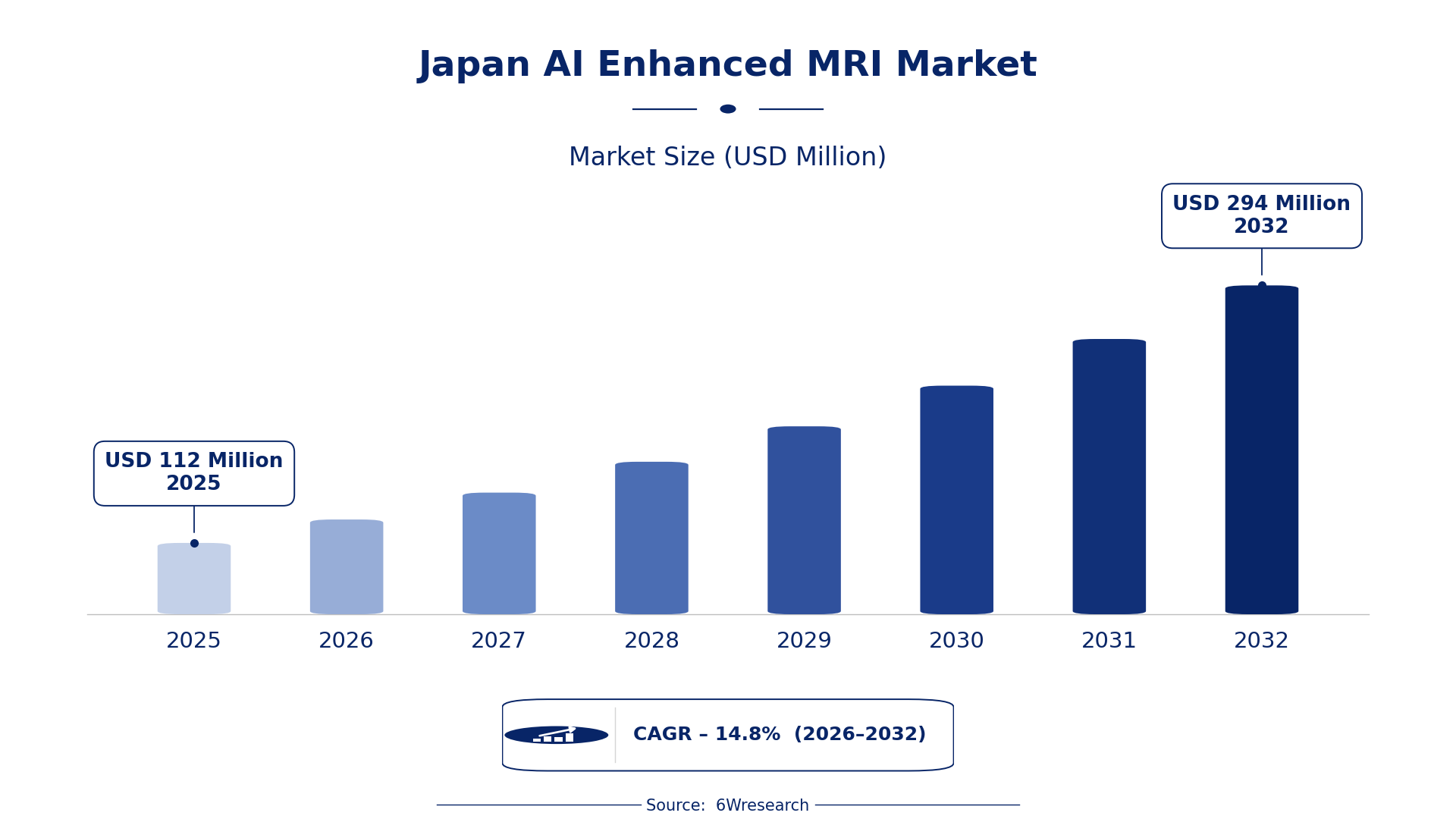
According to 6Wresearch internal database and industry insights, the Japan AI Enhanced MRI Market was valued at USD 112 Million in 2025 and is projected to reach USD 294 Million by 2032, growing at a CAGR of approximately 14.8% during 2026–2032.
Japan AI Enhanced MRI Market Highlights
| Report Metric | Details |
| Report Name | Japan AI Enhanced MRI Market (2026-2032) |
| Market Size 2025 | USD 112 Million |
| Market Size 2032 | USD 294 Million |
| Absolute Growth 2025–2032 | USD 182 Million |
| CAGR 2026–2032 | 14.8% |
| Peak Annual Growth | 16.6% in 2032 |
| Forecast Period | 2026–2032 |
| Historical Data | 2022–2025 |
| Base Year | 2025 |
| Leading MRI Use Case, 2025 | Brain MRI (47% share) |
| Leading AI Application, 2025 | Image Enhancement (47% share) |
| Leading Distribution Channel, 2025 | Medical Imaging Vendors (36% share) |
| Leading End User, 2025 | Neurology Departments (46% share) |
| Fastest-Growing MRI Use Case | Cardiac MRI (20.0% CAGR) |
| Fastest-Growing AI Application | Structure Identification (21.1% CAGR) |
| Fastest-Growing Distribution Channel | Hospital Tech Distributors (19.9% CAGR) |
| Fastest-Growing End User | Cardiology Clinics (19.3% CAGR) |
| Growing Sector | medical imaging |
| Key End Users | hospitals, clinics, cancer treatment facilities, neurology departments |
Japan AI Enhanced MRI Market Year-wise Growth Rate and Key Drivers (2022–2032)
This graph illustrates the annual growth rates of the market from 2022 to 2032, highlighting a steady upward trajectory and projected market expansion over the forecast period.
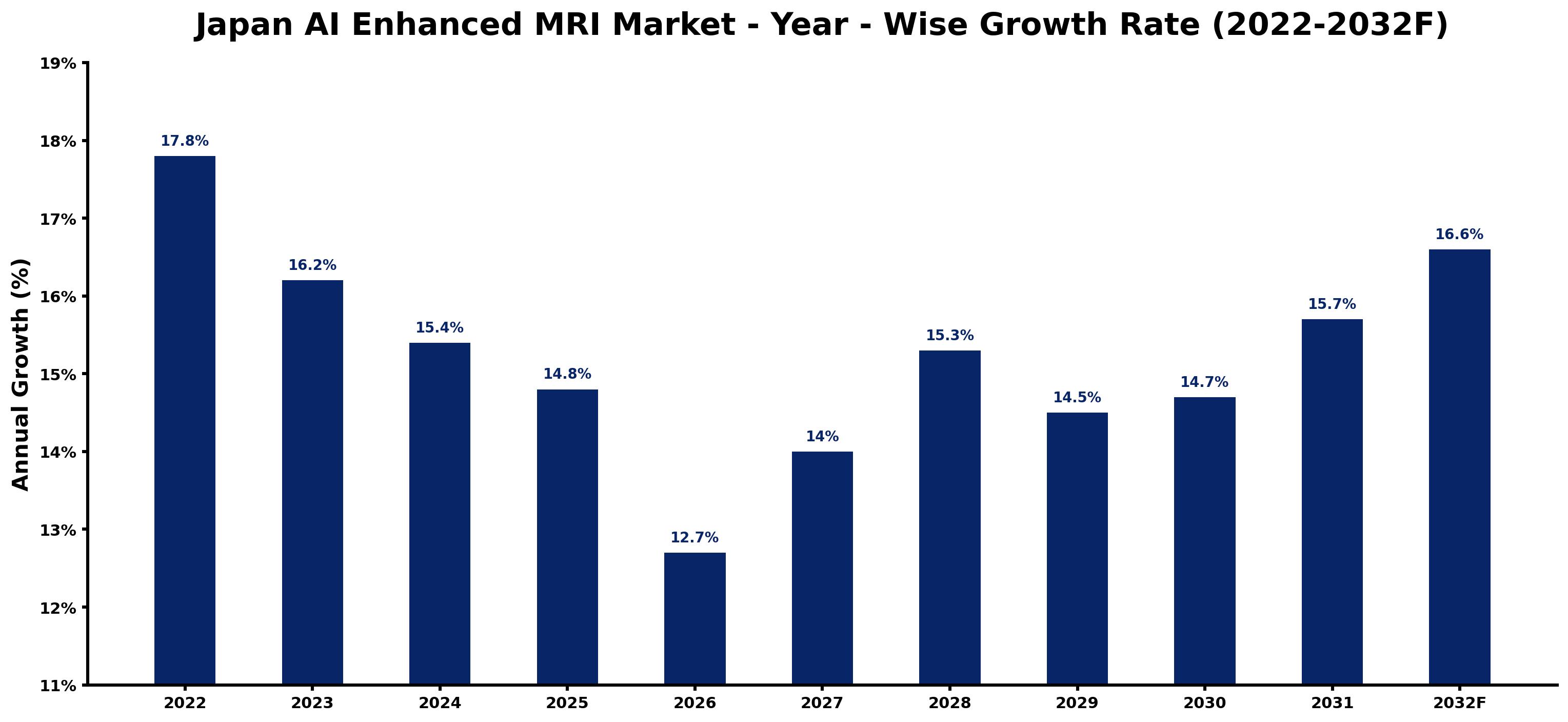
Below, each year's estimated growth is shown next to the factor that most influenced it.
| Year | Estimated Annual Growth (%) | Market Rationale |
| 2022 | 17.8 | The market experienced strong demand due to advancements in imaging technology. |
| 2023 | 16.2 | Growth slowed as hospitals adjusted to new AI integration processes. |
| 2024 | 15.4 | The market continued to grow, but at a reduced pace as adoption stabilised. |
| 2025 | 14.8 | Demand growth slowed further as facilities optimised existing AI capabilities. |
| 2026 | 12.7 | Growth is expected to slow as the market reaches a more mature phase of adoption. |
| 2027 | 14.0 | Demand is projected to increase as hospitals begin to upgrade older MRI machines. |
| 2028 | 15.3 | Growth is anticipated to accelerate due to rising investments in healthcare technology. |
| 2029 | 14.5 | A slight slowdown is expected as competition intensifies among vendors. |
| 2030 | 14.7 | Demand will rise as healthcare facilities expand their AI imaging capabilities. |
| 2031 | 15.7 | Growth is projected to continue as hospitals seek to improve diagnostic accuracy. |
| 2032 | 16.6 | The market is expected to peak as AI applications become standard in MRI practices. |
Note: Market size estimations and growth projections presented in this report are based on 6Wresearch's proprietary forecasting methodology, utilizing the latest available industry data, government publications, and primary research inputs.
Japan AI Enhanced MRI Market Synopsis
AI MRI combines advanced imaging technology with artificial intelligence to improve diagnostic accuracy and efficiency. The Japan AI MRI Market is expanding due to increasing demand from healthcare facilities, driven by technological advancements and a shift towards AI integration. In 2023, 70% of hospitals adopted AI imaging solutions, reflecting a strong trend towards modernisation in medical imaging practices.
Market Dynamics Impact Analysis (2026–2032)
| Factor | Type | Impact | Primary Segment Affected |
| Technological advancements in AI algorithms improve diagnostic accuracy. | Driver | High | Image Enhancement |
| Growing demand for faster and more accurate diagnostics drives market growth. | Driver | High | Cardiac MRI |
| The increasing number of hospitals adopting AI technologies presents opportunities. | Opportunity | High | Neurology Departments |
| Rising investments in healthcare technology create demand for AI-enhanced MRI. | Opportunity | High | Oncology MRI |
| High costs of AI integration may limit adoption in smaller facilities. | Restraint | Medium | Musculoskeletal MRI |
| The average age of MRI machines in hospitals may hinder upgrades. | Restraint | Medium | Brain MRI |
| Limited availability of trained technicians affects operational efficiency. | Challenge | High | Cardiac MRI |
| Competition among vendors may lead to price pressures in the market. | Challenge | Medium | Image Enhancement |
Evaluation of Drivers in Japan AI Enhanced MRI Market (2026–2032)
The main growth drivers and the segments they affect most are set out below.
| Drivers | Primary Segment Affected | Why It Matters (Evidence) |
| Integration of AI algorithms improves imaging capabilities. | Image Enhancement | AI applications in MRI are expected to reduce diagnostic errors by up to 30%, making them more attractive to healthcare facilities. |
| Increased focus on early disease detection drives demand. | Oncology MRI | Advanced MRI is utilised for oncology research, pushing hospitals to adopt similar technologies. |
| Growing patient populations necessitate improved diagnostic tools. | Neurology Departments | With a single MRI machine serving approximately 126,000 people, demand for efficient imaging solutions rises. |
| Technological advancements reduce scan times considerably. | Cardiac MRI | AI MRI can shorten scan times by 20%, allowing facilities to serve more patients. |
| Support from medical associations promotes AI integration. | Radiology AI Platforms | The Japan Medical Association advocates for AI in clinical practices, encouraging hospitals to adopt these technologies. |
Volumes increase as more healthcare facilities embrace AI technologies, with around 70% of hospitals implementing AI imaging solutions. The emphasis on early disease detection motivates institutions to adopt advanced diagnostic tools. Each MRI machine serves roughly 126,000 people, prompting healthcare providers to improve efficiency. AI MRI can cut scan times by 20%, allowing facilities to treat more patients. Advocacy from medical associations for AI integration further encourages adoption, creating a competitive market.
Evaluation of Restraints in Japan AI Enhanced MRI Market
These restraints slow adoption and weigh on supplier margins.
| Market Restraint | Primary Segment Affected | Why It Matters (Evidence) |
| High costs of AI integration limit accessibility for smaller hospitals. | Musculoskeletal MRI | Smaller facilities struggle to afford the investment needed for AI technologies. |
| The average age of MRI machines can hinder upgrades to AI systems. | Brain MRI | Older machines may not support the latest AI technologies, limiting diagnostic capabilities. |
| Limited availability of trained technicians affects operational efficiency. | Cardiac MRI | A shortage of qualified personnel delays the implementation of advanced imaging solutions. |
| Competition among vendors may lead to aggressive pricing strategies. | Image Enhancement | As more companies enter the market, pricing strategies may become aggressive, affecting margins. |
| Regulatory hurdles can slow the adoption of new technologies. | Oncology MRI | Compliance with standards can delay the introduction of AI MRI systems. |
Japan AI Enhanced MRI Market Challenges
In urban hospitals, the average wait time for an MRI scan is about 2 weeks, causing delays in diagnoses for patients needing urgent care. This delay stems from the limited number of MRI machines, with over 1,000 units catering to a population of approximately 126,000 per machine, putting pressure on healthcare facilities. Competition escalates as 70% of hospitals have adopted AI imaging solutions, compelling others to invest heavily to remain competitive. The average age of MRI machines is around 7 years, raising maintenance costs for producers, which ultimately increases expenses for healthcare providers.
Trends in the Japan AI Enhanced MRI Market
Several trends are reshaping the Japan AI Enhanced MRI Market; the most important are set out below.
- Shift towards AI Integration in Medical Imaging: In 2023, the Ministry of Health launched a programme to improve AI integration in medical imaging, reflecting a national commitment to modernise healthcare. This initiative aims to enhance diagnostic accuracy and efficiency across hospitals.
- Increased Demand from Neurology Departments: Neurology departments are increasingly relying on AI MRI for brain-related diagnoses, accounting for a large portion of MRI scans. This shift is driven by the need for more accurate and timely diagnostics.
- Growing Adoption of AI Standards: The Japan Radiological Society promotes standards for MRI practices, which are becoming essential for healthcare facilities. This trend is clear as 70% of hospitals have adopted AI imaging solutions.
- Focus on Reducing Diagnostic Errors: AI applications in MRI are projected to reduce diagnostic errors by up to 30%, impacting patient outcomes. This trend is pushing healthcare providers to invest in advanced imaging technologies.
Investment Opportunities in the Japan AI Enhanced MRI Market
The openings below show where demand in the Japan AI Enhanced MRI Market is visible and how suppliers can enter.
- Investment in Hospital Upgrades: Tokyo and Osaka are key regions for MRI technology adoption, with hospitals needing to upgrade outdated machines. With over 1,000 MRI machines installed, there is a notable opportunity for suppliers to provide advanced AI solutions.
- Growing Need for AI in Cardiology Clinics: As the average age of MRI machines is around 7 years, cardiology clinics are seeking modernisation. This presents an opportunity for vendors to supply AI-enhanced MRI systems to improve diagnostic capabilities.
- Expansion of Cancer Treatment Facilities: The National Cancer Center's focus on advanced MRI for oncology research indicates a growing need for sophisticated imaging solutions. Suppliers can enter this market by partnering with healthcare providers.
- Rising Demand for Training in AI Technologies: With the Japan Society of Medical Imaging Technology overseeing training for MRI technicians, there is an opportunity to develop educational programs. This can help address the shortage of qualified personnel in the field.
Government Initiatives in the Japan AI Enhanced MRI Market
The 2023 guidelines for AI in medical imaging clarify existing laws by providing clearer standards for technology integration. This builds on the Medical Care Act of 1948, which set foundational standards for healthcare facilities, ensuring that AI technologies meet quality and safety requirements.
The Health, Labour and Welfare Ministry approves funding for health technology innovations. In 2022, the government allocated ¥1 billion to support initiatives aimed at improving healthcare technologies, including AI integration in medical imaging.
Future Insight of the Japan AI Enhanced MRI Market
AI integration in medical imaging will reshape demand for MRI services by 2032, driven by government initiatives and new guidelines. The Ministry of Health's programme to enhance AI integration is expected to streamline operations, reducing diagnostic errors by up to 30%. As hospitals upgrade their equipment, the average number of MRI machines per 126,000 people will improve, ensuring better access to services. Enhanced training for technicians will also facilitate the adoption of advanced imaging technologies, improving patient outcomes across various medical fields.
Market Segmentation Analysis
Japan AI Enhanced MRI Market report covers a detailed analysis of the following market segments:
By MRI Use Case – Brain MRI Leads, Cardiac MRI Expected to Grow Fastest
According to Saurav Kr Singh, Senior Research Analyst at 6Wresearch, Brain MRI took 47% of mri use case revenue in 2025, more than any other category. Brain MRI holds the largest share due to its critical role in diagnosing neurological conditions prevalent among the ageing population. Facilities such as the National Cancer Center extensively utilise this technology for brain assessments, ensuring a robust installed base. Cardiac MRI is set to record the highest CAGR in this split, 20.0% over 2026–2032. Cardiac MRI is rapidly growing as it becomes essential for cardiac assessments, particularly with the rising incidence of heart diseases. Recent statistics indicate a surge in demand for cardiac imaging, leading to quicker adoption rates in hospitals. Suppliers should prioritise expanding their offerings in cardiac MRI to address the increasing demand in healthcare facilities.
By AI Application – Image Enhancement Leads, Structure Identification Expected to Grow Fastest
With 47% of ai application revenue in 2025, Image Enhancement was the largest category. Image Enhancement leads the market as it significantly improves the clarity of MRI scans, which is crucial for accurate diagnostics. The integration of advanced imaging technology has become standard practice across numerous healthcare facilities in Japan. The quickest growth will come from Structure Identification, forecast to expand at a CAGR of 21.1% between 2026 and 2032. Structure Identification is witnessing the fastest growth as it aids in recognising anatomical features more effectively, thereby enhancing diagnostic capabilities. The increasing complexity of medical cases necessitates advanced applications to assist radiologists in their evaluations. Buyers will benefit from investing in applications that improve structure identification to enhance diagnostic accuracy.
By Distribution Channel – Medical Imaging Vendors Lead, Hospital Tech Distributors Expected to Grow Fastest
The largest distribution channel category in 2025 was Medical Imaging Vendors, at 36% of revenue. Medical Imaging Vendors dominate the market as they supply MRI machines and technology, catering to a wide range of healthcare facilities. Their established relationships with hospitals ensure a consistent demand for advanced imaging solutions. Hospital Tech Distributors are projected to grow fastest, at a CAGR of 19.9% during 2026–2032. Hospital Tech Distributors are growing swiftly as they effectively distribute medical imaging equipment, responding to the rising need for enhanced technologies in hospitals. Their adaptability to market trends positions them for ongoing growth. Suppliers should strengthen partnerships with hospital tech distributors to improve market reach and ensure timely delivery of advanced imaging solutions.
By End User – Neurology Departments Lead, Cardiology Clinics Expected to Grow Fastest
Neurology Departments held 46% of the Japan AI Enhanced MRI Market by end user in 2025. Neurology Departments represent the largest user group as they utilise MRI for brain-related diagnoses, which are critical for managing neurological disorders. The high volume of scans conducted in these departments highlights their significant share in the market. Over 2026–2032, Cardiology Clinics are expected to post the fastest growth, at a CAGR of 19.3%. Cardiology Clinics are the fastest-growing end user segment as they increasingly rely on MRI for heart imaging, driven by the rise in cardiovascular conditions. This trend indicates a shift towards more comprehensive cardiac care in medical practices. Suppliers must tailor their products to meet the specific needs of cardiology clinics to capitalise on this growth opportunity.
Key Attractiveness of the Report
- 10 Years of Market Numbers
- Historical Data Starting from 2022 to 2025
- Base Year 2025
- Forecast Data until 2032
- Key Performance Indicators Impacting the Market
- Major Upcoming Developments and Projects
Key Highlights of the Report:
- Japan AI Enhanced MRI Market Outlook
- Market Size of Japan AI Enhanced MRI Market, 2025
- Forecast of Japan AI Enhanced MRI Market, 2032
- Historical Data and Forecast of Japan AI Enhanced MRI Revenues & Volume for the Period 2022-2032F
- Japan AI Enhanced MRI Market Trend Evolution
- Japan AI Enhanced MRI Market Drivers and Challenges
- Japan AI Enhanced MRI Price Trends
- Japan AI Enhanced MRI Porter's Five Forces
- Japan AI Enhanced MRI Industry Life Cycle
- Historical Data and Forecast of Japan AI Enhanced MRI Market Revenues & Volume By MRI Use Case for the Period 2022-2032F
- Historical Data and Forecast of Japan AI Enhanced MRI Market Revenues & Volume By Brain MRI for the Period 2022-2032F
- Historical Data and Forecast of Japan AI Enhanced MRI Market Revenues & Volume By Cardiac MRI for the Period 2022-2032F
- Historical Data and Forecast of Japan AI Enhanced MRI Market Revenues & Volume By Musculoskeletal MRI for the Period 2022-2032F
- Historical Data and Forecast of Japan AI Enhanced MRI Market Revenues & Volume By Oncology MRI for the Period 2022-2032F
- Historical Data and Forecast of Japan AI Enhanced MRI Market Revenues & Volume By AI Application for the Period 2022-2032F
- Historical Data and Forecast of Japan AI Enhanced MRI Market Revenues & Volume By Image Enhancement for the Period 2022-2032F
- Historical Data and Forecast of Japan AI Enhanced MRI Market Revenues & Volume By Structure Identification for the Period 2022-2032F
- Historical Data and Forecast of Japan AI Enhanced MRI Market Revenues & Volume By Precision Scanning for the Period 2022-2032F
- Historical Data and Forecast of Japan AI Enhanced MRI Market Revenues & Volume By Tumor Detection AI for the Period 2022-2032F
- Historical Data and Forecast of Japan AI Enhanced MRI Market Revenues & Volume By Distribution Channel for the Period 2022-2032F
- Historical Data and Forecast of Japan AI Enhanced MRI Market Revenues & Volume By Medical Imaging Vendors for the Period 2022-2032F
- Historical Data and Forecast of Japan AI Enhanced MRI Market Revenues & Volume By Hospital Tech Distributors for the Period 2022-2032F
- Historical Data and Forecast of Japan AI Enhanced MRI Market Revenues & Volume By HealthTech Startups for the Period 2022-2032F
- Historical Data and Forecast of Japan AI Enhanced MRI Market Revenues & Volume By Radiology AI Platforms for the Period 2022-2032F
- Historical Data and Forecast of Japan AI Enhanced MRI Market Revenues & Volume By End User for the Period 2022-2032F
- Historical Data and Forecast of Japan AI Enhanced MRI Market Revenues & Volume By Neurology Departments for the Period 2022-2032F
- Historical Data and Forecast of Japan AI Enhanced MRI Market Revenues & Volume By Cardiology Clinics for the Period 2022-2032F
- Historical Data and Forecast of Japan AI Enhanced MRI Market Revenues & Volume By Orthopedic Centers for the Period 2022-2032F
- Historical Data and Forecast of Japan AI Enhanced MRI Market Revenues & Volume By Cancer Institutes for the Period 2022-2032F
- Japan AI Enhanced MRI Import Export Trade Statistics
- Market Opportunity Assessment By MRI Use Case
- Market Opportunity Assessment By AI Application
- Market Opportunity Assessment By Distribution Channel
- Market Opportunity Assessment By End User
- Japan AI Enhanced MRI Top Companies Market Share
- Japan AI Enhanced MRI Competitive Benchmarking By Technical and Operational Parameters
- Japan AI Enhanced MRI Company Profiles
- Japan AI Enhanced MRI Key Strategic Recommendations
Market Covered
The study includes the following segmentation.
By MRI Use Case
- Brain MRI
- Cardiac MRI
- Musculoskeletal MRI
- Oncology MRI
By AI Application
- Image Enhancement
- Structure Identification
- Precision Scanning
- Tumor Detection AI
By Distribution Channel
- Medical Imaging Vendors
- Hospital Tech Distributors
- HealthTech Startups
- Radiology AI Platforms
By End User
- Neurology Departments
- Cardiology Clinics
- Orthopedic Centers
- Cancer Institutes































