Japan AI Gaming Market Size & Growth Rate
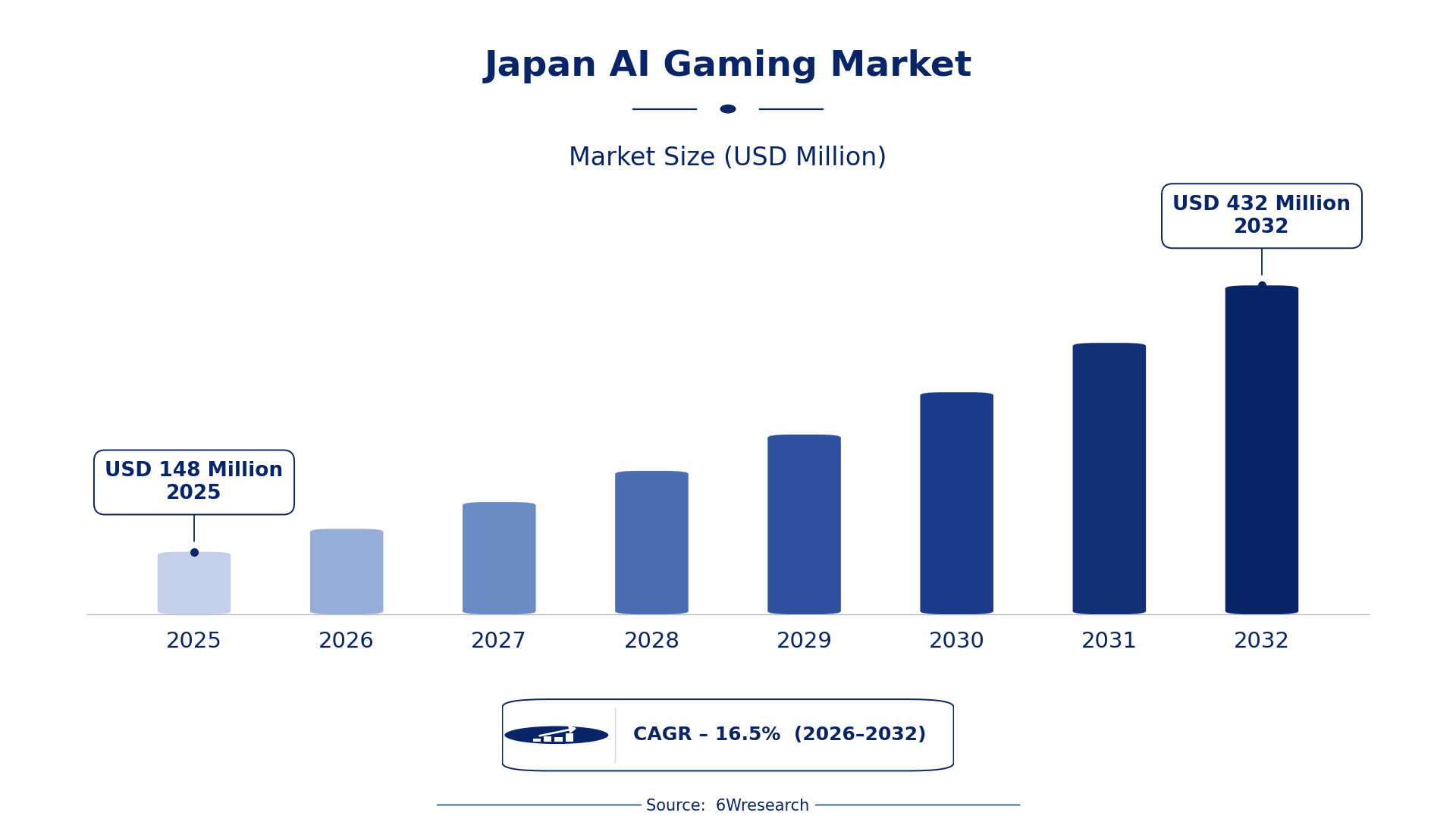
According to 6Wresearch internal database and industry insights, the Japan AI Gaming Market was valued at USD 148 Million in 2025 and is projected to reach USD 432 Million by 2032, growing at a CAGR of approximately 16.5% during 2026–2032.
Japan AI Gaming Market Highlights
| Report Metric | Details |
| Report Name | Japan AI Gaming Market (2026-2032) |
| Market Size 2025 | USD 148 Million |
| Market Size 2032 | USD 432 Million |
| Absolute Growth 2025–2032 | USD 284 Million |
| CAGR 2026–2032 | 16.5% |
| Peak Annual Growth | 17.7% in 2026 |
| Forecast Period | 2026–2032 |
| Historical Data | 2022–2025 |
| Base Year | 2025 |
| Leading Game Type, 2025 | Action Games (48% share) |
| Leading AI Functionality, 2025 | NPC Behavior (47% share) |
| Leading Application Area, 2025 | Immersive Gaming (39% share) |
| Leading Distribution Channel, 2025 | Digital Platforms (42% share) |
| Leading End User, 2025 | Gamers (46% share) |
| Fastest-Growing Game Type | Strategy Games (22.7% CAGR) |
| Fastest-Growing AI Functionality | Decision Support (20.6% CAGR) |
| Fastest-Growing Application Area | AI Opponents (19.6% CAGR) |
| Fastest-Growing Distribution Channel | Online Stores (20.8% CAGR) |
| Fastest-Growing End User | Esports Players (20.5% CAGR) |
| Growing Sector | immersive gaming |
| Key End Users | gamers, esports players, developers, hobbyists |
Japan AI Gaming Market Year-wise Growth Rate and Key Drivers (2022–2032)
This graph illustrates the annual growth rates of the market from 2022 to 2032, highlighting a steady upward trajectory and projected market expansion over the forecast period.
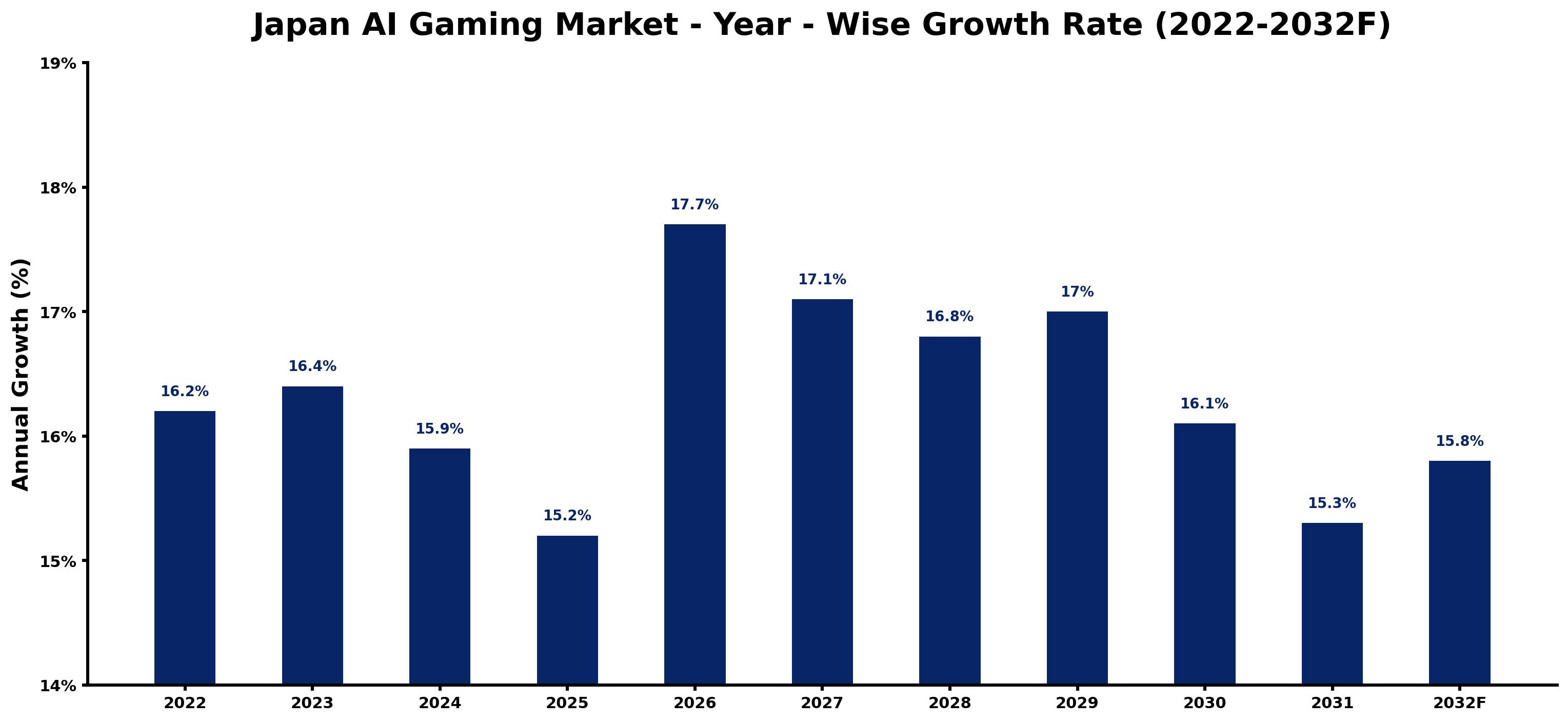
Year by year, the estimates below pair each growth rate with the development that shaped it.
| Year | Estimated Annual Growth (%) | Market Rationale |
| 2022 | 16.2 | The market experienced steady growth with increasing interest in AI-driven gaming experiences. |
| 2023 | 16.4 | Growth accelerated due to a surge in new AI game releases and gamer engagement. |
| 2024 | 15.9 | A slight slowdown occurred as the market adjusted to previous high growth rates. |
| 2025 | 15.2 | Continued demand from gamers and esports players contributed to ongoing market expansion. |
| 2026 | 17.7 | Growth surged again as new AI technologies improve gameplay and user experiences. |
| 2027 | 17.1 | A slowdown in growth followed as market saturation began to set in. |
| 2028 | 16.8 | Demand remained stable, supported by ongoing improvements in AI gaming technology. |
| 2029 | 17.0 | Growth picked up again with renewed interest in AI-driven immersive experiences. |
| 2030 | 16.1 | The market saw a slowdown as competition intensified among gaming platforms. |
| 2031 | 15.3 | Growth continued to decelerate as the market matured and consumer preferences evolved. |
| 2032 | 15.8 | An uptick in demand is expected as new AI applications in gaming gain traction. |
Note: Market size estimations and growth projections presented in this report are based on 6Wresearch's proprietary forecasting methodology, utilizing the latest available industry data, government publications, and primary research inputs.
Japan AI Gaming Market Synopsis
AI gaming integrates artificial intelligence with interactive experiences, improving gameplay through advanced algorithms and machine learning techniques. The Japan AI Gaming Market is experiencing growth, driven by a gaming population of approximately 67 million and a focus on immersive experiences. Factors such as the rise of esports, the integration of AI in over 30% of new game releases, and initiatives from the Digital Agency of Japan are contributing to increased demand and innovation in the sector.
Market Dynamics Impact Analysis (2026–2032)
| Factor | Type | Impact | Primary Segment Affected |
| Growing gaming population and esports interest | Driver | High | Gamers |
| Advancements in AI technology for immersive experiences | Driver | High | Immersive Gaming |
| Increasing demand for AI-driven features in games | Opportunity | High | Action Games |
| Expansion of digital distribution channels for games | Opportunity | High | Action Games |
| High competition among game developers | Restraint | Medium | Action Games |
| Potential market saturation in AI gaming | Restraint | Medium | Action Games |
| High development costs for AI integration | Challenge | High | Action Games |
| Rapid technological changes affecting consumer preferences | Challenge | Medium | Action Games |
Evaluation of Drivers in Japan AI Gaming Market (2026–2032)
The factors lifting demand, and the evidence behind each, are summarised below.
| Drivers | Primary Segment Affected | Why It Matters (Evidence) |
| Increasing gamer engagement through AI integration | Immersive Gaming | The growing gaming population of approximately 67 million in Japan drives demand for more engaging experiences. |
| Rise of esports events attracting millions of viewers | Esports Players | Esports events in Japan attracted over 1 million viewers in 2023, boosting interest in competitive gaming. |
| Integration of AI in new game releases | Action Games | AI is used in over 30% of new game releases, improving gameplay and user interaction. |
| Growth of online gaming sales channels | Digital Platforms | Online gaming sales accounted for 60% of total gaming revenue in Japan in 2023. |
| Support from government initiatives for AI in gaming | Action Games | Funding programs are available to assist developers in adopting AI technologies, promoting growth in the sector. |
What keeps demand rising is the increasing engagement of gamers, with approximately 67 million players in Japan seeking more interactive experiences. The popularity of esports events, which attracted over 1 million viewers in 2023, fuels interest in competitive gaming. AI is integrated into over 30% of new game releases, enhancing gameplay and user interaction. The shift towards digital platforms is clear, as online gaming sales comprised 60% of total revenue.
Evaluation of Restraints in Japan AI Gaming Market
The following restraints limit how fast demand can grow.
| Market Restraint | Primary Segment Affected | Why It Matters (Evidence) |
| Intense competition among game developers | Action Games | High competition can limit profit margins for developers, making it challenging to recoup investments. |
| Market saturation in AI gaming | Action Games | As more AI games are released, distinguishing products becomes harder, affecting sales growth. |
| High costs associated with AI technology integration | Action Games | Developers face considerable expenses when incorporating advanced AI features into games. |
| Changing consumer preferences for gaming experiences | Action Games | Rapid shifts in gamer interests can lead to decreased demand for certain AI-driven games. |
| Regulatory hurdles in AI development | Action Games | Compliance with evolving regulations can slow down the pace of innovation in game development. |
Japan AI Gaming Market Challenges
Limited access to advanced AI technology hampers producers in Japan, as the high cost of these tools can delay game development by up to six months. Stringent regulations regarding data privacy create compliance burdens for developers, leading to increased costs that can reach 15% of project budgets. Rising competition from international gaming markets pressures local producers to innovate rapidly, often straining resources and resulting in reduced profit margins for buyers. Fluctuating consumer preferences in gaming trends can lead to unsold inventory, costing retailers up to 20% in potential revenue losses each year.
Trends in the Japan AI Gaming Market
The trends below show where the Japan AI Gaming Market is heading.
- Shift Towards AI-Driven Immersive Gaming: The Tokyo Game Show showcases the latest in AI gaming technology each year, reflecting a growing trend. In 2023, immersive gaming accounted for 39% of the market share, indicating a strong consumer preference for engaging experiences.
- Rise of AI Opponents in Competitive Gaming: Since 2026, AI opponents have become increasingly popular, improving gameplay in competitive environments. This segment is projected to grow at a CAGR of 19.6%, demonstrating the demand for challenging gameplay.
- Transition from Traditional to Digital Distribution: The shift to digital platforms has accelerated, with digital sales accounting for 60% of total gaming revenue in 2023. This trend is reshaping how games reach consumers, pushing developers to adapt.
- Emergence of AI-Driven Game Development Standards: The ISO/IEC 25010 standard for evaluating software quality, including AI in games, has gained traction since its introduction. This standard helps developers ensure quality in AI gaming experiences.
Investment Opportunities in the Japan AI Gaming Market
The following opportunities in the Japan AI Gaming Market pair current demand with a clear way in.
- Gap in AI-Driven Features for Gamers: With over 67 million gamers in Japan, there is an opportunity to supply AI-driven features. Collaboration with local game developers can help tap into this growing demand.
- Expansion of Digital Platforms for Game Distribution: The digital gaming market accounted for 60% of total revenue in 2023, indicating a need for more digital distribution solutions. Partnering with online stores can facilitate market entry.
- Investment in AI Technology for Game Development: The AI gaming market is set for substantial growth, presenting an opportunity to invest in AI technology. Engaging with game development hubs in Tokyo can provide access to innovative projects.
- Focus on Esports and Competitive Gaming: With esports events attracting over 1 million viewers in 2023, there is a chance to develop AI tools for competitive gaming. Collaborating with esports organizations can enhance product visibility.
Government Initiatives in the Japan AI Gaming Market
The AI Promotion Act, established in 2025, lays down a national framework for AI research and development in gaming. This law encourages innovation by providing guidelines for integrating AI technologies into game design and development processes. The Semiconductor and Digital Industry Strategy, enacted in June 2021, secures domestic semiconductor manufacturing, which is essential for AI technology in gaming.
Funding programs are available to assist developers in adopting AI technologies, promoting growth in the sector. The Digital Agency leads these initiatives, ensuring that the integration of AI into gaming aligns with national standards and supports industry advancements.
Future Insight of the Japan AI Gaming Market
Machine learning techniques will redefine gaming experiences by 2032, enhancing NPC interactions and gameplay realism. The integration of VR technology is projected to attract a broader audience, increasing engagement significantly. Funding programs from the Ministry of Economy, Trade and Industry will drive innovation, supporting a rise in AI applications across the sector. Standards like ISO/IEC 25010 will ensure quality in AI implementations, benefiting buyers and suppliers through improved product reliability.
Market Segmentation Analysis
Japan AI Gaming Market report covers a detailed analysis of the following market segments:
By Game Type – Action Games Lead, Strategy Games Expected to Grow Fastest
According to Hittika Dhall, Research Associate at 6Wresearch, Action Games took 48% of game type revenue in 2025, more than any other category. Action Games hold the largest share due to their broad appeal among the 67 million gamers in Japan, with popular titles that leverage advanced algorithms for enhanced gameplay. This genre's established presence and successful track record ensure its continued dominance in the market. The quickest growth will come from Strategy Games, forecast to expand at a CAGR of 22.7% between 2026 and 2032. Strategy Games are experiencing rapid growth as technological advancements improve gameplay mechanics, attracting players who seek deeper engagement. The increasing complexity of these games is expanding their audience, leading to swift market expansion. Suppliers should focus on developing captivating features in Action and Strategy Games to meet the rising interest among gamers.
By AI Functionality – NPC Behavior Leads, Decision Support Expected to Grow Fastest
NPC Behavior held 47% of the Japan AI Gaming Market by ai functionality in 2025. NPC Behavior is the leading functionality because it significantly enhances gameplay realism, making it essential for engaging gaming experiences. This aspect is critical for the substantial online gaming revenue that relies on interactive elements. Decision Support is projected to grow fastest, at a CAGR of 20.6% during 2026–2032. Decision Support is the fastest-growing functionality, as it assists players in strategic planning, which is increasingly vital in competitive environments. The demand for intricate gameplay mechanics is driving this segment's rapid expansion. Buyers will benefit from advancements that improve NPC interactions and decision-making capabilities in their gaming experiences.
By Application Area – Immersive Gaming Leads, AI Opponents Expected to Grow Fastest
The largest application area category in 2025 was Immersive Gaming, at 39% of revenue. Immersive Gaming leads the market as it is essential for creating engaging experiences that attract a wide audience. Events like the Tokyo Game Show highlight the importance of this area, showcasing the latest advancements in technology each year. AI Opponents are set to record the highest CAGR in this split, 19.6% over 2026–2032. AI Opponents are rapidly gaining popularity as they provide challenging gameplay, appealing to gamers who desire competitive experiences. The surge in esports events, which attracted over 1 million viewers in 2023, is a key factor in this growth. Suppliers should prioritise the development of AI opponents to cater to the increasing demand for competitive gaming experiences.
By Distribution Channel – Digital Platforms Lead, Online Stores Expected to Grow Fastest
In 2025, Digital Platforms led the distribution channel split with a 42% share. Digital Platforms are the primary distribution channel for AI games, providing gamers easy access to a diverse range of titles. This channel is essential for reaching the extensive gaming population in Japan. Over 2026–2032, Online Stores are expected to post the fastest growth, at a CAGR of 20.8%. Online Stores are the fastest-growing distribution channel, driven by the convenience of direct purchases. The trend towards digital sales is evident as more gamers opt for online transactions over traditional retail. Suppliers need to enhance their visibility on digital platforms and online stores to maximise sales potential.
By End User – Gamers Lead, Esports Players Expected to Grow Fastest
With 46% of end user revenue in 2025, Gamers was the largest category. Gamers represent the largest user base for AI gaming, leveraging advanced features to enrich their gameplay experiences. With a gaming population of 67 million, this segment plays a crucial role in market growth. The quickest growth will come from Esports Players, forecast to expand at a CAGR of 20.5% between 2026 and 2032. Esports Players are the fastest-growing segment, utilising AI to gain a competitive edge in tournaments. The rising popularity of esports is attracting more participants to this segment, driving its rapid growth. Suppliers should tailor their offerings to address the distinct needs of both casual gamers and competitive esports players.
Key Attractiveness of the Report
- 10 Years of Market Numbers
- Historical Data Starting from 2022 to 2025
- Base Year 2025
- Forecast Data until 2032
- Key Performance Indicators Impacting the Market
- Major Upcoming Developments and Projects
Key Highlights of the Report:
- Japan AI Gaming Market Outlook
- Market Size of Japan AI Gaming Market, 2025
- Forecast of Japan AI Gaming Market, 2032
- Historical Data and Forecast of Japan AI Gaming Market Revenues & Volume for the Period 2022-2032F
- Japan AI Gaming Market Trend Evolution
- Japan AI Gaming Market Drivers and Challenges
- Japan AI Gaming Market Price Trends
- Japan AI Gaming Market Porter's Five Forces
- Japan AI Gaming Market Industry Life Cycle
- Historical Data and Forecast of Japan AI Gaming Market Revenues & Volume By Game Type for the Period 2022-2032F
- Historical Data and Forecast of Japan AI Gaming Market Revenues & Volume By Action Games for the Period 2022-2032F
- Historical Data and Forecast of Japan AI Gaming Market Revenues & Volume By Strategy Games for the Period 2022-2032F
- Historical Data and Forecast of Japan AI Gaming Market Revenues & Volume By Simulation Games for the Period 2022-2032F
- Historical Data and Forecast of Japan AI Gaming Market Revenues & Volume By VR/AR Games for the Period 2022-2032F
- Historical Data and Forecast of Japan AI Gaming Market Revenues & Volume By AI Functionality for the Period 2022-2032F
- Historical Data and Forecast of Japan AI Gaming Market Revenues & Volume By NPC Behavior for the Period 2022-2032F
- Historical Data and Forecast of Japan AI Gaming Market Revenues & Volume By Decision Support for the Period 2022-2032F
- Historical Data and Forecast of Japan AI Gaming Market Revenues & Volume By Scenario Modeling for the Period 2022-2032F
- Historical Data and Forecast of Japan AI Gaming Market Revenues & Volume By Environment Interaction for the Period 2022-2032F
- Historical Data and Forecast of Japan AI Gaming Market Revenues & Volume By Application Area for the Period 2022-2032F
- Historical Data and Forecast of Japan AI Gaming Market Revenues & Volume By Immersive Gaming for the Period 2022-2032F
- Historical Data and Forecast of Japan AI Gaming Market Revenues & Volume By AI Opponents for the Period 2022-2032F
- Historical Data and Forecast of Japan AI Gaming Market Revenues & Volume By Training for the Period 2022-2032F
- Historical Data and Forecast of Japan AI Gaming Market Revenues & Volume By Realistic Experience for the Period 2022-2032F
- Historical Data and Forecast of Japan AI Gaming Market Revenues & Volume By Distribution Channel for the Period 2022-2032F
- Historical Data and Forecast of Japan AI Gaming Market Revenues & Volume By Digital Platforms for the Period 2022-2032F
- Historical Data and Forecast of Japan AI Gaming Market Revenues & Volume By Online Stores for the Period 2022-2032F
- Historical Data and Forecast of Japan AI Gaming Market Revenues & Volume By PC & Console for the Period 2022-2032F
- Historical Data and Forecast of Japan AI Gaming Market Revenues & Volume By App Stores for the Period 2022-2032F
- Historical Data and Forecast of Japan AI Gaming Market Revenues & Volume By End User for the Period 2022-2032F
- Historical Data and Forecast of Japan AI Gaming Market Revenues & Volume By Gamers for the Period 2022-2032F
- Historical Data and Forecast of Japan AI Gaming Market Revenues & Volume By Esports Players for the Period 2022-2032F
- Historical Data and Forecast of Japan AI Gaming Market Revenues & Volume By Hobbyists for the Period 2022-2032F
- Historical Data and Forecast of Japan AI Gaming Market Revenues & Volume By VR Users for the Period 2022-2032F
- Japan AI Gaming Market Import Export Trade Statistics
- Market Opportunity Assessment By Game Type
- Market Opportunity Assessment By AI Functionality
- Market Opportunity Assessment By Application Area
- Market Opportunity Assessment By Distribution Channel
- Market Opportunity Assessment By End User
- Japan AI Gaming Market Top Companies Market Share
- Japan AI Gaming Market Competitive Benchmarking By Technical and Operational Parameters
- Japan AI Gaming Market Company Profiles
- Japan AI Gaming Market Key Strategic Recommendations
Market Covered
Coverage by segment is as follows.
By Game Type
- Action Games
- Strategy Games
- Simulation Games
- VR/AR Games
By AI Functionality
- NPC Behavior
- Decision Support
- Scenario Modeling
- Environment Interaction
By Application Area
- Immersive Gaming
- AI Opponents
- Training
- Realistic Experience
By Distribution Channel
- Digital Platforms
- Online Stores
- PC & Console
- App Stores
By End User
- Gamers
- Esports Players
- Hobbyists
- VR Users































