Japan AI in Video Games Market Size & Growth Rate
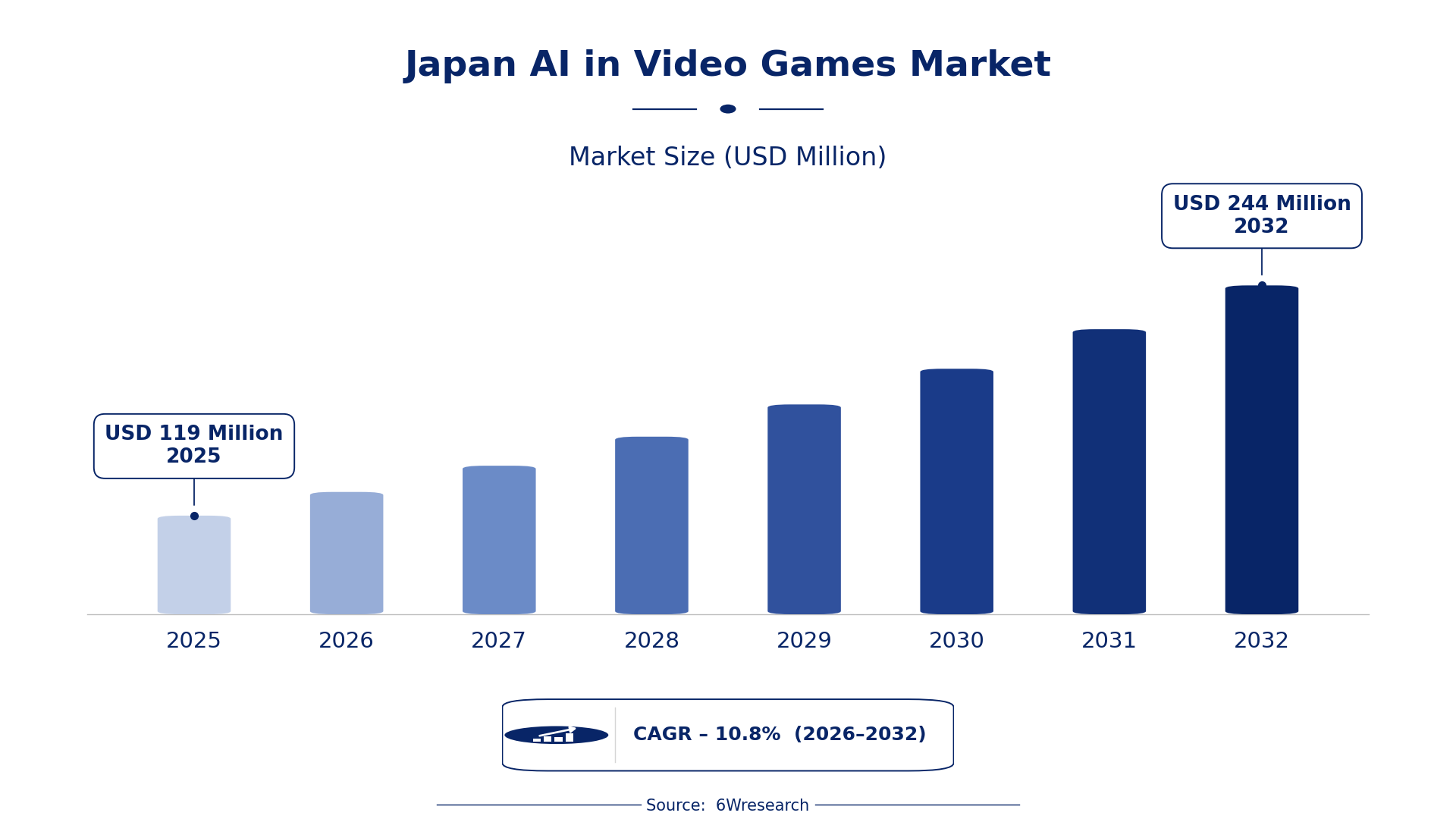
According to 6Wresearch internal database and industry insights, the Japan AI in Video Games Market was valued at USD 119 Million in 2025 and is projected to reach USD 244 Million by 2032, growing at a CAGR of approximately 10.8% during 2026–2032.
Japan AI in Video Games Market Highlights
| Report Metric | Details |
| Report Name | Japan AI in Video Games Market (2026-2032) |
| Market Size 2025 | USD 119 Million |
| Market Size 2032 | USD 244 Million |
| Absolute Growth 2025–2032 | USD 125 Million |
| CAGR 2026–2032 | 10.8% |
| Peak Annual Growth | 12.2% in 2032 |
| Forecast Period | 2026–2032 |
| Historical Data | 2022–2025 |
| Base Year | 2025 |
| Leading Market Type, 2025 | Game Development (42% share) |
| Leading Application, 2025 | Procedural Content Generation (48% share) |
| Leading AI Technology, 2025 | Machine Learning (46% share) |
| Leading End User, 2025 | Game Developers (40% share) |
| Fastest-Growing Market Type | Gameplay (15.3% CAGR) |
| Fastest-Growing Application | Non-Player Character Behavior (15.1% CAGR) |
| Fastest-Growing AI Technology | AI Pathfinding (15.9% CAGR) |
| Fastest-Growing End User | Gamers (14.1% CAGR) |
| Growing Sector | gaming |
| Key End Users | game developers, gamers, game studios, VR companies |
Japan AI in Video Games Market Year-wise Growth Rate and Key Drivers (2022–2032)
This graph illustrates the annual growth rates of the market from 2022 to 2032, highlighting a steady upward trajectory and projected market expansion over the forecast period.
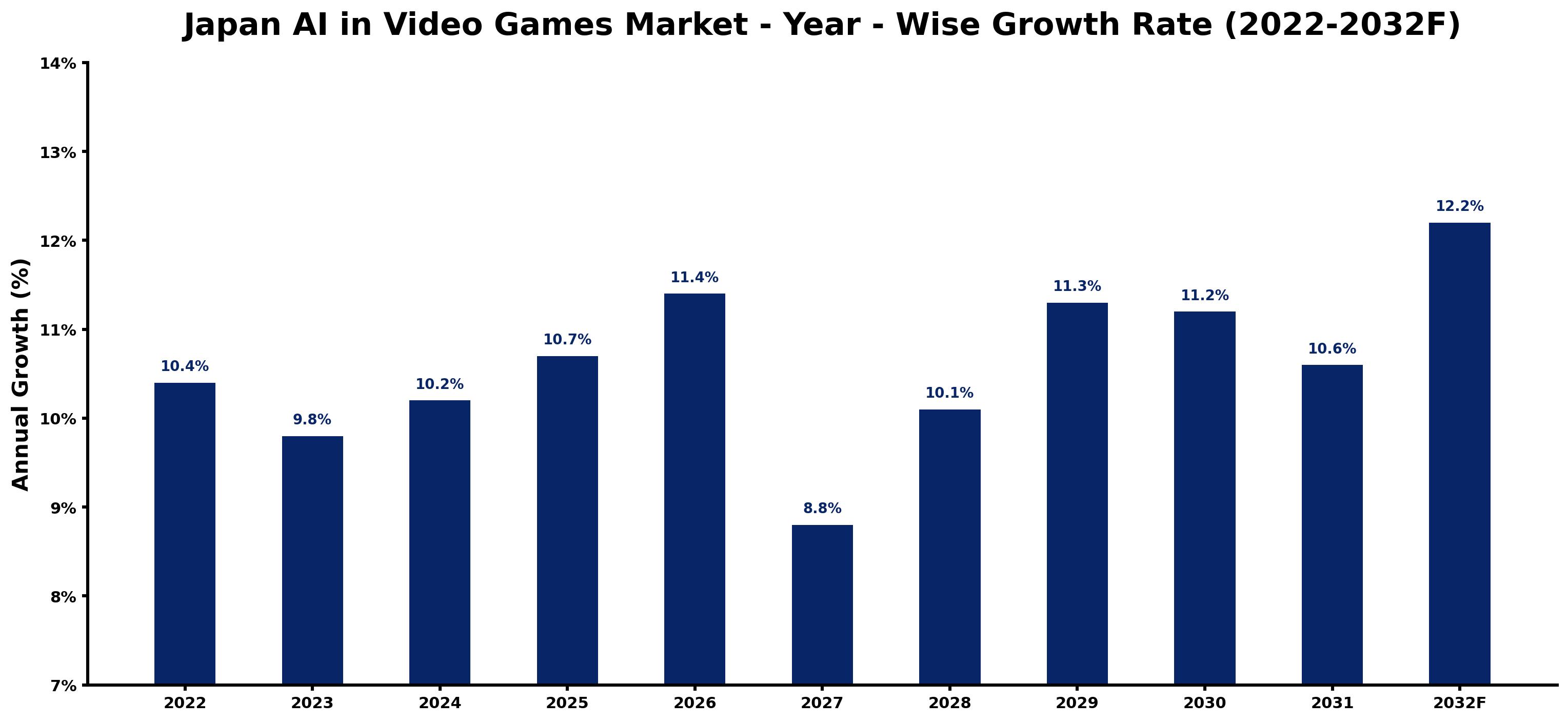
The yearly estimates that follow link every growth rate to its principal driver, so readers can see why the pace changed in each period.
| Year | Estimated Annual Growth (%) | Market Rationale |
| 2022 | 10.4 | The market experienced solid growth, driven by increasing interest in AI technologies. |
| 2023 | 9.8 | Growth slowed slightly due to market saturation in certain segments, yet demand remained strong. |
| 2024 | 10.2 | The market rebounded with renewed investment in gaming technologies and content. |
| 2025 | 10.7 | Growth accelerated as procedural content generation gained traction among developers. |
| 2026 | 11.4 | Demand rose significantly as AI technologies became integral to game development processes. |
| 2027 | 8.8 | Growth slowed as developers faced challenges in integrating advanced AI features. |
| 2028 | 10.1 | The market picked up again as augmented reality games attracted more players. |
| 2029 | 11.3 | Demand surged with the rise of non-player character behaviour enhancements in games. |
| 2030 | 11.2 | Growth slowed slightly as competition increased among game developers. |
| 2031 | 10.6 | The market continued to grow, driven by sustained interest in immersive gameplay technologies. |
| 2032 | 12.2 | Demand peaked as AI applications in gaming reached new heights, improving player experiences. |
Note: Market size estimations and growth projections presented in this report are based on 6Wresearch's proprietary forecasting methodology, utilizing the latest available industry data, government publications, and primary research inputs.
Japan AI in Video Games Market Synopsis
AI in Video Games refers to the application of artificial intelligence technologies to improve gaming experiences through algorithms and machine learning models. In Japan, the gaming industry generated over 1 trillion yen in revenue in 2023, with more than 60 million gamers. The market is expanding due to rising demand for personalised gaming experiences, procedural content generation, and analytics tools, supported by substantial investments in AI technologies and a robust domestic development base.
Market Dynamics Impact Analysis (2026–2032)
| Factor | Type | Impact | Primary Segment Affected |
| Increasing demand for personalized gaming experiences | Driver | High | Gameplay |
| The rise of augmented reality games | Driver | Medium | Augmented Reality |
| Growing interest in procedural content generation | Opportunity | High | Procedural Content Generation |
| Investment in AI technologies for mobile games | Opportunity | Medium | Game Development |
| Challenges in integrating AI into existing game frameworks | Restraint | High | Game Development |
| Market saturation in certain gaming segments | Restraint | Medium | Gameplay |
| High competition among game studios | Challenge | High | Game Developers |
| Rapid technological advancements leading to obsolescence | Challenge | Medium | Game Development |
Evaluation of Drivers in Japan AI in Video Games Market (2026–2032)
Below are the drivers that matter most for revenue growth, with supporting evidence.
| Drivers | Primary Segment Affected | Why It Matters (Evidence) |
| Growing number of gamers | Game Development | With over 60 million gamers in Japan, developers are investing in AI to improve engagement. |
| Increased investment in AI technologies | Gameplay | Investment in AI technologies is projected to rise significantly, leading to more creative gameplay. |
| Popularity of VR and AR games | Augmented Reality | The presence of over 50 VR companies in Japan drives demand for AI-driven gaming experiences. |
| Demand for game analytics tools | Analytics | Game analytics tools are essential for studios to optimize player engagement and retention. |
| Procedural content generation in popular titles | Procedural Content Generation | Procedural content generation is widely used in successful game titles, improving development efficiency. |
Much of the new demand traces back to the increasing number of gamers in Japan, which exceeds 60 million. This large user base encourages developers to invest in AI technologies to improve gameplay experiences. In 2023, the gaming industry generated over 1 trillion yen, prompting further investment in new solutions. The rise of VR technology, with over 50 companies operating in the sector, fuels demand for immersive gaming experiences. The growing popularity of procedural content generation improves game development efficiency and creativity, resulting in more engaging titles.
Evaluation of Restraints in Japan AI in Video Games Market
These restraints slow adoption and weigh on supplier margins.
| Market Restraint | Primary Segment Affected | Why It Matters (Evidence) |
| Integration challenges with existing game frameworks | Game Development | Many developers struggle to incorporate AI technologies into established game structures, delaying innovation. |
| Market saturation in specific gaming segments | Gameplay | As certain segments become saturated, growth opportunities diminish, impacting overall market expansion. |
| High competition among game studios | Game Developers | Intense competition pressures studios to innovate rapidly, straining resources and timelines. |
| Technological obsolescence risks | Game Development | Rapid advancements in AI technology may render existing solutions outdated, affecting long-term investments. |
| Limited access to skilled AI professionals | Game Development | A shortage of qualified AI experts in Japan can hinder the development and integration of new technologies. |
Japan AI in Video Games Market Challenges
In 2023, Japan's gaming industry generated over 1 trillion yen in revenue, but intense competition among producers leads to price wars that erode profit margins and hinder innovation. Rising costs for AI technology development burden distributors, causing delays in game releases that frustrate buyers eager for new content. A shortage of skilled professionals in AI and game development hampers producers, with 50% of studios struggling to hire qualified staff, which stifles growth. Adherence to established standards like JIS X 0129 complicates operations for distributors, resulting in increased costs that ultimately affect pricing for consumers.
Trends in the Japan AI in Video Games Market
These developments are changing demand patterns in the Japan AI in Video Games Market.
- Rise of Procedural Content Generation: Procedural content generation is increasingly adopted in popular game titles, improving development efficiency. In 2023, its usage contributed to Japan's gaming revenue, which exceeded 1 trillion yen.
- Growth of Augmented Reality Games: Augmented reality games are gaining traction, particularly in urban areas. This trend is reflected in the increasing number of players engaging with AR experiences, supported by over 50 VR companies in Japan.
- Shift Towards Enhanced Non-Player Character Behaviour: Game developers are focusing on improving non-player character behaviour to create realistic interactions. This shift is evident in many new titles, which use deep learning algorithms for NPC enhancements.
- Increased Investment in AI Technologies: Investment in AI technologies for gaming is projected to rise by 2025, reflecting the need for advanced gameplay and analytics tools, as highlighted by the Tokyo Game Show's focus on AI advancements.
Investment Opportunities in the Japan AI in Video Games Market
Where to invest in the Japan AI in Video Games Market: the main openings are set out below.
- Timing for Investment in AI Technologies: With investment in AI technologies projected to increase by 2025, there is a prime opportunity for suppliers to enter the market. Game developers are actively seeking innovative solutions to improve gameplay.
- Supply of Game Analytics Tools: The demand for game analytics tools is surging, driven by the need for studios to optimise player engagement. This presents an opportunity for technology providers to partner with game studios in Japan.
- Augmented Reality Game Development: As augmented reality games gain popularity, there is a growing opportunity for developers to create engaging AR experiences. The urban gamer demographic is particularly receptive, creating a market gap to fill.
- Procedural Content Generation Solutions: The increasing use of procedural content generation in popular titles highlights a need for specialised tools. Suppliers can target game developers looking to streamline content creation processes.
Government Initiatives in the Japan AI in Video Games Market
The AI Promotion Act, set to be implemented in 2025, provides guidelines for ethical AI applications, supporting the gaming industry's growth by establishing a national framework for AI research and development. The New Robot Strategy, established in 2015, aims to expand the use of robotics across various sectors, including gaming, encouraging the integration of AI technologies in game development and promoting efficiency.
The Digital Agency leads the government's digital transformation efforts, approving funding for initiatives that promote AI integration in gaming, ensuring that developers have access to resources necessary for innovation. The Ministry of Economy, Trade and Industry supports digital content industries through various initiatives, including a programme with a budget of 2 billion yen dedicated to AI research in gaming.
Future Insight of the Japan AI in Video Games Market
The government's 2 billion yen programme to support AI research will create an investment pipeline, driving demand for advanced gaming experiences. By 2032, procedural content generation will enable developers to craft richer game worlds, attracting millions of players. Initiatives from the Ministry of Economy, Trade and Industry will further stimulate innovation, leading to more sophisticated non-player character behaviours. As mobile gaming continues to dominate, the integration of AI will personalise experiences, ensuring that suppliers can meet the changing expectations of players.
Market Segmentation Analysis
Japan AI in Video Games Market report covers a detailed analysis of the following market segments:
By Market Type – Game Development Leads, Gameplay Expected to Grow Fastest
According to Bhawna Singh, Assistant Manager at 6Wresearch, the largest market type category in 2025 was Game Development, at 42% of revenue. Game development dominates the market due to Japan's extensive network of local studios and developers who are committed to producing high-quality games. Tokyo, as a central hub, boasts numerous companies that leverage advanced techniques to create engaging gaming experiences. Gameplay is projected to grow fastest, at a CAGR of 15.3% during 2026–2032. Gameplay is rapidly growing as developers increasingly prioritise enhancing player interaction through advanced methods. This trend is evident in the rising use of sophisticated techniques to create immersive environments that captivate players. Suppliers should focus on innovations in gameplay to align with the evolving expectations of developers.
By Application – Procedural Content Generation Leads, Non-Player Character Behavior Expected to Grow Fastest
Procedural Content Generation took 48% of application revenue in 2025, more than any other category. Procedural content generation leads the application segment by automating the creation of diverse gameplay experiences, making it essential for developers. Its widespread use in popular titles demonstrates its critical role in the gaming industry. The quickest growth will come from Non-Player Character Behavior, forecast to expand at a CAGR of 15.1% between 2026 and 2032. Non-player character behaviour is the fastest-growing application, driven by the demand for more realistic and engaging game worlds. This growth is facilitated by advancements that enable lifelike interactions, enhancing overall gameplay. Buyers should invest in technologies that improve NPC behaviour to create more captivating gaming experiences.
By AI Technology – Machine Learning Leads, AI Pathfinding Expected to Grow Fastest
Machine Learning held 46% of the Japan AI in Video Games Market by ai technology in 2025. Machine learning is the leading technology in the gaming market, serving as the foundation for various applications that enhance gameplay. Its extensive use in analysing player behaviour solidifies its dominant position in the industry. Over 2026–2032, AI Pathfinding is expected to post the fastest growth, at a CAGR of 15.9%. AI pathfinding is the fastest-growing technology, crucial for NPC movement and interaction, which adds dynamism to games. The increasing complexity of game environments necessitates advanced solutions for effective navigation. Suppliers should develop advanced pathfinding solutions to meet the demands of game developers.
By End User – Game Developers Lead, Gamers Expected to Grow Fastest
In 2025, Game Developers led the end user split with a 40% share. Game developers constitute the largest end user group as they are the primary implementers of technologies in game creation. Their ongoing investment in tools reflects the industry's dedication to enhancing game quality and player engagement. Gamers are set to record the highest CAGR in this split, 14.1% over 2026–2032. Gamers are the fastest-growing end user group, driven by their desire for improved gameplay experiences that utilise technological advancements. With over 60 million gamers in Japan, their expectations for immersive experiences continue to escalate. Suppliers must align their offerings with gamer preferences to maintain market relevance.
Key Attractiveness of the Report
- 10 Years of Market Numbers
- Historical Data Starting from 2022 to 2025
- Base Year 2025
- Forecast Data until 2032
- Key Performance Indicators Impacting the Market
- Major Upcoming Developments and Projects
Key Highlights of the Report:
- Japan AI in Video Games Market Outlook
- Market Size of Japan AI in Video Games Market,2025
- Forecast of Japan AI in Video Games Market, 2032
- Historical Data and Forecast of Japan AI in Video Games Revenues & Volume for the Period 2022-2032
- Japan AI in Video Games Market Trend Evolution
- Japan AI in Video Games Market Drivers and Challenges
- Japan AI in Video Games Price Trends
- Japan AI in Video Games Porter's Five Forces
- Japan AI in Video Games Industry Life Cycle
- Historical Data and Forecast of Japan AI in Video Games Market Revenues & Volume By Market Type for the Period 2022-2032
- Historical Data and Forecast of Japan AI in Video Games Market Revenues & Volume By Game Development for the Period 2022-2032
- Historical Data and Forecast of Japan AI in Video Games Market Revenues & Volume By Gameplay for the Period 2022-2032
- Historical Data and Forecast of Japan AI in Video Games Market Revenues & Volume By Analytics for the Period 2022-2032
- Historical Data and Forecast of Japan AI in Video Games Market Revenues & Volume By Virtual Reality for the Period 2022-2032
- Historical Data and Forecast of Japan AI in Video Games Market Revenues & Volume By Augmented Reality for the Period 2022-2032
- Historical Data and Forecast of Japan AI in Video Games Market Revenues & Volume By Application for the Period 2022-2032
- Historical Data and Forecast of Japan AI in Video Games Market Revenues & Volume By Procedural Content Generation for the Period 2022-2032
- Historical Data and Forecast of Japan AI in Video Games Market Revenues & Volume By Non-Player Character Behavior for the Period 2022-2032
- Historical Data and Forecast of Japan AI in Video Games Market Revenues & Volume By Player Data Analysis for the Period 2022-2032
- Historical Data and Forecast of Japan AI in Video Games Market Revenues & Volume By Realistic Environments for the Period 2022-2032
- Historical Data and Forecast of Japan AI in Video Games Market Revenues & Volume By Interactive Experiences for the Period 2022-2032
- Historical Data and Forecast of Japan AI in Video Games Market Revenues & Volume By AI Technology for the Period 2022-2032
- Historical Data and Forecast of Japan AI in Video Games Market Revenues & Volume By Machine Learning for the Period 2022-2032
- Historical Data and Forecast of Japan AI in Video Games Market Revenues & Volume By AI Pathfinding for the Period 2022-2032
- Historical Data and Forecast of Japan AI in Video Games Market Revenues & Volume By Predictive Modeling for the Period 2022-2032
- Historical Data and Forecast of Japan AI in Video Games Market Revenues & Volume By AI Simulation for the Period 2022-2032
- Historical Data and Forecast of Japan AI in Video Games Market Revenues & Volume By Deep Learning for the Period 2022-2032
- Historical Data and Forecast of Japan AI in Video Games Market Revenues & Volume By End User for the Period 2022-2032
- Historical Data and Forecast of Japan AI in Video Games Market Revenues & Volume By Game Developers for the Period 2022-2032
- Historical Data and Forecast of Japan AI in Video Games Market Revenues & Volume By Gamers for the Period 2022-2032
- Historical Data and Forecast of Japan AI in Video Games Market Revenues & Volume By Game Studios for the Period 2022-2032
- Historical Data and Forecast of Japan AI in Video Games Market Revenues & Volume By VR Companies for the Period 2022-2032
- Historical Data and Forecast of Japan AI in Video Games Market Revenues & Volume By Game Designers for the Period 2022-2032
- Japan AI in Video Games Import Export Trade Statistics
- Market Opportunity Assessment By Market Type
- Market Opportunity Assessment By Application
- Market Opportunity Assessment By AI Technology
- Market Opportunity Assessment By End User
- Japan AI in Video Games Top Companies Market Share
- Japan AI in Video Games Competitive Benchmarking By Technical and Operational Parameters
- Japan AI in Video Games Company Profiles
- Japan AI in Video Games Key Strategic Recommendations
Market Covered
The following segment groups are covered in the report.
By Market Type
- Game Development
- Gameplay
- Analytics
- Virtual Reality
- Augmented Reality
By Application
- Procedural Content Generation
- Non-Player Character Behavior
- Player Data Analysis
- Realistic Environments
- Interactive Experiences
By AI Technology
- Machine Learning
- AI Pathfinding
- Predictive Modeling
- AI Simulation
- Deep Learning
By End User
- Game Developers
- Gamers
- Game Studios
- VR Companies
- Game Designers































