Japan AI Optimized Grid Management Market Size & Growth Rate
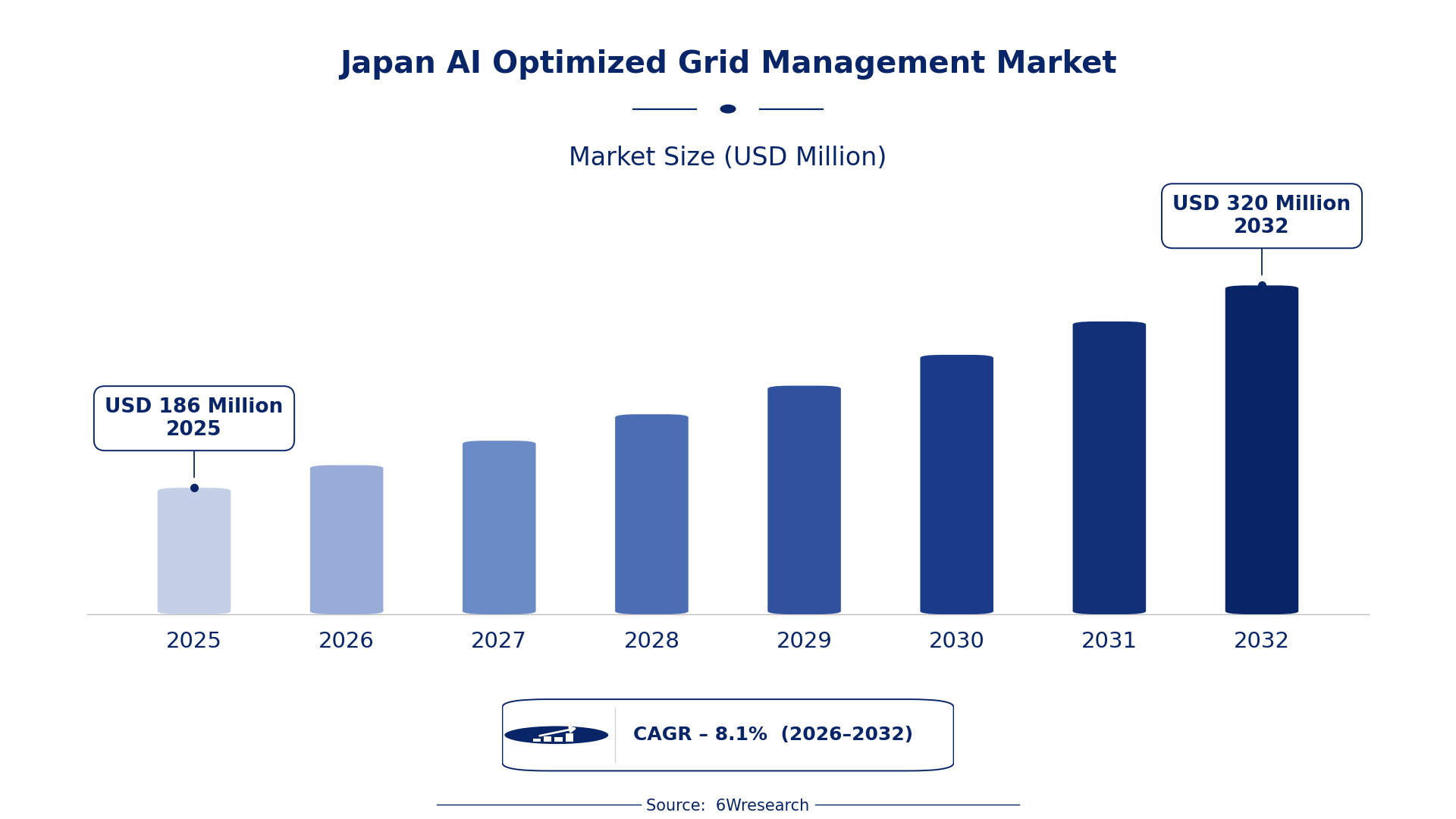
According to 6Wresearch internal database and industry insights, the Japan AI Optimized Grid Management Market was valued at USD 186 Million in 2025 and is projected to reach USD 320 Million by 2032, growing at a CAGR of approximately 8.1% during 2026–2032.
Japan AI Optimized Grid Management Market Highlights
| Report Metric | Details |
| Report Name | Japan AI Optimized Grid Management Market (2026-2032) |
| Market Size 2025 | USD 186 Million |
| Market Size 2032 | USD 320 Million |
| Absolute Growth 2025–2032 | USD 134 Million |
| CAGR 2026–2032 | 8.1% |
| Peak Annual Growth | 8.6% in 2027 |
| Forecast Period | 2026–2032 |
| Historical Data | 2022–2025 |
| Base Year | 2025 |
| Leading Grid Type, 2025 | Smart Grids (37% share) |
| Leading AI Use Case, 2025 | Load Forecasting AI (41% share) |
| Leading Distribution Channel, 2025 | Grid Tech Vendors (39% share) |
| Leading End User, 2025 | Power Utility Companies (39% share) |
| Fastest-Growing Grid Type | Energy Storage Grids (11.4% CAGR) |
| Fastest-Growing AI Use Case | AI-Powered Balancing (11.1% CAGR) |
| Fastest-Growing Distribution Channel | Clean Energy Integrators (10.1% CAGR) |
| Fastest-Growing End User | Renewable Energy Providers (10.6% CAGR) |
| Growing Sector | Renewable Energy |
| Key End Users | Power Utility Companies, Renewable Energy Providers, National Grid Operators |
Japan AI Optimized Grid Management Market Year-wise Growth Rate and Key Drivers (2022–2032)
This graph illustrates the annual growth rates of the market from 2022 to 2032, highlighting a steady upward trajectory and projected market expansion over the forecast period.
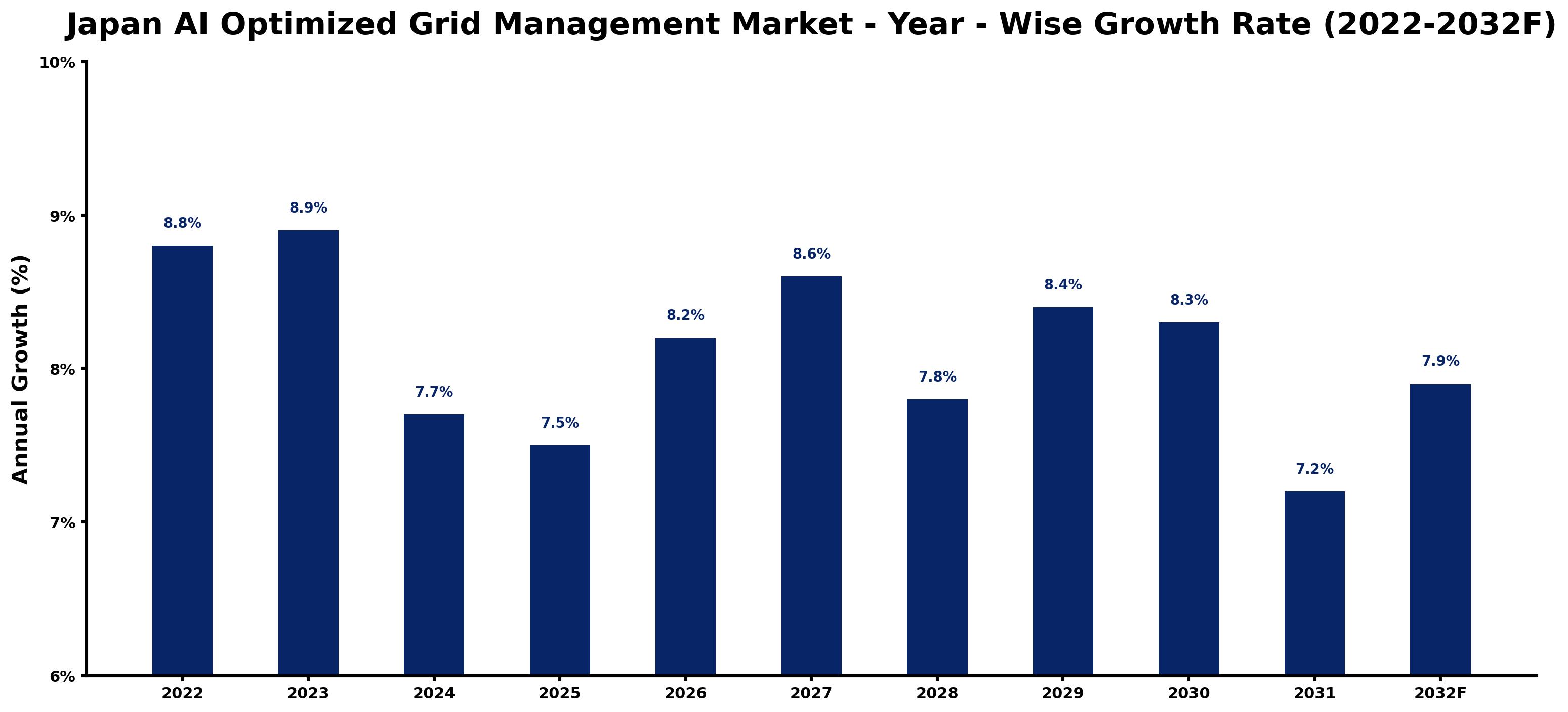
Each row of the following table gives one year's estimated growth and the event or demand shift that explains it.
| Year | Estimated Annual Growth (%) | Market Rationale |
| 2022 | 8.8 | The market experienced strong growth due to increased investments in smart grid technologies. |
| 2023 | 8.9 | Demand surged as major power utilities adopted AI solutions for grid management. |
| 2024 | 7.7 | Growth slowed as market saturation began to affect new technology adoption rates. |
| 2025 | 7.5 | The market continued to grow, albeit at a slower pace, as existing technologies matured. |
| 2026 | 8.2 | Growth is expected to accelerate again as new AI applications emerge in energy management. |
| 2027 | 8.6 | The market is projected to peak with heightened investments in advanced grid technologies and infrastructure. |
| 2028 | 7.8 | A slight slowdown is anticipated as competition intensifies among technology providers. |
| 2029 | 8.4 | Demand is expected to rebound as urban areas expand their AI-powered grid initiatives. |
| 2030 | 8.3 | Growth will moderate as the market begins to stabilise after rapid expansion. |
| 2031 | 7.2 | The market will continue to grow, but at a slower rate due to increased competition. |
| 2032 | 7.9 | Demand for AI solutions is expected to rise as renewable energy integration becomes critical. |
Note: Market size estimations and growth projections presented in this report are based on 6Wresearch's proprietary forecasting methodology, utilizing the latest available industry data, government publications, and primary research inputs.
Japan AI Optimized Grid Management Market Synopsis
AI Optimized Grid Management integrates artificial intelligence into grid systems to improve efficiency and reliability. This technology optimises energy distribution, predicts load demands, and improves fault detection. The Japan AI Optimized Grid Management Market is expanding due to increased adoption by power utility companies and renewable energy providers. The total installed capacity of renewable energy reached 100 GW in 2023, driving the need for advanced grid management solutions and supporting the government’s target of 50% renewable electricity by 2030.
Market Dynamics Impact Analysis (2026–2032)
| Factor | Type | Impact | Primary Segment Affected |
| Growing investments in smart grid technologies | Driver | High | Smart Grids |
| Increasing reliance on renewable energy sources | Driver | High | Renewable Energy Providers |
| Rising demand for energy efficiency solutions | Opportunity | High | Energy Storage Grids |
| Need for advanced load forecasting capabilities | Opportunity | Medium | Load Forecasting AI |
| High initial implementation costs | Restraint | High | Smart Grids |
| Limited awareness among smaller utilities | Restraint | Medium | Power Utility Companies |
| Challenges in integrating legacy systems | Challenge | High | Grid Tech Vendors |
| Regulatory compliance costs for new technologies | Challenge | Medium | Clean Energy Integrators |
Evaluation of Drivers in Japan AI Optimized Grid Management Market (2026–2032)
The following drivers explain most of the expected growth.
| Drivers | Primary Segment Affected | Why It Matters (Evidence) |
| Increased investment in smart grid infrastructure | Smart Grids | Japan's smart grid market is projected to reach 2 trillion yen by 2025, driving demand for advanced technologies. |
| Growing adoption of AI applications in energy management | Load Forecasting AI | A 30% increase in AI applications was reported in 2023, leading to higher demand for forecasting solutions. |
| Rising need for energy efficiency and sustainability | Energy Storage Grids | The government aims for 50% of electricity to come from renewables by 2030, boosting energy storage solutions. |
| Expansion of microgrid projects across the country | Microgrids | Over 100 microgrid projects are operational as of 2023, increasing demand for localized energy management. |
| Implementation of international energy management standards | AI-Powered Balancing | ISO 50001 is a key standard promoting energy management systems, driving adoption of AI solutions. |
Volumes grow on the back of increased investments in smart grid infrastructure, with Japan's smart grid market projected to reach 2 trillion yen by 2025. The growing adoption of AI applications in energy management is clear, as a 30% increase was reported in 2023. Expansion of microgrid projects, with over 100 operational as of 2023, supports localized energy management. The implementation of ISO 50001 promotes energy management systems, driving AI solution adoption.
Evaluation of Restraints in Japan AI Optimized Grid Management Market
The table below lists the restraints and the evidence behind each.
| Market Restraint | Primary Segment Affected | Why It Matters (Evidence) |
| High initial implementation costs | Smart Grids | The cost of integrating advanced technologies can deter smaller utilities from adopting new systems. |
| Limited awareness among smaller utilities | Power Utility Companies | Many smaller utilities lack knowledge about AI technologies, hindering their adoption. |
| Challenges in integrating legacy systems | Grid Tech Vendors | Existing infrastructure complicates the integration of new AI solutions, increasing costs. |
| Regulatory compliance costs for new technologies | Clean Energy Integrators | Compliance with evolving regulations can increase operational costs for integrators. |
| Inconsistent funding for smart grid projects | Energy Storage Grids | Funding fluctuations can delay project implementation and technology upgrades. |
Japan AI Optimized Grid Management Market Challenges
Utilities face high costs from intense competition in the smart grid market, with price variations reaching 15% this year. Project delays occur for buyers due to insufficient AI technology integration, potentially resulting in revenue losses of around 200 million yen. Supply chain challenges arise from reliance on imported components, causing six-month delays in system upgrades for producers. Regulatory compliance demands substantial investments, costing utilities approximately 50 million yen for necessary upgrades, which further strains their financial resources.
Trends in the Japan AI Optimized Grid Management Market
Buyers and suppliers in the Japan AI Optimized Grid Management Market are adjusting to the following trends.
- Shift Towards Smart Grids: Japan's smart grid market is projected to reach 2 trillion yen by 2025, reflecting a shift towards advanced grid management technologies. This trend is driven by the need for improved energy efficiency and reliability.
- Emergence of AI-Powered Balancing: The integration of AI-Powered Balancing solutions is becoming essential for managing peak loads in urban areas. This shift began in 2022, with advanced systems implemented in the Tokyo metropolitan area.
- Growth of Microgrid Projects: Since 2023, Japan has seen over 100 operational microgrid projects, indicating a shift towards localized energy management. This trend supports community resilience and enhances energy distribution efficiency.
- Increase in Load Forecasting AI Adoption: The adoption of Load Forecasting AI has surged, with 80% of major power utilities utilizing this technology. This trend improves predictive capabilities, allowing for better energy distribution management.
Investment Opportunities in the Japan AI Optimized Grid Management Market
Several openings in the Japan AI Optimized Grid Management Market merit attention from investors.
- Gap in Energy Storage Solutions: With the government aiming for 50% renewable electricity by 2030, a gap exists in energy storage solutions. Power utility companies are seeking technologies to meet this demand.
- Timing for AI Integration: Now is an ideal time for investment in AI solutions, as the Renewable Energy Institute reported a 30% increase in AI applications in 2023. Collaborating with grid tech vendors can facilitate market entry.
- Entry through Local Partnerships: Power utility companies are increasingly looking for local partners to enhance their grid management capabilities. Establishing joint ventures can provide access to advanced technologies and local market knowledge.
- Demand from Renewable Energy Providers: Renewable energy providers are actively seeking AI solutions to improve efficiency. Investing in AI-powered technologies can meet the growing needs of this buyer group.
Government Initiatives in the Japan AI Optimized Grid Management Market
The Hydrogen Society Promotion Act, introduced in 2024, provides price-gap support for low-carbon hydrogen and ammonia supply chains. This measure encourages investment in cleaner energy sources, directly impacting grid management technologies by facilitating the integration of renewable resources into the grid.
The Ministry of Economy, Trade and Industry oversees the approval of funding for smart grid initiatives. In 2023, the government allocated 10 billion yen to support projects that improve energy efficiency and promote AI integration in energy systems.
Future Insight of the Japan AI Optimized Grid Management Market
Power utilities will increasingly adopt AI technologies, enhancing grid efficiency and reliability by 2032. The government will invest 10 billion yen in smart grid initiatives, driving advancements in energy management. With load forecasting AI utilised by 80% of utilities, buyers will benefit from more precise energy distribution. The total installed capacity of renewable energy reached 100 GW in 2023, supporting the goal for 50% of electricity to come from renewables by 2030, creating a more robust energy framework.
Market Segmentation Analysis
Japan AI Optimized Grid Management Market report covers a detailed analysis of the following market segments:
By Grid Type – Smart Grids Lead, Energy Storage Grids Expected to Grow Fastest
According to Saurav Kr Singh, Senior Research Analyst at 6Wresearch, in 2025, Smart Grids led the grid type split with a 37% share. Smart Grids hold the largest market share as they are essential for managing real-time data and improving operational efficiency. The implementation of these systems in the Tokyo metropolitan area since 2022 illustrates the strong demand and established base for this technology. Over 2026–2032, Energy Storage Grids are expected to post the fastest growth, at a CAGR of 11.4%. Energy Storage Grids are experiencing rapid growth due to their crucial role in balancing supply and demand within the grid. The government's goal of achieving 50% renewable electricity by 2030 significantly increases the need for these systems, ensuring their continued expansion. This trend indicates that suppliers should focus on developing energy storage technologies to meet the rising demand.
By AI Use Case – Load Forecasting AI Leads, AI-Powered Balancing Expected to Grow Fastest
Load Forecasting AI accounted for 41% of the market by ai use case in 2025. Load Forecasting AI leads the market as it is vital for predicting energy needs accurately. With 80% of major power utilities in Japan utilising this technology, its widespread adoption underscores its importance. AI-Powered Balancing is projected to grow fastest, at a CAGR of 11.1% during 2026–2032. AI-Powered Balancing is the fastest-growing use case as it is necessary for maintaining grid stability. The 30% increase in AI applications in energy management reported in 2023 highlights the urgency for these solutions. Buyers must invest in AI-Powered Balancing technologies to ensure grid stability amid increasing energy demands.
By Distribution Channel – Grid Tech Vendors Lead, Clean Energy Integrators Expected to Grow Fastest
Grid Tech Vendors took 39% of distribution channel revenue in 2025, more than any other category. Grid Tech Vendors dominate the market as they are the primary providers of grid management solutions, ensuring reliability and efficiency. Their established relationships with major power utilities and involvement in numerous projects solidify their leading position in the sector. The quickest growth will come from Clean Energy Integrators, forecast to expand at a CAGR of 10.1% between 2026 and 2032. Clean Energy Integrators are the fastest-growing distribution channel, driven by the urgent need to incorporate renewable energy sources into existing grid frameworks. The government's support for smart grid initiatives further accelerates this growth, positioning them for continued success. Suppliers should consider forming partnerships with Clean Energy Integrators to strengthen their market position.
By End User – Power Utility Companies Lead, Renewable Energy Providers Expected to Grow Fastest
The largest end user category in 2025 was Power Utility Companies, at 39% of revenue. Power Utility Companies are the largest users of grid management technologies, reflecting their central role in energy distribution. Their extensive infrastructure and investment in AI technologies drive this segment's share. Renewable Energy Providers are set to record the highest CAGR in this split, 10.6% over 2026–2032. Renewable Energy Providers are growing rapidly as they increasingly rely on AI for efficiency. The total installed capacity of renewable energy in Japan reached 100 GW in 2023, highlighting their expanding role. Suppliers must tailor their offerings to meet the specific needs of Renewable Energy Providers.
Key Attractiveness of the Report
- 10 Years of Market Numbers
- Historical Data Starting from 2022 to 2025
- Base Year 2025
- Forecast Data until 2032
- Key Performance Indicators Impacting the Market
- Major Upcoming Developments and Projects
Key Highlights of the Report:
- Japan AI Optimized Grid Management Market Outlook
- Market Size of Japan AI Optimized Grid Management Market, 2025
- Forecast of Japan AI Optimized Grid Management Market, 2032
- Historical Data and Forecast of Japan AI Optimized Grid Management Revenues & Volume for the Period 2022-2032F
- Japan AI Optimized Grid Management Market Trend Evolution
- Japan AI Optimized Grid Management Market Drivers and Challenges
- Japan AI Optimized Grid Management Price Trends
- Japan AI Optimized Grid Management Porter's Five Forces
- Japan AI Optimized Grid Management Industry Life Cycle
- Historical Data and Forecast of Japan AI Optimized Grid Management Market Revenues & Volume By Grid Type for the Period 2022-2032F
- Historical Data and Forecast of Japan AI Optimized Grid Management Market Revenues & Volume By Smart Grids for the Period 2022-2032F
- Historical Data and Forecast of Japan AI Optimized Grid Management Market Revenues & Volume By Energy Storage Grids for the Period 2022-2032F
- Historical Data and Forecast of Japan AI Optimized Grid Management Market Revenues & Volume By Transmission Systems for the Period 2022-2032F
- Historical Data and Forecast of Japan AI Optimized Grid Management Market Revenues & Volume By Microgrids for the Period 2022-2032F
- Historical Data and Forecast of Japan AI Optimized Grid Management Market Revenues & Volume By AI Use Case for the Period 2022-2032F
- Historical Data and Forecast of Japan AI Optimized Grid Management Market Revenues & Volume By Load Forecasting AI for the Period 2022-2032F
- Historical Data and Forecast of Japan AI Optimized Grid Management Market Revenues & Volume By AI-Powered Balancing for the Period 2022-2032F
- Historical Data and Forecast of Japan AI Optimized Grid Management Market Revenues & Volume By Fault Prediction AI for the Period 2022-2032F
- Historical Data and Forecast of Japan AI Optimized Grid Management Market Revenues & Volume By Consumption Optimization for the Period 2022-2032F
- Historical Data and Forecast of Japan AI Optimized Grid Management Market Revenues & Volume By Distribution Channel for the Period 2022-2032F
- Historical Data and Forecast of Japan AI Optimized Grid Management Market Revenues & Volume By Grid Tech Vendors for the Period 2022-2032F
- Historical Data and Forecast of Japan AI Optimized Grid Management Market Revenues & Volume By Clean Energy Integrators for the Period 2022-2032F
- Historical Data and Forecast of Japan AI Optimized Grid Management Market Revenues & Volume By Infrastructure Suppliers for the Period 2022-2032F
- Historical Data and Forecast of Japan AI Optimized Grid Management Market Revenues & Volume By Distributed Power Vendors for the Period 2022-2032F
- Historical Data and Forecast of Japan AI Optimized Grid Management Market Revenues & Volume By End User for the Period 2022-2032F
- Historical Data and Forecast of Japan AI Optimized Grid Management Market Revenues & Volume By Power Utility Companies for the Period 2022-2032F
- Historical Data and Forecast of Japan AI Optimized Grid Management Market Revenues & Volume By Renewable Energy Providers for the Period 2022-2032F
- Historical Data and Forecast of Japan AI Optimized Grid Management Market Revenues & Volume By National Grid Operators for the Period 2022-2032F
- Historical Data and Forecast of Japan AI Optimized Grid Management Market Revenues & Volume By Local Communities for the Period 2022-2032F
- Japan AI Optimized Grid Management Import Export Trade Statistics
- Market Opportunity Assessment By Grid Type
- Market Opportunity Assessment By AI Use Case
- Market Opportunity Assessment By Distribution Channel
- Market Opportunity Assessment By End User
- Japan AI Optimized Grid Management Top Companies Market Share
- Japan AI Optimized Grid Management Competitive Benchmarking By Technical and Operational Parameters
- Japan AI Optimized Grid Management Company Profiles
- Japan AI Optimized Grid Management Key Strategic Recommendations
Market Covered
This report examines the market across the segments below.
By Grid Type
- Smart Grids
- Energy Storage Grids
- Transmission Systems
- Microgrids
By AI Use Case
- Load Forecasting AI
- AI-Powered Balancing
- Fault Prediction AI
- Consumption Optimization
By Distribution Channel
- Grid Tech Vendors
- Clean Energy Integrators
- Infrastructure Suppliers
- Distributed Power Vendors
By End User
- Power Utility Companies
- Renewable Energy Providers
- National Grid Operators
- Local Communities































