Japan AI-Powered Farm Systems Market Size & Growth Rate
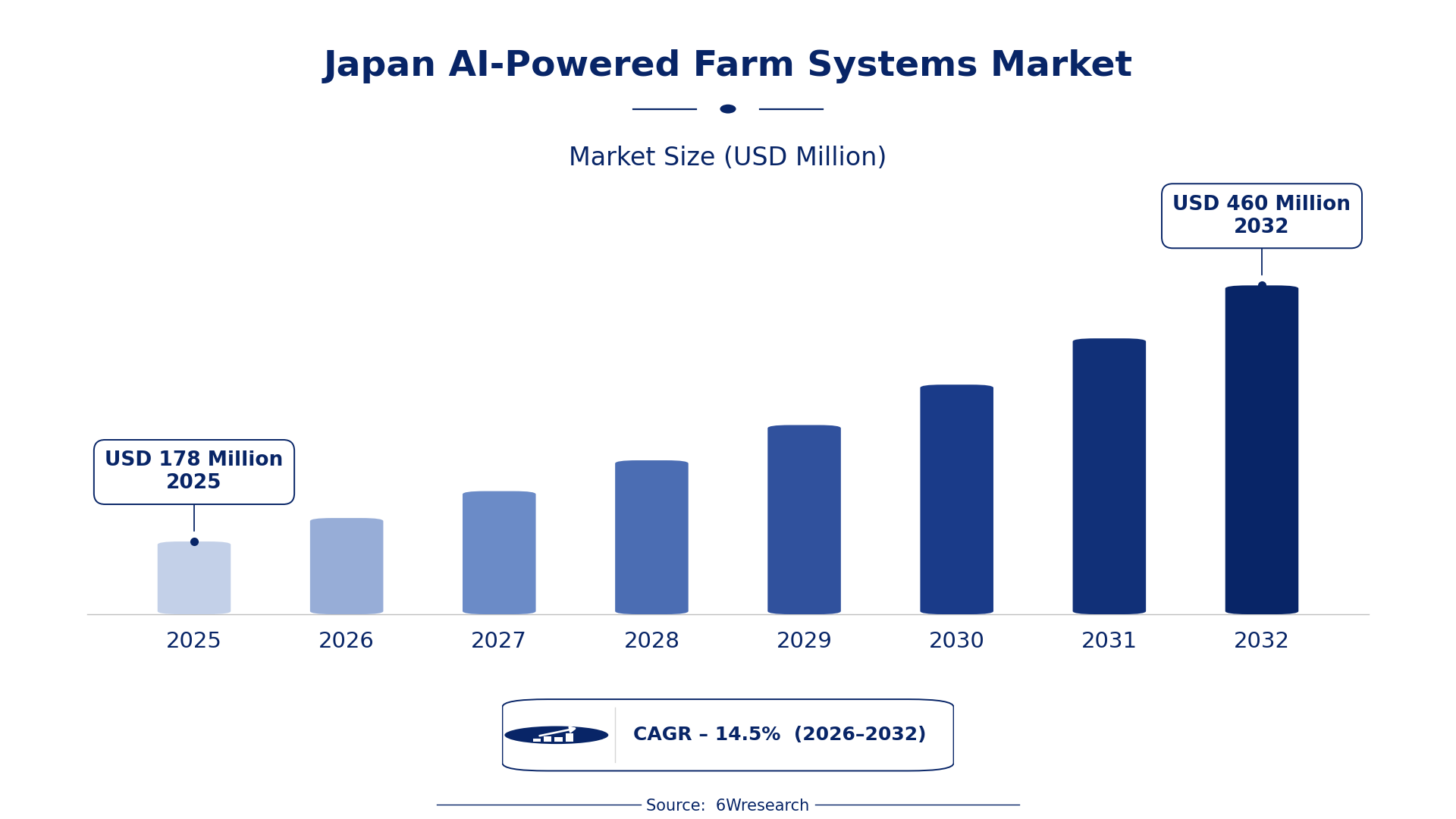
According to 6Wresearch internal database and industry insights, the Japan AI-Powered Farm Systems Market was valued at USD 178 Million in 2025 and is projected to reach USD 460 Million by 2032, growing at a CAGR of approximately 14.5% during 2026–2032.
Japan AI-Powered Farm Systems Market Highlights
| Report Metric | Details |
| Report Name | Japan AI-Powered Farm Systems Market (2026-2032) |
| Market Size 2025 | USD 178 Million |
| Market Size 2032 | USD 460 Million |
| Absolute Growth 2025–2032 | USD 282 Million |
| CAGR 2026–2032 | 14.5% |
| Peak Annual Growth | 15.7% in 2026 |
| Forecast Period | 2026–2032 |
| Historical Data | 2022–2025 |
| Base Year | 2025 |
| Leading Farm System Type, 2025 | Fertilizer Dispensers (48% share) |
| Leading AI Functionality, 2025 | Predictive Nutrient AI (48% share) |
| Leading Distribution Channel, 2025 | Agri-Tech Integrators (44% share) |
| Leading End User, 2025 | Large-scale Farmers (37% share) |
| Fastest-Growing Farm System Type | Soil Monitoring Tools (19.5% CAGR) |
| Fastest-Growing AI Functionality | AI Sensor Analysis (19.9% CAGR) |
| Fastest-Growing Distribution Channel | Smart Farming Platforms (18.5% CAGR) |
| Fastest-Growing End User | Organic Farms (18.6% CAGR) |
| Growing Sector | Agriculture |
| Key End Users | Large-scale Farmers, Organic Farms, Agricultural Enterprises |
Japan AI-Powered Farm Systems Market Year-wise Growth Rate and Key Drivers (2022–2032)
This graph illustrates the annual growth rates of the market from 2022 to 2032, highlighting a steady upward trajectory and projected market expansion over the forecast period.
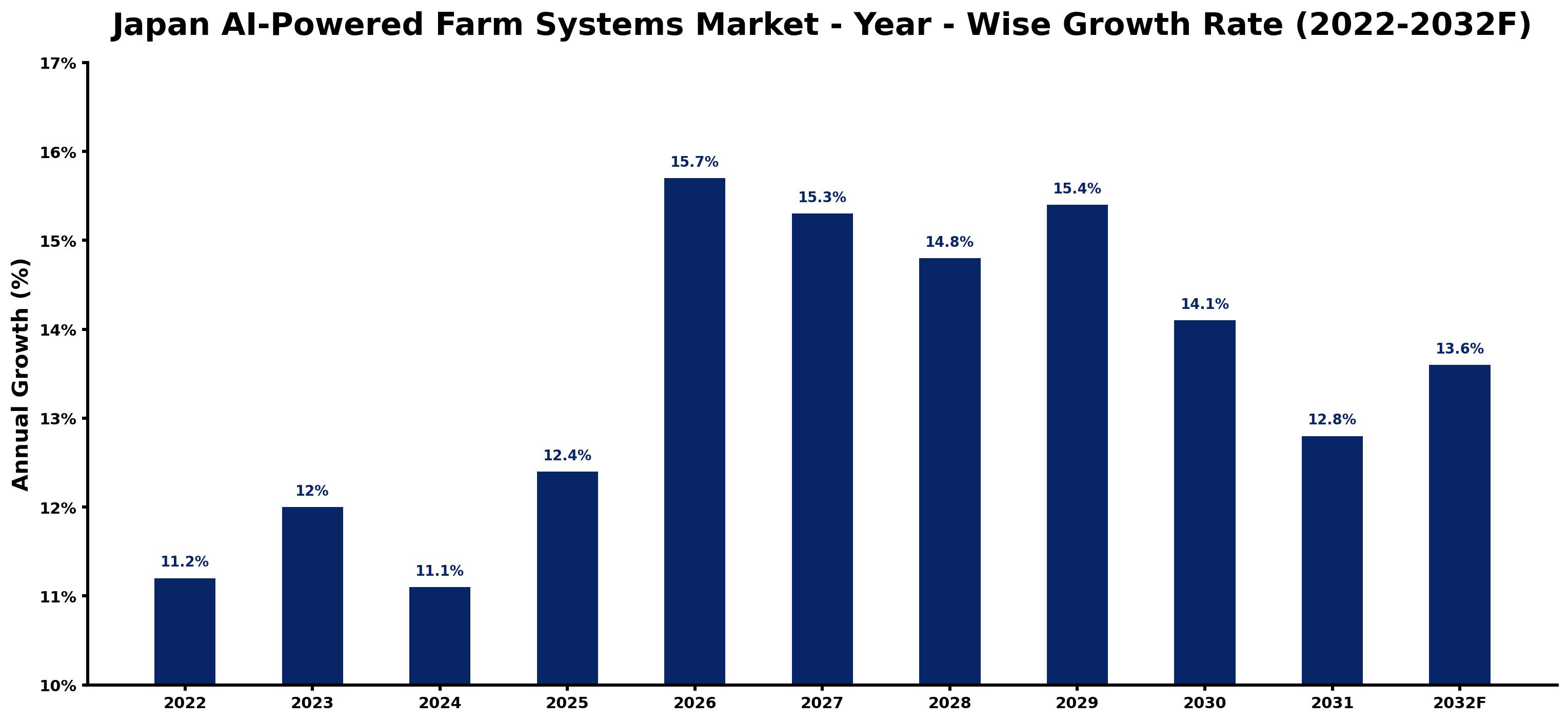
For each year, the table pairs the estimated growth rate with the leading influence on demand, showing how the drivers changed across the period.
| Year | Estimated Annual Growth (%) | Market Rationale |
| 2022 | 11.2 | The agricultural sector showed steady demand for advanced technologies in farming. |
| 2023 | 12.0 | Increased interest in smart farming practices drove higher adoption rates. |
| 2024 | 11.1 | Growth slowed slightly as market adjustments occurred following previous peaks. |
| 2025 | 12.4 | Demand surged as farming solutions gained traction among users. |
| 2026 | 15.7 | The introduction of new technologies is expected to stimulate market expansion. |
| 2027 | 15.3 | Growth is projected to moderate as the market begins to stabilise after rapid increases. |
| 2028 | 14.8 | A slight slowdown is expected as the market adjusts to new standards. |
| 2029 | 15.4 | Demand is expected to accelerate again as large-scale farmers adopt more AI solutions. |
| 2030 | 14.1 | Growth is projected to decelerate as the market reaches a more mature phase. |
| 2031 | 12.8 | The market is expected to continue growing, albeit at a slower pace than before. |
| 2032 | 13.6 | Demand is projected to increase again as new initiatives are launched to improve efficiency. |
Note: Market size estimations and growth projections presented in this report are based on 6Wresearch's proprietary forecasting methodology, utilizing the latest available industry data, government publications, and primary research inputs.
Japan AI-Powered Farm Systems Market Synopsis
AI-Powered Farm Systems utilise advanced technologies such as machine learning and IoT to optimise agricultural processes. These systems improve crop yields, resource management, and operational efficiency. The Japan AI-Powered Farm Systems Market is expanding due to rising demand from large-scale farmers and the government's commitment to smart farming initiatives. With a target of 30% AI adoption by 2025 and substantial investments in decarbonisation, the market is poised for notable growth in the coming years.
Market Dynamics Impact Analysis (2026–2032)
| Factor | Type | Impact | Primary Segment Affected |
| Growing interest in sustainable farming practices | Driver | High | AI Sensor Analysis |
| Increased investment in agricultural technology | Driver | High | Predictive Nutrient AI |
| Rising demand for water-efficient solutions | Opportunity | High | Irrigation Controllers |
| Expansion of organic farming practices | Opportunity | Medium | Organic Farms |
| High initial investment costs for technology adoption | Restraint | High | Harvesting Systems |
| Limited awareness among traditional farmers | Restraint | Medium | Soil Monitoring Tools |
| Competition from low-cost alternatives | Challenge | High | Agri-Tech Integrators |
| Slow adoption rates in rural areas | Challenge | Medium | Smart Farming Platforms |
Evaluation of Drivers in Japan AI-Powered Farm Systems Market (2026–2032)
Key forces behind demand, with the segment each one moves most, are listed below.
| Drivers | Primary Segment Affected | Why It Matters (Evidence) |
| Increased crop yields due to AI technology | Predictive Nutrient AI | AI technology can optimise fertilizer use, leading to a 30% increase in crop yields, particularly in regions where advanced practices are implemented. |
| Growing focus on resource management | AI Sensor Analysis | Real-time data insights from AI sensors enable farmers to manage resources more efficiently, contributing to sustainability goals and reducing costs by up to 20%. |
| Government initiatives promoting smart farming | Irrigation Controllers | The GX Basic Policy aims to encourage technology adoption, motivating farmers to invest in efficient irrigation systems, with a target of 30% AI adoption by 2025. |
| Rising consumer demand for organic produce | Organic Farms | The increasing number of organic farms, exceeding 100,000, drives demand for advanced farming technologies to meet consumer preferences and improve yield quality. |
| Technological advancements in agricultural machinery | Harvesting Systems | Innovations in machinery are automating labor-intensive processes, improving efficiency for large-scale farmers and reducing operational costs by 15%. |
The strongest pull on demand comes from large-scale farmers seeking to improve crop yields through advanced technologies. Approximately 1.5 million people work in Japan's agricultural sector, driving the need for efficient resource management. In the Chubu region, AI-powered irrigation systems can reduce water usage by up to 30%, prompting farmers to invest in these technologies. The push for sustainability is driving investment in tools that provide valuable insights for operational efficiency, particularly in large-scale farming operations.
Evaluation of Restraints in Japan AI-Powered Farm Systems Market
These restraints slow adoption and weigh on supplier margins.
| Market Restraint | Primary Segment Affected | Why It Matters (Evidence) |
| High initial costs for AI technology implementation | Harvesting Systems | The investment required for advanced harvesting systems can deter smaller farmers from adopting these technologies, often exceeding JPY 5 million. |
| Limited understanding of AI benefits among traditional farmers | Soil Monitoring Tools | Many traditional farmers lack awareness of how AI can improve soil health, resulting in slower adoption rates and missed opportunities for increased yields. |
| Regulatory hurdles in technology deployment | Irrigation Controllers | Compliance with environmental regulations can complicate the adoption of new irrigation technologies, causing delays in implementation. |
| Dependency on external technology providers | Agri-Tech Integrators | Reliance on external providers for technology solutions can limit local innovation and responsiveness, affecting the speed of technology integration. |
| Market saturation in certain technology segments | Smart Farming Platforms | As more players enter the market, competition increases, potentially leading to price wars and reduced margins, impacting profitability. |
Japan AI-Powered Farm Systems Market Challenges
Producers struggle with a shortage of skilled workers in advanced agricultural technologies, stemming from an ageing workforce and limited training opportunities, which delays the implementation of AI-powered systems. Buyers face rising costs as producers attempt to adopt new technologies without adequate support, resulting in higher prices for agricultural products. Many producers hesitate to invest in AI technology due to high initial costs, which hampers their operational efficiency and restricts buyers' access to improved crop yields. The slow integration of technology in farming practices leads to stagnation, preventing producers from meeting market demands effectively.
Trends in the Japan AI-Powered Farm Systems Market
Below are the shifts with the largest effect on the Japan AI-Powered Farm Systems Market.
- Shift towards Sustainable Farming Practices: Japan is increasingly adopting sustainable farming practices, with a target of 30% AI adoption by 2025. This initiative encourages the use of AI technologies to improve environmental outcomes, particularly in the Tohoku region.
- Transition from Traditional to Smart Farming: In 2023, the government allocated 5 billion yen for smart farming initiatives, marking a shift towards integrating advanced technologies in agriculture. This investment is expected to improve operational efficiency across the sector, especially among large-scale farmers.
- Emergence of AI-Driven Irrigation Solutions: AI-powered irrigation systems are gaining traction, with the potential to reduce water usage by up to 30%. This trend is particularly evident in the Chubu region, known for its agricultural technology development and innovation.
- Rise of Organic Farming Technologies: The number of organic farms in Japan surpassed 100,000 in 2022, leading to increased demand for technologies that support sustainable practices, such as AI Sensor Analysis tools that enhance productivity.
Investment Opportunities in the Japan AI-Powered Farm Systems Market
The following areas offer the clearest openings for investors and suppliers in the Japan AI-Powered Farm Systems Market.
- AI-Powered Irrigation Systems: With a target of 30% AI adoption by 2025, there is a strong opportunity to supply AI-powered irrigation systems. Large-scale farmers in the Kanto region are particularly interested in these technologies to improve water efficiency and reduce costs.
- Soil Monitoring Technologies: The growing emphasis on soil health presents an opportunity to invest in soil monitoring tools. Agricultural enterprises in the Tohoku region are seeking advanced solutions to improve soil management practices and enhance crop yields.
- Smart Farming Platforms: The demand for integrated farm management solutions is rising, creating opportunities for suppliers of smart farming platforms. The Chubu region is a key market for these technologies, driven by local agricultural innovation and investment.
- AI Sensor Analysis Tools: As farmers increasingly recognise the value of data insights, there is a growing need for AI sensor analysis tools. This trend is particularly strong among organic farms aiming to optimise their practices and improve sustainability.
Government Initiatives in the Japan AI-Powered Farm Systems Market
The GX Promotion Act (2023) establishes a legal framework for promoting decarbonisation in agriculture, building on previous laws that encourage energy efficiency improvements. This act mandates agricultural producers to adopt AI technologies that align with sustainability goals, promoting innovation and reducing emissions.
Large-scale farmers benefit from the Ministry of Agriculture's subsidy program for smart farming equipment, which was launched in 2023. This initiative allocates 5 billion yen to support technology adoption, enabling farmers to improve productivity and reduce environmental impact while enhancing operational efficiency.
Future Insight of the Japan AI-Powered Farm Systems Market
A policy-driven shift will reshape the agricultural sector, targeting a 46% reduction in greenhouse gas emissions by 2030. The government plans to boost AI adoption in farming, which will improve resource management for producers. Public and private investments of approximately JPY 150 trillion over the next decade will stimulate technological advancements. The establishment of the Smart Agriculture Consortium will promote collaboration, enabling suppliers to innovate and respond to the evolving needs of the agricultural market.
Market Segmentation Analysis
Japan AI-Powered Farm Systems Market report covers a detailed analysis of the following market segments:
By Farm System Type – Fertilizer Dispensers Lead, Soil Monitoring Tools Expected to Grow Fastest
According to Saurav Kr Singh, Senior Research Analyst at 6Wresearch, Fertilizer Dispensers held 48% of the Japan AI-Powered Farm Systems Market by farm system type in 2025. Fertilizer dispensers command the largest share as they are vital for precise nutrient application, essential for maximising crop yields. Their widespread use is particularly evident in the Tohoku region, where farmers are focused on enhancing productivity. The quickest growth will come from Soil Monitoring Tools, forecast to expand at a CAGR of 19.5% between 2026 and 2032. Soil monitoring tools are rapidly gaining traction due to their critical role in assessing soil health, which is increasingly important for sustainable farming. The government's target to cut chemical fertiliser use by 50% by 2030 is a key factor driving this growth. Suppliers should prioritise the development of advanced soil monitoring tools to meet the growing demand.
By AI Functionality – Predictive Nutrient AI Leads, AI Sensor Analysis Expected to Grow Fastest
With 48% of ai functionality revenue in 2025, Predictive Nutrient AI was the largest category. Predictive nutrient AI leads the market by optimising fertiliser use, which is crucial for improving agricultural productivity. This technology aligns with Japan's environmental goals, particularly in reducing greenhouse gas emissions through better resource management. AI Sensor Analysis is projected to grow fastest, at a CAGR of 19.9% during 2026–2032. AI sensor analysis is experiencing rapid growth as it provides real-time data insights that farmers need for timely decision-making. The government's aim to increase AI adoption by 30% by 2025 is significantly propelling this segment. Buyers will benefit from investing in AI sensor analysis to enhance operational efficiency and achieve sustainability objectives.
By Distribution Channel – Agri-Tech Integrators Lead, Smart Farming Platforms Expected to Grow Fastest
Agri-Tech Integrators took 44% of distribution channel revenue in 2025, more than any other category. Agri-tech integrators hold the largest share by effectively connecting various technologies, which is essential for the smooth operation of AI-powered farm systems. Their role is especially prominent in the Chubu region, known for its agricultural technology advancements. Over 2026–2032, Smart Farming Platforms are expected to post the fastest growth, at a CAGR of 18.5%. Smart farming platforms are quickly gaining traction as they centralise farm management, making it easier for farmers to implement advanced technologies. This growth is further supported by the Ministry of Agriculture's subsidy programme for smart farming equipment launched in 2023. Suppliers should consider partnerships with smart farming platforms to expand their market reach.
By End User – Large-scale Farmers Lead, Organic Farms Expected to Grow Fastest
Large-scale Farmers accounted for 37% of the market by end user in 2025. Large-scale farmers represent the largest segment due to the considerable efficiency gains they achieve from AI-powered farm systems. Their operational scale allows for greater investments in advanced agricultural technologies. Organic Farms are set to record the highest CAGR in this split, 18.6% over 2026–2032. Organic farms are the fastest-growing segment as they increasingly adopt technology for sustainable practices, driven by consumer demand for organic products. The presence of over 100,000 organic farms in Japan highlights this trend. Suppliers should tailor their offerings to meet the specific needs of organic farms to capitalise on this growth opportunity.
Key Attractiveness of the Report
- 10 Years of Market Numbers
- Historical Data Starting from 2022 to 2025
- Base Year 2025
- Forecast Data until 2032
- Key Performance Indicators Impacting the Market
- Major Upcoming Developments and Projects
Key Highlights of the Report:
- Japan AI-Powered Farm Systems Market Outlook
- Market Size of Japan AI-Powered Farm Systems Market, 2025
- Forecast of Japan AI-Powered Farm Systems Market, 2032
- Historical Data and Forecast of Japan AI-Powered Farm Systems Revenues & Volume for the Period 2022-2032F
- Japan AI-Powered Farm Systems Market Trend Evolution
- Japan AI-Powered Farm Systems Market Drivers and Challenges
- Japan AI-Powered Farm Systems Price Trends
- Japan AI-Powered Farm Systems Porter's Five Forces
- Japan AI-Powered Farm Systems Industry Life Cycle
- Historical Data and Forecast of Japan AI-Powered Farm Systems Market Revenues & Volume By Farm System Type for the Period 2022-2032F
- Historical Data and Forecast of Japan AI-Powered Farm Systems Market Revenues & Volume By Irrigation Controllers for the Period 2022-2032F
- Historical Data and Forecast of Japan AI-Powered Farm Systems Market Revenues & Volume By Soil Monitoring Tools for the Period 2022-2032F
- Historical Data and Forecast of Japan AI-Powered Farm Systems Market Revenues & Volume By Harvesting Systems for the Period 2022-2032F
- Historical Data and Forecast of Japan AI-Powered Farm Systems Market Revenues & Volume By Fertilizer Dispensers for the Period 2022-2032F
- Historical Data and Forecast of Japan AI-Powered Farm Systems Market Revenues & Volume By AI Functionality for the Period 2022-2032F
- Historical Data and Forecast of Japan AI-Powered Farm Systems Market Revenues & Volume By Water Flow Optimization for the Period 2022-2032F
- Historical Data and Forecast of Japan AI-Powered Farm Systems Market Revenues & Volume By AI Sensor Analysis for the Period 2022-2032F
- Historical Data and Forecast of Japan AI-Powered Farm Systems Market Revenues & Volume By AI-Guided Robotics for the Period 2022-2032F
- Historical Data and Forecast of Japan AI-Powered Farm Systems Market Revenues & Volume By Predictive Nutrient AI for the Period 2022-2032F
- Historical Data and Forecast of Japan AI-Powered Farm Systems Market Revenues & Volume By Distribution Channel for the Period 2022-2032F
- Historical Data and Forecast of Japan AI-Powered Farm Systems Market Revenues & Volume By Agri-Tech Integrators for the Period 2022-2032F
- Historical Data and Forecast of Japan AI-Powered Farm Systems Market Revenues & Volume By Smart Farming Platforms for the Period 2022-2032F
- Historical Data and Forecast of Japan AI-Powered Farm Systems Market Revenues & Volume By Equipment Distributors for the Period 2022-2032F
- Historical Data and Forecast of Japan AI-Powered Farm Systems Market Revenues & Volume By Agri Automation Suppliers for the Period 2022-2032F
- Historical Data and Forecast of Japan AI-Powered Farm Systems Market Revenues & Volume By End User for the Period 2022-2032F
- Historical Data and Forecast of Japan AI-Powered Farm Systems Market Revenues & Volume By Crop Growers for the Period 2022-2032F
- Historical Data and Forecast of Japan AI-Powered Farm Systems Market Revenues & Volume By Organic Farms for the Period 2022-2032F
- Historical Data and Forecast of Japan AI-Powered Farm Systems Market Revenues & Volume By Agricultural Enterprises for the Period 2022-2032F
- Historical Data and Forecast of Japan AI-Powered Farm Systems Market Revenues & Volume By Large-scale Farmers for the Period 2022-2032F
- Japan AI-Powered Farm Systems Import Export Trade Statistics
- Market Opportunity Assessment By Farm System Type
- Market Opportunity Assessment By AI Functionality
- Market Opportunity Assessment By Distribution Channel
- Market Opportunity Assessment By End User
- Japan AI-Powered Farm Systems Top Companies Market Share
- Japan AI-Powered Farm Systems Competitive Benchmarking By Technical and Operational Parameters
- Japan AI-Powered Farm Systems Company Profiles
- Japan AI-Powered Farm Systems Key Strategic Recommendations
Market Covered
Coverage by segment is as follows.
By Farm System Type
- Irrigation Controllers
- Soil Monitoring Tools
- Harvesting Systems
- Fertilizer Dispensers
By AI Functionality
- Water Flow Optimization
- AI Sensor Analysis
- AI-Guided Robotics
- Predictive Nutrient AI
By Distribution Channel
- Agri-Tech Integrators
- Smart Farming Platforms
- Equipment Distributors
- Agri Automation Suppliers
By End User
- Crop Growers
- Organic Farms
- Agricultural Enterprises
- Large-scale Farmers































