Japan AI-Powered Fleet Systems Market Size & Growth Rate
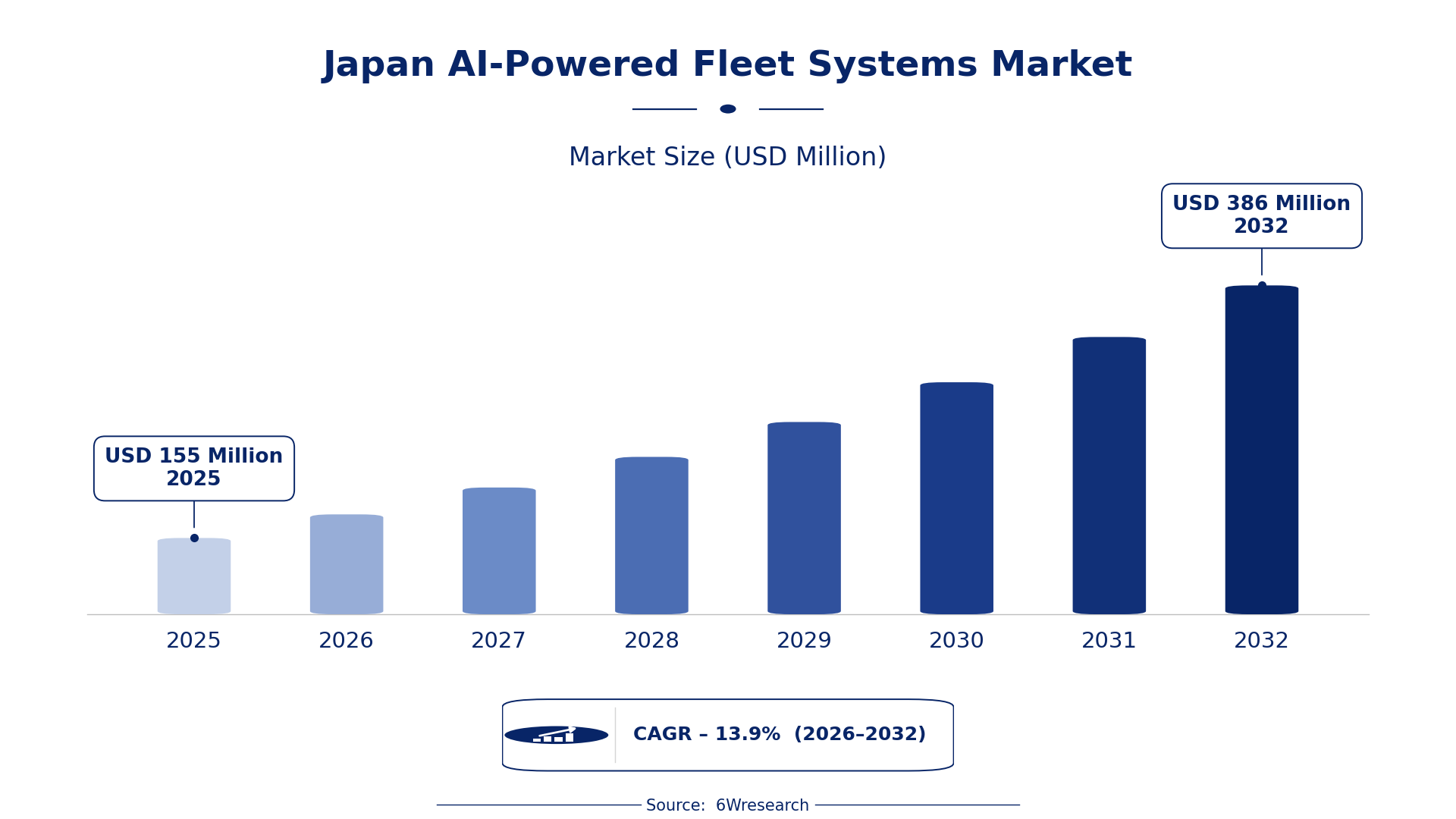
According to 6Wresearch internal database and industry insights, the Japan AI-Powered Fleet Systems Market was valued at USD 155 Million in 2025 and is projected to reach USD 386 Million by 2032, growing at a CAGR of approximately 13.9% during 2026–2032.
Japan AI-Powered Fleet Systems Market Highlights
| Report Metric | Details |
| Report Name | Japan AI-Powered Fleet Systems Market (2026-2032) |
| Market Size 2025 | USD 155 Million |
| Market Size 2032 | USD 386 Million |
| Absolute Growth 2025–2032 | USD 231 Million |
| CAGR 2026–2032 | 13.9% |
| Peak Annual Growth | 15.6% in 2026 |
| Forecast Period | 2026–2032 |
| Historical Data | 2022–2025 |
| Base Year | 2025 |
| Leading Fleet Type, 2025 | Logistics Fleets (48% share) |
| Leading AI Optimization, 2025 | Route Planning AI (42% share) |
| Leading Distribution Channel, 2025 | Transportation Software (39% share) |
| Leading End User, 2025 | Courier Services (54% share) |
| Fastest-Growing Fleet Type | Public Transit Fleets (18.8% CAGR) |
| Fastest-Growing AI Optimization | Demand Prediction (18.4% CAGR) |
| Fastest-Growing Distribution Channel | Fleet Management SaaS (17.4% CAGR) |
| Fastest-Growing End User | Municipal Transit Offices (17.3% CAGR) |
| Growing Sector | Logistics and Public Transit |
| Key End Users | Logistics companies, Public transit agencies, Municipal transit offices, Courier services |
Japan AI-Powered Fleet Systems Market Year-wise Growth Rate and Key Drivers (2022–2032)
This graph illustrates the annual growth rates of the market from 2022 to 2032, highlighting a steady upward trajectory and projected market expansion over the forecast period.
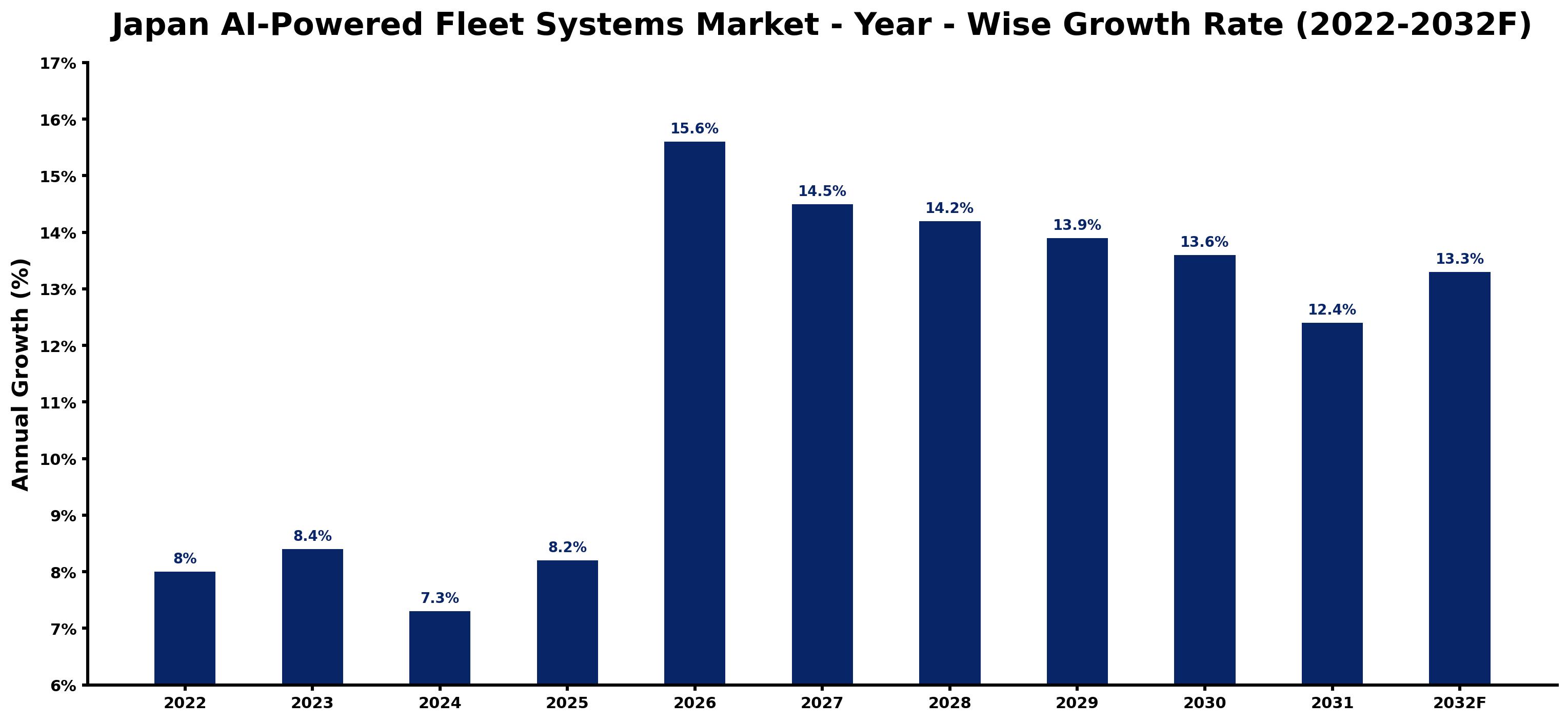
Year by year, the estimates below pair each growth rate with the development that shaped it.
| Year | Estimated Annual Growth (%) | Market Rationale |
| 2022 | 8.0 | The market experienced stable growth with increasing interest in AI technologies. |
| 2023 | 8.4 | Growth accelerated due to heightened investments in fleet optimization technologies. |
| 2024 | 7.3 | Growth slowed slightly as companies adjusted to new technologies and market conditions. |
| 2025 | 8.2 | Demand surged as public transit systems sought modernization and efficiency improvements. |
| 2026 | 15.6 | The market is expected to peak with advancements in AI and fleet management solutions. |
| 2027 | 14.5 | Growth will decelerate as the market begins to stabilise after rapid expansion. |
| 2028 | 14.2 | Continued interest in AI solutions is projected to lead to sustained growth, albeit at a slower rate. |
| 2029 | 13.9 | The market will maintain steady growth as urbanization trends persist. |
| 2030 | 13.6 | Growth is expected to slow further as the market matures and competition intensifies. |
| 2031 | 12.4 | The market will continue to grow, driven by ongoing investments in smart transportation. |
| 2032 | 13.3 | Demand is projected to rise as urban areas increasingly adopt AI-powered solutions. |
Note: Market size estimations and growth projections presented in this report are based on 6Wresearch's proprietary forecasting methodology, utilizing the latest available industry data, government publications, and primary research inputs.
Japan AI-Powered Fleet Systems Market Synopsis
AI-Powered Fleet Systems optimise operations through advanced algorithms and machine learning, particularly in logistics and public transit. The Japan AI-Powered Fleet Systems Market is expanding due to rising urbanisation, substantial investments in fleet optimisation, and government initiatives promoting smart transportation. The logistics sector, valued at approximately 20 trillion yen, is a key driver, alongside increasing adoption of AI technologies in public transit systems. With over 9 million residents in the Tokyo metropolitan area, efficient fleet management is essential for service improvement and operational efficiency.
Market Dynamics Impact Analysis (2026–2032)
| Factor | Type | Impact | Primary Segment Affected |
| Growing urbanisation in Japan is increasing the demand for efficient public transit solutions. | Driver | High | Public Transit Fleets |
| Significant investments in logistics technology are driving fleet optimisation. | Driver | High | Logistics Fleets |
| The push for decarbonisation is creating opportunities for AI-powered solutions. | Opportunity | High | Logistics Fleets |
| Rising fuel costs are prompting fleet operators to seek efficiency improvements. | Opportunity | Medium | Public Transit Fleets |
| High initial investment costs can deter smaller operators from adopting AI systems. | Restraint | High | Logistics Fleets |
| Limited awareness of AI benefits among traditional fleet operators hampers adoption. | Restraint | Medium | Public Transit Fleets |
| The complexity of integration with existing systems poses challenges for fleet operators. | Challenge | High | Logistics Fleets |
| Talent shortages in AI and data analytics limit operational capabilities. | Challenge | Medium | Public Transit Fleets |
Evaluation of Drivers in Japan AI-Powered Fleet Systems Market (2026–2032)
Below are the drivers that matter most for revenue growth, with supporting evidence.
| Drivers | Primary Segment Affected | Why It Matters (Evidence) |
| Increasing urbanisation leads to higher demand for efficient public transport solutions. | Public Transit Fleets | Tokyo's public transit system serves over 8 million passengers daily, necessitating advanced fleet management. |
| Significant investments in logistics technology are enhancing fleet optimisation. | Logistics Fleets | Japan's logistics sector is valued at approximately 20 trillion yen, driving demand for AI solutions. |
| Government initiatives promote smart transportation, boosting AI adoption. | Public Transit Fleets | The Ministry of Land, Infrastructure, Transport and Tourism has supported smart transportation since 2020. |
| The need for cost reductions is pushing fleet operators towards AI solutions. | Logistics Fleets | The average maintenance cost for fleets is targeted to be reduced by 10% by 2025. |
| Growing fuel prices are incentivising fleet operators to optimise routes. | Public Transit Fleets | The average fuel consumption reduction target for fleets is set at 15% by 2025. |
Volumes grow on the back of increasing urbanisation, with Tokyo's public transit system serving over 8 million passengers daily, necessitating advanced management solutions. The logistics sector, valued at approximately 20 trillion yen, is investing heavily in technology to optimise operations. The average maintenance cost for fleets is targeted to be reduced by 10% by 2025, prompting operators to seek AI solutions. Rising fuel prices are pushing fleet operators to optimise routes, leading to increased demand for AI-powered systems.
Evaluation of Restraints in Japan AI-Powered Fleet Systems Market
Several factors work against faster growth; the main ones are summarised below.
| Market Restraint | Primary Segment Affected | Why It Matters (Evidence) |
| High initial investment costs deter smaller operators from adopting AI systems. | Logistics Fleets | Many smaller logistics companies struggle to afford the upfront costs associated with AI implementation. |
| Limited awareness of AI benefits among traditional fleet operators hampers adoption. | Public Transit Fleets | Some public transit agencies remain unaware of the operational efficiencies AI can provide. |
| Integration complexity with existing systems poses challenges for fleet operators. | Logistics Fleets | Many companies face difficulties in merging new AI technologies with legacy systems. |
| Talent shortages in AI and data analytics limit operational capabilities. | Public Transit Fleets | The lack of skilled professionals hinders the effective implementation of AI solutions. |
| Regulatory compliance can slow down the adoption of new technologies. | Logistics Fleets | Fleet operators must navigate complex regulations that can delay AI integration. |
Japan AI-Powered Fleet Systems Market Challenges
In Japan, evolving regulations from the Ministry of Land, Infrastructure, Transport and Tourism complicate compliance for logistics companies, delaying operations and increasing costs by up to 15%. Skills shortages in advanced AI technology prevent fleet operators from fully utilising telematics systems, resulting in inefficiencies that burden public transit agencies. The average age of public transit vehicles exceeds 10 years, necessitating urgent upgrades that many operators struggle to finance, leading to higher maintenance costs. The target to reduce average maintenance costs by 10% by 2025 remains unachieved, straining budgets for fleet managers.
Trends in the Japan AI-Powered Fleet Systems Market
The shifts below are changing how Japan AI-Powered Fleet Systems Market products are bought and supplied.
- Shift from Traditional to AI-Driven Fleet Management: Since 2020, public transit agencies have increasingly adopted AI technologies to improve operational efficiency. For instance, the Ministry of Land, Infrastructure, Transport and Tourism has promoted smart transportation initiatives, leading to a 15% target reduction in fuel consumption by 2025.
- Transition from Manual to Automated Route Planning: The introduction of Route Planning AI in logistics has transformed delivery operations. As of 2023, telematics systems are integrated into 70% of new logistics vehicles, improving route efficiency and reducing operational costs.
- Emergence of Fleet Management SaaS Solutions: The growing adoption of Fleet Management SaaS solutions is reshaping fleet operations. In urban areas, these solutions have seen a rise in usage, driven by the need for real-time monitoring and management.
- Public Transit Modernisation Prioritised: Public transit systems are prioritising modernisation to meet increasing passenger demands. With over 9 million residents in the Tokyo metropolitan area, efficient fleet management has become essential for service improvement.
Investment Opportunities in the Japan AI-Powered Fleet Systems Market
The openings below show where demand in the Japan AI-Powered Fleet Systems Market is visible and how suppliers can enter.
- Timing for Investment in AI Solutions: With Japan's logistics sector valued at approximately 20 trillion yen, there is a strong opportunity for AI-powered fleet systems. Investing in these technologies can yield substantial returns as demand for efficiency rises.
- Entry into the Public Transit Sector: The public transit sector presents a strong opportunity for AI solutions, particularly in urban areas. Collaborating with municipal transit offices can facilitate entry into this growing market.
- Gap in AI Adoption Among Smaller Operators: As many smaller fleet operators lag in AI adoption, there is a gap to fill. Providing tailored AI solutions can help these operators improve efficiency and reduce costs.
- Supply of Route Planning AI Solutions: The demand for Route Planning AI is increasing, driven by the need for operational efficiency. Suppliers can target logistics companies looking to optimise their delivery routes.
Government Initiatives in the Japan AI-Powered Fleet Systems Market
The GX Promotion Act (2023) mandates a transition towards greener technologies for fleet operators. This law compels companies to adopt AI-powered fleet systems that improve operational efficiency while reducing emissions, aligning with Japan's decarbonisation goals. The GX Basic Policy aims for about JPY 150 trillion of public-private decarbonisation investment over 10 years, supporting the development of AI technologies in fleet management.
In 2023, the Japanese government allocated 5 billion yen for smart transportation projects, administered by the Ministry of Land, Infrastructure, Transport and Tourism. This funding supports the development and integration of AI technologies in fleet management, benefitting both producers and users.
Future Insight of the Japan AI-Powered Fleet Systems Market
By 2032, Japan's GX Basic Policy will drive an estimated JPY 150 trillion in public and private decarbonisation investment, prompting fleet operators to adopt AI-powered systems for improved efficiency. The government's allocation of 5 billion yen for smart transportation projects will accelerate the integration of technology in urban transport, improving service delivery for public transit users. As urbanisation continues, demand for optimised management will rise, pushing suppliers to innovate. Support for eco-friendly operations through subsidies will encourage operators to modernise their vehicles, aligning with the goal of achieving net zero emissions by 2050.
Market Segmentation Analysis
Japan AI-Powered Fleet Systems Market report covers a detailed analysis of the following market segments:
By Fleet Type – Logistics Fleets Lead, Public Transit Fleets Expected to Grow Fastest
According to Saurav Kr Singh, Senior Research Analyst at 6Wresearch, in 2025, Logistics Fleets led the fleet type split with a 48% share. Logistics fleets occupy the largest market share due to their essential function in streamlining delivery routes and reducing costs. The logistics sector, valued at approximately 20 trillion yen, showcases a robust demand for advanced fleet systems that enhance operational efficiency. Over 2026–2032, Public Transit Fleets are expected to post the fastest growth, at a CAGR of 18.8%. Public transit fleets are witnessing rapid growth as urbanisation amplifies the need for effective management of schedules and service delivery. The Tokyo metropolitan area, with over 9 million residents, significantly drives this increasing demand for efficient fleet solutions. Suppliers should focus on developing tailored solutions for public transit to capitalise on this growth opportunity.
By AI Optimization – Route Planning AI Leads, Demand Prediction Expected to Grow Fastest
Route Planning AI held 42% of the Japan AI-Powered Fleet Systems Market by ai optimization in 2025. Route planning systems dominate the market as they are crucial for optimising travel routes and minimising fuel consumption across fleets. Their integration is vital for achieving operational efficiency and meeting sustainability targets in fleet operations. Demand Prediction is projected to grow fastest, at a CAGR of 18.4% during 2026–2032. Demand prediction is rapidly gaining traction as it aids in accurately forecasting needs, which is increasingly essential amid urbanisation trends. This growth will likely continue as fleets increasingly depend on data-driven insights for operational improvements. Investing in demand prediction capabilities will be necessary for suppliers to align with the evolving requirements of fleet operators.
By Distribution Channel – Transportation Software Leads, Fleet Management SaaS Expected to Grow Fastest
With 39% of distribution channel revenue in 2025, Transportation Software was the largest category. Transportation software leads the market because it is fundamental for managing fleet operations effectively. Its widespread use across various sectors ensures consistent demand for these systems, driving market growth. The quickest growth will come from Fleet Management SaaS, forecast to expand at a CAGR of 17.4% between 2026 and 2032. Fleet management SaaS is the fastest-growing segment, propelled by the rising need for real-time monitoring and management solutions. This trend is particularly pronounced in urban areas where operational efficiency is critical for fleet success. Suppliers should prioritise SaaS offerings to meet the increasing demand for real-time fleet management solutions.
By End User – Courier Services Lead, Municipal Transit Offices Expected to Grow Fastest
The largest end user category in 2025 was Courier Services, at 54% of revenue. Courier services represent the largest share as they are vital for optimising delivery operations and meeting customer expectations. The surge in e-commerce activities in Japan further fuels this demand for efficient fleet systems tailored to logistics needs. Municipal Transit Offices are set to record the highest CAGR in this split, 17.3% over 2026–2032. Municipal transit offices are the fastest-growing end user, driven by the necessity for improved public transport efficiency. The high volume of daily passengers in urban areas highlights the urgent need for advanced fleet management solutions. Focusing on solutions designed for municipal transit offices will be essential for suppliers aiming to expand their market presence.
Key Attractiveness of the Report
- 10 Years of Market Numbers
- Historical Data Starting from 2022 to 2025
- Base Year 2025
- Forecast Data until 2032
- Key Performance Indicators Impacting the Market
- Major Upcoming Developments and Projects
Key Highlights of the Report:
- Japan AI-Powered Fleet Systems Market Outlook
- Market Size of Japan AI-Powered Fleet Systems Market, 2025
- Forecast of Japan AI-Powered Fleet Systems Market, 2032
- Historical Data and Forecast of Japan AI-Powered Fleet Systems Revenues & Volume for the Period 2022-2032F
- Japan AI-Powered Fleet Systems Market Trend Evolution
- Japan AI-Powered Fleet Systems Market Drivers and Challenges
- Japan AI-Powered Fleet Systems Price Trends
- Japan AI-Powered Fleet Systems Porter's Five Forces
- Japan AI-Powered Fleet Systems Industry Life Cycle
- Historical Data and Forecast of Japan AI-Powered Fleet Systems Market Revenues & Volume By Fleet Type for the Period 2022-2032F
- Historical Data and Forecast of Japan AI-Powered Fleet Systems Market Revenues & Volume By Logistics Fleets for the Period 2022-2032F
- Historical Data and Forecast of Japan AI-Powered Fleet Systems Market Revenues & Volume By Public Transit Fleets for the Period 2022-2032F
- Historical Data and Forecast of Japan AI-Powered Fleet Systems Market Revenues & Volume By Utility Vehicles for the Period 2022-2032F
- Historical Data and Forecast of Japan AI-Powered Fleet Systems Market Revenues & Volume By Rental Fleets for the Period 2022-2032F
- Historical Data and Forecast of Japan AI-Powered Fleet Systems Market Revenues & Volume By AI Optimization for the Period 2022-2032F
- Historical Data and Forecast of Japan AI-Powered Fleet Systems Market Revenues & Volume By Route Planning AI for the Period 2022-2032F
- Historical Data and Forecast of Japan AI-Powered Fleet Systems Market Revenues & Volume By Demand Prediction for the Period 2022-2032F
- Historical Data and Forecast of Japan AI-Powered Fleet Systems Market Revenues & Volume By Maintenance Scheduling for the Period 2022-2032F
- Historical Data and Forecast of Japan AI-Powered Fleet Systems Market Revenues & Volume By Usage Analytics AI for the Period 2022-2032F
- Historical Data and Forecast of Japan AI-Powered Fleet Systems Market Revenues & Volume By Distribution Channel for the Period 2022-2032F
- Historical Data and Forecast of Japan AI-Powered Fleet Systems Market Revenues & Volume By Transportation Software for the Period 2022-2032F
- Historical Data and Forecast of Japan AI-Powered Fleet Systems Market Revenues & Volume By Fleet Management SaaS for the Period 2022-2032F
- Historical Data and Forecast of Japan AI-Powered Fleet Systems Market Revenues & Volume By Telematics Vendors for the Period 2022-2032F
- Historical Data and Forecast of Japan AI-Powered Fleet Systems Market Revenues & Volume By Rental Service Platforms for the Period 2022-2032F
- Historical Data and Forecast of Japan AI-Powered Fleet Systems Market Revenues & Volume By End User for the Period 2022-2032F
- Historical Data and Forecast of Japan AI-Powered Fleet Systems Market Revenues & Volume By Courier Services for the Period 2022-2032F
- Historical Data and Forecast of Japan AI-Powered Fleet Systems Market Revenues & Volume By Municipal Transit Offices for the Period 2022-2032F
- Historical Data and Forecast of Japan AI-Powered Fleet Systems Market Revenues & Volume By Energy Providers for the Period 2022-2032F
- Historical Data and Forecast of Japan AI-Powered Fleet Systems Market Revenues & Volume By Automotive Leasing Firms for the Period 2022-2032F
- Japan AI-Powered Fleet Systems Import Export Trade Statistics
- Market Opportunity Assessment By Fleet Type
- Market Opportunity Assessment By AI Optimization
- Market Opportunity Assessment By Distribution Channel
- Market Opportunity Assessment By End User
- Japan AI-Powered Fleet Systems Top Companies Market Share
- Japan AI-Powered Fleet Systems Competitive Benchmarking By Technical and Operational Parameters
- Japan AI-Powered Fleet Systems Company Profiles
- Japan AI-Powered Fleet Systems Key Strategic Recommendations
Market Covered
Segments analysed in this report are listed below.
By Fleet Type
- Logistics Fleets
- Public Transit Fleets
- Utility Vehicles
- Rental Fleets
By AI Optimization
- Route Planning AI
- Demand Prediction
- Maintenance Scheduling
- Usage Analytics AI
By Distribution Channel
- Transportation Software
- Fleet Management SaaS
- Telematics Vendors
- Rental Service Platforms
By End User
- Courier Services
- Municipal Transit Offices
- Energy Providers
- Automotive Leasing Firms































