Japan AI-Powered Merchandising Market Size & Growth Rate
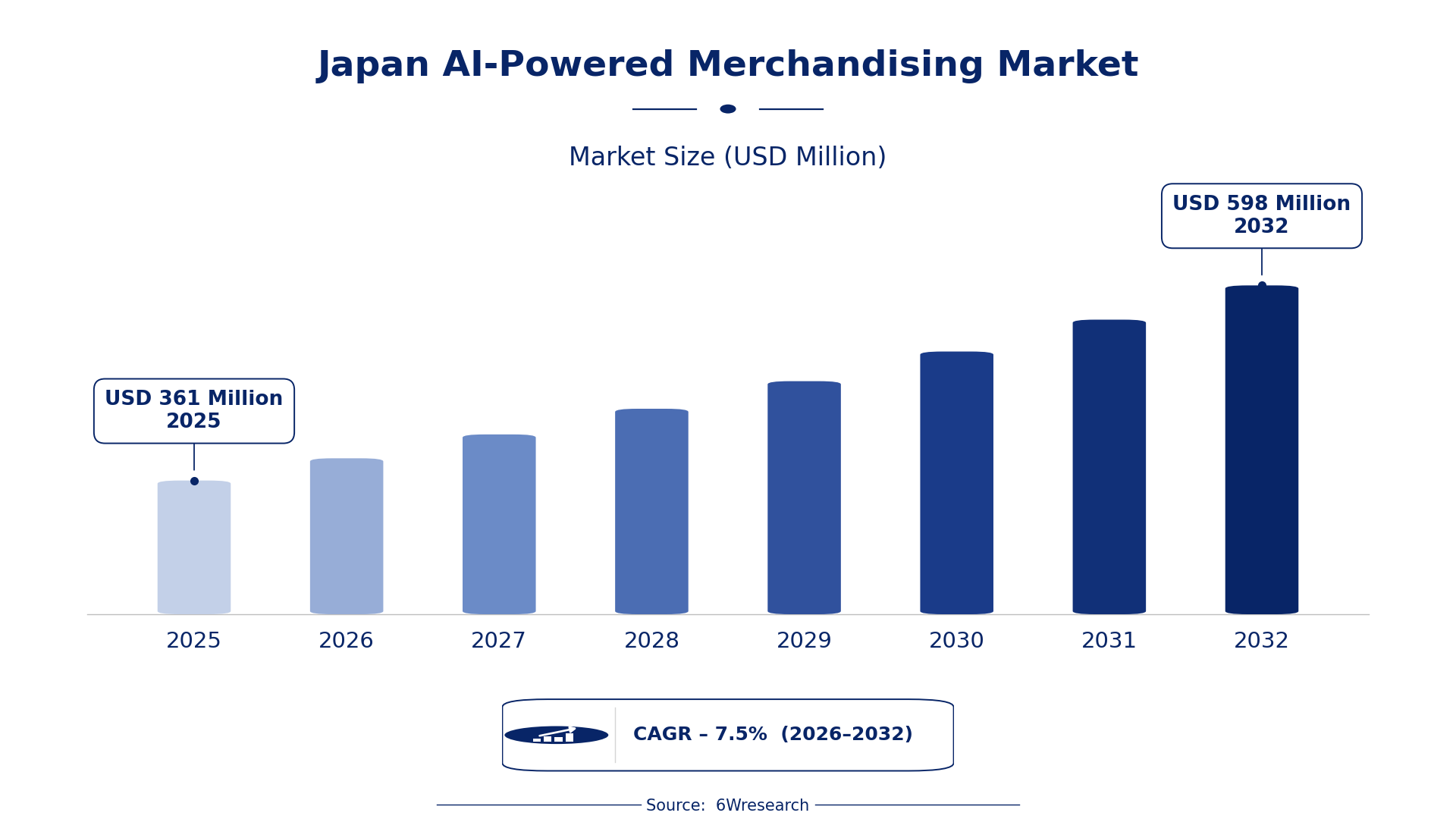
According to 6Wresearch internal database and industry insights, the Japan AI-Powered Merchandising Market was valued at USD 361 Million in 2025 and is projected to reach USD 598 Million by 2032, growing at a CAGR of approximately 7.5% during 2026–2032.
Japan AI-Powered Merchandising Market Highlights
| Report Metric | Details |
| Report Name | Japan AI-Powered Merchandising Market (2026-2032) |
| Market Size 2025 | USD 361 Million |
| Market Size 2032 | USD 598 Million |
| Absolute Growth 2025–2032 | USD 237 Million |
| CAGR 2026–2032 | 7.5% |
| Peak Annual Growth | 10.3% in 2026 |
| Forecast Period | 2026–2032 |
| Historical Data | 2022–2025 |
| Base Year | 2025 |
| Leading Retail Type, 2025 | E-Commerce (42% share) |
| Leading AI Capability, 2025 | Demand Forecasting AI (39% share) |
| Leading Distribution Channel, 2025 | Retail AI SaaS Providers (41% share) |
| Leading End User, 2025 | Online Marketplaces (41% share) |
| Fastest-Growing AI Capability | Dynamic Pricing Engine (9.4% CAGR) |
| Fastest-Growing Distribution Channel | Online Merchandising Tools (9.7% CAGR) |
| Fastest-Growing End User | Apparel Brands (9.6% CAGR) |
| Growing Sector | Apparel Brands |
| Key End Users | Online Marketplaces, Apparel Brands, Supermarkets, Quick-Service Retailers |
Japan AI-Powered Merchandising Market Year-wise Growth Rate and Key Drivers (2022–2032)
This graph illustrates the annual growth rates of the market from 2022 to 2032, highlighting a steady upward trajectory and projected market expansion over the forecast period.
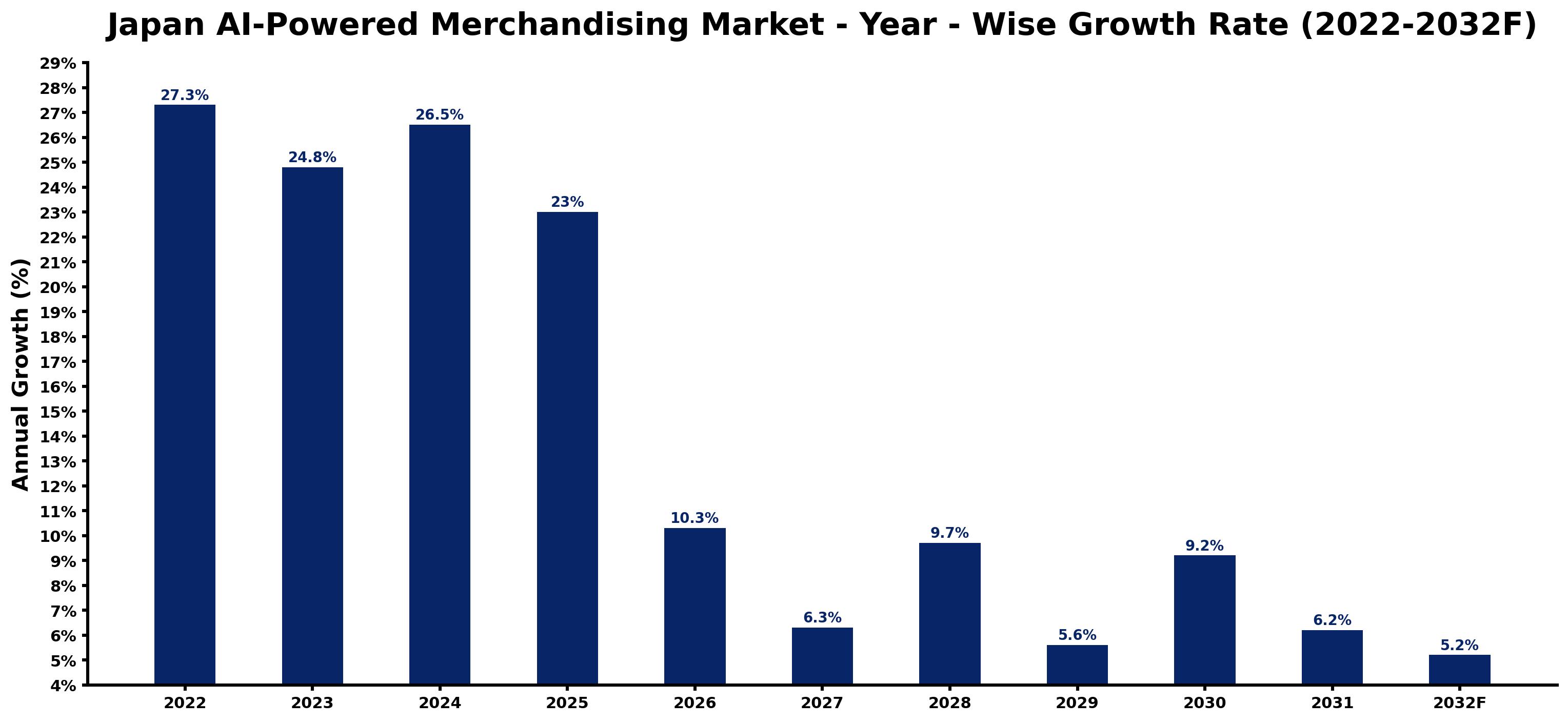
The table below sets out the estimated growth rate for each year and the main factor behind it.
| Year | Estimated Annual Growth (%) | Market Rationale |
| 2022 | 27.3 | The market experienced strong growth due to increased AI adoption in retail operations. |
| 2023 | 24.8 | Growth slowed as companies adjusted to the previous year's rapid expansion. |
| 2024 | 26.5 | The market rebounded with renewed investments in AI technologies and applications. |
| 2025 | 23.0 | Growth slowed again as market saturation began to affect new adoption rates. |
| 2026 | 10.3 | The market growth rate is expected to slow as the peak of AI investment is reached. |
| 2027 | 6.3 | Demand will continue to grow but at a slower pace as market maturity sets in. |
| 2028 | 9.7 | Growth is projected to pick up again as new AI applications are introduced to the market. |
| 2029 | 5.6 | Demand growth is expected to slow as competition intensifies among existing solutions. |
| 2030 | 9.2 | The market will see a resurgence in growth driven by new AI applications. |
| 2031 | 6.2 | Growth is projected to slow again as the market stabilises and matures further. |
| 2032 | 5.2 | The market continues to grow, albeit at a reduced rate as competition remains fierce. |
Note: Market size estimations and growth projections presented in this report are based on 6Wresearch's proprietary forecasting methodology, utilizing the latest available industry data, government publications, and primary research inputs.
Japan AI-Powered Merchandising Market Synopsis
AI-Powered Merchandising optimises retail operations through advanced algorithms and machine learning, improving decision-making in demand forecasting, dynamic pricing, and personalised shopping experiences. The Japan AI-Powered Merchandising Market is expanding due to investments in AI technologies, driven by the growing retail sector and rising e-commerce sales, which reached 20 trillion JPY in 2022. The Tokyo metropolitan area serves as a key hub for retail innovation, fuelling demand for AI solutions.
Market Dynamics Impact Analysis (2026–2032)
| Factor | Type | Impact | Primary Segment Affected |
| Increased investment in AI technologies drives demand for AI-Powered Merchandising solutions. | Driver | High | Demand Forecasting AI |
| The growth of e-commerce necessitates advanced merchandising tools to enhance user experience. | Driver | High | Online Marketplaces |
| The shift towards personalised shopping experiences creates demand for AI-driven solutions. | Opportunity | High | Product Personalization |
| Retailers seek to optimise inventory management, presenting opportunities for AI solutions. | Opportunity | Medium | Inventory Prediction |
| High implementation costs of AI solutions can deter smaller retailers from adoption. | Restraint | High | Retail AI SaaS Providers |
| Limited understanding of AI capabilities among traditional retailers restricts market growth. | Restraint | Medium | Grocery Chains |
| Competition among AI solution providers can lead to price wars, affecting profitability. | Challenge | High | Dynamic Pricing Engine |
| Rapid technological advancements may outpace some retailers' ability to adapt. | Challenge | Medium | Apparel Brands |
Evaluation of Drivers in Japan AI-Powered Merchandising Market (2026–2032)
Demand rests on the following drivers, each shown with the segment it touches most.
| Drivers | Primary Segment Affected | Why It Matters (Evidence) |
| Increased funding for AI research and development boosts technology adoption. | Demand Forecasting AI | Japan's retail sector benefits from substantial investments in AI technologies, promoting integration with a market value of approximately 160 trillion JPY. |
| Growing e-commerce sales drive demand for AI-powered merchandising solutions. | Online Marketplaces | E-commerce sales in Japan reached 20 trillion JPY in 2022, necessitating improved user experiences. |
| Demand for personalised shopping experiences encourages retailers to adopt AI solutions. | Product Personalization | AI-driven tools improve customer engagement, leading to increased sales and loyalty. |
| Retailers are investing in AI to optimise inventory management and reduce waste. | Inventory Prediction | AI-driven inventory management can reduce waste by up to 20%, boosting profitability. |
| Dynamic pricing tools are increasingly adopted to respond to market fluctuations. | Dynamic Pricing Engine | Over 30% of retail transactions now utilise dynamic pricing tools, reflecting market trends. |
What keeps demand rising is the substantial funding for AI research and development, promoting integration in retail. E-commerce sales reached 20 trillion JPY in 2022, driving the need for AI-powered merchandising solutions. Retailers increasingly seek personalised shopping experiences, improving customer engagement and loyalty. AI-driven inventory management can reduce waste by up to 20%, prompting more retailers to invest. Dynamic pricing tools are now employed in over 30% of retail transactions, showcasing the market's shift towards advanced AI solutions.
Evaluation of Restraints in Japan AI-Powered Merchandising Market
These are the pressures that could keep growth below its potential.
| Market Restraint | Primary Segment Affected | Why It Matters (Evidence) |
| High implementation costs deter smaller retailers from adopting AI solutions. | Retail AI SaaS Providers | The initial investment required for AI technologies can be prohibitive for many small businesses. |
| Limited understanding of AI capabilities restricts adoption among traditional retailers. | Grocery Chains | Many traditional retailers lack the expertise to effectively implement AI technologies. |
| Market saturation leads to increased competition, impacting profitability for providers. | Dynamic Pricing Engine | As more players enter the market, pricing pressures can reduce margins for solution providers. |
| Slow technology adoption rates among some retailers hinder overall market growth. | Apparel Brands | Retailers hesitant to change may miss out on competitive advantages offered by AI. |
| Data privacy concerns can limit the use of AI in merchandising applications. | Product Personalization | Regulations regarding personal data usage can complicate AI implementation strategies. |
Japan AI-Powered Merchandising Market Challenges
Dynamic pricing tools are increasingly used in over 30% of retail transactions, yet many retailers struggle with outdated technology that hampers efficiency. This issue exists due to Japan's slow adoption of new systems, causing delays in decision-making for suppliers and resulting in lost sales opportunities. Limited access to advanced algorithms disrupts supply chains, leading to inventory mismanagement for producers. A shortage of AI expertise persists, with only 40% of major supermarkets utilising demand forecasting tools, delaying innovation for buyers. Rising operational costs threaten profitability, as average consumer spending on food and groceries consumes 30% of household budgets, straining retailers' margins.
Trends in the Japan AI-Powered Merchandising Market
Four trends stand out in the Japan AI-Powered Merchandising Market.
- Shift from Traditional to AI-Driven Merchandising: Since 2022, retailers have increasingly adopted AI-driven merchandising tools to improve operational efficiency. For instance, over 40% of major supermarkets in Japan now use demand forecasting tools, reflecting a shift in strategy.
- Transition from Static to Dynamic Pricing Models: The retail sector is moving towards dynamic pricing models, with over 30% of transactions now employing these strategies. This change is evident in supermarkets and e-commerce platforms, which adjust prices in real-time based on demand.
- Emergence of Personalised Shopping Experiences: In 2023, retailers began focusing on personalised shopping experiences, utilising AI to tailor recommendations. This trend is exemplified by the increasing use of AI-driven tools in online marketplaces, which improve user engagement.
- Growth of AI-Powered Inventory Management: The adoption of AI-powered inventory management systems has accelerated since 2022, with retailers aiming to reduce waste. AI-driven solutions can cut waste by up to 20%, making them increasingly attractive to grocery chains.
Investment Opportunities in the Japan AI-Powered Merchandising Market
Where to invest in the Japan AI-Powered Merchandising Market: the main openings are set out below.
- E-Commerce Retailers Seeking AI Solutions: E-commerce retailers are increasingly looking for AI-powered merchandising tools to improve user experience. The e-commerce sector is projected to grow annually by 10% through 2025, creating demand for innovative solutions.
- Investment in AI for Personalisation: With the average consumer spending about 1,000 JPY per visit to convenience stores, there is a growing need for personalisation. Retailers can invest in AI tools to tailor shopping experiences, particularly in urban areas.
- Urban Retail Hubs Adopting AI Technologies: Tokyo and Osaka are key urban areas where AI retail solutions are gaining traction. Investing in partnerships with local retailers can facilitate entry into these markets, capitalising on the growing demand for AI tools.
- Collaboration with AI Retail Partners: Retailers are increasingly seeking partnerships with AI retail partners to implement advanced technologies. Engaging in joint ventures can provide access to essential AI capabilities and improve competitive positioning.
Government Initiatives in the Japan AI-Powered Merchandising Market
The GX Promotion Act of 2023 establishes a framework for promoting sustainable practices in retail. This act supports investments in AI technologies that improve operational efficiency, aligning with Japan's target of JPY 150 trillion in decarbonisation investment over the next decade. Additionally, the Act on the Rational Use of Energy mandates large energy users to improve efficiency, indirectly encouraging the adoption of AI solutions in retail.
The Ministry of Economy, Trade and Industry (METI) oversees various initiatives aimed at promoting AI integration in retail. This agency funds projects that improve technological capabilities, ensuring that retailers can access the necessary resources to implement AI solutions effectively. The Japan Retailers Association also plays a role in promoting technology adoption, facilitating training and support for retailers looking to improve their operations through AI.
Future Insight of the Japan AI-Powered Merchandising Market
Japan's commitment to a 46% reduction in greenhouse-gas emissions by 2030 will drive investment in AI-powered merchandising technologies, prompting suppliers to innovate. By 2032, the integration of dynamic pricing and demand forecasting tools will become standard practice, improving operational efficiency for retailers. E-commerce growth, projected at 20 trillion JPY in 2022, will push buyers to adopt AI solutions for personalised shopping experiences. The establishment of the JIS Q 15001 standard will ensure data protection, enhancing consumer trust and encouraging broader AI adoption across the retail sector.
Market Segmentation Analysis
Japan AI-Powered Merchandising Market report covers a detailed analysis of the following market segments:
By Retail Type – E-Commerce Leads and Records the Fastest Growth
According to Saurav Kr Singh, Senior Research Analyst at 6Wresearch, in 2025, E-Commerce led the retail type split with a 42% share. E-Commerce holds the largest share due to its extensive reach and integration with advanced algorithms that enhance customer experiences. The sector generated sales of 20 trillion JPY in 2022, showcasing its dominance in Japan's retail market. E-Commerce is also forecast to expand faster than any other category, at a CAGR of 10.4% over 2026–2032. The e-commerce sector is projected to grow annually by 10% through 2025, as consumer reliance on online shopping continues to increase. This growth will further solidify E-Commerce's lead as it continues to attract more users. Suppliers should focus on enhancing their online presence to capture the growing e-commerce market.
By AI Capability – Demand Forecasting AI Leads, Dynamic Pricing Engine Expected to Grow Fastest
Demand Forecasting AI took 39% of ai capability revenue in 2025, more than any other category. Demand Forecasting AI leads the market due to its importance for retailers in accurately predicting consumer behaviour and managing stock levels. With 40% of major supermarkets in Japan utilising these tools, the demand for such capabilities is evident. Dynamic Pricing Engine is set to record the highest CAGR in this split, 9.4% over 2026–2032. Dynamic Pricing Engines are experiencing rapid growth as they allow retailers to adjust prices in real-time based on demand fluctuations. This capability is increasingly crucial as over 30% of retail transactions now involve dynamic pricing tools. Buyers must invest in advanced capabilities to remain competitive and responsive to market changes.
By Distribution Channel – Retail AI SaaS Providers Lead, Online Merchandising Tools Expected to Grow Fastest
Retail AI SaaS Providers accounted for 41% of the market by distribution channel in 2025. Retail AI SaaS Providers dominate the market by offering essential tools that enable retailers to implement AI solutions effectively. Their widespread adoption is critical for businesses looking to leverage AI in their operations. The quickest growth will come from Online Merchandising Tools, forecast to expand at a CAGR of 9.7% between 2026 and 2032. Online Merchandising Tools are growing quickly as they facilitate effective online sales strategies and enhance customer engagement. The shift towards digital retail is driving this demand, making it a key area for growth. Suppliers should develop robust online solutions to meet the increasing demand from retailers.
By End User – Online Marketplaces Lead, Apparel Brands Expected to Grow Fastest
With 41% of end user revenue in 2025, Online Marketplaces was the largest category. Online Marketplaces are the leading end user as they heavily rely on AI to optimise user experience and boost sales. Their significant market presence necessitates advanced tools to maintain competitiveness. Apparel Brands are projected to grow fastest, at a CAGR of 9.6% during 2026–2032. Apparel Brands are rapidly adopting technologies for trend analysis and inventory management, reflecting a shift towards data-driven decision-making in the fashion sector. This trend is expected to accelerate as brands seek to enhance operational efficiency. Buyers in the apparel sector should prioritise integration to stay ahead of market trends and consumer preferences.
Key Attractiveness of the Report
- 10 Years of Market Numbers
- Historical Data Starting from 2022 to 2025
- Base Year 2025
- Forecast Data until 2032
- Key Performance Indicators Impacting the Market
- Major Upcoming Developments and Projects
Key Highlights of the Report:
- Japan AI-Powered Merchandising Market Outlook
- Market Size of Japan AI-Powered Merchandising Market, 2025
- Forecast of Japan AI-Powered Merchandising Market, 2032
- Historical Data and Forecast of Japan AI-Powered Merchandising Revenues & Volume for the Period 2022-2032F
- Japan AI-Powered Merchandising Market Trend Evolution
- Japan AI-Powered Merchandising Market Drivers and Challenges
- Japan AI-Powered Merchandising Price Trends
- Japan AI-Powered Merchandising Porter's Five Forces
- Japan AI-Powered Merchandising Industry Life Cycle
- Historical Data and Forecast of Japan AI-Powered Merchandising Market Revenues & Volume By Retail Type for the Period 2022-2032F
- Historical Data and Forecast of Japan AI-Powered Merchandising Market Revenues & Volume By Fashion Retail for the Period 2022-2032F
- Historical Data and Forecast of Japan AI-Powered Merchandising Market Revenues & Volume By Grocery Chains for the Period 2022-2032F
- Historical Data and Forecast of Japan AI-Powered Merchandising Market Revenues & Volume By E-Commerce for the Period 2022-2032F
- Historical Data and Forecast of Japan AI-Powered Merchandising Market Revenues & Volume By Convenience Stores for the Period 2022-2032F
- Historical Data and Forecast of Japan AI-Powered Merchandising Market Revenues & Volume By AI Capability for the Period 2022-2032F
- Historical Data and Forecast of Japan AI-Powered Merchandising Market Revenues & Volume By Demand Forecasting AI for the Period 2022-2032F
- Historical Data and Forecast of Japan AI-Powered Merchandising Market Revenues & Volume By Dynamic Pricing Engine for the Period 2022-2032F
- Historical Data and Forecast of Japan AI-Powered Merchandising Market Revenues & Volume By Product Personalization for the Period 2022-2032F
- Historical Data and Forecast of Japan AI-Powered Merchandising Market Revenues & Volume By Inventory Prediction for the Period 2022-2032F
- Historical Data and Forecast of Japan AI-Powered Merchandising Market Revenues & Volume By Distribution Channel for the Period 2022-2032F
- Historical Data and Forecast of Japan AI-Powered Merchandising Market Revenues & Volume By Retail AI SaaS Providers for the Period 2022-2032F
- Historical Data and Forecast of Japan AI-Powered Merchandising Market Revenues & Volume By Supply Chain Software Firms for the Period 2022-2032F
- Historical Data and Forecast of Japan AI-Powered Merchandising Market Revenues & Volume By Online Merchandising Tools for the Period 2022-2032F
- Historical Data and Forecast of Japan AI-Powered Merchandising Market Revenues & Volume By AI Retail Partners for the Period 2022-2032F
- Historical Data and Forecast of Japan AI-Powered Merchandising Market Revenues & Volume By End User for the Period 2022-2032F
- Historical Data and Forecast of Japan AI-Powered Merchandising Market Revenues & Volume By Apparel Brands for the Period 2022-2032F
- Historical Data and Forecast of Japan AI-Powered Merchandising Market Revenues & Volume By Supermarkets for the Period 2022-2032F
- Historical Data and Forecast of Japan AI-Powered Merchandising Market Revenues & Volume By Online Marketplaces for the Period 2022-2032F
- Historical Data and Forecast of Japan AI-Powered Merchandising Market Revenues & Volume By Quick-Service Retailers for the Period 2022-2032F
- Japan AI-Powered Merchandising Import Export Trade Statistics
- Market Opportunity Assessment By Retail Type
- Market Opportunity Assessment By AI Capability
- Market Opportunity Assessment By Distribution Channel
- Market Opportunity Assessment By End User
- Japan AI-Powered Merchandising Top Companies Market Share
- Japan AI-Powered Merchandising Competitive Benchmarking By Technical and Operational Parameters
- Japan AI-Powered Merchandising Company Profiles
- Japan AI-Powered Merchandising Key Strategic Recommendations
Market Covered
The following segment groups are covered in the report.
By Retail Type
- Fashion Retail
- Grocery Chains
- E-Commerce
- Convenience Stores
By AI Capability
- Demand Forecasting AI
- Dynamic Pricing Engine
- Product Personalization
- Inventory Prediction
By Distribution Channel
- Retail AI SaaS Providers
- Supply Chain Software Firms
- Online Merchandising Tools
- AI Retail Partners
By End User
- Apparel Brands
- Supermarkets
- Online Marketplaces
- Quick-Service Retailers































