Japan AI Traffic Management Market Size & Growth Rate
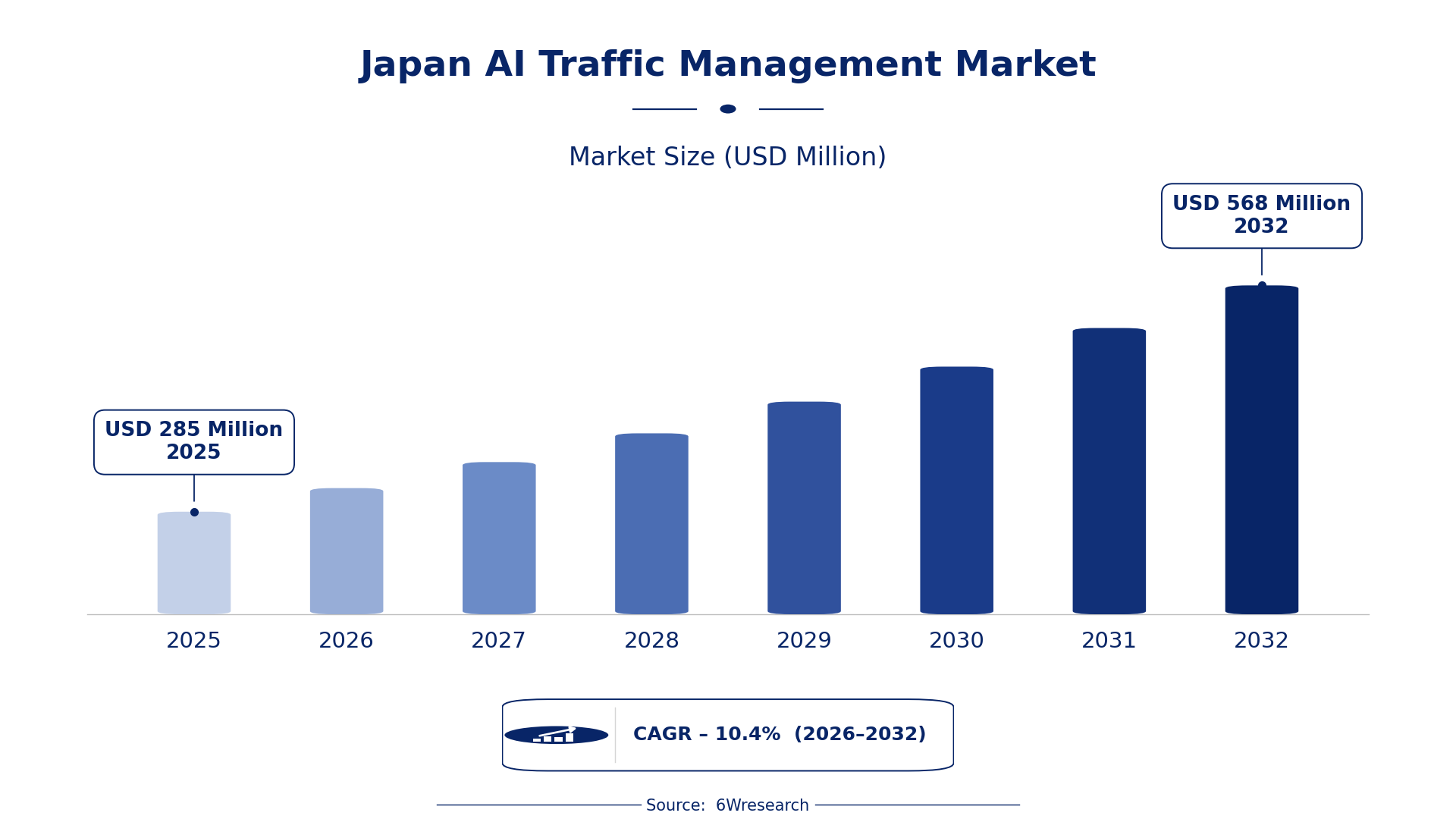
According to 6Wresearch internal database and industry insights, the Japan AI Traffic Management Market was valued at USD 285 Million in 2025 and is projected to reach USD 568 Million by 2032, growing at a CAGR of approximately 10.4% during 2026–2032.
Japan AI Traffic Management Market Highlights
| Report Metric | Details |
| Report Name | Japan AI Traffic Management Market (2026-2032) |
| Market Size 2025 | USD 285 Million |
| Market Size 2032 | USD 568 Million |
| Absolute Growth 2025–2032 | USD 283 Million |
| CAGR 2026–2032 | 10.4% |
| Peak Annual Growth | 11.5% in 2028 |
| Forecast Period | 2026–2032 |
| Historical Data | 2022–2025 |
| Base Year | 2025 |
| Leading Traffic Segment, 2025 | Urban Road Traffic (41% share) |
| Leading AI Application, 2025 | Real-Time Congestion Mapping (46% share) |
| Leading Distribution Channel, 2025 | Smart City Platforms (41% share) |
| Leading End User, 2025 | Municipal Authorities (32% share) |
| Fastest-Growing Traffic Segment | Highway Control (13.0% CAGR) |
| Fastest-Growing AI Application | Predictive Flow Monitoring (13.9% CAGR) |
| Fastest-Growing Distribution Channel | Transport Tech Integrators (13.3% CAGR) |
| Fastest-Growing End User | Highway Authorities (13.5% CAGR) |
| Growing Sector | Urban Traffic Management |
| Key End Users | Municipal Authorities, Highway Authorities, Smart Infrastructure Agencies, Metro & Bus Corporations |
Japan AI Traffic Management Market Year-wise Growth Rate and Key Drivers (2022–2032)
This graph illustrates the annual growth rates of the market from 2022 to 2032, highlighting a steady upward trajectory and projected market expansion over the forecast period.
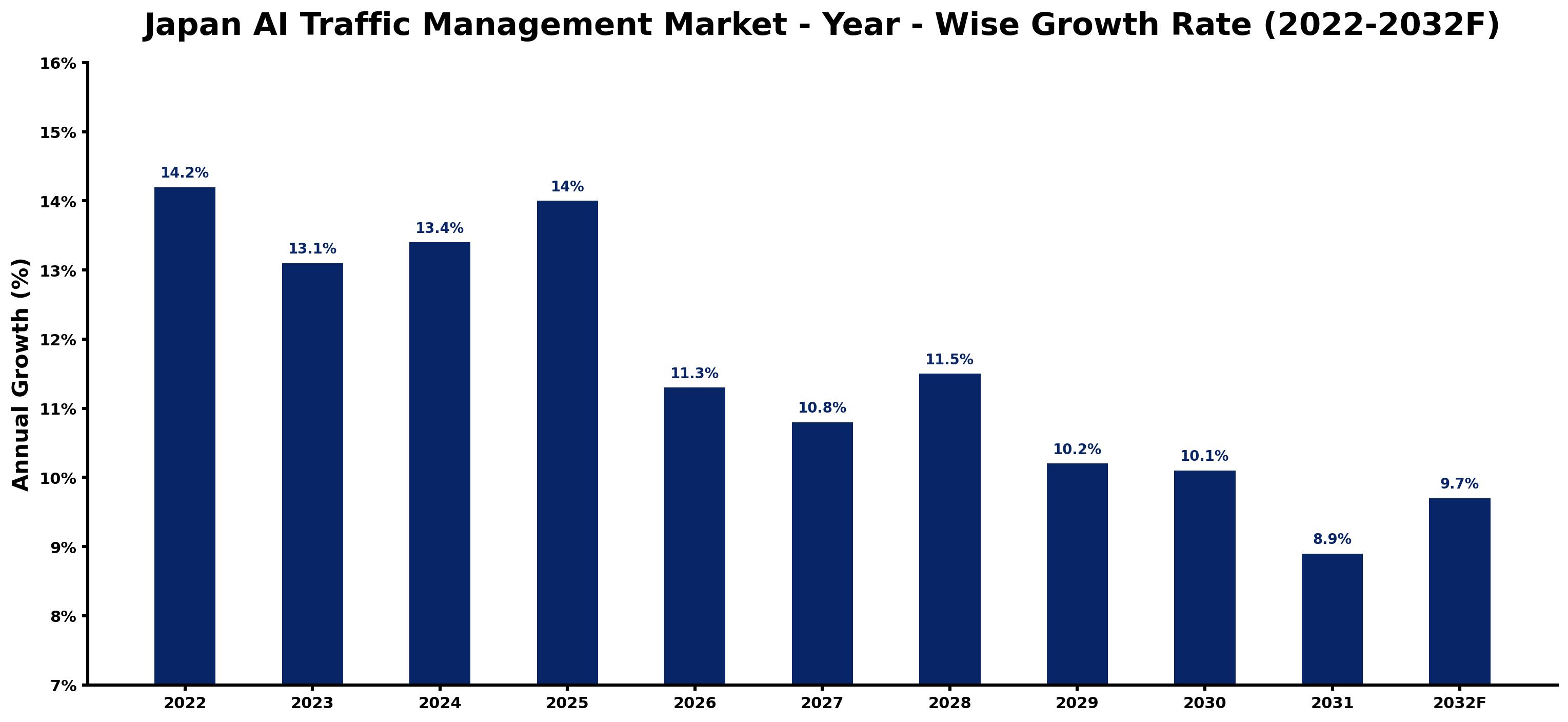
Each row of the following table gives one year's estimated growth and the event or demand shift that explains it.
| Year | Estimated Annual Growth (%) | Market Rationale |
| 2022 | 14.2 | The market experienced strong growth due to increased urban congestion. |
| 2023 | 13.1 | Growth slowed as cities began implementing more AI traffic solutions. |
| 2024 | 13.4 | Demand rose as more cities adopted AI technologies for traffic management. |
| 2025 | 14.0 | The market continued to expand with investments in smart city initiatives. |
| 2026 | 11.3 | Growth is expected to slow as the market stabilises after rapid expansion. |
| 2027 | 10.8 | The trend of urbanization is projected to support ongoing demand for AI solutions. |
| 2028 | 11.5 | Growth will accelerate again as new AI traffic management systems are deployed. |
| 2029 | 10.2 | Demand is expected to slow as market saturation begins to affect growth rates. |
| 2030 | 10.1 | The market will continue to grow, driven by ongoing urban mobility improvements. |
| 2031 | 8.9 | Growth is expected to slow as the market matures and competition intensifies. |
| 2032 | 9.7 | Demand is expected to rise again as new technologies are integrated. |
Note: Market size estimations and growth projections presented in this report are based on 6Wresearch's proprietary forecasting methodology, utilizing the latest available industry data, government publications, and primary research inputs.
Japan AI Traffic Management Market Synopsis
AI Traffic Management optimizes traffic flow and reduces congestion using artificial intelligence and real-time data from various sources. In Japan, the market is expanding due to urbanization, with over 9 million registered vehicles in Tokyo contributing to congestion. Government initiatives promote smart traffic systems, while investments in smart city projects, including ¥1 billion allocated by the Tokyo Metropolitan Government, are driving new demand for AI solutions.
Market Dynamics Impact Analysis (2026–2032)
| Factor | Type | Impact | Primary Segment Affected |
| Increasing urban congestion necessitates advanced traffic management solutions. | Driver | High | Urban Road Traffic |
| Government investments in smart city initiatives create a supportive environment for AI solutions. | Driver | High | Smart City Platforms |
| The growing need for efficient public transport systems presents opportunities for AI integration. | Opportunity | High | Public Transport Routing |
| The rise of smart infrastructure projects creates demand for AI traffic management systems. | Opportunity | High | IoT Traffic Devices |
| High initial investment costs for AI systems can deter adoption by municipalities. | Restraint | Medium | Municipal Authorities |
| Limited awareness of AI benefits among smaller municipalities hinders market growth. | Restraint | Medium | Highway Authorities |
| Competition among technology providers can lead to pricing pressures. | Challenge | High | Transport Tech Integrators |
| Integration challenges with existing traffic systems can delay implementation. | Challenge | High | Smart Infrastructure Agencies |
Evaluation of Drivers in Japan AI Traffic Management Market (2026–2032)
The table below links each growth driver to the segment it affects and the evidence for it.
| Drivers | Primary Segment Affected | Why It Matters (Evidence) |
| Rising vehicle registrations increase traffic congestion, driving demand for AI solutions. | Urban Road Traffic | Tokyo has over 9 million registered vehicles, leading to greater congestion management needs. |
| Government funding for smart city projects supports AI traffic management adoption. | Smart City Platforms | The Tokyo Metropolitan Government allocated ¥1 billion for smart city initiatives in 2023. |
| Public transport accounts for 30% of daily commutes, necessitating efficient routing solutions. | Public Transport Routing | This high percentage drives demand for AI to improve public transport efficiency. |
| Real-time data collection from IoT devices improves traffic flow management. | IoT Traffic Devices | The integration of IoT devices is essential for effective traffic monitoring and data analysis. |
| Research on traffic optimization by national institutes promotes AI adoption. | Predictive Flow Monitoring | Ongoing research aims to improve traffic systems and promote AI adoption. |
Volumes grow on the back of rising vehicle registrations, with over 9 million vehicles in Tokyo creating congestion. Public transport, accounting for 30% of daily commutes, drives demand for efficient routing solutions.
Evaluation of Restraints in Japan AI Traffic Management Market
The key brakes on demand, and where they bite hardest, are shown below.
| Market Restraint | Primary Segment Affected | Why It Matters (Evidence) |
| High initial investment costs for AI systems can deter municipalities from adopting new technologies. | Municipal Authorities | The average cost of implementing AI traffic management systems can be prohibitive for smaller municipalities. |
| Limited awareness of AI benefits among smaller municipalities hinders market growth. | Highway Authorities | Many smaller authorities lack the resources to educate themselves on AI traffic management advantages. |
| Integration challenges with existing traffic systems can delay implementation. | Smart Infrastructure Agencies | Legacy systems may not easily accommodate new AI technologies, complicating upgrades. |
| Regulatory hurdles can slow down the deployment of AI traffic solutions. | Transport Tech Integrators | Compliance with existing traffic regulations may require extensive modifications to new systems. |
| Competition among technology providers can lead to pricing pressures. | Transport Tech Integrators | As more players enter the market, aggressive pricing strategies may affect margins. |
Japan AI Traffic Management Market Challenges
Tokyo has over 9 million registered vehicles, creating severe congestion that delays public transport for commuters. Many urban areas struggle with inadequate technology, as only over 20 major cities have deployed AI traffic management, limiting operational efficiency for city planners. Local governments encounter difficulties adhering to the ISO 37120 standard for sustainable cities, as compliance demands significant infrastructure investment, which can postpone project timelines. Rising costs associated with AI integration in public transport systems strain municipal budgets, diverting funds from urban mobility initiatives.
Trends in the Japan AI Traffic Management Market
The following changes are redrawing the Japan AI Traffic Management Market.
- Shift towards AI-Driven Traffic Solutions: In 2023, Japan saw a notable shift towards AI-driven traffic management solutions, with over 20 major cities implementing such systems. This trend reflects the increasing need for efficient urban mobility solutions, as urban areas face growing congestion.
- Transition from Traditional to Smart Traffic Management: The adoption of smart traffic management systems has been accelerating since 2022, with Tokyo leading the way. The implementation of the ISO 37120 standard for sustainable cities has driven this change, emphasizing the need for effective traffic management.
- Emergence of Real-Time Data Utilization: Real-time data utilization in traffic management began gaining traction in 2023, particularly in urban areas. The integration of IoT devices for traffic monitoring has become essential, with urban traffic volumes exceeding 1.5 million vehicles daily.
- Prioritisation of Public Transport Efficiency: Since 2022, there has been a growing focus on enhancing public transport efficiency through AI solutions. The integration of AI in public transport routing is vital, as public transport accounts for 30% of daily commutes in urban areas.
Investment Opportunities in the Japan AI Traffic Management Market
The opportunities below stand out in the Japan AI Traffic Management Market for new entrants and existing suppliers.
- Municipal Authorities seeking AI solutions: With urban traffic congestion worsening, municipal authorities are actively seeking AI traffic management solutions. The market gap is evident, with over 9 million vehicles in Tokyo driving demand for effective systems.
- Highway Authorities investing in optimization: Highway authorities are currently prioritising investments in AI systems to optimize traffic flow. The Tokyo Bay Area, a key region for smart infrastructure projects, presents substantial opportunities for suppliers.
- Smart City Agencies expanding initiatives: Smart city agencies are expanding their initiatives to integrate AI traffic solutions. The Tokyo Metropolitan Government's ¥1 billion allocation for smart city projects in 2023 highlights the urgency for new solutions.
- Transport Tech Integrators enhancing capabilities: Transport tech integrators are focusing on enhancing their capabilities to meet growing demand for AI solutions. The integration of IoT devices is essential for effective traffic management, especially in urban areas.
Government Initiatives in the Japan AI Traffic Management Market
The Electrical Appliance and Material Safety Act regulates the safety of electrical appliances, adding a layer of compliance for AI traffic management systems. This law, alongside the Digital Agency's efforts to standardize digital infrastructure, ensures that AI solutions meet safety and interoperability standards, promoting wider adoption. The Ministry of Land, Infrastructure, Transport and Tourism supports smart traffic initiatives, with funding allocated for research and development.
The Digital Agency oversees the approval of smart city initiatives, funding projects that integrate AI into urban infrastructure. This agency's focus on digital transformation supports municipalities in implementing advanced traffic management systems, ensuring compliance with national standards. The Ministry of Internal Affairs and Communications also supports IoT integration in traffic systems, facilitating modernisation efforts.
Future Insight of the Japan AI Traffic Management Market
The rollout of smart city projects will transform urban traffic management by 2032, focusing on optimizing mobility and safety. Integration of AI in public transport will streamline operations and improve commuter experiences. The Tokyo Bay Area will see advanced infrastructure projects that facilitate smooth traffic flow. Government initiatives supporting IoT integration will promote real-time data sharing, addressing congestion in urban areas with daily traffic volumes exceeding 1.5 million vehicles.
Market Segmentation Analysis
Japan AI Traffic Management Market report covers a detailed analysis of the following market segments:
By Traffic Segment – Urban Road Traffic Leads, Highway Control Expected to Grow Fastest
According to Saurav Kr Singh, Senior Research Analyst at 6Wresearch, Urban Road Traffic held 41% of the Japan AI Traffic Management Market by traffic segment in 2025. Urban road traffic holds the largest share due to the high number of vehicles in cities like Tokyo, which has over 9 million registered vehicles. This segment is essential for managing congestion and improving urban mobility, making it a priority for municipal authorities. Highway Control is set to record the highest CAGR in this split, 13.0% over 2026–2032. Highway control is growing rapidly as it optimises traffic flow on highways, crucial for addressing the rising average daily traffic volume exceeding 1.5 million vehicles in urban areas. As urbanisation continues, the need for efficient highway management will further accelerate this segment's growth. Suppliers should focus on solutions tailored for urban road traffic to meet the increasing demands from municipal authorities.
By AI Application – Real-Time Congestion Mapping Leads, Predictive Flow Monitoring Expected to Grow Fastest
Real-Time Congestion Mapping accounted for 46% of the market by ai application in 2025. Real-time congestion mapping is the leading application because it provides immediate traffic assessments, vital for urban mobility in densely populated areas. This application is widely used in major cities, aligning with government initiatives for smart traffic systems. Over 2026–2032, Predictive Flow Monitoring is expected to post the fastest growth, at a CAGR of 13.9%. Predictive flow monitoring is the fastest-growing application, as it assists in anticipating traffic patterns, enabling proactive traffic management. The recent push for integrating AI in public transportation systems will further boost its adoption. Buyers should invest in predictive flow monitoring technologies to enhance their traffic management capabilities.
By Distribution Channel – Smart City Platforms Lead, Transport Tech Integrators Expected to Grow Fastest
Smart City Platforms took 41% of distribution channel revenue in 2025, more than any other category. Smart city platforms dominate the distribution channel due to their critical role in implementing comprehensive smart city solutions across urban areas. These platforms facilitate the integration of various traffic management technologies, making them essential for municipal authorities. Transport Tech Integrators are projected to grow fastest, at a CAGR of 13.3% during 2026–2032. Transport tech integrators are the fastest-growing channel, as they enable the incorporation of advanced traffic management solutions into existing systems. Their importance is increasing as cities strive to modernise their traffic infrastructure. Suppliers need to collaborate with transport tech integrators to effectively reach municipal authorities.
By End User – Municipal Authorities Lead, Highway Authorities Expected to Grow Fastest
The largest end user category in 2025 was Municipal Authorities, at 32% of revenue. Municipal authorities are the primary users of traffic management systems, responsible for overseeing urban traffic in cities like Tokyo. Their focus on improving urban mobility drives the demand for these systems. The quickest growth will come from Highway Authorities, forecast to expand at a CAGR of 13.5% between 2026 and 2032. Highway authorities are experiencing the fastest growth as key stakeholders in optimising highway traffic, especially with the increasing vehicle numbers. Their involvement in smart infrastructure projects will further enhance their role in this market. Suppliers should tailor their offerings to meet the specific needs of highway authorities to capitalise on this growing segment.
Key Attractiveness of the Report
- 10 Years of Market Numbers
- Historical Data Starting from 2022 to 2025
- Base Year 2025
- Forecast Data until 2032
- Key Performance Indicators Impacting the Market
- Major Upcoming Developments and Projects
Key Highlights of the Report:
- Japan AI Traffic Management Market Outlook
- Market Size of Japan AI Traffic Management Market, 2025
- Forecast of Japan AI Traffic Management Market, 2032
- Historical Data and Forecast of Japan AI Traffic Management Revenues & Volume for the Period 2022-2032F
- Japan AI Traffic Management Market Trend Evolution
- Japan AI Traffic Management Market Drivers and Challenges
- Japan AI Traffic Management Price Trends
- Japan AI Traffic Management Porter's Five Forces
- Japan AI Traffic Management Industry Life Cycle
- Historical Data and Forecast of Japan AI Traffic Management Market Revenues & Volume By Traffic Segment for the Period 2022-2032F
- Historical Data and Forecast of Japan AI Traffic Management Market Revenues & Volume By Urban Road Traffic for the Period 2022-2032F
- Historical Data and Forecast of Japan AI Traffic Management Market Revenues & Volume By Highway Control for the Period 2022-2032F
- Historical Data and Forecast of Japan AI Traffic Management Market Revenues & Volume By Intersection Management for the Period 2022-2032F
- Historical Data and Forecast of Japan AI Traffic Management Market Revenues & Volume By Public Transport Routing for the Period 2022-2032F
- Historical Data and Forecast of Japan AI Traffic Management Market Revenues & Volume By AI Application for the Period 2022-2032F
- Historical Data and Forecast of Japan AI Traffic Management Market Revenues & Volume By Real-Time Congestion Mapping for the Period 2022-2032F
- Historical Data and Forecast of Japan AI Traffic Management Market Revenues & Volume By Predictive Flow Monitoring for the Period 2022-2032F
- Historical Data and Forecast of Japan AI Traffic Management Market Revenues & Volume By AI-Driven Signal Optimization for the Period 2022-2032F
- Historical Data and Forecast of Japan AI Traffic Management Market Revenues & Volume By Pattern Recognition for the Period 2022-2032F
- Historical Data and Forecast of Japan AI Traffic Management Market Revenues & Volume By Distribution Channel for the Period 2022-2032F
- Historical Data and Forecast of Japan AI Traffic Management Market Revenues & Volume By Smart City Platforms for the Period 2022-2032F
- Historical Data and Forecast of Japan AI Traffic Management Market Revenues & Volume By Transport Tech Integrators for the Period 2022-2032F
- Historical Data and Forecast of Japan AI Traffic Management Market Revenues & Volume By IoT Traffic Devices for the Period 2022-2032F
- Historical Data and Forecast of Japan AI Traffic Management Market Revenues & Volume By Mobility SaaS Solutions for the Period 2022-2032F
- Historical Data and Forecast of Japan AI Traffic Management Market Revenues & Volume By End User for the Period 2022-2032F
- Historical Data and Forecast of Japan AI Traffic Management Market Revenues & Volume By Municipal Authorities for the Period 2022-2032F
- Historical Data and Forecast of Japan AI Traffic Management Market Revenues & Volume By Highway Authorities for the Period 2022-2032F
- Historical Data and Forecast of Japan AI Traffic Management Market Revenues & Volume By Smart Infrastructure Agencies for the Period 2022-2032F
- Historical Data and Forecast of Japan AI Traffic Management Market Revenues & Volume By Metro & Bus Corporations for the Period 2022-2032F
- Japan AI Traffic Management Import Export Trade Statistics
- Market Opportunity Assessment By Traffic Segment
- Market Opportunity Assessment By AI Application
- Market Opportunity Assessment By Distribution Channel
- Market Opportunity Assessment By End User
- Japan AI Traffic Management Top Companies Market Share
- Japan AI Traffic Management Competitive Benchmarking By Technical and Operational Parameters
- Japan AI Traffic Management Company Profiles
- Japan AI Traffic Management Key Strategic Recommendations
Market Covered
This report examines the market across the segments below.
By Traffic Segment
- Urban Road Traffic
- Highway Control
- Intersection Management
- Public Transport Routing
By AI Application
- Real-Time Congestion Mapping
- Predictive Flow Monitoring
- AI-Driven Signal Optimization
- Pattern Recognition
By Distribution Channel
- Smart City Platforms
- Transport Tech Integrators
- IoT Traffic Devices
- Mobility SaaS Solutions
By End User
- Municipal Authorities
- Highway Authorities
- Smart Infrastructure Agencies
- Metro & Bus Corporations































