Japan AI Ultrasound Market Size & Growth Rate
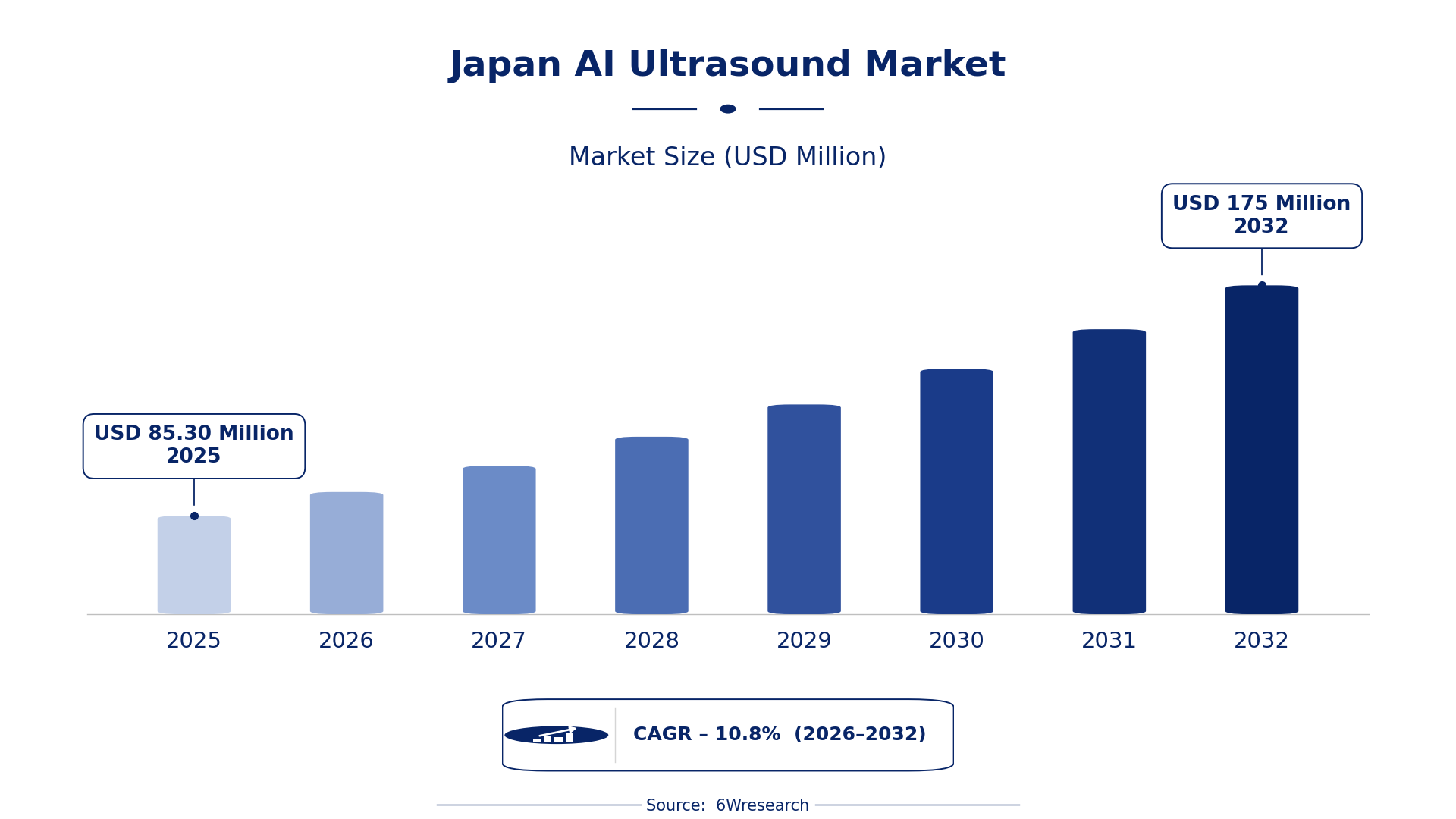
According to 6Wresearch internal database and industry insights, the Japan AI Ultrasound Market was valued at USD 85.30 Million in 2025 and is projected to reach USD 175 Million by 2032, growing at a CAGR of approximately 10.8% during 2026–2032.
Japan AI Ultrasound Market Highlights
| Report Metric | Details |
| Report Name | Japan AI Ultrasound Market (2026-2032) |
| Market Size 2025 | USD 85.30 Million |
| Market Size 2032 | USD 175 Million |
| Absolute Growth 2025–2032 | USD 89.70 Million |
| CAGR 2026–2032 | 10.8% |
| Peak Annual Growth | 14.0% in 2026 |
| Forecast Period | 2026–2032 |
| Historical Data | 2022–2025 |
| Base Year | 2025 |
| Leading Imaging Type, 2025 | Abdominal Ultrasound (46% share) |
| Leading AI Application, 2025 | Feature Detection (49% share) |
| Leading Distribution Channel, 2025 | Medical Device Vendors (41% share) |
| Leading End User, 2025 | General Hospitals (45% share) |
| Fastest-Growing Imaging Type | Obstetric Imaging (15.1% CAGR) |
| Fastest-Growing AI Application | Automated Measurement (14.4% CAGR) |
| Fastest-Growing Distribution Channel | Health SaaS Platforms (13.3% CAGR) |
| Fastest-Growing End User | Gynecology Clinics (13.4% CAGR) |
| Growing Sector | Automated Measurement |
| Key End Users | Feature Detection, Image Segmentation, Automated Measurement, Anomaly Identification |
Japan AI Ultrasound Market Year-wise Growth Rate and Key Drivers (2022–2032)
This graph illustrates the annual growth rates of the market from 2022 to 2032, highlighting a steady upward trajectory and projected market expansion over the forecast period.
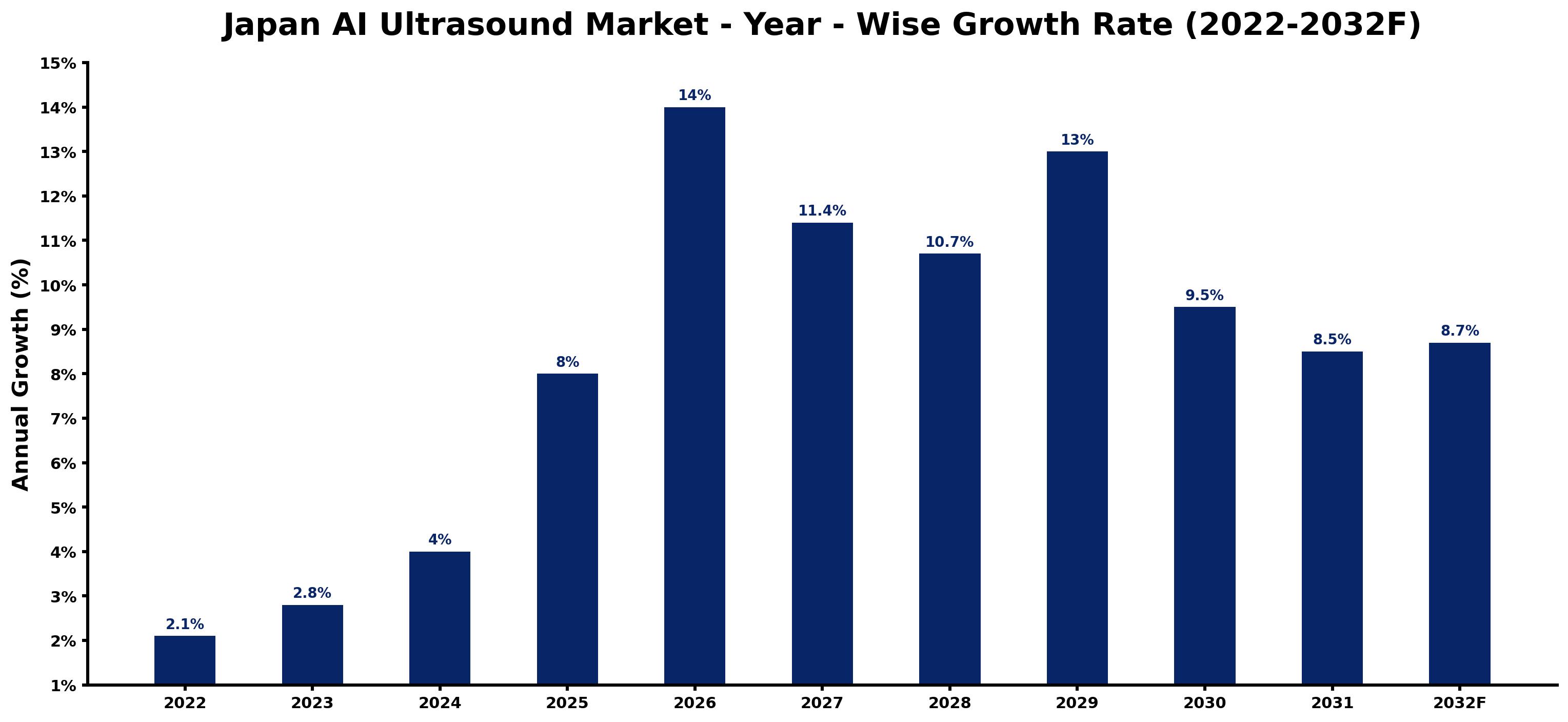
The table below sets out the estimated growth rate for each year and the main factor behind it.
| Year | Estimated Annual Growth (%) | Market Rationale |
| 2022 | 2.1 | The market was stable, reflecting existing healthcare demands and technology adoption. |
| 2023 | 2.8 | Growth accelerated due to increased investments in medical imaging technologies. |
| 2024 | 4.0 | Demand rose as healthcare facilities expanded their diagnostic capabilities. |
| 2025 | 8.0 | The market experienced growth driven by advancements in AI integration. |
| 2026 | 14.0 | Growth peaked as hospitals adopted AI ultrasound for improved diagnostic accuracy. |
| 2027 | 11.4 | The market growth slowed slightly due to market saturation in some segments. |
| 2028 | 10.7 | Demand continued to grow, albeit at a slower pace, as technology matured. |
| 2029 | 13.0 | A resurgence in growth occurred as new applications for AI ultrasound emerged. |
| 2030 | 9.5 | Growth moderated as the market adjusted to new technological standards. |
| 2031 | 8.5 | The market continued to grow steadily, reflecting ongoing healthcare needs. |
| 2032 | 8.7 | Growth picked up again as healthcare facilities upgraded their imaging systems. |
Note: Market size estimations and growth projections presented in this report are based on 6Wresearch's proprietary forecasting methodology, utilizing the latest available industry data, government publications, and primary research inputs.
Japan AI Ultrasound Market Synopsis
AI Ultrasound integrates artificial intelligence with traditional ultrasound imaging to improve diagnostic accuracy and efficiency. This technology is essential for detecting abnormalities, automating measurements, and improving imaging quality in various medical fields. The Japan AI Ultrasound Market is expanding due to a growing aging population, with over 8,000 general hospitals adopting advanced ultrasound technologies. The government's health technology initiative and increasing healthcare expenditure are driving demand for AI ultrasound, leading to significant growth by 2032.
Market Dynamics Impact Analysis (2026–2032)
| Factor | Type | Impact | Primary Segment Affected |
| Growing aging population requiring increased diagnostic imaging services | Driver | High | General Hospitals |
| Advancements in AI technology enhancing imaging capabilities | Driver | High | Feature Detection |
| Rising demand for efficient diagnostic tools in healthcare | Opportunity | High | Obstetric Imaging |
| Expansion of healthcare facilities investing in advanced imaging technologies | Opportunity | High | Gynecology Clinics |
| High costs associated with AI ultrasound implementation | Restraint | Medium | Medical Device Vendors |
| Limited availability of trained professionals to operate advanced systems | Restraint | Medium | Diagnostic Equipment Firms |
| Challenges in integrating AI with existing healthcare systems | Challenge | High | Health SaaS Platforms |
| Regulatory hurdles affecting the speed of technology adoption | Challenge | High | Hospital IT Channels |
Evaluation of Drivers in Japan AI Ultrasound Market (2026–2032)
Demand rests on the following drivers, each shown with the segment it touches most.
| Drivers | Primary Segment Affected | Why It Matters (Evidence) |
| Increased healthcare expenditure | General Hospitals | Japan's healthcare expenditure is approximately 10% of its GDP, prompting hospitals to invest in advanced imaging technologies. |
| Technological advancements in AI | Feature Detection | Ongoing training programs for healthcare professionals support the integration of AI in ultrasound imaging, improving outcomes. |
| Aging population driving demand for diagnostics | Obstetric Imaging | The average life expectancy in Japan is 84 years, increasing the need for regular health check-ups and diagnostics. |
| Government initiatives promoting health technology | Gynecology Clinics | In 2023, the government launched a health technology initiative to enhance medical imaging capabilities, boosting adoption. |
| Rising prevalence of cardiovascular diseases | Cardiac Ultrasound | Cardiovascular diseases account for 30% of all deaths in Japan, driving demand for cardiac ultrasound services. |
Most of the extra volume comes from increased healthcare expenditure, which stands at approximately 10% of GDP, prompting hospitals to invest in advanced imaging technologies. The aging population drives demand for regular health check-ups and diagnostics. The rising prevalence of cardiovascular diseases, accounting for 30% of all deaths, is increasing the demand for cardiac ultrasound services.
Evaluation of Restraints in Japan AI Ultrasound Market
These are the pressures that could keep growth below its potential.
| Market Restraint | Primary Segment Affected | Why It Matters (Evidence) |
| High implementation costs for AI ultrasound systems | Medical Device Vendors | The initial investment for AI ultrasound technology can exceed ¥10 million, limiting access for smaller healthcare facilities. |
| Shortage of trained professionals in AI applications | Diagnostic Equipment Firms | Limited availability of skilled personnel hampers effective use of advanced ultrasound technologies, with only 30% trained. |
| Integration challenges with existing healthcare systems | Health SaaS Platforms | Healthcare facilities face difficulties in incorporating AI ultrasound into their workflows, impacting efficiency. |
| Regulatory compliance requirements delaying market entry | Hospital IT Channels | Stringent regulations can slow down the approval process for new AI ultrasound technologies, affecting availability. |
| Market saturation in certain segments limiting growth potential | General Hospitals | As more hospitals adopt AI ultrasound, growth rates may stabilise due to market maturity. |
Japan AI Ultrasound Market Challenges
High costs of AI ultrasound systems restrict access for buyers, as advanced imaging technology can exceed ¥10 million per unit, making it unaffordable for smaller clinics. Skills shortages in AI application hinder effective utilisation, with only 30% of healthcare professionals trained in advanced imaging techniques, delaying adoption in hospitals. Rising operational costs, including maintenance and training, can consume up to 20% of a hospital's budget, diverting funds from essential patient care. Intense competition among imaging technology providers leads to price wars, which can compromise quality and innovation, affecting hospitals' ability to invest in new technologies.
Trends in the Japan AI Ultrasound Market
The trends below show where the Japan AI Ultrasound Market is heading.
- Transition to Advanced Imaging Technologies in Tokyo: The Tokyo metropolitan area is experiencing a shift towards advanced imaging technologies, with over 8,000 general hospitals adopting AI ultrasound. This trend reflects a growing need for improved diagnostic capabilities, supported by the government's health technology initiative.
- Gynecology Clinics Expanding Use of AI Ultrasound: Gynecology clinics are increasingly incorporating AI ultrasound for obstetric assessments, with approximately 1,500 clinics currently using this technology. This shift is driven by the need for better monitoring of pregnancy and fetal development.
- Focus on Automated Measurement in Diagnostics: A growing emphasis on automated measurement technologies in ultrasound imaging is improving efficiency and accuracy. This trend is clear as healthcare facilities invest in AI applications to streamline diagnostic processes and enhance patient outcomes.
- Emergence of Health SaaS Platforms for Imaging: Health SaaS platforms are becoming key players in the AI ultrasound market, providing software solutions that effectively utilise ultrasound data. This shift is backed by a projected CAGR of 13.3% in the coming years.
Investment Opportunities in the Japan AI Ultrasound Market
Below are the investment opportunities with the strongest case in the Japan AI Ultrasound Market.
- General Hospitals Seeking Advanced Imaging Solutions: General hospitals in Japan are increasingly looking for advanced imaging solutions, with a projected demand gap of ¥5 billion. Collaborating with local medical device vendors can facilitate entry into this growing market.
- Tokyo's Medical Facilities Upgrading Technology: Tokyo's medical facilities are upgrading their imaging technology, with over 8,000 hospitals adopting AI ultrasound. Suppliers can enter this market through partnerships with local healthcare providers.
- Health Clinics Expanding Diagnostic Capabilities: Health clinics are expanding their diagnostic capabilities, with approximately 1,500 gynecology clinics using ultrasound technology. Establishing joint ventures with local clinics can improve market presence.
- Increasing Need for AI Applications in Imaging: The demand for AI applications in imaging is rising, presenting significant opportunities for suppliers to enter the market through certification and local partnerships.
Government Initiatives in the Japan AI Ultrasound Market
The PMD Act regulates the approval, manufacture, and quality of pharmaceuticals and medical devices, ensuring that AI ultrasound systems meet safety and efficacy standards. Compliance with this law is essential for manufacturers to market their products effectively in Japan.
The Pharmaceuticals and Medical Devices Agency (PMDA) reviews medical devices, including AI ultrasound systems, to ensure they meet regulatory requirements. This process is vital for healthcare providers to access safe and effective imaging technologies.
Future Insight of the Japan AI Ultrasound Market
AI ultrasound will transform diagnostic imaging by 2032, with machine learning algorithms enabling real-time data analysis. The government's health technology initiative will improve imaging capabilities, enhancing the detection of abnormalities across various medical fields. By 2023, ¥5 billion allocated for health technology research will drive advancements in AI applications. Expanded training programmes for healthcare professionals will ensure a skilled workforce, facilitating effective integration of these technologies in medical facilities.
Market Segmentation Analysis
Japan AI Ultrasound Market report covers a detailed analysis of the following market segments:
By Imaging Type – Abdominal Ultrasound Leads, Obstetric Imaging Expected to Grow Fastest
According to Saurav Kr Singh, Senior Research Analyst at 6Wresearch, the largest imaging type category in 2025 was Abdominal Ultrasound, at 46% of revenue. Abdominal ultrasound holds the largest share due to its essential role in diagnosing various abdominal conditions, widely employed in general hospitals. The presence of over 8,000 general hospitals in Japan utilising advanced imaging technologies reinforces its dominance in the market. The quickest growth will come from Obstetric Imaging, forecast to expand at a CAGR of 15.1% between 2026 and 2032. Obstetric imaging is growing rapidly as it is crucial for monitoring pregnancies and fetal development, reflecting the increasing emphasis on maternal health in Japan. The rise in pregnancy rates and the prioritisation of prenatal care are key factors driving this segment's expansion. Suppliers should focus on enhancing abdominal ultrasound offerings while also developing solutions for obstetric imaging to meet the rising demand.
By AI Application – Feature Detection Leads, Automated Measurement Expected to Grow Fastest
Feature Detection held 49% of the Japan AI Ultrasound Market by ai application in 2025. Feature detection leads the market as it is vital for identifying specific characteristics in ultrasound images, which significantly improves diagnostic accuracy. Its essential role across various medical assessments ensures broad adoption among healthcare providers in Japan. Automated Measurement is set to record the highest CAGR in this split, 14.4% over 2026–2032. Automated measurement is experiencing the highest growth rate as it enhances efficiency by delivering rapid and accurate measurements during ultrasound procedures. This capability is increasingly important as healthcare facilities aim to optimise operations and minimise patient wait times. Providers need to invest in feature detection technologies while also advancing automated measurement solutions to seize emerging market opportunities.
By Distribution Channel – Medical Device Vendors Lead, Health SaaS Platforms Expected to Grow Fastest
In 2025, Medical Device Vendors led the distribution channel split with a 41% share. Medical device vendors are the primary distributors as they supply ultrasound equipment to healthcare facilities, establishing a strong foothold in the market. Their established relationships with hospitals and clinics ensure consistent demand for advanced imaging technologies in Japan. Health SaaS Platforms are projected to grow fastest, at a CAGR of 13.3% during 2026–2032. Health SaaS platforms are witnessing the fastest growth due to their ability to provide software solutions that effectively utilise ultrasound data for improved patient management. The rising adoption of digital health solutions among healthcare providers is driving this segment's momentum. Suppliers should strengthen collaborations with medical device vendors while also exploring opportunities within health SaaS platforms to broaden market reach.
By End User – General Hospitals Lead, Gynecology Clinics Expected to Grow Fastest
General Hospitals took 45% of end user revenue in 2025, more than any other category. General hospitals represent the largest end-user segment as they are the primary facilities employing AI ultrasound for diverse diagnostic purposes. Their extensive patient base and wide-ranging medical services fuel the demand for advanced imaging technologies. Over 2026–2032, Gynecology Clinics are expected to post the fastest growth, at a CAGR of 13.4%. Gynecology clinics are the fastest-growing end-user segment, primarily using AI ultrasound for obstetric and gynecological assessments. The heightened focus on women's health and prenatal care is significantly increasing demand in this sector. Vendors should cater to the needs of general hospitals while also developing targeted solutions for gynecology clinics to capitalise on growth potential.
Key Attractiveness of the Report
- 10 Years of Market Numbers
- Historical Data Starting from 2022 to 2025
- Base Year 2025
- Forecast Data until 2032
- Key Performance Indicators Impacting the Market
- Major Upcoming Developments and Projects
Key Highlights of the Report:
- Japan AI Ultrasound Market Outlook
- Market Size of Japan AI Ultrasound Market, 2025
- Forecast of Japan AI Ultrasound Market, 2032
- Historical Data and Forecast of Japan AI Ultrasound Revenues & Volume for the Period 2022-2032F
- Japan AI Ultrasound Market Trend Evolution
- Japan AI Ultrasound Market Drivers and Challenges
- Japan AI Ultrasound Price Trends
- Japan AI Ultrasound Porter's Five Forces
- Japan AI Ultrasound Industry Life Cycle
- Historical Data and Forecast of Japan AI Ultrasound Market Revenues & Volume By Imaging Type for the Period 2022-2032F
- Historical Data and Forecast of Japan AI Ultrasound Market Revenues & Volume By Abdominal Ultrasound for the Period 2022-2032F
- Historical Data and Forecast of Japan AI Ultrasound Market Revenues & Volume By Obstetric Imaging for the Period 2022-2032F
- Historical Data and Forecast of Japan AI Ultrasound Market Revenues & Volume By Cardiac Ultrasound for the Period 2022-2032F
- Historical Data and Forecast of Japan AI Ultrasound Market Revenues & Volume By Thyroid & Neck Imaging for the Period 2022-2032F
- Historical Data and Forecast of Japan AI Ultrasound Market Revenues & Volume By AI Application for the Period 2022-2032F
- Historical Data and Forecast of Japan AI Ultrasound Market Revenues & Volume By Feature Detection for the Period 2022-2032F
- Historical Data and Forecast of Japan AI Ultrasound Market Revenues & Volume By Image Segmentation for the Period 2022-2032F
- Historical Data and Forecast of Japan AI Ultrasound Market Revenues & Volume By Automated Measurement for the Period 2022-2032F
- Historical Data and Forecast of Japan AI Ultrasound Market Revenues & Volume By Anomaly Identification for the Period 2022-2032F
- Historical Data and Forecast of Japan AI Ultrasound Market Revenues & Volume By Distribution Channel for the Period 2022-2032F
- Historical Data and Forecast of Japan AI Ultrasound Market Revenues & Volume By Medical Device Vendors for the Period 2022-2032F
- Historical Data and Forecast of Japan AI Ultrasound Market Revenues & Volume By Health SaaS Platforms for the Period 2022-2032F
- Historical Data and Forecast of Japan AI Ultrasound Market Revenues & Volume By Diagnostic Equipment Firms for the Period 2022-2032F
- Historical Data and Forecast of Japan AI Ultrasound Market Revenues & Volume By Hospital IT Channels for the Period 2022-2032F
- Historical Data and Forecast of Japan AI Ultrasound Market Revenues & Volume By End User for the Period 2022-2032F
- Historical Data and Forecast of Japan AI Ultrasound Market Revenues & Volume By General Hospitals for the Period 2022-2032F
- Historical Data and Forecast of Japan AI Ultrasound Market Revenues & Volume By Gynecology Clinics for the Period 2022-2032F
- Historical Data and Forecast of Japan AI Ultrasound Market Revenues & Volume By Cardiovascular Departments for the Period 2022-2032F
- Historical Data and Forecast of Japan AI Ultrasound Market Revenues & Volume By Endocrinology Units for the Period 2022-2032F
- Japan AI Ultrasound Import Export Trade Statistics
- Market Opportunity Assessment By Imaging Type
- Market Opportunity Assessment By AI Application
- Market Opportunity Assessment By Distribution Channel
- Market Opportunity Assessment By End User
- Japan AI Ultrasound Top Companies Market Share
- Japan AI Ultrasound Competitive Benchmarking By Technical and Operational Parameters
- Japan AI Ultrasound Company Profiles
- Japan AI Ultrasound Key Strategic Recommendations
Market Covered
The study includes the following segmentation.
By Imaging Type
- Abdominal Ultrasound
- Obstetric Imaging
- Cardiac Ultrasound
- Thyroid & Neck Imaging
By AI Application
- Feature Detection
- Image Segmentation
- Automated Measurement
- Anomaly Identification
By Distribution Channel
- Medical Device Vendors
- Health SaaS Platforms
- Diagnostic Equipment Firms
- Hospital IT Channels
By End User
- General Hospitals
- Gynecology Clinics
- Cardiovascular Departments
- Endocrinology Units































