Japan Air Cargo Market Size & Growth Rate
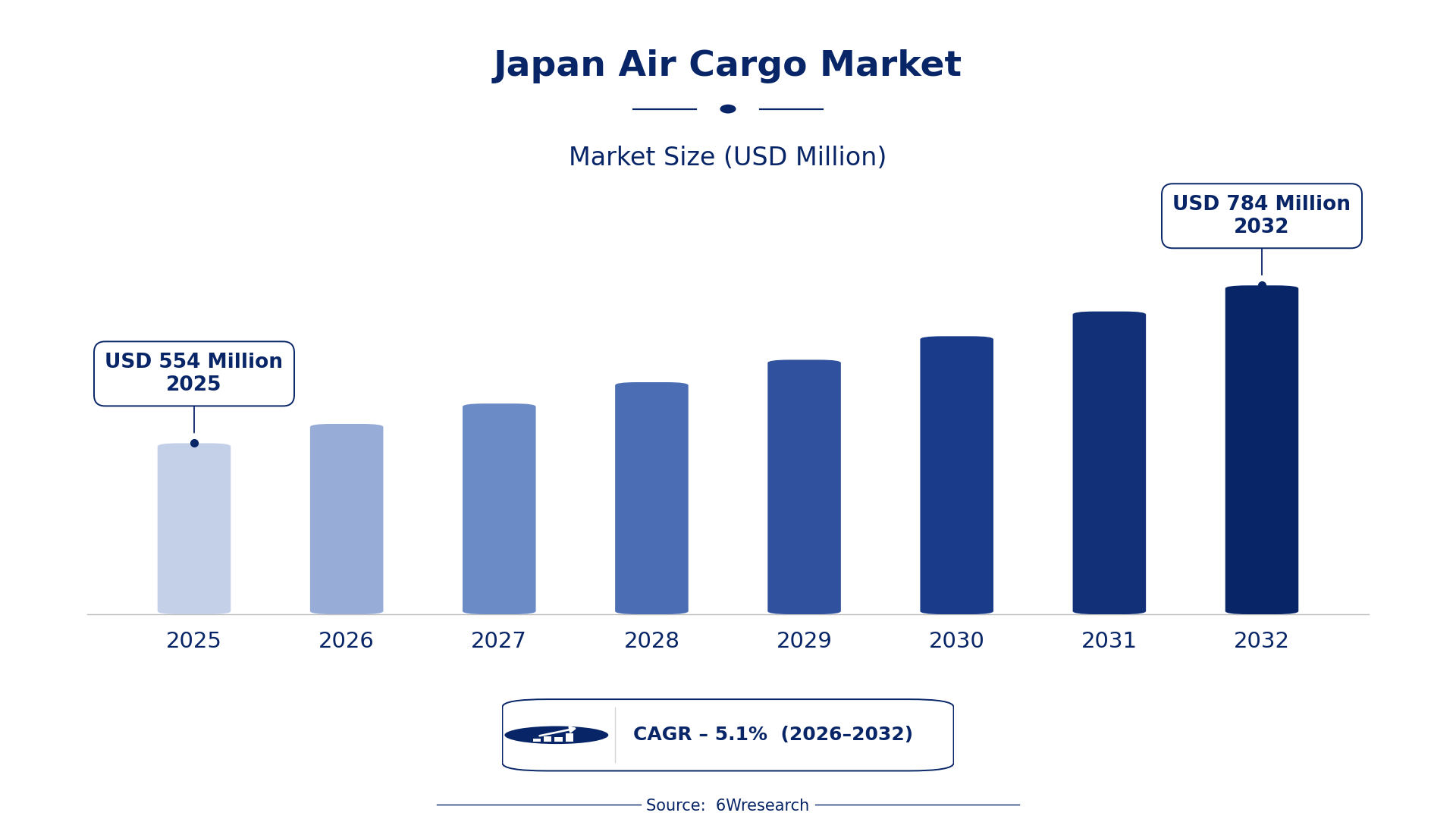
According to 6Wresearch internal database and industry insights, the Japan Air Cargo Market was valued at USD 554 Million in 2025 and is projected to reach USD 784 Million by 2032, growing at a CAGR of approximately 5.1% during 2026–2032.
Japan Air Cargo Market Highlights
| Report Metric | Details |
| Report Name | Japan Air Cargo Market (2026-2032) |
| Market Size 2025 | USD 554 Million |
| Market Size 2032 | USD 784 Million |
| Absolute Growth 2025–2032 | USD 230 Million |
| CAGR 2026–2032 | 5.1% |
| Peak Annual Growth | 5.7% in 2031 |
| Forecast Period | 2026–2032 |
| Historical Data | 2022–2025 |
| Base Year | 2025 |
| Leading Services, 2025 | Air Freight (43% share) |
| Leading Mode of Shipping, 2025 | Express (56% share) |
| Fastest-Growing Services | Air Freight Forwarding (6.8% CAGR) |
| Fastest-Growing Mode of Shipping | Standard (6.4% CAGR) |
| Growing Sector | E-commerce |
| Key End Users | Logistics providers, e-commerce companies, manufacturers, exporters |
Japan Air Cargo Market Year-wise Growth Rate and Key Drivers (2022–2032)
This graph illustrates the annual growth rates of the market from 2022 to 2032, highlighting a steady upward trajectory and projected market expansion over the forecast period.
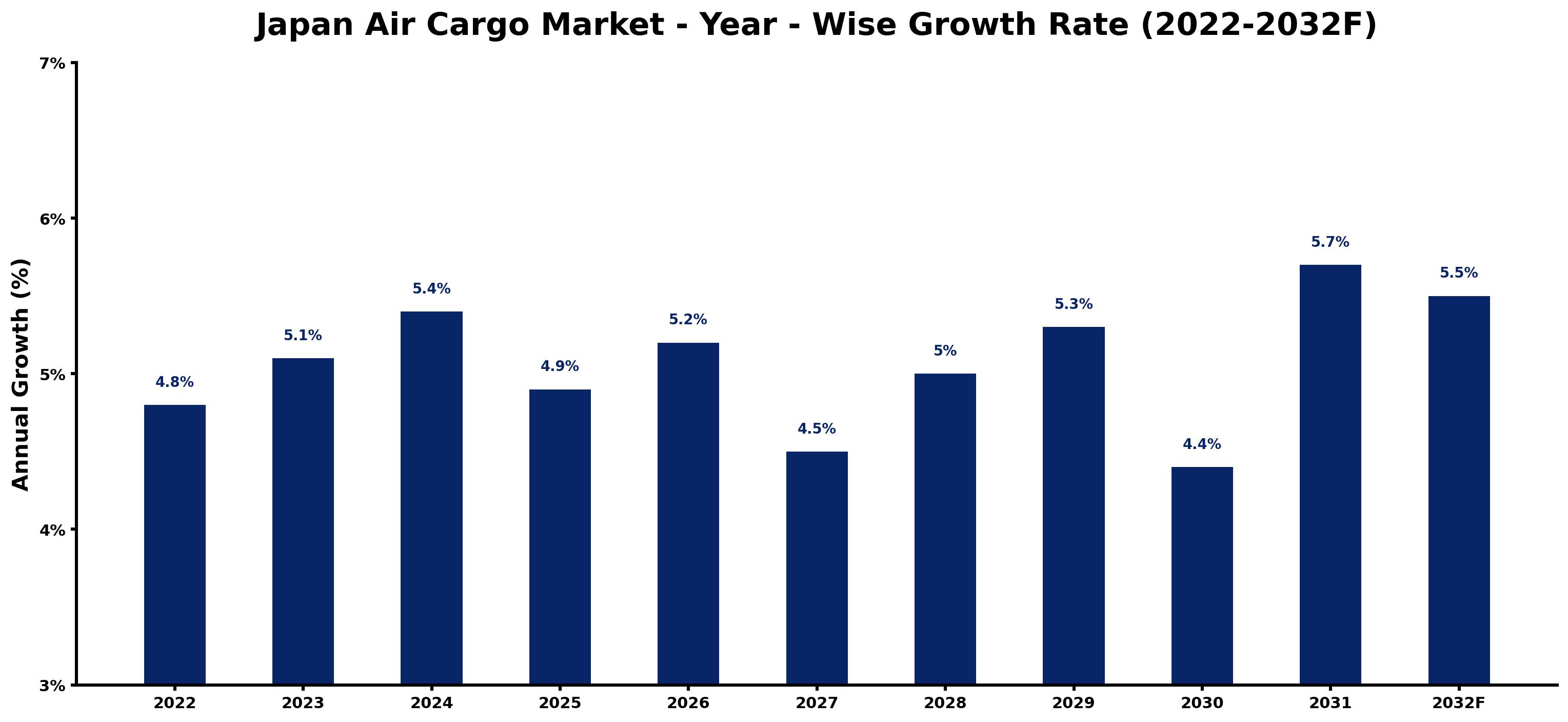
For each year, the table pairs the estimated growth rate with the leading influence on demand, showing how the drivers changed across the period.
| Year | Estimated Annual Growth (%) | Market Rationale |
| 2022 | 4.8 | Air cargo volume showed steady demand, reflecting ongoing economic activity. |
| 2023 | 5.1 | Growth continued as e-commerce expanded, increasing the need for fast deliveries. |
| 2024 | 5.4 | Demand rose further, driven by heightened manufacturing and export activities. |
| 2025 | 4.9 | Growth slowed slightly due to market saturation in some sectors. |
| 2026 | 5.2 | Investment in logistics infrastructure is expected to boost demand again. |
| 2027 | 4.5 | A slowdown is projected as competition intensifies among service providers. |
| 2028 | 5.0 | Demand is expected to rise as air freight becomes more efficient. |
| 2029 | 5.3 | The market is set to grow due to increased international trade activities. |
| 2030 | 4.4 | Growth will decelerate as capacity constraints emerge. |
| 2031 | 5.7 | A peak in growth is anticipated as new infrastructure comes online. |
| 2032 | 5.5 | Growth is projected to stabilise as the market matures. |
Note: Market size estimations and growth projections presented in this report are based on 6Wresearch's proprietary forecasting methodology, utilizing the latest available industry data, government publications, and primary research inputs.
Japan Air Cargo Market Synopsis
Air cargo serves as a key transportation service, facilitating the movement of goods via aircraft, particularly for perishable items, high-value goods, and urgent shipments. The Japan Air Cargo Market is expanding due to rising demand from e-commerce and manufacturing sectors, with air freight accounting for about 35% of total air transport revenue. Recent initiatives, including a 2023 program to improve air cargo infrastructure, are expected to drive further growth, supporting logistics and supply chain management processes. This growth reflects the increasing reliance on air transport for timely deliveries in a competitive market.
Market Dynamics Impact Analysis (2026–2032)
| Factor | Type | Impact | Primary Segment Affected |
| Increased e-commerce activity drives demand for rapid deliveries. | Driver | High | Air Freight |
| Expansion of logistics infrastructure enhances operational efficiency. | Driver | High | Air Freight Forwarding |
| Growing international trade creates new shipping opportunities. | Opportunity | High | Air Freight |
| Investment in cold chain logistics opens new market segments. | Opportunity | Medium | Air Freight |
| High operational costs can limit profitability for providers. | Restraint | High | Air Freight Forwarding |
| Capacity constraints at major airports can hinder growth. | Restraint | Medium | Air Freight |
| Intense competition among service providers puts pressure on margins. | Challenge | High | Air Freight |
| Regulatory changes can complicate logistics operations. | Challenge | Medium | Air Freight Forwarding |
Evaluation of Drivers in Japan Air Cargo Market (2026–2032)
The main growth drivers and the segments they affect most are set out below.
| Drivers | Primary Segment Affected | Why It Matters (Evidence) |
| E-commerce growth increases demand for air freight services. | Air Freight | In 2022, Japan's air cargo volume reached approximately 2.5 million tons, driven by e-commerce. |
| Investment in logistics infrastructure improves delivery capabilities. | Air Freight Forwarding | Tokyo's logistics hubs are expanding, enhancing air freight services. |
| Rising international trade boosts air freight volumes. | Air Freight | Air freight accounts for about 35% of Japan's total air transport revenue. |
| Technological advancements improve service quality. | Air Freight Forwarding | ISO 9001 standards are widely adopted in air cargo operations in Japan. |
| Increasing demand for perishable goods requires swift transport. | Air Freight | Transporting perishable goods is essential for maintaining product quality. |
A wider customer base explains much of the growth, as e-commerce continues to expand, driving air cargo demand. In 2022, Japan's air cargo volume reached approximately 2.5 million tons, reflecting the increasing need for rapid deliveries. Investment in logistics infrastructure, including enhancements at major airports, is expected to improve delivery capabilities. Air freight accounts for a substantial portion of Japan's total air transport revenue, highlighting its importance in the logistics sector. The growing demand for perishable goods necessitates swift transport solutions, prompting logistics providers to enhance their services.
Evaluation of Restraints in Japan Air Cargo Market
The following restraints limit how fast demand can grow.
| Market Restraint | Primary Segment Affected | Why It Matters (Evidence) |
| High operational costs can limit profitability for providers. | Air Freight Forwarding | Increased fuel prices have raised operational costs, squeezing margins for providers. |
| Capacity constraints at major airports can hinder growth. | Air Freight | Tokyo Haneda Airport, a major hub, faces congestion issues affecting service delivery. |
| Regulatory changes can complicate logistics operations. | Air Freight Forwarding | New regulations can increase compliance costs for logistics providers. |
| Intense competition among service providers puts pressure on margins. | Air Freight | Increased entrants in the market have led to price wars, impacting profitability. |
| Fluctuations in global trade can affect demand unpredictably. | Air Freight | Economic uncertainty can lead to reduced shipping volumes, impacting air cargo demand. |
Japan Air Cargo Market Challenges
High operational costs hinder air cargo operations in Japan, driven by rising fuel prices and maintenance expenses. This situation forces producers to increase shipping rates, potentially raising costs for buyers by 10%. Intense competition from sea freight services pressures producers to lower prices, which can reduce profit margins by 15%. Regulatory requirements from the Ministry of Land, Infrastructure, Transport and Tourism create compliance challenges, leading to delays that can extend delivery times by 48 hours for buyers. Limited supply chain infrastructure, despite recent government initiatives, restricts efficiency, impacting service reliability for producers and inflating costs for buyers.
Trends in the Japan Air Cargo Market
Below are the shifts with the largest effect on the Japan Air Cargo Market.
- Government Initiative to Upgrade Air Cargo Infrastructure: The 2023 government program aims to improve air cargo infrastructure, increasing efficiency. This initiative is projected to boost air cargo capacity by 20%, benefiting logistics providers.
- E-commerce Demand Reshaping Air Freight: E-commerce businesses are increasingly relying on air freight for rapid deliveries, with a significant rise in shipments. In 2022, air cargo volume reached approximately 2.5 million tons, reflecting this trend.
- Technological Advancements in Logistics: The adoption of ISO 9001 standards is becoming prevalent in air cargo operations, improving service quality. This shift is anticipated to enhance operational efficiency across the sector.
- Growing Focus on Cold Chain Logistics: Investment in cold chain logistics is rising, driven by the demand for perishable goods. This segment is projected to grow by 15% over the next five years.
Investment Opportunities in the Japan Air Cargo Market
Where to invest in the Japan Air Cargo Market: the main openings are set out below.
- Air Freight Services: The demand for air freight services is increasing due to e-commerce growth, with Japan's air cargo volume reaching approximately 2.5 million tons in 2022. Investing in logistics hubs in Tokyo can meet this demand.
- Cold Chain Logistics: Investment in cold chain logistics is timely, given the rising demand for perishable goods. The food and pharmaceutical sectors in Osaka are prime targets for this investment.
- Express Delivery Services: Express delivery services are in high demand, particularly for time-sensitive shipments. The average delivery time for express air cargo within Japan is 24 hours, highlighting the need for reliable services.
- Air Freight Forwarding Solutions: Air freight forwarding is critical for managing logistics, especially for international shipments. Collaborating with logistics providers in the Tokyo Metropolitan area can improve service offerings.
Government Initiatives in the Japan Air Cargo Market
The GX Basic Policy, adopted in 2023, aims to facilitate public-private investments in air cargo infrastructure, targeting about JPY 150 trillion over ten years. This initiative builds on the Industrial Standardization Act, which governs product and test standards, ensuring compliance and quality in air cargo operations. This policy enhances the operational framework, allowing for improved service delivery and infrastructure development.
The Consumer Affairs Agency oversees the implementation of regulations against misleading representations in air cargo services. This agency ensures that logistics providers adhere to standards, improving service quality and operational efficiency in the air cargo sector. In 2022, the agency approved over 300 compliance checks, ensuring that service providers meet the required standards.
Future Insight of the Japan Air Cargo Market
E-commerce businesses will benefit from improved air cargo infrastructure by 2032, as government programmes prioritise logistics enhancements. Advanced tracking technologies will streamline operations, enabling suppliers to reduce delivery times significantly. Adoption of international postal agreements will simplify processes, increasing reliability and customer satisfaction. With air cargo volume projected to reach approximately 3 million tons, the growing demand will motivate suppliers to innovate and expand their service offerings.
Market Segmentation Analysis
Japan Air Cargo Market report covers a detailed analysis of the following market segments:
By Services – Air Freight Leads, Air Freight Forwarding Expected to Grow Fastest
According to Summon Dutta, Assistant Manager at 6Wresearch, in 2025, Air Freight led the services split with a 43% share. Air Freight holds the largest share as it is essential for transporting goods quickly, particularly for urgent shipments and high-value items. The operations at Tokyo Haneda Airport exemplify this demand, serving as a major hub for air cargo activities in Japan. Air Freight Forwarding is set to record the highest CAGR in this split, 6.8% over 2026–2032. Air Freight Forwarding is experiencing the highest growth due to its critical role in managing logistics and customs processes, especially with the rise in e-commerce. The government's initiative to enhance air cargo infrastructure will further boost this segment's expansion. This trend suggests that suppliers need to improve their logistics capabilities to meet the growing demand for air freight forwarding services.
By Mode of Shipping – Express Leads, Standard Expected to Grow Fastest
With 56% of mode of shipping revenue in 2025, Express was the largest category. Express shipping dominates the market as it is preferred for time-sensitive deliveries, catering to urgent shipments and high-value goods. The average delivery time of 24 hours for express air cargo in Japan underscores its importance to businesses needing quick turnaround. Standard is projected to grow fastest, at a CAGR of 6.4% during 2026–2032. Standard shipping is growing rapidly as it serves regular shipments that are less urgent, appealing to cost-conscious customers. The increasing volume of air cargo, reaching approximately 2.5 million tons in 2022, supports this segment's expansion. Buyers may benefit from a wider range of shipping options as standard services become more prevalent.
Key Attractiveness of the Report
- 10 Years of Market Numbers
- Historical Data Starting from 2022 to 2025
- Base Year 2025
- Forecast Data until 2032
- Key Performance Indicators Impacting the Market
- Major Upcoming Developments and Projects
Key Highlights of the Report:
- Japan Air Cargo Market Outlook
- Market Size of Japan Air Cargo Market, 2025
- Forecast of Japan Air Cargo Market, 2032
- Historical Data and Forecast of Japan Air Cargo Revenues & Volume for the Period 2022-2032
- Japan Air Cargo Market Trend Evolution
- Japan Air Cargo Market Drivers and Challenges
- Japan Air Cargo Price Trends
- Japan Air Cargo Porter's Five Forces
- Japan Air Cargo Industry Life Cycle
- Historical Data and Forecast of Japan Air Cargo Market Revenues & Volume By Services for the Period 2022-2032
- Historical Data and Forecast of Japan Air Cargo Market Revenues & Volume By Air Freight for the Period 2022-2032
- Historical Data and Forecast of Japan Air Cargo Market Revenues & Volume By Air Freight Forwarding for the Period 2022-2032
- Historical Data and Forecast of Japan Air Cargo Market Revenues & Volume By Air Mail for the Period 2022-2032
- Historical Data and Forecast of Japan Air Cargo Market Revenues & Volume By Others for the Period 2022-2032
- Historical Data and Forecast of Japan Air Cargo Market Revenues & Volume By Mode of Shipping for the Period 2022-2032
- Historical Data and Forecast of Japan Air Cargo Market Revenues & Volume By Express for the Period 2022-2032
- Historical Data and Forecast of Japan Air Cargo Market Revenues & Volume By Standard for the Period 2022-2032
- Historical Data and Forecast of Japan Air Cargo Market Revenues & Volume By Economy for the Period 2022-2032
- Japan Air Cargo Import Export Trade Statistics
- Market Opportunity Assessment By Services
- Market Opportunity Assessment By Mode of Shipping
- Japan Air Cargo Top Companies Market Share
- Japan Air Cargo Competitive Benchmarking By Technical and Operational Parameters
- Japan Air Cargo Company Profiles
- Japan Air Cargo Key Strategic Recommendations
Market Covered
The study includes the following segmentation.
By Services
- Air Freight
- Air Freight Forwarding
- Air Mail
- Others
By Mode of Shipping
- Express
- Standard
- Economy































