Japan Air Conditioning Systems for Vehicles Market Size & Growth Rate
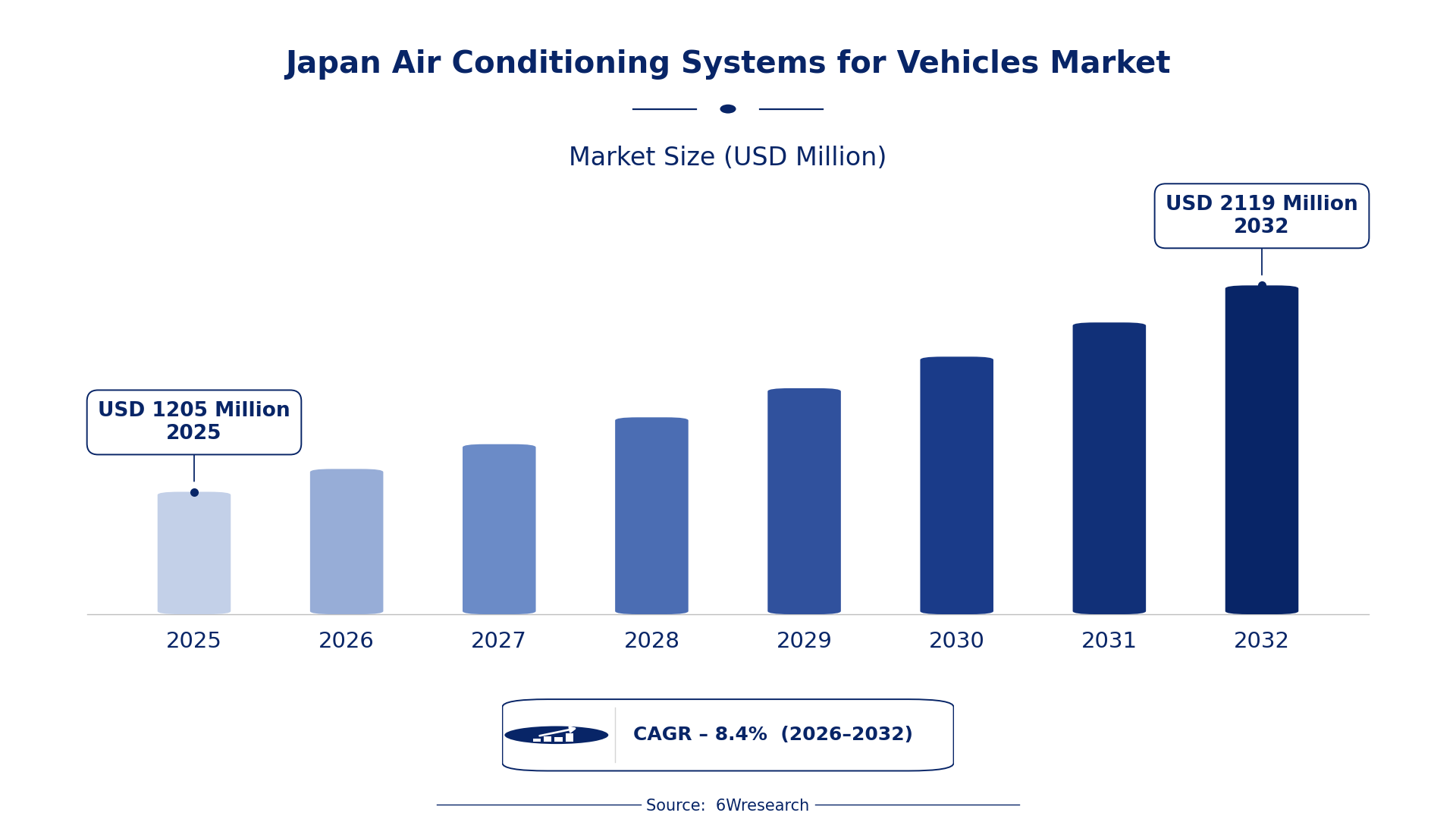
According to 6Wresearch internal database and industry insights, the Japan Air Conditioning Systems for Vehicles Market was valued at USD 1,205 Million in 2025 and is projected to reach USD 2,119 Million by 2032, growing at a CAGR of approximately 8.4% during 2026–2032.
Japan Air Conditioning Systems for Vehicles Market Highlights
| Report Metric | Details |
| Report Name | Japan Air Conditioning Systems for Vehicles Market (2026-2032) |
| Market Size 2025 | USD 1,205 Million |
| Market Size 2032 | USD 2,119 Million |
| Absolute Growth 2025–2032 | USD 914 Million |
| CAGR 2026–2032 | 8.4% |
| Peak Annual Growth | 9.4% in 2032 |
| Forecast Period | 2026–2032 |
| Historical Data | 2022–2025 |
| Base Year | 2025 |
| Leading System Type, 2025 | Manual AC Systems (48% share) |
| Leading Cooling Mechanism, 2025 | Basic Compressor (47% share) |
| Leading Distribution Channel, 2025 | Tier-1 Auto Suppliers (50% share) |
| Leading End User, 2025 | Entry-Level Vehicle OEMs (54% share) |
| Fastest-Growing System Type | Automatic Climate Control (12.1% CAGR) |
| Fastest-Growing Cooling Mechanism | Smart Temperature Sensors (11.7% CAGR) |
| Fastest-Growing Distribution Channel | HVAC Tech Vendors (10.9% CAGR) |
| Fastest-Growing End User | Luxury Car Manufacturers (11.2% CAGR) |
| Growing Sector | Electric Vehicles |
| Key End Users | Entry-Level Vehicle OEMs, Luxury Car Manufacturers, Electric Car OEMs, SUV and MPV OEMs |
Japan Air Conditioning Systems for Vehicles Market Year-wise Growth Rate and Key Drivers (2022–2032)
This graph illustrates the annual growth rates of the market from 2022 to 2032, highlighting a steady upward trajectory and projected market expansion over the forecast period.
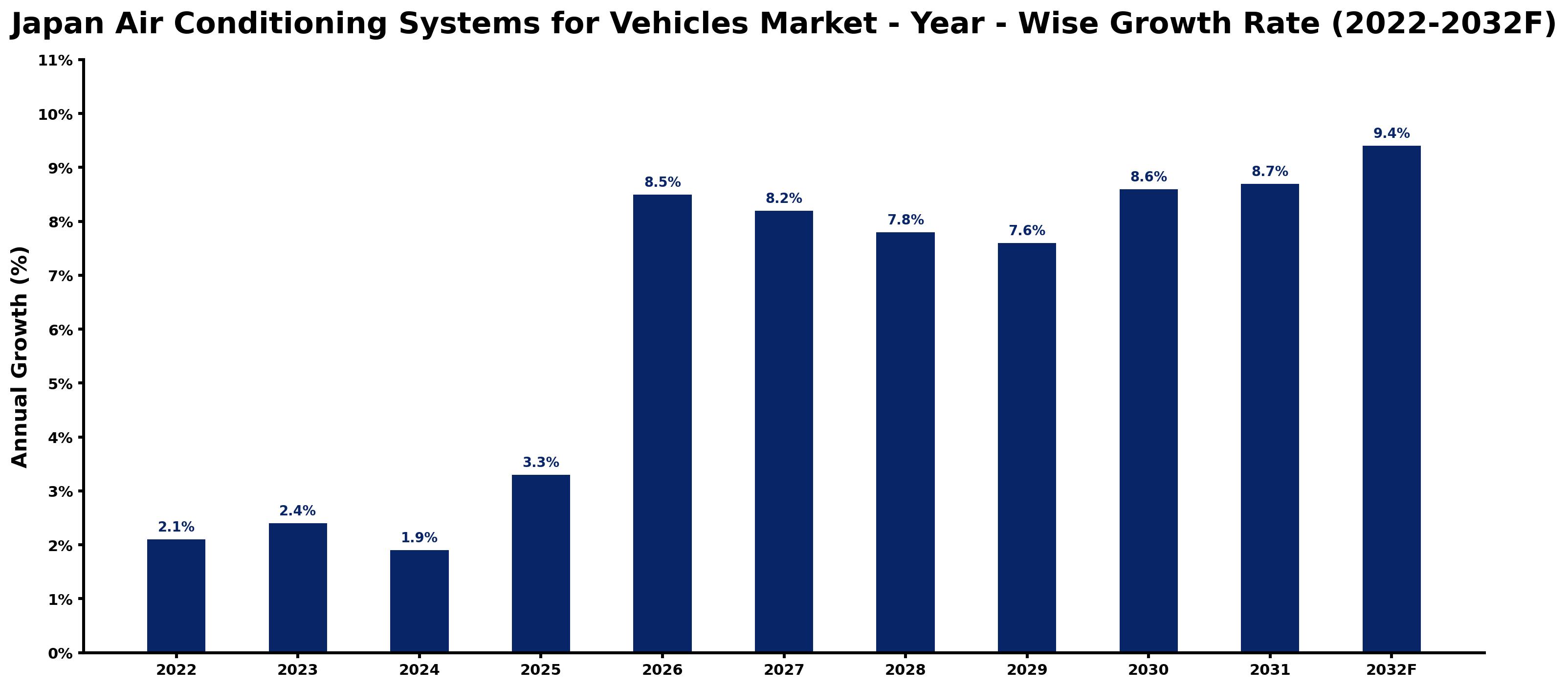
For each year, the table pairs the estimated growth rate with the leading influence on demand, showing how the drivers changed across the period.
| Year | Estimated Annual Growth (%) | Market Rationale |
| 2022 | 2.1 | The market experienced moderate growth driven by stable vehicle registrations. |
| 2023 | 2.4 | Demand increased as manufacturers focused on improving vehicle comfort features. |
| 2024 | 1.9 | Growth slowed as supply chain issues affected component availability. |
| 2025 | 3.3 | The market rebounded with rising consumer interest in advanced climate control systems. |
| 2026 | 8.5 | Demand surged due to the growing adoption of electric vehicles requiring efficient cooling. |
| 2027 | 8.2 | Growth slowed slightly as manufacturers adjusted to new production standards. |
| 2028 | 7.8 | The market continued to grow as eco-friendly refrigerants gained traction among buyers. |
| 2029 | 7.6 | Demand remained stable, driven by consistent vehicle production levels. |
| 2030 | 8.6 | Growth accelerated as manufacturers aimed for compliance with stricter emissions regulations. |
| 2031 | 8.7 | The market continued to expand with rising investments in automotive technology. |
| 2032 | 9.4 | Demand peaked as consumer preferences shifted towards luxury and electric vehicles. |
Note: Market size estimations and growth projections presented in this report are based on 6Wresearch's proprietary forecasting methodology, utilizing the latest available industry data, government publications, and primary research inputs.
Japan Air Conditioning Systems for Vehicles Market Synopsis
Air Conditioning Systems for Vehicles are mechanical systems designed to cool and dehumidify vehicle interiors, utilising components such as compressors and condensers. The Japan Air Conditioning Systems for Vehicles Market is growing due to increasing vehicle registrations, a shift towards electric vehicles, and the adoption of advanced climate control technologies. Demand is driven by domestic manufacturers and a growing emphasis on eco-friendly refrigerants, particularly under the GX Promotion Act, which supports sustainable practices in the automotive sector.
Market Dynamics Impact Analysis (2026–2032)
| Factor | Type | Impact | Primary Segment Affected |
| Growing adoption of electric vehicles drives demand for efficient cooling systems. | Driver | High | Electric Vehicle AC |
| Rising consumer preference for luxury vehicles boosts demand for advanced climate control. | Driver | High | Automatic Climate Control |
| Increasing focus on eco-friendly refrigerants presents opportunities for suppliers. | Opportunity | High | Eco-Friendly Refrigerants |
| The push for enhanced vehicle comfort creates demand for multi-zone cooling systems. | Opportunity | Medium | Multi-Zone Cooling |
| Supply chain disruptions have affected the availability of critical components. | Restraint | High | Basic Compressor |
| Stringent regulations on emissions may limit production capabilities. | Restraint | Medium | Electric Vehicle AC |
| High production costs for advanced systems can deter manufacturers. | Challenge | High | Automatic Climate Control |
| Competition from international suppliers pressures local manufacturers' pricing. | Challenge | Medium | Tier-1 Auto Suppliers |
Evaluation of Drivers in Japan Air Conditioning Systems for Vehicles Market (2026–2032)
The following drivers explain most of the expected growth.
| Drivers | Primary Segment Affected | Why It Matters (Evidence) |
| Increasing vehicle registrations fuel demand for air conditioning systems. | Electric Vehicle AC | In 2022, Japan had around 78 million registered vehicles, leading to higher AC system sales. |
| Growing interest in luxury vehicles boosts demand for advanced climate control. | Automatic Climate Control | Luxury car manufacturers are investing more in climate control technologies to improve passenger comfort. |
| Rising environmental awareness drives the need for eco-friendly refrigerants. | Eco-Friendly Refrigerants | The Green Growth Strategy promotes eco-friendly refrigerants, encouraging suppliers to innovate. |
| Technological advancements in AC systems improve efficiency and performance. | Basic Compressor | Japan's automotive sector invested approximately 1 trillion yen in R&D in 2023, improving system capabilities. |
| The shift towards electric vehicles necessitates efficient cooling solutions. | Electric Vehicle AC | The adoption of electric vehicles is projected to reach 20% by 2025, driving demand for specialized AC systems. |
Orders keep climbing as the automotive sector invests heavily in research and development, with approximately 1 trillion yen allocated in 2023. This investment improves system capabilities, particularly for Automatic Climate Control systems, which are increasingly sought after by luxury vehicle manufacturers. Interest in eco-friendly refrigerants is also rising, driven by the Green Growth Strategy that promotes sustainable practices. With around 78 million registered vehicles in Japan, the demand for efficient air conditioning systems continues to rise, especially as electric vehicle adoption reaches 20% by 2025.
Evaluation of Restraints in Japan Air Conditioning Systems for Vehicles Market
The main factors holding the market back are set out below.
| Market Restraint | Primary Segment Affected | Why It Matters (Evidence) |
| Supply chain disruptions hinder the availability of key components. | Basic Compressor | In 2022, manufacturers faced challenges sourcing materials, impacting production timelines. |
| Stringent emissions regulations may limit production capabilities. | Electric Vehicle AC | The government aims for a 50% reduction in CO2 emissions from vehicles by 2030, affecting manufacturing processes. |
| High production costs for advanced systems can deter manufacturers. | Automatic Climate Control | Rising costs of components and technology may lead to increased retail prices. |
| Competition from international suppliers pressures local manufacturers' pricing. | Tier-1 Auto Suppliers | Local suppliers must adjust pricing strategies to remain competitive against global players. |
| Limited consumer awareness of advanced AC technologies restricts market growth. | Automatic Climate Control | Many consumers still prefer basic systems due to cost considerations. |
Japan Air Conditioning Systems for Vehicles Market Challenges
Producers in Japan experience escalating costs for eco-friendly refrigerants, driven by stringent environmental regulations that increase material expenses by 15%. Buyers face supply chain delays due to reliance on specific regions for critical components, extending production timelines by up to three months. Compliance with JIS standards requires frequent updates to manufacturing processes, raising operational costs for producers by approximately 10% of their annual budget. Technology adoption challenges compel buyers to rely on outdated systems, which can decrease vehicle efficiency by 25%.
Trends in the Japan Air Conditioning Systems for Vehicles Market
The following changes are redrawing the Japan Air Conditioning Systems for Vehicles Market.
- Shift Towards Eco-Friendly Refrigerants: Since 2020, the Japanese automotive sector has increasingly adopted eco-friendly refrigerants due to regulations. The GX Promotion Act has led to a 30% rise in eco-friendly refrigerant usage among manufacturers.
- Transition from Manual to Automatic Climate Control: In 2023, the demand for Automatic Climate Control systems surged as luxury vehicle manufacturers prioritised passenger comfort. This segment is projected to grow through 2032.
- Emergence of Smart Temperature Sensors: Smart Temperature Sensors are becoming prevalent in vehicle AC systems, improving efficiency. By 2025, this technology is anticipated to grow rapidly, driven by consumer demand for advanced features.
- Increased Focus on Multi-Zone Cooling: The demand for Multi-Zone Cooling systems has grown among SUV and MPV OEMs since 2022, as consumer preferences shift towards enhanced comfort in larger vehicles.
Investment Opportunities in the Japan Air Conditioning Systems for Vehicles Market
The following areas offer the clearest openings for investors and suppliers in the Japan Air Conditioning Systems for Vehicles Market.
- Entry-Level Vehicle OEMs Seeking Cost-Effective Solutions: Entry-Level Vehicle OEMs are looking for affordable air conditioning solutions to meet market demands. Collaborating with local suppliers can facilitate market entry and improve competitiveness.
- Growing Demand for Advanced Climate Control: As the luxury vehicle segment expands, manufacturers are investing in Automatic Climate Control systems. This presents an opportunity for suppliers to provide advanced technologies.
- Partnerships with HVAC Tech Vendors: Now is the time for manufacturers to partner with HVAC Tech Vendors to improve system efficiency. The HVAC sector is projected to grow significantly through 2032.
- Investment in Eco-Friendly Technologies: With Japan targeting a 46% reduction in greenhouse gas emissions by 2030, there is a significant opportunity for suppliers of eco-friendly refrigerants to meet this demand.
Government Initiatives in the Japan Air Conditioning Systems for Vehicles Market
The GX Basic Policy, adopted in 2023, outlines targets for reducing greenhouse gas emissions in the automotive sector. This includes a commitment to eco-friendly refrigerants and advanced climate control technologies, which are essential for compliance and market competitiveness. The policy aims for about JPY 150 trillion of public-private decarbonisation investment over 10 years, benefiting manufacturers of air conditioning systems.
The Battery Industry Strategy, initiated by METI in August 2022, supports manufacturers in transitioning to sustainable practices, ensuring compliance with national emissions targets. This initiative encourages the adoption of eco-friendly technologies in air conditioning systems, with a focus on enhancing efficiency and reducing environmental impact.
Future Insight of the Japan Air Conditioning Systems for Vehicles Market
The shift towards a 46% reduction in greenhouse-gas emissions by 2030 will drive advancements in air conditioning systems, prompting suppliers to invest in new technologies. By 2032, the expected rise in electric vehicle adoption will lead to the development of new standards for vehicle air conditioning efficiency. Integration of advanced materials is set to improve system performance and reduce energy consumption significantly. As the automotive sector allocates around 1 trillion yen to R&D, buyers will gain access to more efficient and environmentally friendly air conditioning solutions.
Market Segmentation Analysis
Japan Air Conditioning Systems for Vehicles Market report covers a detailed analysis of the following market segments:
By System Type – Manual AC Systems Lead, Automatic Climate Control Expected to Grow Fastest
According to Saurav Kr Singh, Senior Research Analyst at 6Wresearch, Manual AC Systems took 48% of system type revenue in 2025, more than any other category. Manual AC Systems dominate the market due to their widespread use in entry-level vehicles, which constitute a substantial portion of the automotive sector. This segment caters to a large customer base seeking cost-effective solutions for air conditioning. The quickest growth will come from Automatic Climate Control, forecast to expand at a CAGR of 12.1% between 2026 and 2032. Automatic Climate Control is experiencing rapid growth as luxury vehicles increasingly incorporate advanced comfort features, appealing to consumers willing to invest in premium experiences. The rising demand for high-end vehicles is a key factor in this segment's expansion. Suppliers should focus on developing advanced systems to meet the growing expectations of luxury vehicle manufacturers.
By Cooling Mechanism – Basic Compressor Leads, Smart Temperature Sensors Expected to Grow Fastest
With 47% of cooling mechanism revenue in 2025, Basic Compressor was the largest category. Basic Compressors are essential components found in all air conditioning systems, making them indispensable for vehicle manufacturers. Their fundamental role in ensuring effective cooling contributes to their leading market position. Over 2026–2032, Smart Temperature Sensors are expected to post the fastest growth, at a CAGR of 11.7%. Smart Temperature Sensors are gaining traction as manufacturers seek to improve energy efficiency and user comfort in advanced systems. The increasing focus on eco-friendly technologies is propelling this segment's growth. Suppliers must invest in smart technologies to align with the automotive industry's shift towards efficiency and sustainability.
By Distribution Channel – Tier-1 Auto Suppliers Lead, HVAC Tech Vendors Expected to Grow Fastest
The largest distribution channel category in 2025 was Tier-1 Auto Suppliers, at 50% of revenue. Tier-1 Auto Suppliers maintain the largest share because they provide essential components directly to original equipment manufacturers, ensuring a reliable supply chain. Their strong presence in major automotive regions like Tokyo and Aichi supports sustained demand for their offerings. HVAC Tech Vendors are projected to grow fastest, at a CAGR of 10.9% during 2026–2032. HVAC Tech Vendors are rapidly expanding as they deliver advanced technologies and systems to manufacturers, aligning with the industry's focus on improving vehicle efficiency. The shift towards eco-friendly refrigerants is a key factor in this segment's swift growth. Suppliers should consider partnerships with HVAC Tech Vendors to integrate advanced technologies into their product lines.
By End User – Entry-Level Vehicle OEMs Lead, Luxury Car Manufacturers Expected to Grow Fastest
Entry-Level Vehicle OEMs accounted for 54% of the market by end user in 2025. Entry-Level Vehicle OEMs hold the leading position as they extensively utilise basic air conditioning systems to meet consumer expectations for affordable vehicles. Their substantial production volumes, influenced by Japan's large automotive market, reinforce their market dominance. Luxury Car Manufacturers are set to record the highest CAGR in this split, 11.2% over 2026–2032. Luxury Car Manufacturers are experiencing significant growth driven by their increasing need for advanced climate control systems that enhance passenger comfort. The rise in consumer affluence in Japan is a primary factor contributing to this demand. Suppliers should aim to create customised solutions for luxury car manufacturers to take advantage of this growing market segment.
Key Attractiveness of the Report
- 10 Years of Market Numbers
- Historical Data Starting from 2022 to 2025
- Base Year 2025
- Forecast Data until 2032
- Key Performance Indicators Impacting the Market
- Major Upcoming Developments and Projects
Key Highlights of the Report:
- Japan Air Conditioning Systems for Vehicles Market Outlook
- Market Size of Japan Air Conditioning Systems for Vehicles Market, 2025
- Forecast of Japan Air Conditioning Systems for Vehicles Market, 2032
- Historical Data and Forecast of Japan Air Conditioning Systems for Vehicles Revenues & Volume for the Period 2022-2032F
- Japan Air Conditioning Systems for Vehicles Market Trend Evolution
- Japan Air Conditioning Systems for Vehicles Market Drivers and Challenges
- Japan Air Conditioning Systems for Vehicles Price Trends
- Japan Air Conditioning Systems for Vehicles Porter's Five Forces
- Japan Air Conditioning Systems for Vehicles Industry Life Cycle
- Historical Data and Forecast of Japan Air Conditioning Systems for Vehicles Market Revenues & Volume By System Type for the Period 2022-2032F
- Historical Data and Forecast of Japan Air Conditioning Systems for Vehicles Market Revenues & Volume By Manual AC Systems for the Period 2022-2032F
- Historical Data and Forecast of Japan Air Conditioning Systems for Vehicles Market Revenues & Volume By Automatic Climate Control for the Period 2022-2032F
- Historical Data and Forecast of Japan Air Conditioning Systems for Vehicles Market Revenues & Volume By Electric Vehicle AC for the Period 2022-2032F
- Historical Data and Forecast of Japan Air Conditioning Systems for Vehicles Market Revenues & Volume By Rear AC Units for the Period 2022-2032F
- Historical Data and Forecast of Japan Air Conditioning Systems for Vehicles Market Revenues & Volume By Cooling Mechanism for the Period 2022-2032F
- Historical Data and Forecast of Japan Air Conditioning Systems for Vehicles Market Revenues & Volume By Basic Compressor for the Period 2022-2032F
- Historical Data and Forecast of Japan Air Conditioning Systems for Vehicles Market Revenues & Volume By Smart Temperature Sensors for the Period 2022-2032F
- Historical Data and Forecast of Japan Air Conditioning Systems for Vehicles Market Revenues & Volume By Eco-Friendly Refrigerants for the Period 2022-2032F
- Historical Data and Forecast of Japan Air Conditioning Systems for Vehicles Market Revenues & Volume By Multi-Zone Cooling for the Period 2022-2032F
- Historical Data and Forecast of Japan Air Conditioning Systems for Vehicles Market Revenues & Volume By Distribution Channel for the Period 2022-2032F
- Historical Data and Forecast of Japan Air Conditioning Systems for Vehicles Market Revenues & Volume By Tier-1 Auto Suppliers for the Period 2022-2032F
- Historical Data and Forecast of Japan Air Conditioning Systems for Vehicles Market Revenues & Volume By HVAC Tech Vendors for the Period 2022-2032F
- Historical Data and Forecast of Japan Air Conditioning Systems for Vehicles Market Revenues & Volume By EV Component Providers for the Period 2022-2032F
- Historical Data and Forecast of Japan Air Conditioning Systems for Vehicles Market Revenues & Volume By Auto Component Retailers for the Period 2022-2032F
- Historical Data and Forecast of Japan Air Conditioning Systems for Vehicles Market Revenues & Volume By End User for the Period 2022-2032F
- Historical Data and Forecast of Japan Air Conditioning Systems for Vehicles Market Revenues & Volume By Entry-Level Vehicle OEMs for the Period 2022-2032F
- Historical Data and Forecast of Japan Air Conditioning Systems for Vehicles Market Revenues & Volume By Luxury Car Manufacturers for the Period 2022-2032F
- Historical Data and Forecast of Japan Air Conditioning Systems for Vehicles Market Revenues & Volume By Electric Car OEMs for the Period 2022-2032F
- Historical Data and Forecast of Japan Air Conditioning Systems for Vehicles Market Revenues & Volume By SUV and MPV OEMs for the Period 2022-2032F
- Japan Air Conditioning Systems for Vehicles Import Export Trade Statistics
- Market Opportunity Assessment By System Type
- Market Opportunity Assessment By Cooling Mechanism
- Market Opportunity Assessment By Distribution Channel
- Market Opportunity Assessment By End User
- Japan Air Conditioning Systems for Vehicles Top Companies Market Share
- Japan Air Conditioning Systems for Vehicles Competitive Benchmarking By Technical and Operational Parameters
- Japan Air Conditioning Systems for Vehicles Company Profiles
- Japan Air Conditioning Systems for Vehicles Key Strategic Recommendations
Market Covered
This report examines the market across the segments below.
By System Type
- Manual AC Systems
- Automatic Climate Control
- Electric Vehicle AC
- Rear AC Units
By Cooling Mechanism
- Basic Compressor
- Smart Temperature Sensors
- Eco-Friendly Refrigerants
- Multi-Zone Cooling
By Distribution Channel
- Tier-1 Auto Suppliers
- HVAC Tech Vendors
- EV Component Providers
- Auto Component Retailers
By End User
- Entry-Level Vehicle OEMs
- Luxury Car Manufacturers
- Electric Car OEMs
- SUV and MPV OEMs































