Japan Air Defense Sensor Market Size & Growth Rate
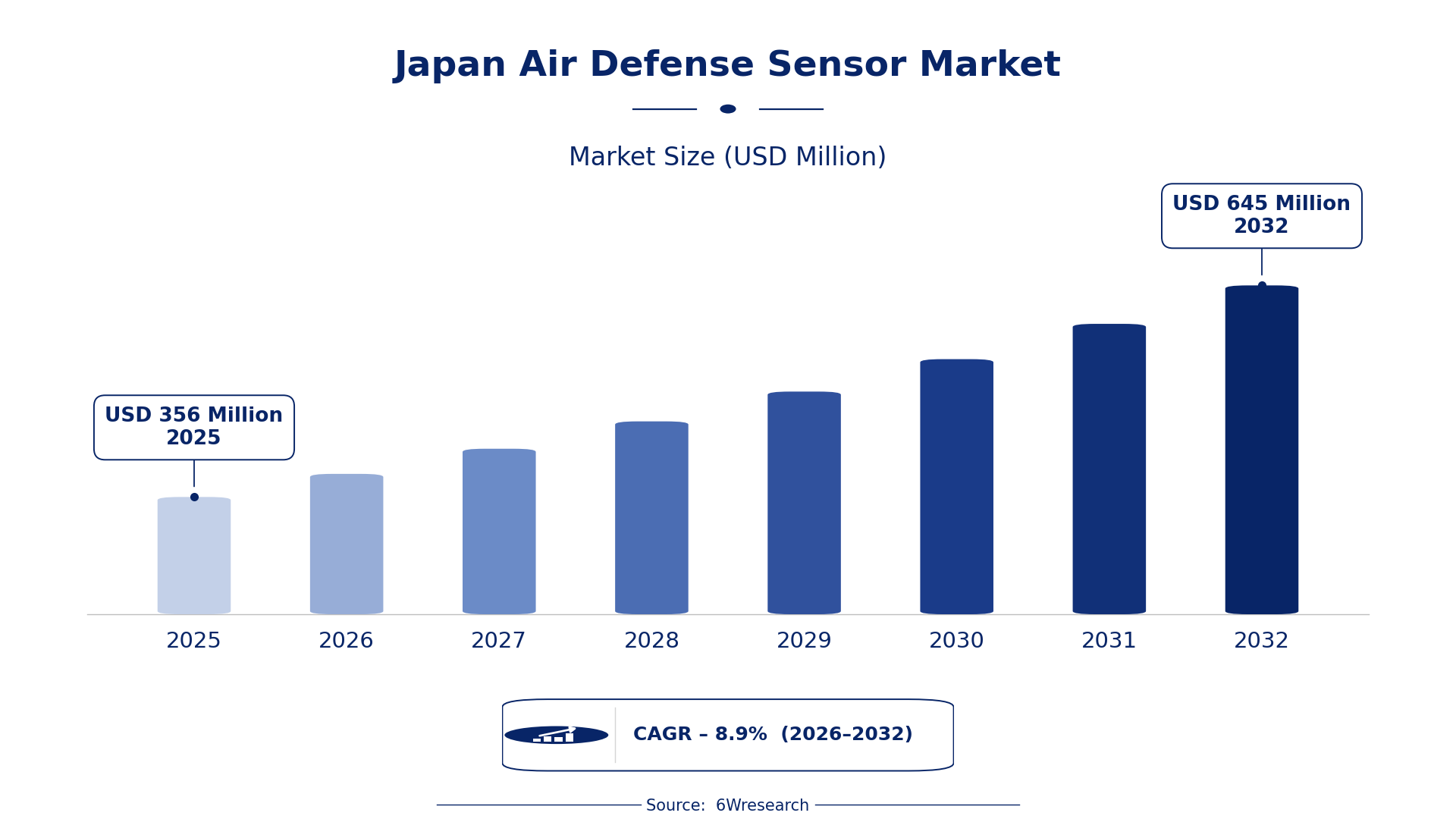
According to 6Wresearch internal database and industry insights, the Japan Air Defense Sensor Market was valued at USD 356 Million in 2025 and is projected to reach USD 645 Million by 2032, growing at a CAGR of approximately 8.9% during 2026–2032.
Japan Air Defense Sensor Market Highlights
| Report Metric | Details |
| Report Name | Japan Air Defense Sensor Market (2026-2032) |
| Market Size 2025 | USD 356 Million |
| Market Size 2032 | USD 645 Million |
| Absolute Growth 2025–2032 | USD 289 Million |
| CAGR 2026–2032 | 8.9% |
| Peak Annual Growth | 10.2% in 2029 |
| Forecast Period | 2026–2032 |
| Historical Data | 2022–2025 |
| Base Year | 2025 |
| Leading Sensor Type, 2025 | Radar Sensors (38% share) |
| Leading Detection Range, 2025 | Long-Range Targeting (35% share) |
| Leading Distribution Channel, 2025 | Defense OEMs (45% share) |
| Leading End User, 2025 | Air Force Units (40% share) |
| Fastest-Growing Sensor Type | IR Sensors (12.9% CAGR) |
| Fastest-Growing Detection Range | Heat Signature Tracking (12.7% CAGR) |
| Fastest-Growing Distribution Channel | Military Suppliers (11.1% CAGR) |
| Fastest-Growing End User | Missile Defense Systems (11.3% CAGR) |
| Growing Sector | military defense systems |
| Key End Users | Japan Air Self-Defense Force, military suppliers, defense OEMs |
Japan Air Defense Sensor Market Year-wise Growth Rate and Key Drivers (2022–2032)
This graph illustrates the annual growth rates of the market from 2022 to 2032, highlighting a steady upward trajectory and projected market expansion over the forecast period.
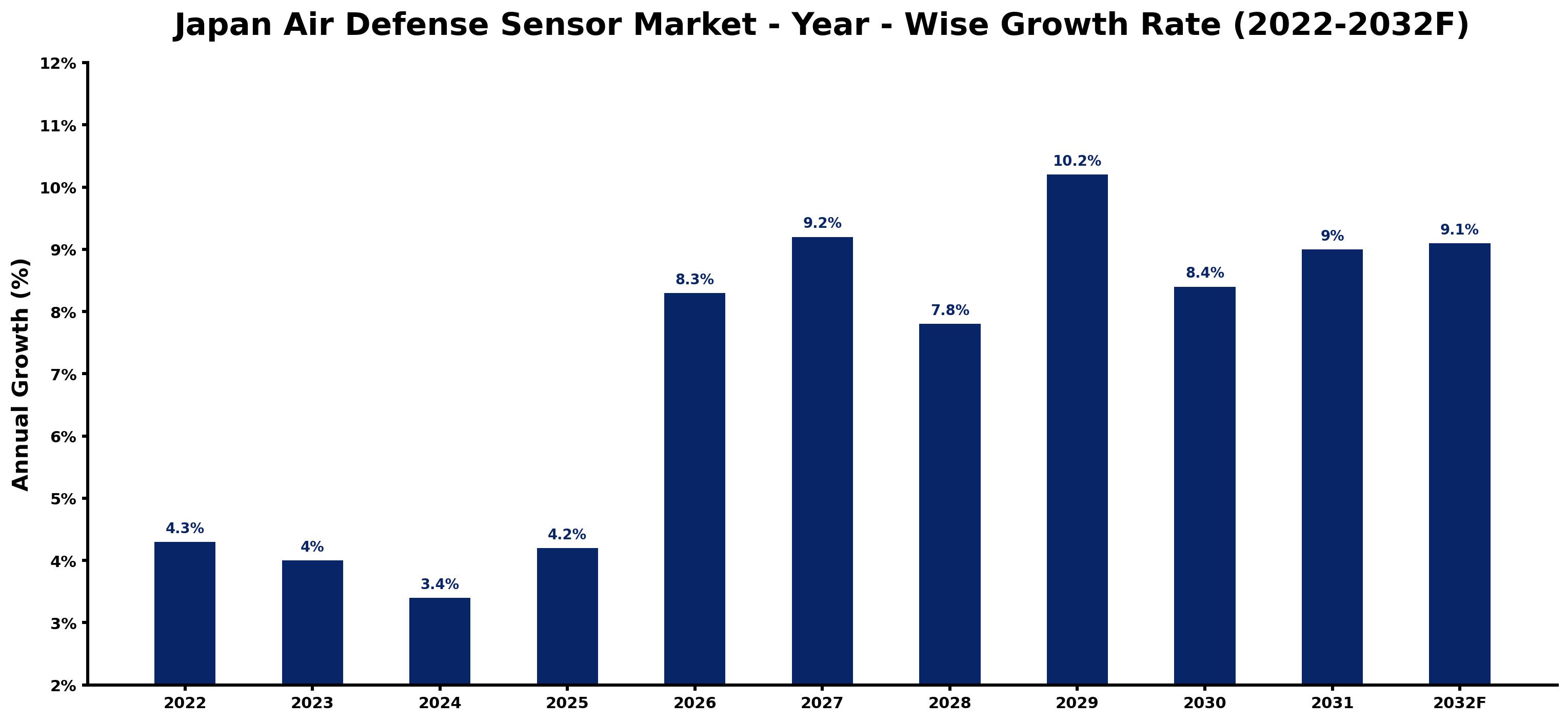
The following figures match every annual growth estimate with the main market development of that year, giving the reasoning behind each rise or slowdown.
| Year | Estimated Annual Growth (%) | Market Rationale |
| 2022 | 4.3 | The market experienced solid growth as military investments increased. |
| 2023 | 4.0 | Growth slowed slightly due to a temporary reduction in defense spending. |
| 2024 | 3.4 | The market continued to grow, albeit at a slower pace, as projects were delayed. |
| 2025 | 4.2 | Growth accelerated again as new contracts for advanced radar systems were awarded. |
| 2026 | 8.3 | Demand is expected to surge as the Ministry of Defense launches new initiatives for air defense. |
| 2027 | 9.2 | The market is projected to expand further due to rising tensions in the region driving procurement. |
| 2028 | 7.8 | Growth is anticipated to slow as the market stabilises after a period of rapid expansion. |
| 2029 | 10.2 | The market will peak as major investments in multi-sensor systems are realised. |
| 2030 | 8.4 | Growth is expected to moderate as the focus shifts to integration and maintenance of systems. |
| 2031 | 9.0 | Demand will increase again as new technologies are adopted in air defense. |
| 2032 | 9.1 | The market is projected to continue growing steadily as international collaborations intensify. |
Note: Market size estimations and growth projections presented in this report are based on 6Wresearch's proprietary forecasting methodology, utilizing the latest available industry data, government publications, and primary research inputs.
Japan Air Defense Sensor Market Synopsis
Air defense sensors are critical technologies for detecting aerial threats, integrating electronic engineering and software development. Their primary applications include military defense systems and surveillance. The Japan Air Defense Sensor Market is expanding due to increased defense budgets, with ¥6 trillion allocated for military enhancements in 2023. The focus on advanced radar systems and AI integration, alongside partnerships with allied nations, drives demand from the Japan Air Self-Defense Force and other military units.
Market Dynamics Impact Analysis (2026–2032)
| Factor | Type | Impact | Primary Segment Affected |
| Increased defense budget allocations | Driver | High | Radar Sensors |
| Integration of AI technologies in defense systems | Driver | High | Multi-Sensor Systems |
| Growing demand for advanced surveillance technologies | Opportunity | High | IR Sensors |
| Partnerships with allied nations for technology sharing | Opportunity | Medium | Long-Range Targeting |
| Supply chain vulnerabilities affecting component availability | Restraint | High | Military Suppliers |
| Challenges in maintaining compliance with international standards | Restraint | Medium | Defense OEMs |
| High costs associated with advanced technology integration | Challenge | High | Multi-Sensor Systems |
| Limited domestic production capacity for critical components | Challenge | Medium | Radar Sensors |
Evaluation of Drivers in Japan Air Defense Sensor Market (2026–2032)
Key forces behind demand, with the segment each one moves most, are listed below.
| Drivers | Primary Segment Affected | Why It Matters (Evidence) |
| Increased military spending | Radar Sensors | Japan's defense budget allocated ¥6 trillion in 2023, boosting procurement of radar systems. |
| AI integration in defense systems | Multi-Sensor Systems | Government initiatives focus on AI integration, improving situational awareness and driving demand. |
| Rising regional tensions | Long-Range Targeting | Increased threats from neighboring countries have led to higher demand for long-range capabilities. |
| Technological advancements in sensor capabilities | IR Sensors | New developments in infrared technology improve detection, attracting military buyers. |
| Collaborations with allied nations | Military Suppliers | Partnerships enhance technology sharing, increasing procurement from local suppliers. |
What keeps demand rising is Japan's defense budget, which allocated ¥6 trillion for military enhancements in 2023. This investment propels the acquisition of advanced radar systems, especially by the Japan Air Self-Defense Force. Heightened regional tensions have increased the need for long-range targeting capabilities. Progress in infrared technology attracts military buyers, while partnerships with allied nations encourage procurement from local suppliers.
Evaluation of Restraints in Japan Air Defense Sensor Market
The main factors holding the market back are set out below.
| Market Restraint | Primary Segment Affected | Why It Matters (Evidence) |
| Supply chain vulnerabilities impacting component availability | Military Suppliers | Japan's reliance on imports for critical components has caused delays in production. |
| Challenges in maintaining compliance with international standards | Defense OEMs | Adhering to ISO 9001 standards requires significant investment and time. |
| High costs associated with advanced technology integration | Multi-Sensor Systems | Integrating new technologies into existing systems can exceed budget constraints. |
| Limited domestic production capacity for critical components | Radar Sensors | Manufacturers face challenges in scaling up production to meet growing demand. |
| Market competition from foreign suppliers | IR Sensors | International suppliers offer competitive pricing, affecting local market share. |
Japan Air Defense Sensor Market Challenges
Japan's defense budget allocated ¥6 trillion in 2023, but regulatory complexities slow down procurement processes for military buyers, risking project overruns. Intense competition from international firms compels suppliers to reduce prices, impacting their profit margins. A shortage of advanced technology skills hampers supplier capabilities, leading to extended development times for new systems. Buyers encounter difficulties in integrating multi-sensor technologies, complicating operational efficiency and potentially raising training and maintenance costs by up to 20%.
Trends in the Japan Air Defense Sensor Market
The trends below show where the Japan Air Defense Sensor Market is heading.
- Shift towards AI Integration in Defense Systems: Japan is increasingly adopting AI technologies in air defense systems, improving threat detection. The Ministry of Defense's focus on AI integration is reflected in the ¥6 trillion allocated in 2023.
- Transition from Single to Multi-Sensor Systems: The adoption of multi-sensor systems is growing, as they provide comprehensive threat detection. In 2023, Japan invested in over 10 advanced radar systems to strengthen its capabilities.
- Emergence of Long-Range Targeting Systems: Long-range targeting systems are becoming essential for intercepting distant threats. This shift began in 2023, aligning with Japan's National Security Strategy to enhance surveillance technologies.
- Increased Focus on Domestic Production: Japan is prioritising domestic production of defense components to reduce reliance on imports. The Semiconductor and Digital Industry Strategy launched in 2021 aims to secure local manufacturing.
Investment Opportunities in the Japan Air Defense Sensor Market
The following areas offer the clearest openings for investors and suppliers in the Japan Air Defense Sensor Market.
- Growing Demand for Advanced Surveillance Technologies: Now is the time to invest in advanced surveillance technologies, as Japan's defense budget allocated ¥6 trillion in 2023. Military suppliers can benefit from increasing orders from the Japan Air Self-Defense Force.
- Expansion of Multi-Sensor Systems: The Tokyo region is a key area for defense technology development, creating opportunities for suppliers. Investing in multi-sensor systems will meet the rising demand for effective threat detection.
- Partnerships for Technology Sharing: With increasing collaborations with allied nations, there is an opportunity for joint ventures. Suppliers can enter the market by partnering with local defense manufacturers to enhance capabilities.
- Investment in AI Technologies: The focus on AI integration in defense systems presents a lucrative opportunity. Military suppliers can invest in AI technologies to meet the demands of the Japan Air Self-Defense Force.
Government Initiatives in the Japan Air Defense Sensor Market
The Economic Security Promotion Act, enacted in 2022, supports supply-chain resilience for critical products. This law ensures that domestic manufacturers meet necessary standards, which is important for air defense sensor production and procurement.
The Ministry of Defense approves funding for advanced radar systems under the Semiconductor and Digital Industry Strategy. This strategy, initiated in June 2021, aims to secure domestic semiconductor manufacturing for defense applications.
Future Insight of the Japan Air Defense Sensor Market
By 2032, military buyers will experience enhanced air defense capabilities through AI integration in surveillance systems and advanced radar technologies. Investment in over 10 advanced radar systems will significantly improve threat detection processes. Collaborations with allied nations will expedite technology sharing, enabling suppliers to innovate more rapidly. Adherence to ISO 9001 standards will ensure higher quality in defense manufacturing, boosting buyer confidence in procurement.
Market Segmentation Analysis
Japan Air Defense Sensor Market report covers a detailed analysis of the following market segments:
By Sensor Type – Radar Sensors Lead, IR Sensors Expected to Grow Fastest
According to Saurav Kr Singh, Senior Research Analyst at 6Wresearch, in 2025, Radar Sensors led the sensor type split with a 38% share. Radar sensors play a critical role in tracking aerial threats, making them indispensable for the Japan Air Self-Defense Force. Their integration into over 10 advanced radar systems highlights their importance in the nation's defence framework. IR Sensors are projected to grow fastest, at a CAGR of 12.9% during 2026–2032. The growth of IR sensors stems from their essential role in detecting heat signatures, particularly beneficial in operations against stealth targets. This increasing focus on advanced detection technologies is projected to elevate their market share. Suppliers must focus on advancing IR sensor technologies to meet the rising demand.
By Detection Range – Long-Range Targeting Leads, Heat Signature Tracking Expected to Grow Fastest
Long-Range Targeting held 35% of the Japan Air Defense Sensor Market by detection range in 2025. Long-range targeting is crucial for intercepting distant threats, aligning with Japan's strategic defence initiatives. This capability is reinforced by the emphasis on advanced surveillance technologies in the National Security Strategy. The quickest growth will come from Heat Signature Tracking, forecast to expand at a CAGR of 12.7% between 2026 and 2032. Heat signature tracking is gaining traction due to its effectiveness in identifying stealthy targets. This trend indicates a shift towards more sophisticated detection methods in the air defence sector. Buyers should prioritise investments in technologies that enhance both long-range and heat signature detection capabilities.
By Distribution Channel – Defense OEMs Lead, Military Suppliers Expected to Grow Fastest
Defense OEMs took 45% of distribution channel revenue in 2025, more than any other category. Defense OEMs are the primary manufacturers of defence systems, ensuring the effective integration of air defense sensors into military solutions. Their established relationships with the Japan Air Self-Defense Force solidify their leading market position. Military Suppliers are set to record the highest CAGR in this split, 11.1% over 2026–2032. Military suppliers are experiencing rapid growth as they provide essential components and systems that support air defense operations. The increased defence budget allocation is driving demand for military supplies. Suppliers should strengthen partnerships with military suppliers to enhance market reach and responsiveness.
By End User – Air Force Units Lead, Missile Defense Systems Expected to Grow Fastest
Air Force Units accounted for 40% of the market by end user in 2025. Air force units are the main users of air defense systems, which are vital for maintaining air superiority. Their active involvement in military operations ensures a steady demand for advanced air defense technologies. Over 2026–2032, Missile Defense Systems are expected to post the fastest growth, at a CAGR of 11.3%. Missile defense systems are integral to national defense, and their swift adoption underscores the urgency of addressing aerial threats. This focus on missile defense marks a strategic shift in Japan's military priorities. Buyers should consider investing in missile defense technologies to align with national security objectives.
Key Attractiveness of the Report
- 10 Years of Market Numbers
- Historical Data Starting from 2022 to 2025
- Base Year 2025
- Forecast Data until 2032
- Key Performance Indicators Impacting the Market
- Major Upcoming Developments and Projects
Key Highlights of the Report:
- Japan Air Defense Sensor Market Outlook
- Market Size of Japan Air Defense Sensor Market, 2025
- Forecast of Japan Air Defense Sensor Market, 2032
- Historical Data and Forecast of Japan Air Defense Sensor Revenues & Volume for the Period 2022-2032F
- Japan Air Defense Sensor Market Trend Evolution
- Japan Air Defense Sensor Market Drivers and Challenges
- Japan Air Defense Sensor Price Trends
- Japan Air Defense Sensor Porter's Five Forces
- Japan Air Defense Sensor Industry Life Cycle
- Historical Data and Forecast of Japan Air Defense Sensor Market Revenues & Volume By Sensor Type for the Period 2022-2032F
- Historical Data and Forecast of Japan Air Defense Sensor Market Revenues & Volume By Radar Sensors for the Period 2022-2032F
- Historical Data and Forecast of Japan Air Defense Sensor Market Revenues & Volume By IR Sensors for the Period 2022-2032F
- Historical Data and Forecast of Japan Air Defense Sensor Market Revenues & Volume By Acoustic Sensors for the Period 2022-2032F
- Historical Data and Forecast of Japan Air Defense Sensor Market Revenues & Volume By Multi-Sensor Systems for the Period 2022-2032F
- Historical Data and Forecast of Japan Air Defense Sensor Market Revenues & Volume By Detection Range for the Period 2022-2032F
- Historical Data and Forecast of Japan Air Defense Sensor Market Revenues & Volume By Long-Range Targeting for the Period 2022-2032F
- Historical Data and Forecast of Japan Air Defense Sensor Market Revenues & Volume By Heat Signature Tracking for the Period 2022-2032F
- Historical Data and Forecast of Japan Air Defense Sensor Market Revenues & Volume By AI Sound Classification for the Period 2022-2032F
- Historical Data and Forecast of Japan Air Defense Sensor Market Revenues & Volume By AI Data Fusion for the Period 2022-2032F
- Historical Data and Forecast of Japan Air Defense Sensor Market Revenues & Volume By Distribution Channel for the Period 2022-2032F
- Historical Data and Forecast of Japan Air Defense Sensor Market Revenues & Volume By Defense OEMs for the Period 2022-2032F
- Historical Data and Forecast of Japan Air Defense Sensor Market Revenues & Volume By Military Suppliers for the Period 2022-2032F
- Historical Data and Forecast of Japan Air Defense Sensor Market Revenues & Volume By Tactical Gear Vendors for the Period 2022-2032F
- Historical Data and Forecast of Japan Air Defense Sensor Market Revenues & Volume By Government Contractors for the Period 2022-2032F
- Historical Data and Forecast of Japan Air Defense Sensor Market Revenues & Volume By End User for the Period 2022-2032F
- Historical Data and Forecast of Japan Air Defense Sensor Market Revenues & Volume By Air Force Units for the Period 2022-2032F
- Historical Data and Forecast of Japan Air Defense Sensor Market Revenues & Volume By Missile Defense Systems for the Period 2022-2032F
- Historical Data and Forecast of Japan Air Defense Sensor Market Revenues & Volume By Battlefield Surveillance Units for the Period 2022-2032F
- Historical Data and Forecast of Japan Air Defense Sensor Market Revenues & Volume By National Defense Agencies for the Period 2022-2032F
- Japan Air Defense Sensor Import Export Trade Statistics
- Market Opportunity Assessment By Sensor Type
- Market Opportunity Assessment By Detection Range
- Market Opportunity Assessment By Distribution Channel
- Market Opportunity Assessment By End User
- Japan Air Defense Sensor Top Companies Market Share
- Japan Air Defense Sensor Competitive Benchmarking By Technical and Operational Parameters
- Japan Air Defense Sensor Company Profiles
- Japan Air Defense Sensor Key Strategic Recommendations
Market Covered
Segments analysed in this report are listed below.
By Sensor Type
- Radar Sensors
- IR Sensors
- Acoustic Sensors
- Multi-Sensor Systems
By Detection Range
- Long-Range Targeting
- Heat Signature Tracking
- AI Sound Classification
- AI Data Fusion
By Distribution Channel
- Defense OEMs
- Military Suppliers
- Tactical Gear Vendors
- Government Contractors
By End User
- Air Force Units
- Missile Defense Systems
- Battlefield Surveillance Units
- National Defense Agencies































