Japan Air Intake Control System Market Size & Growth Rate
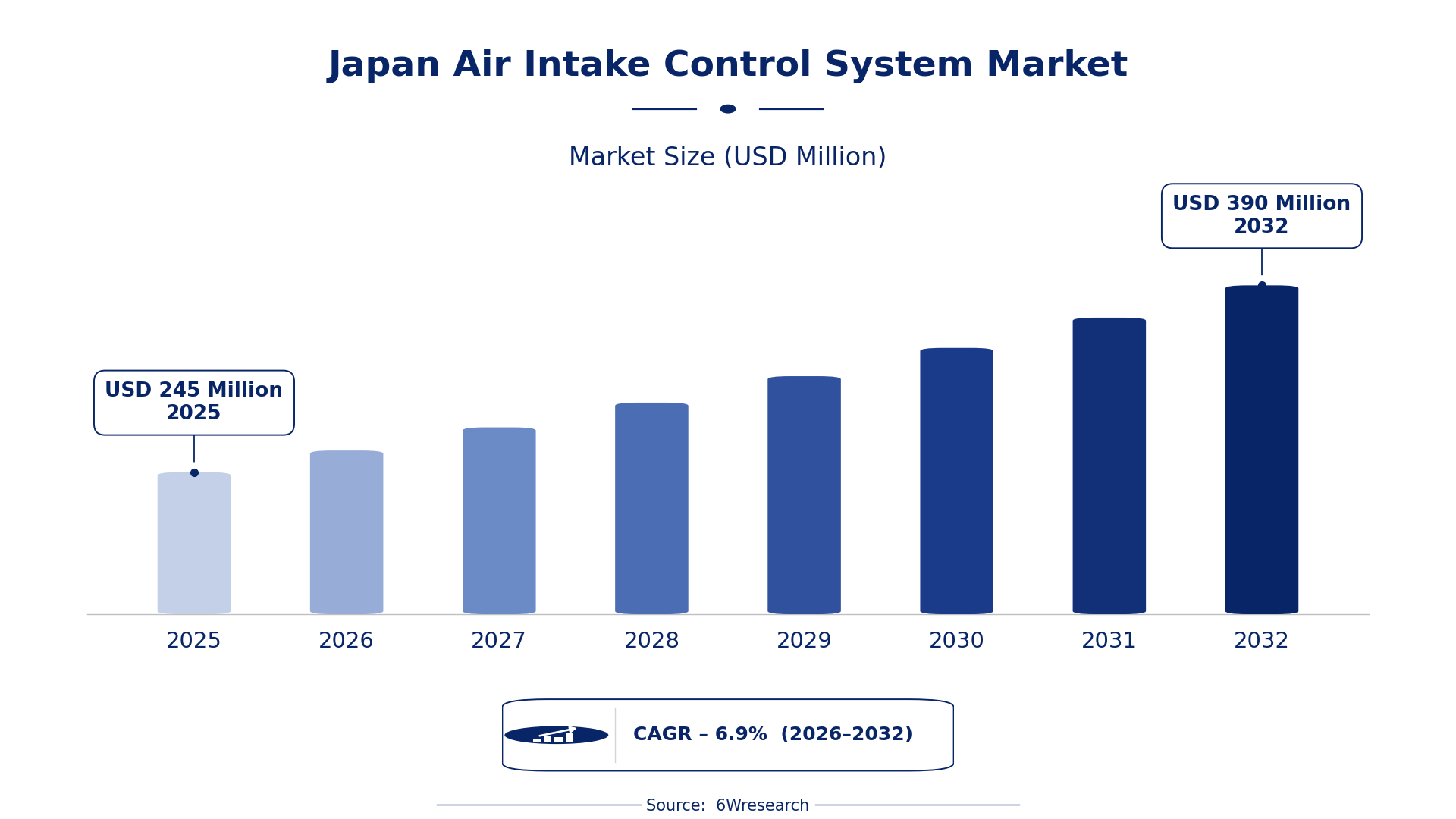
According to 6Wresearch internal database and industry insights, the Japan Air Intake Control System Market was valued at USD 245 Million in 2025 and is projected to reach USD 390 Million by 2032, growing at a CAGR of approximately 6.9% during 2026–2032.
Japan Air Intake Control System Market Highlights
| Report Metric | Details |
| Report Name | Japan Air Intake Control System Market (2026-2032) |
| Market Size 2025 | USD 245 Million |
| Market Size 2032 | USD 390 Million |
| Absolute Growth 2025–2032 | USD 145 Million |
| CAGR 2026–2032 | 6.9% |
| Peak Annual Growth | 7.8% in 2027 |
| Forecast Period | 2026–2032 |
| Historical Data | 2022–2025 |
| Base Year | 2025 |
| Leading Control Type, 2025 | Variable Valve Timing (37% share) |
| Leading Technology Used, 2025 | Electronic Control Units (44% share) |
| Leading Distribution Channel, 2025 | Automotive OEMs (35% share) |
| Leading End User, 2025 | Passenger Vehicle Makers (38% share) |
| Fastest-Growing Control Type | Turbo Intake Systems (10.3% CAGR) |
| Fastest-Growing Technology Used | Boost Pressure AI (9.8% CAGR) |
| Fastest-Growing Distribution Channel | Aftermarket Dealers (8.9% CAGR) |
| Fastest-Growing End User | Sports Car Manufacturers (9.1% CAGR) |
| Growing Sector | Sports Car Manufacturers |
| Key End Users | Passenger Vehicle Makers, Sports Car Manufacturers, Car Enthusiasts, Electric Vehicle OEMs |
Japan Air Intake Control System Market Year-wise Growth Rate and Key Drivers (2022–2032)
This graph illustrates the annual growth rates of the market from 2022 to 2032, highlighting a steady upward trajectory and projected market expansion over the forecast period.
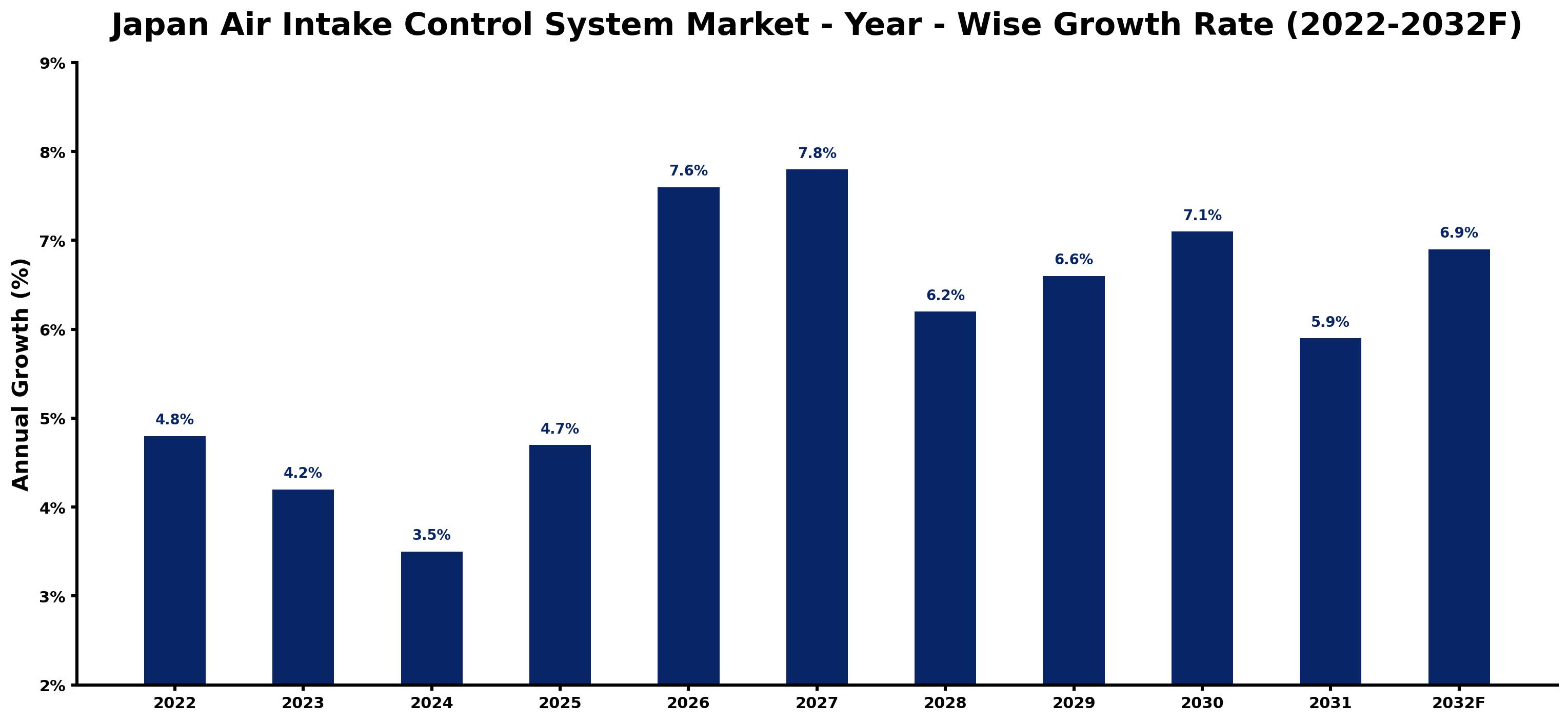
Below, each year's estimated growth is shown next to the factor that most influenced it.
| Year | Estimated Annual Growth (%) | Market Rationale |
| 2022 | 4.8 | Demand was strong due to a recovering automotive sector and increased production. |
| 2023 | 4.2 | Growth slowed as supply chain issues impacted production rates and availability. |
| 2024 | 3.5 | Market growth continued to decelerate amid ongoing supply challenges and inflationary pressures. |
| 2025 | 4.7 | Demand increased as automotive manufacturers ramped up production to meet consumer needs. |
| 2026 | 7.6 | The market is expected to surge as technological advancements in air intake systems gain traction. |
| 2027 | 7.8 | Demand is projected to peak with heightened interest in performance vehicles and eco-friendly technologies. |
| 2028 | 6.2 | Growth is anticipated to slow as the market stabilises after the peak demand period. |
| 2029 | 6.6 | Increased exports and domestic sales are expected to contribute to a rise in market activity. |
| 2030 | 7.1 | Technological innovations in air intake systems will drive further growth. |
| 2031 | 5.9 | Growth is projected to decelerate as market saturation begins to influence purchasing decisions. |
| 2032 | 6.9 | The market is expected to grow steadily with ongoing advancements in automotive technologies. |
Note: Market size estimations and growth projections presented in this report are based on 6Wresearch's proprietary forecasting methodology, utilizing the latest available industry data, government publications, and primary research inputs.
Japan Air Intake Control System Market Synopsis
Air Intake Control Systems optimise engine performance by regulating airflow into engines, utilising components like sensors and electronic control units. The Japan Air Intake Control System Market is growing due to the automotive sector's production of over 8 million vehicles in 2022, driven by domestic demand and exports. Factors such as the adoption of Variable Valve Timing in over 70% of new vehicles and government support for eco-friendly technologies are driving market growth, with a projected size of USD 390 million by 2032.
Market Dynamics Impact Analysis (2026–2032)
| Factor | Type | Impact | Primary Segment Affected |
| Growing adoption of Variable Valve Timing systems | Driver | High | Variable Valve Timing |
| Increased demand for Turbo Intake Systems in performance vehicles | Driver | High | Turbo Intake Systems |
| Rising interest in aftermarket enhancements among car enthusiasts | Opportunity | Medium | Cold Air Intakes |
| Growth in electric vehicle production creating new market segments | Opportunity | Medium | Electronic Control Units |
| Supply chain disruptions affecting component availability | Restraint | High | Parts Suppliers |
| High production costs limiting affordability of advanced systems | Restraint | Medium | Automotive OEMs |
| Competition from alternative technologies in engine performance | Challenge | High | Turbo Intake Systems |
| Regulatory changes impacting manufacturing processes and standards | Challenge | Medium | Electronic Control Units |
Evaluation of Drivers in Japan Air Intake Control System Market (2026–2032)
The table below links each growth driver to the segment it affects and the evidence for it.
| Drivers | Primary Segment Affected | Why It Matters (Evidence) |
| Strong production of over 8 million vehicles in 2022 | Electronic Control Units | This high production volume drives demand for efficient air intake systems, resulting in increased purchases by automotive manufacturers. |
| Variable Valve Timing systems are standard in over 70% of new vehicles | Variable Valve Timing | This widespread adoption necessitates advanced air intake control systems, prompting manufacturers to invest in these technologies. |
| Growing consumer preference for performance vehicles | Turbo Intake Systems | As sports car manufacturers seek higher power outputs, demand for turbo intake systems rises, resulting in increased sales. |
| Rising interest in eco-friendly automotive technologies | Cold Air Intakes | The push for fuel efficiency and reduced emissions drives aftermarket sales of performance upgrades among car enthusiasts. |
| Government support for R&D in automotive technologies | Smart Air Sensors | Funding for advanced technologies encourages manufacturers to adopt air intake systems, boosting market demand. |
Several shifts outside the market lift sales. The Tokyo region's automotive sector produced over 8 million vehicles in 2022, increasing demand for air intake control systems. The growing consumer preference for performance vehicles has led to a surge in demand for turbo intake systems, as manufacturers seek higher power outputs. The push for eco-friendly automotive technologies promotes the adoption of air intake solutions, further stimulating market growth. Funding for R&D in automotive technologies encourages manufacturers to invest in advanced systems, boosting overall market demand.
Evaluation of Restraints in Japan Air Intake Control System Market
These restraints slow adoption and weigh on supplier margins.
| Market Restraint | Primary Segment Affected | Why It Matters (Evidence) |
| Supply chain disruptions affecting component availability | Parts Suppliers | These disruptions have led to delays in production schedules, impacting the timely delivery of air intake systems to manufacturers. |
| High production costs limiting affordability of advanced systems | Automotive OEMs | Increased costs for components and materials have made it challenging for OEMs to maintain competitive pricing for advanced air intake technologies. |
| Competition from alternative technologies in engine performance | Turbo Intake Systems | Emerging technologies may divert investment and interest away from traditional air intake systems, limiting market growth. |
| Regulatory changes impacting manufacturing processes and standards | Electronic Control Units | New regulations may require additional compliance measures, increasing production complexity and costs for manufacturers. |
| Limited adoption of Smart Air Sensors in mainstream vehicles | Smart Air Sensors | The slow uptake of these advanced systems restricts their market penetration, affecting overall demand for air intake technologies. |
Japan Air Intake Control System Market Challenges
Producers face intense competition, with Japan's automotive sector producing over 8 million vehicles in 2022, which pressures prices and reduces profit margins. Regulatory hurdles arise from the Ministry of Land, Infrastructure, Transport and Tourism imposing stringent standards, delaying product launches and costing manufacturers valuable market share. Supply chain disruptions occur due to reliance on specific components, such as sensors, leading to production delays and increased costs for producers. Technology adoption remains slow among smaller manufacturers, resulting in outdated features that buyers increasingly demand, risking their competitiveness in a fast-evolving market.
Trends in the Japan Air Intake Control System Market
Buyers and suppliers in the Japan Air Intake Control System Market are adjusting to the following trends.
- Shift from Traditional to Advanced Air Intake Technologies: The automotive industry is increasingly adopting advanced air intake technologies, such as Variable Valve Timing, which are now standard in over 70% of new vehicles. This shift improves engine performance and efficiency, driving demand for sophisticated systems.
- Transition from Aftermarket Modifications to OEM Integrations: Car enthusiasts are increasingly turning to OEM-integrated solutions rather than aftermarket modifications. In 2023, online sales of automotive parts increased by 15%, indicating a growing preference for factory-installed enhancements.
- Emergence of Eco-Friendly Automotive Technologies: Japan launched a program in 2023 to promote eco-friendly automotive technologies, encouraging manufacturers to invest in sustainable air intake systems. This initiative aligns with global environmental standards and boosts market growth.
- Rise of Performance Enhancers Among Younger Consumers: Younger car enthusiasts are increasingly interested in performance enhancers, with a notable rise in aftermarket sales. This trend reflects a shift in consumer preferences towards customised vehicle performance.
Investment Opportunities in the Japan Air Intake Control System Market
The opportunities below stand out in the Japan Air Intake Control System Market for new entrants and existing suppliers.
- Current Demand for Eco-Friendly Solutions: With the automotive sector focusing on sustainable technologies, there is a growing need for eco-friendly air intake systems. Automotive OEMs are seeking solutions to meet environmental standards, creating opportunities for suppliers.
- Increasing Interest in Performance Enhancements: As sports car manufacturers target performance, the demand for advanced air intake systems is rising. Suppliers can enter this market by collaborating with automotive OEMs to develop new products.
- Rising Online Sales of Automotive Parts: The increase in online sales of automotive parts, which grew by 15% in 2023, presents an opportunity for suppliers to reach a broader customer base. Establishing partnerships with online platforms can enhance market presence.
- Investment in Advanced Manufacturing Technologies: The push for advanced manufacturing technologies in the automotive sector creates opportunities for investment. Collaborating with local partners can facilitate entry into this growing market.
Government Initiatives in the Japan Air Intake Control System Market
The Economic Security Promotion Act (2022) supports supply-chain resilience for designated critical products, stabilising air intake system production. This act encourages manufacturers to invest in reliable sourcing and production practices, ensuring a steady supply of components.
In 2023, the Ministry of Land, Infrastructure, Transport and Tourism allocated JPY 5 billion to support R&D in eco-friendly automotive technologies. This funding aims to promote innovation in air intake systems and improve compliance with environmental standards.
Future Insight of the Japan Air Intake Control System Market
By 2032, suppliers will need to adapt to new standards set by the JSAE to maintain market access and meet buyer expectations. The Japanese government’s support for R&D in automotive technologies will drive advancements, improving overall vehicle performance. Electric vehicle production is expected to reach 1 million units by 2030, prompting a shift in consumer preferences towards greener options. Online sales of automotive parts will continue to expand, providing buyers with easier access to the latest performance components.
Market Segmentation Analysis
Japan Air Intake Control System Market report covers a detailed analysis of the following market segments:
By Control Type – Variable Valve Timing Leads, Turbo Intake Systems Expected to Grow Fastest
According to Saurav Kr Singh, Senior Research Analyst at 6Wresearch, the largest control type category in 2025 was Variable Valve Timing, at 37% of revenue. Variable Valve Timing holds the largest share due to its critical role in optimising engine performance and efficiency, widely adopted across over 70% of new vehicles produced in Japan. This technology is essential for manufacturers aiming to meet stringent emissions regulations while enhancing fuel economy. The quickest growth will come from Turbo Intake Systems, forecast to expand at a CAGR of 10.3% between 2026 and 2032. Turbo Intake Systems are experiencing rapid growth as sports car manufacturers increasingly adopt them to enhance power output, reflecting a shift towards performance-oriented vehicles. The rising popularity of these systems among younger car enthusiasts further accelerates their market expansion. Suppliers should focus on developing advanced Turbo Intake Systems to meet the growing demand from performance vehicle manufacturers.
By Technology Used – Electronic Control Units Lead, Boost Pressure AI Expected to Grow Fastest
In 2025, Electronic Control Units led the technology used split with a 44% share. Electronic Control Units dominate the market as they are vital for controlling various engine parameters, including air intake, thereby ensuring optimal engine performance. Their widespread integration in the automotive sector underscores their importance to manufacturers aiming for efficiency and compliance with regulations. Over 2026–2032, Boost Pressure AI is expected to post the fastest growth, at a CAGR of 9.8%. Boost Pressure AI is gaining traction due to its critical role in managing turbocharger efficiency, which is increasingly sought after by manufacturers of high-performance vehicles. The growing emphasis on advanced technologies in the automotive sector fuels the demand for such innovative solutions. Buyers will benefit from investing in vehicles equipped with advanced Boost Pressure AI to enhance engine performance and efficiency.
By Distribution Channel – Automotive OEMs Lead, Aftermarket Dealers Expected to Grow Fastest
Automotive OEMs held 35% of the Japan Air Intake Control System Market by distribution channel in 2025. Automotive OEMs account for the largest share as they are the primary manufacturers of vehicles that utilise air intake control systems, ensuring a steady demand for these technologies. Their established relationships with component suppliers further solidify their market position. Aftermarket Dealers are projected to grow fastest, at a CAGR of 8.9% during 2026–2032. Aftermarket Dealers are witnessing rapid growth as consumers increasingly seek enhancements and replacements for existing systems, driven by trends in vehicle performance upgrades. The rise in online sales of automotive parts also contributes to this channel's expansion. Suppliers should consider strengthening partnerships with aftermarket dealers to capture the growing demand for performance upgrades.
By End User – Passenger Vehicle Makers Lead, Sports Car Manufacturers Expected to Grow Fastest
Passenger Vehicle Makers took 38% of end user revenue in 2025, more than any other category. Passenger Vehicle Makers represent the largest share as they are significant users of air intake systems in their production processes, reflecting the high volume of vehicles manufactured in Japan. Their continuous production of over 8 million vehicles annually ensures sustained demand for these systems. Sports Car Manufacturers are set to record the highest CAGR in this split, 9.1% over 2026–2032. Sports Car Manufacturers are experiencing the fastest growth as they increasingly utilise advanced air intake systems to meet the performance expectations of consumers. This trend is supported by the rising popularity of performance vehicles among younger demographics. Suppliers should tailor their offerings to meet the specific needs of sports car manufacturers to capitalise on this growing market segment.
Key Attractiveness of the Report
- 10 Years of Market Numbers
- Historical Data Starting from 2022 to 2025
- Base Year 2025
- Forecast Data until 2032
- Key Performance Indicators Impacting the Market
- Major Upcoming Developments and Projects
Key Highlights of the Report:
- Japan Air Intake Control System Market Outlook
- Market Size of Japan Air Intake Control System Market, 2025
- Forecast of Japan Air Intake Control System Market, 2032
- Historical Data and Forecast of Japan Air Intake Control System Revenues & Volume for the Period 2022-2032F
- Japan Air Intake Control System Market Trend Evolution
- Japan Air Intake Control System Market Drivers and Challenges
- Japan Air Intake Control System Price Trends
- Japan Air Intake Control System Porter's Five Forces
- Japan Air Intake Control System Industry Life Cycle
- Historical Data and Forecast of Japan Air Intake Control System Market Revenues & Volume By Control Type for the Period 2022-2032F
- Historical Data and Forecast of Japan Air Intake Control System Market Revenues & Volume By Variable Valve Timing for the Period 2022-2032F
- Historical Data and Forecast of Japan Air Intake Control System Market Revenues & Volume By Turbo Intake Systems for the Period 2022-2032F
- Historical Data and Forecast of Japan Air Intake Control System Market Revenues & Volume By Cold Air Intakes for the Period 2022-2032F
- Historical Data and Forecast of Japan Air Intake Control System Market Revenues & Volume By Smart Air Sensors for the Period 2022-2032F
- Historical Data and Forecast of Japan Air Intake Control System Market Revenues & Volume By Technology Used for the Period 2022-2032F
- Historical Data and Forecast of Japan Air Intake Control System Market Revenues & Volume By Electronic Control Units for the Period 2022-2032F
- Historical Data and Forecast of Japan Air Intake Control System Market Revenues & Volume By Boost Pressure AI for the Period 2022-2032F
- Historical Data and Forecast of Japan Air Intake Control System Market Revenues & Volume By Performance Enhancers for the Period 2022-2032F
- Historical Data and Forecast of Japan Air Intake Control System Market Revenues & Volume By AI-Regulated Air Mix for the Period 2022-2032F
- Historical Data and Forecast of Japan Air Intake Control System Market Revenues & Volume By Distribution Channel for the Period 2022-2032F
- Historical Data and Forecast of Japan Air Intake Control System Market Revenues & Volume By Automotive OEMs for the Period 2022-2032F
- Historical Data and Forecast of Japan Air Intake Control System Market Revenues & Volume By Parts Suppliers for the Period 2022-2032F
- Historical Data and Forecast of Japan Air Intake Control System Market Revenues & Volume By Aftermarket Dealers for the Period 2022-2032F
- Historical Data and Forecast of Japan Air Intake Control System Market Revenues & Volume By Online Auto Stores for the Period 2022-2032F
- Historical Data and Forecast of Japan Air Intake Control System Market Revenues & Volume By End User for the Period 2022-2032F
- Historical Data and Forecast of Japan Air Intake Control System Market Revenues & Volume By Passenger Vehicle Makers for the Period 2022-2032F
- Historical Data and Forecast of Japan Air Intake Control System Market Revenues & Volume By Sports Car Manufacturers for the Period 2022-2032F
- Historical Data and Forecast of Japan Air Intake Control System Market Revenues & Volume By Car Enthusiasts for the Period 2022-2032F
- Historical Data and Forecast of Japan Air Intake Control System Market Revenues & Volume By Electric Vehicle OEMs for the Period 2022-2032F
- Japan Air Intake Control System Import Export Trade Statistics
- Market Opportunity Assessment By Control Type
- Market Opportunity Assessment By Technology Used
- Market Opportunity Assessment By Distribution Channel
- Market Opportunity Assessment By End User
- Japan Air Intake Control System Top Companies Market Share
- Japan Air Intake Control System Competitive Benchmarking By Technical and Operational Parameters
- Japan Air Intake Control System Company Profiles
- Japan Air Intake Control System Key Strategic Recommendations
Market Covered
Coverage by segment is as follows.
By Control Type
- Variable Valve Timing
- Turbo Intake Systems
- Cold Air Intakes
- Smart Air Sensors
By Technology Used
- Electronic Control Units
- Boost Pressure AI
- Performance Enhancers
- AI-Regulated Air Mix
By Distribution Channel
- Automotive OEMs
- Parts Suppliers
- Aftermarket Dealers
- Online Auto Stores
By End User
- Passenger Vehicle Makers
- Sports Car Manufacturers
- Car Enthusiasts
- Electric Vehicle OEMs































