Japan Air Purification Wearables Market Size & Growth Rate
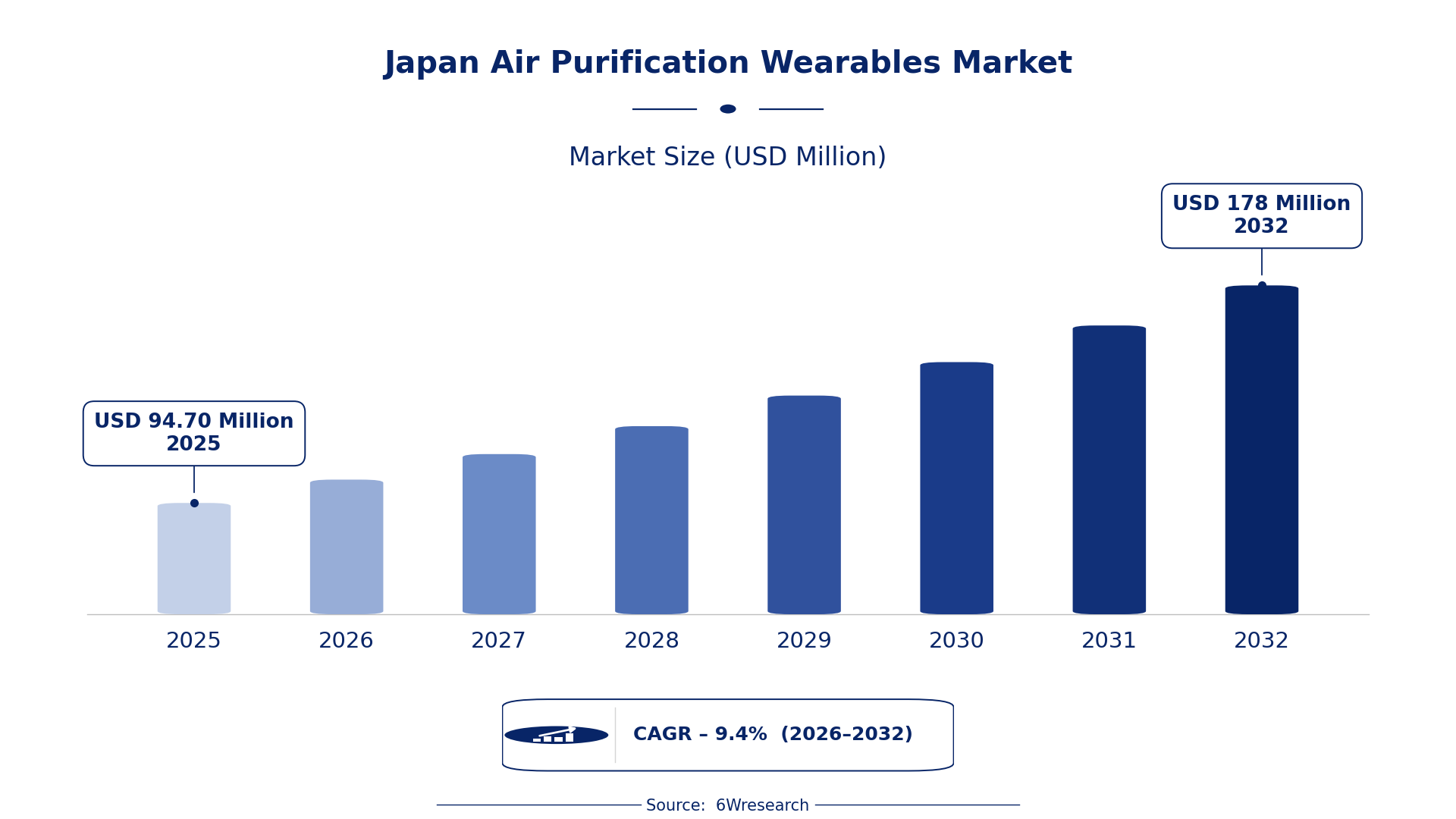
According to 6Wresearch internal database and industry insights, the Japan Air Purification Wearables Market was valued at USD 94.70 Million in 2025 and is projected to reach USD 178 Million by 2032, growing at a CAGR of approximately 9.4% during 2026–2032.
Japan Air Purification Wearables Market Highlights
| Report Metric | Details |
| Report Name | Japan Air Purification Wearables Market (2026-2032) |
| Market Size 2025 | USD 94.70 Million |
| Market Size 2032 | USD 178 Million |
| Absolute Growth 2025–2032 | USD 83.30 Million |
| CAGR 2026–2032 | 9.4% |
| Peak Annual Growth | 13.8% in 2026 |
| Forecast Period | 2026–2032 |
| Historical Data | 2022–2025 |
| Base Year | 2025 |
| Leading Wearable Type, 2025 | Neckband Purifiers (45% share) |
| Leading Purification Method, 2025 | Ion-Based Air Flow (39% share) |
| Leading Distribution Channel, 2025 | E-commerce Sites (34% share) |
| Leading End User, 2025 | Urban Commuters (49% share) |
| Fastest-Growing Wearable Type | Mask Devices (13.2% CAGR) |
| Fastest-Growing Purification Method | HEPA/Carbon Filters (12.8% CAGR) |
| Fastest-Growing Distribution Channel | Health Product Retailers (12.6% CAGR) |
| Fastest-Growing End User | Outdoor Workers (11.8% CAGR) |
| Growing Sector | Outdoor Workers |
| Key End Users | Urban Commuters, Outdoor Workers, Allergy-Prone Individuals, Fitness & Travel Users |
Japan Air Purification Wearables Market Year-wise Growth Rate and Key Drivers (2022–2032)
This graph illustrates the annual growth rates of the market from 2022 to 2032, highlighting a steady upward trajectory and projected market expansion over the forecast period.
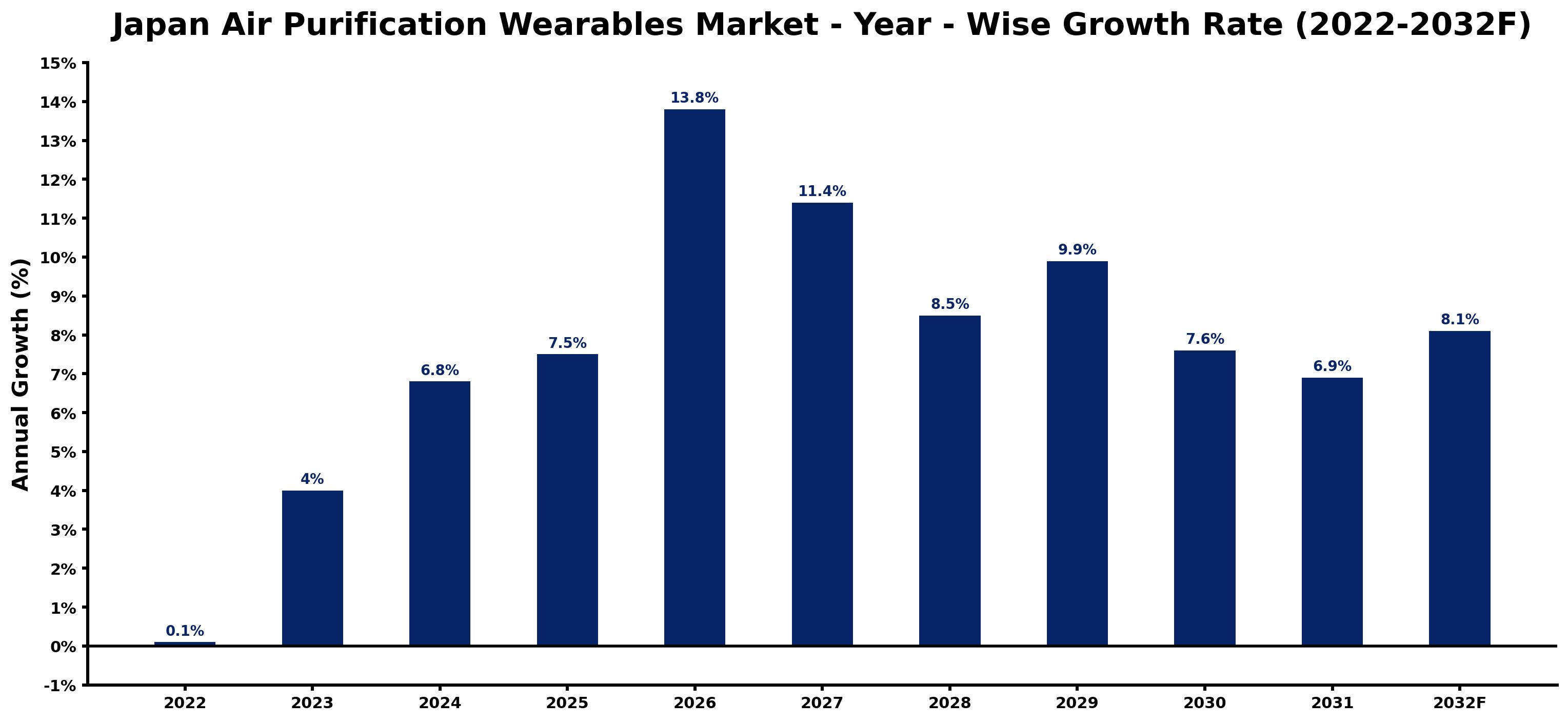
Below, each year's estimated growth is shown next to the factor that most influenced it.
| Year | Estimated Annual Growth (%) | Market Rationale |
| 2022 | 0.1 | The market experienced minimal growth as awareness of air purification wearables began to rise. |
| 2023 | 4.0 | Growth accelerated due to increased urban pollution levels, prompting more consumers to seek personal filtration solutions. |
| 2024 | 6.8 | Demand continued to rise as health-conscious individuals increasingly prioritised air quality in their daily lives. |
| 2025 | 7.5 | The market reached its historical peak as urban commuters adopted wearables for improved air quality. |
| 2026 | 13.8 | Growth peaked as the introduction of new technologies and designs attracted a wider customer base. |
| 2027 | 11.4 | Growth slowed slightly as the market began to stabilise after rapid expansion in previous years. |
| 2028 | 8.5 | The market continued to grow, though at a slower pace, as consumer preferences matured. |
| 2029 | 9.9 | Demand increased again as more outdoor workers sought effective air purification solutions. |
| 2030 | 7.6 | Growth slowed again as market saturation began to affect new customer acquisition. |
| 2031 | 6.9 | The market maintained growth, albeit at a reduced rate, as ongoing health concerns persisted. |
| 2032 | 8.1 | Growth rebounded as new innovations and health campaigns revitalised consumer interest. |
Note: Market size estimations and growth projections presented in this report are based on 6Wresearch's proprietary forecasting methodology, utilizing the latest available industry data, government publications, and primary research inputs.
Japan Air Purification Wearables Market Synopsis
Air purification wearables are personal devices designed to filter and clean the air around users, utilising advanced filtration technologies such as HEPA filters and ionization methods. The Japan Air Purification Wearables Market is propelled by a growing urban population exceeding 90 million and escalating pollution levels in cities like Tokyo. Health-conscious individuals and urban commuters are increasingly seeking these devices, especially following government campaigns that promote air quality awareness, which further stimulates market growth.
Market Dynamics Impact Analysis (2026–2032)
| Factor | Type | Impact | Primary Segment Affected |
| Increasing urban pollution levels in metropolitan areas drive demand for air purification wearables. | Driver | High | Neckband Purifiers |
| Health-conscious consumers are investing in personal air quality solutions to mitigate health risks. | Driver | High | Mask Devices |
| The growing urban commuter population creates a significant market for portable air filtration solutions. | Opportunity | High | Clip-on Purifiers |
| The rise of outdoor workers seeking protection from pollutants presents a new market segment. | Opportunity | Medium | Outdoor Workers |
| High production costs for advanced filtration technologies may limit market growth. | Restraint | High | AI-Controlled Devices |
| Strict regulatory compliance requirements can hinder market entry for new manufacturers. | Restraint | Medium | Ion-Based Air Flow |
| Limited consumer awareness about the benefits of air purification wearables can restrict market growth. | Challenge | High | HEPA/Carbon Filters |
| Competition from alternative air purification solutions may impact market share for wearables. | Challenge | Medium | Fan with UV-C |
Evaluation of Drivers in Japan Air Purification Wearables Market (2026–2032)
Key forces behind demand, with the segment each one moves most, are listed below.
| Drivers | Primary Segment Affected | Why It Matters (Evidence) |
| Rising pollution levels in urban areas increase the need for personal air filtration solutions. | Neckband Purifiers | In Tokyo, high pollution levels drive urban commuters to seek effective air purification wearables. |
| Health-conscious consumers are prioritising air quality to reduce health risks. | Mask Devices | Approximately 30% of Japan's population is allergy-prone, boosting demand for effective air filtration. |
| The urban commuter demographic is increasingly adopting wearables for cleaner air during travel. | Clip-on Purifiers | Japan's urban population exceeds 90 million, creating a substantial market for portable air solutions. |
| Outdoor workers are seeking effective air purification solutions due to exposure to pollutants. | Outdoor Workers | Approximately 4 million outdoor workers in Japan benefit from personal air filtration wearables. |
| Technological advancements in filtration methods improve product effectiveness and consumer appeal. | AI-Controlled Devices | Integration of smart technology in wearables is becoming a key selling point for health-focused consumers. |
A wider customer base explains much of the growth, as rising pollution levels in urban areas increase the need for personal air filtration solutions. In Tokyo, high pollution levels drive urban commuters to seek effective air purification wearables, with the urban population exceeding 90 million. Health-conscious consumers prioritise air quality to reduce health risks, particularly among the allergy-prone population, estimated at 30%. Outdoor workers, numbering approximately 4 million, are increasingly adopting these devices due to their exposure to pollutants. Technological advancements in filtration methods improve product effectiveness, appealing to a broader demographic.
Evaluation of Restraints in Japan Air Purification Wearables Market
These are the pressures that could keep growth below its potential.
| Market Restraint | Primary Segment Affected | Why It Matters (Evidence) |
| High production costs for advanced filtration technologies may limit market growth. | AI-Controlled Devices | Manufacturers face challenges in maintaining affordability while integrating advanced features. |
| Strict regulatory compliance requirements can hinder market entry for new manufacturers. | Ion-Based Air Flow | Compliance with safety standards can delay product launches and increase operational costs. |
| Limited consumer awareness about the benefits of air purification wearables can restrict market growth. | HEPA/Carbon Filters | Many potential buyers are unaware of the advantages of using personal air filtration devices. |
| Competition from alternative air purification solutions may impact market share for wearables. | Fan with UV-C | Consumers may opt for stationary air purifiers over portable wearables due to perceived effectiveness. |
| Market saturation in urban areas can slow down new customer acquisition efforts. | Clip-on Purifiers | As more consumers adopt wearables, attracting new buyers becomes increasingly challenging. |
Japan Air Purification Wearables Market Challenges
High pollution levels in urban areas create an urgent need for air purification wearables, prompting buyers to seek effective solutions swiftly. Stricter air quality regulations from the Tokyo Metropolitan Government raise compliance costs for producers, delaying product launches by up to six months. Manufacturers encounter difficulties in integrating advanced filtration technologies, which can elevate production costs by 15%, impacting pricing strategies for buyers. Shortages of skilled workers in the wearable technology sector impede innovation, resulting in slower development cycles that frustrate consumers eager for new features.
Trends in the Japan Air Purification Wearables Market
Below are the shifts with the largest effect on the Japan Air Purification Wearables Market.
- Tokyo Health Expo Promoting Wearable Innovations: The annual Tokyo Health Expo highlights innovations in health technologies, including air purification wearables. In 2023, the event attracted thousands of visitors, underscoring the growing interest in personal health solutions.
- Shift Towards Smart Air Purification Wearables: A noticeable shift towards the integration of smart technology in air purification wearables is occurring. In 2023, over 70% of new models featured air quality monitoring capabilities, appealing to tech-savvy consumers.
- Increase in Health Awareness Campaigns: Health awareness campaigns launched by the Tokyo Metropolitan Government in 2023 have raised public consciousness about air quality. This initiative has led to a 30% increase in consumer inquiries regarding air purification wearables.
- Rise of E-commerce for Wearable Devices: E-commerce sites have emerged as the primary distribution channel for air purification wearables. In 2025, approximately 34% of sales were made through online platforms, reflecting changing consumer shopping habits.
Investment Opportunities in the Japan Air Purification Wearables Market
The opportunities below stand out in the Japan Air Purification Wearables Market for new entrants and existing suppliers.
- Air Purification Wearables: With rising pollution levels, there is an opportunity to supply advanced air purification wearables. In 2023, the urban population's health concerns led to a 30% increase in inquiries about these devices, indicating strong demand.
- Health Product Retailers: Now is an opportune time to invest in health product retailers as distribution channels for air purification wearables. The growing awareness of air quality issues among consumers supports this trend, particularly in urban areas.
- Outdoor Workers: Outdoor workers represent a key buyer group needing effective air purification solutions. With approximately 4 million outdoor workers in Japan, suppliers can enter this market by partnering with local distributors.
- E-commerce Platforms: Investing in e-commerce platforms for air purification wearables is timely, as online sales are on the rise. The shift towards digital shopping is clear, with 34% of sales made through e-commerce sites in 2025.
Government Initiatives in the Japan Air Purification Wearables Market
The Electrical Appliance and Material Safety Act (1961) regulates the safety of electrical appliances, ensuring that air purification wearables meet rigorous safety standards. This law complements the Clinical Trials Act (2017), which establishes rules for testing health-related devices, further assuring consumer confidence in the market.
The Pharmaceuticals and Medical Devices Agency (PMDA) oversees the approval of health-related wearable devices, ensuring compliance with safety regulations. This agency also funds initiatives aimed at promoting air quality awareness, supporting manufacturers in their efforts to meet regulatory standards.
Future Insight of the Japan Air Purification Wearables Market
The Tokyo Health Expo will showcase advancements in wearable health technologies, driving further interest in air purification wearables. By 2032, government initiatives for clean air technology will likely result in increased funding for research and development, benefiting suppliers. Integration of air quality monitoring features will become standard, improving user experience and attracting more buyers. With 70% of consumers willing to invest in personal air quality solutions, the market is set for significant expansion.
Market Segmentation Analysis
Japan Air Purification Wearables Market report covers a detailed analysis of the following market segments:
By Wearable Type – Neckband Purifiers Lead, Mask Devices Expected to Grow Fastest
According to Saurav Kr Singh, Senior Research Analyst at 6Wresearch, Neckband Purifiers accounted for 45% of the market by wearable type in 2025. Neckband purifiers dominate the market due to their practicality for urban commuters who require personal air filtration while travelling. The high urban population in Japan, exceeding 90 million, ensures a consistent demand for this wearable type. The quickest growth will come from Mask Devices, forecast to expand at a CAGR of 13.2% between 2026 and 2032. Mask devices are experiencing rapid growth as they integrate with masks, appealing to health-conscious individuals prioritising air quality. The government's campaign promoting air quality awareness has significantly stimulated interest in these devices. Suppliers should focus on developing mask devices to align with the increasing demand for integrated air purification solutions.
By Purification Method – Ion-Based Air Flow Leads, HEPA/Carbon Filters Expected to Grow Fastest
With 39% of purification method revenue in 2025, Ion-Based Air Flow was the largest category. Ion-based air flow technology leads the market as it effectively reduces airborne particles, making it a preferred choice for consumers. This method aligns well with the needs of Japan's allergy-prone population, estimated at 30%, who seek effective solutions. HEPA/Carbon Filters are set to record the highest CAGR in this split, 12.8% over 2026–2032. HEPA/carbon filters are growing swiftly in popularity due to their high-efficiency filtration capabilities, essential for urban environments with high pollution levels. Their integration into various wearable devices is attracting health-conscious buyers. Manufacturers should prioritise the development of HEPA/carbon filter technologies to meet the rising demand for efficient air purification methods.
By Distribution Channel – E-commerce Sites Lead, Health Product Retailers Expected to Grow Fastest
In 2025, E-commerce Sites led the distribution channel split with a 34% share. E-commerce sites are the leading distribution channel for air purification wearables, providing consumers with easy access to a diverse range of products. This channel resonates with Japan's tech-savvy urban population, who prefer the convenience of online shopping. Health Product Retailers are projected to grow fastest, at a CAGR of 12.6% during 2026–2032. Health product retailers are witnessing the fastest growth as they provide physical access to air purification wearables, catering to consumers who favour in-person shopping. The rising focus on health and wellness products is propelling this trend. Retailers should enhance their presence in health product outlets to capitalise on the growing interest in personal air purification devices.
By End User – Urban Commuters Lead, Outdoor Workers Expected to Grow Fastest
The largest end user category in 2025 was Urban Commuters, at 49% of revenue. Urban commuters constitute the largest user group of air purification wearables, primarily due to their daily exposure to pollution in metropolitan settings. This demographic, predominantly aged 35-50, places a high priority on air quality during their commutes, creating a substantial market. Over 2026–2032, Outdoor Workers are expected to post the fastest growth, at a CAGR of 11.8%. Outdoor workers are the fastest-growing segment as they face considerable exposure to pollutants, making air purification wearables essential for their health. With around 4 million outdoor workers in Japan, there is significant potential for market expansion. Suppliers should customise their marketing strategies to address the specific needs of outdoor workers, thereby increasing their appeal in this growing segment.
Key Attractiveness of the Report
- 10 Years of Market Numbers
- Historical Data Starting from 2022 to 2025
- Base Year 2025
- Forecast Data until 2032
- Key Performance Indicators Impacting the Market
- Major Upcoming Developments and Projects
Key Highlights of the Report:
- Japan Air Purification Wearables Market Outlook
- Market Size of Japan Air Purification Wearables Market, 2025
- Forecast of Japan Air Purification Wearables Market, 2032
- Historical Data and Forecast of Japan Air Purification Wearables Revenues & Volume for the Period 2022-2032F
- Japan Air Purification Wearables Market Trend Evolution
- Japan Air Purification Wearables Market Drivers and Challenges
- Japan Air Purification Wearables Price Trends
- Japan Air Purification Wearables Porter's Five Forces
- Japan Air Purification Wearables Industry Life Cycle
- Historical Data and Forecast of Japan Air Purification Wearables Market Revenues & Volume By Wearable Type for the Period 2022-2032F
- Historical Data and Forecast of Japan Air Purification Wearables Market Revenues & Volume By Neckband Purifiers for the Period 2022-2032F
- Historical Data and Forecast of Japan Air Purification Wearables Market Revenues & Volume By Mask Devices for the Period 2022-2032F
- Historical Data and Forecast of Japan Air Purification Wearables Market Revenues & Volume By Clip-on Purifiers for the Period 2022-2032F
- Historical Data and Forecast of Japan Air Purification Wearables Market Revenues & Volume By AI-Controlled Devices for the Period 2022-2032F
- Historical Data and Forecast of Japan Air Purification Wearables Market Revenues & Volume By Purification Method for the Period 2022-2032F
- Historical Data and Forecast of Japan Air Purification Wearables Market Revenues & Volume By Ion-Based Air Flow for the Period 2022-2032F
- Historical Data and Forecast of Japan Air Purification Wearables Market Revenues & Volume By HEPA/Carbon Filters for the Period 2022-2032F
- Historical Data and Forecast of Japan Air Purification Wearables Market Revenues & Volume By Fan with UV-C for the Period 2022-2032F
- Historical Data and Forecast of Japan Air Purification Wearables Market Revenues & Volume By Air Quality Monitoring for the Period 2022-2032F
- Historical Data and Forecast of Japan Air Purification Wearables Market Revenues & Volume By Distribution Channel for the Period 2022-2032F
- Historical Data and Forecast of Japan Air Purification Wearables Market Revenues & Volume By E-commerce Sites for the Period 2022-2032F
- Historical Data and Forecast of Japan Air Purification Wearables Market Revenues & Volume By Health Product Retailers for the Period 2022-2032F
- Historical Data and Forecast of Japan Air Purification Wearables Market Revenues & Volume By Wellness Tech Startups for the Period 2022-2032F
- Historical Data and Forecast of Japan Air Purification Wearables Market Revenues & Volume By Smart Wearable Distributors for the Period 2022-2032F
- Historical Data and Forecast of Japan Air Purification Wearables Market Revenues & Volume By End User for the Period 2022-2032F
- Historical Data and Forecast of Japan Air Purification Wearables Market Revenues & Volume By Urban Commuters for the Period 2022-2032F
- Historical Data and Forecast of Japan Air Purification Wearables Market Revenues & Volume By Outdoor Workers for the Period 2022-2032F
- Historical Data and Forecast of Japan Air Purification Wearables Market Revenues & Volume By Allergy-Prone Individuals for the Period 2022-2032F
- Historical Data and Forecast of Japan Air Purification Wearables Market Revenues & Volume By Fitness & Travel Users for the Period 2022-2032F
- Japan Air Purification Wearables Import Export Trade Statistics
- Market Opportunity Assessment By Wearable Type
- Market Opportunity Assessment By Purification Method
- Market Opportunity Assessment By Distribution Channel
- Market Opportunity Assessment By End User
- Japan Air Purification Wearables Top Companies Market Share
- Japan Air Purification Wearables Competitive Benchmarking By Technical and Operational Parameters
- Japan Air Purification Wearables Company Profiles
- Japan Air Purification Wearables Key Strategic Recommendations
Market Covered
This report examines the market across the segments below.
By Wearable Type
- Neckband Purifiers
- Mask Devices
- Clip-on Purifiers
- AI-Controlled Devices
By Purification Method
- Ion-Based Air Flow
- HEPA/Carbon Filters
- Fan with UV-C
- Air Quality Monitoring
By Distribution Channel
- E-commerce Sites
- Health Product Retailers
- Wellness Tech Startups
- Smart Wearable Distributors
By End User
- Urban Commuters
- Outdoor Workers
- Allergy-Prone Individuals
- Fitness & Travel Users































