Japan Air Seeder Systems Market Size & Growth Rate
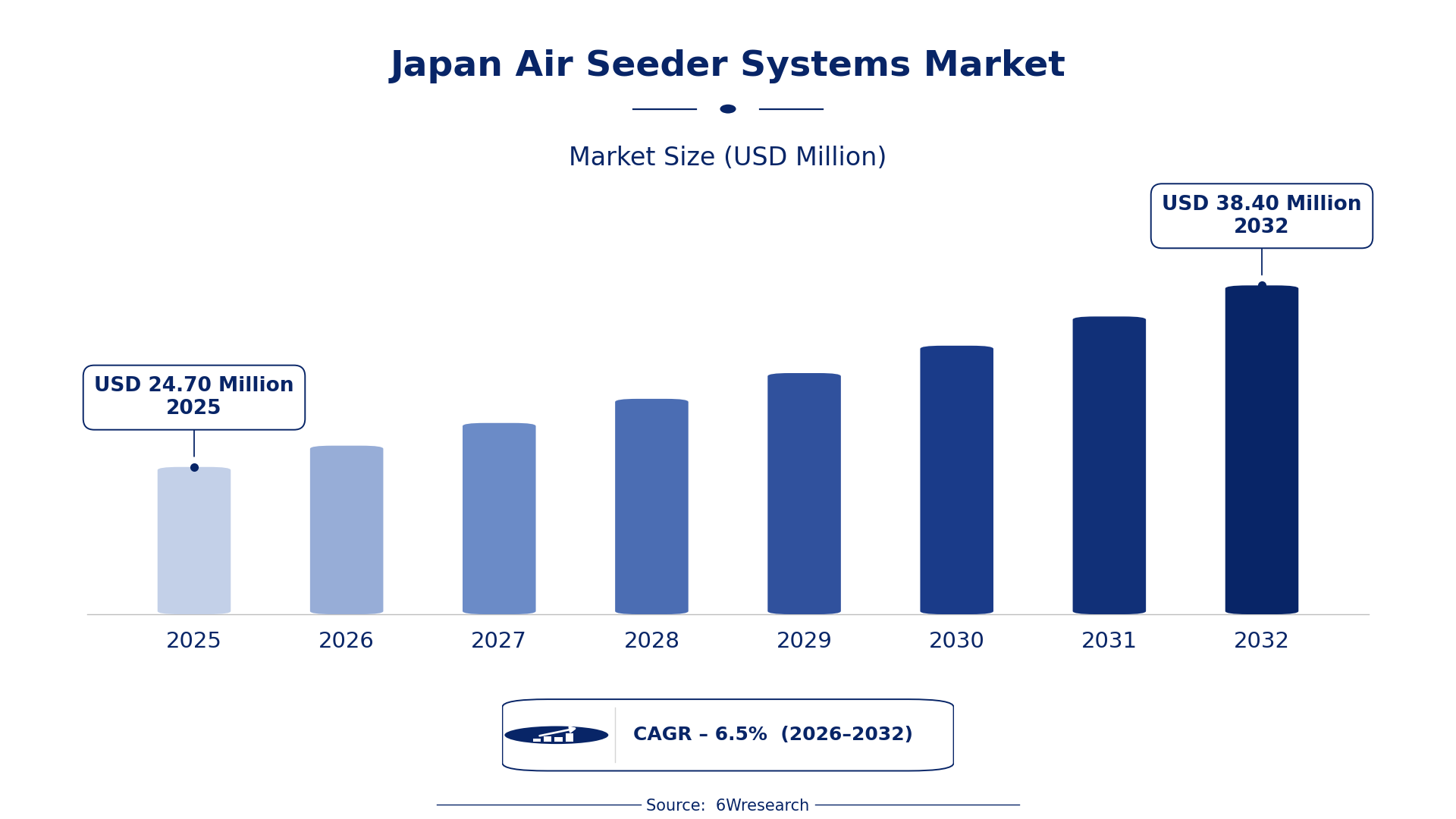
According to 6Wresearch internal database and industry insights, the Japan Air Seeder Systems Market was valued at USD 24.70 Million in 2025 and is projected to reach USD 38.40 Million by 2032, growing at a CAGR of approximately 6.5% during 2026–2032.
Japan Air Seeder Systems Market Highlights
| Report Metric | Details |
| Report Name | Japan Air Seeder Systems Market (2026-2032) |
| Market Size 2025 | USD 24.70 Million |
| Market Size 2032 | USD 38.40 Million |
| Absolute Growth 2025–2032 | USD 13.70 Million |
| CAGR 2026–2032 | 6.5% |
| Peak Annual Growth | 7.3% in 2028 |
| Forecast Period | 2026–2032 |
| Historical Data | 2022–2025 |
| Base Year | 2025 |
| Leading Product Type, 2025 | Central Air Seeders (44% share) |
| Leading Mechanism Type, 2025 | Pneumatic Delivery (41% share) |
| Leading Distribution Channel, 2025 | Agricultural Equipment Dealers (49% share) |
| Leading End User, 2025 | Large-Scale Farms (49% share) |
| Fastest-Growing Product Type | Precision Air Seeders (9.5% CAGR) |
| Fastest-Growing Mechanism Type | Variable Rate Control (9.0% CAGR) |
| Fastest-Growing Distribution Channel | Online Platforms (8.6% CAGR) |
| Fastest-Growing End User | Modern Farming Enterprises (8.3% CAGR) |
| Growing Sector | Modern Farming Enterprises |
| Key End Users | Large-Scale Farms, Commercial Agriculture Farms, Modern Farming Enterprises, Cereal Crop Producers |
Japan Air Seeder Systems Market Year-wise Growth Rate and Key Drivers (2022–2032)
This graph illustrates the annual growth rates of the market from 2022 to 2032, highlighting a steady upward trajectory and projected market expansion over the forecast period.
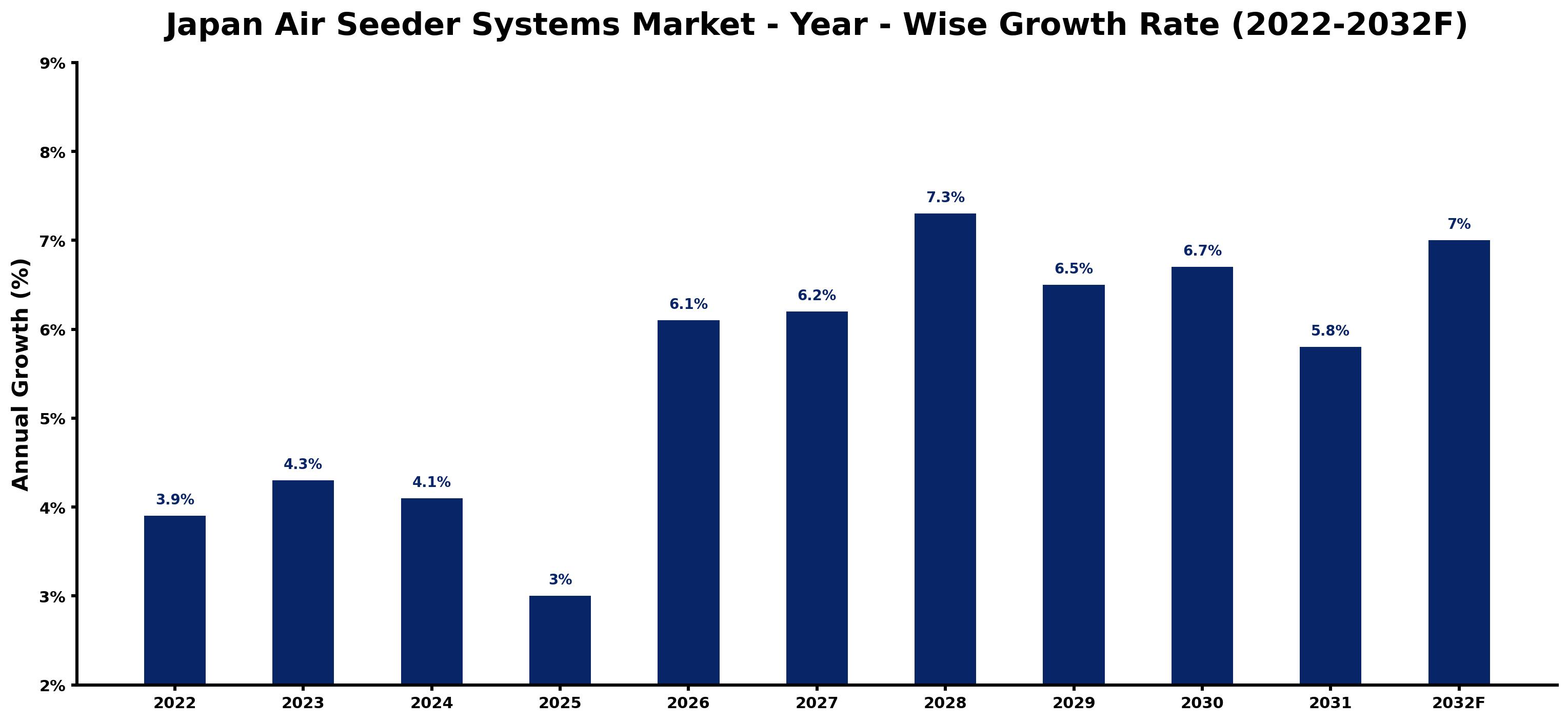
The yearly estimates that follow link every growth rate to its principal driver, so readers can see why the pace changed in each period.
| Year | Estimated Annual Growth (%) | Market Rationale |
| 2022 | 3.9 | The agricultural sector showed stable demand for air seeder systems during this year. |
| 2023 | 4.3 | Increased adoption of precision air seeders for rice cultivation drove market growth. |
| 2024 | 4.1 | A slight slowdown occurred as large-scale farms adjusted to new technologies. |
| 2025 | 3.0 | Market growth continued to decelerate as farmers faced challenges in modernization. |
| 2026 | 6.1 | Demand is expected to surge as investments in advanced seeding technologies increase efficiency. |
| 2027 | 6.2 | Growth is projected to accelerate further with rising interest in modern farming practices. |
| 2028 | 7.3 | The peak growth year will be driven by heightened investments in agricultural technology. |
| 2029 | 6.5 | Growth is expected to slow as the market begins to stabilise after rapid advancements. |
| 2030 | 6.7 | Demand will increase again as more farms adopt modern farming practices. |
| 2031 | 5.8 | A slowdown is projected as the market adjusts to the previous years' growth. |
| 2032 | 7.0 | Growth is expected to revive due to renewed interest in sustainable farming practices. |
Note: Market size estimations and growth projections presented in this report are based on 6Wresearch's proprietary forecasting methodology, utilizing the latest available industry data, government publications, and primary research inputs.
Japan Air Seeder Systems Market Synopsis
Air Seeder Systems are critical agricultural machinery designed for efficient seed planting using pneumatic or mechanical methods. The Japan Air Seeder Systems Market is expanding due to rising demand from large-scale and commercial farms aiming to improve planting efficiency and reduce labour costs. Market growth is driven by increased technology adoption, supported by government initiatives promoting agricultural modernisation, including a target for a 30% increase in technology use by 2025. The Kanto region is a major area for cereal crop production, further driving demand.
Market Dynamics Impact Analysis (2026–2032)
| Factor | Type | Impact | Primary Segment Affected |
| Growing adoption of precision air seeders for rice cultivation | Driver | High | Precision Air Seeders |
| Increased online sales of agricultural equipment | Driver | Medium | Online Platforms |
| Rising demand for sustainable farming practices | Opportunity | High | Commercial Agriculture Farms |
| Expansion of the agricultural technology market | Opportunity | Medium | Large-Scale Farms |
| Aging farmer population leading to labour shortages | Restraint | High | Large-Scale Farms |
| High initial investment costs for advanced systems | Restraint | Medium | Precision Air Seeders |
| Limited access to financing for small farms | Challenge | High | Commercial Agriculture Farms |
| Technological integration challenges in traditional farming | Challenge | Medium | Modern Farming Enterprises |
Evaluation of Drivers in Japan Air Seeder Systems Market (2026–2032)
Below are the drivers that matter most for revenue growth, with supporting evidence.
| Drivers | Primary Segment Affected | Why It Matters (Evidence) |
| Increased adoption of precision air seeders | Precision Air Seeders | Farmers in the Tohoku region are adopting precision air seeders, with a 20% increase in usage for rice cultivation to improve efficiency. |
| Rising online sales of agricultural equipment | Online Platforms | The shift towards digital purchasing has led to a 20% increase in online sales, facilitating easier access to air seeder systems for farmers. |
| Growing interest in variable rate control systems | Variable Rate Control | Farmers are adopting these systems to optimise seed placement based on field conditions, with a 25% increase in usage reported in 2023. |
| Government support for agricultural modernization | Commercial Agriculture Farms | Subsidies and programs from the Japanese government encourage investment in advanced agricultural technologies, with funding exceeding USD 10 million in 2023. |
| Expansion of large-scale farms | Large-Scale Farms | The average size of large-scale farms in Japan is approximately 30 hectares, necessitating efficient planting solutions to manage larger areas. |
Behind the steady rise in orders sits the increasing adoption of precision air seeders, particularly in the Kanto region, where rice cultivation demands efficiency. In 2022, online sales of agricultural equipment surged by 20%, enabling farmers to access air seeders more easily. Variable rate control systems are becoming popular as they allow farmers to adjust seeding rates based on specific field conditions, with 25% more farmers using them in 2023. Support for agricultural modernization is driving demand among commercial agriculture farms, while the expansion of large-scale farms, averaging about 30 hectares, necessitates efficient planting solutions.
Evaluation of Restraints in Japan Air Seeder Systems Market
These are the pressures that could keep growth below its potential.
| Market Restraint | Primary Segment Affected | Why It Matters (Evidence) |
| Aging farmer population leading to labour shortages | Large-Scale Farms | With an average farmer age over 67 years, there are fewer workers available, impacting productivity. |
| High initial investment costs for advanced systems | Precision Air Seeders | The cost of advanced air seeders can be prohibitive, with prices reaching up to USD 20,000, discouraging some farmers from upgrading. |
| Limited access to financing for small farms | Commercial Agriculture Farms | Many small farms struggle to secure funding for new technologies, with only 30% able to access loans for equipment purchases. |
| Technological integration challenges in traditional farming | Modern Farming Enterprises | Farmers accustomed to traditional methods may resist adopting new technologies, slowing market growth and delaying efficiency improvements. |
| Regulatory compliance costs for agricultural equipment | Agricultural Equipment Dealers | Compliance with standards like ISO 9001 increases costs for manufacturers, impacting pricing and making it harder for them to compete. |
Japan Air Seeder Systems Market Challenges
High technology costs burden large-scale farms, as advanced air seeder systems require an investment of over 5 million yen, delaying adoption and reducing planting efficiency. Local producers face competition from imported machinery, forcing them to lower prices, which can cut profit margins by up to 15%. Limited supplier availability restricts buyers' access to modern equipment, causing procurement delays that can extend planting schedules by weeks. Rising operational costs, driven by an ageing farmer population with an average age over 67 years, can increase expenses for producers, limiting their ability to invest in efficient farming practices.
Trends in the Japan Air Seeder Systems Market
The trends below show where the Japan Air Seeder Systems Market is heading.
- Shift from Traditional to Precision Agriculture: Since 2022, large-scale farms have increasingly adopted precision air seeders, with usage rising by 20% in the Kanto region, improving planting efficiency.
- Emergence of Online Platforms for Equipment Sales: In 2023, online platforms became a preferred channel for purchasing agricultural equipment, with a 20% increase in sales, facilitating easier access for farmers across Japan.
- Growing Adoption of Variable Rate Control Systems: Beginning in 2026, variable rate control systems gained traction among modern farming enterprises, allowing for tailored seeding rates, optimising yields by 15%.
- Focus on Sustainable Farming Practices: In 2023, the Japanese government launched a program promoting sustainable farming practices, encouraging farmers to adopt eco-friendly technologies, aligning with modernisation goals.
Investment Opportunities in the Japan Air Seeder Systems Market
The openings below show where demand in the Japan Air Seeder Systems Market is visible and how suppliers can enter.
- Timing for Investment: With the Japanese agricultural sector aiming for a 30% increase in technology adoption by 2025, there is a significant opportunity to invest in advanced air seeder systems for large-scale farms.
- Large-Scale Farms Seeking Efficiency: Large-scale farms are increasingly looking for efficient planting solutions, creating demand for precision air seeders that enhance productivity and reduce labour costs.
- Entry through Local Partnerships: Investing in precision air seeders now can be facilitated through partnerships with Agricultural Equipment Dealers, ensuring effective distribution and market penetration.
- Supply of Advanced Air Seeder Systems: There is a growing need for advanced air seeder systems in Japan, particularly among commercial agriculture farms, driven by the push for modernisation.
Government Initiatives in the Japan Air Seeder Systems Market
The Electrical Appliance and Material Safety Act, established in 1961, regulates the safety standards for agricultural machinery in Japan, ensuring that air seeder systems meet essential safety requirements. Additionally, the Act on the Rational Use of Energy mandates energy efficiency improvements, impacting the design and operation of air seeder systems, which must comply with these regulations to be marketed effectively.
The Ministry of Agriculture, Forestry and Fisheries oversees the approval of agricultural equipment, including air seeder systems, ensuring compliance with Japanese Agricultural Standards (JAS). In 2023, the government allocated funds to support agricultural technology research and development, promoting innovation in air seeder systems and enhancing their adoption among farmers.
Future Insight of the Japan Air Seeder Systems Market
Large-scale farms will increasingly adopt advanced air seeder systems by 2032, as government subsidies promote agricultural modernisation. Precision farming technologies will improve planting accuracy, benefiting buyers by increasing crop yields by 30% by 2025. A rise in online sales platforms will streamline equipment access, making it easier for producers to acquire necessary machinery. The agricultural machinery fair in Tokyo will showcase innovations, encouraging collaboration between suppliers and buyers and transforming the market.
Market Segmentation Analysis
Japan Air Seeder Systems Market report covers a detailed analysis of the following market segments:
By Product Type – Central Air Seeders Lead, Precision Air Seeders Expected to Grow Fastest
According to Saurav Kr Singh, Senior Research Analyst at 6Wresearch, Central Air Seeders took 44% of product type revenue in 2025, more than any other category. Central air seeders dominate the market due to their ability to plant multiple seed types simultaneously, which is crucial for large-scale agricultural operations. Their widespread use in the Tohoku region for rice production illustrates their importance in enhancing planting efficiency. The quickest growth will come from Precision Air Seeders, forecast to expand at a CAGR of 9.5% between 2026 and 2032. Precision air seeders are rapidly gaining traction because they ensure accurate seed placement, leading to better yields. The growing adoption of these systems in rice cultivation demonstrates their increasing relevance among farmers aiming for improved productivity. Suppliers should focus on enhancing precision air seeders to meet the rising demand in the market.
By Mechanism Type – Pneumatic Delivery Leads, Variable Rate Control Expected to Grow Fastest
In 2025, Pneumatic Delivery led the mechanism type split with a 41% share. Pneumatic delivery systems lead the market as they efficiently utilise air pressure for seed distribution, which is essential for extensive farming practices. Their reliability and established usage among farmers across Japan contribute to their dominant position. Variable Rate Control is projected to grow fastest, at a CAGR of 9.0% during 2026–2032. Variable rate control systems are witnessing rapid growth since they allow for adjustable seeding rates based on varying field conditions, optimising resource use. This flexibility appeals to modern farming enterprises seeking to enhance operational efficiency. Buyers should invest in variable rate control systems to maximise their farming efficiency.
By Distribution Channel – Agricultural Equipment Dealers Lead, Online Platforms Expected to Grow Fastest
The largest distribution channel category in 2025 was Agricultural Equipment Dealers, at 49% of revenue. Agricultural equipment dealers are the leading sales channel for farmers, offering vital support and access to air seeder systems. Their established relationships and expertise make them a trusted source for large-scale farming operations. Over 2026–2032, Online Platforms are expected to post the fastest growth, at a CAGR of 8.6%. Online platforms are rapidly expanding as a distribution channel, evidenced by a 20% increase in online sales of agricultural equipment last year. This trend indicates a shift towards convenience and accessibility for contemporary farmers. Suppliers should strengthen their online strategies to capture the increasing segment of online buyers.
By End User – Large-Scale Farms Lead, Modern Farming Enterprises Expected to Grow Fastest
With 49% of end user revenue in 2025, Large-Scale Farms was the largest category. Large-scale farms represent the largest segment of air seeder system users, driven by their need for effective planting across extensive arable land. Their critical role in Japan's food production underscores their reliance on advanced agricultural technologies. Modern Farming Enterprises are set to record the highest CAGR in this split, 8.3% over 2026–2032. Modern farming enterprises are increasingly embracing technology to boost efficiency, as evidenced by their growing interest in air seeder systems. This trend indicates a shift towards more technologically advanced agricultural methods. Suppliers must tailor their products to meet the specific needs of modern farming enterprises.
Key Attractiveness of the Report
- 10 Years of Market Numbers
- Historical Data Starting from 2022 to 2025
- Base Year 2025
- Forecast Data until 2032
- Key Performance Indicators Impacting the Market
- Major Upcoming Developments and Projects
Key Highlights of the Report:
- Japan Air Seeder Systems Market Outlook
- Market Size of Japan Air Seeder Systems Market, 2025
- Forecast of Japan Air Seeder Systems Market, 2032
- Historical Data and Forecast of Japan Air Seeder Systems Revenues & Volume for the Period 2022-2032F
- Japan Air Seeder Systems Market Trend Evolution
- Japan Air Seeder Systems Market Drivers and Challenges
- Japan Air Seeder Systems Price Trends
- Japan Air Seeder Systems Porter's Five Forces
- Japan Air Seeder Systems Industry Life Cycle
- Historical Data and Forecast of Japan Air Seeder Systems Market Revenues & Volume By Product Type for the Period 2022-2032F
- Historical Data and Forecast of Japan Air Seeder Systems Market Revenues & Volume By Box Air Seeders for the Period 2022-2032F
- Historical Data and Forecast of Japan Air Seeder Systems Market Revenues & Volume By Central Air Seeders for the Period 2022-2032F
- Historical Data and Forecast of Japan Air Seeder Systems Market Revenues & Volume By Tow-Behind Models for the Period 2022-2032F
- Historical Data and Forecast of Japan Air Seeder Systems Market Revenues & Volume By Precision Air Seeders for the Period 2022-2032F
- Historical Data and Forecast of Japan Air Seeder Systems Market Revenues & Volume By Mechanism Type for the Period 2022-2032F
- Historical Data and Forecast of Japan Air Seeder Systems Market Revenues & Volume By Ground Drive for the Period 2022-2032F
- Historical Data and Forecast of Japan Air Seeder Systems Market Revenues & Volume By Pneumatic Delivery for the Period 2022-2032F
- Historical Data and Forecast of Japan Air Seeder Systems Market Revenues & Volume By Hydraulic Driven for the Period 2022-2032F
- Historical Data and Forecast of Japan Air Seeder Systems Market Revenues & Volume By Variable Rate Control for the Period 2022-2032F
- Historical Data and Forecast of Japan Air Seeder Systems Market Revenues & Volume By Distribution Channel for the Period 2022-2032F
- Historical Data and Forecast of Japan Air Seeder Systems Market Revenues & Volume By Agricultural Equipment Dealers for the Period 2022-2032F
- Historical Data and Forecast of Japan Air Seeder Systems Market Revenues & Volume By OEM Distributors for the Period 2022-2032F
- Historical Data and Forecast of Japan Air Seeder Systems Market Revenues & Volume By Tractor Showrooms for the Period 2022-2032F
- Historical Data and Forecast of Japan Air Seeder Systems Market Revenues & Volume By Online Platforms for the Period 2022-2032F
- Historical Data and Forecast of Japan Air Seeder Systems Market Revenues & Volume By End User for the Period 2022-2032F
- Historical Data and Forecast of Japan Air Seeder Systems Market Revenues & Volume By Large-Scale Farms for the Period 2022-2032F
- Historical Data and Forecast of Japan Air Seeder Systems Market Revenues & Volume By Commercial Agriculture Farms for the Period 2022-2032F
- Historical Data and Forecast of Japan Air Seeder Systems Market Revenues & Volume By Cereal Crop Producers for the Period 2022-2032F
- Historical Data and Forecast of Japan Air Seeder Systems Market Revenues & Volume By Modern Farming Enterprises for the Period 2022-2032F
- Japan Air Seeder Systems Import Export Trade Statistics
- Market Opportunity Assessment By Product Type
- Market Opportunity Assessment By Mechanism Type
- Market Opportunity Assessment By Distribution Channel
- Market Opportunity Assessment By End User
- Japan Air Seeder Systems Top Companies Market Share
- Japan Air Seeder Systems Competitive Benchmarking By Technical and Operational Parameters
- Japan Air Seeder Systems Company Profiles
- Japan Air Seeder Systems Key Strategic Recommendations
Market Covered
This report examines the market across the segments below.
By Product Type
- Box Air Seeders
- Central Air Seeders
- Tow-Behind Models
- Precision Air Seeders
By Mechanism Type
- Ground Drive
- Pneumatic Delivery
- Hydraulic Driven
- Variable Rate Control
By Distribution Channel
- Agricultural Equipment Dealers
- OEM Distributors
- Tractor Showrooms
- Online Platforms
By End User
- Large-Scale Farms
- Commercial Agriculture Farms
- Cereal Crop Producers
- Modern Farming Enterprises































