Japan Air Traffic Control Systems Market Size & Growth Rate
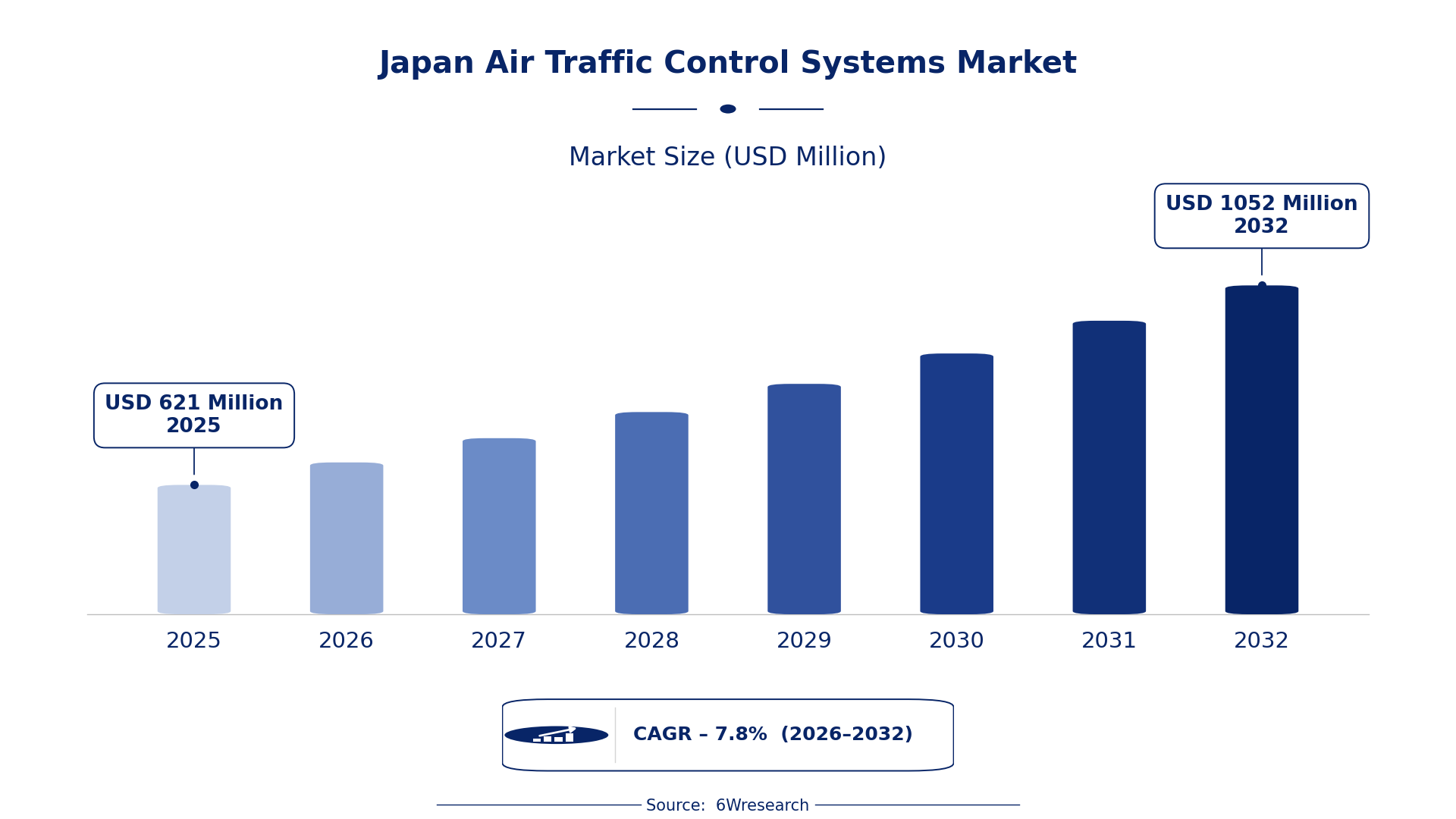
According to 6Wresearch internal database and industry insights, the Japan Air Traffic Control Systems Market was valued at USD 621 Million in 2025 and is projected to reach USD 1,052 Million by 2032, growing at a CAGR of approximately 7.8% during 2026–2032.
Japan Air Traffic Control Systems Market Highlights
| Report Metric | Details |
| Report Name | Japan Air Traffic Control Systems Market (2026-2032) |
| Market Size 2025 | USD 621 Million |
| Market Size 2032 | USD 1,052 Million |
| Absolute Growth 2025–2032 | USD 431 Million |
| CAGR 2026–2032 | 7.8% |
| Peak Annual Growth | 10.9% in 2032 |
| Forecast Period | 2026–2032 |
| Historical Data | 2022–2025 |
| Base Year | 2025 |
| Leading System Type, 2025 | Radar-Based Systems (46% share) |
| Leading Technology Type, 2025 | Primary & Secondary Radar (41% share) |
| Leading Distribution Channel, 2025 | Government Contracts (49% share) |
| Leading End User, 2025 | National Air Navigation Units (47% share) |
| Fastest-Growing System Type | Automation Systems (11.6% CAGR) |
| Fastest-Growing Technology Type | AI-Powered Tools (11.7% CAGR) |
| Fastest-Growing Distribution Channel | Software Vendors (10.4% CAGR) |
| Fastest-Growing End User | ATC Service Providers (10.2% CAGR) |
| Growing Sector | Air Traffic Management |
| Key End Users | National Air Navigation Units, Civil Aviation Authorities, ATC Service Providers, Airport Authorities |
Japan Air Traffic Control Systems Market Year-wise Growth Rate and Key Drivers (2022–2032)
This graph illustrates the annual growth rates of the market from 2022 to 2032, highlighting a steady upward trajectory and projected market expansion over the forecast period.
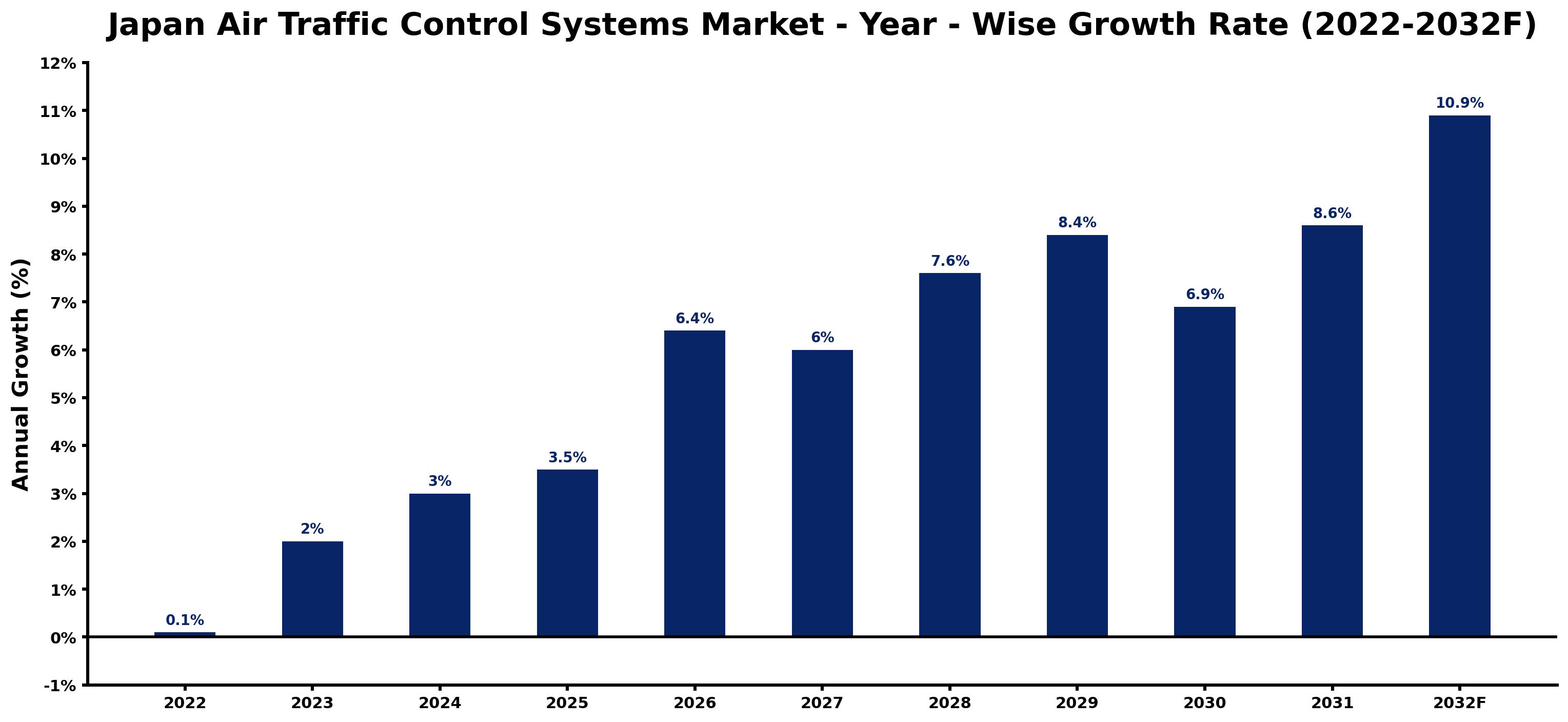
The following figures match every annual growth estimate with the main market development of that year, giving the reasoning behind each rise or slowdown.
| Year | Estimated Annual Growth (%) | Market Rationale |
| 2022 | 0.1 | The market experienced minimal growth due to ongoing adjustments in air traffic management. |
| 2023 | 2.0 | Growth accelerated as Japan's airports resumed operations following disruptions. |
| 2024 | 3.0 | Increased flight volumes contributed to higher demand for air traffic control systems. |
| 2025 | 3.5 | Investment in technology upgrades supported a stronger growth rate in this year. |
| 2026 | 6.4 | The implementation of new automation systems is expected to improve operational efficiency. |
| 2027 | 6.0 | Growth slowed slightly as market saturation began to affect demand. |
| 2028 | 7.6 | A rise in air travel demand prompted renewed interest in system upgrades. |
| 2029 | 8.4 | Technological advancements in real-time data integration further boosted market growth. |
| 2030 | 6.9 | Growth moderated as the market stabilised after several years of rapid expansion. |
| 2031 | 8.6 | Increased investments in AI-powered tools are projected to drive further growth. |
| 2032 | 10.9 | The peak growth rate reflects substantial modernization efforts in air traffic control. |
Note: Market size estimations and growth projections presented in this report are based on 6Wresearch's proprietary forecasting methodology, utilizing the latest available industry data, government publications, and primary research inputs.
Japan Air Traffic Control Systems Market Synopsis
Air traffic control systems are essential for managing air traffic, providing real-time information to pilots, and ensuring compliance with regulations. The ongoing modernization programme, with an investment of ¥15 billion for technology upgrades, supports this growth. Rising flight volumes, particularly in the Tokyo region, which handles approximately 1,200 flights daily, drive demand from national air navigation units and civil aviation authorities. The integration of AI in air traffic systems is improving operational efficiency, further stimulating market expansion.
Market Dynamics Impact Analysis (2026–2032)
| Factor | Type | Impact | Primary Segment Affected |
| Increasing flight volumes in the Tokyo region drive demand for air traffic control systems. | Driver | High | Radar-Based Systems |
| Investment in modernisation programmes enhances system capabilities and efficiency. | Driver | High | Voice Communication |
| The need for advanced air traffic management solutions presents opportunities for new entrants. | Opportunity | High | Automation Systems |
| Growing demand for real-time data integration systems opens avenues for innovation. | Opportunity | Medium | Real-Time Data Integration |
| High costs associated with system upgrades can limit procurement for smaller airports. | Restraint | High | National Air Navigation Units |
| Regulatory compliance requirements may delay system implementation timelines. | Restraint | Medium | Civil Aviation Authorities |
| Rising operational costs challenge the profitability of air traffic control providers. | Challenge | High | ATC Service Providers |
| Capacity constraints at busy airports can hinder service expansion and efficiency. | Challenge | Medium | Airport Authorities |
Evaluation of Drivers in Japan Air Traffic Control Systems Market (2026–2032)
The following drivers explain most of the expected growth.
| Drivers | Primary Segment Affected | Why It Matters (Evidence) |
| Rising flight volumes in the Tokyo region increase demand for radar-based systems. | Radar-Based Systems | The Tokyo region manages approximately 1,200 flights daily, necessitating advanced tracking capabilities. |
| Investment in modernisation programmes improves system capabilities and efficiency. | Voice Communication | Japan invested ¥15 billion in 2022 to upgrade air traffic control technology. |
| The integration of AI-powered tools enhances operational decision-making for air traffic controllers. | AI-Powered Tools | Government initiatives support the adoption of AI in air traffic control systems. |
| Real-time data integration systems improve the accuracy of flight tracking. | Real-Time Data Integration | Japan has implemented a real-time data integration system for effective flight management. |
| Government contracts provide a stable revenue source for air traffic control system providers. | Government Contracts | National air navigation units are primary users, ensuring consistent demand for systems. |
What keeps demand rising is the increasing number of flights handled by the Tokyo region, which manages approximately 1,200 flights daily. This surge necessitates advanced radar-based systems for accurate tracking. In 2022, Japan's investment of ¥15 billion in modernising air traffic control technology improved operational capabilities. The integration of AI-powered tools enhances decision-making processes for air traffic controllers. The implementation of real-time data integration systems has optimised flight tracking, further driving demand from national air navigation units and civil aviation authorities.
Evaluation of Restraints in Japan Air Traffic Control Systems Market
Below are the constraints most often cited by buyers and suppliers, with the segment each affects.
| Market Restraint | Primary Segment Affected | Why It Matters (Evidence) |
| High costs associated with system upgrades limit procurement for smaller airports. | National Air Navigation Units | Budget constraints can prevent smaller units from acquiring advanced systems. |
| Regulatory compliance requirements may delay system implementation timelines. | Civil Aviation Authorities | Stringent regulations necessitate thorough testing and certification processes. |
| Operational costs are rising, impacting the profitability of air traffic control providers. | ATC Service Providers | Increased expenses for technology and personnel can strain budgets. |
| Capacity constraints at busy airports hinder service expansion and efficiency. | Airport Authorities | Limited infrastructure can restrict the ability to accommodate more flights. |
| Market saturation may lead to reduced growth opportunities for new entrants. | Automation Systems | Established players dominate the market, making it challenging for newcomers. |
Japan Air Traffic Control Systems Market Challenges
Japan's air traffic control systems require substantial investment, with ¥15 billion allocated for upgrades in 2022, straining budgets for national air navigation units. High costs hinder producers from innovating, resulting in outdated systems that affect service quality for civil aviation authorities. Regulatory compliance adds complexity, as adherence to ICAO standards necessitates ongoing training and certification, delaying system updates for over 3,000 personnel. Competition from international standards forces local suppliers to elevate their offerings, which can lead to increased prices for buyers needing efficient air traffic management.
Trends in the Japan Air Traffic Control Systems Market
Four trends stand out in the Japan Air Traffic Control Systems Market.
- Shift from Traditional to Automated Systems: Since 2023, Japan has been transitioning towards automated air traffic control systems to improve efficiency. The Tokyo Area Control Center is adopting these technologies to manage increasing flight volumes, with an investment of ¥15 billion in upgrades.
- Emergence of AI in Air Traffic Control: The integration of AI-powered tools in air traffic control systems began in 2023, driven by government support. This trend is expected to improve predictive analytics capabilities, enhancing operational efficiency.
- Increased Focus on Real-Time Data Integration: Starting in 2022, Japan implemented a real-time data integration system for flight tracking. This system improves accuracy and decision-making, benefiting national air navigation units across the country.
- Growing Demand for Compliance with International Standards: Since 2022, adherence to ICAO standards has become a priority for Japan's air traffic control systems. This compliance ensures alignment with global aviation practices, improving safety and operational efficiency.
Investment Opportunities in the Japan Air Traffic Control Systems Market
The openings below show where demand in the Japan Air Traffic Control Systems Market is visible and how suppliers can enter.
- National Air Navigation Units require advanced tracking systems now: With increasing flight volumes, there is a pressing need for sophisticated radar systems. Collaborating with local technology firms can facilitate entry into this market, especially in urban areas like Tokyo.
- Government Contracts offer stable revenue streams: Investing in automation systems can meet the rising demand from national air navigation units. Partnering with local firms can ease market entry and ensure compliance with regulations.
- The demand for improved flight tracking solutions presents opportunities for technology providers.: Engaging with civil aviation authorities can streamline the approval process for new systems.
- AI-Powered Tools are gaining traction: The push for AI integration in air traffic control systems is strong, with government support. Suppliers should consider joint ventures with local firms to tap into this growing segment.
Government Initiatives in the Japan Air Traffic Control Systems Market
The Electrical Appliance and Material Safety Act (1961) regulates the safety of electrical appliances, ensuring that air traffic control systems meet safety standards. The Ministry of Land, Infrastructure, Transport and Tourism oversees compliance with these regulations, which are essential for maintaining operational integrity in Japan's air traffic management. In 2022, Japan invested ¥15 billion in upgrading air traffic control technology, which supports the implementation of these standards.
National air navigation units benefit from the Digital Agency's initiatives, which streamline digital transformation efforts. The agency funds projects aimed at improving system efficiency, ensuring that air traffic control providers can implement modern technologies effectively.
Future Insight of the Japan Air Traffic Control Systems Market
The upcoming modernization program for ATC infrastructure will introduce advanced radar systems and improve data processing technologies. By 2032, Japan's integration of AI in air traffic control will streamline operations, reducing average flight delays to under 4 minutes. New communication tools will improve coordination between multiple airports in the Tokyo Metropolitan Area. Comprehensive training programs for air traffic controllers will ensure a skilled workforce, allowing buyers to benefit from improved safety and efficiency in air traffic management.
Market Segmentation Analysis
Japan Air Traffic Control Systems Market report covers a detailed analysis of the following market segments:
By System Type – Radar-Based Systems Lead, Automation Systems Expected to Grow Fastest
According to Saurav Kr Singh, Senior Research Analyst at 6Wresearch, with 46% of system type revenue in 2025, Radar-Based Systems was the largest category. Radar-based systems are crucial for tracking aircraft positions, ensuring safety and efficiency in Japan's air traffic management. With over 90 airports employing these systems, they form the essential framework for the country's air traffic control operations. The quickest growth will come from Automation Systems, forecast to expand at a CAGR of 11.6% between 2026 and 2032. The swift adoption of automation systems is fuelled by the need for improved operational efficiency in air traffic management. For instance, the Tokyo Area Control Center is increasingly integrating automated solutions to streamline its processes. Suppliers should focus on developing automation technologies to meet the growing demand for enhanced efficiency in air traffic control.
By Technology Type – Primary & Secondary Radar Leads, AI-Powered Tools Expected to Grow Fastest
Primary & Secondary Radar held 41% of the Japan Air Traffic Control Systems Market by technology type in 2025. Primary and secondary radar technologies are fundamental for airspace surveillance, providing accurate tracking of aircraft in Japan's busy airspace. Their widespread application across the nation's airports solidifies their position as the leading technology in air traffic control systems. Over 2026–2032, AI-Powered Tools are expected to post the fastest growth, at a CAGR of 11.7%. AI-powered tools are emerging as they offer advanced capabilities for enhancing decision-making in air traffic management. The government's push to incorporate AI into ATC systems is accelerating their adoption within the industry. Buyers will benefit from investing in AI technologies to boost predictive capabilities and overall air traffic management.
By Distribution Channel – Government Contracts Lead, Software Vendors Expected to Grow Fastest
Government Contracts accounted for 49% of the market by distribution channel in 2025. Government contracts serve as the main funding source for air traffic control system procurement, making them vital for the sector's development in Japan. This reliance on government funding is underscored by the ¥15 billion investment made in 2022 for upgrading ATC technology. Software Vendors are set to record the highest CAGR in this split, 10.4% over 2026–2032. The rise of software vendors is associated with the growing demand for specialised applications that enhance air traffic management operations. As technology progresses, these vendors are becoming essential partners for ATC service providers looking to modernise their systems. Suppliers must establish strong collaborations with software vendors to leverage new technologies that can improve air traffic control efficiency.
By End User – National Air Navigation Units Lead, ATC Service Providers Expected to Grow Fastest
National Air Navigation Units took 47% of end user revenue in 2025, more than any other category. National air navigation units are the primary users of air traffic control systems, responsible for managing airspace in Japan. Their vital role in ensuring safety and efficiency in air traffic establishes them as the leading end user in this market. ATC Service Providers are projected to grow fastest, at a CAGR of 10.2% during 2026–2032. ATC service providers are experiencing rapid growth as they manage the operational aspects of air traffic, particularly in high-density areas like the Tokyo Metropolitan Area. Their direct involvement in air traffic operations allows them to swiftly respond to changing demands. Suppliers should tailor their offerings to meet the specific needs of ATC service providers to capture this expanding market segment.
Key Attractiveness of the Report
- 10 Years of Market Numbers
- Historical Data Starting from 2022 to 2025
- Base Year 2025
- Forecast Data until 2032
- Key Performance Indicators Impacting the Market
- Major Upcoming Developments and Projects
Key Highlights of the Report:
- Japan Air Traffic Control Systems Market Outlook
- Market Size of Japan Air Traffic Control Systems Market, 2025
- Forecast of Japan Air Traffic Control Systems Market, 2032
- Historical Data and Forecast of Japan Air Traffic Control Systems Revenues & Volume for the Period 2022-2032F
- Japan Air Traffic Control Systems Market Trend Evolution
- Japan Air Traffic Control Systems Market Drivers and Challenges
- Japan Air Traffic Control Systems Price Trends
- Japan Air Traffic Control Systems Porter's Five Forces
- Japan Air Traffic Control Systems Industry Life Cycle
- Historical Data and Forecast of Japan Air Traffic Control Systems Market Revenues & Volume By System Type for the Period 2022-2032F
- Historical Data and Forecast of Japan Air Traffic Control Systems Market Revenues & Volume By Radar-Based Systems for the Period 2022-2032F
- Historical Data and Forecast of Japan Air Traffic Control Systems Market Revenues & Volume By Voice Communication for the Period 2022-2032F
- Historical Data and Forecast of Japan Air Traffic Control Systems Market Revenues & Volume By Flight Planning Tools for the Period 2022-2032F
- Historical Data and Forecast of Japan Air Traffic Control Systems Market Revenues & Volume By Automation Systems for the Period 2022-2032F
- Historical Data and Forecast of Japan Air Traffic Control Systems Market Revenues & Volume By Technology Type for the Period 2022-2032F
- Historical Data and Forecast of Japan Air Traffic Control Systems Market Revenues & Volume By Primary & Secondary Radar for the Period 2022-2032F
- Historical Data and Forecast of Japan Air Traffic Control Systems Market Revenues & Volume By IP-Based Communication for the Period 2022-2032F
- Historical Data and Forecast of Japan Air Traffic Control Systems Market Revenues & Volume By AI-Powered Tools for the Period 2022-2032F
- Historical Data and Forecast of Japan Air Traffic Control Systems Market Revenues & Volume By Real-Time Data Integration for the Period 2022-2032F
- Historical Data and Forecast of Japan Air Traffic Control Systems Market Revenues & Volume By Distribution Channel for the Period 2022-2032F
- Historical Data and Forecast of Japan Air Traffic Control Systems Market Revenues & Volume By Aerospace OEMs for the Period 2022-2032F
- Historical Data and Forecast of Japan Air Traffic Control Systems Market Revenues & Volume By Defense Contractors for the Period 2022-2032F
- Historical Data and Forecast of Japan Air Traffic Control Systems Market Revenues & Volume By Software Vendors for the Period 2022-2032F
- Historical Data and Forecast of Japan Air Traffic Control Systems Market Revenues & Volume By Government Contracts for the Period 2022-2032F
- Historical Data and Forecast of Japan Air Traffic Control Systems Market Revenues & Volume By End User for the Period 2022-2032F
- Historical Data and Forecast of Japan Air Traffic Control Systems Market Revenues & Volume By National Air Navigation Units for the Period 2022-2032F
- Historical Data and Forecast of Japan Air Traffic Control Systems Market Revenues & Volume By Civil Aviation Authorities for the Period 2022-2032F
- Historical Data and Forecast of Japan Air Traffic Control Systems Market Revenues & Volume By ATC Service Providers for the Period 2022-2032F
- Historical Data and Forecast of Japan Air Traffic Control Systems Market Revenues & Volume By Airport Authorities for the Period 2022-2032F
- Japan Air Traffic Control Systems Import Export Trade Statistics
- Market Opportunity Assessment By System Type
- Market Opportunity Assessment By Technology Type
- Market Opportunity Assessment By Distribution Channel
- Market Opportunity Assessment By End User
- Japan Air Traffic Control Systems Top Companies Market Share
- Japan Air Traffic Control Systems Competitive Benchmarking By Technical and Operational Parameters
- Japan Air Traffic Control Systems Company Profiles
- Japan Air Traffic Control Systems Key Strategic Recommendations
Market Covered
Coverage by segment is as follows.
By System Type
- Radar-Based Systems
- Voice Communication
- Flight Planning Tools
- Automation Systems
By Technology Type
- Primary & Secondary Radar
- IP-Based Communication
- AI-Powered Tools
- Real-Time Data Integration
By Distribution Channel
- Aerospace OEMs
- Defense Contractors
- Software Vendors
- Government Contracts
By End User
- National Air Navigation Units
- Civil Aviation Authorities
- ATC Service Providers
- Airport Authorities































