Japan Air Traffic Management Systems Market Size & Growth Rate
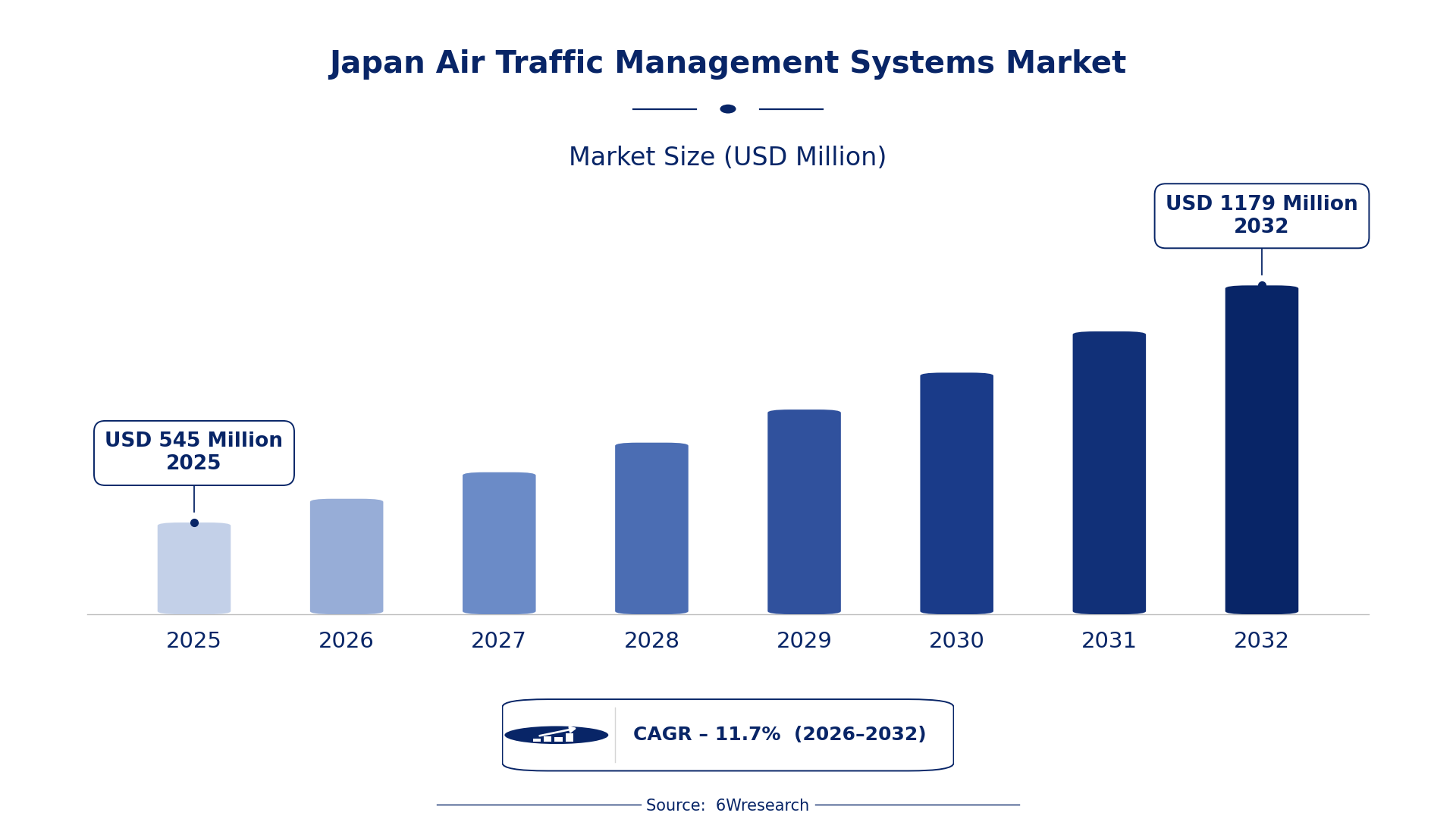
According to 6Wresearch internal database and industry insights, the Japan Air Traffic Management Systems Market was valued at USD 545 Million in 2025 and is projected to reach USD 1,179 Million by 2032, growing at a CAGR of approximately 11.7% during 2026–2032.
Japan Air Traffic Management Systems Market Highlights
| Report Metric | Details |
| Report Name | Japan Air Traffic Management Systems Market (2026-2032) |
| Market Size 2025 | USD 545 Million |
| Market Size 2032 | USD 1,179 Million |
| Absolute Growth 2025–2032 | USD 634 Million |
| CAGR 2026–2032 | 11.7% |
| Peak Annual Growth | 13.4% in 2030 |
| Forecast Period | 2026–2032 |
| Historical Data | 2022–2025 |
| Base Year | 2025 |
| Leading Segment Type, 2025 | Communication Systems (53% share) |
| Leading Integration Type, 2025 | Networked Voice/Data (38% share) |
| Leading Distribution Channel, 2025 | ATC OEM Providers (37% share) |
| Leading End User, 2025 | Aviation Regulatory Bodies (41% share) |
| Fastest-Growing Segment Type | Decision Support Tools (16.5% CAGR) |
| Fastest-Growing Integration Type | AI & Machine Learning (18.2% CAGR) |
| Fastest-Growing Distribution Channel | Software Development Firms (15.7% CAGR) |
| Fastest-Growing End User | Aviation Management Agencies (15.2% CAGR) |
| Growing Sector | Aviation Management Agencies |
| Key End Users | Aviation Regulatory Bodies, Commercial Airlines, Airport Infrastructure Groups, Aviation Management Agencies |
Japan Air Traffic Management Systems Market Year-wise Growth Rate and Key Drivers (2022–2032)
This graph illustrates the annual growth rates of the market from 2022 to 2032, highlighting a steady upward trajectory and projected market expansion over the forecast period.
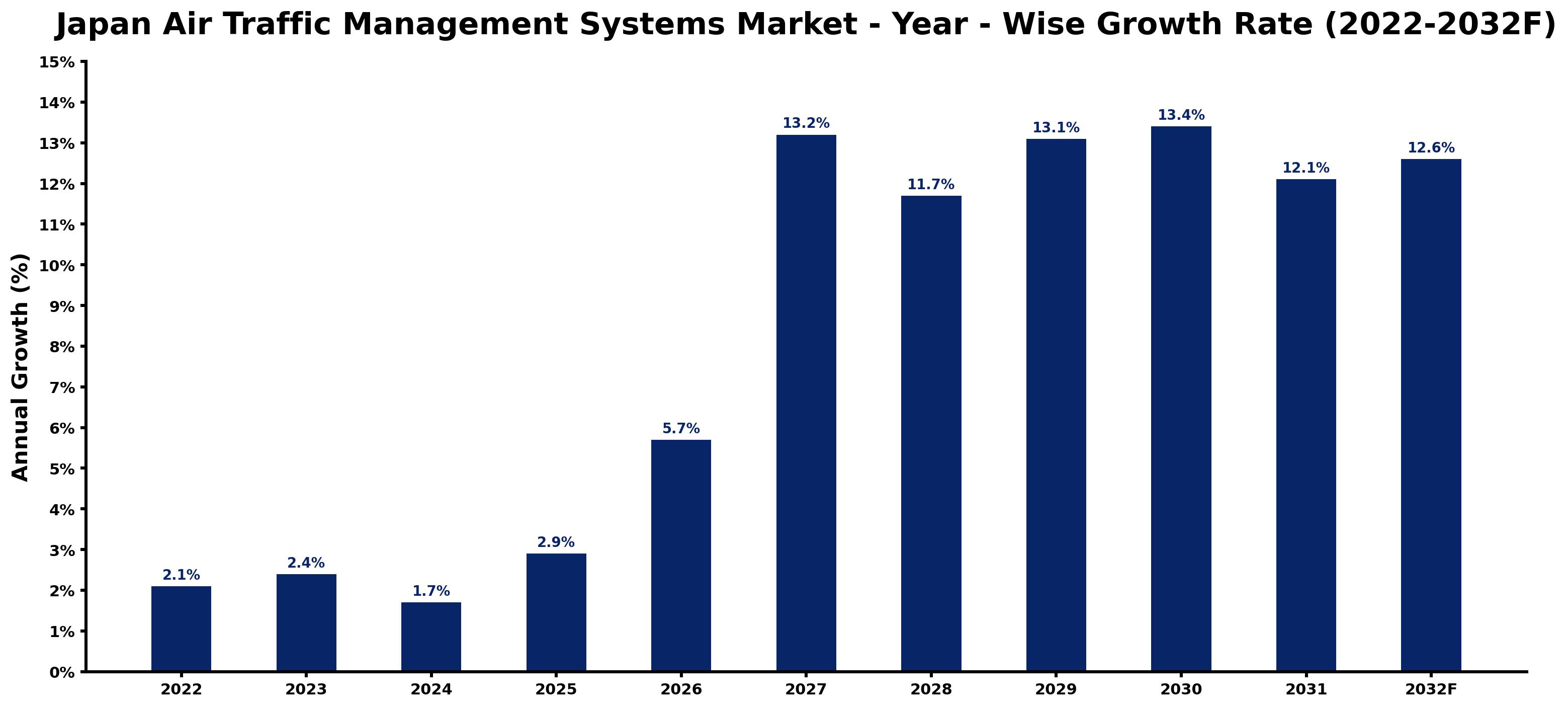
The table below sets out the estimated growth rate for each year and the main factor behind it.
| Year | Estimated Annual Growth (%) | Market Rationale |
| 2022 | 2.1 | The market experienced stable demand from aviation regulatory bodies and commercial airlines. |
| 2023 | 2.4 | Growth was driven by increased passenger traffic and airport infrastructure investments. |
| 2024 | 1.7 | A slowdown occurred as demand stabilised following earlier investments in air traffic management. |
| 2025 | 2.9 | Demand rose due to the Tokyo area's busy air traffic and operational upgrades. |
| 2026 | 5.7 | Growth is expected to accelerate as the government focuses on AI integration in air traffic systems. |
| 2027 | 13.2 | A surge in demand is projected as the Tokyo air traffic control centre manages more flights. |
| 2028 | 11.7 | Growth is expected to slow as the market adjusts to previous high levels of investment and demand. |
| 2029 | 13.1 | Demand is projected to rise again with ongoing upgrades to air traffic management systems across airports. |
| 2030 | 13.4 | The peak growth will be driven by the anticipated handling of over 100 million passengers. |
| 2031 | 12.1 | Growth is expected to slow as the market stabilises after reaching peak operational capacity. |
| 2032 | 12.6 | Demand is projected to increase with further advancements in AI and system integration. |
Note: Market size estimations and growth projections presented in this report are based on 6Wresearch's proprietary forecasting methodology, utilizing the latest available industry data, government publications, and primary research inputs.
Japan Air Traffic Management Systems Market Synopsis
Air Traffic Management Systems are advanced technologies that ensure the safety and efficiency of air traffic operations, optimising flight paths and providing real-time data to controllers. The Japan Air Traffic Management Systems Market is growing due to increased passenger traffic, with over 100 million expected annually by 2025, and government investments in aviation infrastructure, including ¥10 billion in 2023. Key buyers include domestic airlines, airport authorities, and regulatory bodies, all contributing to the rising need for efficient air traffic management solutions.
Market Dynamics Impact Analysis (2026–2032)
| Factor | Type | Impact | Primary Segment Affected |
| Growing passenger traffic in the Tokyo area | Driver | High | Communication Systems |
| Investment in AI technologies for air traffic management | Driver | High | Navigation Systems |
| Expansion of airport infrastructure in Japan | Opportunity | High | Surveillance Systems |
| Rising demand for efficient air traffic operations | Opportunity | High | Decision Support Tools |
| High costs of implementing advanced systems | Restraint | Medium | Communication Systems |
| Regulatory compliance requirements for air traffic systems | Restraint | Medium | Navigation Systems |
| Limited integration of legacy systems with new technology | Challenge | High | Surveillance Systems |
| Shortage of skilled personnel in air traffic management | Challenge | Medium | Decision Support Tools |
Evaluation of Drivers in Japan Air Traffic Management Systems Market (2026–2032)
The factors lifting demand, and the evidence behind each, are summarised below.
| Drivers | Primary Segment Affected | Why It Matters (Evidence) |
| Increased passenger traffic | Communication Systems | Japan's airports are expected to handle over 100 million passengers by 2025, driving demand for efficient communication systems. |
| Investment in AI technologies | Navigation Systems | The government aims to boost AI use in air traffic management by 2025, prompting demand for advanced navigation systems. |
| Infrastructure upgrades | Surveillance Systems | The Japanese government invested ¥10 billion in aviation infrastructure upgrades in 2023, increasing the need for surveillance systems. |
| Regulatory standards | Decision Support Tools | The Japan Civil Aviation Bureau sets stringent standards, driving demand for decision support tools to ensure compliance. |
| Expansion of air traffic control centres | Networked Voice/Data | Tokyo's air traffic control centre manages thousands of flights daily, necessitating advanced networked voice/data systems for efficient operations. |
Several shifts outside the market lift sales. The Tokyo area is projected to handle over 100 million passengers annually by 2025, increasing demand for advanced communication systems. In 2023, a significant investment of ¥10 billion in aviation infrastructure upgrades led to greater demand for modern surveillance solutions. The expansion of Tokyo's air traffic control centre requires advanced networked voice/data systems for efficient operations.
Evaluation of Restraints in Japan Air Traffic Management Systems Market
The table below lists the restraints and the evidence behind each.
| Market Restraint | Primary Segment Affected | Why It Matters (Evidence) |
| High costs of implementing advanced systems | Communication Systems | The investment required for advanced communication systems can deter smaller airports from upgrading. |
| Regulatory compliance requirements | Navigation Systems | Regulations from the Japan Civil Aviation Bureau increase operational costs for navigation systems. |
| Limited integration of legacy systems | Surveillance Systems | Many airports face challenges in integrating new surveillance systems with existing technology. |
| Shortage of skilled personnel | Decision Support Tools | The lack of trained professionals in air traffic management can hinder the effective use of decision support tools. |
| Market saturation in major hubs | Networked Voice/Data | With many airports already equipped, growth in networked voice/data systems may slow in saturated markets. |
Japan Air Traffic Management Systems Market Challenges
Domestic airlines face supply chain disruptions because they rely on imported components for air traffic management systems, which can delay system upgrades by up to six months. Skills shortages in software engineering hinder the development of advanced ATMS, causing project timelines to extend and affecting operational efficiency for airport authorities. Increased competition from global aviation technology firms forces local producers to lower prices, which can limit investment in innovation and quality for buyers. Regulatory changes from the Ministry of Land, Infrastructure, Transport and Tourism impose additional compliance costs, resulting in potential delays in system implementation for airports.
Trends in the Japan Air Traffic Management Systems Market
Buyers and suppliers in the Japan Air Traffic Management Systems Market are adjusting to the following trends.
- Shift Towards AI Integration in Air Traffic Management: Beginning in 2023, Japan is increasingly integrating AI technologies into air traffic management systems. The government aims to boost AI use by 2025, which will streamline operations and improve safety across airports.
- Transition from Legacy Systems to Advanced Technologies: The aviation sector is moving away from outdated legacy systems towards more advanced technologies. Tokyo's air traffic control centre is adopting new systems, with over 50% of current systems being networked voice/data.
- Emergence of Advanced Surveillance Systems: Starting in 2026, airports are focusing on upgrading surveillance systems to improve safety. The Japan Civil Aviation Bureau's new standards will drive investment in advanced tracking technologies.
- Prioritisation of Communication Systems: In 2025, communication systems will become a priority as passenger traffic increases. Airports in the Tokyo area are investing heavily in these systems to manage the growing number of flights.
Investment Opportunities in the Japan Air Traffic Management Systems Market
Where to invest in the Japan Air Traffic Management Systems Market: the main openings are set out below.
- Investment in AI Technologies: With the government aiming to boost AI use in air traffic management by 2025, there is a rising need for AI-driven solutions. Aviation regulatory bodies are seeking advanced systems to improve efficiency and safety.
- Supply of Advanced Surveillance Systems: The Japan Civil Aviation Bureau's new standards will drive investment in advanced tracking technologies, creating opportunities for suppliers. Airports are expected to invest significantly in these systems to meet compliance requirements.
- Development of Communication Systems: As passenger traffic is projected to exceed 100 million annually by 2025, airports will need to upgrade communication systems. Collaborating with airport infrastructure groups will facilitate entry into this market.
- Expansion of Networked Voice/Data Systems: With approximately 50% of air traffic control systems in Japan being networked voice/data systems, suppliers can target upgrades in this area. Airports in major hubs will be key buyers.
Government Initiatives in the Japan Air Traffic Management Systems Market
The Japan Air Traffic Management Systems Market is influenced by various policies, including the AI Promotion Act (2025), which establishes a framework for AI integration in air traffic management. This act encourages investment in AI technologies, improving operational efficiency and safety standards. The government also aims to enhance the use of AI in air traffic management by 2025, which will streamline operations across airports.
Aviation regulatory bodies utilise the Digital Agency, established in 2021, to implement common system standards. This agency supports the integration of advanced technologies in air traffic management, ensuring compliance and improving overall system performance. The Digital Agency also facilitates collaboration between technology providers and airports, enhancing the effectiveness of air traffic management systems.
Future Insight of the Japan Air Traffic Management Systems Market
Airlines will experience advancements in air traffic management systems by 2032, driven by heightened government investment in aviation infrastructure. The Japan Civil Aviation Bureau plans to introduce new standards that will improve safety and efficiency, directly benefiting airport operations. The integration of AI technologies will optimise flight paths, minimising delays for passengers. With air traffic expected to manage over 100 million passengers annually by 2025, the demand for efficient operations will push suppliers to innovate and enhance service delivery.
Market Segmentation Analysis
Japan Air Traffic Management Systems Market report covers a detailed analysis of the following market segments:
By Segment Type – Communication Systems Lead, Decision Support Tools Expected to Grow Fastest
According to Saurav Kr Singh, Senior Research Analyst at 6Wresearch, the largest segment type category in 2025 was Communication Systems, at 53% of revenue. Communication Systems dominate the market because they are crucial for real-time communication between air traffic controllers and aircraft. The extensive use of these systems in the Tokyo air traffic control centre, which manages thousands of flights daily, underscores their importance. The quickest growth will come from Decision Support Tools, forecast to expand at a CAGR of 16.5% between 2026 and 2032. Decision Support Tools are experiencing rapid growth as they enhance operational decision-making in complex air traffic scenarios. The increasing intricacy of operations in busy airports like Tokyo drives the demand for these tools, ensuring their sustained relevance. Suppliers should focus on developing advanced decision support tools to meet the growing demands of air traffic management.
By Integration Type – Networked Voice/Data Leads, AI & Machine Learning Expected to Grow Fastest
With 38% of integration type revenue in 2025, Networked Voice/Data was the largest category. Networked Voice/Data systems lead the market as they are vital for seamless communication across various air traffic management systems. Their widespread application in the Tokyo air traffic control centre illustrates their essential role in ensuring efficient operations. AI & Machine Learning is set to record the highest CAGR in this split, 18.2% over 2026–2032. AI and Machine Learning technologies are gaining traction due to their ability to analyse large data sets for operational optimisation. The government's commitment to enhancing AI usage in air traffic management by 2025 will further boost this segment's growth. Buyers must prioritise the integration of advanced technologies to improve operational efficiency and streamline decision-making processes.
By Distribution Channel – ATC OEM Providers Lead, Software Development Firms Expected to Grow Fastest
ATC OEM Providers held 37% of the Japan Air Traffic Management Systems Market by distribution channel in 2025. ATC OEM Providers hold the largest share as they supply essential systems directly to air traffic control operations. Their critical role in maintaining up-to-date communication systems is vital for ensuring safety and efficiency in air traffic management. Over 2026–2032, Software Development Firms are expected to post the fastest growth, at a CAGR of 15.7%. Software Development Firms are experiencing the fastest growth as they create tailored software solutions for air traffic management. The rising demand for sophisticated software to support operational efficiency is propelling this trend. Suppliers should consider partnerships with software development firms to enhance their product offerings and meet evolving market demands.
By End User – Aviation Regulatory Bodies Lead, Aviation Management Agencies Expected to Grow Fastest
Aviation Regulatory Bodies took 41% of end user revenue in 2025, more than any other category. Aviation Regulatory Bodies represent the largest share as they oversee and regulate air traffic management in Japan. Their authority in setting standards and guidelines is crucial for ensuring the safety and efficiency of air traffic operations. Aviation Management Agencies are projected to grow fastest, at a CAGR of 15.2% during 2026–2032. Aviation Management Agencies are rapidly expanding as they take on increased responsibilities for managing air traffic operations. The projected rise in passenger numbers to over 100 million by 2025 necessitates improved management capabilities. Suppliers should tailor their products to meet the specific needs of aviation management agencies to capitalise on this growth opportunity.
Key Attractiveness of the Report
- 10 Years of Market Numbers
- Historical Data Starting from 2022 to 2025
- Base Year 2025
- Forecast Data until 2032
- Key Performance Indicators Impacting the Market
- Major Upcoming Developments and Projects
Key Highlights of the Report:
- Japan Air Traffic Management Systems Market Outlook
- Market Size of Japan Air Traffic Management Systems Market, 2025
- Forecast of Japan Air Traffic Management Systems Market, 2032
- Historical Data and Forecast of Japan Air Traffic Management Systems Revenues & Volume for the Period 2022-2032F
- Japan Air Traffic Management Systems Market Trend Evolution
- Japan Air Traffic Management Systems Market Drivers and Challenges
- Japan Air Traffic Management Systems Price Trends
- Japan Air Traffic Management Systems Porter's Five Forces
- Japan Air Traffic Management Systems Industry Life Cycle
- Historical Data and Forecast of Japan Air Traffic Management Systems Market Revenues & Volume By Segment Type for the Period 2022-2032F
- Historical Data and Forecast of Japan Air Traffic Management Systems Market Revenues & Volume By Communication Systems for the Period 2022-2032F
- Historical Data and Forecast of Japan Air Traffic Management Systems Market Revenues & Volume By Navigation Systems for the Period 2022-2032F
- Historical Data and Forecast of Japan Air Traffic Management Systems Market Revenues & Volume By Surveillance Systems for the Period 2022-2032F
- Historical Data and Forecast of Japan Air Traffic Management Systems Market Revenues & Volume By Decision Support Tools for the Period 2022-2032F
- Historical Data and Forecast of Japan Air Traffic Management Systems Market Revenues & Volume By Integration Type for the Period 2022-2032F
- Historical Data and Forecast of Japan Air Traffic Management Systems Market Revenues & Volume By Networked Voice/Data for the Period 2022-2032F
- Historical Data and Forecast of Japan Air Traffic Management Systems Market Revenues & Volume By GPS & Satellite-Based for the Period 2022-2032F
- Historical Data and Forecast of Japan Air Traffic Management Systems Market Revenues & Volume By ADS-B, MLAT for the Period 2022-2032F
- Historical Data and Forecast of Japan Air Traffic Management Systems Market Revenues & Volume By AI & Machine Learning for the Period 2022-2032F
- Historical Data and Forecast of Japan Air Traffic Management Systems Market Revenues & Volume By Distribution Channel for the Period 2022-2032F
- Historical Data and Forecast of Japan Air Traffic Management Systems Market Revenues & Volume By ATC OEM Providers for the Period 2022-2032F
- Historical Data and Forecast of Japan Air Traffic Management Systems Market Revenues & Volume By Air Traffic Tech Integrators for the Period 2022-2032F
- Historical Data and Forecast of Japan Air Traffic Management Systems Market Revenues & Volume By Government Procurement for the Period 2022-2032F
- Historical Data and Forecast of Japan Air Traffic Management Systems Market Revenues & Volume By Software Development Firms for the Period 2022-2032F
- Historical Data and Forecast of Japan Air Traffic Management Systems Market Revenues & Volume By End User for the Period 2022-2032F
- Historical Data and Forecast of Japan Air Traffic Management Systems Market Revenues & Volume By Aviation Regulatory Bodies for the Period 2022-2032F
- Historical Data and Forecast of Japan Air Traffic Management Systems Market Revenues & Volume By Commercial Airlines for the Period 2022-2032F
- Historical Data and Forecast of Japan Air Traffic Management Systems Market Revenues & Volume By Airport Infrastructure Groups for the Period 2022-2032F
- Historical Data and Forecast of Japan Air Traffic Management Systems Market Revenues & Volume By Aviation Management Agencies for the Period 2022-2032F
- Japan Air Traffic Management Systems Import Export Trade Statistics
- Market Opportunity Assessment By Segment Type
- Market Opportunity Assessment By Integration Type
- Market Opportunity Assessment By Distribution Channel
- Market Opportunity Assessment By End User
- Japan Air Traffic Management Systems Top Companies Market Share
- Japan Air Traffic Management Systems Competitive Benchmarking By Technical and Operational Parameters
- Japan Air Traffic Management Systems Company Profiles
- Japan Air Traffic Management Systems Key Strategic Recommendations
Market Covered
The report covers the following segments.
By Segment Type
- Communication Systems
- Navigation Systems
- Surveillance Systems
- Decision Support Tools
By Integration Type
- Networked Voice/Data
- GPS & Satellite-Based
- ADS-B
- MLAT
- AI & Machine Learning
By Distribution Channel
- ATC OEM Providers
- Air Traffic Tech Integrators
- Government Procurement
- Software Development Firms
By End User
- Aviation Regulatory Bodies
- Commercial Airlines
- Airport Infrastructure Groups
- Aviation Management Agencies































