Japan Air Traffic Sequencing Market Size & Growth Rate
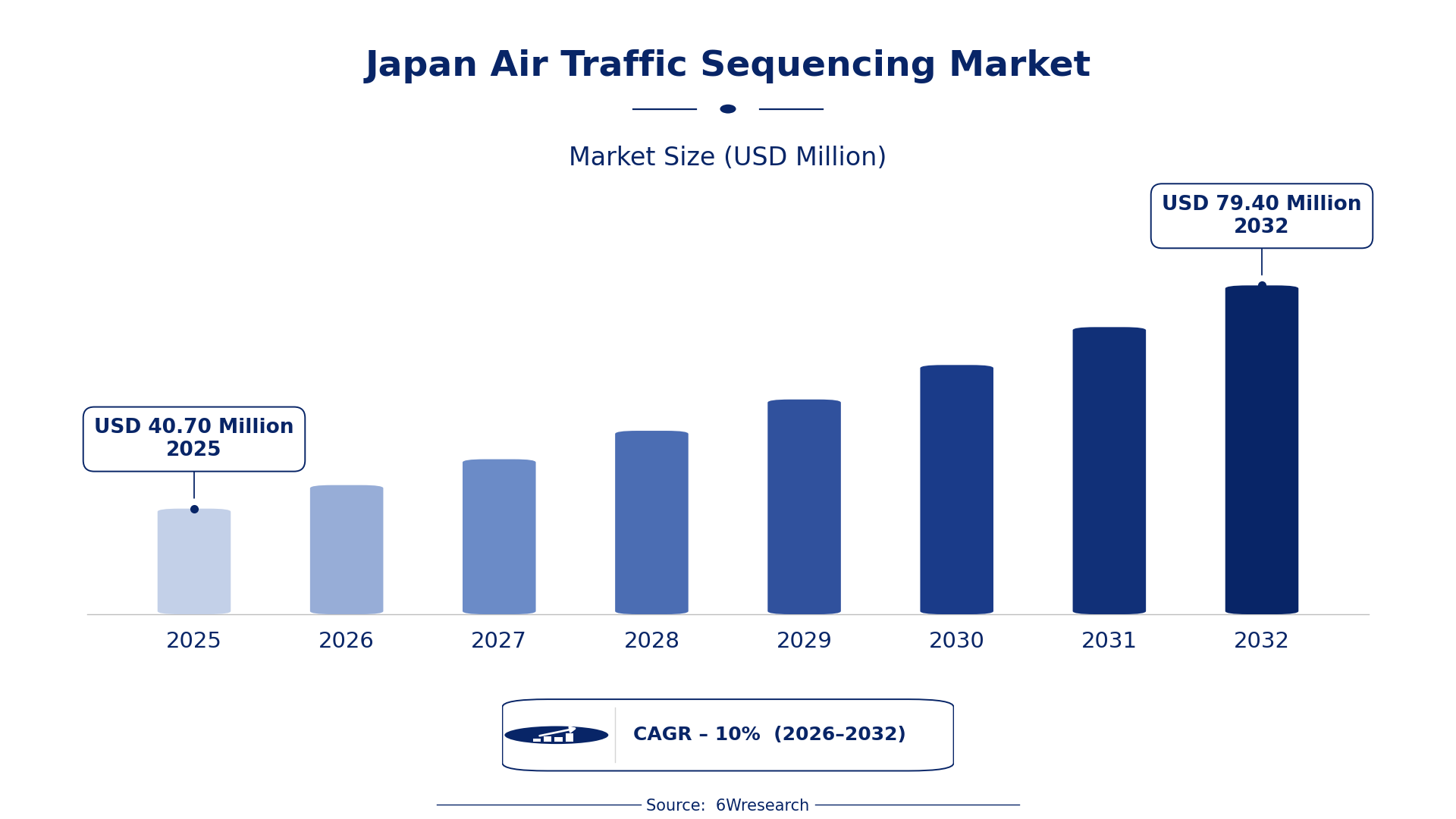
According to 6Wresearch internal database and industry insights, the Japan Air Traffic Sequencing Market was valued at USD 40.70 Million in 2025 and is projected to reach USD 79.40 Million by 2032, growing at a CAGR of approximately 10% during 2026–2032.
Japan Air Traffic Sequencing Market Highlights
| Report Metric | Details |
| Report Name | Japan Air Traffic Sequencing Market (2026-2032) |
| Market Size 2025 | USD 40.70 Million |
| Market Size 2032 | USD 79.40 Million |
| Absolute Growth 2025–2032 | USD 38.70 Million |
| CAGR 2026–2032 | 10% |
| Peak Annual Growth | 11.6% in 2031 |
| Forecast Period | 2026–2032 |
| Historical Data | 2022–2025 |
| Base Year | 2025 |
| Leading System Type, 2025 | Departure Sequencing (41% share) |
| Leading Scheduling Feature, 2025 | AI-Based Slot Assignment (42% share) |
| Leading Distribution Channel, 2025 | Aviation Software Providers (48% share) |
| Leading End User, 2025 | Airport Control Centers (36% share) |
| Fastest-Growing System Type | Integrated Tools (13.9% CAGR) |
| Fastest-Growing Scheduling Feature | Dynamic Optimization (13.1% CAGR) |
| Fastest-Growing Distribution Channel | Traffic Management Suppliers (14.3% CAGR) |
| Fastest-Growing End User | Civil Aviation Authorities (12.8% CAGR) |
| Growing Sector | Aviation |
| Key End Users | Airport Control Centers, Civil Aviation Authorities, Airlines |
Japan Air Traffic Sequencing Market Year-wise Growth Rate and Key Drivers (2022–2032)
This graph illustrates the annual growth rates of the market from 2022 to 2032, highlighting a steady upward trajectory and projected market expansion over the forecast period.
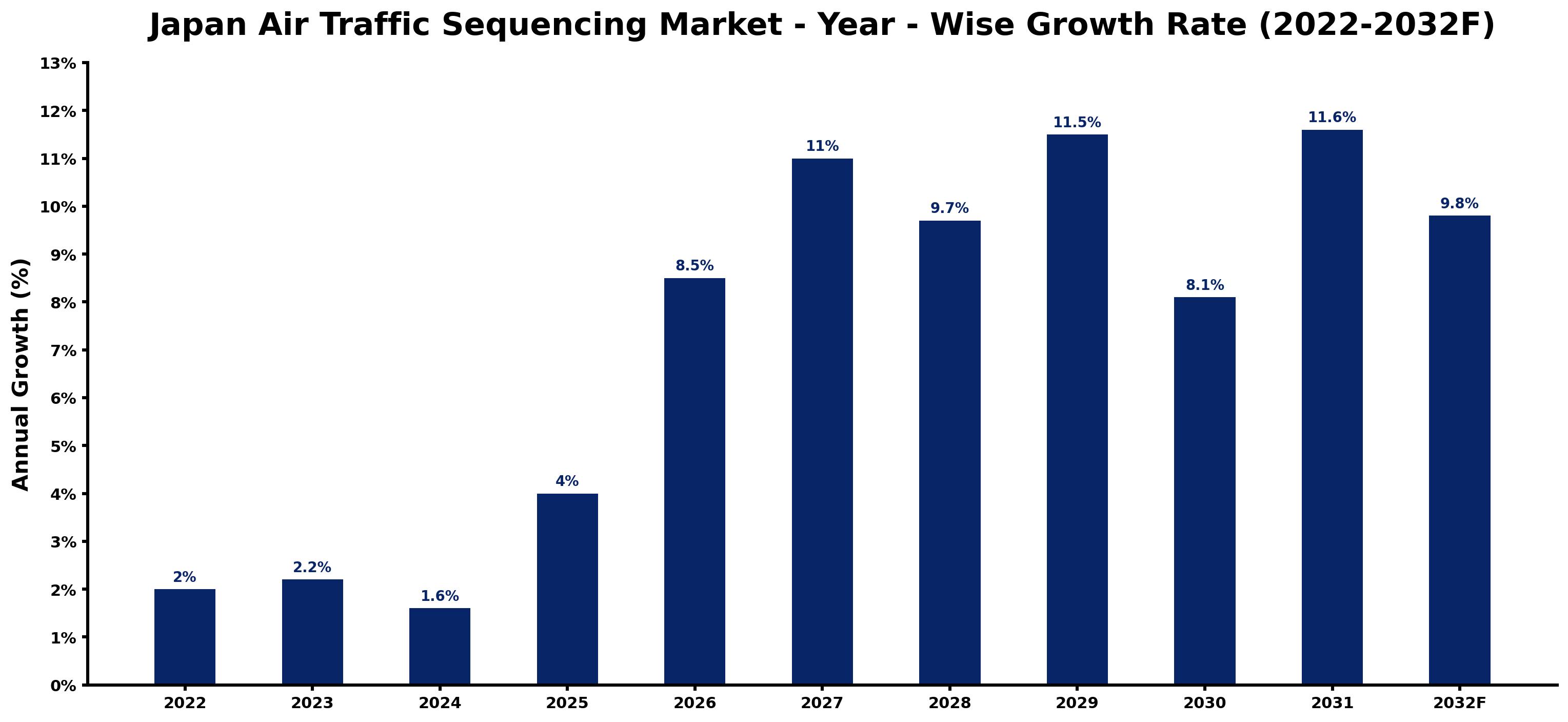
Year by year, the estimates below pair each growth rate with the development that shaped it.
| Year | Estimated Annual Growth (%) | Market Rationale |
| 2022 | 2.0 | The market experienced steady growth due to ongoing modernization efforts in air traffic systems. |
| 2023 | 2.2 | Demand increased as airports enhanced their operational capabilities to manage rising flight volumes. |
| 2024 | 1.6 | Growth slowed slightly as the market adjusted to new technologies and operational changes. |
| 2025 | 4.0 | A surge in demand occurred as the Tokyo 2020 Olympics prompted significant upgrades in air traffic management. |
| 2026 | 8.5 | Investment in AI technologies for air traffic management is expected to drive further growth. |
| 2027 | 11.0 | The introduction of new dynamic optimization tools will enhance efficiency in air traffic sequencing. |
| 2028 | 9.7 | Growth is projected to slow as the market stabilizes after rapid technological advancements. |
| 2029 | 11.5 | Increased international traffic will boost demand for advanced air traffic sequencing solutions. |
| 2030 | 8.1 | A slowdown is anticipated as the market adapts to regulatory changes and new operational standards. |
| 2031 | 11.6 | The peak growth rate is driven by the implementation of innovative air traffic management technologies. |
| 2032 | 9.8 | Growth will continue as the government aims for a 30% reduction in delays by 2025. |
Note: Market size estimations and growth projections presented in this report are based on 6Wresearch's proprietary forecasting methodology, utilizing the latest available industry data, government publications, and primary research inputs.
Japan Air Traffic Sequencing Market Synopsis
Air Traffic Sequencing optimises aircraft movements to improve safety and efficiency in air traffic management. In Japan, the aviation industry is robust, with over 100 airports equipped with sequencing systems. Key drivers include the integration of AI technologies and substantial government investments, such as the ¥10 billion allocated for modernisation in 2023. The Tokyo region, handling approximately 1,200 flights daily, illustrates the growing demand for efficient air traffic solutions.
Market Dynamics Impact Analysis (2026–2032)
| Factor | Type | Impact | Primary Segment Affected |
| Integration of AI technologies into air traffic management systems | Driver | High | AI-Based Slot Assignment |
| High volume of daily flights in the Tokyo region | Driver | High | Departure Sequencing |
| Need for improved air traffic efficiency due to increasing flight numbers | Opportunity | High | Dynamic Optimization |
| Investment in advanced air traffic management systems by airports | Opportunity | Medium | Traffic Management Suppliers |
| Regulatory compliance costs for air traffic management systems | Restraint | High | Aviation Software Providers |
| Limited availability of skilled personnel for air traffic control | Restraint | Medium | Airport Control Centers |
| Technological integration challenges for existing systems | Challenge | High | Integrated Tools |
| Competition among airports to adopt the latest technologies | Challenge | Medium | Civil Aviation Authorities |
Evaluation of Drivers in Japan Air Traffic Sequencing Market (2026–2032)
The factors lifting demand, and the evidence behind each, are summarised below.
| Drivers | Primary Segment Affected | Why It Matters (Evidence) |
| Increased adoption of AI technologies | AI-Based Slot Assignment | AI technologies are projected to improve the efficiency of slot assignments, leading to better operational performance in airports. |
| High flight volumes in major regions | Departure Sequencing | The Tokyo region's daily handling of approximately 1,200 flights necessitates effective departure sequencing solutions. |
| Growing need for real-time optimization tools | Dynamic Optimization | Dynamic optimization tools are essential for adjusting traffic flows, resulting in reduced delays and improved safety. |
| Government investments in air traffic modernization | Traffic Management Suppliers | The ¥10 billion investment in 2023 supports the procurement of advanced systems, boosting demand for suppliers. |
| Implementation of safety regulations by authorities | Aviation Software Providers | Compliance with ISO 9001 standards drives the need for reliable software solutions in air traffic management. |
The strongest pull on demand comes from the increased adoption of AI technologies, which are projected to improve operational performance. Airports are managing high flight volumes, with the Tokyo region handling approximately 1,200 flights daily, driving the need for effective sequencing solutions. Substantial investments, such as the ¥10 billion allocated for air traffic modernisation in 2023, support the procurement of advanced systems. The rising need for real-time optimisation tools is clear as airports seek to reduce delays and improve safety. Compliance with ISO 9001 standards further increases the demand for reliable software solutions in air traffic management.
Evaluation of Restraints in Japan Air Traffic Sequencing Market
These are the pressures that could keep growth below its potential.
| Market Restraint | Primary Segment Affected | Why It Matters (Evidence) |
| Compliance costs associated with regulatory standards | Aviation Software Providers | Adhering to ISO 9001 standards increases operational costs for software providers, impacting pricing. |
| Shortage of skilled air traffic control personnel | Airport Control Centers | The limited pool of qualified personnel can delay the implementation of new technologies. |
| Integration challenges with existing air traffic systems | Integrated Tools | Legacy systems may hinder the adoption of advanced sequencing technologies, affecting efficiency. |
| High costs of advanced air traffic management systems | Traffic Management Suppliers | The financial burden of upgrading to modern systems can deter smaller airports from investing. |
| Regulatory compliance delays for new technologies | Civil Aviation Authorities | Lengthy approval processes for new systems can slow down the deployment of innovations. |
Japan Air Traffic Sequencing Market Challenges
High congestion from approximately 1,200 flights daily in the Tokyo region creates delays for buyers, as longer wait times hinder operational efficiency. Many air traffic management systems still rely on outdated protocols, which increases operational costs by 30% for air traffic controllers. A ¥10 billion government investment in modernisation may not meet all regional needs, leaving some buyers with insufficient technological support. Local traffic management by regional ATC units faces disruptions, resulting in delays that affect flight schedules for airlines, complicating their ability to maintain timely operations.
Trends in the Japan Air Traffic Sequencing Market
Several trends are reshaping the Japan Air Traffic Sequencing Market; the most important are set out below.
- Shift Towards AI-Driven Air Traffic Management: AI technologies are increasingly integrated into air traffic management systems, improving efficiency and safety. The government aims for a 30% reduction in delays by 2025, prompting airports to adopt these technologies.
- Emergence of Dynamic Optimisation Tools: Dynamic optimisation tools are becoming essential for real-time adjustments in air traffic flows. The Civil Aviation Authority mandates their use, reflecting a trend towards more responsive air traffic management.
- Increase in International Flight Traffic: The volume of international flights is rising, necessitating improved air traffic sequencing solutions. Airports are responding by upgrading their systems to handle the increased demand effectively.
- Focus on Sustainability in Air Traffic Management: Sustainability is becoming a priority in air traffic management strategies. The Air Traffic Management Strategy 2023 emphasises environmentally friendly practices, influencing technology investments.
Investment Opportunities in the Japan Air Traffic Sequencing Market
The following opportunities in the Japan Air Traffic Sequencing Market pair current demand with a clear way in.
- Airport Control Centres seeking advanced solutions: Airport Control Centres require advanced air traffic management systems to improve efficiency. With over 100 airports in Japan, there is a significant market gap for innovative solutions.
- Government investment in modernisation initiatives: The ¥10 billion allocated for air traffic modernisation presents opportunities for suppliers to provide advanced technologies. Airports can partner with local firms to enhance their systems.
- Growing demand for real-time optimisation tools: As flight volumes increase, there is a pressing need for tools that optimise traffic flows. Suppliers can enter this market by collaborating with regional ATC units.
- Civil Aviation Authorities focusing on regulatory compliance: With new regulations in place, there is a demand for compliant air traffic management systems. Suppliers can gain market entry by obtaining necessary certifications.
Government Initiatives in the Japan Air Traffic Sequencing Market
The Electrical Appliance and Material Safety Act regulates the safety of air traffic management systems, ensuring compliance with national standards. This act mandates that all systems meet specific safety criteria before deployment, impacting producers and buyers alike.
The Digital Agency oversees the government's digital transformation, implementing common system standards for air traffic management. This agency's initiatives aim to streamline processes and improve the efficiency of air traffic operations.
Future Insight of the Japan Air Traffic Sequencing Market
New air traffic management systems will be implemented by 2032, featuring advanced algorithms for real-time data analysis. AI technologies will improve operational efficiency and reduce delays, supporting the government's goal of a 30% reduction in delays by 2025. Updated training programmes for air traffic controllers will ensure personnel are skilled in the latest systems, improving safety. Enhanced protocols in the Kansai region will address high traffic volumes, leading to more effective local air traffic management.
Market Segmentation Analysis
Japan Air Traffic Sequencing Market report covers a detailed analysis of the following market segments:
By System Type – Departure Sequencing Leads, Integrated Tools Expected to Grow Fastest
According to Vasu Joshi, Associate Consultant at 6Wresearch, the largest system type category in 2025 was Departure Sequencing, at 41% of revenue. Departure Sequencing holds the largest share due to its critical role in managing takeoffs efficiently at airports. The Tokyo region, which handles approximately 1,200 flights daily, relies on this system to ensure smooth operations and minimise delays. Integrated Tools are projected to grow fastest, at a CAGR of 13.9% during 2026–2032. The growth of Integrated Tools is propelled by the increasing adoption of advanced technologies in air traffic management systems. With the government investing ¥10 billion in air traffic modernization in 2023, these tools are becoming essential for enhancing overall sequencing efficiency. Suppliers should focus on developing integrated solutions to meet the rising demand for advanced air traffic management.
By Scheduling Feature – AI-Based Slot Assignment Leads, Dynamic Optimization Expected to Grow Fastest
AI-Based Slot Assignment held 42% of the Japan Air Traffic Sequencing Market by scheduling feature in 2025. AI-Based Slot Assignment dominates the market as it is directly employed for optimising takeoff and landing slots, which is crucial for maintaining flight schedules. This method is particularly vital in busy regions like Tokyo, where high flight volumes necessitate effective slot management. The quickest growth will come from Dynamic Optimization, forecast to expand at a CAGR of 13.1% between 2026 and 2032. Dynamic Optimization is experiencing rapid growth due to its ability to adjust traffic flows in real-time, which is essential for improving overall efficiency. The government's goal for a 30% reduction in delays by 2025 highlights the increasing need for such adaptive solutions. Buyers should prioritise technologies that offer real-time optimisation to enhance operational efficiency and reduce delays.
By Distribution Channel – Aviation Software Providers Lead, Traffic Management Suppliers Expected to Grow Fastest
Aviation Software Providers took 48% of distribution channel revenue in 2025, more than any other category. Aviation Software Providers lead the market as they deliver essential software solutions for sequencing, which are critical for efficient air traffic management. Their established presence and expertise make them indispensable in the aviation sector, particularly in high-traffic areas. Over 2026–2032, Traffic Management Suppliers are expected to post the fastest growth, at a CAGR of 14.3%. Traffic Management Suppliers are growing quickly as they provide critical technology that supports air traffic management. With the rising demand for advanced systems, these suppliers are well-positioned to capture a larger market share. Suppliers must strengthen partnerships with traffic management suppliers to ensure comprehensive solutions for air traffic control.
By End User – Airport Control Centers Lead, Civil Aviation Authorities Expected to Grow Fastest
Airport Control Centers accounted for 36% of the market by end user in 2025. Airport Control Centers are the largest segment as they serve as central hubs for managing air traffic operations, directly influencing safety and efficiency. Their pivotal role in coordinating flights makes them essential stakeholders in the air traffic management market. Civil Aviation Authorities are set to record the highest CAGR in this split, 12.8% over 2026–2032. Civil Aviation Authorities are witnessing rapid growth as they oversee air traffic management regulations. Their commitment to implementing new technologies aligns with the industry's push for improved safety and efficiency. Suppliers should engage with civil aviation authorities to align their offerings with regulatory advancements and market needs.
Key Attractiveness of the Report
- 10 Years of Market Numbers
- Historical Data Starting from 2022 to 2025
- Base Year 2025
- Forecast Data until 2032
- Key Performance Indicators Impacting the Market
- Major Upcoming Developments and Projects
Key Highlights of the Report:
- Japan Air Traffic Sequencing Market Outlook
- Market Size of Japan Air Traffic Sequencing Market, 2025
- Forecast of Japan Air Traffic Sequencing Market, 2032
- Historical Data and Forecast of Japan Air Traffic Sequencing Revenues & Volume for the Period 2022-2032F
- Japan Air Traffic Sequencing Market Trend Evolution
- Japan Air Traffic Sequencing Market Drivers and Challenges
- Japan Air Traffic Sequencing Price Trends
- Japan Air Traffic Sequencing Porter's Five Forces
- Japan Air Traffic Sequencing Industry Life Cycle
- Historical Data and Forecast of Japan Air Traffic Sequencing Market Revenues & Volume By System Type for the Period 2022-2032F
- Historical Data and Forecast of Japan Air Traffic Sequencing Market Revenues & Volume By Departure Sequencing for the Period 2022-2032F
- Historical Data and Forecast of Japan Air Traffic Sequencing Market Revenues & Volume By Arrival Sequencing for the Period 2022-2032F
- Historical Data and Forecast of Japan Air Traffic Sequencing Market Revenues & Volume By En-Route Sequencing for the Period 2022-2032F
- Historical Data and Forecast of Japan Air Traffic Sequencing Market Revenues & Volume By Integrated Tools for the Period 2022-2032F
- Historical Data and Forecast of Japan Air Traffic Sequencing Market Revenues & Volume By Scheduling Feature for the Period 2022-2032F
- Historical Data and Forecast of Japan Air Traffic Sequencing Market Revenues & Volume By AI-Based Slot Assignment for the Period 2022-2032F
- Historical Data and Forecast of Japan Air Traffic Sequencing Market Revenues & Volume By Dynamic Optimization for the Period 2022-2032F
- Historical Data and Forecast of Japan Air Traffic Sequencing Market Revenues & Volume By Route Conflict Prediction for the Period 2022-2032F
- Historical Data and Forecast of Japan Air Traffic Sequencing Market Revenues & Volume By Time-Based Flow Control for the Period 2022-2032F
- Historical Data and Forecast of Japan Air Traffic Sequencing Market Revenues & Volume By Distribution Channel for the Period 2022-2032F
- Historical Data and Forecast of Japan Air Traffic Sequencing Market Revenues & Volume By Aviation Software Providers for the Period 2022-2032F
- Historical Data and Forecast of Japan Air Traffic Sequencing Market Revenues & Volume By Government Contractors for the Period 2022-2032F
- Historical Data and Forecast of Japan Air Traffic Sequencing Market Revenues & Volume By Traffic Management Suppliers for the Period 2022-2032F
- Historical Data and Forecast of Japan Air Traffic Sequencing Market Revenues & Volume By Online Software Platforms for the Period 2022-2032F
- Historical Data and Forecast of Japan Air Traffic Sequencing Market Revenues & Volume By End User for the Period 2022-2032F
- Historical Data and Forecast of Japan Air Traffic Sequencing Market Revenues & Volume By Airport Control Centers for the Period 2022-2032F
- Historical Data and Forecast of Japan Air Traffic Sequencing Market Revenues & Volume By Civil Aviation Authorities for the Period 2022-2032F
- Historical Data and Forecast of Japan Air Traffic Sequencing Market Revenues & Volume By Regional ATC Units for the Period 2022-2032F
- Historical Data and Forecast of Japan Air Traffic Sequencing Market Revenues & Volume By Airlines for the Period 2022-2032F
- Japan Air Traffic Sequencing Import Export Trade Statistics
- Market Opportunity Assessment By System Type
- Market Opportunity Assessment By Scheduling Feature
- Market Opportunity Assessment By Distribution Channel
- Market Opportunity Assessment By End User
- Japan Air Traffic Sequencing Top Companies Market Share
- Japan Air Traffic Sequencing Competitive Benchmarking By Technical and Operational Parameters
- Japan Air Traffic Sequencing Company Profiles
- Japan Air Traffic Sequencing Key Strategic Recommendations
Market Covered
This report examines the market across the segments below.
By System Type
- Departure Sequencing
- Arrival Sequencing
- En-Route Sequencing
- Integrated Tools
By Scheduling Feature
- AI-Based Slot Assignment
- Dynamic Optimization
- Route Conflict Prediction
- Time-Based Flow Control
By Distribution Channel
- Aviation Software Providers
- Government Contractors
- Traffic Management Suppliers
- Online Software Platforms
By End User
- Airport Control Centers
- Civil Aviation Authorities
- Regional ATC Units
- Airlines































