Japan Airbag Deployment Mechanisms Market Size & Growth Rate
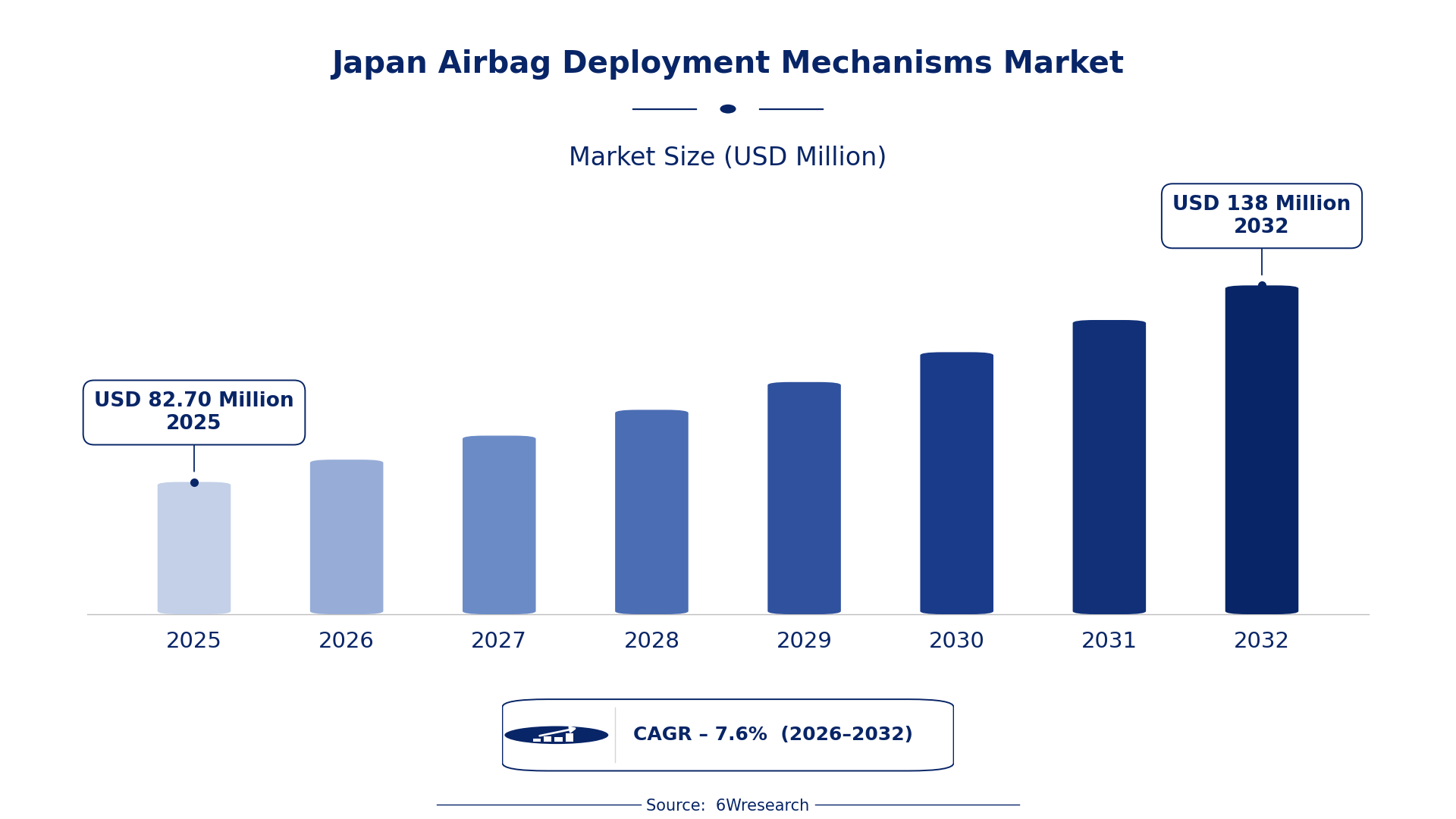
According to 6Wresearch internal database and industry insights, the Japan Airbag Deployment Mechanisms Market was valued at USD 82.70 Million in 2025 and is projected to reach USD 138 Million by 2032, growing at a CAGR of approximately 7.6% during 2026–2032.
Japan Airbag Deployment Mechanisms Market Highlights
| Report Metric | Details |
| Report Name | Japan Airbag Deployment Mechanisms Market (2026-2032) |
| Market Size 2025 | USD 82.70 Million |
| Market Size 2032 | USD 138 Million |
| Absolute Growth 2025–2032 | USD 55.30 Million |
| CAGR 2026–2032 | 7.6% |
| Peak Annual Growth | 8.1% in 2029 |
| Forecast Period | 2026–2032 |
| Historical Data | 2022–2025 |
| Base Year | 2025 |
| Leading Deployment Mechanism, 2025 | Pyrotechnic Inflators (39% share) |
| Leading Sensor Type, 2025 | Crash Detection Sensors (47% share) |
| Leading Distribution Channel, 2025 | Tier-1 Automotive Suppliers (44% share) |
| Leading End User, 2025 | Passenger Vehicle OEMs (47% share) |
| Fastest-Growing Deployment Mechanism | Hybrid Inflators (10.7% CAGR) |
| Fastest-Growing Sensor Type | AI-Based Impact Analysis (11.0% CAGR) |
| Fastest-Growing Distribution Channel | Safety System Vendors (9.4% CAGR) |
| Fastest-Growing End User | Electric Vehicle Manufacturers (10.1% CAGR) |
| Growing Sector | Electric Vehicle Manufacturers |
| Key End Users | Passenger Vehicle OEMs, Premium Automotive Brands, Electric Vehicle Manufacturers, Commercial Vehicle Makers |
Japan Airbag Deployment Mechanisms Market Year-wise Growth Rate and Key Drivers (2022–2032)
This graph illustrates the annual growth rates of the market from 2022 to 2032, highlighting a steady upward trajectory and projected market expansion over the forecast period.
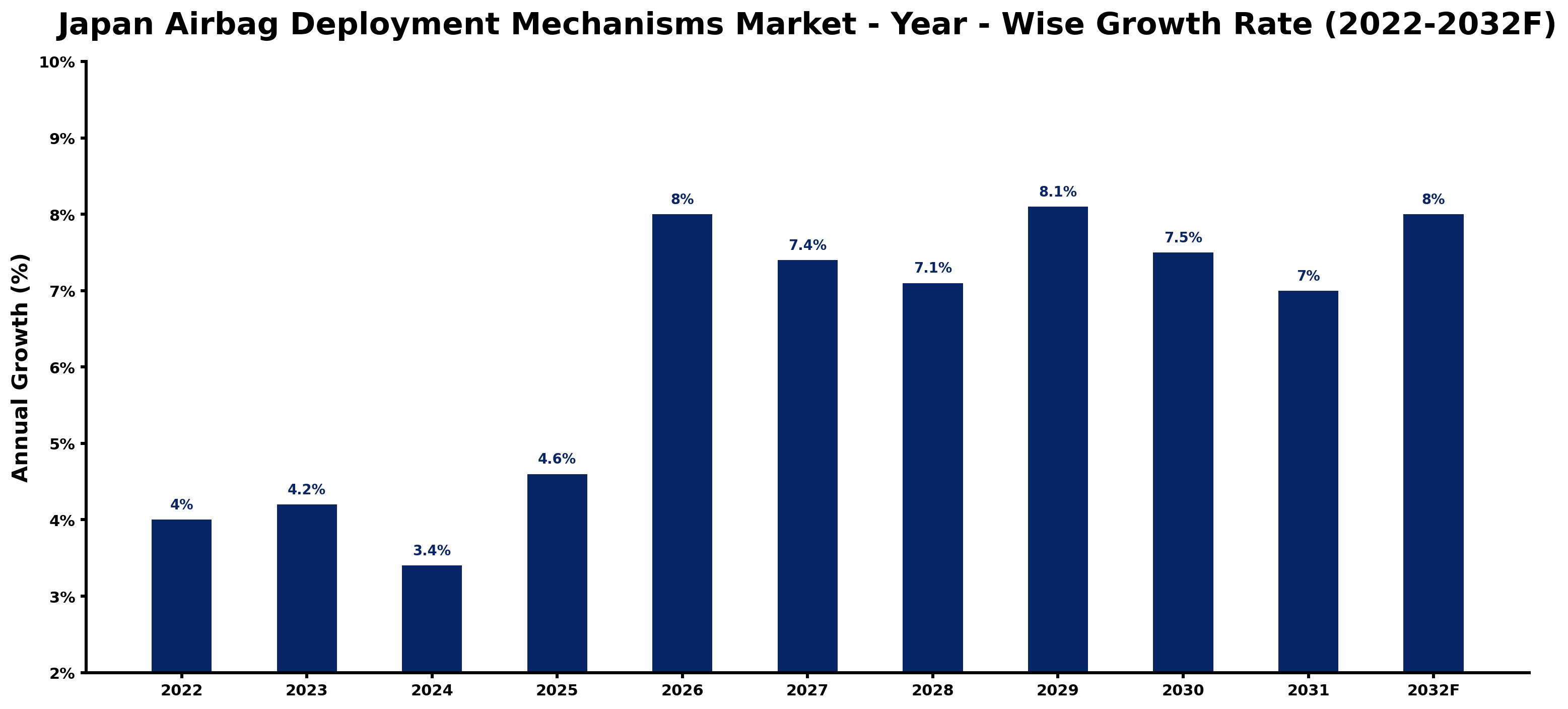
The table below sets out the estimated growth rate for each year and the main factor behind it.
| Year | Estimated Annual Growth (%) | Market Rationale |
| 2022 | 4.0 | The automotive industry produced a large number of vehicles, maintaining steady demand for safety features. |
| 2023 | 4.2 | Growth continued as vehicle safety standards gained importance among manufacturers and consumers. |
| 2024 | 3.4 | The market experienced a slowdown as production faced challenges in meeting evolving safety regulations. |
| 2025 | 4.6 | Demand increased as manufacturers adopted advanced airbag technologies to comply with new safety standards. |
| 2026 | 8.0 | The market is expected to surge with heightened focus on vehicle safety and the introduction of new deployment mechanisms. |
| 2027 | 7.4 | Growth is projected to slow as the market adjusts to new technologies and production capacities. |
| 2028 | 7.1 | The market is expected to continue growing, driven by the integration of advanced safety systems in new vehicles. |
| 2029 | 8.1 | Demand is projected to peak as manufacturers focus on improving vehicle safety features amid rising consumer awareness. |
| 2030 | 7.5 | Growth is expected to moderate as the market stabilises after rapid technological advancements in airbag systems. |
| 2031 | 7.0 | The market will maintain steady growth as ongoing safety initiatives continue to influence production. |
| 2032 | 8.0 | Demand is projected to surge again as electric vehicle manufacturers increasingly integrate advanced airbag systems. |
Note: Market size estimations and growth projections presented in this report are based on 6Wresearch's proprietary forecasting methodology, utilizing the latest available industry data, government publications, and primary research inputs.
Japan Airbag Deployment Mechanisms Market Synopsis
Airbag deployment mechanisms are safety devices designed to inflate airbags during collisions, primarily using pyrotechnic materials or compressed gases. The Japan Airbag Deployment Mechanisms Market is driven by the automotive sector, which produced approximately 8 million vehicles in 2022. The introduction of advanced safety standards, a growing focus on vehicle safety, and increasing production of electric vehicles are propelling market growth. The Japanese government promotes vehicle safety through initiatives like the JIS D 0203 standard, stimulating demand for advanced airbag technologies.
Market Dynamics Impact Analysis (2026–2032)
| Factor | Type | Impact | Primary Segment Affected |
| Growing focus on vehicle safety standards | Driver | High | Pyrotechnic Inflators |
| Increased production of electric vehicles | Driver | High | Pyrotechnic Inflators |
| Rising demand for advanced safety features in vehicles | Opportunity | High | Pyrotechnic Inflators |
| Emerging technologies in airbag systems | Opportunity | Medium | Pyrotechnic Inflators |
| Challenges in meeting stringent safety regulations | Restraint | High | Pyrotechnic Inflators |
| High competition among airbag manufacturers | Restraint | Medium | Airbag Manufacturers |
| Supply chain disruptions affecting production timelines | Challenge | High | Pyrotechnic Inflators |
| Rising costs of raw materials impacting pricing strategies | Challenge | Medium | Pyrotechnic Inflators |
Evaluation of Drivers in Japan Airbag Deployment Mechanisms Market (2026–2032)
The factors lifting demand, and the evidence behind each, are summarised below.
| Drivers | Primary Segment Affected | Why It Matters (Evidence) |
| Increased vehicle production | Pyrotechnic Inflators | Japan's automotive industry produced approximately 8 million vehicles in 2022, boosting demand for airbag deployment mechanisms. |
| Focus on advanced safety features | Pyrotechnic Inflators | The introduction of new safety standards drives manufacturers to invest in advanced airbag technologies. |
| Growing electric vehicle market | Pyrotechnic Inflators | With around 3 million registered electric vehicles in Japan, demand for integrated airbag systems is rising. |
| Technological advancements in airbag systems | Pyrotechnic Inflators | The adoption of advanced driver-assistance systems in new vehicles increases the need for sophisticated airbag deployment mechanisms. |
| Rising consumer awareness of vehicle safety | Pyrotechnic Inflators | Japan's population of approximately 125 million increasingly prioritises safety features in vehicle purchases. |
A wider customer base explains much of the growth, as the automotive industry produced approximately 8 million vehicles in 2022, leading to heightened demand for airbag deployment mechanisms. The focus on advanced safety features has intensified with the introduction of new safety standards, prompting manufacturers to invest in advanced technologies. The growing electric vehicle market, with around 3 million registered units, is driving the integration of airbag systems. Consumer awareness of vehicle safety is also rising, as Japan's population increasingly prioritises safety features in their vehicle purchases. Advancements in airbag systems, particularly in sensor types, are improving overall vehicle safety.
Evaluation of Restraints in Japan Airbag Deployment Mechanisms Market
The key brakes on demand, and where they bite hardest, are shown below.
| Market Restraint | Primary Segment Affected | Why It Matters (Evidence) |
| Challenges in meeting stringent safety regulations | Pyrotechnic Inflators | Manufacturers face difficulties in complying with evolving safety standards, impacting production timelines and costs. |
| High competition among airbag manufacturers | Airbag Manufacturers | Intense competition leads to pricing pressures, affecting profit margins for suppliers in the market. |
| Supply chain disruptions affecting production timelines | Pyrotechnic Inflators | Global supply chain issues have delayed the availability of critical components necessary for airbag systems. |
| Rising costs of raw materials impacting pricing strategies | Pyrotechnic Inflators | Increased prices for essential materials have forced manufacturers to reconsider their pricing strategies. |
| Limited adoption of advanced technologies in traditional vehicles | Pyrotechnic Inflators | Many older vehicles, averaging over 10 years, lack the infrastructure for advanced airbag systems. |
Japan Airbag Deployment Mechanisms Market Challenges
Producers face high costs due to intense competition among over 100 airbag manufacturers, which suppresses profit margins and limits their ability to invest in new technologies. Technological integration issues arise from the complexity of advanced systems, delaying crucial updates for consumers, especially those with vehicles over 10 years old. Compliance with JIS D 0203 and ISO 26262 increases operational costs for manufacturers, which can lead to higher prices for buyers seeking affordable safety features. Supply chain disruptions in sourcing pyrotechnic materials can cause production delays, forcing manufacturers to extend lead times and impacting buyers' access to essential safety upgrades.
Trends in the Japan Airbag Deployment Mechanisms Market
These developments are changing demand patterns in the Japan Airbag Deployment Mechanisms Market.
- Shift towards Advanced Airbag Technologies: The Tokyo Metropolitan Area is experiencing a shift towards advanced airbag technologies, with manufacturers increasingly adopting dual-stage deployment systems. Approximately 8 million vehicles produced in 2022 reflect this trend, improving vehicle safety.
- Integration of AI-Based Impact Analysis: Electric Vehicle Manufacturers are adopting AI-based impact analysis technologies, with an expected CAGR of 11.0% for this segment. This integration is reshaping safety protocols in the automotive sector, ensuring better crash response.
- Growing Demand for Hybrid Inflators: In recent years, Hybrid Inflators have gained traction, with a projected CAGR of 10.7% from 2026 to 2032. This trend is evident as manufacturers seek efficient solutions for airbag deployment.
- Emergence of Safety System Vendors: Safety System Vendors are increasingly becoming key players in the market, with a projected growth rate of 9.4%. Their role in integrating airbag mechanisms into broader safety solutions is vital for future developments.
Investment Opportunities in the Japan Airbag Deployment Mechanisms Market
Several openings in the Japan Airbag Deployment Mechanisms Market merit attention from investors.
- Timing for Investment: With the automotive safety market projected to grow, there is a significant opportunity for investment in advanced airbag technologies. The focus on safety features among Passenger Vehicle OEMs is increasing, creating demand for innovative solutions.
- Gap in Safety Features: The average age of vehicles on the road in Japan is over 10 years, indicating a gap in safety features. Investment in upgrading airbag systems for older vehicles presents a lucrative opportunity for suppliers.
- Electric Vehicle Integration: The rise of electric vehicles, with around 3 million registered units, creates a demand for integrated airbag systems. Suppliers can enter this market by partnering with Electric Vehicle Manufacturers to provide advanced solutions.
- Safety Standards Compliance: As the Japanese government promotes vehicle safety standards, there is an opportunity for manufacturers to invest in compliance technologies. Collaborating with industry associations can facilitate access to resources and expertise.
Government Initiatives in the Japan Airbag Deployment Mechanisms Market
The Economic Security Promotion Act (2022) supports supply-chain resilience for designated critical products and materials, which directly impacts airbag manufacturers by ensuring a stable supply of essential components. This measure is crucial for maintaining production timelines and meeting safety standards.
The Ministry of Land, Infrastructure, Transport and Tourism oversees the implementation of safety initiatives that promote vehicle safety standards, including the JIS D 0203 standard. This agency's efforts ensure that manufacturers adhere to regulations, enhancing the overall safety of vehicles on the road.
Future Insight of the Japan Airbag Deployment Mechanisms Market
Investment in automotive safety will see a significant increase by 2032, driven by government initiatives like the ¥10 billion budget for safety research. This funding will stimulate demand for advanced airbag technologies, especially as the number of registered electric vehicles grows. Stricter safety standards will require producers to innovate their deployment mechanisms, improving functionality. The rising adoption of advanced driver-assistance systems will create opportunities for integration with airbag technologies, enhancing overall vehicle safety for consumers.
Market Segmentation Analysis
Japan Airbag Deployment Mechanisms Market report covers a detailed analysis of the following market segments:
By Deployment Mechanism – Pyrotechnic Inflators Lead, Hybrid Inflators Expected to Grow Fastest
According to Saurav Kr Singh, Senior Research Analyst at 6Wresearch, Pyrotechnic Inflators held 39% of the Japan Airbag Deployment Mechanisms Market by deployment mechanism in 2025. Pyrotechnic inflators command the largest share because they are integral to most airbag systems, ensuring rapid inflation during collisions. Their widespread use aligns with Japan's stringent vehicle safety standards, particularly the JIS D 0203 regulations. Hybrid Inflators are set to record the highest CAGR in this split, 10.7% over 2026–2032. Hybrid inflators are witnessing rapid growth as they effectively merge gas and pyrotechnic technologies, enhancing overall airbag performance. This segment is gaining traction as manufacturers focus on improving safety features to meet evolving market expectations. Suppliers should focus on advancing hybrid inflator technologies to meet the increasing demand for enhanced safety solutions.
By Sensor Type – Crash Detection Sensors Lead, AI-Based Impact Analysis Expected to Grow Fastest
In 2025, Crash Detection Sensors led the sensor type split with a 47% share. Crash detection sensors lead the market due to their critical function in initiating airbag deployment, which is essential for effective safety measures during accidents. Their importance is underscored by Japan's robust automotive production, necessitating reliable safety systems. AI-Based Impact Analysis is projected to grow fastest, at a CAGR of 11.0% during 2026–2032. AI-based impact analysis is emerging swiftly as it offers advanced capabilities for improving vehicle safety systems. The automotive industry’s shift towards smarter technologies is likely to propel this segment's growth significantly. Investing in advanced sensor technologies will be crucial for suppliers to remain competitive in the automotive safety market.
By Distribution Channel – Tier-1 Automotive Suppliers Lead, Safety System Vendors Expected to Grow Fastest
Tier-1 Automotive Suppliers took 44% of distribution channel revenue in 2025, more than any other category. Tier-1 automotive suppliers dominate the distribution channel as they play a vital role in the supply chain for airbag systems, providing essential components to vehicle manufacturers. Their established relationships with automotive producers facilitate the integration of airbag technologies across a wide range of vehicles. Over 2026–2032, Safety System Vendors are expected to post the fastest growth, at a CAGR of 9.4%. Safety system vendors are experiencing rapid growth as they integrate airbag mechanisms into comprehensive vehicle safety solutions. This trend reflects the increasing demand for holistic safety systems among automotive manufacturers. Suppliers should consider partnerships with safety system vendors to expand their market reach and improve product integration.
By End User – Passenger Vehicle OEMs Lead, Electric Vehicle Manufacturers Expected to Grow Fastest
Passenger Vehicle OEMs accounted for 47% of the market by end user in 2025. Passenger vehicle OEMs represent the largest end users of airbag technologies, driven by the high volume of vehicles produced in Japan. Their focus on safety features aligns with consumer expectations and regulatory requirements, ensuring sustained demand for airbags. The quickest growth will come from Electric Vehicle Manufacturers, forecast to expand at a CAGR of 10.1% between 2026 and 2032. Electric vehicle manufacturers are the fastest-growing end user segment as they integrate airbag systems into new vehicle designs, responding to the increasing popularity of electric vehicles. This trend is expected to accelerate as the market for electric vehicles expands. Suppliers must adapt their offerings to cater to the unique requirements of electric vehicle manufacturers to capitalise on this growth opportunity.
Key Attractiveness of the Report
- 10 Years of Market Numbers
- Historical Data Starting from 2022 to 2025
- Base Year 2025
- Forecast Data until 2032
- Key Performance Indicators Impacting the Market
- Major Upcoming Developments and Projects
Key Highlights of the Report:
- Japan Airbag Deployment Mechanisms Market Outlook
- Market Size of Japan Airbag Deployment Mechanisms Market, 2025
- Forecast of Japan Airbag Deployment Mechanisms Market, 2032
- Historical Data and Forecast of Japan Airbag Deployment Mechanisms Revenues & Volume for the Period 2022-2032F
- Japan Airbag Deployment Mechanisms Market Trend Evolution
- Japan Airbag Deployment Mechanisms Market Drivers and Challenges
- Japan Airbag Deployment Mechanisms Price Trends
- Japan Airbag Deployment Mechanisms Porter's Five Forces
- Japan Airbag Deployment Mechanisms Industry Life Cycle
- Historical Data and Forecast of Japan Airbag Deployment Mechanisms Market Revenues & Volume By Deployment Mechanism for the Period 2022-2032F
- Historical Data and Forecast of Japan Airbag Deployment Mechanisms Market Revenues & Volume By Pyrotechnic Inflators for the Period 2022-2032F
- Historical Data and Forecast of Japan Airbag Deployment Mechanisms Market Revenues & Volume By Hybrid Inflators for the Period 2022-2032F
- Historical Data and Forecast of Japan Airbag Deployment Mechanisms Market Revenues & Volume By Compressed Gas Systems for the Period 2022-2032F
- Historical Data and Forecast of Japan Airbag Deployment Mechanisms Market Revenues & Volume By Dual-Stage Deployment for the Period 2022-2032F
- Historical Data and Forecast of Japan Airbag Deployment Mechanisms Market Revenues & Volume By Sensor Type for the Period 2022-2032F
- Historical Data and Forecast of Japan Airbag Deployment Mechanisms Market Revenues & Volume By Crash Detection Sensors for the Period 2022-2032F
- Historical Data and Forecast of Japan Airbag Deployment Mechanisms Market Revenues & Volume By Gas Generator Units for the Period 2022-2032F
- Historical Data and Forecast of Japan Airbag Deployment Mechanisms Market Revenues & Volume By Pressure Triggered for the Period 2022-2032F
- Historical Data and Forecast of Japan Airbag Deployment Mechanisms Market Revenues & Volume By AI-Based Impact Analysis for the Period 2022-2032F
- Historical Data and Forecast of Japan Airbag Deployment Mechanisms Market Revenues & Volume By Distribution Channel for the Period 2022-2032F
- Historical Data and Forecast of Japan Airbag Deployment Mechanisms Market Revenues & Volume By Airbag Manufacturers for the Period 2022-2032F
- Historical Data and Forecast of Japan Airbag Deployment Mechanisms Market Revenues & Volume By Safety System Vendors for the Period 2022-2032F
- Historical Data and Forecast of Japan Airbag Deployment Mechanisms Market Revenues & Volume By Industrial Distributors for the Period 2022-2032F
- Historical Data and Forecast of Japan Airbag Deployment Mechanisms Market Revenues & Volume By Tier-1 Automotive Suppliers for the Period 2022-2032F
- Historical Data and Forecast of Japan Airbag Deployment Mechanisms Market Revenues & Volume By End User for the Period 2022-2032F
- Historical Data and Forecast of Japan Airbag Deployment Mechanisms Market Revenues & Volume By Passenger Vehicle OEMs for the Period 2022-2032F
- Historical Data and Forecast of Japan Airbag Deployment Mechanisms Market Revenues & Volume By Premium Automotive Brands for the Period 2022-2032F
- Historical Data and Forecast of Japan Airbag Deployment Mechanisms Market Revenues & Volume By Commercial Vehicle Makers for the Period 2022-2032F
- Historical Data and Forecast of Japan Airbag Deployment Mechanisms Market Revenues & Volume By Electric Vehicle Manufacturers for the Period 2022-2032F
- Japan Airbag Deployment Mechanisms Import Export Trade Statistics
- Market Opportunity Assessment By Deployment Mechanism
- Market Opportunity Assessment By Sensor Type
- Market Opportunity Assessment By Distribution Channel
- Market Opportunity Assessment By End User
- Japan Airbag Deployment Mechanisms Top Companies Market Share
- Japan Airbag Deployment Mechanisms Competitive Benchmarking By Technical and Operational Parameters
- Japan Airbag Deployment Mechanisms Company Profiles
- Japan Airbag Deployment Mechanisms Key Strategic Recommendations
Market Covered
The following segment groups are covered in the report.
By Deployment Mechanism
- Pyrotechnic Inflators
- Hybrid Inflators
- Compressed Gas Systems
- Dual-Stage Deployment
By Sensor Type
- Crash Detection Sensors
- Gas Generator Units
- Pressure Triggered
- AI-Based Impact Analysis
By Distribution Channel
- Airbag Manufacturers
- Safety System Vendors
- Industrial Distributors
- Tier-1 Automotive Suppliers
By End User
- Passenger Vehicle OEMs
- Premium Automotive Brands
- Commercial Vehicle Makers
- Electric Vehicle Manufacturers































