Japan Airbag Fabric Treatment Materials Market Size & Growth Rate
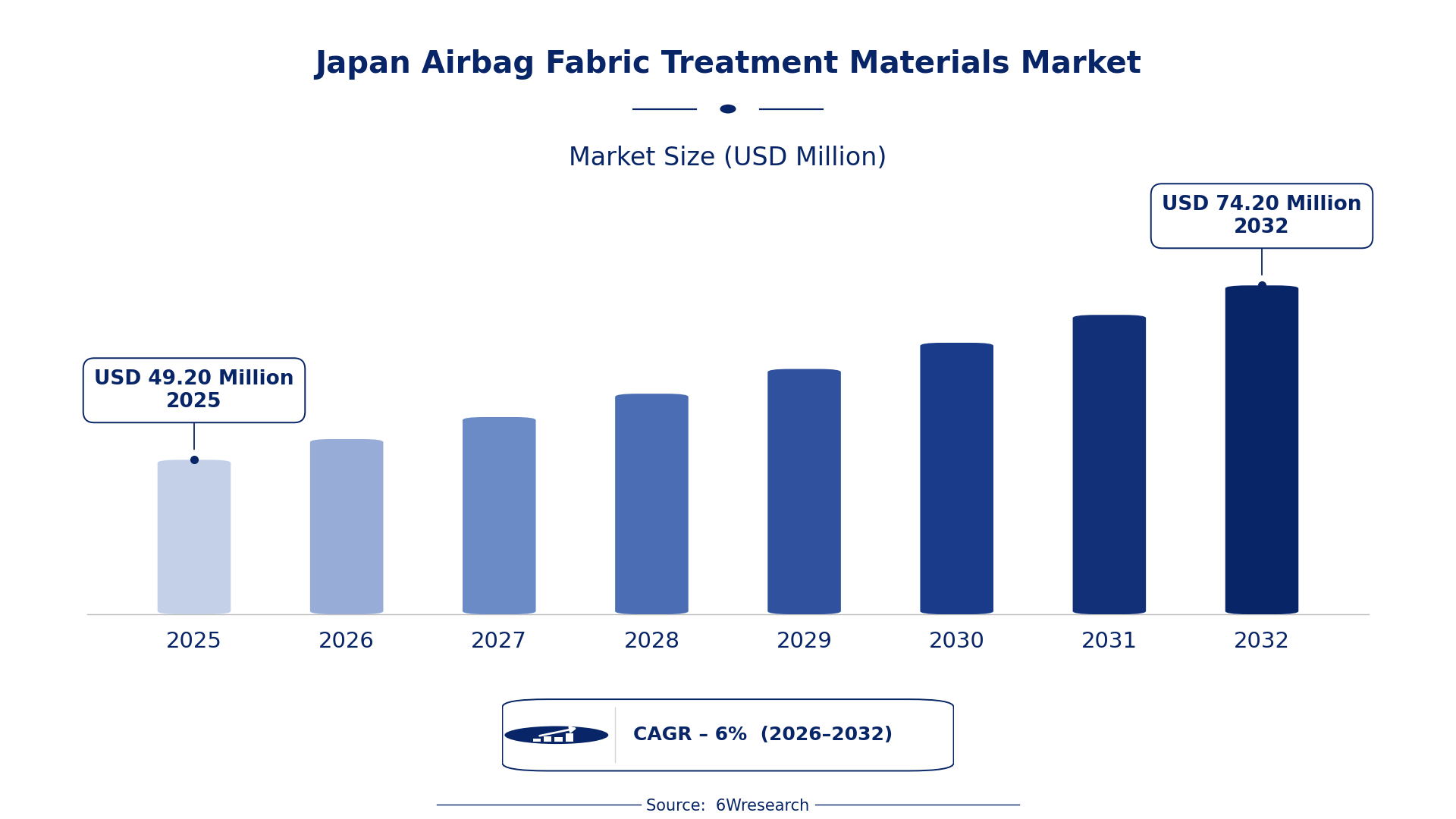
According to 6Wresearch internal database and industry insights, the Japan Airbag Fabric Treatment Materials Market was valued at USD 49.20 Million in 2025 and is projected to reach USD 74.20 Million by 2032, growing at a CAGR of approximately 6% during 2026–2032.
Japan Airbag Fabric Treatment Materials Market Highlights
| Report Metric | Details |
| Report Name | Japan Airbag Fabric Treatment Materials Market (2026-2032) |
| Market Size 2025 | USD 49.20 Million |
| Market Size 2032 | USD 74.20 Million |
| Absolute Growth 2025–2032 | USD 25 Million |
| CAGR 2026–2032 | 6% |
| Peak Annual Growth | 7.2% in 2028 |
| Forecast Period | 2026–2032 |
| Historical Data | 2022–2025 |
| Base Year | 2025 |
| Leading Material Type, 2025 | Nylon 66 (39% share) |
| Leading Treatment Technology, 2025 | Flame Retardant Coating (42% share) |
| Leading Distribution Channel, 2025 | Automotive OEM Distributors (48% share) |
| Leading End User, 2025 | Airbag Manufacturers (44% share) |
| Fastest-Growing Material Type | Polyester Blend (8.4% CAGR) |
| Fastest-Growing Treatment Technology | High-Heat Resistance (8.6% CAGR) |
| Fastest-Growing Distribution Channel | Online Chemical Distributors (7.9% CAGR) |
| Fastest-Growing End User | Tier-1 Automotive Suppliers (7.7% CAGR) |
| Growing Sector | automotive safety equipment |
| Key End Users | airbag manufacturers, automotive OEM distributors, tier-1 automotive suppliers |
Japan Airbag Fabric Treatment Materials Market Year-wise Growth Rate and Key Drivers (2022–2032)
This graph illustrates the annual growth rates of the market from 2022 to 2032, highlighting a steady upward trajectory and projected market expansion over the forecast period.
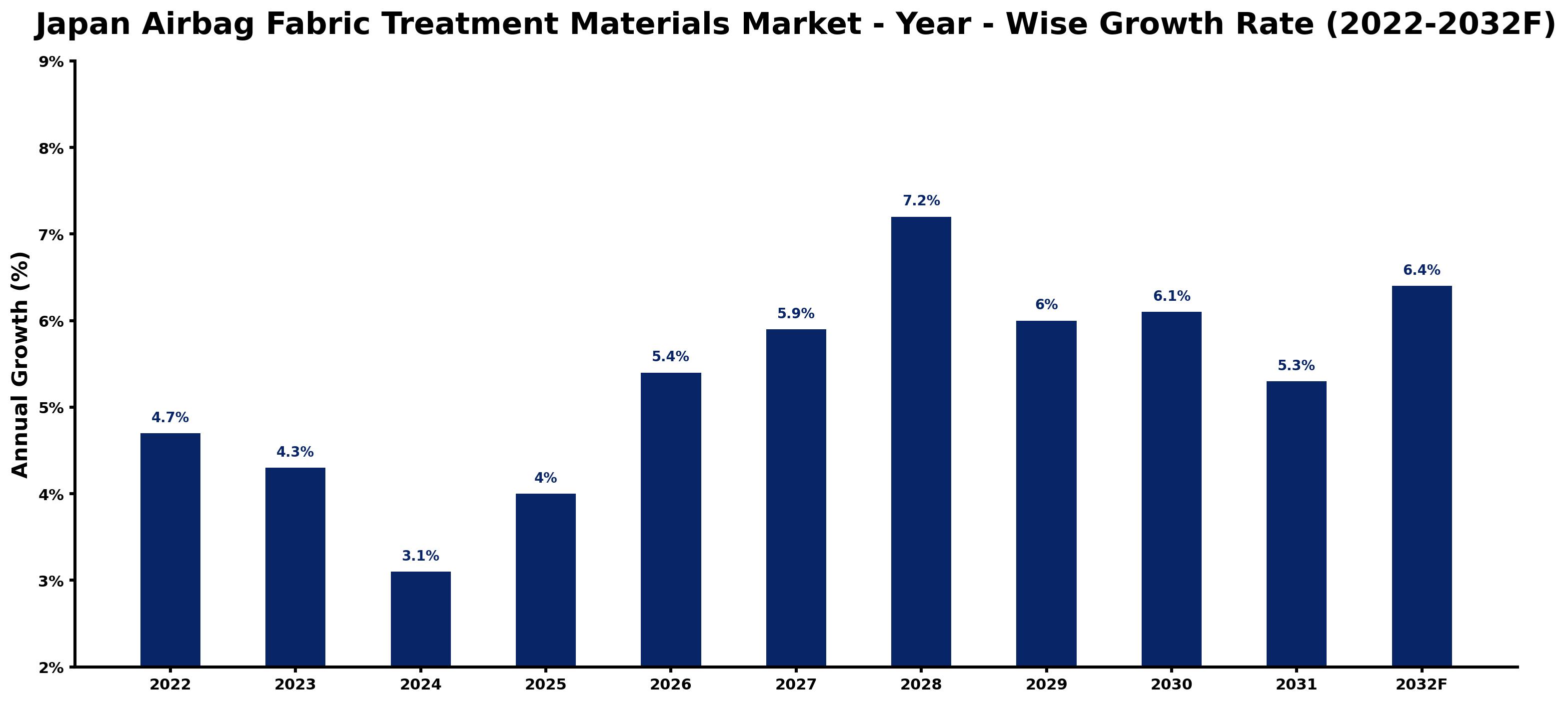
Below, each year's estimated growth is shown next to the factor that most influenced it.
| Year | Estimated Annual Growth (%) | Market Rationale |
| 2022 | 4.7 | The market experienced strong demand from domestic airbag manufacturers and suppliers. |
| 2023 | 4.3 | Growth slowed due to market adjustments and evolving safety regulations. |
| 2024 | 3.1 | Manufacturers adapted to new standards, leading to slower growth. |
| 2025 | 4.0 | Increased investments in automotive safety technologies drove faster growth. |
| 2026 | 5.4 | Demand is expected to rise as manufacturers focus on eco-friendly treatment processes. |
| 2027 | 5.9 | The market is projected to grow with rising production of vehicles and airbags. |
| 2028 | 7.2 | A peak in growth will occur as safety regulations intensify and technology advances. |
| 2029 | 6.0 | Growth is expected to slow as the market stabilises after the peak year. |
| 2030 | 6.1 | Increased focus on sustainability will lead to renewed demand for treatment materials. |
| 2031 | 5.3 | Competition among suppliers will contribute to a slower growth rate. |
| 2032 | 6.4 | Demand is expected to rise with ongoing investments in automotive safety. |
Note: Market size estimations and growth projections presented in this report are based on 6Wresearch's proprietary forecasting methodology, utilizing the latest available industry data, government publications, and primary research inputs.
Japan Airbag Fabric Treatment Materials Market Synopsis
Airbag Fabric Treatment Materials are specialized chemicals that improve the performance of airbag fabrics, focusing on fire resistance, water repellency, and durability. In Japan, the automotive sector produced 8.3 million vehicles in 2022, driving demand from airbag manufacturers. The Japan Airbag Fabric Treatment Materials Market is growing due to increasing safety regulations, investments in eco-friendly processes, and advancements in automotive safety technologies, projected to reach USD 74.20 Million by 2032.
Market Dynamics Impact Analysis (2026–2032)
| Factor | Type | Impact | Primary Segment Affected |
| Increasing automotive safety regulations drive demand for advanced airbag fabric treatments. | Driver | High | Flame Retardant Coating |
| Growing investments in eco-friendly manufacturing processes create new opportunities. | Driver | High | Water Repellency Finish |
| The shift towards online distribution channels opens new market access. | Opportunity | Medium | Online Chemical Distributors |
| Rising demand for high-heat resistance materials presents a growth avenue. | Opportunity | High | High-Heat Resistance |
| Stringent fire safety standards may limit product offerings for some manufacturers. | Restraint | High | Flame Retardant Coating |
| Competition among suppliers can lead to price pressures in the market. | Restraint | Medium | Nylon 66 |
| Supply chain disruptions can delay the availability of raw materials. | Challenge | High | Polyester Blend |
| Technological advancements require continuous investment from manufacturers. | Challenge | Medium | High-Heat Resistance |
Evaluation of Drivers in Japan Airbag Fabric Treatment Materials Market (2026–2032)
The table below links each growth driver to the segment it affects and the evidence for it.
| Drivers | Primary Segment Affected | Why It Matters (Evidence) |
| Rising vehicle production increases demand for airbag fabrics. | Flame Retardant Coating | Japan's automotive sector produced 8.3 million vehicles in 2022, boosting the need for safety materials. |
| Investment in eco-friendly processes drives market appeal. | Water Repellency Finish | Airbag manufacturers are adopting eco-friendly treatment processes to meet consumer expectations. |
| Increased focus on safety technologies drives material innovation. | High-Heat Resistance | Research and development investments in automotive safety reached $1 billion in 2023. |
| Growing installed base of airbags fuels ongoing demand. | Nylon 66 | The installed base of airbags in vehicles exceeds 50 million units in Japan. |
| Regulatory compliance necessitates advanced treatment materials. | Polyester Blend | JIS standards are important for airbag fabric treatments, influencing material selection. |
Orders keep climbing as investments in automotive safety technologies rise. In 2022, Japan produced 8.3 million vehicles, driving demand for airbag fabric treatments. Research and development in automotive safety reached $1 billion in 2023, leading to innovations in treatment materials. The installed base of airbags exceeds 50 million units, creating a sustained need for high-quality materials. Compliance with JIS standards ensures manufacturers require advanced treatment options, further propelling market growth.
Evaluation of Restraints in Japan Airbag Fabric Treatment Materials Market
The main factors holding the market back are set out below.
| Market Restraint | Primary Segment Affected | Why It Matters (Evidence) |
| Stringent fire safety standards limit product formulations. | Flame Retardant Coating | Japan's regulations necessitate specific chemical properties, restricting options for manufacturers. |
| Price competition among suppliers can affect profitability. | Nylon 66 | With multiple suppliers in the market, pricing pressures can impact margins for producers. |
| Supply chain disruptions can hinder material availability. | Polyester Blend | Global supply chain issues have affected the timely procurement of raw materials. |
| Technological advancements require constant investment in R&D. | High-Heat Resistance | Manufacturers must continuously invest to keep up with evolving safety standards. |
| Market consolidation may limit choices for buyers. | Water Repellency Finish | As suppliers merge, fewer options may be available for manufacturers seeking materials. |
Japan Airbag Fabric Treatment Materials Market Challenges
Producers encounter outdated treatment technologies that hinder compliance with evolving safety regulations, delaying production timelines for suppliers. Rising environmental regulations have inflated raw material costs, increasing expenses for producers and potentially raising prices for buyers. A shortage of skilled technicians in the automotive sector impedes the development of essential treatment processes, causing delays for manufacturers. Supply chain disruptions, exacerbated by global events, restrict the timely delivery of critical materials, leading to production delays for producers and affecting the availability of airbag systems in the market.
Trends in the Japan Airbag Fabric Treatment Materials Market
The trends below show where the Japan Airbag Fabric Treatment Materials Market is heading.
- Shift towards Eco-Friendly Treatment Processes: Japanese airbag manufacturers are increasingly adopting eco-friendly treatment processes, aligning with global sustainability trends. In 2023, investments in such technologies reached $1 billion, reflecting a commitment to greener practices.
- Transition from Traditional to Online Distribution Channels: The rise of online chemical distributors is reshaping the market. In 2023, this channel accounted for a growing share of orders, providing easier access for smaller manufacturers.
- Emergence of High-Heat Resistance Materials: High-heat resistance materials are gaining traction as safety regulations evolve. This segment is projected to grow at a CAGR of 8.6% from 2026 to 2032, driven by increasing vehicle safety standards.
- Focus on Advanced Automotive Safety Technologies: The automotive industry is prioritising safety innovations, with the Tokyo Motor Show showcasing new technologies. In 2023, government funding for safety advancements reached JPY 150 trillion.
Investment Opportunities in the Japan Airbag Fabric Treatment Materials Market
The following opportunities in the Japan Airbag Fabric Treatment Materials Market pair current demand with a clear way in.
- Market Gap for High-Heat Resistance Materials: With a projected CAGR of 8.6%, there is an opportunity to supply high-heat resistance materials. Tier-1 automotive suppliers in Japan are key targets for partnerships.
- Growing Demand for Eco-Friendly Treatments: Japan's push for sustainability creates a timely opportunity for eco-friendly treatment materials. Manufacturers can enter this market by collaborating with local suppliers and obtaining necessary certifications.
- Expansion of Online Distribution Channels: The shift towards online distribution channels presents an opportunity to reach new buyers. Investing in digital platforms will enable suppliers to tap into a growing market segment.
- Increased Investment in Automotive Safety Technologies: With JPY 150 trillion earmarked for decarbonisation and safety technologies, suppliers should focus on treatment solutions. Partnering with automotive OEMs will facilitate market entry.
Government Initiatives in the Japan Airbag Fabric Treatment Materials Market
The Chemical Substances Control Law, enacted in 1973, mandates evaluation and control of chemical substances used in manufacturing airbag fabric treatments. This law ensures that producers comply with safety and environmental standards, impacting their production processes and material selection. Additionally, the Green Growth Strategy aims for carbon neutrality by 2050, influencing investment in eco-friendly technologies.
The Ministry of Land, Infrastructure, Transport and Tourism oversees automotive safety regulations, approving new materials and technologies for airbag production. In 2023, government subsidies were allocated to support innovations in automotive safety, encouraging manufacturers to adopt advanced treatment materials that meet stringent safety standards.
Future Insight of the Japan Airbag Fabric Treatment Materials Market
Investment in eco-friendly treatment technologies will surge, driven by Japan's commitment to decarbonisation by 2050. Enhanced automotive safety standards will stimulate innovation, resulting in superior product offerings for buyers. The installed base of over 50 million airbags in vehicles will necessitate ongoing upgrades and replacements, creating opportunities for suppliers. Government initiatives supporting safety technology will propel research and development, ensuring a continuous influx of new solutions in the airbag fabric treatment market.
Market Segmentation Analysis
Japan Airbag Fabric Treatment Materials Market report covers a detailed analysis of the following market segments:
By Material Type – Nylon 66 Leads, Polyester Blend Expected to Grow Fastest
According to Saurav Kr Singh, Senior Research Analyst at 6Wresearch, Nylon 66 took 39% of material type revenue in 2025, more than any other category. Nylon 66 holds the largest share due to its exceptional strength and durability, making it the preferred choice for airbag fabrics. The automotive sector's production of 8.3 million vehicles in 2022 underscores the reliance on this material for safety applications. Polyester Blend is set to record the highest CAGR in this split, 8.4% over 2026–2032. The Polyester Blend is experiencing rapid growth as it provides a cost-effective solution without compromising durability, appealing to manufacturers aiming to optimise production costs. This trend is supported by the increasing focus on economical solutions within the automotive industry. Suppliers should enhance the properties of Polyester Blend to meet the rising demand for cost-effective materials.
By Treatment Technology – Flame Retardant Coating Leads, High-Heat Resistance Expected to Grow Fastest
Flame Retardant Coating held 42% of the Japan Airbag Fabric Treatment Materials Market by treatment technology in 2025. Flame Retardant Coating is the leading treatment technology because it is vital for complying with stringent safety standards in the automotive sector. Adherence to JIS standards ensures that airbag fabrics meet safety requirements, making this technology indispensable. High-Heat Resistance is projected to grow fastest, at a CAGR of 8.6% during 2026–2032. High-Heat Resistance is growing rapidly as it is critical for ensuring safe airbag deployment under extreme conditions. The heightened emphasis on automotive safety technologies is propelling the demand for this treatment. Investing in High-Heat Resistance technologies will be essential for suppliers to align with evolving safety regulations.
By Distribution Channel – Automotive OEM Distributors Lead, Online Chemical Distributors Expected to Grow Fastest
In 2025, Automotive OEM Distributors led the distribution channel split with a 48% share. Automotive OEM Distributors dominate the distribution channel as they provide a vital link between manufacturers and treatment material suppliers. Their established relationships with airbag manufacturers ensure efficient supply chains and timely delivery of materials. The quickest growth will come from Online Chemical Distributors, forecast to expand at a CAGR of 7.9% between 2026 and 2032. Online Chemical Distributors are witnessing the fastest growth due to their convenience for smaller orders, appealing to a broader customer base. This shift reflects changing purchasing behaviours in the automotive sector. Suppliers should enhance their online presence to capitalise on the growing demand through digital channels.
By End User – Airbag Manufacturers Lead, Tier-1 Automotive Suppliers Expected to Grow Fastest
With 44% of end user revenue in 2025, Airbag Manufacturers was the largest category. Airbag Manufacturers represent the largest end user group as they are the primary consumers of treatment materials necessary for airbag production. The installed base of over 50 million airbags in vehicles in Japan drives consistent demand for these materials. Over 2026–2032, Tier-1 Automotive Suppliers are expected to post the fastest growth, at a CAGR of 7.7%. Tier-1 Automotive Suppliers are the fastest-growing group as they increasingly incorporate airbag systems into their vehicle designs. Their expanding role in the supply chain is driven by rising safety regulations and innovations in automotive safety. Suppliers should strengthen partnerships with Tier-1 Automotive Suppliers to align with the industry's shift towards enhanced safety features.
Key Attractiveness of the Report
- 10 Years of Market Numbers
- Historical Data Starting from 2022 to 2025
- Base Year 2025
- Forecast Data until 2032
- Key Performance Indicators Impacting the Market
- Major Upcoming Developments and Projects
Key Highlights of the Report:
- Japan Airbag Fabric Treatment Materials Market Outlook
- Market Size of Japan Airbag Fabric Treatment Materials Market, 2025
- Forecast of Japan Airbag Fabric Treatment Materials Market, 2032
- Historical Data and Forecast of Japan Airbag Fabric Treatment Materials Revenues & Volume for the Period 2022-2032F
- Japan Airbag Fabric Treatment Materials Market Trend Evolution
- Japan Airbag Fabric Treatment Materials Market Drivers and Challenges
- Japan Airbag Fabric Treatment Materials Price Trends
- Japan Airbag Fabric Treatment Materials Porter's Five Forces
- Japan Airbag Fabric Treatment Materials Industry Life Cycle
- Historical Data and Forecast of Japan Airbag Fabric Treatment Materials Market Revenues & Volume By Material Type for the Period 2022-2032F
- Historical Data and Forecast of Japan Airbag Fabric Treatment Materials Market Revenues & Volume By Nylon 66 for the Period 2022-2032F
- Historical Data and Forecast of Japan Airbag Fabric Treatment Materials Market Revenues & Volume By Polyester Blend for the Period 2022-2032F
- Historical Data and Forecast of Japan Airbag Fabric Treatment Materials Market Revenues & Volume By Neoprene-Coated Nylon for the Period 2022-2032F
- Historical Data and Forecast of Japan Airbag Fabric Treatment Materials Market Revenues & Volume By Silicone-Coated Nylon for the Period 2022-2032F
- Historical Data and Forecast of Japan Airbag Fabric Treatment Materials Market Revenues & Volume By Treatment Technology for the Period 2022-2032F
- Historical Data and Forecast of Japan Airbag Fabric Treatment Materials Market Revenues & Volume By Flame Retardant Coating for the Period 2022-2032F
- Historical Data and Forecast of Japan Airbag Fabric Treatment Materials Market Revenues & Volume By UV-Resistant Coating for the Period 2022-2032F
- Historical Data and Forecast of Japan Airbag Fabric Treatment Materials Market Revenues & Volume By Water Repellency Finish for the Period 2022-2032F
- Historical Data and Forecast of Japan Airbag Fabric Treatment Materials Market Revenues & Volume By High-Heat Resistance for the Period 2022-2032F
- Historical Data and Forecast of Japan Airbag Fabric Treatment Materials Market Revenues & Volume By Distribution Channel for the Period 2022-2032F
- Historical Data and Forecast of Japan Airbag Fabric Treatment Materials Market Revenues & Volume By Specialty Chemical Suppliers for the Period 2022-2032F
- Historical Data and Forecast of Japan Airbag Fabric Treatment Materials Market Revenues & Volume By Automotive OEM Distributors for the Period 2022-2032F
- Historical Data and Forecast of Japan Airbag Fabric Treatment Materials Market Revenues & Volume By Online Chemical Distributors for the Period 2022-2032F
- Historical Data and Forecast of Japan Airbag Fabric Treatment Materials Market Revenues & Volume By Direct Sales for the Period 2022-2032F
- Historical Data and Forecast of Japan Airbag Fabric Treatment Materials Market Revenues & Volume By End User for the Period 2022-2032F
- Historical Data and Forecast of Japan Airbag Fabric Treatment Materials Market Revenues & Volume By Airbag Manufacturers for the Period 2022-2032F
- Historical Data and Forecast of Japan Airbag Fabric Treatment Materials Market Revenues & Volume By Tier-1 Automotive Suppliers for the Period 2022-2032F
- Historical Data and Forecast of Japan Airbag Fabric Treatment Materials Market Revenues & Volume By Airbag Textile Mills for the Period 2022-2032F
- Historical Data and Forecast of Japan Airbag Fabric Treatment Materials Market Revenues & Volume By Automotive Safety Equipment OEMs for the Period 2022-2032F
- Japan Airbag Fabric Treatment Materials Import Export Trade Statistics
- Market Opportunity Assessment By Material Type
- Market Opportunity Assessment By Treatment Technology
- Market Opportunity Assessment By Distribution Channel
- Market Opportunity Assessment By End User
- Japan Airbag Fabric Treatment Materials Top Companies Market Share
- Japan Airbag Fabric Treatment Materials Competitive Benchmarking By Technical and Operational Parameters
- Japan Airbag Fabric Treatment Materials Company Profiles
- Japan Airbag Fabric Treatment Materials Key Strategic Recommendations
Market Covered
The study includes the following segmentation.
By Material Type
- Nylon 66
- Polyester Blend
- Neoprene-Coated Nylon
- Silicone-Coated Nylon
By Treatment Technology
- Flame Retardant Coating
- UV-Resistant Coating
- Water Repellency Finish
- High-Heat Resistance
By Distribution Channel
- Specialty Chemical Suppliers
- Automotive OEM Distributors
- Online Chemical Distributors
- Direct Sales
By End User
- Airbag Manufacturers
- Tier-1 Automotive Suppliers
- Airbag Textile Mills
- Automotive Safety Equipment OEMs































