Japan Airbag Impact Sensor Market Size & Growth Rate
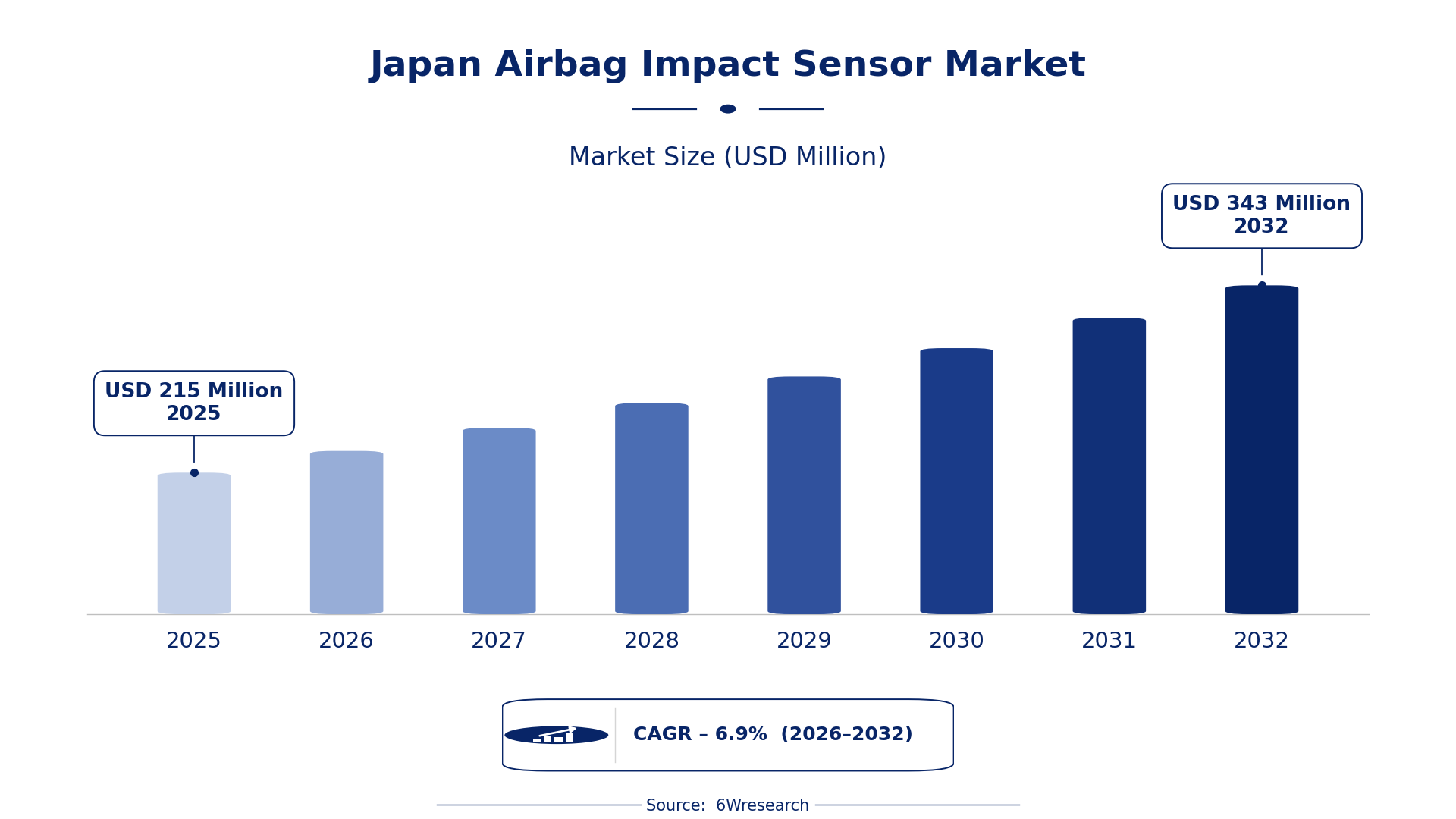
According to 6Wresearch internal database and industry insights, the Japan Airbag Impact Sensor Market was valued at USD 215 Million in 2025 and is projected to reach USD 343 Million by 2032, growing at a CAGR of approximately 6.9% during 2026–2032.
Japan Airbag Impact Sensor Market Highlights
| Report Metric | Details |
| Report Name | Japan Airbag Impact Sensor Market (2026-2032) |
| Market Size 2025 | USD 215 Million |
| Market Size 2032 | USD 343 Million |
| Absolute Growth 2025–2032 | USD 128 Million |
| CAGR 2026–2032 | 6.9% |
| Peak Annual Growth | 7.7% in 2032 |
| Forecast Period | 2026–2032 |
| Historical Data | 2022–2025 |
| Base Year | 2025 |
| Leading Sensor Type, 2025 | Accelerometers (38% share) |
| Leading Activation Technology, 2025 | MEMS-Based Activation (43% share) |
| Leading Distribution Channel, 2025 | Tier-1 OEM Suppliers (40% share) |
| Leading End User, 2025 | Passenger Vehicle OEMs (40% share) |
| Fastest-Growing Sensor Type | AI-Enabled Sensors (10.7% CAGR) |
| Fastest-Growing Activation Technology | Predictive Crash Logic (9.7% CAGR) |
| Fastest-Growing Distribution Channel | Automotive AI Sensor Firms (10.1% CAGR) |
| Fastest-Growing End User | EV & ADAS System Integrators (9.5% CAGR) |
| Growing Sector | automotive safety |
| Key End Users | Passenger Vehicle OEMs, Commercial Vehicle Makers, Luxury Car Manufacturers |
Japan Airbag Impact Sensor Market Year-wise Growth Rate and Key Drivers (2022–2032)
This graph illustrates the annual growth rates of the market from 2022 to 2032, highlighting a steady upward trajectory and projected market expansion over the forecast period.
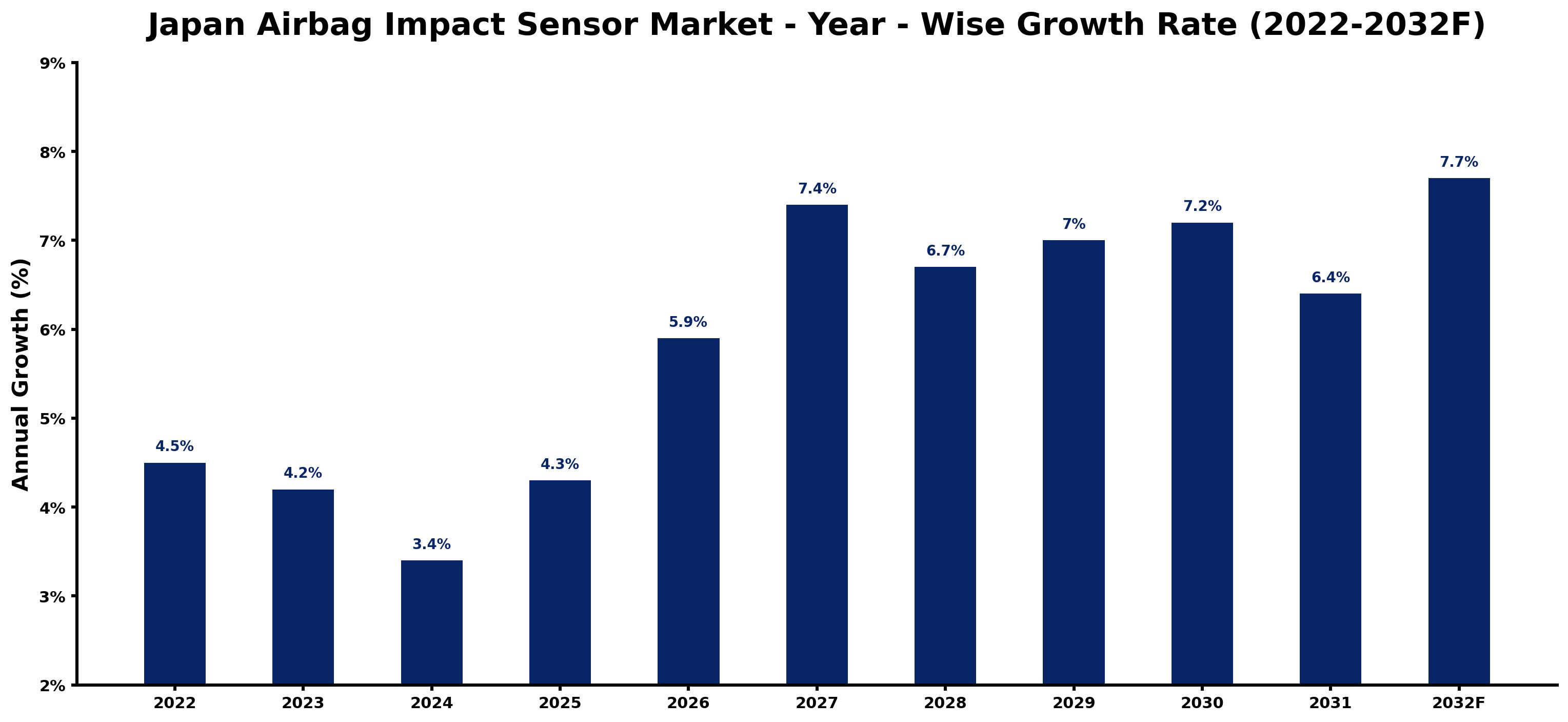
For each year, the table pairs the estimated growth rate with the leading influence on demand, showing how the drivers changed across the period.
| Year | Estimated Annual Growth (%) | Market Rationale |
| 2022 | 4.5 | Growth was supported by increasing vehicle production and safety regulations. |
| 2023 | 4.2 | Demand slowed slightly due to market saturation and high production costs. |
| 2024 | 3.4 | Growth continued to slow as manufacturers faced supply chain challenges. |
| 2025 | 4.3 | An increase in vehicle production and safety technology adoption boosted growth. |
| 2026 | 5.9 | Demand is expected to rise with the introduction of new safety standards. |
| 2027 | 7.4 | Growth is driven by the rising focus on advanced safety features in vehicles. |
| 2028 | 6.7 | A slight slowdown is anticipated as the market stabilises after rapid growth. |
| 2029 | 7.0 | Demand is expected to increase as manufacturers improve safety technology. |
| 2030 | 7.2 | Growth will continue as electric vehicle production expands. |
| 2031 | 6.4 | A slowdown is projected as the market adjusts to new safety regulations. |
| 2032 | 7.7 | Demand is expected to peak as safety standards become more stringent. |
Note: Market size estimations and growth projections presented in this report are based on 6Wresearch's proprietary forecasting methodology, utilizing the latest available industry data, government publications, and primary research inputs.
Japan Airbag Impact Sensor Market Synopsis
Airbag impact sensors serve as vital automotive safety devices that detect collisions and activate airbag deployment, primarily aimed at protecting passengers. The Japan Airbag Impact Sensor Market is growing due to increased vehicle production, which hit 8.5 million units in 2023, alongside a heightened focus on safety features driven by stringent regulations such as the JIS D 0203 standard. Government initiatives promoting automotive safety research further support the demand for advanced safety technologies, creating a strong market environment.
Market Dynamics Impact Analysis (2026–2032)
| Factor | Type | Impact | Primary Segment Affected |
| Increasing vehicle production | Driver | High | Accelerometers |
| Rising safety regulations | Driver | High | Pressure Sensors |
| Growing demand for electric vehicles | Opportunity | Medium | AI-Enabled Sensors |
| Expansion of automotive safety technologies | Opportunity | High | MEMS-Based Activation |
| High production costs | Restraint | Medium | Gas Pressure Detection |
| Supply chain disruptions | Restraint | High | Angular Impact Detection |
| Competition from alternative safety technologies | Challenge | High | Predictive Crash Logic |
| Fluctuating raw material prices | Challenge | Medium | Automotive Sensor Suppliers |
Evaluation of Drivers in Japan Airbag Impact Sensor Market (2026–2032)
Below are the drivers that matter most for revenue growth, with supporting evidence.
| Drivers | Primary Segment Affected | Why It Matters (Evidence) |
| Rising vehicle production | Accelerometers | In 2023, Japan's vehicle production reached 8.5 million units, increasing demand for sensors. |
| Stringent safety regulations | Pressure Sensors | The JIS D 0203 standard mandates safety features, driving sensor adoption in new models. |
| Focus on electric vehicle safety | AI-Enabled Sensors | The production of electric vehicles is projected to increase by 20% by 2025, boosting sensor demand. |
| Advancements in automotive safety technology | MEMS-Based Activation | The government allocated 100 billion yen for automotive safety research, supporting innovation in sensor technology. |
| Consumer demand for luxury features | Gas Pressure Detection | Luxury car manufacturers are increasingly integrating advanced safety features into their vehicles. |
Most of the extra volume comes from Japan's automotive sector, valued at approximately 10 trillion yen. In 2023, vehicle production reached 8.5 million units, leading to higher demand for airbag impact sensors. The implementation of the JIS D 0203 standard has heightened the need for safety features, prompting manufacturers to invest in advanced technologies. With the production of electric vehicles projected to rise by 20% by 2025, there is a clear impetus for sensor adoption.
Evaluation of Restraints in Japan Airbag Impact Sensor Market
The table below lists the restraints and the evidence behind each.
| Market Restraint | Primary Segment Affected | Why It Matters (Evidence) |
| High production costs | Gas Pressure Detection | Japan's national weighted-average minimum wage rose to JPY 1,055 per hour, increasing manufacturing expenses. |
| Supply chain disruptions | Angular Impact Detection | The ongoing global supply chain issues have delayed the availability of essential components. |
| Competition from alternative technologies | Predictive Crash Logic | Emerging safety technologies are gaining traction, challenging traditional sensor markets. |
| Fluctuating raw material prices | Automotive Sensor Suppliers | Rising costs of raw materials are impacting profit margins for sensor manufacturers. |
| Market saturation | MEMS-Based Activation | The market is becoming saturated with existing technologies, limiting growth opportunities. |
Japan Airbag Impact Sensor Market Challenges
In 2023, Japan's vehicle production reached 8 million units, creating intense demand for airbag impact sensors among buyers. Rising labour costs, with the national minimum wage at JPY 1,055 per hour, strain profit margins for manufacturers and delay sensor availability. A shortage of skilled workers in automotive technology complicates the development of advanced features, making it difficult for producers to meet regulatory requirements. Rapid technological advancements often lag behind evolving safety standards, such as the JIS D 0203, complicating compliance for suppliers and risking financial penalties.
Trends in the Japan Airbag Impact Sensor Market
The shifts below are changing how Japan Airbag Impact Sensor Market products are bought and supplied.
- Shift towards Advanced Safety Features: In 2023, the focus on advanced safety features intensified as Japan's automotive sector embraced new technologies. The Tokyo Motor Show showcased innovations in safety systems, reflecting a growing trend towards improved vehicle protection.
- Transition from Traditional to MEMS-Based Sensors: Since 2022, there has been a notable shift from traditional sensors to MEMS-based activation technologies. This change is clear as 43% of airbag impact sensors in 2025 are expected to utilise MEMS technology.
- Emergence of AI-Enabled Safety Solutions: The introduction of AI-enabled sensors began in 2023, marking a significant shift in safety technology. This trend is expected to grow as manufacturers seek to integrate intelligent systems into vehicles.
- Increased Focus on Electric Vehicle Safety: With the projected 20% increase in electric vehicle production by 2025, there is a heightened emphasis on safety technologies. This shift is prompting manufacturers to invest in advanced airbag impact sensors.
Investment Opportunities in the Japan Airbag Impact Sensor Market
The following areas offer the clearest openings for investors and suppliers in the Japan Airbag Impact Sensor Market.
- Tokyo Automotive Manufacturing Facilities: Tokyo is a major hub for automotive manufacturing, presenting opportunities for suppliers of airbag impact sensors. With vehicle production valued at approximately 10 trillion yen, there is strong demand for safety technologies.
- Supply of Advanced MEMS Sensors: Investing in MEMS-based activation technologies is timely, as they dominate the market. Passenger Vehicle OEMs are increasingly seeking suppliers of advanced sensors to meet safety standards.
- Growing Demand for Electric Vehicles: As electric vehicle production is projected to rise by 20% by 2025, there is an opportunity to supply advanced safety sensors. Collaborating with EV manufacturers can facilitate market entry.
- Investment in Automotive Safety Research: The government allocated 100 billion yen for automotive safety research, creating opportunities for technology developers. Engaging with research institutions can lead to innovative sensor solutions.
Government Initiatives in the Japan Airbag Impact Sensor Market
The Act on Japanese Industrial Standards governs the testing and certification of airbag impact sensors, ensuring compliance with safety regulations. This law mandates that manufacturers adhere to strict standards, impacting production processes and quality assurance measures. In 2023, the government introduced incentives for safety technology adoption in vehicles, further supporting the industry's focus on safety.
The Ministry of Land, Infrastructure, Transport and Tourism oversees vehicle safety regulations, approving new safety technologies. In 2023, the ministry's initiatives aimed at improving vehicle safety have led to increased funding for sensor development and implementation, benefiting manufacturers and ensuring compliance with safety standards.
Future Insight of the Japan Airbag Impact Sensor Market
The government's 100 billion yen investment in automotive safety research will drive innovation in airbag impact sensor technology. By 2032, the integration of electric vehicles will transform market conditions, compelling suppliers to develop new sensor technologies. The automotive electronics market is projected to reach 4 trillion yen by 2025, fuelling demand for advanced safety systems. Buyers will gain from improved safety features, while suppliers must adapt to new regulations and standards to stay competitive.
Market Segmentation Analysis
Japan Airbag Impact Sensor Market report covers a detailed analysis of the following market segments:
By Sensor Type – Accelerometers Lead, AI-Enabled Sensors Expected to Grow Fastest
According to Saurav Kr Singh, Senior Research Analyst at 6Wresearch, in 2025, Accelerometers led the sensor type split with a 38% share. Accelerometers lead the market as they are critical for detecting sudden changes in vehicle motion, essential for timely airbag deployment. Their extensive use in Japan's automotive sector underscores the country's focus on passenger safety, particularly in models adhering to the JIS D 0203 standard. AI-Enabled Sensors are set to record the highest CAGR in this split, 10.7% over 2026–2032. AI-Enabled Sensors are projected to grow rapidly as the automotive industry increasingly seeks to enhance safety features through advanced technologies. The government's initiatives to promote safety technology adoption will likely accelerate the integration of these sensors into future vehicle designs. Suppliers should focus on developing advanced sensor technologies to align with the growing demand for enhanced safety features in vehicles.
By Activation Technology – MEMS-Based Activation Leads, Predictive Crash Logic Expected to Grow Fastest
MEMS-Based Activation accounted for 43% of the market by activation technology in 2025. MEMS-Based Activation technology dominates the market due to its compact size and reliability, making it the preferred choice among manufacturers in Japan. This technology's widespread adoption is supported by the stringent safety regulations overseen by the Ministry of Land, Infrastructure, Transport and Tourism. Over 2026–2032, Predictive Crash Logic is expected to post the fastest growth, at a CAGR of 9.7%. Predictive Crash Logic is expected to experience rapid growth as it represents a proactive approach to accident prevention, appealing to manufacturers focused on enhancing vehicle safety. The increasing emphasis on safety innovations will likely drive further investment in this technology, particularly as the automotive sector evolves. Manufacturers must invest in research and development to remain competitive as predictive technologies gain traction in the market.
By Distribution Channel – Tier-1 OEM Suppliers Lead, Automotive AI Sensor Firms Expected to Grow Fastest
Tier-1 OEM Suppliers took 40% of distribution channel revenue in 2025, more than any other category. Tier-1 OEM Suppliers hold the largest share as they serve as the primary suppliers to vehicle manufacturers, ensuring consistent demand for airbag impact sensors. Their established relationships with automakers facilitate the integration of these vital components into approximately 8.5 million vehicles produced annually in Japan. The quickest growth will come from Automotive AI Sensor Firms, forecast to expand at a CAGR of 10.1% between 2026 and 2032. Automotive AI Sensor Firms are set to grow quickly due to the increasing interest in integrating advanced technologies into automotive safety systems. As the market shifts towards smarter vehicle technologies, these firms are likely to capture a larger share of the market, particularly with government incentives for safety technology adoption. Suppliers should explore partnerships with technology firms to leverage emerging innovations in their product offerings.
By End User – Passenger Vehicle OEMs Lead, EV & ADAS System Integrators Expected to Grow Fastest
With 40% of end user revenue in 2025, Passenger Vehicle OEMs was the largest category. Passenger Vehicle OEMs are the largest consumers of airbag impact sensors, reflecting the high volume of passenger vehicles produced in Japan. Their focus on safety features drives a steady demand for reliable sensor technologies in new models. EV & ADAS System Integrators are projected to grow fastest, at a CAGR of 9.5% during 2026–2032. EV & ADAS System Integrators are experiencing rapid growth as the automotive industry increasingly incorporates advanced driver-assistance systems into new electric vehicles. This trend is expected to accelerate as consumer preferences shift towards safer and more technologically advanced vehicles. Suppliers should align their product development with the needs of EV and ADAS integrators to seize emerging opportunities.
Key Attractiveness of the Report
- 10 Years of Market Numbers
- Historical Data Starting from 2022 to 2025
- Base Year 2025
- Forecast Data until 2032
- Key Performance Indicators Impacting the Market
- Major Upcoming Developments and Projects
Key Highlights of the Report:
- Japan Airbag Impact Sensor Market Outlook
- Market Size of Japan Airbag Impact Sensor Market, 2025
- Forecast of Japan Airbag Impact Sensor Market, 2032
- Historical Data and Forecast of Japan Airbag Impact Sensor Revenues & Volume for the Period 2022-2032F
- Japan Airbag Impact Sensor Market Trend Evolution
- Japan Airbag Impact Sensor Market Drivers and Challenges
- Japan Airbag Impact Sensor Price Trends
- Japan Airbag Impact Sensor Porter's Five Forces
- Japan Airbag Impact Sensor Industry Life Cycle
- Historical Data and Forecast of Japan Airbag Impact Sensor Market Revenues & Volume By Sensor Type for the Period 2022-2032F
- Historical Data and Forecast of Japan Airbag Impact Sensor Market Revenues & Volume By Accelerometers for the Period 2022-2032F
- Historical Data and Forecast of Japan Airbag Impact Sensor Market Revenues & Volume By Pressure Sensors for the Period 2022-2032F
- Historical Data and Forecast of Japan Airbag Impact Sensor Market Revenues & Volume By Gyroscopes for the Period 2022-2032F
- Historical Data and Forecast of Japan Airbag Impact Sensor Market Revenues & Volume By AI-Enabled Sensors for the Period 2022-2032F
- Historical Data and Forecast of Japan Airbag Impact Sensor Market Revenues & Volume By Activation Technology for the Period 2022-2032F
- Historical Data and Forecast of Japan Airbag Impact Sensor Market Revenues & Volume By MEMS-Based Activation for the Period 2022-2032F
- Historical Data and Forecast of Japan Airbag Impact Sensor Market Revenues & Volume By Gas Pressure Detection for the Period 2022-2032F
- Historical Data and Forecast of Japan Airbag Impact Sensor Market Revenues & Volume By Angular Impact Detection for the Period 2022-2032F
- Historical Data and Forecast of Japan Airbag Impact Sensor Market Revenues & Volume By Predictive Crash Logic for the Period 2022-2032F
- Historical Data and Forecast of Japan Airbag Impact Sensor Market Revenues & Volume By Distribution Channel for the Period 2022-2032F
- Historical Data and Forecast of Japan Airbag Impact Sensor Market Revenues & Volume By Automotive Sensor Suppliers for the Period 2022-2032F
- Historical Data and Forecast of Japan Airbag Impact Sensor Market Revenues & Volume By Auto Electronics Distributors for the Period 2022-2032F
- Historical Data and Forecast of Japan Airbag Impact Sensor Market Revenues & Volume By Tier-1 OEM Suppliers for the Period 2022-2032F
- Historical Data and Forecast of Japan Airbag Impact Sensor Market Revenues & Volume By Automotive AI Sensor Firms for the Period 2022-2032F
- Historical Data and Forecast of Japan Airbag Impact Sensor Market Revenues & Volume By End User for the Period 2022-2032F
- Historical Data and Forecast of Japan Airbag Impact Sensor Market Revenues & Volume By Passenger Vehicle OEMs for the Period 2022-2032F
- Historical Data and Forecast of Japan Airbag Impact Sensor Market Revenues & Volume By Commercial Vehicle Makers for the Period 2022-2032F
- Historical Data and Forecast of Japan Airbag Impact Sensor Market Revenues & Volume By Luxury Car Manufacturers for the Period 2022-2032F
- Historical Data and Forecast of Japan Airbag Impact Sensor Market Revenues & Volume By EV & ADAS System Integrators for the Period 2022-2032F
- Japan Airbag Impact Sensor Import Export Trade Statistics
- Market Opportunity Assessment By Sensor Type
- Market Opportunity Assessment By Activation Technology
- Market Opportunity Assessment By Distribution Channel
- Market Opportunity Assessment By End User
- Japan Airbag Impact Sensor Top Companies Market Share
- Japan Airbag Impact Sensor Competitive Benchmarking By Technical and Operational Parameters
- Japan Airbag Impact Sensor Company Profiles
- Japan Airbag Impact Sensor Key Strategic Recommendations
Market Covered
The report covers the following segments.
By Sensor Type
- Accelerometers
- Pressure Sensors
- Gyroscopes
- AI-Enabled Sensors
By Activation Technology
- MEMS-Based Activation
- Gas Pressure Detection
- Angular Impact Detection
- Predictive Crash Logic
By Distribution Channel
- Automotive Sensor Suppliers
- Auto Electronics Distributors
- Tier-1 OEM Suppliers
- Automotive AI Sensor Firms
By End User
- Passenger Vehicle OEMs
- Commercial Vehicle Makers
- Luxury Car Manufacturers
- EV & ADAS System Integrators































